
📅 Originally Published: · Last Reviewed and Updated:
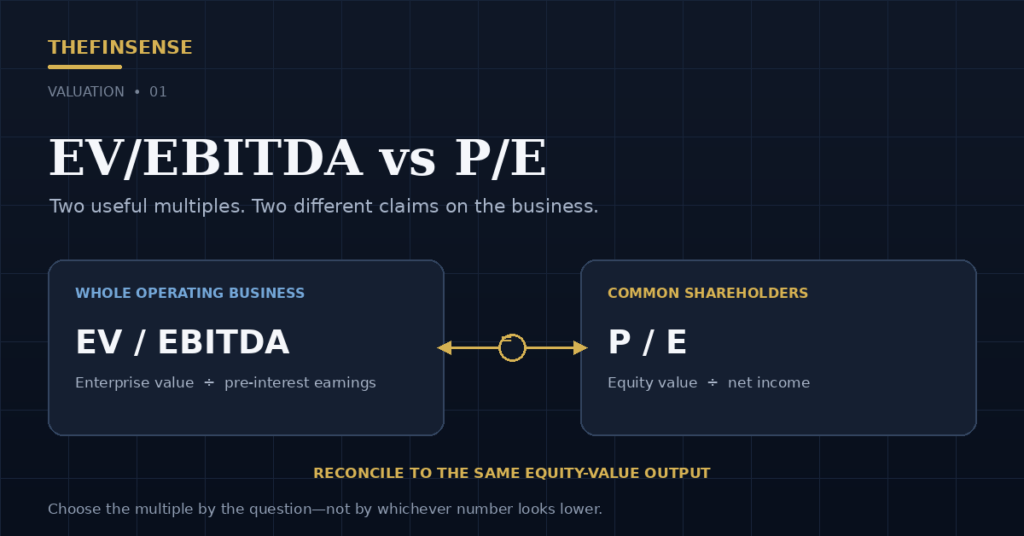
EV/EBITDA vs P/E has no universal winner. EV/EBITDA compares the value of the whole business with pre-interest earnings, while P/E compares common equity with net income. Use EV/EBITDA when debt, cash, or capital structure can change the read. Use P/E when the question is what common shareholders are paying for net income. Never divide the two multiples or treat the gap between them as an investment loss.
You screen two profitable companies. P/E ranks one as cheaper, while EV/EBITDA ranks the other as cheaper. Picking the lower number feels decisive, but it lets the screener choose the valuation question for you.
The conflict is not just accounting noise. P/E starts with the market value of common equity. EV/EBITDA starts with enterprise value after adding debt and other claims and then subtracting cash. Two similar companies can still rank differently because they finance the business in different ways.
The decision is not which multiple wins. Ask which claim on the business you are valuing. Then convert both methods to the same endpoint before you compare them.
EV/EBITDA vs P/E at a Glance
The easiest way to compare EV/EBITDA vs P/E is to see what each ratio puts on top and bottom, then trace its final output.
| Question | P/E | EV/EBITDA |
|---|---|---|
| Numerator | Equity value or share price | Enterprise value: equity value plus debt and other claims, less cash |
| Denominator | Net income or earnings per share available to common shareholders | EBITDA before interest, taxes, depreciation, and amortization |
| Primary perspective | Common shareholder | Whole operating business |
| More useful when | Net income is positive, comparable, and economically meaningful | Capital structures differ or the analysis begins at enterprise value |
| Main blind spot | Interest expense, tax effects, and accounting choices can impair comparability | EBITDA can ignore capital spending, working capital, taxes, and questionable add-backs |
| Output before reconciliation | Implied equity value | Implied enterprise value |
Aswath Damodaran treats P/E as an equity multiple because both parts of the ratio belong to equity investors. He treats EV/EBITDA as a firm-value multiple and notes that it can be easier to compare companies with different debt loads because enterprise value is matched with pre-debt earnings.
That does not make EV/EBITDA automatically better. It means it fits a different question. A metric earns its place only when it matches the claim being valued.
Why You Cannot Divide P/E by EV/EBITDA
Suppose a company trades at 24x P/E and 10x EV/EBITDA. Dividing 24 by 10 produces 2.4, but that result has no standard valuation meaning. The numerator of P/E is equity value; the numerator of EV/EBITDA is enterprise value. Net income and EBITDA also sit at different levels of the income statement.
The gap between the numbers can reflect leverage, but it can also reflect cash, tax rates, depreciation, amortization, minority interests, preferred stock, leases, non-core income, and the link between EBITDA and net income. Dividing the two headline multiples cannot isolate any one of those effects.
Invalid shortcut: “P/E is 140% higher than EV/EBITDA, so leverage made the stock 140% more expensive.” That math compares unlike value bases. It does not measure a shareholder loss, a deal premium, or a penalty caused by the capital structure.
A difference between two unlike multiples cannot be compounded as if an investor lost that share of principal on day one. To estimate a real cost, you need an actual cash-flow difference, purchase-price difference, financing cost, or return path from a valid model.
The same rule applies beyond this topic. Before using a ratio, check whether its value measure and earnings measure belong to the same claimholders. Also make sure the peer companies use the same accounting rules. Our guides to the debt-to-equity ratio and adjusted P/E ratio show how quickly rankings can change when the measurement basis changes.
What Acquisition Analysis Actually Uses
The EV/EBITDA vs P/E choice in deal work often begins with enterprise-value multiples because a buyer is pricing the whole business, not just its current shares. Still, the claim that deal professionals “ignore P/E” is too broad.
A 2025 merger proxy filed with the U.S. Securities and Exchange Commission gives a useful real-world example. In Greenhill’s work for Techpoint, the adviser calculated EV/EBITDA, EV/revenue, and P/E for selected public companies. It then applied a range for each method and converted the results into implied per-share equity values. The filing also made clear that the tables had to be read with their assumptions and supporting text.
That is closer to real practice: use several methods, understand what each one measures, and bring them to a common output. EV/EBITDA may lead the enterprise-level view, but P/E can still help when net income and the peer set are sound. Discounted cash flow can add another view instead of forcing one multiple to carry the whole conclusion.
Read the valuation bridge, not just the headline multiple. In a merger filing or fairness opinion, look for how the adviser moves from enterprise value to equity value. Debt, cash, leases, minority interests, preferred claims, and diluted shares can materially change the per-share result.
For company research, the same bridge often begins in the balance sheet and footnotes. The guide on how to read a 10-K is the better starting point when what counts as debt, lease liabilities, or deal adjustments are unclear.
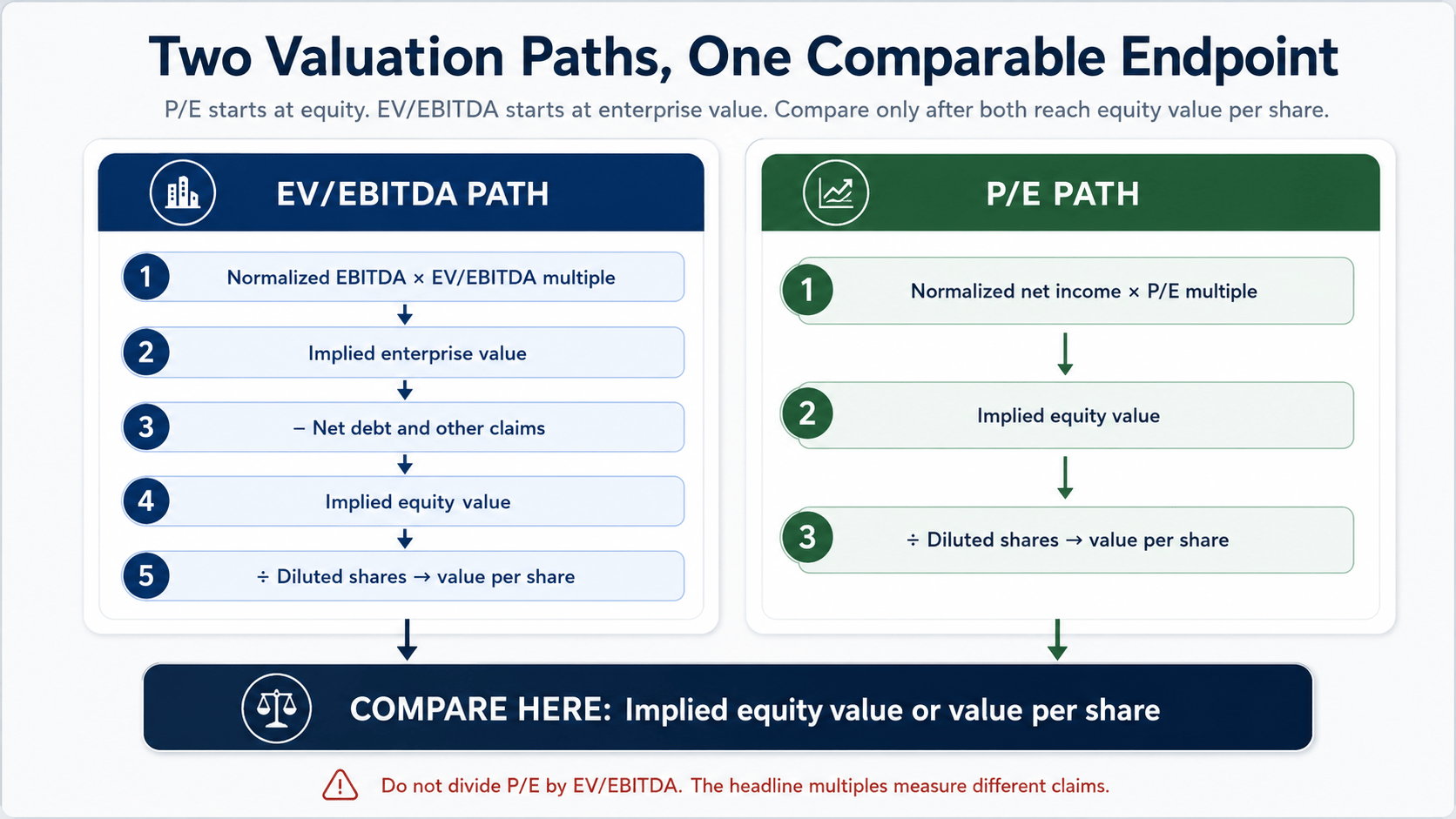
Worked Example: Convert Both Methods to the Same Output
Consider a made-up company with the following figures. The numbers show the method only; they are not a recommendation or a claim about a real security.
| Input | Amount |
|---|---|
| Normalized EBITDA | $100 million |
| Selected EV/EBITDA multiple | 10.0x |
| Net debt | $300 million |
| Diluted shares | 50 million |
| Normalized net income | $40 million |
| Selected P/E multiple | 17.0x |
Method 1: EV/EBITDA to equity value
- Step 1: Implied enterprise value = $100 million × 10.0 = $1.0 billion.
- Step 2: Implied equity value = $1.0 billion − $300 million net debt = $700 million.
- Step 3: Implied value per share = $700 million ÷ 50 million shares = $14.00.
Method 2: P/E to equity value
- Step 1: Implied equity value = $40 million × 17.0 = $680 million.
- Step 2: Implied value per share = $680 million ÷ 50 million shares = $13.60.
The comparison is now valid because both methods end at implied equity value per share. The $14.00 and $13.60 values are close, but neither is correct by itself. The gap can come from peer ranges, earnings adjustments, what counts as debt, the bridge from EBITDA to net income, or the market’s view of growth and risk.
A sound valuation checks those assumptions. It does not divide 17.0x by 10.0x and call the result a leverage distortion.
Use the same six inputs from the worked example, or replace them with your own figures. Enter dollar figures in millions. The tool converts both methods to implied value per share and then shows the gap between those two equity values.
EV/EBITDA vs P/E Same-Endpoint Calculator
Turn an enterprise-value method and an equity-value method into the same per-share output before you compare them.
| Calculation | EV/EBITDA path | P/E path |
|---|---|---|
| Implied enterprise value | N/A | |
| Implied equity value | ||
| Implied value per share |
Calculator scope
- Use matched periods: EBITDA, net income, net debt, and diluted shares should describe the same valuation date or a forecast period you chose on purpose and can explain.
- Net debt can be negative: enter a negative value when the company has net cash under your chosen debt-and-cash definition.
- Use positive earnings: the tool stops when EBITDA or net income is zero or negative because those headline multiples no longer give a useful read.
- Multiple selection is still judgment: the calculator does not choose peers, normalize EBITDA for you, or decide which reference multiple is appropriate.
- Read the gap narrowly: it is the difference between two per-share equity values after both methods reach the same endpoint. It is not P/E divided by EV/EBITDA or an expected gain or loss.
When EV/EBITDA or P/E Can Mislead You
Both ratios in an EV/EBITDA vs P/E comparison are shortcuts. They become dangerous when the shortcut hides the variable driving the decision.
EV/EBITDA can look clean while the economics are not
EBITDA does not subtract capital expenditures or changes in working capital. That matters in businesses that need continuous spending to maintain assets. A company can report healthy EBITDA while producing weak free cash flow.
Adjusted EBITDA creates another peer-check problem. The SEC staff warns that excluding normal, recurring cash costs can make a non-GAAP measure misleading. It also warns that company-specific adjustments can make one firm’s measure hard to compare with another firm’s measure.
Before accepting an adjusted EBITDA figure, tie it back to the closest GAAP measure and inspect the cash-flow statement. Our cash-flow statement guide shows where capital spending, working-capital needs, and recurring cash costs show up again.
P/E can fail before the comparison even starts
P/E becomes unusable when earnings are negative. It can also swing sharply when net income is pushed down or up by tax items, asset sales, impairments, restructuring charges, or a cyclical margin peak.
Even with positive earnings, trailing and forward P/E can tell different stories. Use the same earnings basis across the peer set. A low P/E is not proof that a stock is cheap; it may reflect weak expected growth, high risk, or earnings that the market does not expect to last.
Some sectors need different tools
Banks and insurers are poor fits for EV/EBITDA because debt and interest are part of the business model. REITs often use funds from operations (FFO) or adjusted funds from operations (AFFO). Young companies with negative EBITDA may need revenue-based methods, scenario work, or discounted cash flow. Commodity producers may need mid-cycle earnings rather than one spot-year multiple.
The metric should follow the business model. Forcing the same ratio across every sector creates a tidy screen and a weak valuation.
A Practical EV/EBITDA vs P/E Decision Checklist
| Question | What to do |
|---|---|
| Am I valuing the whole operating business or only common equity? | Start with an enterprise multiple for the whole business and an equity multiple for common shares. |
| Do the companies have meaningfully different debt or cash positions? | Use an enterprise-value framework, then examine the debt and cash bridge explicitly. |
| Is EBITDA positive, consistently defined, and close enough to operating economics? | If not, reject EV/EBITDA or rebuild the denominator from filings. |
| Is net income positive and comparable across the peer set? | If yes, P/E may add a useful equity-level cross-check. If no, do not force it. |
| Have I converted both methods to the same endpoint? | Compare implied equity value with equity value, or per-share value with per-share value. |
| Do the methods disagree materially? | Trace the disagreement to assumptions about growth, margins, taxes, capital intensity, leverage, or normalization. |
When EV/EBITDA and P/E disagree, the gap is useful only if you trace its cause. A wide valuation range is not a command to average the numbers. It is a signal to find the assumption that separates the two methods.
Frequently Asked Questions
What is the main EV/EBITDA vs P/E difference?
EV/EBITDA starts from enterprise value and pre-interest earnings, so it values the whole business before the financing bridge. P/E starts from common equity and net income, so it values what remains for common shareholders. Convert both methods to equity value before comparing their results.
Is EV/EBITDA always better than P/E?
No. EV/EBITDA is often more useful when capital structures differ or the work begins with enterprise value. P/E can be more direct when net income is positive and already reflects the needed earnings adjustments. The business model and valuation question decide which ratio deserves more weight.
Why does EV/EBITDA reduce leverage differences?
Enterprise value includes debt and equity claims, while EBITDA is measured before interest expense. That pairing makes the multiple less directly affected by the financing mix than P/E. It does not make leverage irrelevant, because debt still affects the bridge from enterprise value to equity value and the risk of the business.
Can I compare a company’s P/E with its EV/EBITDA?
You can use both as separate views, but you should not divide them or call the difference a percentage mispricing. Convert each method to the same final output first, then trace why the implied equity values differ.
Does a low EV/EBITDA mean a stock is cheap?
Not by itself. A low multiple can reflect weak growth, cyclical peak earnings, high capital spending, poor cash conversion, regulatory risk, or an EBITDA figure that needs adjustment. Compare similar businesses and test the denominator against filings and cash flow.
What should I use for banks, insurers, REITs, or companies with negative EBITDA?
Banks and insurers usually need equity-based and balance-sheet measures instead of EV/EBITDA. REITs commonly use funds from operations (FFO) or adjusted funds from operations (AFFO). Companies with negative EBITDA may need revenue multiples, scenario work, or discounted cash flow. The tool still has to match the economics of the sector.
Bottom Line: Match the Multiple to the Claim
EV/EBITDA vs P/E becomes useful once you stop asking which number is smaller. EV/EBITDA frames the value of the operating enterprise before financing costs. P/E frames the value common shareholders pay for net income after those costs.
For deal work or companies with very different debt loads, EV/EBITDA often gives the cleaner starting point. For profitable companies with comparable equity earnings, P/E remains a useful cross-check. A full valuation may use both, along with other methods, and bring each result to implied equity value.
The practical rule is to compare like with like. If two methods begin with different claims on the business, convert them to the same endpoint before drawing a conclusion.
A useful portfolio check
Pick one company you follow and calculate both its enterprise-value bridge and its equity-value output. The exercise is usually more revealing than ranking the two headline multiples.
- Damodaran, Investment Valuation, Chapter 18: used for the definitions of P/E and EV/EBITDA, the equity-versus-firm-value distinction, and the stated benefits and limits of enterprise multiples. Read the chapter.
- U.S. Securities and Exchange Commission, Techpoint merger proxy filed March 17, 2025: used as a real-world primary example of an adviser applying EV/EBITDA, EV/revenue, and P/E and converting the methods to implied per-share equity values. Read the filing.
- SEC Non-GAAP Financial Measures C&DIs: used for the limits on recurring cash expense exclusions, inconsistent adjustments, and unclear non-GAAP labels. Read the guidance.
- Method: the worked example is hypothetical. Both methods were calculated independently and reconciled to implied equity value per share. No backtest was used because the article explains valuation measurement rather than a historical trading strategy.
- Calculator: EV-method equity value = EBITDA × selected EV/EBITDA multiple − net debt. P/E-method equity value = normalized net income × selected P/E multiple. Both are divided by the same diluted-share count. Dollar inputs use millions, and the displayed percentage is only the difference between the two reconciled per-share estimates.
- Limits: actual merger analyses may adjust for leases, minority interests, preferred stock, pension obligations, transaction costs, synergies, control premiums, and diluted securities. Peer selection and normalization remain judgment calls.
AI-assisted tools supported source organization and consistency checks. The author reviewed the source documents, recalculated the worked example, revised the reasoning, and approved the final article. See the editorial policy.
Update history
- v1.2 2026-08-19 UPDATE
Repaired canonical internal links and trust-package markup, added a same-endpoint reconciliation calculator, and prepared the companion diagram that shows where EV/EBITDA and P/E become comparable. The core thesis and worked example remain unchanged.
- v1.1 2026-07-19 UPDATE
Rebuilt the article after a full factual and methodological review. Removed the invalid 128.7% “distortion,” the unsupported $214,285 compounding claim, and the related calculator and sensitivity table. Added a same-output valuation example, SEC filing evidence, clearer failure modes, and a new trust package.
- v1.0 2026-04-24 PUBLISH
Original publication.