
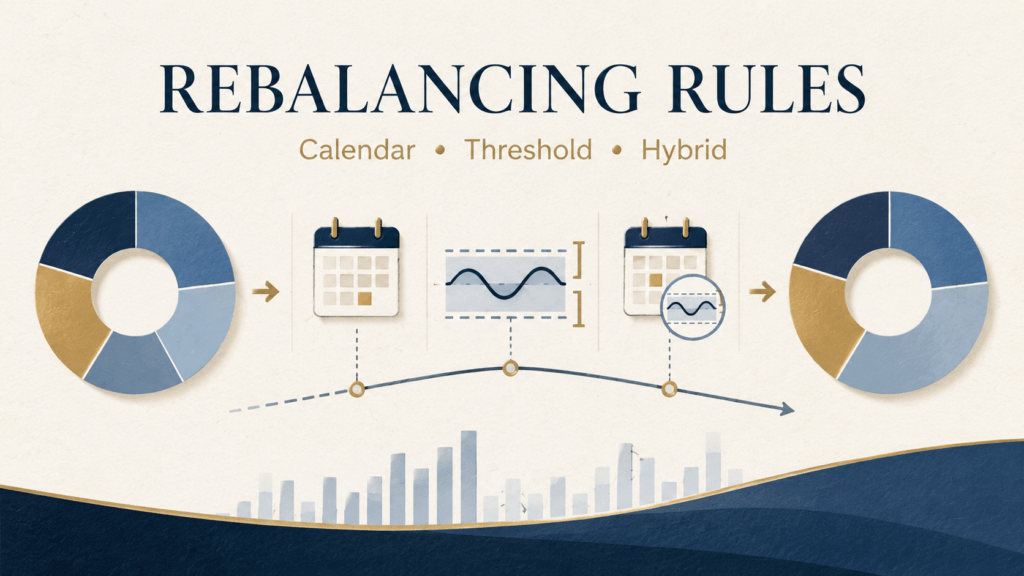
A practical portfolio rebalancing strategy separates reviewing from trading. Check the portfolio on a schedule, but trade only when the allocation has moved far enough from its target to matter. Use new contributions, dividends, or withdrawals first when they can reduce the drift. Calendar, threshold, and hybrid rules can all work. The best fit depends on the account, taxes, monitoring burden, and how tightly you need to control risk.
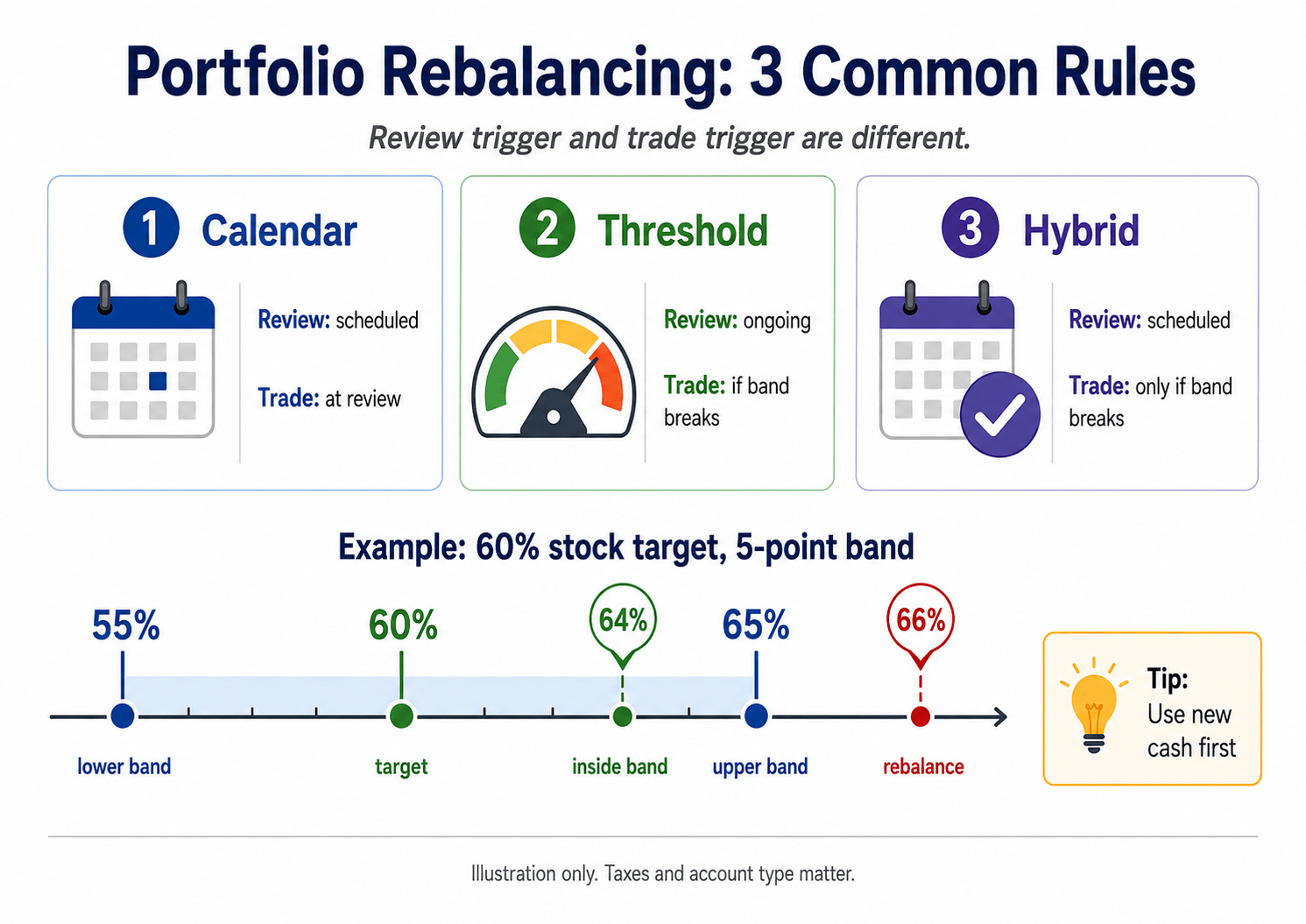
Your statement shows 66% stocks and 34% bonds, while the target is 60% and 40%. One rule tells you to trade because the review date arrived. Another tells you to trade because stocks crossed a five-percentage-point band. A third tells you to check on a set date and act only if the band has been crossed.
Those rules can lead to the same trade today, but they are not the same system. They differ in how often you look, what triggers a trade, and how much tax or monitoring they can create. Research can show the trade-offs, but it cannot choose the rule for your account.
Which Portfolio Rebalancing Strategy Fits Your Account?
Start with the account structure because it changes both control and cost. A target-date fund, managed account, retirement account, and taxable portfolio do not work the same way.
| Account or portfolio | Practical starting point | What to check before trading |
|---|---|---|
| One target-date or balanced fund | Usually let the fund handle its internal rebalancing. | Confirm that the fund still fits your time horizon and risk capacity. You do not control the trades among holdings inside the fund. |
| Robo-advisor or managed account | Let the manager’s policy operate unless your overall target has changed. | Read the program disclosure. The trigger may be proprietary, and a manual trade can interfere with the manager’s tax or allocation process. |
| Self-managed 401(k) or IRA with broad funds | A calendar review paired with a drift threshold is a practical starting point. | Compare the whole account with the written target. New contributions can often correct smaller imbalances. |
| Self-managed taxable portfolio | A hybrid rule can limit routine selling while adding a tax check before trades. | Review unrealized gains, holding periods, losses, available cash, and whether purchases alone can reduce the drift. |
| Several accounts serving one household goal | Consider the combined portfolio when the accounts can be coordinated. | A fund can look overweight in one account while the household portfolio remains near target. |
The target itself belongs in your asset allocation strategy. The monitoring and trade rule belongs in a written investment policy statement. Rebalancing should restore a decision you already made. It should not quietly replace that decision because one fund recently won or lost.
What Does the Rebalancing Research Actually Prove?
Recent research can show how specific rebalancing rules behaved under specific assumptions. The useful lesson is not that one rule guarantees higher returns for every household. It is that trigger design, trade size, transaction costs, and allowed drift can change the result.
Vanguard’s December 2024 target-date-fund study uses a 200/175 threshold rule. The policy triggers when modeled allocation drift reaches 200 basis points. It then trades only far enough to leave 175 basis points of drift instead of resetting fully to target.
| Finding | What the source supports | What it does not support |
|---|---|---|
| Vanguard 200/175 policy | In 10,000 ten-year simulations of a professionally managed global 60/40 target-date portfolio, the threshold policy had lower modeled transaction costs and higher expected returns than monthly or quarterly resets. | A guaranteed return advantage for every 401(k), IRA, or taxable portfolio. |
| 15 to 22 basis points | Vanguard reported this range as the annual relative benefit during accumulation years versus monthly rebalancing. It used a certainty fee equivalent based on the full distribution of simulated outcomes. | A fee charged to a retail account or a fixed annual return gap that can be compounded for decades. |
| Institutional rebalancing cost | A National Bureau of Economic Research (NBER) working paper links predictable institutional rebalancing flow with next-day price pressure. Under its assumptions, the estimated annual cost is about 8 basis points. | A charge of 17 basis points on each household rebalance or proof that a calendar setting creates the same cost in a personal account. |
| Daryanani’s opportunistic rebalancing | The historical study tested frequent monitoring with bands stated as a percentage of each target weight. Its results favored wider bands in the periods studied. | Proof that a five-percentage-point absolute band, or any one threshold, is universally optimal. Later work found the return result depended heavily on the sample period. |
Vanguard’s simulations assumed no cash flows or futures. That matters for a saver who contributes every payday, because contributions can reduce drift without a sale. The study also modeled a target-date-fund process across asset classes and vintages, not a simple household account.
The NBER paper studies a different mechanism. It links predictable institutional rebalancing flow with next-day market effects. The roughly 17-basis-point equity response and the paper’s later annual cost estimate of about 8 basis points are different measurements. NBER working papers are circulated for discussion and have not gone through the peer review used for journal publication.
Primary evidence: Vanguard, The Rebalancing Edge (2024); Harvey, Mazzoleni, and Melone, NBER Working Paper 33554; Daryanani, Opportunistic Rebalancing (2008).
Calendar vs Threshold vs Hybrid: The Rule Difference
A clean portfolio rebalancing strategy separates the review trigger from the trade trigger.
TheFinSense_Portfolio_Rebalancing_Rule_Worksheet
| Method | When you look | When you trade | Main trade-off |
|---|---|---|---|
| Calendar | On a fixed schedule, such as once a year. | When the review date arrives and the rule calls for a reset. | Easy to follow, but a rigid version can trade when drift is small. |
| Threshold | Often or continuously. | Only when an asset class leaves a stated band. | Links trades to drift, but it needs monitoring and a precise band definition. |
| Hybrid | On a fixed review schedule. | Only if the portfolio is outside the stated band at review. | Limits monitoring, but it can allow temporary drift between review dates. |
Absolute and relative bands are not interchangeable
A five-percentage-point absolute band around a 60% stock target means the trigger sits at 55% and 65%. A 20% relative band uses the target weight as the base. For a 60% stock target, that gives a range of 48% to 72%.
Write the unit into the rule. “Rebalance at 5%” is incomplete. State either “five percentage points from target” or “a set percentage of the target weight.” The math and the resulting trades can be very different.
Daryanani’s paper expressed bands as a percentage of each target allocation. Vanguard and Fidelity use a five-percentage-point drift as an investor example. Those examples can help you define a rule, but they do not establish one threshold as the best choice for every portfolio.
Build a Portfolio Rebalancing Strategy You Can Follow
Set the target and define the band
Write the target percentages for the major sleeves that drive portfolio risk, such as U.S. stocks, international stocks, bonds, and cash. Keep the list tied to real allocation choices. A long list of tiny fund-level bands can create work without improving risk control.
Then define the trigger in full. Name the measurement, the threshold, and the destination after a trade. For example: “Review quarterly. If stocks are more than five percentage points from the 60% target, rebalance to the stated target.” A partial rebalance can also work, but the destination should be written in advance.
Choose when to review and what to trade first
An annual review is simple and appears in Vanguard’s retail guidance. A quarterly review can fit a hybrid rule, frequent cash flows, or a more complex portfolio. Checking every day adds little value unless your rule truly requires that level of monitoring.
Before selling, direct new contributions, dividends, interest, or planned withdrawals toward the side that needs help when practical. This can move the portfolio toward target without realizing a gain. It also keeps the trade decision tied to allocation drift rather than to a market forecast.
Know when the problem is not rebalancing
A scary headline, a forecast, or one fund’s recent underperformance is not allocation drift. A change in goals, time horizon, income stability, or risk capacity may justify a new target, but that is an asset-allocation decision.
That distinction matters because a rebalance restores the plan you already chose. Changing the target creates a new plan. If you cannot tell which decision you are making, stop before placing the trade and write down the reason first.
Example rule, not a universal recommendation
Review the household portfolio every quarter. Trade only when a major asset class is more than five percentage points from target. Use contributions and distributions first. Before selling in a taxable account, review gains, losses, holding periods, and whether another account can absorb the adjustment. If the position has multiple lots, check which tax lot the sale will use before placing the order.
Download the Portfolio Rebalancing Rule Worksheet
Free PDF worksheet
Use this 2-page worksheet to write your target allocation, review schedule, drift band, cash-flow rule, trade destination, and taxable-account check in one place.
Taxes, Contributions, and Managed Accounts Change the Answer
The same portfolio rebalancing strategy can be simple in an IRA and costly in a taxable account. Account structure changes the implementation before the market outlook does.
In tax-advantaged accounts, trades inside a 401(k), traditional IRA, Roth IRA, HSA, or 529 generally do not create a current federal capital-gains bill. That removes one source of friction. It does not make every trade useful, and plan rules or fund limits can still matter.
In taxable accounts, a sale can realize a gain or loss. The result depends on cost basis, holding period, other gains and losses, and the investor’s tax situation. A threshold rule can avoid trades when drift is small, but it does not guarantee fewer trades or a lower tax bill than every calendar rule. Trade count, trade size, and tax cost depend on the rule and the path the portfolio takes.
When a sale would realize a loss, the wash-sale rule can affect the tax result if substantially identical securities are purchased around the sale. The guide to tax-loss harvesting rules explains how replacement purchases can complicate a loss-harvesting trade.
For target-date funds and managed accounts, the manager may already control the rebalancing process. A target-date fund rebalances its underlying sleeves, and a robo-advisor may monitor drift automatically. The exact trigger, tax logic, and destination can vary by provider, so check the program documents before adding manual trades around the managed process.
Do not confuse changing the target with rebalancing. Moving from 80% stocks to 50% because retirement is closer may be a valid planning decision. Moving because stocks fell this week is a market call unless your written plan says your risk capacity changed.
Portfolio Rebalancing Strategy FAQ
Does threshold rebalancing always beat calendar rebalancing?
No. Vanguard’s target-date-fund simulations favored its 200/175 threshold policy over monthly and quarterly methods under the study’s assumptions. Other portfolios can have different cash flows, taxes, costs, and monitoring needs. Rebalancing is mainly a way to control allocation risk, not a guaranteed source of extra return.
Is a five-percent threshold the standard rule?
No. Five percentage points is a common investor-education example, not a universal standard. First state whether the band is absolute or relative. Then choose a band that fits the portfolio, taxes, trading costs, and the amount of drift you are willing to accept.
How often should I check my portfolio?
An annual review is a practical baseline for many simple portfolios. A quarterly review can fit a hybrid rule or frequent contributions. Checking more often is useful only when the written rule needs it and you can avoid reactive trading.
Should I rebalance each account or the whole household?
Use the household view when the accounts serve the same goal and can be coordinated. Account-level rebalancing may still be needed when plans have limited fund menus, different owners, separate goals, or tax constraints. Your written policy should say which level controls the target.
Portfolio Rebalancing Strategy: The Bottom Line
A good rebalancing rule tells you both when to look and when to trade. That keeps a routine review from turning into an automatic sale every time a date arrives.
For many self-managed portfolios, a hybrid process is a practical starting point: review on a schedule, act only after meaningful drift, and use cash flows before sales when possible. Taxable accounts need an extra tax check. Managed accounts and target-date funds may already handle the trigger for you.
The goal is not to find a threshold that wins every backtest. It is to keep the portfolio close enough to the risk you chose while avoiding trades that your plan does not require.
YOUR TURN
Does your account use a calendar rule, a drift threshold, a hybrid rule, or no written rebalancing rule at all?
- Vanguard Research (December 2024): Target-date-fund simulations comparing 200/175 threshold rebalancing with monthly and quarterly methods. The study used 10,000 ten-year simulations and excluded cash flows.
- Vanguard and Fidelity investor guidance: Calendar, threshold, and combined or hybrid methods, five-percentage-point examples, tax considerations, and use of cash flows.
- Harvey, Mazzoleni, and Melone: NBER Working Paper 33554. Used for the institutional order-flow mechanism and its stated cost estimate, not as a household trading-cost estimate. NBER working papers are circulated for discussion and are not peer-reviewed journal publications.
- Daryanani (2008): Historical opportunistic-rebalancing study. Its bands are relative to target weights. Later FPA discussion notes that follow-up research found the return result was highly dependent on the sample period.
Method: Each empirical claim was matched to the source’s population, time horizon, unit, and calculation basis. Research about target-date funds or institutional trading is used only within that scope. Household guidance is presented as a decision framework rather than a guaranteed return rule.
AI tools assisted with source organization and consistency checks. Danny Hwang reviewed the primary sources and approved the final analysis.
Update history
-
v2.1
2026-08-14
REVIEWClarified the account-first decision path, distinguished trade count from transaction-cost results in the Vanguard study, tightened the evidence limits around historical band research, updated internal links and trust surfaces, and simplified the implementation sections.
-
v2.0
2026-07-16
CORRECTIONRemoved unsupported fixed-savings and universal-return claims, separated institutional market-impact research from household trading costs, and rebuilt the article around calendar, threshold, and hybrid decision rules.
-
v1.0
2026-04-09
PUBLISHOriginal publication.