
📅 Originally Published: · Last Updated:
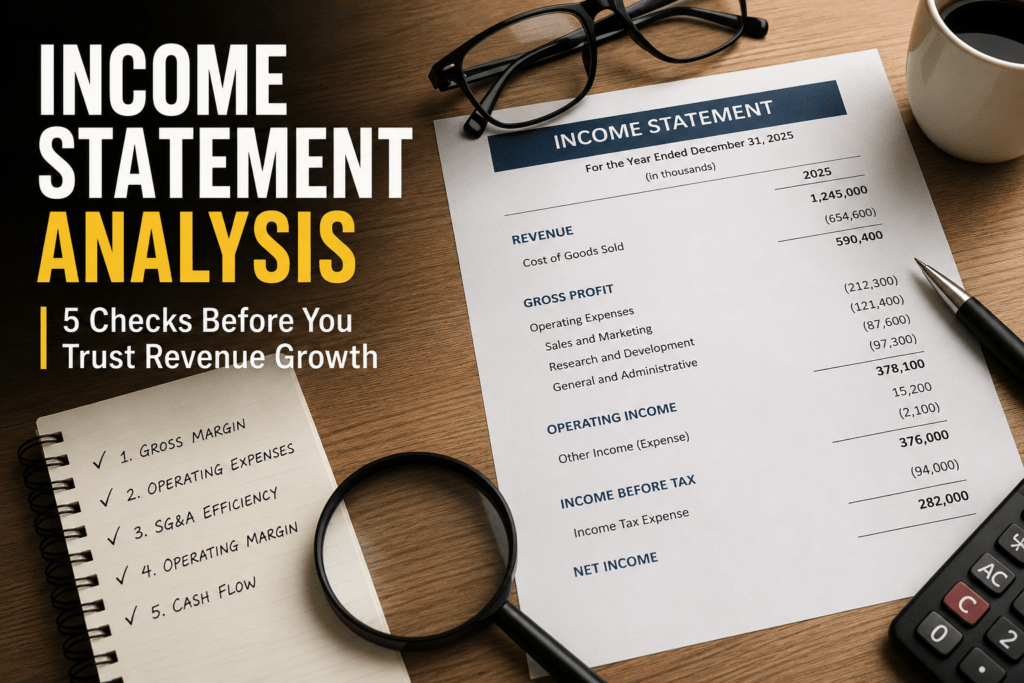
Income statement analysis should answer one practical question: did revenue growth reach operating profit? Start with gross margin, then compare operating-expense growth, SG&A and R&D ratios, operating margin, and cash flow. Anderson, Banker, and Janakiraman found asymmetric SG&A changes across 7,629 firms, but their coefficients do not predict a stock-price loss. Use the evidence to investigate cost behavior, not to manufacture a portfolio forecast.
Revenue is the easiest number in an earnings release to celebrate. It tells you that customers bought more. It does not tell you how much of that growth survived product costs, hiring, sales commissions, research spending, or the overhead needed to support a larger company.
That missing information can change a real decision. A revenue beat may justify adding to a position, or it may be the moment to slow down and read the expense lines. The difference becomes visible when you follow the income statement in order instead of treating the top line as the verdict.
The Five Income Statement Checks Before You Trust Revenue Growth
Begin with the question that brought you to the filing, then move down the statement one layer at a time. The sequence matters because each line explains what happened to the line below it.
| Check | Calculate or Compare | What It Can Reveal | Next Question |
|---|---|---|---|
| 1. Revenue | Year-over-year and sequential growth | Demand, pricing, acquisitions, or currency effects | Did gross profit keep pace? |
| 2. Gross margin | Gross profit divided by revenue | Changes in pricing, product mix, direct costs, or unit economics | If margin fell, what changed in cost of revenue? |
| 3. Operating expenses | Expense growth versus revenue growth | Whether the operating base expanded faster than sales | Which category caused the increase? |
| 4. Expense ratios | SG&A and R&D divided by revenue | Where operating leverage improved or weakened | Is the change temporary, deliberate, or structural? |
| 5. Profit and cash | GAAP operating margin, operating cash flow, and reconciliations | How much reported growth reached profit and cash generation | Do exclusions or working-capital changes explain the gap? |
These checks are diagnostic, not automatic sell rules. A falling margin may reflect a product launch that later pays off. A rising R&D ratio may be exactly what a growing software company should spend. The job is to find the source of the change and decide whether management’s explanation fits the numbers.
Avoid universal red-flag thresholds. A 200-basis-point margin change can be routine in one industry and alarming in another. Compare the company with its own history, direct peers, stated plan, and the economics of the business.
What SG&A Cost Stickiness Actually Means
Cost stickiness describes an asymmetry in how costs respond when activity rises and falls. Anderson, Banker, and Janakiraman studied annual Compustat data from 1979 through 1998. Across 64,663 firm-year observations from 7,629 industrial firms, SG&A increased about 0.55% for a 1% sales increase but decreased about 0.35% for a 1% sales decline.
The distinction matters because those percentages describe changes in SG&A itself. They are not percentages of revenue, operating income, or a stock price. Converting the difference into an investment loss without first restoring the correct denominator creates a much larger number than the research supports.
A Correct Translation of the Paper’s Coefficients
Consider an illustrative company with $1 billion of annual revenue. Use the study’s sample-average SG&A ratio of 26.41%, then assume revenue falls 4%. The paper’s log model gives the following comparison.
| Step | Calculation | Result |
|---|---|---|
| Sticky-cost path | 0.960.3545 | SG&A falls to 98.56% of its prior level |
| Symmetric reference path | 0.960.5459 | SG&A falls to 97.80% of its prior level |
| Difference | 98.56% minus 97.80% | 0.77% of the prior SG&A balance |
| Dollar illustration | $1 billion × 26.41% × 0.77% | About $2.03 million |
| Operating-income context | $2.03 million divided by $120 million | About 1.69% of operating income at a 12% margin |
This is still economically relevant. Two million dollars is real money. It may help explain why margins do not recover as quickly as sales. It does not establish a 6.67% stock repricing, and it cannot be compounded into a 30-year portfolio gap without a separate, defensible model linking the accounting change to valuation and future returns.
The original study also found that stickiness varied with firm circumstances and became less pronounced over longer aggregation periods. That is another reason to treat 0.55 and 0.35 as historical sample estimates rather than universal company thresholds.
A Real Filing Example: monday.com Q4 2025
monday.com reported a strong revenue headline for the quarter ended December 31, 2025. Revenue reached $333.9 million, up 25% year over year. Reading further down the same statement changes the picture from a simple beat into a more useful operating diagnosis.
| Metric | Q4 2025 | Q4 2024 | What Changed |
|---|---|---|---|
| Revenue | $333.878 million | $267.976 million | Up 24.6% |
| Gross margin | 88.8% | 88.6% | Up about 20 basis points |
| Sales and marketing plus G&A as a share of revenue | 62.7% | 61.8% | Up about 89 basis points |
| R&D as a share of revenue | 25.4% | 23.3% | Up about 217 basis points |
| Total operating expenses | $294.160 million | $227.878 million | Up 29.1%, faster than revenue |
| GAAP operating margin | 0.7% | 3.6% | Down about 287 basis points |
| Operating cash flow | $59.7 million | $76.7 million | Down about 22% |
The gross-margin check passes: direct economics were stable. The pressure appeared below gross profit. R&D grew faster than revenue, total operating expenses rose 29.1%, and the GAAP operating margin narrowed. That combination explains why 25% revenue growth did not produce operating-income growth.
The release also reported a non-GAAP operating margin of 13%, down from 15%, with an estimated 180-basis-point negative currency effect. That context matters. It suggests the margin change cannot be understood from the GAAP statement alone. It also shows why the reconciliation deserves a read instead of choosing whichever version of profit looks better.
This analysis does not say monday.com was a bad business or that its shares should have been sold. It identifies the decision that remained after the headline: was the heavier spending a productive investment, an FX-driven temporary squeeze, or the start of weaker operating leverage? Management commentary, the reconciliation, customer metrics, guidance, and later quarters have to answer that question.
Why Gross Profit Deserves More Attention Than Revenue Alone
Gross profit combines sales with the direct cost required to generate them. That gives it information a revenue number cannot carry by itself.
Chiu and Haight studied 269,967 firm-quarter observations covering 10,005 firms from 1977 through 2010. Their long-short portfolio tests found that seasonally differenced gross-profit surprises predicted subsequent three-month returns after controlling for several other accounting signals. In their multivariate regressions, the return-predictive contribution of revenue surprises diminished after gross-profit surprises entered the model.
The study supports a narrow conclusion: gross profit contained incremental information in that historical sample and research design. It does not mean every gross-margin increase predicts a rising stock, or that a reader can copy the paper’s decile strategy without shorting, trading costs, risk controls, and data timing. For a filing reader, the useful takeaway is modest: when revenue surprises you, inspect the gross profit that came with it.
A Five-Minute Income Statement Analysis Workflow
1. Use the Same Period and Accounting Basis
Compare a quarter with the same quarter one year earlier when the business is seasonal. Keep GAAP figures with GAAP figures. If management emphasizes non-GAAP results, reconcile the exclusions before using them in a trend.
2. Recalculate the Ratios Yourself
Divide gross profit by revenue, then divide the major operating-expense categories by revenue. Small presentation changes can disappear inside rounded percentages. The raw statement values let you see whether a ratio moved by 20 basis points or 200.
3. Find the Expense Category That Changed the Story
If gross margin held but operating margin fell, move to SG&A, R&D, restructuring charges, and stock-based compensation. Read the notes and management discussion for hiring, commissions, acquisitions, currency effects, or one-time items. For a deeper filing workflow, use the TheFinSense guide to reading a 10-K and 10-Q.
4. Reconcile Profit With Cash Flow
Operating income and operating cash flow answer different questions. A profitable quarter can have weak cash conversion because of receivables, deferred revenue, inventory, or other working-capital movements. Continue the diagnosis with the cash flow statement analysis guide.
5. Decide What Evidence Would Change Your View
Write down the next observable test. It may be gross-margin recovery, operating-expense growth below revenue growth, lower stock-based compensation, or stronger cash conversion. A defined follow-up test is more useful than reacting to one quarter’s headline.
FASB ASU 2024-03 will add more expense detail to the notes for public business entities. Annual adoption begins for reporting periods after December 15, 2026, and interim adoption begins within annual periods after December 15, 2027. The standard requires disclosure of specified expense categories within relevant income-statement captions. It should improve visibility, but investors will still need the notes, reconciliations, and management discussion to interpret why expenses changed.
The same discipline applies when revenue growth looks unusually strong. The companion guide on revenue growth and accrual quality checks whether reported expansion is supported by the balance sheet and cash collection.
Frequently Asked Questions About Income Statement Analysis
What should I check first on an income statement?
Read revenue to establish the growth story, then calculate gross margin immediately. Revenue shows the amount sold. Gross margin shows how much remained after direct costs. The two figures together tell you more than either one alone.
Is rising SG&A always a warning sign?
No. SG&A can rise because a company is hiring salespeople, entering a market, or building systems for future growth. Compare its growth and revenue share with management’s plan and later results. The concern is unexplained or persistent spending that fails to support revenue, margin, or cash generation.
Should I compare income statements quarter over quarter or year over year?
Use both, but prioritize year-over-year comparisons for seasonal businesses. Sequential comparisons can still reveal a sudden change. Keep the period length, accounting basis, and major one-time items consistent before drawing a conclusion.
Should I use GAAP or non-GAAP operating income?
Start with GAAP, then review the non-GAAP reconciliation. Non-GAAP measures can clarify recurring operations, but they may exclude stock-based compensation, restructuring, or other economically meaningful costs. Track both consistently and judge each exclusion rather than accepting the adjusted figure automatically.
Can income statement analysis predict a stock’s return?
No single ratio can reliably predict an individual stock’s future return. Income statement analysis helps you test the quality and sustainability of reported growth. Valuation, expectations, competition, balance-sheet risk, cash flow, and market conditions still affect the investment result.
The Bottom Line on Income Statement Analysis
Revenue growth tells you that sales expanded. Before acting, check what remained after direct costs and operating expenses.
Check whether gross profit kept pace, identify the operating expense that changed, and see how much growth reached GAAP operating profit and cash flow. Cost-stickiness research explains why expenses may adjust slowly, but it does not supply a stock-price haircut. Keep the denominator intact, use company-specific evidence, and define what the next quarter must prove.
YOUR TURN
Which line changed the story in the latest earnings report you read: gross margin, SG&A, R&D, operating margin, or cash flow?
- Anderson, Banker, and Janakiraman (2003): Are Selling, General, and Administrative Costs Sticky? The article uses the pooled 1979 to 1998 coefficients and the reported 26.41% sample-average SG&A share.
- Chiu and Haight (2014): Gross Profit Surprises and Future Stock Returns. The article limits the finding to the paper’s 1977 to 2010 sample and long-short research design.
- monday.com: Q4 and fiscal-year 2025 results, released February 9, 2026. All displayed ratios were recalculated from the statement values.
- Financial Accounting Standards Board: ASU 2024-03 project summary and effective-date clarification.
Cross-check: The article compares gross-margin, operating-expense, operating-margin, and cash-flow evidence before reaching a company-level interpretation.
AI disclosure: AI assisted with source organization, calculation checks, and copyediting. Load-bearing figures were checked against the primary sources listed above, and derived values were independently reproduced before publication.
Update History
- Version 2.0 July 17, 2026 Major factual correction Removed the unsupported $100,340 portfolio claim and 6.67% repricing assumption, restored the correct SG&A denominator, recalculated the monday.com filing example, and rebuilt the article as a decision router.
- Version 1.0 April 14, 2026 Original publication Initial article published.
Educational quantitative analysis based on published data. Not investment, tax, or legal advice. Consult a licensed professional before acting on any calculation. About TheFinSense.