
Published: · Last updated:
The price/earnings-to-growth (PEG) ratio divides a price-to-earnings (P/E) multiple by an expected earnings-growth rate. It can help compare profitable growth stocks, but the number is only as comparable as the earnings measure, forecast source, and time horizon behind it. Treat common cutoffs as rough conventions, not buy signals. Before acting, verify the formula, inspect forecast revisions, and test whether the business evidence can support the projected growth.
A stock screener can make a PEG of 0.9 look objectively cheaper than a PEG of 1.3. That ranking feels precise because both figures fit in one column. The comparison may still be weak.
The screen may be combining a trailing or forward P/E with a long-term growth estimate from a different horizon. It may also hide recent estimate cuts, disagreement among analysts, or a business that needs unusually heavy reinvestment to reach the forecast. That matters before money moves, because the decimal is easy to compare while the assumptions remain hidden.
Growth belongs in valuation. The practical question is whether the growth number on one screen deserves to be compared with another company’s number.
What the PEG Ratio Actually Calculates
The standard PEG ratio formula is straightforward:
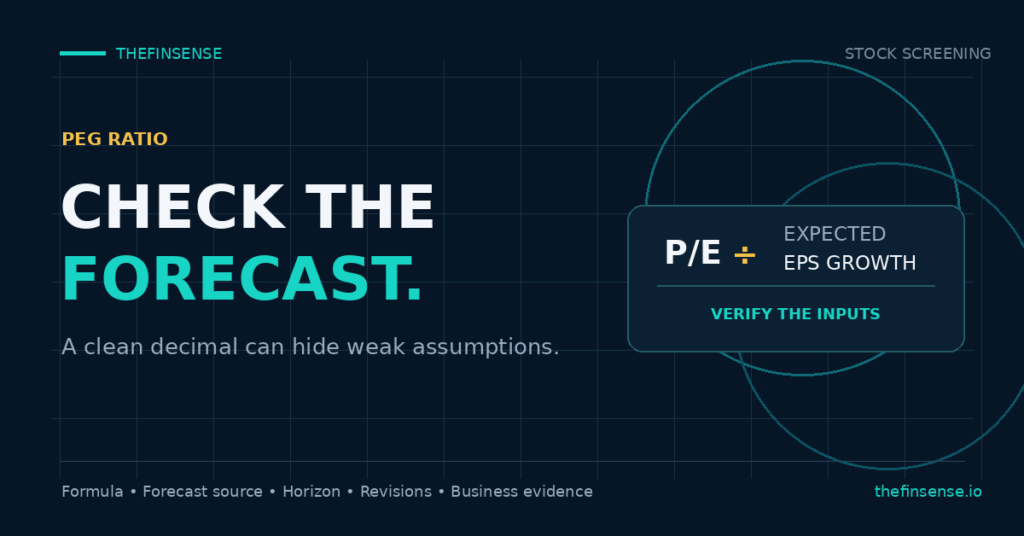
PEG = P/E ratio ÷ expected EPS growth rate
A P/E of 24 divided by expected earnings-per-share (EPS) growth of 20% produces a PEG of 1.2. Enter the growth rate as the whole percentage number, 20, rather than 0.20.
The formula adds information that plain P/E omits. A company growing earnings rapidly can reasonably trade at a higher multiple than a slow-growing peer. Peter Easton’s research found that PEG-based rankings can improve on P/E rankings. He also showed why the shortcut is too simple: it assumes a short-run growth forecast captures the longer-run future. His refined return estimates moved closely with PEG-based results, but the PEG estimates tended to be lower.
That is a narrower and more useful conclusion than “PEG does not work.” The ratio can organize a watchlist. It cannot make the forecast inside the denominator reliable.
Use the PEG ratio as a screening question: Is this valuation multiple plausible if the stated growth forecast holds? Do not use it as a final answer about fair value or future return.
The same input-matching problem appears in the adjusted P/E ratio. A ratio is only useful when the numerator and denominator refer to the same business claim and the same period.
Mistake 1: Treating the PEG Threshold as Universal
The familiar rule says a PEG below 1.0 is cheap, 1.0 is fair, and a result above 1.0 is expensive. That convention is easy to remember, but it is not a law of valuation.
CFA Institute researchers tested the PEG ratio as a broad-market timing rule using S&P 500 data from 1985 through 2020 and Yardeni Research forward-growth estimates. In that index-level dataset, PEG fell below 1.0 only a handful of months in the 1980s, three times in the 2000s, and five times in the 2010s. Trading results were inconsistent, and raising the threshold to 1.25 or 1.5 did not create a dependable market-timing rule.
That evidence has a strict boundary. It concerns the S&P 500 as a market-level series, not a cross-section of individual stocks. It does not prove that every stock below 1.0 is unattractive. It shows why a popular cutoff should not be treated as a universal switch.
| Screen Result | Reasonable Interpretation | What It Does Not Prove |
|---|---|---|
| Below 1.0 | The multiple is low relative to the stated growth estimate | The stock is undervalued or the forecast will be realized |
| Near 1.0 | P/E and the quoted growth number are numerically similar | Fair value has been established |
| Above 1.0 | The multiple is high relative to the stated growth estimate | The stock is necessarily overvalued |
Sector differences also matter. A utility, a cyclical producer, and a software company do not deserve the same growth horizon, reinvestment needs, or risk adjustment. One cutoff erases those differences.
Mistake 2: Ignoring the Inputs Behind the Decimal
Two platforms can display different PEG figures for the same company without either one making an arithmetic error. The result changes when the provider changes the P/E basis, growth horizon, consensus source, or update date.
Before comparing two stocks, answer four questions:
- P/E basis: Trailing earnings, next-year consensus earnings, and another forward period are not interchangeable.
- Growth measure: Earnings per share, operating earnings, and revenue growth answer different questions.
- Forecast horizon: A next-year estimate and a three-to-five-year forecast carry different uncertainty.
- Refresh date: A PEG based on pre-guidance forecasts can remain visible after the investment case has changed.
Suppose a stock trades at 24 times earnings. With expected EPS growth of 20%, the PEG is 1.2. If the growth estimate falls to 12% while the P/E remains 24, the PEG becomes 2.0. No share-price move is required for the valuation signal to change.
Change the P/E and growth inputs below to compare PEG results, not future stock returns. The tool shows each scenario separately.
PEG Growth Stress Test
Change P/E or EPS growth to see how PEG responds.
| Scenario | EPS growth | PEG ratio |
|---|
This shows whether a modest growth cut changes the PEG result enough to change the screen. Recheck it when the growth estimate changes.
Mistake 3: Turning a Growth Forecast Into an Expected Return
An earnings-growth forecast is not an expected stock return. Even accurate business growth can be offset by a high starting valuation, dilution, weaker margins, higher capital needs, or multiple compression. The PEG ratio does not model those paths.
A common error is to take a difference between growth scenarios and compound it as though it were the same difference in stock returns. The arithmetic may be correct for the assumed return paths, but it does not establish that a forecast error caused the return gap.
Do not compound a growth-estimate difference as though it were a stock-return difference. EPS growth, valuation change, dividends, dilution, and investor return are related, but they are not the same measurement.
Long-term growth is hard to estimate. Tengulov, Zechner, and Zwiebel studied companies listed on the AMEX, NASDAQ, and NYSE in the United States. In their out-of-sample tests, LASSO forecasts explained between 1.5% and 12.5% of the variation in realized five- and ten-year sales or EBITDA growth, depending on the measure and sample period. The authors present this as evidence of some predictive power, not a complete forecast of company growth.
That limitation supports a modest conclusion: treat a long-term growth estimate as a range to stress-test, not a fact to convert mechanically into portfolio wealth.
Mistake 4: Skipping the Business Evidence
A PEG screen becomes useful only after the forecast is compared with the company’s operating evidence. You do not need a proprietary “quality-adjusted PEG”; you need the filings and a clear test of whether the assumptions are plausible.
Start with the income statement and cash-flow statement. The TheFinSense guide to income statement analysis explains how revenue, margins, and nonrecurring items shape reported earnings. Then use the 10-K and recent 10-Q to answer the following:
- Revenue source: Is growth coming from volume, price, acquisitions, or accounting changes?
- Margin path: Does the forecast require margins to keep expanding after an unusually strong period?
- Reinvestment: How much capital spending, working capital, research, or acquisition spending is needed to support the plan?
- Share count: Will stock-based compensation or new issuance dilute per-share growth?
- Estimate movement: Are consensus forecasts rising, stable, or falling after the latest guidance?
Return on invested capital can add context, but it is not a universal pass/fail gate. Company-defined ROIC calculations vary, and a historical trend does not guarantee future growth. Use it alongside margins, cash conversion, leverage, and competitive evidence.
An economic moat may help explain why growth persists, but durability and valuation remain separate questions. A strong business can still be a poor purchase at the wrong price.
A 10-Minute PEG Ratio Audit
Use this sequence before a PEG-ranked stock moves from a watchlist to deeper research.
| Check | What to Verify | Decision |
|---|---|---|
| 1. Formula | P/E basis, growth measure, horizon, provider, and update date | Stop if the inputs cannot be identified |
| 2. Revisions | Direction and size of recent EPS-estimate changes | Recalculate the PEG with a lower growth case |
| 3. Business support | Revenue source, margins, reinvestment, cash conversion, and dilution | Reject forecasts that require unsupported operating changes |
| 4. Valuation range | PEG under base, downside, and upside growth assumptions | Proceed only when the conclusion survives a reasonable range |
| 5. Cross-check | Forward P/E, EV-based multiple, free-cash-flow yield, and balance-sheet risk | Do not let one ratio carry the thesis |
A useful downside case does not need to predict the exact miss. First reduce the growth assumption while holding the P/E constant; that isolates PEG’s denominator sensitivity. Then run a separate valuation stress test in which the market also assigns a lower multiple. The second exercise is broader than a PEG recalculation and tests a different source of downside.
The SEC’s Investor.gov guide to reading a 10-K points investors to the business description, risk factors, MD&A, audited financial statements, and notes. Those sections provide the evidence a screener cannot.
PEG Ratio: Frequently Asked Questions
What is a good PEG ratio?
There is no PEG ratio that counts as good across every company. A lower PEG means the P/E is lower relative to the stated growth estimate. The comparison is useful only when the earnings basis, growth measure, horizon, and business risk are comparable.
Is a PEG ratio below 1.0 a buy signal?
No. It may identify a stock worth investigating, but it can also reflect an optimistic forecast, cyclical peak earnings, a recent estimate that has not been updated, or risks that the ratio does not measure.
Should I use trailing or forward P/E in the formula?
Use the definition supplied by the data provider and keep it consistent across the comparison. Forward P/E may align more naturally with expected growth, but it adds another forecast. Trailing P/E uses reported earnings but may be stale or distorted by one-time items.
Can the PEG ratio be negative?
Yes, when earnings or expected growth is negative, but the result is usually not useful as a normal ranking value. A negative denominator changes the meaning of the ratio, so move to other valuation and operating measures.
Does a lower PEG ratio predict a higher stock return?
Not by itself. The ratio does not fully model starting valuation risk, estimate revisions, margins, reinvestment, dilution, dividends, balance-sheet risk, or future multiple changes. It is a screening input, not a return forecast.
Bottom Line: Audit the Forecast Before You Trust the PEG Ratio
The PEG ratio solves one real problem: plain P/E ignores growth. It creates another: the growth estimate can look more certain than it is.
Use the decimal to narrow a list, not to rank stocks automatically. Confirm the formula, check revisions, read the filings, and recalculate the ratio under a lower-growth case. If the conclusion disappears after a modest forecast change, the apparent bargain depended too heavily on the forecast.
The number becomes useful after you can explain every input inside it.
Your turn
Which input does your stock screener use for PEG: trailing or forward P/E, and what growth horizon sits in the denominator?
- Easton (2004), The Accounting Review: PEG can improve on P/E as a parsimonious ranking tool, but its short-run-growth assumption is too simple and its implied expected-return estimates are biased downward relative to a refined model.
- Tengulov, Zechner, and Zwiebel (2025), JFQA: U.S. exchange-listed-company evidence on long-term growth predictability; out-of-sample forecast R-squared ranged from 1.5% to 12.5% across the reported five- and ten-year sales and EBITDA tests.
- Horstmeyer, Patel, and Lee (2025), CFA Institute: S&P 500 PEG data from 1985–2020 produced rare sub-1.0 observations and inconsistent market-timing results. This evidence is index-level and is not presented as an individual-stock backtest.
- U.S. SEC, Investor.gov: official guide to the 10-K sections used for business, risk, MD&A, financial-statement, and note review.
Method: The PEG examples and three-scenario stress table are direct arithmetic using stated P/E and EPS-growth inputs. No TheFinSense historical backtest or stock-return projection is used. The article distinguishes market-level timing evidence, individual-company forecast research, and illustrative calculations rather than treating them as interchangeable.
Limitations: PEG definitions vary by provider. Forecast availability, horizon, and revision history may require a paid data service. The cited studies do not establish a universal fair-value threshold or a causal return effect for an individual stock.
AI-assisted research tools supported source discovery and consistency checks. The article’s claims, calculations, scope limits, and final wording were reviewed against the cited primary and official sources under TheFinSense’s editorial process.
Update history
-
v2.1
2026-08-19
MINOR UPDATE
Repaired legacy internal links, migrated the financial disclosure block to the current contract, expanded the PEG sensitivity example to three growth scenarios, clarified the separate multiple-compression stress test, and made local readability repairs without changing the article thesis. -
v2.0
2026-07-19
MAJOR CORRECTION
Removed unsupported analyst-overshoot, proprietary-screen, sector, and portfolio-loss claims; separated index-level PEG evidence from individual-stock use; replaced the wealth projection with reproducible ratio arithmetic; rebuilt the article around a four-check forecast audit. -
v1.0
2026-04-21
PUBLISH
Original article published.