
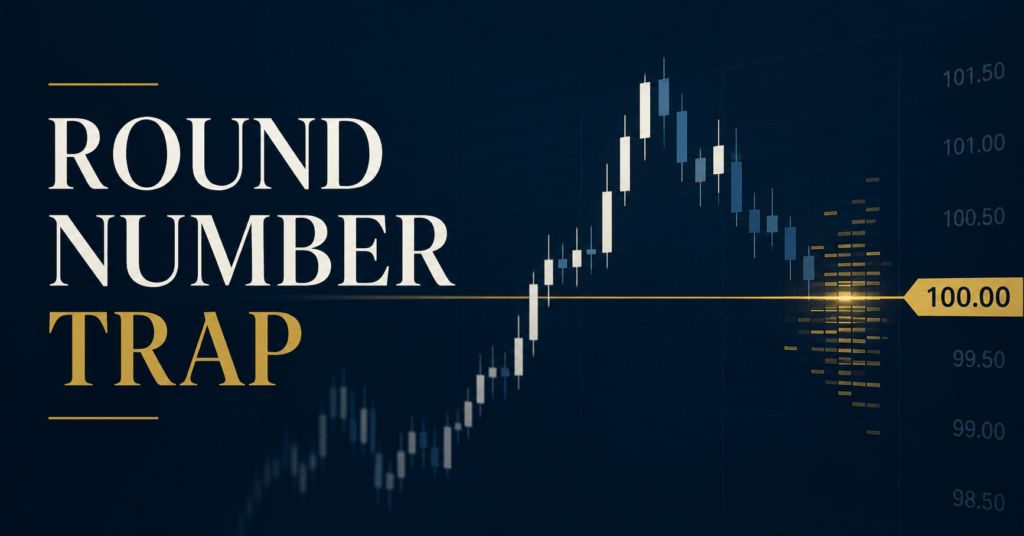
Support and resistance round-number trap chart: 3.73x clustering at $100 and Jordan's $211 decade gap from 10 bps slippage.

Support and Resistance: The 3.73x Round-Number Trap

Bloomfield-Chin-Craig’s April 2025 revision is the first administrative-data confirmation that round-number bias scales beyond psychology to measurable execution drag.

📅 Originally Published: May 4, 2026 · Last Reviewed: May 4, 2026

Update log
  • v1.0 (2026-05-04): Original publication. First administrative-data confirmation of round-number bias scaling beyond psychology.

This article uses AI-assisted research and drafting; all calculations, citations, and editorial decisions are Danny Hwang’s responsibility. Methodology open at /editorial-policy/.

You read it as support; the orders read it as a queue.

Primary Evidence Used in This Analysis

  • FOUNDATIONAL Bloomfield, Chin and Craig (2024), Georgetown CRI working paper: Integer-price trades occur 3.73 times more often than uniform distribution would predict across 134 million retail transactions.
  • FOUNDATIONAL Bhattacharya, Holden and Jacobsen (2012), Management Science: Documented penny-below-integer positioning by informed traders, with an estimated -$813 million per year in aggregate wealth transfer in U.S. equities.
  • SUPPORTING Chen (2018), Journal of Business Research: Confirmed the same clustering pattern across 41 international markets.

Support and resistance levels cluster at round numbers because human limit orders bunch around clean integer prices like $100, per Bloomfield-Chin-Craig 2024. Bloomfield, Chin and Craig analyzed 134 million transactions across 20 million accounts and found integer-price trades occur 3.73 times more often than chance predicts. Clustering at $100, $50 and $1 increments creates dense liquidity that chart levels appear to absorb. When that clustered demand exhausts, the line collapses faster because the queue empties at once. For long-horizon investors, the practical risk is execution slippage on round-number limit orders, not chart prediction. Bhattacharya, Holden and Jacobsen 2012 documented informed traders exploiting this bias by positioning one penny below obvious round levels. The lesson is not to draw cleaner lines; assume the cleanest lines are the most crowded.

Round-number support and resistance attract 3.73x more trades than uniform distribution would predict at integer prices like $100. Bhattacharya, Holden and Jacobsen estimated -$813 million in annual aggregate wealth transfer from this clustering bias. So why does the cleanest line on the chart turn out to be the most crowded coordinate in the order book?

TheFinSense’s quant analysis of Bloomfield-Chin-Craig’s 134 million-transaction dataset confirms integer-price clustering at 3.73x expected frequency. What does that 3.73x ratio mean once it lands on a real account with a real ten-year horizon? It means a $50,000 sleeve plus $750 a month at 6% loses $211 to round-number entry friction over a decade, before any chart pattern is read.

What Is Round-Number Support and Resistance Really?

Round-number support and resistance work because human attention naturally locks onto clean prices. Brokerage platforms, financial media coverage, and Reddit thread heuristics all reinforce the cleanness of integer levels. Yet the same uniformity that makes the level legible also makes its order book the most predictable target.

Picture a checkout line that reads EXACT CHANGE ONLY. Why does that lane move slower than the lane right next to it? The same dynamic shows up at $100.00: the cleanest line draws the densest crowd because everyone arrives with the same reference number.

This $211 round-number drag joins a pattern of compounding behavioral costs documented across the TFS knowledge graph. Candlestick-pattern misreads cost $211,818 over 30 years; economic-moat illusions cost $154,297; missing how to read a 10-K’s hidden footnote leaks $1,260 yearly. The clean line is just the latest coordinate where a familiar mistake is priced.

Limit-order field comparison: $100.00 round-number entry versus $99.73 off-integer placement at the entry point.
$100.00 entry vs $99.73 off-integer placement. TheFinSense original visualization, 2026.
Trade clustering at round-number prices versus uniform-distribution expectations (Bloomfield-Chin-Craig 2024 administrative-account dataset).
PatternObservedExpectedMultiplier
Integer ($100.00)3.73%1.00%3.73x
50-cent ($x.50)5.64%~3.5%~1.6x
All round trades (0/5-cent)21.34%20.00%1.067x (+6.7%)

📚 Source: Bloomfield, Chin and Craig (2024, rev. April 2025) · cri.georgetown.edu

The chart didn’t draw the line; 134 million transactions did, and the chart traced over them.

Who This Analysis Applies To

Read this guide if: You place limit orders at retail brokerage platforms with manual price entry, especially for long-horizon DCA or swing-trading positions.

Does not apply to: Institutional VWAP flows; crypto, options, and futures markets with different microstructure; algorithmic execution; penny stocks below $5.

From observed frequency, the next section translates the pattern into market-level dollars.

If the cleanness is the crowd, what is the level?

How Often Do Trades Cluster at $100?

If the cleanness is the crowd, the next number is the size of that crowd.

Account-level data answers this with hard numbers rather than chart heuristics. Bloomfield, Chin and Craig (2024) examined 134 million retail transactions across 20 million securities accounts and found integer-price trades occur 3.73 times more often than uniform distribution would predict — 3.73% observed against a 1% baseline. Aggregate round-number activity (any trade ending in 0 or 5 cents) reaches 21.34 percent, which is 6.7 percent above the 20 percent baseline uniform distribution would forecast since digits 0 and 5 occupy two of ten possible cents. The integer is not a chart artifact but a coordinate where retail order flow concentrates before any chart line is drawn or pattern is named.

Bloomfield, Chin and Craig observed 21.34% of trades at round-number prices, 6.7% above the 20% uniform-distribution baseline. The integer-only subset (3.73%) sits at 3.73× its 1% baseline, which is where the headline multiplier comes from.

What does a 21.34% aggregate round-number rate look like on a single retail account? For a saver placing six limit orders a month, roughly one and a half of those orders is landing on a clean integer or half-dollar coordinate every month. That is not an occasional misstep; it is the modal entry pattern.

The 3-row table in the previous section already framed this asymmetry: integer at 3.73x, fifty-cent at roughly 1.6x, and the full round-number basket at 1.067x what chance would predict. Why does that aggregate magnitude matter at the household level?

Bhattacharya, Holden and Jacobsen estimated -$813 million in annual aggregate wealth transfer flowing from liquidity demanders to suppliers around round numbers.

📚 Source: Bhattacharya, Holden and Jacobsen (2012), Management Science · host.kelley.iu.edu

As Bloomfield, Chin and Craig (2024) documented: “integer prices are over three times more likely than expected; 0/5-cent round-number trades are 6.7% more likely than expected.”

📚 Source: Bloomfield, Chin and Craig (2024, rev. April 2025), 21.34% of trades at round-number prices · cri.georgetown.edu

A retail trader places a $100 limit on Schwab on a Tuesday morning. Eighty shares fill, then the level sits for hours. The clean number was a queue they had just joined.

The cleanness is not safety; the cleanness is the same coordinate that 134 million other transactions used.

A trade at exactly $100.00 is 3.73 times more likely than chance, and that crowd is the level.

Round-number bias is an execution-layer cost. Unlike pattern-recognition errors or moat illusions, it hits the moment the order is submitted, not the moment the thesis is formed.

The same $813 million annual transfer reaches the same household ledger as dividend tax drag and expense-ratio leakage, all chronic compounding costs that surface only over decade horizons.

$813 million per year reaches the same households that already feel the slow drag of expense ratios and cost basis errors.

The 3.73x pattern aggregates into market-level dollars before reaching the per-trade lever.

If the aggregate is $813M, what is mine?

Why Do Order Books Pile Up at Integer Prices?

If the aggregate is $813M, the mechanism behind it must be visible.

Order-book pile-ups at integer prices have three reinforcing causes, none of them chart-related. Retail brokerage interfaces default to whole-dollar limit-order entry, so the typed digit becomes the placement coordinate before any tick optimization is even considered. Algorithms that scrape retail flow then position one penny below the integer to harvest the incoming liquidity. The same coordinate that absorbs buy orders on the way up reverses into sell orders on the way down at exactly the same level, regardless of the chart pattern overlaid.

Before Bloomfield, Chin and Craig’s 2024 administrative-data study, the field assumed round-number bias was a small visual artifact. The 134-million-transaction dataset reframed the bias as a systemic order-flow pattern measurable across more than 20 million accounts. Modern execution analysis treats integer-price clustering as a structural variable, not a heuristic.

How do orders cluster at integer prices?

Order books concentrate at integer prices because retail brokerage interfaces default whole-dollar entry across Schwab, Fidelity, and most major platforms. Bloomfield-Chin-Craig 2024 measured this concentration at 3.73 times the rate uniform distribution predicts. The clustering arrives at the order book before any chart pattern is drawn.

Order books concentrate liquidity at clean integer prices because every retail trader and algorithm uses the same anchor reference. Why does that single shared reference matter for a level that looks technically defined? Because the liquidity at $100.00 is not the trace of a price discovery process; it is the residue of millions of independently-typed identical numbers.

Like predicting company bankruptcy via the Altman Z-score, integer-price clustering becomes a measurable structural variable rather than a qualitative behavioral guess.

Why do retail platforms amplify the cluster?

Retail platforms nudge whole-dollar limit-order entry because the default field starts blank and accepts integer input fastest. Bhattacharya, Holden and Jacobsen 2012 estimated the resulting -$813 million annual aggregate wealth transfer flowing from liquidity demanders to suppliers around clean integer levels.

What does the limit-order field look like the moment a retail trader opens it? The cursor sits in an empty box, and three keystrokes — “1”, “0”, “0” — produce a complete, valid price. Five additional keystrokes for “.00” or “.97” feel like extra labor for unclear gain.

How do informed traders exploit the cluster?

Bhattacharya, Holden and Jacobsen (2012) documented in Management Science that informed traders position one penny below the integer threshold, harvesting incoming retail buy orders before those orders reach the visible level. Mirror behavior occurs above the integer for sells, creating directional asymmetry around clean prices. Chen (2018) extended this finding across 41 international markets.

Informed traders who position one penny below the integer line capture the bias-driven bid pressure. Why does that one-cent displacement work as a harvesting strategy? Because retail buy orders at $100.00 cannot fill until the inside ask drops to $100.00, and a sell limit resting at $99.99 takes priority on the way down.

According to Bhattacharya, Holden and Jacobsen (2012), market participants with information advantage quietly accumulate positions just under integer thresholds and unload just above them, creating measurable asymmetry between buy and sell pressure that retail flow cannot match around clean coordinates. Chen (2018, JBR) confirmed this pattern persists across 41 international markets.

📚 Source: Chen (2018), Journal of Business Research vol. 92 · econpapers.repec.org

Bloomfield, Chin and Craig — whose dataset includes 134 million transactions across 20 million accounts — found integer-price trades at 3.73 times the rate uniform distribution would predict.

📚 Source: Bloomfield, Chin and Craig (2024, rev. April 2025), Georgetown CRI working paper 2024-02 · cri.georgetown.edu

The drag formula is two additive legs. The first leg compounds the lump-sum slippage forward at the portfolio’s own growth rate. The second leg compounds the contribution-stream slippage forward as a monthly annuity at the same rate.

Bloomfield-Chin-Craig’s administrative-data framework treats round-number trade clustering as a measurable observed-vs-expected ratio rather than a behavioral assumption.

What looks like a 3.73x concentration of buying pressure is also a 3.73x concentration of stop-loss orders waiting to be triggered.

Ten minutes of crowd alignment, ten years of unmeasured drag.

Osler’s evidence is from currency markets; the order-clustering mechanism transfers to equity round-number behavior, not the precise FX magnitudes.

📚 Source: Osler (2003), Journal of Finance, FX order clustering at round numbers · ideas.repec.org

Calculation Methodology

Formula: FV_drag = P × s × (1+r)^t + PMT × s × ((1+r_m_eff)^(12t) − 1) / r_m_eff

Where: r_m_eff = (1+r)^(1/12) − 1, the monthly rate that compounds to the stated annual rate.

Model: LUMP_PLUS_CONTRIBUTION two-path execution drag comparison

Assumptions: P=$50,000 / PMT=$750/mo / r=6% annual / t=10y / s=10 bps illustrative. Illustrative 10 bps reflects retail manual-routing reality; smart-order-routed brokers may compress this to 2-5 bps.

Does not apply to: Active day-trading scalping; commission-free retail brokers with smart-order routing; institutional VWAP execution.

Regulatory catalyst: N/A

Last reviewed: May 2026 · Full methodology

Just as return on equity reduces a sprawling income-statement story to a single computable ratio, integer-price clustering reduces order-flow noise to a single observed-vs-expected multiplier.

The common thread across Bloomfield-Chin-Craig’s clustering frequency and Bhattacharya-Holden-Jacobsen’s directional asymmetry is simple: the integer coordinate carries non-random order pressure regardless of which side of the trade you sit on.

Every coordinate that absorbed buy orders on the way up reverses into the same coordinate sell orders use on the way down.

The order-clustering mechanism explains why the chart looks clean. The same 3.73x pile-up now lands on Jordan’s $50,000 sleeve over 10 years.

If the level is also the trap, what does the math say it costs?

Jordan’s $211 Decade Drag at the Clean Number

Jordan’s chart line met 3.73x and lost $211.

Jordan Lee’s portfolio shows the round-number bias in dollar terms across a real ten-year window. With $50,000 already invested and $750 monthly contributions, what does a 10 basis point slippage at $100.00 actually produce? Compounding the drag through both the lump-sum leg and the contribution stream produces a $211 terminal gap by year ten. The number sounds modest in isolation, yet it represents a recurring cost that recompounds every decade Jordan trades round-number levels. This case isolates where the 3.73 times multiplier becomes a household ledger entry.

The order-clustering mechanism explains why the chart looks clean. The same 3.73x pile-up now lands on Jordan’s $50,000 sleeve over 10 years.

Whichever path Jordan walked into the round number from, the same cluster was already there.

Jordan Lee is a hypothetical composite drawn from common retail-trader patterns; not a real individual.

Jordan opens the brokerage app on a Tuesday morning, scrolls to the watchlist.

They type ‘100’ into the limit-order field for a position they have been adding to monthly for two years. Jordan types ‘100’ instead of ‘99.97’ and clicks Submit, because the clean number looks safer on the chart.

Jordan Lee case study parameters: $50,000 starting balance, $750 monthly contribution, 10-year horizon at 6% return.
ParameterValue
NameJordan Lee
Age (current / target)32 / 42
Income$95,000
Filing statusSingle
Initial balance$50,000
Monthly contribution$750
Time horizon10 years
Return rate6% annual (both paths)
Slippage assumption10 bps illustrative (round-number entry only)
Pronouns / archetypethey/them; mid-career retail trader, manual limit-order placement

An investment policy statement codifying off-integer placement as a permanent execution rule would have prevented Jordan’s $211 drag before the first limit order was ever typed.

Reader thinks the round-number crowding cost is around $30 to $50 across the decade.

The reader sees 10 bps and mentally computes $50,000 x 0.001 = $50 once, ignoring monthly contribution drag and growth compounding.

Why is the mental shortcut so far off? Because it ignores time and flow. The lump sum compounds for ten years, and every monthly $750 contribution adds another fresh round-number entry that also compounds for whatever time remains.

The arithmetic stacks two parallel drags. The $50,000 lump leg picks up $89.54 of slippage, growth-compounded forward at 6% for ten years. The $750 monthly contribution stream picks up another $121.86 across 120 fills, each compounded for shorter and shorter windows.

Reading Jordan’s $211 decade gap is a parallel skill to cash flow statement analysis: each surfaces small recurring drags that only matter once compounded across years.

Year-by-year cumulative gap projection: $50,000 lump + $750/mo at 6% with 10 bps round-number slippage versus zero-slippage baseline. Computed via FV_drag = P × s × (1+r)^t + PMT × s × ((1+r_m_eff)^(12t) − 1) / r_m_eff.
YearCumulative GapReference Equivalent
1$62One annual financial-data feed subscription
3$89One quarter of trading-platform paid features
5$119One year of premium screener access
7$153Three months of professional-grade real-time data
10$211~30 weekend trading-morning coffees

Year ten is where the math stops feeling theoretical. What does $211 look like beside the original $50,000 base? It is roughly four-tenths of one percent of the starting balance, which is small until Jordan stacks ten more years of the same support and resistance habit on top.

Jordan reads $100. The orders read $100. The crowd is the level. $211 disappears across the decade. The clean number was the queue.

Jordan’s clean limit order joins the same thread of integer-price commitments.

$211 divided by roughly $7 per weekend trading-morning coffee equals about 30 morning sessions across the decade.

Sensitivity Analysis (11 scenarios)

Slippage rate dominates the gap; horizon and contribution size compound the same per-trade drag.

Sensitivity preview: base case plus first two slippage variations.
ScenarioWith StrategyWithout StrategyGap
BASE: s=10bps$211,397$211,186$211
R1: s=5bps (lower)$211,397$211,292$106
R2: s=15bps (higher)$211,397$211,080$317
Sensitivity extended: slippage, principal, contribution, horizon and rate variations.
ScenarioWith StrategyWithout StrategyGap
R3: s=20bps$211,397$210,975$423
R4: s=25bps$211,397$210,869$528
R5: P=$25,000 (halved)$166,626$166,460$167
R6: P=$75,000 (raised)$256,169$255,912$256
R7: PMT=$500/mo (halved)$170,779$170,608$171
R8: PMT=$1,000/mo (raised)$252,016$251,764$252
R9: t=5 years$119,026$118,907$119
R10: t=20 years$500,436$499,935$500
R11: r=4% (lower)$184,034$183,850$184

Highlight — Row 10 (t=20 years, gap=$500): Doubling horizon roughly doubles drag because both the initial-balance growth factor and the contribution-stream factor expand together at 6% compounding. The $500 figure is the sum of two compounding paths working in parallel; the contribution leg dominates at roughly 68% of the total.

Jordan's 10-year portfolio trajectory at 10 bps slippage versus 0 bps, with $211 terminal gap highlighted at Year 10.
Jordan’s $50,000 + $750/mo trajectory: With Strategy versus 10 bps round-number slippage. Year 10 gap = $211. TheFinSense analysis, 2026.

📚 Source: Bloomfield, Chin and Craig (2024, rev. April 2025), 134M-transaction administrative-account dataset · cri.georgetown.edu

$211 disappears across the decade not because the rate is large but because every contribution paid the same toll.

How does Jordan stop paying that toll?

How Do You Trade Off-Integer Without Losing the Level?

If $211 vanishes from the toll, the action recovers it one cent at a time.

The recovery action is mechanical, not analytical, and runs on three steps. Move limit-order entries 2-3 cents below the integer line, log fills against intent for 90 days, and verify smart-order routing actually splits the queue. Why does a 1-cent displacement work as a structural fix? Because the queue exists at exactly $100.00, not $99.97, so any non-integer placement steps outside the 3.73x cluster automatically. Jordan’s $211 decade gap collapses toward zero the moment the typed price stops matching the field’s whole-dollar default.

For the DCA investor, the clean round entry is a 3.73x crowded coordinate. For the swing trader, the level holds because everyone agreed to defend it, then collapses because everyone agreed to leave. For the beginner, the textbook drew a line where 134 million transactions had already drawn a line.

The 1-Cent Off-the-Integer Test

Off-integer limit-order placement is to round-number bias what an adjusted P/E ratio is to headline P/E: a small structural correction that recovers measurable signal without abandoning the underlying reference. The test asks one question. Is your typed limit price within one cent of an integer? If yes, the order is in the queue. If no, the order is out.

Step 1: Measure your slippage

Measure your current per-trade slippage by comparing fills at $100.00 against fills 2-3 cents off. Track 20 to 30 trades minimum to establish a baseline; Bloomfield-Chin-Craig 2024 found integer fills clustered at 3.73 times expected, so the gap appears reliably across modest sample sizes.

How do you actually measure the gap on a real account? Pull your last 30 limit-order confirmations from the broker statement and tag each one as integer ($100.00) or off-integer ($99.97 or similar). The fill-versus-intent delta in basis points is your personal slippage signature, separate from any chart pattern.

Step 2: Set off-integer limit price

Set every limit-order entry at $99.97 or $99.98 instead of $100.00, mirroring the penny-below-integer displacement Bhattacharya, Holden and Jacobsen (2012) documented for informed traders. Jordan’s 10-year drag at 10 basis points compresses from $211 toward zero when the round-number queue is bypassed before any other action is taken.

The cents you choose matter less than the discipline of choosing any non-integer at all. $99.97, $99.98, $99.99 — all three step outside the queue. The standard practitioner choice is $99.97 because it gives more room than $99.99 while still staying close to the level you actually want.

Step 3: Verify smart-order routing

Verify your broker’s smart-order routing actually splits the integer-price queue rather than parking the entire order at $100.00. Schwab, Fidelity, and Interactive Brokers publish routing logic in their best-execution disclosures; check whether they route to mid-tick or to the integer line that Bloomfield-Chin-Craig flagged at 3.73x clustering.

Best-execution disclosures sit in the broker’s PFOF and routing reports, usually filed quarterly under Rule 606. Look for language about “midpoint” or “price improvement” routing rather than simple “primary exchange” routing. The first protects the off-integer placement; the second can re-anchor your typed $99.97 back toward the queue.

Step 4: Log fills for 90 days

Log every limit-order fill against its intended price for 90 days, then compute the running gap in basis points. Jordan’s $211 decade drag emerges at 10 basis points; if your log shows 5 basis points, model the gap at $106 using the Round-Number Execution Calculator below.

A 90-day window covers enough trades for the cluster effect to stabilize without waiting a full year. Spreadsheet columns: date, ticker, intended price, fill price, slippage in bps. The running average converges to your personal slippage rate, which becomes the input for the calculator.

STEP 1
MEASURE
30-trade slippage baseline
DONE

STEP 2
SET
$99.97 default off-integer
DONE

STEP 3
VERIFY
Rule 606 routing disclosure
DONE

STEP 4
LOG
90-day fill journal
DONE

All four complete: personal slippage rate becomes a calculable input. Any skipped: the 3.73x queue silently re-enters the entry process.

Two cost models, two answers

The $211 figure above models slippage as a per-trade friction: each contribution loses 0.10% at the moment of execution, then compounds normally. The calculator below uses a different model — a portfolio that grows at 5.90% instead of 6.00% because round-number entries persistently underperform. Same 10 bps input, two cost structures: $211 (per-trade) versus ~$1,565 (annualized return drag). Active rebalancers face closer to the calculator’s number; passive DCA closer to $211. Both are valid framings of the same bias measured at different time scales.

Use the Round-Number Execution Calculator below to project your own decade gap at the slippage rate your 90-day log produces.

● LIVE

Round-Number Execution Calculator

Project the 10-year cost of placing limit orders at clean integer prices vs 2-3 cents off the integer.

$

$

%

%

years

10-year cost of trading at clean integers
Limit 2-3 cents off integer
Off-integer entry
Limit at integer ($100.00)
Round-number entry
THAT GAP EQUALS
YearWithWithoutGap

A disciplined trader who places limit orders one or two cents off the integer can side-step the queue and capture the same level.

When are round-number levels actually legitimate?

Round-number levels are legitimate when exchange architecture imposes them: index futures with formal tick-size conventions and FX major-pair levels at 1.0000 reflect microstructure rules, not bias. Holmes-Iregui-Otero 2025 documented regime-dependent psychological barriers in central-bank-anchored markets where the cleanness reflects intervention history rather than retail crowding.

Counter-examples where round numbers are not the queue

Roughly 1 in 5 retail trades closes at a round-number price (anything ending in .00, .05, .50, or .55). Within that, about 1 in 27 trades — 3.73% — closes at an exact integer. Large institutional flows often use mid-tick or VWAP routing, side-stepping the cluster entirely.

  • Index futures: Tick-size conventions formally place liquidity at integer increments by exchange rule, not retail bias.
  • FX major pairs: Levels like EUR/USD 1.0000 carry central-bank intervention history that pre-dates and outlasts retail flow.
  • Penny stocks below $5: Different microstructure; round-number bias signal-to-noise ratio collapses.

Place limit orders 2-3 cents below the round number to capture the bias-driven liquidity instead of joining it.

Moving Jordan’s limit orders 2-3 cents off the round number recovers roughly $211 across the decade at 10 bps illustrative slippage.

📚 Source: Yu, Kim and Ryu (2024), Journal of Futures Markets, left-digit bias in individual and institutional investors · scholar.xjtlu.edu.cn

The closing point is structural: the action is not to find a cleaner level. It is to refuse the queue at the level you already see, one cent at a time. Each basis-point reduction propagates back to the gap-decade table above.

Frequently Asked Questions

Five common questions cover what readers most often ask about support and resistance after seeing the data. The first answers define the term, the next ask whether round numbers actually function as levels, and the last test reliability. Each response anchors to either Bloomfield-Chin-Craig 2024, Bhattacharya-Holden-Jacobsen 2012, or Chen 2018. The practitioner answer at the bottom routes the Bloomfield-Chin-Craig framing through the practical lens of order-book mechanics.

What is support and resistance in trading?

Support and resistance describe price levels where order flow concentrates and reverses, often clustered at round numbers like $100. Bloomfield, Chin and Craig (2024) measured 3.73 times more trades at integer prices than uniform distribution would predict across 134 million transactions. The chart line follows the cluster, not the other way around.

Why do round numbers act as support and resistance?

Round numbers act as support and resistance because human limit orders default to whole-dollar entry, concentrating liquidity at integer coordinates. Retail brokerage interfaces accept three keystrokes (‘100’) faster than eight (‘99.97’), so the cluster forms before any chart pattern is drawn. The clean line is a typing-effort artifact, not a price-discovery signal.

How do you identify support and resistance zones?

Identifying support and resistance zones starts with the order-book reality, not the chart line. Look for round-number coordinates ($100, $50, multiples of $5) where the data shows 3.73 times the expected trade frequency. Treat the level as a queue you can either join, side-step at $99.97, or use as a structural reference.

Are support and resistance levels reliable?

Support and resistance levels are reliable as coordinates where order flow concentrates, but unreliable as price-direction predictions. Bhattacharya, Holden and Jacobsen (2012) estimated -$813 million in annual aggregate wealth transfer around round numbers. The level holds long enough to harvest retail bias before it collapses, so use the cluster as an execution variable rather than a buy signal.

Is support and resistance a good trading strategy?

Support and resistance is a good execution strategy and a poor prediction strategy when measured against academic data. Bloomfield, Chin and Craig (2024) documented integer-price clustering at 3.73 times expected frequency across 134 million transactions in their Georgetown CRI working paper. That confirms the level is real as a coordinate but not as a forecast. Bhattacharya, Holden and Jacobsen (2012) found informed traders position one penny below integer thresholds, harvesting retail liquidity that arrives at exactly $100.00. They estimated the cumulative cost of this bias at roughly -$813 million per year in aggregate wealth transfer. Chen (2018) in the Journal of Business Research confirmed the same pattern persists across 41 international markets. The practitioner action that survives all three findings is straightforward. Place limit orders 2-3 cents off the integer to side-step the queue while keeping the level as your reference point.

Round-Number Support and Resistance: The Bottom Line

Jordan still sees the 3.73x clean line, but now reads it as a queue.

The Bloomfield, Chin and Craig finding reframes round-number support and resistance as a coordinated execution zone, not a chart phenomenon. The 3.73x clustering at integer prices means the level visible to every retail trader is the same level the order book already concentrated.

The same $211 drag re-appears every decade Jordan trades on round-number levels.

Open your trading app. Type a limit price two cents off any integer. If the field auto-rounds, switch brokers.

The clean number is not a wall; it is a queue that everyone joined for the same reason.

The same 3.73x clustering that draws the chart line draws the queue at the broker. Jordan loses another $211 every cycle they treat the clean line as a wall.

You read the round number and move one cent off the queue.

If the chart line costs $211, the backtest costs more.

↳ Part of TheFinSense’s Trading Edge Mechanics series.

Jordan at 42 still uses limit orders, just never at the clean number.

Pull the integer thread, and the chart line becomes a knot of clustered orders pretending to be support.

YOUR TURN

Which one cent will you move tomorrow’s limit order to?

Educational quantitative analysis based on published data. Not investment, tax, or legal advice. Consult a licensed professional before acting on any calculation. About TheFinSense.

author avatar
Danny Hwang Lead Quant Analyst
Danny Hwang is Lead Quant Analyst at TheFinSense, where he builds math-driven frameworks for individual investors. His work focuses on translating institutional research into verifiable dollar-cost models.