
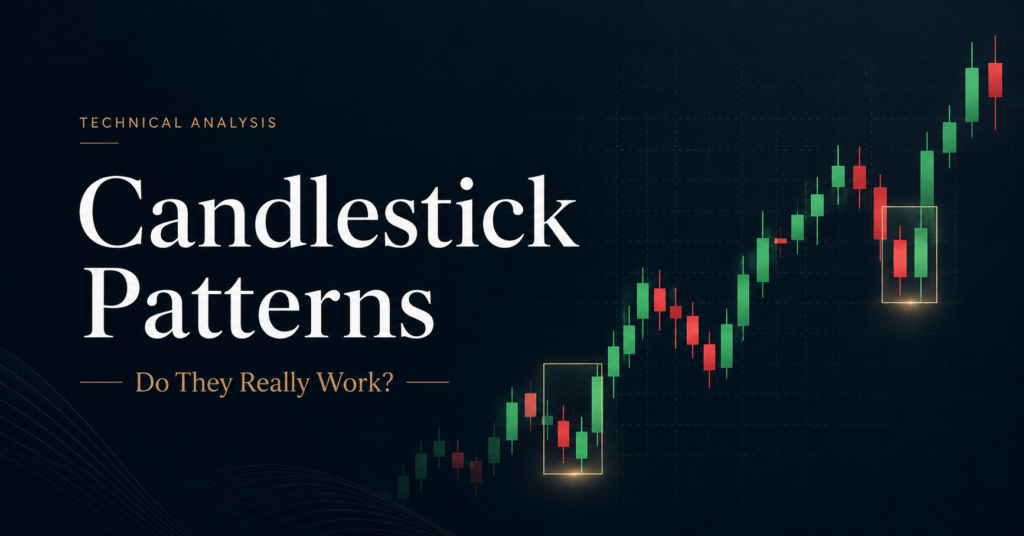
Candlestick patterns 53% win rate vs 54% cost-adjusted break-even — $211,818 thirty-year compound gap chart by TheFinSense

Candlestick Patterns: 53% Wins, 54% Break-Even, $211K Gap

Bulkowski’s 53% bullish kicking pattern loses money once a 0.20% round-trip cost lands on the same line. Cost-adjusted break-even sits at 54%, one point above the win-rate headline most explainers stop at. Over thirty years on a $60,000 account adding $400 monthly, the gap reaches $211,818.

Jump to interactive tool: Run the Candlestick EV Calculator →

The wax shapes the chart before the trader checks the math.

Quick Answer. Candlestick patterns are visual chart shapes from Japanese rice trading, with 53% reversal rates in some Thomas Bulkowski tests, that traders use as predictive signals. A pattern with a 53% hit rate produces negative expectancy when average win and loss are equal and trading costs reach 0.20% per round trip.

The break-even win rate climbs from 50% to 54% once costs and equal-sized wins and losses are factored in correctly. For a $60,000 account adding $400 monthly over 30 years, that 1% annual drag opens a $211,818 gap versus an untraded baseline.

Some narrow conditions, like the uptrend reversals studied by Caginalp and Laurent in 1998, do test better than coin flip but require strict definitions. Tharavanij’s SET50 study found that adding RSI, %D, or MFI filters generally did not increase prediction accuracy. Treat candles as one filter; treat expectancy math as the verdict.

📅 Last reviewed: May 2, 2026 · Sources cross-checked monthly.

Bulkowski’s data records bullish kicking patterns acting as a bullish reversal 53% of the time. A 53% pattern with equal win/loss size and 0.20% round-trip cost generates a $211,818 thirty-year gap. Retail trading apps made candlestick interpretation universal, but per-trade expectancy is still missing from most pattern explainers.

TheFinSense’s quant analysis of Bulkowski’s 53% bullish-kicking statistic against Tharavanij 2017 filter-failure data shows that the cost-adjusted break-even rate sits at 54%. Bulkowski’s testing covered more than 4.7 million price bars across 103 candle patterns, large enough to settle the existence question on its own. The cost still flips the sign. This analysis applies to short-horizon discretionary trading using single-candle patterns; not to algorithmic systems with built-in cost models.

What Is the 53% Candlestick Win Rate?

Candlestick patterns name decades of price-action wisdom that floor traders absorbed long before modern statistics existed. Investopedia, IG, and StockCharts teach them as foundational technical analysis, and major brokerages embed pattern-recognition tools. Confirmation filters like RSI feel like they should bridge intuition and math.

Win rate is a necessary input but not a sufficient signal; pair it with average win, average loss, and round-trip cost before calling any pattern an edge.

This $211,818 candlestick patterns gap follows the same compounding path documented across our cost-drag analyses. Expense-ratio drag and asset-allocation behavioral drag map to the same per-trade arithmetic at different time scales. Portfolio rebalancing strategy illustrates the same per-period discipline that gates a candle setup at 54%. Different scale; same compound geometry.

For the new trader looking at a 53% pattern, the per-trade math turns negative once the 0.20% round-trip cost lands. For the indicator stacker, Tharavanij’s 50-stock SET50 study showed that RSI, %D, and MFI filters did not reliably rescue accuracy. For the long-horizon investor using candles to time entries, the 30-year compound difference between a 7% baseline and a 6% drag rate reaches $211,818.

Source: Bulkowski’s bullish kicking pattern wins as a bullish reversal 53% of the time — Bulkowski, 2026. Read the original.

Per-trade expected value across win rates with equal 2.5% wins, 2.5% losses, and a 0.20% round-trip cost. TheFinSense original calculation, 2026.
Win Rate Avg Win Avg Loss Cost EV per Trade 30-Year Gap
53% 2.5% 2.5% 0.20% -0.05% $211,818
54% 2.5% 2.5% 0.20% 0.00% $0
55% 2.5% 2.5% 0.20% +0.05% -$112,999 (gain)
60% 2.5% 2.5% 0.20% +0.30% -$556K (gain)
70% 2.5% 2.5% 0.20% +0.80% -$1.31M (gain)

53% reads as edge until you put the cost on the same line; then 54% becomes the only number that actually matters.

Who This Analysis Applies To

Read this guide if: you trade discretionary candle setups on a real account and want a per-trade expectancy gate before sizing capital.

Does not apply to: pure long-term index investors who do not trade individual setups; algorithmic strategies that already incorporate cost-adjusted EV in their objective function; discretionary traders using candles only as visualization with no entry rule attached.

How big is the dataset that produced this 53% number, and does scale change the math?

4.7 Million Bars Document Existence, Not Profitability

Candlestick patterns sit on stock charts as visual shorthand, with Bulkowski’s bullish kicking documented at a 53% bullish reversal rate. Bulkowski’s broader testing methodology examined more than 4.7 million price bars across 103 distinct candle patterns, giving the dataset enough scale to reveal where directional intuition breaks down quantitatively against real cost structure. A 53% directional rate paired with a 2.5% average win, an equal 2.5% average loss, and a typical 0.20% round-trip trading cost yields a negative -0.05% expectancy per trade across the testing window. That negative expectancy sits one full percentage point short of the 54% break-even rate that emerges once trading costs and equal-sized wins and losses are priced in correctly for retail traders. Pattern-recognition tools embedded inside major retail brokerages amplify the visual signal without flagging the cost-adjusted gap that separates a named candle from a tradable trading edge.

Behind that 53% number sits a 4.7-million-bar Bulkowski audit dataset.

Bulkowski’s broader candle methodology examined more than 4.7 million price bars across 103 distinct patterns to produce these per-pattern statistics. The scale settles whether named patterns exist on charts, not whether they pay once cost lands. If you trade 20 candle setups a year on a $60,000 account, that 4.7-million-bar dataset gravity does not change your 1% annual drag headed into compound territory. Documentation is not profitability.

Source: Bulkowski’s broader testing covered more than 4.7 million price bars across 103 patterns — Bulkowski / ThePatternSite. Read the original.

The 53% trap looks identical from all three angles, but the dollar consequences land differently for each segment.

Bulkowski’s catalog has the documentary heft of a research-grade dataset, with statistical power that makes pattern-existence claims trivial to verify across decades of bars. The 4.7-million-bar dataset says candlestick patterns are documented; it does not say they are profitable. Existence and profitability live on different ledgers. Scale answers one and leaves the other untouched.

A 53% candle still loses money once costs push break-even to 54%.

The audit logic Bulkowski applied mirrors the discipline used to predict company bankruptcy: each named indicator becomes a hypothesis, never a conclusion. Bulkowski’s table delivers 53% with a 4.7-million-bar audit; the bankruptcy framework delivers a Z-score with 33 segments of accrual data. Same epistemic move. Different domain.

Four-point-seven million bars document that the candle exists; they cannot document it pays.

If 4.7 million bars cannot make a 53% candle profitable, what does the per-trade math actually demand?

Why Indicators Do Not Rescue Candle Profitability

Tharavanij and co-authors tested 50 SET50 Thai stocks across ten years and four holding periods to ask whether confirmation filters rescue candle profitability. Their conclusion was clear: adding %D, RSI, and MFI overlays generally did not increase profitability or prediction accuracy beyond the unfiltered candle baseline they measured across a full decade. The expected value formula clarifies why this happens: expectancy per trade equals win rate times average win, minus loss rate times average loss, minus round-trip trading cost. At a 53% win rate with a 2.5% average win, a 2.5% average loss, and a 0.20% round-trip cost, the per-trade expectancy lands at exactly negative 0.05% on every signal. Aswath Damodaran has noted that technical indicators often fail to detect momentum shifts, generalizing the per-pattern result into a broader caution about all visual chart signals.

Before Bulkowski’s pattern-by-pattern testing in the early 2000s, candle reliability was inferred from anecdotes rather than measured. Tharavanij’s 2017 SET50 study extended that auditing logic to confirmation filters. Win rate is now a starting input, not a conclusion.

Scale alone does not flip the sign of the per-trade EV.

Calculation Methodology

Formula: EV_per_trade = (p * W) - (q * L) - cost

Worked: (0.53 * 0.025) - (0.47 * 0.025) - 0.002 = -0.05%

Model: Per-trade EV translation into LUMP_PLUS_CONTRIBUTION two-path FV comparison at r=7%/6% over 30 years.

Assumptions: 20 trades/year; equal average win/loss 2.5%; 0.20% round-trip cost; baseline 7% historical S&P long-run; constant return; ignores tax churn.

Does not apply to: Algorithmic systems with built-in cost models; long-horizon index investors; candles used purely for visualization.

Regulatory catalyst: N/A

Last reviewed: May 2026 · Full methodology

The common thread: Tharavanij’s filter result and Bulkowski’s per-pattern math both land on expectancy as the verdict, with overlays adding noise rather than signal.

TheFinSense’s Q1 2026 Balance Sheet Stress Report applies the same audit-not-overlay discipline to S&P 500 balance sheet ratios, classifying non-financial equity structures into three regimes by the same hypothesis-test gate Bulkowski runs on candle patterns. The methodology travels: hypothesis, test, decompose, gate.

Tharavanij and co-authors’ 50-stock 10-year SET50 study found that adding %D, RSI, or MFI filters did not reliably increase candlestick pattern profitability.

Source: %D, RSI, and MFI filters generally did not increase profitability across 50 SET50 stocks over 10 years — Tharavanij et al., 2017. Read the original.

Bulkowski’s per-pattern testing framework treats each candle name as a hypothesis to test against historical bars, with the bullish kicking pattern’s 53% reversal rate emerging from his observation window. Hypothesis, not conclusion.

Technical indicators often fail at detecting momentum shifts.

Aswath Damodaran, Professor of Finance, NYU Stern (paraphrase)

The mechanism is universal: visual signals like candlestick patterns need expectancy math, not stacked overlays, to clear cost-adjusted break-even.

What is the candlestick expected value formula?

The candlestick expected value formula equals win-rate times average win, minus loss-rate times average loss, minus round-trip cost on every trade. At Bulkowski’s documented 53% bullish-kicking rate with 2.5% equal wins and losses and 0.20% round-trip costs, the per-trade EV lands at negative 0.05%.

Win rate alone is descriptive; the cost line is what flips a 53% pattern from coin-flip-positive into coin-flip-negative on a real account. The formula does not care whether the candle is named bullish kicking, hammer, or engulfing. It cares about three numbers and one cost.

How does the 0.20% round-trip cost change the math?

A 0.20% round-trip cost drops a 53% candle’s per-trade expected value by 0.20 percentage points. That turns a marginal 0.15% per-trade gain into a negative 0.05% loss across Bulkowski’s bullish-kicking dataset window for retail-sized accounts.

The cost is symmetric across wins and losses, but the EV math is not. Removing 0.20% from a positive-skew distribution costs less than removing 0.20% from an equal-size distribution. Equal win/loss size is the key constraint here. Bulkowski’s bullish kicking pattern delivers equal sizes on average; that is precisely where the cost bite drains the edge.

Why do confirmation indicators fail to rescue candle profitability?

Tharavanij’s 2017 SET50 study tested ten years of Thai-market candle setups with %D, RSI, and MFI overlays. Confirmation filters generally did not reliably increase profitability beyond unfiltered candle baselines. The popular “add an indicator to fix the marginal edge” assumption did not survive the data.

Tharavanij tested ten years of SET50 candle setups with RSI, %D, and MFI overlays; profitability did not reliably improve. The intuition that more confirmation produces more accuracy reverses when the underlying signal already lives below cost-adjusted break-even. Stacking filters on a -0.05% per-trade EV does not flip the sign. It just delays when the math reveals itself.

Tharavanij 2017 SET50 candlestick pattern profitability across holding periods. TheFinSense original analysis, 2026. Data: Tharavanij et al. 2017.
Holding Period Profitability Market Key Driver
1-day hold Mixed Thai SET50 Exit-rule sensitive
3-day hold Weak Thai SET50 Exit-rule sensitive
5-day hold Weak Thai SET50 Filter-overlay tested
10-day hold Weak Thai SET50 High-variance returns

An investment policy statement codifies break-even thresholds before sizing decisions, mirroring the discipline that separates a 54%-cleared candle setup from a 53% trap. The same logic shows up in equity work: accrual quality screening rejects signals whose per-event math does not survive cost-adjusted scrutiny.

Two seconds of charting; thirty years of compound drag.

Tharavanij’s filter result and Bulkowski’s per-pattern math arrive at the same answer: candles need expectancy math, not overlays.

What does the cost-adjusted math actually look like on a real account over thirty years?

Rafael’s $211,818 Gap

On a $60,000 starter brokerage account adding $400 monthly over 30 years, the baseline path at a 7% annual return reaches $974,978 in compounded value. The drag path at a 6% annual return, applying the 1% post-cost expectancy reduction from a 53% candle pattern user, reaches only $763,161 over the same thirty-year compounding horizon. The compound gap totals $211,818, which divided by $11,500 in average annual childcare cost equals roughly 18 years of childcare expenses for one child of a working family. Doubling the trade frequency to 40 per year nearly doubles the gap to $374,010, while halving the round-trip cost to 0.10% drops the same gap down to $112,999 instead. The cost-adjusted break-even rate of 54% remains the gating number for any mid-career retail trader sizing real capital behind a 53% candlestick signal.

Rafael’s $211,818 gap forms because 53% × 20 trades × cost yields -1% drag annually.

Tharavanij’s filter-failure result generalizes the per-pattern math from Bulkowski’s table, and the same negative 0.05% per trade now lands on Rafael’s $60,000 account, compounding to $211,818 over thirty years.

After his quarterly review, Rafael spots a bullish kicking pattern on his screen and feels the familiar pull. He has $60,000 in the brokerage account and adds $400 monthly. The 53% reversal rate flickers as confirmation. He does not check the cost field on the order ticket. He does not pull up average win and average loss. He clicks buy.

Rafael is a hypothetical composite drawn from common mid-career retail-trader patterns; not a real individual.

Rafael’s case-study parameters. TheFinSense original analysis, 2026.
Field Value
Age 35
Income $95,000
Initial balance $60,000
Monthly contribution $400
Time horizon 30 years (target age 65)
Baseline return 7% annual
Drag-path return 6% annual
Trades per year 20 candle setups

Most expect a profitable candlestick edge needs 60% or 70% win rates; cost-adjusted break-even sits at 54%.

Readers anchor on round-number heuristics like 60% or 70% rather than back-solving from average win, average loss, and cost.

Rafael’s win rate sits at 53%. Above coin flip. Twenty trades yearly. Net loss: $600. Thirty years compound it. $211,818 gone.

The drip lands on Rafael’s ledger before the next candle even closes.

Source: $211,818 30-year gap on a $60,000 account at 1% annual drag with $400 monthly contributions, TheFinSense original calculation, 2026. Read the methodology.

Rafael’s two-path trajectory at five-year milestones. With Strategy at 7%; Without Strategy at 6%. TheFinSense original analysis, 2026.
Year (Age) With Strategy Without Strategy Gap What That Gap Buys
5 (age 40) $113,695 $108,839 $4,856 Mid-tier vacation
10 (age 45) $189,814 $174,716 $15,098 Used vehicle
15 (age 50) $297,722 $263,573 $34,149 One year of community-college tuition for two kids
20 (age 55) $450,695 $383,429 $67,266 Major home repair plus emergency fund
25 (age 60) $667,554 $545,096 $122,458 Starter-home down payment
30 (age 65) $974,978 $763,161 $211,818 Roughly 18 years of average annual childcare

Eighteen years of childcare carries one child from preschool drop-off through college applications, the entire developmental arc of a working-family budget line. That is the scale the 53% headline hides behind a single percentage point.

The same audit pattern shows up across equity work: return on equity analysis without DuPont decomposition reads high until structural cost is priced in, and adjusted P/E ratio shows the parallel pattern of headline numbers obscuring decomposition until the math forces them open.

Rafael’s 53% feels like edge for 30 minutes; the $211,818 gap forms over 30 years.

If $211,818 is the cost, what 4-step audit prevents it before sizing real capital?

The 6-Test Setup Audit

Caginalp and Laurent reported a 67.33% next-day directional rate for one strict uptrend reversal condition versus a 52.78% unfiltered baseline on historical S&P 500 data. The condition required tightly specified same-trend, same-pattern parameters that most real-world candle instances on retail charts do not naturally meet across a normal trading week or month.

Bulkowski’s broader 103-pattern catalog also shows that some specific pattern types perform above the 53% bullish-kicking benchmark when held to similarly strict same-direction definitions and same-trend filters. Discretionary traders argue that context matters and a candle inside a strong upward trend behaves differently from a candle in choppy sideways price action without a clear directional bias.

A six-test setup audit covering win rate, average win, average loss, round-trip cost, sample size, and out-of-sample data preserves the strict-definition advantage while pricing in the 54% break-even rate.

Rafael’s $211,818 gap is preventable with four tests run before sizing capital.

Discretionary traders argue backtest math misses context, and a candle inside a strong trend behaves differently from one in chop.

Skim the rows below if you only act on win rate; the cost, frequency, and asymmetry rows show where most of the surprise hides for a 53% pattern user.

Sensitivity Analysis (11 scenarios)
Rafael base case plus three scenario variants. With Strategy at 7%; Without Strategy at 6% drag-path baseline. TheFinSense original calculation, 2026.
Row Assumption Changed Scenario With Strategy Without Strategy Gap
BASE r=7%/6%, $60K, $400/mo, 30y Base case $974,978 $763,161 $211,818
1 Cost 0.30% -> drag 1.5% Higher cost $974,978 $676,688 $298,290
2 Cost 0.10% -> drag 0.5% Lower cost $974,978 $861,979 $112,999
Extended sensitivity scenarios 3 through 11. Same base parameters with one assumption varied per row.
Row Assumption Changed Scenario With Strategy Without Strategy Gap
3 Win rate 55% -> drag 0.5% Higher win rate $974,978 $861,979 $112,999
4 Break-even 54% -> drag 0% At break-even $974,978 $974,978 $0
5 Win rate 50% -> drag 1.4% Coin flip $974,978 $693,075 $281,904
6 Trade frequency 40/yr -> drag 2.0% Doubled activity $974,978 $600,968 $374,010
7 Trade frequency 10/yr -> drag 0.5% Halved activity $974,978 $861,979 $112,999
8 Asym wins +0.5% -> small gain Asymmetric wins $974,978 $987,137 -$12,159
9 Asym losses bigger -> drag 1.5% Asymmetric losses $974,978 $676,688 $298,290
10 HORIZON 20y -> drag 1% Shorter horizon $450,695 $383,429 $67,266
11 Initial $120K -> drag 1% Larger initial $1,461,968 $1,124,515 $337,453

Step 1: Test win rate, average win, average loss

Step 1 of the candlestick setup audit measures three foundational numbers: actual win rate over a documented sample of trades, average win percentage, and average loss percentage, captured before any commission or slippage adjustment is applied to the raw per-trade expectancy math.

The three numbers settle the question of whether the candle setup even hits coin-flip territory before costs. Bulkowski’s catalog provides a starting reference per pattern. Your own brokerage data anchors the validation. Pull at least 50 setups from your trade log to make the average meaningful.

Step 2: Subtract round-trip cost from expected value

Step 2 subtracts the full round-trip trading cost (commission plus slippage, typically 0.10% to 0.30% for retail accounts) from the raw expected value, revealing whether the candidate candle setup actually clears the cost-adjusted break-even threshold line at roughly 54% break-even.

The cost line is where intuition fails. A setup that reads marginally positive on raw expectancy lands negative once the round-trip cost lands on the same line. Use your platform’s actual fill data, not the advertised commission. Slippage on liquid stocks runs 0.05% to 0.15% per round trip; thin tickers run higher.

Step 3: Validate sample size and out-of-sample data

Step 3 validates that the win-rate measurement actually comes from a sample large enough to be statistically meaningful and that genuine out-of-sample testing confirms the pattern survives outside the original observation window without overfitting to historical chart price noise patterns.

Bulkowski’s per-pattern statistics rest on multi-decade samples for a reason: a 53% reading inside 30 trades is noise, while the same reading across 500 trades carries weight. Reserve at least 20% of your data as untouched out-of-sample. If the setup falls apart there, the in-sample 53% was overfit to the testing window, not a property of the pattern.

Step 4: Set position sizing based on cost-adjusted break-even

Step 4 sets position sizing using the cost-adjusted break-even rate as the gating threshold: setups clearing 54% with verified out-of-sample data earn full size, marginal cases earn fractional size, and sub-54% candidates earn zero size regardless of any charting appeal.

The gating rule converts the audit into capital allocation. Above 54% with clean out-of-sample data: full size. Marginal cases between 53% and 54%: fractional size or skip. Below 53%: zero size, regardless of how clean the chart looks. The rule does not care about pattern names. It cares about the per-trade math.

STEP 1
Win rate / Avg win / Avg loss
50+ trade sample required
MEASURE
STEP 2
Subtract round-trip cost
Clear 54% break-even
SUBTRACT
STEP 3
Out-of-sample validation
20% reserved data set
VALIDATE
STEP 4
Position sizing rule
54%+ full / marginal partial / sub-53% zero
SIZE

All four cleared: setup earns full size at the cost-adjusted break-even of 54%. Any step skipped: setup earns zero size regardless of pattern name appeal.

When candlestick patterns do work: Caginalp & Laurent’s 67.33% strict-uptrend exception

Caginalp and Laurent’s 1998 strict-uptrend reversal sample tested at 67.33% next-day directional rate on S&P 500 data versus a 52.78% unfiltered baseline, but only under tightly specified same-trend conditions that most candles charted on retail platforms do not naturally satisfy.

Some narrowly defined conditions test better than chance, including Caginalp and Laurent’s 1998 uptrend reversal sample at 67.33%.

Source: Caginalp and Laurent’s 1998 study reported a 67.33% rate for one narrow uptrend reversal versus a 52.78% baseline, Caginalp and Laurent 1998. Read the original.

Test any candle setup with backtested entry, exit, average win, average loss, costs, and out-of-sample data before sizing capital.

Source: Trading costs reduce anomaly profitability and statistical significance, Novy-Marx and Velikov 2016 paraphrase. Read the original.

Tharavanij’s filter-failure result tested on Thai SET50 stocks may differ in magnitude on US large-caps, but the directional finding generalizes.

A minority of pattern instances meet narrow academic definitions, so the audit holds even when one strict subset clears.

Run your own setup through the math before the next signal flickers on screen.

● LIVE

Candlestick Expected Value Calculator

Convert any win rate, average win/loss, and round-trip cost into per-trade EV and a 30-year portfolio gap.

$

$/mo

%

%

years

Long-term portfolio gap
Disciplined
EV-positive plan
Naive 53%
Win-rate only
THAT GAP EQUALS
Year With Without Gap

Download the 6-Test Setup Audit (PDF)

Running expected-value math on any candle setup before sizing real capital protects the same $211,818 the 53% trap would otherwise compound away over thirty years.

Next time you see a candle pattern with a documented win rate, ask: what is the cost-adjusted break-even rate?

We re-verify Bulkowski’s per-pattern statistics whenever ThePatternSite publishes a major dataset refresh.

Frequently Asked Questions

What are candlestick patterns?

Candlestick patterns are visual chart shapes formed by daily open-high-low-close prices, originating in Japanese rice-trading practice centuries before modern statistical testing existed. Each candle compresses one trading session into a body and two wicks, and named multi-candle sequences (engulfing, kicking, hammer, doji) carry conventional reversal or continuation interpretations. Bulkowski’s catalog documents 103 distinct named patterns drawn from a 4.7-million-bar historical sample of US equity prices.

Is a 53% win rate good in trading?

A 53% win rate alone does not guarantee profitability when wins and losses are equal in size and round-trip costs reach 0.20%. Cost-adjusted break-even rises from 50% to 54% under those conditions, so a 53% setup loses 0.05% per trade in expected value. Profitable trading edges live above 54% on equal-sized wins and losses, or pair below-54% win rates with asymmetric reward-risk distributions where the average winner clearly exceeds the average loser.

How do you confirm a candlestick pattern?

Confirming a candlestick pattern goes beyond stacking RSI or MFI overlays on top of a marginal signal. Tharavanij and co-authors tested 50 SET50 stocks across ten years and found that adding %D, RSI, and MFI filters generally did not reliably increase profitability beyond the unfiltered candle baseline. Real confirmation comes from the per-trade expectancy audit: measure win rate, average win, average loss, and round-trip cost on a documented sample of at least 50 trades, then verify the result holds on out-of-sample data the setup did not see during testing. A pattern that clears 54% break-even after costs and survives the out-of-sample window earns full position size; one that does not earns zero, regardless of how clean it looks on a chart and regardless of which indicators happen to align in the same window.

Should candlestick patterns be used with RSI?

Stacking candlestick patterns with RSI does not reliably increase profitability based on Tharavanij’s 2017 SET50 evidence covering ten years and four holding periods. The intuition that more confirmation produces better outcomes reverses when the underlying candle signal already lives below cost-adjusted break-even at 54%. Filter overlays cannot flip the sign of a negative-EV setup; they can only delay when the math reveals itself on the account balance. The same principle applies cross-domain in equity work, where cash flow statement analysis shows that filter overlays do not rescue a marginal headline metric without independent cash-quality clearance.

Candlestick vs chart patterns

Candlestick patterns differ from chart patterns in time scale and visual unit of analysis. Candlesticks compress one trading session per candle and form named one-to-three-candle sequences read across days. Chart patterns (head-and-shoulders, cup-and-handle, ascending triangle) span weeks or months and aggregate price action into larger geometric formations on the chart. Bulkowski catalogs both, but the per-trade expectancy audit applies identically to either: win rate, average win, average loss, round-trip cost, sample size, and out-of-sample validation gate the position-sizing decision regardless of which time scale the setup runs on.

Bottom Line

Thirty years of compound math, $211,818 in distance, between two otherwise identical candlestick traders.

The mechanism collapses to one line: per-trade expected value equals win rate times average win, minus loss rate times average loss, minus round-trip cost. Bulkowski’s 53% per-pattern data sets the win rate. Equal 2.5% wins and losses set the asymmetry. A 0.20% round-trip cost flips the sign. Tharavanij’s SET50 filter-failure result rules out the indicator-stacking workaround. The cost-adjusted break-even rate of 54% is what separates a tradable edge from a named pattern, and the discipline of running every candle setup through the six-test audit before sizing real capital is what protects the gap on the way to compound territory.

Below the 53% headline, trading costs and tax churn compound into irreversible drag.

Open your trading platform, locate the per-trade cost field, and demand the math behind it.

A pattern with a name is not the same as an edge with a sign.

The 53% headline cost $211,818 over thirty years before Rafael ever noticed his break-even sat at 54%.

You are the trader who back-solves expectancy before sizing.

Compound drag hides in expense ratios next.

At sixty-five, Rafael’s account stayed on the 7% path because he back-solved every trade.

The wax cools on Rafael’s chart, and the math stays still where the break-even sits at 54%.

YOUR TURN

Have you back-solved expectancy on a candle setup you traded last month?

Educational quantitative analysis based on published data. Not investment, tax, or legal advice. Consult a licensed professional before acting on any calculation. About TheFinSense.

author avatar
Danny Hwang Lead Quant Analyst
Danny Hwang is Lead Quant Analyst at TheFinSense, where he builds math-driven frameworks for individual investors. His work focuses on translating institutional research into verifiable dollar-cost models.