

Originally Published: · Last Updated:
How to read a 10-K depends on why you opened it. Use a broad orientation pass when you are learning a company, then use a focused annual-review pass that compares the business, risks, management’s explanation, financial statements, notes, audit report, and controls. Do not treat any three sections as a complete substitute for the filing. Escalate whenever a change in one section is not explained by the others.
A 10-K can feel like a test of endurance. Start with the decision you are trying to make and the disclosures that could change it.
Suppose the earnings call sounded clean and you are considering adding to the position. Finishing the filing is not the outcome that matters. You need to know whether the business, cash flow, risks, accounting choices, and controls still support the reason you own the stock.
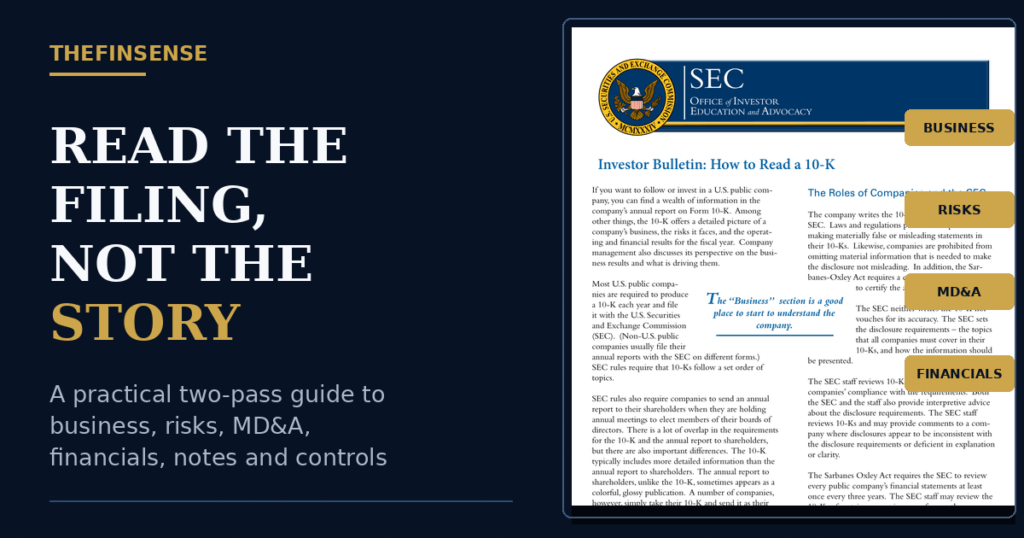
The SEC describes the 10-K as a detailed account of a company’s business, risks, operating results, financial condition, and management’s view of what drove those results. It also warns that the SEC does not write the filing or vouch for its accuracy. Management prepares it, senior executives certify it, and the independent auditor addresses the financial statements and, for many issuers, internal control over financial reporting.
That makes a 10-K more than a longer earnings release. It is where the polished story meets required disclosure, accounting detail, and audit evidence.
Choose the Right 10-K Reading Mode
Before deciding what to read first, decide whether you are learning the company, reviewing an existing holding, or investigating a warning sign. Each task needs a different depth of reading.
Most bad advice about how to read a 10-K assumes every reader has the same job. If you are wondering how to read a 10-K efficiently, first separate orientation, annual review, and red-flag investigation. A first-time buyer needs a map of the company. A long-time shareholder needs to find what changed. Someone investigating a possible accounting or solvency problem needs to follow the issue wherever it appears, including the notes, auditor’s report, controls, legal proceedings, and exhibits.
| Reading mode | Start here | What should change your decision |
|---|---|---|
| First-time orientation | Item 1 Business, Item 1A Risk Factors, segment and geographic notes | You cannot explain how the company makes money, where it is exposed, or which assumptions the thesis requires |
| Annual holding review | Prior-year filing, current Item 1A, Item 7 MD&A, Item 8 statements and notes | A new risk, changed accounting estimate, weakening cash conversion, or unexplained shift in margins or capital needs |
| Red-flag investigation | The disclosure that raised the concern, then related notes, audit report, Item 9, Item 9A, and exhibits | A qualified or adverse audit matter, material weakness, auditor disagreement, liquidity pressure, covenant issue, or inconsistent disclosure |
A study by Dyer, Lang, and Stice-Lawrence is sometimes used to justify a three-section shortcut. Their evidence does not support that leap. The researchers found that median 10-K text in their sample rose from about 23,000 words in 1996 to nearly 50,000 in 2013. Three disclosure topics explained most of that increase: fair value and impairment, internal controls, and risk factors. But those topics appeared across major sections of the filing. The study did not show that three numbered sections contain all investor-relevant evidence.
Evidence: Dyer, Lang, and Stice-Lawrence studied 75,991 firm-years from 1996 through 2013 and explicitly noted that the growing topics were not confined to a single section. Read the paper.
Longer filings still create a real processing problem. A useful response is to choose a reading mode, keep a prior-year filing open for comparison, and follow material changes across sections.
Start With the Business and Risk Map
A practical answer to how to read a 10-K starts with Item 1 and Item 1A when the company is new to you. This orientation pass establishes the operating model and the conditions that could break it.
Read Item 1 before judging the numbers
The SEC calls the Business section a good place to start. Read it until you can answer a few plain questions: What does the company sell? Who pays it? Which segments matter? Where are the important assets, customers, suppliers, and regulations? Is growth coming from volume, price, acquisition, or a change in mix?
The business model is the map that makes later numbers interpretable. The financial statements become easier to evaluate once you know which operating drivers should appear in revenue, margins, working capital, capital spending, and segment results.
Write a one-sentence business model before moving on. A useful version names the customer, the product or service, the main economic driver, and the largest dependency. When you cannot do that, you are not ready to value the company.
Use Item 1A to challenge the investment thesis
Risk Factors should not be reduced to a word count or a score. Look for changes in order, specificity, and emphasis. Compare the current filing with the prior year. A newly added risk, a risk moved closer to the top, or language that becomes more concrete can matter more than a paragraph that appears every year.
Campbell and coauthors found that firms facing greater risk disclosed more risk factors and that the type of disclosure varied with the kind of risk the firm faced. They also found that market participants incorporated information from those disclosures into assessments of firm risk and stock price. That does not make every sentence informative, but it is enough reason to read for company-specific changes rather than dismissing the entire section as boilerplate.
Evidence: Campbell, Chen, Dhaliwal, Lu, and Steele examined mandatory risk-factor disclosures and found that their content reflected the type and level of firm risk. Review the paper and abstract.
Connect the risk language to the original thesis. A company sold as a durable economic moat should not be quietly describing weaker pricing power, customer concentration, supply dependence, or regulatory pressure without a credible offset. The filing may not tell you what the stock is worth, but it can tell you that the story you were valuing has changed.
Connect MD&A to the Financial Statements
Item 7 explains management’s view of performance and liquidity. Item 8 supplies the audited statements and notes. Read them together, because an explanation without the underlying numbers is incomplete and a number without its accounting context can mislead.
Read MD&A for causes, not adjectives
Management’s Discussion and Analysis should help you understand what changed in operations, liquidity, capital resources, estimates, and known trends or uncertainties. Strip away words such as strong, resilient, disciplined, or temporary. Record the actual cause management gives for the change.
Then test whether the cause appears elsewhere. If management credits demand for revenue growth, check unit volume, price, backlog, customer concentration, and receivables. If management calls a margin decline temporary, inspect inventory, restructuring costs, purchase commitments, and the assumptions behind impairment or reserve estimates.
This is where how to read a 10-K becomes less about page order and more about reconciliation. Determine whether management’s explanation fits the filed numbers and notes.
A quick reconciliation example: Suppose management attributes revenue growth to stronger customer demand, but receivables rise much faster than sales and operating cash flow weakens. That mismatch is not proof of misconduct. It is a reason to open the revenue-recognition and allowance notes, check whether payment terms or customer concentration changed, and ask whether the cash pattern supports management’s explanation.
Read Item 8 as a connected system
Item 8 includes the financial statements, notes, and auditor’s report. Do not stop at net income. Trace the same operating story through the income statement, balance sheet, cash flow statement, and relevant footnotes.
- Income statement: Did growth come with stable or improving economics, or did expenses and one-time adjustments do the work?
- Balance sheet: Did receivables, inventory, debt, deferred revenue, goodwill, or other assets move faster than the business explanation would suggest?
- Cash flow statement: Did reported earnings convert into operating cash, and what working-capital movements explain the difference?
- Notes: Which estimates, segment definitions, commitments, contingencies, stock compensation, pensions, taxes, or acquisitions materially affect the headline numbers?
The cross-check is where separate financial-statement skills come together. Use the income statement analysis guide when margins and expense classifications are the issue. Use the cash flow statement analysis guide when earnings and cash are moving in different directions.
Do not use a fixed cash-conversion threshold across every industry. Banks, insurers, asset-heavy manufacturers, subscription businesses, and rapidly growing retailers can produce very different working-capital patterns. Compare the company with its own history and with economically similar firms before calling a divergence a red flag.
Know When to Escalate Beyond the Core Sections
Knowing when to expand the review is part of how to read a 10-K without missing what matters. Follow audit, control, liquidity, legal, market-risk, governance, or contract issues wherever the filing points, because the evidence determines the stopping point.
Read the auditor’s report and controls disclosure
The SEC’s investor bulletin calls the auditor’s report a key part of the 10-K. Most reports express an unqualified opinion, but the exact opinion and the basis for it matter. Also read critical audit matters where applicable. They identify areas that involved especially challenging, subjective, or complex auditor judgment, although they do not by themselves mean the statements are misstated.
Item 9A covers disclosure controls and internal control over financial reporting. A material weakness deserves investigation, not an automatic buy or sell rule. Ask what process failed, which accounts are affected, whether a misstatement occurred, how long remediation has been underway, and whether the weakness repeats.
Check Item 9, market risk, legal matters, and exhibits when relevant
Item 9 covers changes in or disagreements with accountants. Item 7A can matter when interest rates, currencies, commodity prices, or other market exposures are central to the business. Item 3 can surface significant legal proceedings. Exhibits may contain debt agreements, major contracts, acquisition terms, and executive certifications that become important once a concern points you there.
A going-concern disclosure, debt covenant problem, or qualified opinion is serious, but it does not mechanically predict a restatement or dictate that a position must be sold. Those facts change the risk assessment and require deeper work on liquidity, financing options, operating viability, and the investor’s own exposure. The bankruptcy prediction guide can help organize solvency ratios, but no single model replaces the filing-specific analysis.
Use This Repeatable 10-K Checklist
A good 10-K review leaves a short record of what changed, what reconciled, what did not, and what evidence would change your conclusion. This checklist shows how to read a 10-K as a repeatable decision record rather than an arbitrary confidence score.
- Open the filing in SEC EDGAR. Confirm the form, fiscal year, filing date, and whether the document is an amendment.
- Choose your reading mode. Use orientation, annual review, or red-flag investigation.
- Write the current thesis in one sentence. Name the operating driver and the assumption most likely to fail.
- Compare Item 1 and Item 1A with the prior year. Record new, removed, reordered, or more specific disclosures.
- Read Item 7 for management’s causal explanation. Pull out concrete drivers of revenue, margins, liquidity, capital spending, and estimates.
- Reconcile Item 7 with Item 8. Follow the explanation through all three statements and the relevant notes.
- Read the audit report and Item 9A. Note the opinion, critical audit matters, material weaknesses, and remediation status.
- Escalate where the evidence points. Add Item 7A, Item 3, Item 9, governance disclosures, proxy material, or exhibits as needed.
- Write a decision memo. Separate confirmed facts, unresolved questions, and the specific evidence that would change the thesis.
SEC EDGAR provides free public access to company filings and lets you search by company, ticker, CIK, form, and filing date. Use the filed document rather than a third-party summary when the wording, footnotes, or amendments matter.
Official tools: Search SEC filings in EDGAR and review the SEC’s Investor Bulletin: How to Read a 10-K.
Frequently Asked Questions About How to Read a 10-K
What is a 10-K?
A 10-K is the annual report most U.S. public companies file with the SEC. It covers the business, material risks, management’s discussion, audited financial statements, notes, controls, governance information, and other required disclosures. Foreign private issuers generally use Form 20-F instead.
What part of a 10-K should I read first?
For a new company, start with Item 1 Business and Item 1A Risk Factors. For an existing holding, compare the current and prior filing, then focus on changed risks, Item 7 MD&A, Item 8 statements and notes, the audit report, and Item 9A controls. The reason for reading should determine the order.
Do I need to read a 10-K cover to cover?
For a new company, a broad read often helps because the business model, segments, accounting choices, and risks are still unfamiliar. Repeat reviews can be more focused, but any material change should be followed across every related section and note. Skimming three fixed sections is not a universal substitute.
Are 10-K risk factors only boilerplate?
Some language is generic or repeated, but the section can still be informative. Compare it with the prior year and look for new, reordered, removed, or more specific risks. Academic evidence also finds that risk-factor content varies with the type and level of risk firms face.
When is a 10-K due?
The deadline depends on filer status. Large accelerated filers generally have 60 days after fiscal year-end, accelerated filers 75 days, and non-accelerated filers 90 days. Check the cover page and the SEC filing guidance rather than assuming every company has the same deadline.
How to Read a 10-K: The Bottom Line
A useful 10-K review changes depth with the task. Start by deciding what you need to learn. Build the business and risk map when the company is new to you. For an annual review, compare the current filing with the prior year and reconcile management’s explanation with the statements and notes. When a warning appears, follow it into the auditor’s report, controls, legal disclosures, market-risk section, governance material, or exhibits.
Before closing the filing, write four lines: what changed, what reconciled, what remains unresolved, and what evidence would change your thesis. If you cannot fill in those four lines, the review has not yet answered the decision you brought to it.
Investigate the unresolved item most capable of changing cash flow, solvency, or the business model before you add to, reduce, or simply keep the position.
YOUR TURN
Which disclosure in the latest 10-K of your largest individual holding would most likely change your thesis?
- SEC Office of Investor Education and Advocacy: Used to map the purpose of Item 1, Item 1A, Item 7, Item 7A, Item 8, the auditor’s report, Item 9, and Item 9A.
- Dyer, Lang, and Stice-Lawrence (2017): Used only for the 1996-2013 sample, filing-length trend, and concentration of growth in three disclosure topics. The paper states that those topics extend across major sections.
- Campbell et al. (2014): Used to support the narrower claim that mandatory risk-factor disclosures contain information related to firm risk and market assessments.
- Method: The prior article’s three-section inference, evidence-gap score, dollar exposure calculator, fixed threshold, and unsupported timing claims were removed. This revision uses an SEC-aligned decision router and does not model investment returns.
- Limits: This checklist does not replace company-specific accounting expertise, legal review, industry context, valuation work, or professional advice.
AI-assisted tools were used for source organization and drafting support. Danny Hwang reviewed the complete article, checked the cited primary and academic sources, and approved the final wording under TheFinSense’s editorial policy.
Update history
-
v2.1
2026-07-20
EDITORIAL
Moved repeated correction commentary out of the Bottom Line, added a practical MD&A-to-statements reconciliation example, and tightened SEO-driven phrasing without changing the article’s factual conclusions.
-
v2.0
2026-07-19
CORRECTION
Rebuilt the article after source review showed that three disclosure topics were incorrectly treated as three exclusive reading sections. Removed the unsupported scoring model, calculator, dollar exposure, fixed threshold, and investment-action rules.
-
v1.0
2026-04-28
PUBLISH
Original publication.
Educational quantitative analysis based on published data. Not investment, tax, or legal advice. Consult a licensed professional before acting on any calculation. About TheFinSense.