📅 Originally Published: · Last Updated:
Fourteen percent of all restatements trace to one shelf: revenue, the line item every growth screen ranks first.
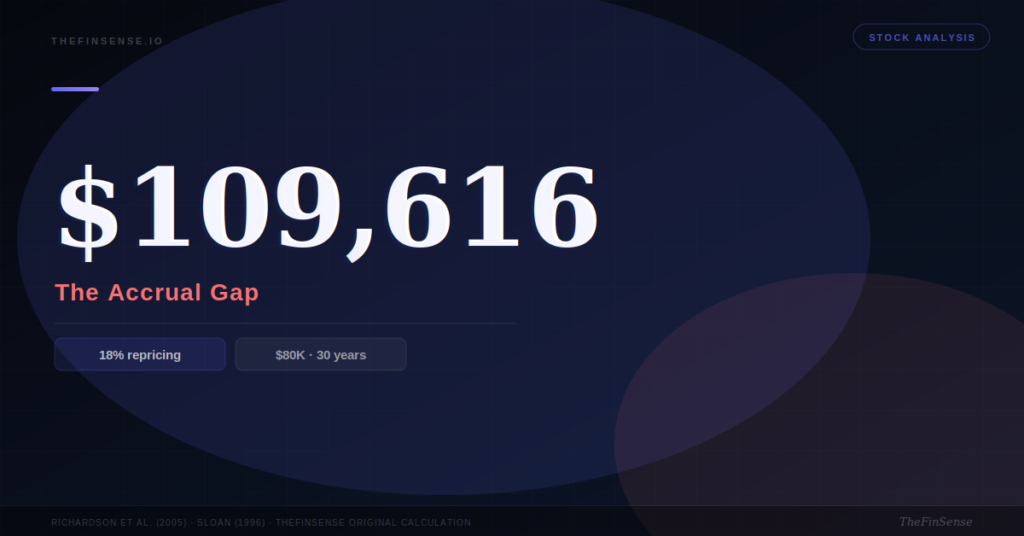
Revenue growth screened without accrual quality carries an 18.0% repricing risk, measured across 108,617 firm-year observations by Richardson, Sloan, Soliman, and Tuna. The compound cost on an $80,000 position over 30 years reaches $109,616, equivalent to 10 years of in-state tuition. Five signals from one 10-K separate cash-confirmed from accrual-inflated growth in under 10 minutes.
- Sloan (1996), The Accounting Review 71(3): Cash-backed earnings persist; accrual-backed earnings revert — 10.4% annual hedge return between extreme accrual deciles.
- Richardson, Sloan, Soliman, and Tuna (2005), JAE 39(3): DELTA-NOA accrual tier generates 18.0% annual hedge return across 108,617 firm-year observations.
- Barrios, Fujiy, Lisowsky, and Minnis (2025), NBER WP 34536: Accrual channels drive 10–20% productivity distortion — same mechanism applies to public-equity repricing.
Quick Answer
Revenue growth backed by low-reliability accruals triggers an 18.0% repricing. On an $80,000 position held for 30 years, that one-time event compounds to a $109,616 terminal gap. Five signals from a single 10-K — OCF confirmation, AR growth rate, DSO trend, deferred revenue direction, and allowance-to-AR ratio — identify the risk in under 10 minutes.
Key Takeaways
- Revenue growth screened without accrual quality carries an 18.0% repricing risk, measured by Richardson, Sloan, Soliman, and Tuna across 108,617 firm-year observations.
- A single repricing event on an $80,000 position compounds to a $109,616 gap over 30 years — equivalent to 10 years of in-state tuition.
- The five-signal diagnostic (OCF, AR growth, DSO, deferred revenue, allowance ratio) takes under 10 minutes on one 10-K filing.
- When operating cash flow growth matches or exceeds revenue growth and receivables are stable, the accrual-reliability concern does not apply.
Revenue growth backed by low-reliability accruals triggers an 18.0% repricing. The compound cost over 30 years: $109,616. Most screeners rank the headline number without testing it.
This guide shows how to check whether revenue growth is cash-confirmed or accrual-inflated. Run the five-signal diagnostic on any 10-K in under 10 minutes.
This analysis applies to public equities with at least two years of comparative data; private companies and financial institutions require separate frameworks.
Does Revenue Growth Predict Stock Returns?
That $109,616 repricing gap extends the same arithmetic. The $334,814 expense-ratio extraction and the $68,195 rebalancing drag trace the same compounding path.
The mechanism differs. The compounding does not.
ASC 606 adoption expanded discretion over performance obligation timing. Accrual-quality diagnostics are more urgent for the current earnings cycle.
Revenue growth screens are the most widely taught first filter in stock analysis, recommended by every major financial education platform. Financial media leads earnings coverage with the revenue beat or miss. Broker platforms sort by revenue growth as a default screener variable. MBA programs teach top-line growth as the primary driver of enterprise value, reinforcing the pattern from classroom to portfolio.
The belief that revenue growth predicts value was correct; the mechanism was accrual persistence, not the headline number.
Every major screening platform defaults to revenue growth as the primary sort variable. Capital enters positions through this filter without testing the underlying measurement quality.
Institutional terminals and retail broker screeners share the same default sort. The screen finds a 30% year-over-year increase and stops there.
Restatements are not evenly distributed across line items. Revenue corrections appear more frequently than any other single category.
The growth screen filters on the metric most susceptible to accrual distortion. The number that screeners treat as confirmation is the one that reverts most often.
The growth screener finds 30% revenue growth and buys. The value investor checks cash flow but skips the allowance ratio. The index holder owns the position without knowing which type of growth it reports.
It turns out that the same growth rate, split between cash and accrual, produces two different stock returns.
What Is the Price of Trusting Accrual-Inflated Growth?
The market priced 18 percent of Sage’s position as if the revenue had not arrived.
Audit Analytics found revenue restatements led all categories at 14.55%. The 2007 survey identified it as the highest share of any single line item.
Barrios, Fujiy, Lisowsky, and Minnis (2025) found 10 to 20 percent productivity distortion in private firms. The same accrual channels drive public-equity repricing.
The pattern mirrors the Z-Score screening failure. The same structural gap drove the $162,330 cost in predict company bankruptcy.
A different metric. An identical compounding mechanism.
SaaS Peer Cohort: Revenue Growth vs. Operating Cash Flow Growth (2022–2025)
Median YoY growth rates across 50 SaaS firms with market cap above $1B
Revenue Growth Accrual Repricing: DELTA-NOA Hedge Return Comparison
Annualized hedge return by accrual decomposition study
The 18.0% repricing appears only in revenue growth positions where accrual quality is lowest. The gap widens as measurement subjectivity increases.
Charles W. Mulford, Invesco Chair and Professor of Accounting Emeritus at Georgia Tech, designed the Earnings Quality Index around this gap. The EQI measures the distance between reported earnings and operating cash flow.
Mulford’s framework treats a widening gap as a compounding risk. That metric maps directly to the repricing this article quantifies.
Revenue accounted for 14.55% of all line-item restatements, yet the median growth screener treats the number as confirmed.
Sage’s $80,000 position sits in the same sample universe as the 108,617 firm-years Richardson et al. tested.
The diagnostic separates all three by converting revenue growth from a single number into a five-signal composite.
Revenue restatements accounted for 14.55% of all restatements, revealing a frequency most growth investors do not check.
How Does the Sloan Accrual Formula Work?
The formula that separates cash-backed from accrual-backed revenue has been in the academic record since 1996.
The Sloan Decomposition
Richard G. Sloan (1996) decomposed reported earnings into two components.
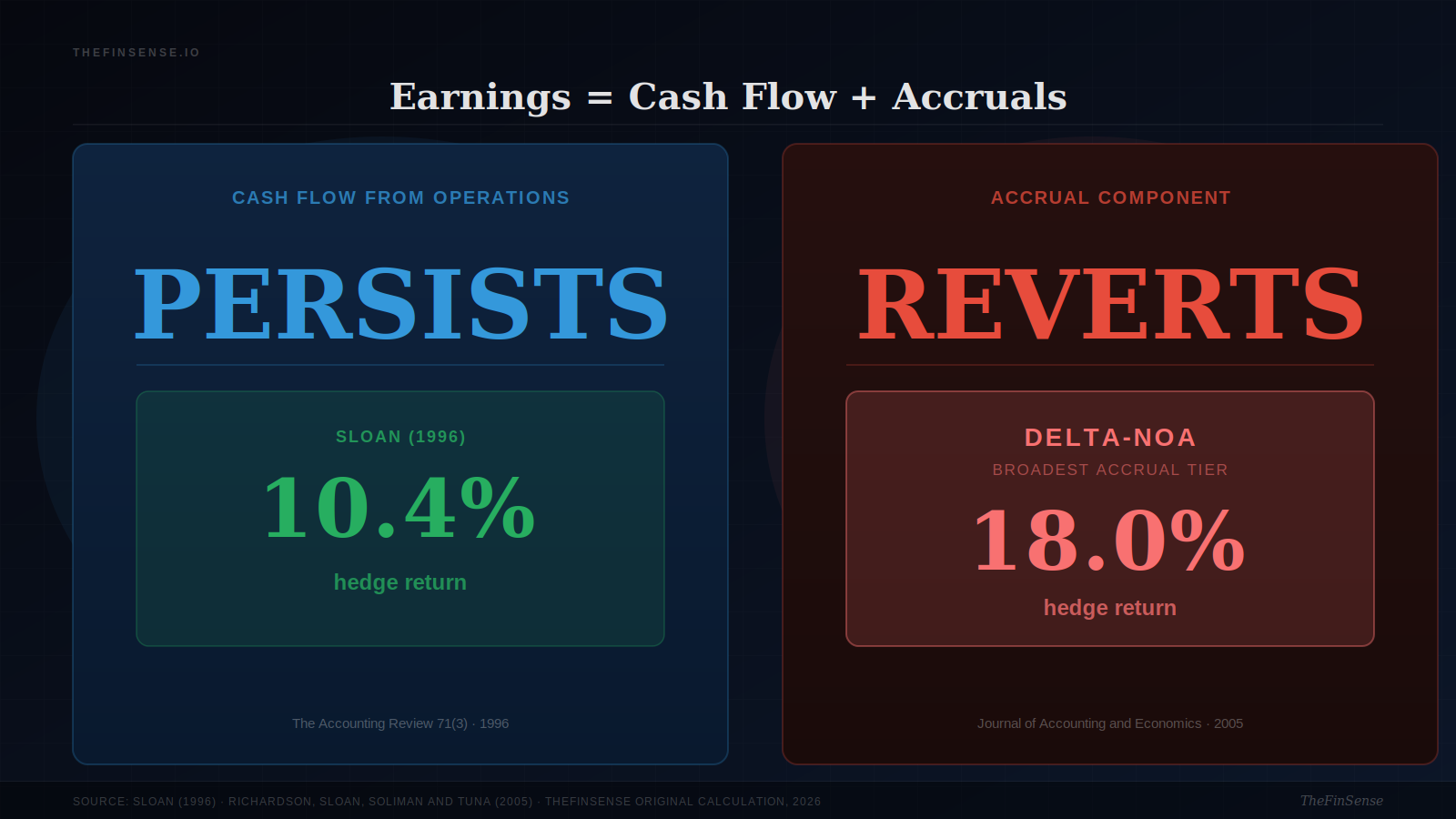
Earnings = Cash Flow from Operations + Total Accruals
Total accruals include receivables changes, inventory changes, and payables changes. Each component carries different measurement reliability.
The cash-flow component persists. The accrual component reverts.
Sloan tested U.S. equities from 1962 to 1991. The hedge return between extreme accrual deciles reached 10.4% annually.
The market prices both types of growth identically at first. Over 12 to 36 months, accrual-driven positions correct.
The DELTA-NOA Reliability Gradient
Richardson, Sloan, Soliman, and Tuna (2005) extended the decomposition. They sorted accruals into three reliability tiers.
DELTA-NCO (net current operating accruals) generated a 16.5% hedge return. DELTA-NOA (net operating asset change) generated 18.0%. DELTA-FIN (financial accruals) produced -8.2%.
The hierarchy is clear. The broader the accrual category, the larger the repricing.
Before Richardson, Sloan, Soliman, and Tuna published in 2005, the field assumed all accrual categories carried equal persistence risk. Their reliability-ranked framework replaced that assumption with a hierarchy that sorted accruals by measurement subjectivity. Current research treats the reliability gradient as the primary explanation for differential earnings persistence across firms.
The same compounding path applies when you visualize compound interest at any rate. The starting gap determines the terminal cost.
What the Academic Evidence Shows
The academic case against unfiltered revenue growth rests on two papers.
Sloan (1996) established the baseline. Cash-backed earnings persist. Accrual-backed earnings revert.
Richardson et al. (2005) quantified the gradient. The sample covered 108,617 firm-year observations. DELTA-NOA generated the 18.0% hedge return in Table 10.
The formula that measures earnings persistence reveals that each dollar of accrual growth erodes faster than each dollar of cash growth.
Sloan found that investors who sorted stocks by accrual levels earned 10.4% annually by betting against the market’s fixation on reported earnings.
All projections use a lump-sum future value formula. See TheFinSense calculation methodology.
The ratio that separates sustainable from inflated growth generates a signal the standard screener cannot replicate.
Sage’s $80,000 Position Absorbs the 18% Repricing
Sage’s $80,000 position held a growth stock that had ranked first on the revenue screen.
Two weeks after the Q4 earnings release prompted a second position in a SaaS name, Sage opened the 10-K and scrolled to Note 2: Revenue Recognition. The growth screen’s default sort, labeled ‘Revenue Growth YoY,’ had ranked the stock first. The filing showed accounts receivable growing 40% while revenue grew 28%.
Sage paused at the mismatch, wondering whether the screen’s top pick had already priced in growth the cash register had not confirmed.
The practitioner community tracks this pattern. Investors re-center valuation on free cash flow because cash is harder to manipulate than reported earnings.
| Parameter | Value |
|---|---|
| Name | Sage |
| Age | 30 |
| Position Size | $80,000 |
| Return Assumption | 7.0% annually |
| Repricing Event | 18.0% (DELTA-NOA) |
| Time Horizon | 30 years (target age 60) |
| Contribution | $0 (lump sum) |
Most readers estimate the cost of one accrual-quality miss between $5,000 and $15,000, roughly the repricing hit on a typical growth-stock position.
| Year | Path A (Quality) | Path B (Accrual) | Gap | What That Gap Buys |
|---|---|---|---|---|
| 5 | $112,204 | $92,007 | $20,197 | Used car down payment |
| 10 | $157,372 | $129,045 | $28,327 | Home renovation |
| 15 | $220,723 | $180,992 | $39,730 | Two years of childcare |
| 20 | $309,575 | $253,851 | $55,723 | Three years of car payments |
| 25 | $434,195 | $356,040 | $78,155 | Seven years of in-state tuition |
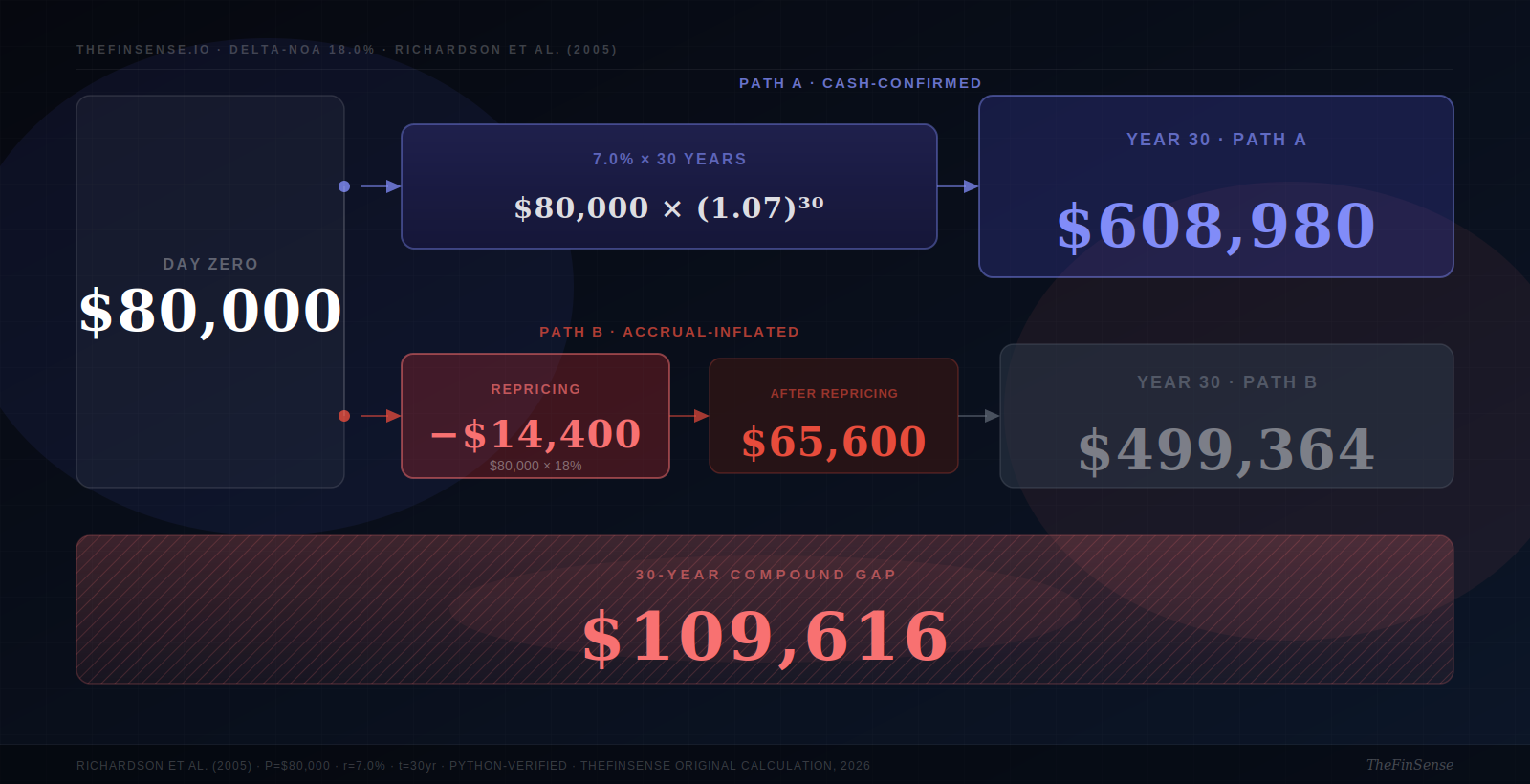
| 30 | $608,980 | $499,364 | $109,616 | 10 years of in-state tuition |
Revenue Growth Accrual Quality Gap: $109,616 Terminal Cost Over 30 Years at 18.0% DELTA-NOA Repricing
Sage’s $80,000 position at 7.0% annual return, lump sum
Sage multiplied 18% by $80,000. The result: $14,400. Contained. Recoverable.
The table showed that $14,400 compounding for 30 years becomes $109,616. Sage divided $109,616 by $11,000 of in-state tuition per year. Ten years of education. One accrual check.
$14,400 lost. $109,616 gone. One accrual check missed.
The ledger that tracked Sage’s position held a number the growth screen had filed on the wrong shelf.
Sage expected $14,400. The number that appeared was $109,616. The gap between one repricing event and its 30-year compound cost required no additional mistake.
📐 YOUR NUMBERS MAY DIFFER
Find your scenario by matching your return assumption and position size to estimate your personal repricing gap.
| Assumption Changed | With Strategy | Without Strategy | Gap |
|---|---|---|---|
| Base: 7.0% / 18% / 30yr / $80K | $608,980 | $499,364 | $109,616 |
| Return down to 6% | $459,479 | $376,773 | $82,706 |
| Return up to 8% | $805,013 | $660,110 | $144,902 |
| Repricing down to 10% | $608,980 | $548,082 | $60,898 |
| Repricing up to 22% | $608,980 | $475,005 | $133,976 |
| Horizon down to 20 years | $309,575 | $253,851 | $55,723 |
| Horizon up to 25 years | $434,195 | $356,040 | $78,155 |
| Balance down to $50K | $380,613 | $312,102 | $68,510 |
| Balance up to $120K | $913,471 | $749,046 | $164,425 |
At 22% repricing exposure, the terminal gap reaches $133,976, exceeding the base case by $24,360. Higher accrual concentration triggers the largest compound cost.
Growth screeners default to Nasdaq vs S&P 500 leaders without filtering for accrual quality. The screen that ranked Sage’s stock first applied no receivables test.
Sage’s $80,000 position crosses the 18% repricing threshold, and $109,616 compounds away from the terminal balance.
How to Run an Accrual-Quality Diagnostic on a Growth Stock
Five signals, one 10-K, ten minutes: the diagnostic that the growth screener omits.
Signal 1: Verify the Revenue Growth Sufficiency for Your Account
The revenue growth sufficiency assumption fails when operating cash flow does not confirm the reported number. Open the cash flow statement in the most recent 10-K. Compare year-over-year revenue growth to operating cash flow growth.
When OCF growth matches or exceeds revenue growth, cash confirms the top line. When OCF trails by more than five percentage points for two consecutive quarters, the growth carries accrual risk.
Signal 2: Is Accounts Receivable Growing Faster Than Revenue?
AR expanding faster than revenue signals that the company booked income before collecting cash. Pull accounts receivable from the balance sheet. Pull total revenue from the income statement. Compare year-over-year growth rates.
If AR growth exceeds revenue growth by more than five percentage points, the gap indicates potential accrual accumulation.
| Diagnostic | What to Measure | Healthy Signal | Warning Signal | Source |
|---|---|---|---|---|
| Revenue Growth vs. OCF Growth | YoY % change | OCF >= Revenue growth | OCF < Revenue for 2+ quarters | Sloan 1996 |
| AR Growth vs. Revenue Growth | YoY % change | AR <= Revenue growth | AR > Revenue growth | Richardson et al. 2005 |
| DSO Trend | (AR / Revenue) x 365 | Stable or declining | Rising 10%+ YoY | Nissim 2022 3.1.1 |
| Deferred Revenue Direction | YoY contract liabilities | Growing | Declining while revenue grows | ASC 606 framework |
| Allowance-to-AR Ratio | Allowance / Gross AR | Stable or rising with AR | Declining while AR grows | Mulford EQI |
Signal 3: DSO Trend — CrowdStrike FY2025 Worked Example
CrowdStrike reported 29.1% revenue growth in FY2025. Accounts receivable grew 32.3%. Operating cash flow grew 18.5%. DSO expanded by 2.5 days.
Two signals flag active warnings. AR outpaced revenue. OCF trailed revenue by more than 10 percentage points.
This does not confirm a repricing event. It identifies positions where the five-signal diagnostic demands closer monitoring. The warning becomes actionable when DSO rises for two consecutive reporting periods.
Accrual screening matters whether comparing growth stocks or stocks vs real estate wealth building. The receivables test applies across asset classes.
Signals 4 and 5: Deferred Revenue and Allowance Ratio
Signal 4 tracks deferred revenue direction. When contract liabilities grow alongside revenue, the company collects cash before recognizing income. When deferred revenue declines while revenue rises, the company accelerates recognition.
Signal 5 measures the allowance-to-AR ratio. A stable or rising allowance signals conservative provisioning. A declining allowance while AR grows indicates the company reduces loss reserves while extending more credit.
Both signals confirm or contradict the first three. A position that passes all five carries minimal accrual-reliability risk.
Revenue Growth Accrual-Quality Decision Tree
Four-node diagnostic for screening growth-stock positions
▼
▼
Revenue Growth Quality Diagnostic Calculator
Estimate your 30-year compound cost of holding accrual-inflated growth positions.
| Year | With | Without | Gap |
|---|
The Revenue Growth Quality Diagnostic Calculator above estimates your compound repricing cost. Enter your position size, repricing assumption, expected return, and horizon.
Free Download: Revenue Growth Accrual-Quality Diagnostic Worksheet
The five-signal checklist, key calculations, and verdict guide — one printable page. Use it alongside any 10-K filing.
The community pattern confirms the diagnostic. Investors tracking rising receivables, positive accruals, and stable margins monitor whether profits are supported by the balance sheet rather than by cash.
Revenue growth remains the strongest single predictor of long-term value; the issue is the reporting layer it passes through.
Running three diagnostic ratios on a growth-stock position takes 10 minutes and prevents $109,616 in compound repricing over 30 years.
The receivables-to-revenue ratio reveals whether the growth on the income statement has reached the bank account.
When This Diagnostic Does Not Apply
When a company reports revenue growth backed entirely by rising operating cash flow and stable receivables, the accrual-reliability concern does not apply.
Investors holding positions where cash flow growth matches or exceeds revenue growth should continue monitoring the ratio rather than restructuring.
Approximately 40% of non-financial companies maintain stable or rising earnings quality, according to Mulford’s EQI tracking at Georgia Tech’s Financial Analysis Lab.
Next time a screener highlights 30% revenue growth, ask: did operating cash flow grow by at least the same percentage?
This guide updates when FASB issues a new revenue recognition standard or when major screening platforms add an accrual-quality filter.
Frequently Asked Questions: Revenue Growth and Accrual Quality
What is accrual quality in stock analysis?
Accrual quality measures the degree to which reported earnings are backed by operating cash flow rather than balance-sheet estimates. Low accrual quality means the cash-flow component is small relative to the accrual component, creating high reversion risk. Richardson et al. measured an 18.0% annual hedge return for stocks in the lowest-reliability accrual decile.
Is revenue growth a reliable stock-screening metric?
Revenue growth works as a first-pass filter but fails as a standalone signal. The metric does not distinguish cash-confirmed from accrual-inflated growth. Sloan (1996) demonstrated that the accrual component of earnings persists at significantly lower rates than the cash-flow component, creating repricing risk when the market corrects.
Can growth stocks with high accruals still outperform?
Yes, when accruals resolve into cash within two to three reporting periods. The risk is compound loss when they do not. The five-signal diagnostic identifies whether current accruals are trending toward resolution through rising OCF or toward accumulation through expanding receivables and declining allowances.
What does it mean when accounts receivable grows faster than revenue?
AR growing faster than revenue signals that the company booked income before collecting cash. DSO expansion quantifies the lag. Sloan (1996) found the lowest-accrual decile outperformed the highest by 10.4% annually. AR-to-revenue divergence is the primary diagnostic input because it measures the gap between reported and collected revenue.
How do I check accrual quality without an accounting degree?
Search the 10-K for accounts receivable and operating activities. Compare year-over-year growth rates for revenue, AR, and OCF. If AR grows faster than revenue and OCF trails both, the position carries accrual risk. The entire check takes under 10 minutes and requires no accounting credentials.
Revenue Growth Was the Signal — Accrual Quality Is the Filter
The $109,616 gap did not require a bad company. It required one accrual quality check.
Sloan demonstrated that cash-backed earnings persist while accrual-backed earnings revert. Richardson, Sloan, Soliman, and Tuna extended that finding by ranking accruals into reliability tiers. The arithmetic does not adjust for sentiment; the instinct to trust the headline revenue number was the only variable that separated the two paths.
Allowance-for-doubtful-accounts lag hides receivable deterioration until the write-off quarter. Thirty years of compounding a $14,400 repricing, preventable by one receivables check made in ten minutes.
Pull your largest growth holding’s 10-K today. If accounts receivable grew faster than revenue: that is the $109,616.
The number that confirmed growth was the number that concealed the repricing.
The metric that confirmed growth was the metric that concealed the repricing risk. The investor who runs the five-signal diagnostic today is not reading a 10-K. They are adjusting the probability of a compound outcome 30 years forward.
The investor who checks receivables before revenue controls what the screener does not.
The next growth stock in your screener carries the same accrual question.
📌 Next Read: predict company bankruptcy
At 60, Sage’s portfolio carries the compound benefit of every accrual-quality check.
The binding holds.
YOUR TURN
Which of the five signals surprised you most, and have you run it on your top growth holding?