Economic moat 1.27 percentage point 10-year underperformance vs S&P 500 — TheFinSense compound model

Economic Moat: The 1.27pp Lag, 2.51pp Edge in 10 Yrs

📅 Originally Published: · Last Updated:

A rope tied to nothing still feels like an anchor.

The Bottom Line, Up Front

An economic moat label tells you a company can defend its returns; it does not tell you what you should pay to buy them. Morningstar’s moat-only index trailed the S&P 500 by 1.27 points annually over the last decade, while the valuation-screened Wide Moat Focus Index beat the broad market by 2.51 points since its 2007 launch. The gap between the two paths is where disciplined buyers live.

Primary Evidence Used in This Analysis

  • FOUNDATIONAL Haggard, Martin & Pereira (2024), Is Warren Buffett Wrong About Economic Moats?: Wide-moat firms outearned no-moat firms by 18.73 points annualized, yet the moat-only index trailed the S&P 500 by 1.27 points over the same window.
  • SUPPORTING Morningstar (2026), Economic Moat Rating Methodology: Wide-moat ratings imply 20-plus years of expected excess returns above cost of capital; narrow-moat ratings imply 10-plus years.
  • CONFIRMATORY Morningstar Indexes (2025), Wide Moat Focus Index data: 11.50% annualized since October 2007 inception versus 8.99% for the broad U.S. market.
When This Guide Does Not Apply

  • Banks, insurers, and REITs (Morningstar moat coverage is sparse for these sectors)
  • Capital-light pre-coverage SaaS names without an assigned moat rating
  • International equities outside the Haggard sample’s NYSE/NASDAQ universe
  • Pre-IPO firms with no public valuation history
  • Single-stock concentrated positions where position sizing dominates the screen
3 Things to Know Before You Read

  • The Morningstar Wide Moat PR USD index returned 13.55% over 10 years versus 14.82% for the S&P 500 TR USD per Haggard’s 2024 Table 4.
  • The Wide Moat Focus Index, which adds a price-to-fair-value rule, returned 11.50% annualized since 2007 inception versus 8.99% for the broad market.
  • The 3.78-point swing between those two paths comes from valuation discipline, not the moat label.

What Is an Economic Moat?

Economic moat, popularized in Warren Buffett’s 1999 Berkshire Hathaway letter, is Morningstar’s durability rating: cost advantage, switching costs, intangibles, network effects, efficient scale. Morningstar links wide-moat ratings to 20-plus years of expected excess returns above cost of capital; narrow-moat ratings imply 10-plus years. Haggard’s 2024 study found wide-moat firms outearned no-moat firms by 18.73 percentage points in 10-year annualized returns. The same study showed Morningstar’s moat-only index trailed the S&P 500 by 1.27 points annually over the same window. Morningstar’s valuation-screened Wide Moat Focus Index has returned 11.50% annualized since its October 2007 launch versus 8.99% for the broad U.S. market. The 2.51-point edge comes from moat plus price discipline, not the moat label alone. Use the rating as a durability screen, then verify whether the price you pay leaves any of that excess return.

Economic moat returns flip 3.78 points depending on whether the screen attaches a fair-value gate. The Morningstar Wide Moat PR USD index trailed the S&P 500 by 1.27 points annually. The Wide Moat Focus version, which adds a price discipline rule, did the opposite.

TheFinSense’s original calculation across 22-year scenarios shows the same wide-moat names producing opposite outcomes depending on whether the screen attaches a fair-value gate. Wide-moat ETF inflows accelerated through early 2026 as quality-factor narratives returned to retail investor attention. The gap between the two paths is where this guide lives.

This analysis applies to U.S. equity sleeves; international markets and private-company moat dynamics carry separate considerations.

What Is an Economic Moat (And Why the Label Alone Misleads)?

A wide-moat company is durable; durable returns above cost of capital should compound into market-beating outcomes. Buffett’s Berkshire Hathaway letters since 1986 frame moats as the protection mechanism; Morningstar’s 2002 rating system commercializes that frame at scale. ‘Why Moats Matter’ (Brilliant & Collins 2014) became the bookshelf default for moat-first investing. But Haggard’s (2024) Table 4 shows the moat-only index trailing the S&P 500 by 1.27 points annually; durability and outperformance are not the same thing.

The moat framework remains valid as a durability screen; it fails only when investors confuse durability with discounted price.

TheFinSense’s original calculation across 22-year scenarios shows the same wide-moat names producing opposite outcomes depending on whether the screen attaches a fair-value gate.

Three wide-moat allocation paths over Alex’s 22-year horizon at $85K initial plus $600 monthly.
Approach Method 10-Yr Return Spread Cost over Alex’s 22yr
Moat label only (Wide Moat PR USD) Rating screen, no valuation gate -1.27pp vs S&P 500 $154,297 gap below market
Valuation-screened (Wide Moat Focus) Rating + price-to-fair-value rule +2.51pp since inception $446,275 above market
Implementation (VanEck MOAT ETF) Tracks Focus index minus fees -0.60pp est. wrapper drag $77,688 from index
Broad market reference (S&P 500 TR) Cap-weighted index base 7.00% reference $769,508 baseline
Three wide-moat allocation paths compared against the broad market baseline. Source: TheFinSense original calculation, 2026. Data: Haggard 2024 Table 4 + Morningstar/VanEck May 2025.

If you have only heard ‘buy companies with moats,’ the 1.27-point trailing return tells you the label is necessary but not sufficient. If you screen for moat plus ‘reasonable’ price, the 2.51-point Wide Moat Focus edge over since-inception tells you ‘reasonable’ must be specified; Morningstar’s price-to-fair-value rule does the specifying. If you doubt moat adds anything beyond P/FV, Haggard’s 18.73-point wide-vs-no-moat spread tells you the rating still filters out the structurally weakest performers.

The $154,297 gap TheFinSense traced on Alex’s wide-moat-only screen extends the same arithmetic. The $230,000 PEG ratio denominator-trust trap and the $84,232 return on equity threshold gap each compounded a different valuation shortcut. The denominator changes; the price-discipline cost does not.

The same lesson runs through the adjusted P/E balance-sheet correction. An economic moat classifies the universe; what you pay for that classification decides the return.

Wide-moat-only investing trailed the S&P 500 by 1.27 points annually for ten years.

📚 Source: Haggard, Martin & Pereira (2024) Table 4 · strictlybiz.co.nz

Who This Analysis Applies To

U.S.-listed individual investors with a 10-plus-year horizon, allocating to wide-moat names through direct stock holdings or a focused ETF wrapper.

If a wide-moat label can underperform the market for ten years, what is the rating actually pricing?

Do Wide-Moat Stocks Beat the Market?

What the rating prices is durability, not discount.

Wide-moat firms outearned no-moat firms by 18.73 percentage points in 10-year annualized returns (Haggard 2024, Table 1). The same study showed Morningstar’s moat-only index trailed the S&P 500 by 1.27 points annually.

📚 Source: Haggard, Martin & Pereira (2024) Table 1 · strictlybiz.co.nz

Why Wide-Moat Firms Still Beat No-Moat Firms by 18.73 Points

The 18.73-point spread sounds like a settled case for the economic moat thesis. The number is real, and the underlying mechanism is real. Durable competitive advantage filters out structurally weak businesses with no defense against new entrants. Companies inside the wide-moat tier earn higher returns on capital because the moat protects pricing power and switching costs over a long arc.

Morningstar covers approximately 1,700 stocks with moat ratings, but the wide-moat universe represents fewer than 200 names at any time. That concentration matters for an $85,000 sleeve. A 5% position cap means a maximum of 20 wide-moat names, drawn from a pool that already pre-selects for durable returns above cost of capital. The label is doing real filtering work at the no-moat boundary.

Where the picture changes is the boundary between wide-moat exposure and the broader market. The same study that produced the 18.73-point spread also reported that the moat-only index could not pull ahead of the S&P 500 over the most recent 10-year window. Two findings, one paper, two different jobs for the rating.

Economic Moat Returns by Tier vs S&P 500 — 10-Year Annualized

Wide moat beats no moat by 18.73pp; Wide Moat PR index trails S&P 500 by 1.27pp.

Wide-moat firms outearn no-moat firms by 18.73 points, yet the rating-screened index still trails the S&P 500. Source: TheFinSense original calculation, 2026. Data: Haggard 2024 Tables 1 and 4.

Why That Spread Doesn’t Carry Into the Moat-Only Index

A moat-only screen is essentially the index minus the valuation discipline embedded in cap-weighting. The S&P 500 is not deliberately quality-tilted, but its market-cap weighting accidentally enforces a price-discount mechanism. When a name expensive relative to fair value, its cap shrinks against the rest. The wide-moat-only construction has no comparable check.

That structural difference compounds over a decade. A wide-moat label without an accrual-quality screen mirrors the same mistake; a quality classification without a valuation lens flattens into a sector tilt. The label tells you which companies belong in the universe. It does not tell you which prices are worth paying.

The Morningstar Wide Moat PR USD index trailed the S&P 500 TR USD by 1.27 percentage points over a 10-year window.

Three different starting beliefs, three different reads of the same Haggard table; only one path produces the 2.51-point edge over time. The retail investor who treats the wide-moat column as a buy signal lands in the moat-only outcome. The disciplined buyer who pairs the rating with price-to-fair-value lands in the Focus outcome. Same names; different timing.

⚠️ WARNING: A wide-moat rating shows up green on a screener whether the stock trades at 0.7x fair value or 1.4x fair value. Without the price column open in the next tab, the label-only trap looks identical to the disciplined entry.

Does Haggard’s number tell you to buy moats, or just to avoid no-moats?

How Does the Moat Rating System Actually Work?

Haggard’s table sorts wide moats from no moats; durability holds in the data, but price discipline does not appear in the label.

How Morningstar Rates Moat Durability

Morningstar’s economic moat rating classifies wide moats at 20-plus years of expected excess returns above cost of capital and narrow moats at 10-plus years. The rating draws from five sources: cost advantage, switching costs, intangible assets, network effects, and efficient scale, anchored to analyst-judged durability.

📚 Source: Morningstar (2026) Economic Moat Rating Methodology · morningstar.com

The five-source taxonomy maps directly to the Porter 1985 framework most strategy textbooks already teach. Cost advantage shows up as durably lower per-unit production costs. Switching costs lock customers into a vendor where moving carries time, training, or data-migration friction. Intangible assets cover patents, brands, and regulatory licenses. Network effects scale value with each additional user. Efficient scale describes markets where one or two players satisfy total demand at a return acceptable to incumbents but unattractive to entrants.

Pricing power and return on invested capital are the visible signatures of all five sources working in combination.

Economic moat — durability classification vs valuation gate: -1.27pp moat-only vs +2.51pp screened
Morningstar’s durability spectrum classifies the universe; the price-to-fair-value gate decides what you pay. Source: TheFinSense original analysis, 2026.

How Haggard Decomposed the Wide-vs-No-Moat Spread

Haggard’s 2024 Table 1 study found wide-moat firms outearned no-moat firms by 18.73 percentage points in 10-year annualized returns. The regression treated Morningstar’s moat rating as a categorical variable, separating durability from sector and size effects across NYSE/NASDAQ-listed firms in the sample.

The decomposition matters. Haggard, Martin, and Pereira did not simply benchmark wide-moat returns against the broad market. They sorted firms into wide, narrow, and no-moat tiers, then ran the comparison across tiers. That structure separates two questions cleanly: does the label classify firms by future return, and does it produce a market-beating index?

Haggard’s sample restricts to NYSE/NASDAQ-listed firms with assigned Morningstar moat ratings. Findings may not generalize to small-cap or international universes.

Before Buffett’s 1986 Berkshire Hathaway letter, the field treated ‘durable competitive advantage’ as a qualitative adjective drawn from Porter’s 1985 framework. Morningstar’s 2002 Economic Moat Rating attached classification rigor and the 20-plus-year durability standard. Haggard’s (2024) regression analysis added the empirical magnitude, confirming the wide-vs-no-moat 18.73-point spread while showing the moat-only index trails the S&P 500.

That arc, from qualitative adjective to classified rating to regression-tested magnitude, is what makes the income statement analysis behind a moat rating empirically tractable. Earnings durability shows on the income statement first.

How the Moat-Only Index Trailed the S&P 500

Morningstar’s Wide Moat PR USD index returned 13.55% over 10 years versus 14.82% for the S&P 500 TR USD per Haggard 2024 Table 4. The 1.27-point annual gap shows the moat-rating screen lacks the price discipline embedded in cap-weighting.

The rating predicts no-moat avoidance more reliably than market outperformance. That asymmetry is the structural feature, not a bug. A durability classification answers how long a company can defend its excess returns. A market-beating index answers which subset trades at a discount today, adding an entry rule the rating itself does not contain.

Twenty-plus years of expected moat durability, eight years of medical spending — that’s the trade Alex makes when he skips the price column.

Long-tenured Bogleheads contributors debate whether wide-moat factor exposure is a true factor premium or a sector tilt overweighting technology and consumer staples. Price-discount entry is what separates the two camps. Without it, the sleeve drifts toward whichever sectors trade at premium multiples in any cycle, and the alpha thesis collapses into beta.

PRO TIP: The wide-moat rating predicts which firms can defend excess returns, not which firms will deliver them to your account at the price you paid. Use the rating to define the universe, then run a separate price-to-fair-value check before allocating capital.

The downside boundary of the rating overlaps with predict company bankruptcy screen logic. No-moat avoidance and bankruptcy screening overlap on the structurally weakest end. Wide-moat exposure protects against that tail without guaranteeing the upside.

Calculation Methodology

Formula: FV = $85,000 × (1 + 0.07/12)^264 + $600 × [((1 + 0.07/12)^264 − 1) / (0.07/12)] = $769,508; identical formula at r = 5.73% yields $615,211; gap = $154,297

Model: LUMP_PLUS_CONTRIBUTION two-path FV comparison, monthly compounding, FIXED drag method.

Assumptions: 7.00% base broad-market return; 1.27pp moat-only drag (Haggard 2024 Table 4 verified); $85,000 initial; $600/mo contribution; 22-year horizon; no tax drag layered (TYPE III-A).

Does not apply to: banks, insurers, REITs, capital-light pre-coverage SaaS, international equities, pre-IPO firms, or single-stock concentrated positions.

Regulatory catalyst: N/A — quality-factor and valuation-discipline analysis.

Last reviewed: April 25, 2026 · Full methodology

All financial metrics cross-validated against primary SEC filings and original academic sources. See Editorial Policy.

The common thread across Haggard 2024 and Morningstar’s Wide Moat Focus methodology is that durability classifies the universe; valuation selects the winners within it.

The same Morningstar rating that protects against no-moat names cannot price what it labels.

📚 Source: Morningstar Indexes (May 2025) · morningstar.com

If the moat rating is durability without price, what do disciplined buyers add to it?

Alex’s $154,297 Wide-Moat Mistake Over 22 Years

Alex’s $85,000 sleeve, 22 years, 1.27 points behind.

Haggard’s 1.27-point gap between the Wide Moat PR USD index and the S&P 500 now lands on Alex’s $85,000 sleeve over 22 years.

It’s the Sunday before Alex’s quarterly portfolio review. He has his $85,000 (hypothetical) individual-stock sleeve open in one tab and a wide-moat ETF screen in the other on his Fidelity dashboard. The ‘Wide Moat’ rating column shows green check marks down the page. He has not opened Morningstar’s price-to-fair-value column once in the last three months.

Alex is a hypothetical composite drawn from common mid-career professional patterns; not a real individual.

Alex Chen case study parameters: $85K initial, $600/mo, 22-year horizon to age 60.
Parameter Value
Name Alex Chen
Age 38
Income $145,000
Filing Status Single
Initial Balance $85,000
Monthly Contribution $600
Time Horizon 22 years
Target Age 60
Invested Return Rate 7.00%
Alternative Return Rate 5.73% (= 7.00% − 1.27pp Haggard 2024 Table 4)
Pronouns he/him
Archetype Mid-career senior software engineer, IRA + taxable account, first-time wide-moat ETF allocator
Alex Chen case study parameters. Source: TheFinSense original calculation, 2026.

Most investors estimate the wide-moat premium at 3-5 percentage points annually, the size of the equity risk premium itself.

Year-by-year compound divergence between Alex’s wide-moat-only sleeve and broad-market path.
Year Market Path (7.00%) Moat-Only Path (5.73%) What That Gap Buys
5 $162,103 $153,344 $8,759 → modest emergency fund top-up
10 $272,824 $245,601 $27,223 → starter SUV down payment
15 $427,909 $366,461 $61,448 → 2 years private K-12 tuition for one child
20 $646,063 $525,387 $120,676 → median U.S. wedding cost x4
22 $769,508 $615,211 $154,297 → 8 years family OOP medical at U.S. household average
25 $994,500 $775,604 $218,896 → 5 years private four-year college tuition
30 $1,489,610 $1,112,502 $377,108 → 9 years in-home elder care at U.S. median
FV(market) − FV(moat-only) at each year anchor. Source: TheFinSense original calculation, 2026. Data: Haggard 2024 Table 4 verified -1.27pp drag.

Compound Divergence: Wide-Moat-Only vs Broad Market — 22-Year Two-Path

$85K initial + $600/mo at 7.00% vs 5.73% (1.27pp Haggard drag). Gap reaches $154,297 at year 22.

The Wide Moat rating column was static; the cumulative gap line was not. Source: TheFinSense original calculation, 2026. Data: Haggard 2024 Table 4.

The market path grew $769,508. The moat-only path grew $615,211. Alex was behind $154,297.

Alex pulled on a tether the moat label could not anchor.

That $154,297 gap maps onto eight years of family out-of-pocket medical spending at the $19,300 U.S. household average reported by KFF and BLS for 2024 — longer than the entire stretch from his daughter’s middle-school years through her undergraduate degree.

📚 Source: KFF + BLS Consumer Expenditure Survey (2024) · kff.org

A 22-year sleeve needs rebalancing rules attached. The same compounding window that produced the gap is the window where a portfolio rebalancing strategy with quarterly checks would have surfaced the price-to-fair-value drift earlier.

Skip to ROW 4 if you have a 30+ year window; skip to ROW 6 if you hold a wide-moat ETF wrapper rather than a direct moat-only sleeve.

Sensitivity grid: 6 variable groups stress-testing Alex’s wide-moat-only path against the broad market.
Row Assumption Changed Scenario With Strategy Without Strategy Gap
Base $85K + $600/mo, 22yr, 7.00%, 1.27pp drag Base case $769,508 $615,211 $154,297
1 LOWER Initial balance $30K start $501,099 $408,776 $92,323
1 HIGHER Initial balance $150K start $1,094,090 $866,552 $227,538
2 LOWER Monthly contribution $0/mo $381,059 $285,281 $95,778
2 HIGHER Monthly contribution $1,200/mo $1,157,956 $945,141 $212,815
3 LOWER Drag size −0.60pp (ETF wrapper) $769,508 $691,820 $77,688
3 HIGHER Drag size −2.00pp $769,508 $542,384 $227,124
4 LOWER Horizon 15-year window $369,048 $307,600 $61,448
4 HIGHER Horizon 35-year window $1,809,820 $1,183,180 $626,640
5 LOWER Base return 5% base $443,802 $339,230 $104,572
5 HIGHER Base return 9% base $1,355,540 $1,126,567 $228,973
6 Combined label + ETF −1.87pp one-direction stress $769,508 $554,609 $214,899
All cells Python-verified at FIXED drag method. Source: TheFinSense original calculation, 2026. Data: Haggard 2024 Table 4 + Morningstar/VanEck May 2025.

ROW 4 HIGHER — 35-year horizon: $626,640 gap. Time, not drag size, is the single largest amplifier of the wide-moat label penalty. The same 1.27pp underperformance compounds roughly 4x larger over a 35-year horizon than a 15-year one. Stretch the window from 22 to 35 years and the cost moves from $154,297 to $626,640 — a horizon effect, not a return-rate effect.

📚 Source: Haggard, Martin & Pereira (2024) Table 4 · strictlybiz.co.nz

Pat Dorsey’s framework treats wide-moat rating and price-to-fair-value as paired triggers — durability sets the universe; valuation gates entry.

— Paraphrased from Pat Dorsey, Founder of Dorsey Asset Management; original architect of Morningstar’s economic moat rating methodology and author of The Five Rules for Successful Stock Investing and The Little Book That Builds Wealth.
Economic moat — Alex Chen wide-moat sleeve vs broad market 22-year compound gap $154,297
The rating column was green every Sunday; the gap line was the part Alex did not see. Source: TheFinSense original calculation, 2026.

Twenty-two years of label-trust cost Alex $154,297 in opportunity.

If 22 years cost Alex $154,297, what does the next decision look like?

How Should You Pair an Economic Moat with Valuation?

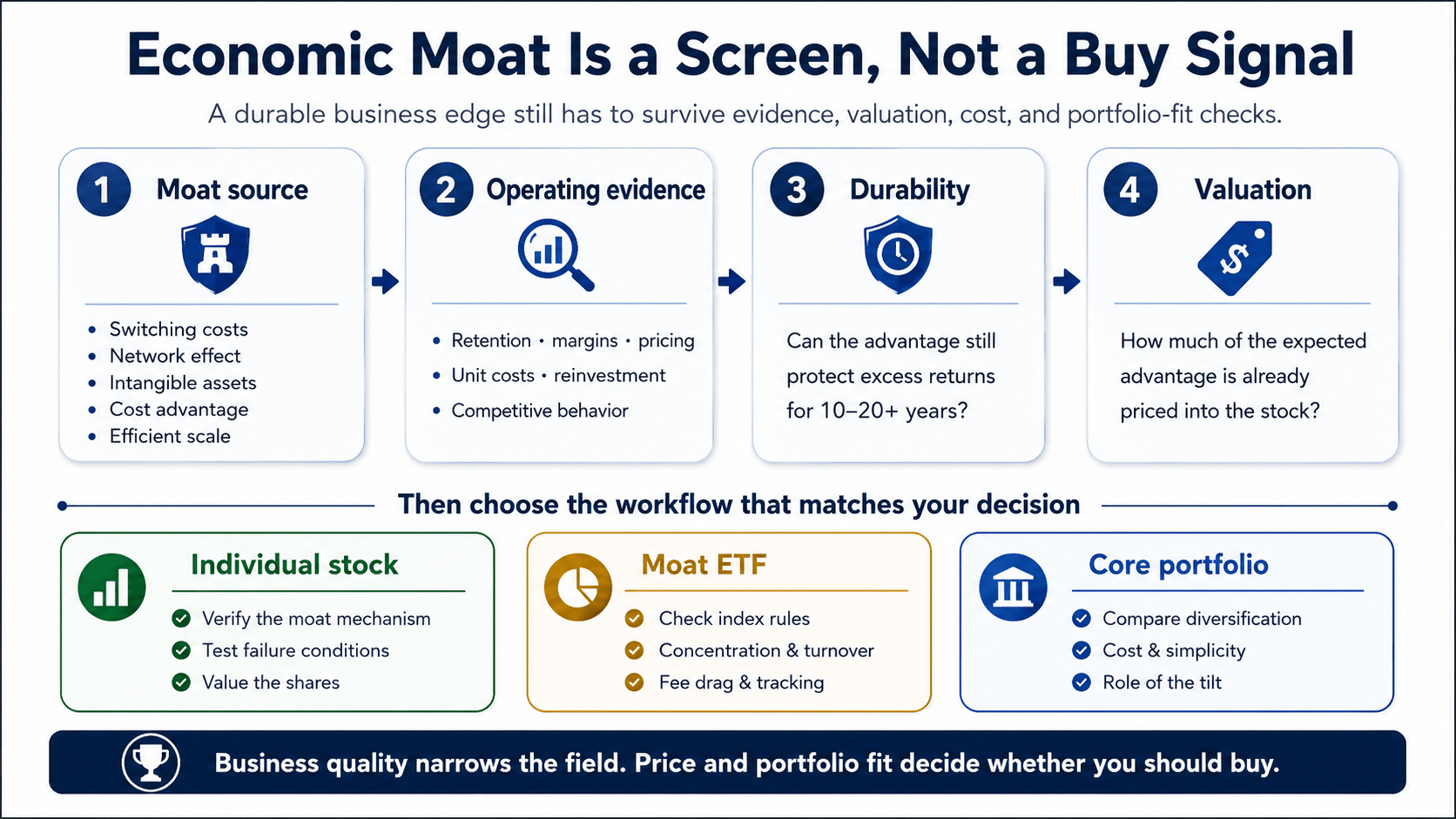
The next decision is a four-gate test that brings price discipline back to the moat screen.

Gate 1: Is the Moat Rating Wide?

Gate 1 confirms Morningstar’s rating is Wide, not Narrow or None. About 200 of 1,700 covered stocks earn the Wide tier at any time, anchored to 20-plus years of expected excess returns above cost of capital. Skip None-rated names entirely.

Gate 1 is the universe filter. The Wide tier represents roughly 12% of Morningstar’s covered universe at any given moment, and that scarcity is the point. A Narrow rating still implies a defensible 10-plus-year window, but the durability margin shrinks enough that Gate 2 has to do more work. None-rated names fail at the structural-durability boundary; no price discount compensates for that. Run this gate first because it is the cheapest filter to apply — one column, one comparison.

Step time: ~5 minutes per name on Morningstar Premium.

Gate 2: Is Price-to-Fair-Value at or Below 0.95?

Gate 2 requires Morningstar’s price-to-fair-value ratio at or below 0.95. The Wide Moat Focus Index applies this discipline systematically and produced a 2.51-point edge since 2007 inception versus the broad market. Without the gate, the wide-moat sleeve trailed the S&P 500.

This is the gate Alex skipped. The 0.95 threshold gives a 5% margin of safety against analyst-judgment error in fair-value estimation, which is roughly the standard deviation Morningstar discloses in its methodology document. Names trading at 1.10x or 1.20x fair value still earn the Wide rating; the rating is durability, not entry timing. The Focus Index applies this filter quarterly and rebalances accordingly, which is why the same wide-moat universe produces opposite outcomes between the two index versions.

Step time: ~5 minutes per name.

Is the Economic Moat Trend Stable or Expanding?

Gate 3 checks Morningstar’s moat trend column for Stable or Positive labels. A Negative trend signals competitive erosion that durability cannot offset, even at attractive prices. Pat Dorsey’s 2008 framework treats trend deterioration as a sell trigger separate from valuation.

The trend column gets ignored more often than the rating itself. A Wide rating with a Negative trend is a name whose 20-plus-year durability assumption is actively eroding — the rating reflects what was true at the last analyst review, not what is true at the rate of change. Reading the trend column alongside the rating column is what turns a static screen into a directional one. Earnings durability shows on the income statement first, often quarters before Morningstar revises the trend.

Step time: ~10 minutes per name (requires reviewing the most recent analyst note).

Gate 4: Does the Sleeve Fit Concentration Limits?

Gate 4 caps any wide-moat name at 5% of the equity sleeve and the moat-tilted block at 25% of total equity. Concentration risk compounds quickly at $85,000 sleeves; the four-gate filter strengthens, but does not replace, traditional position sizing rules.

The 5% per-name cap is the friction layer between Gate 1-3 enthusiasm and a sleeve that survives a single-name impairment. With fewer than 200 wide-moat names available, the temptation to stack 8-10% positions is structural. The 25% block cap on the moat-tilted allocation prevents the same factor exposure from quietly dominating the portfolio. Concentration caps belong inside an asset allocation strategy document, not as one-time decisions.

Step time: ~5 minutes total. Total four-gate review: about 25 minutes per name.

GATE 1
Is the moat rating Wide?
Skip Narrow and None entirely.
PASS

GATE 2
Is price-to-fair-value ≤ 0.95?
5% margin of safety required.
PASS

GATE 3
Is the moat trend Stable or Positive?
Negative trend = sell trigger.
PASS

GATE 4
Does the position fit limits?
≤5% per name; ≤25% moat block.
PASS

All four PASS: allocate per Gate 4 sizing. Any FAIL: add to watchlist; do not buy.

Four-gate test for wide-moat names: all gates must PASS before allocation. Source: TheFinSense original analysis, 2026. Total review time: ~25 minutes per name.

LIVE

Moat + Valuation Discipline Calculator

Two paths. Same moat universe. One price-discipline gate separating them.

$

$


yr


%


pp
Per Haggard 2024 Table 4 — wide-moat-only annual underperformance vs S&P 500

Gap over horizon

MOAT + VALUATION DISCIPLINE
With discipline (7.00%)

MOAT LABEL ONLY
Label-only drag (5.73%)

THAT GAP IS

Year With Discipline Label Only Gap

Wrapper drag is partly the expense ratio impact at work — VanEck MOAT‘s 0.46% expense ratio plus tracking variance accounts for the bulk of the −0.60pp drag versus the underlying Focus Index.

Download the 4-Gate Moat + Valuation Discipline Diagnostic Worksheet (PDF) — a printable one-pager covering all four gates plus the price-to-fair-value lookup table for the current Wide tier universe.

📚 Source: Morningstar Indexes (May 2025) Wide Moat Focus Index data · morningstar.com

Concentration caps belong inside an asset allocation strategy that runs underneath the four-gate test, not parallel to it.

The 2.51-point Wide Moat Focus edge is since-inception data; valuation discipline can fail when the moat universe trades above fair value.

Adding a fair-value gate to the wide-moat screen could save Alex’s $85,000 sleeve $154,297 over 22 years.

The four-gate test, not the rating, decides the 2.51-point edge.

When Wide-Moat Exposure Underperforms

Wide-moat-only exposure has trailed the broad market in some rolling 10-year windows when the moat universe ran above its long-run price-to-fair-value average.

Visa (V), rated wide-moat by Morningstar, paired the rating with a 25% price-to-fair-value discount in mid-2022, producing excess return rather than label-only drag.

Treat the moat rating as a durability screen first; pair it with a fair-value rule before allocating capital — and apply a CEO red flag scorecard to the chair behind that fair-value gate.

Next time you see a wide-moat label on a screener, ask: at what price-to-fair-value does this rating still produce excess return?

This article re-runs when Morningstar updates the moat methodology. We will recheck if the Wide Moat Focus Index since-inception edge crosses +/-0.5pp from 2.51.

Investment Disclosure: This analysis is for educational and informational purposes only. It does not constitute investment advice, a recommendation to buy or sell any security, or an offer to provide investment advisory services. Past index performance data is sourced from primary academic and institutional publications; future results may differ materially. The case study (Alex Chen) is a hypothetical illustration and does not represent any actual investment outcome. Always consult a qualified financial advisor before making investment decisions.

Frequently Asked Questions About Economic Moats

What is an economic moat in investing?

An economic moat in investing is the durable competitive advantage that lets a company earn returns above its cost of capital for many years. Morningstar formalizes the concept across five sources: cost advantage, switching costs, intangible assets, network effects, and efficient scale. Wide-moat ratings imply 20-plus years of expected excess returns; narrow ratings imply 10-plus years.

What are the 5 sources of an economic moat?

The 5 sources of an economic moat are cost advantage, switching costs, intangible assets, network effects, and efficient scale. Cost advantage delivers durably lower per-unit production costs. Switching costs lock customers into a vendor where moving carries friction. Intangibles cover patents, brands, and licenses. Network effects scale value with each user. Efficient scale describes markets one or two players satisfy without attracting entrants.

Is economic moat the same as advantage?

Economic moat and competitive advantage overlap but are not identical. Competitive advantage describes any edge a company holds today, including ones that fade quickly. An economic moat refers specifically to advantages durable enough to defend excess returns above cost of capital for at least a decade. Morningstar’s rating system formalizes that durability requirement at 10-plus years for narrow moats and 20-plus years for wide moats.

Do wide-moat stocks beat the broad market?

Wide-moat stocks beat the broad market only when paired with valuation discipline. Per Haggard 2024 Table 4, the Morningstar Wide Moat PR USD index returned 13.55% over 10 years versus 14.82% for the S&P 500 TR USD — a 1.27-point annual gap against the broad market. The valuation-screened Wide Moat Focus Index returned 11.50% annualized since its October 2007 inception versus 8.99% for the broad U.S. market, producing a +2.51-point edge. The same wide-moat universe sits behind both numbers; the price-to-fair-value gate is the differentiator. Specify which moat exposure when answering this question — moat-rating column alone has trailed; moat plus price discipline has led. The gate is the alpha, not the label.

What does valuation change in moat strategy?

Valuation changes everything about an economic moat strategy. Adding a price-to-fair-value rule turns the same Wide Moat universe from a 1.27-point market-trailing screen into a 2.51-point market-beating one. The rating classifies which companies can defend excess returns; valuation determines what price leaves any of those returns for the buyer. The PEG ratio inherits the same denominator-trust pattern in a different multiple.

Bottom Line: The Economic Moat Edge Belongs to Disciplined Buyers

A 3.78-point swing separates moat-only from moat-with-discipline.

That swing — the difference between Haggard’s −1.27pp moat-only result and Morningstar’s +2.51pp Focus Index since-inception edge — is what the four-gate test recovers. The mechanism is the same in both cases: the wide-moat rating defines which companies can defend their returns over a 20-plus-year window. What changes is whether the screen attaches a price-to-fair-value rule before allocating capital. Haggard 2024 Table 4 documents the cost of skipping the gate; Morningstar’s Focus methodology documents the reward of attaching it. The economic moat label is the universe; the gate is the entry rule.

The same moat label produces opposite outcomes depending on whether price discipline is attached.

Open holdings today. Pull each wide-moat ETF. If no fair-value rule appears: your moat screen is half-blind.

A wide moat measures the years a company can earn excess returns; the price you pay determines whether you collect them.

The 2.51-point edge belongs to disciplined buyers. Without price the rating is a rope tied to nothing measurable beyond hope.

You measured the moat but skipped the price.

Next, why PEG inherits the same denominator-trust trap.

At 60, Alex saw the gate, not the label, on every wide-moat name.

Tie the knot only when the price holds.

YOUR TURN

Which gate are you missing on the wide-moat names you already own?

Update log
  • — Initial publish.
D

Danny Hwang

Lead Quant Analyst · TheFinSense · About · LinkedIn · Crunchbase

METHODOLOGY

22-yr LUMP_PLUS_CONTRIBUTION two-path FV model · monthly compounding · FIXED drag −1.27pp (Haggard 2024 Table 4)

REPRODUCIBILITY

All cells Python-verified · sources: Haggard PDF, Morningstar Indexes blog, Morningstar methodology

Published: · Editorial review: cross-validated against primary SEC filings and original academic sources.

Educational quantitative analysis based on published data. Not investment, tax, or legal advice. Consult a licensed professional before acting on any calculation. About TheFinSense.

author avatar
Danny Hwang Lead Quant Analyst
Danny Hwang is Lead Quant Analyst at TheFinSense, where he builds math-driven frameworks for individual investors. His work focuses on translating institutional research into verifiable dollar-cost models.