

📅 Last reviewed: · Data checked through: August 30, 2026 review of SEC Investor.gov, Betterment pricing updated June 18, 2026, Betterment TLH disclosure updated July 31, 2026, IRS Topic 409 and Pub. 550, Investor.gov transfer guidance, and peer-reviewed robo-advice and tax-loss-harvesting research.
Robo-advisor vs DIY comes down to one question: does the service fix a job you are likely to neglect or botch? A robo-advisor can help a hesitant beginner get invested, keep a portfolio on its target mix, rebalance on schedule, and handle taxable-account trades. DIY is often better when you can hold a simple ETF mix, automate deposits, and follow written rules. The fee is not waste by default, but it should buy more than a polished interface.
Robo-advisor vs DIY: which one fits you?
Start with the work each approach leaves on your desk. Both can hold diversified ETFs. What changes is who chooses the allocation, handles rebalancing, manages tax lots, and keeps the plan intact when markets get uncomfortable.
| Situation | Likely better fit | Reason |
|---|---|---|
| New investor who keeps delaying the first investment | Robo-advisor | Guided onboarding and automatic allocation can turn indecision into a working portfolio. |
| Taxable investor with multiple lots and meaningful realized gains | Depends | Tax-aware trading may help, but the value varies with tax rates, available losses, and the rest of the household portfolio. |
| IRA investor using broad index ETFs | DIY | Tax-loss harvesting does not apply inside the IRA, leaving allocation and rebalancing as the main jobs. |
| Investor comfortable following a written three-fund plan | DIY | The same broad market exposure can often be maintained without an ongoing advisory charge. |
| Investor who repeatedly panic-sells or chases recent winners | Robo-advisor; human adviser if coaching is the main need | Automation can keep rebalancing and routine trades on schedule, but it cannot stop you from selling or withdrawing. |
DIY only wins when it stays a system. A neglected account with no target mix, no rebalancing rule, and impulsive trades is not a fair low-cost option. An investment policy statement can supply much of the discipline people assume must come from an app.
What does the robo-advisor fee really cost?
A 0.25% management fee costs $25 a year on $10,000, $250 on $100,000, and $2,500 on $1 million before any discounts. The dollar fee rises with the account, and money paid out no longer earns future returns. That is the same compounding effect behind expense ratio impact.
The SEC shows the effect with a $100,000 portfolio growing at 4% for 20 years. Its July 2025 bulletin ends at about $208,000 with a 0.25% annual fee, $198,000 with a 0.50% fee, and $179,000 with a 1.00% fee. These are examples, not forecasts. The point is simple: recurring fees reduce both the balance and the future return that money could have earned.
Pricing also matters more at small balances when a platform uses a subscription fee. As a dated example, Betterment’s Digital plan disclosure updated June 18, 2026 says eligible households pay 0.25% annually when the balance is at least $24,000 or recurring deposits total at least $200 per month. Otherwise, the charge is $5 per month.
| Account balance | Annual dollar fee | Effective annual rate |
|---|---|---|
| $5,000 | $60 | 1.20% |
| $10,000 | $60 | 0.60% |
| $20,000 | $60 | 0.30% |
That flat-fee example is why robo-advisor vs DIY should be compared in both dollars and rates. It also belongs beside other brokerage hidden fees. A platform can still be worth the cost, but the fee should be judged against the work it performs for you.
What does the robo-advisor research actually show?
The Promises and Pitfalls of Robo-Advising, published in The Review of Financial Studies, looked at a robo service that adjusted portfolios to each investor’s existing holdings and stated choices. It found the biggest gains among people who had started with poor diversification.
The results were not the same for everyone. People who had started with concentrated portfolios later held more stocks and saw lower volatility and better returns. Those who were already well diversified held fewer stocks and saw a smaller drop in volatility, but they also traded more. The study also found less disposition effect, trend chasing, and rank-related bias after adoption.
Plain English
A robo-advisor can improve a messy portfolio without beating the market. Its best case is an investor who would otherwise concentrate, chase, delay, or keep changing the plan. Its weakest case is a steady index investor who already follows a simple allocation and rebalancing rule.
For robo-advisor vs DIY, the study supports paying for help when the starting portfolio or process is messy. It does not prove that a DIY investor who already follows a sound plan gains from another fee. The result depends on where the investor starts.
Can tax-loss harvesting offset robo-advisor fees?
It can help in a taxable account, but it is not a guaranteed rebate. Tax-loss harvesting realizes losses that can offset capital gains. If losses exceed gains, IRS Topic 409 allows up to $3,000 of excess net capital loss to reduce other income for the year, with the rest carried forward. The value depends on the gains, income, tax rates, and future tax bills the investor actually has.
The study Tax-Loss Harvesting: An Individual Investor’s Perspective found wide differences across investor profiles and market settings. Investor traits explained roughly 60% of the variation in modeled results. That is a strong warning against treating one marketed “tax alpha” number as a rule for everyone.
Tax reality: TLH does not create a tax deduction inside an IRA. In a taxable account, it depends on losses that are available to harvest and often defers tax instead of erasing it. Judge the result after fees and taxes, not from the feature label alone.
External accounts matter too. IRS Pub. 550 says a wash sale can occur when you or your spouse buys substantially identical stock within the wash-sale window, including a purchase in an IRA. Betterment’s TLH disclosure, updated July 31, 2026, says its system cannot avoid wash sales caused by trades in accounts held outside Betterment. The investor must monitor those accounts.
The number of losses available to harvest can also change as a portfolio ages. New deposits create lots close to their purchase price, while a long rising market can leave more holdings with gains. A robo-advisor may run the process more often than a DIY investor, but the tax value still has to beat the fee in that investor’s case.
Robo-advisor vs DIY: what happens over 20 years?
This model changes one variable: an added 0.25 percentage-point fee. Assume an investor starts with $100,000, adds $1,000 at the end of each month, and earns an 8.00% nominal annual rate before fees, divided by 12 for monthly compounding. Both paths use the same 0.03% fund cost. The only difference is the extra 0.25% fee on the robo path.
Robo-Advisor Fee Hurdle Calculator
Change the inputs to see how much extra ending wealth a robo-advisor would need to create to offset its advisory fee in this fixed-return model.
| Path | Gross return | Annual drag modeled | Net return used | Ending value |
|---|---|---|---|---|
| DIY ETF portfolio | 8.00% | 0.03% fund expenses | 7.97% | $1,076,582 |
| Robo-advisor portfolio | 8.00% | 0.03% fund expenses + 25 bps advisory fee | 7.72% | $1,034,959 |
| Modeled difference | Same market return | 0.25 percentage point | Fee only | $41,623 |
Method in brief: The model starts with $100,000, adds $1,000 at each month-end for 240 months, and divides each stated nominal annual rate by 12 to get the monthly rate. Both paths use the same 0.03% fund cost; the robo path alone adds a 0.25% fee. Taxes, changing returns, cash drag, and behavior or tax benefits are left out. The $41,623 result shows only the fee difference in this scenario; it does not predict either portfolio’s return.
The $41,623 difference is a model output, not a forecast. Actual results depend on returns, cash flows, product pricing, taxes, and investor behavior. The model treats the fee as a steady annual drag. Real platforms may calculate fees from daily balances and charge them monthly.
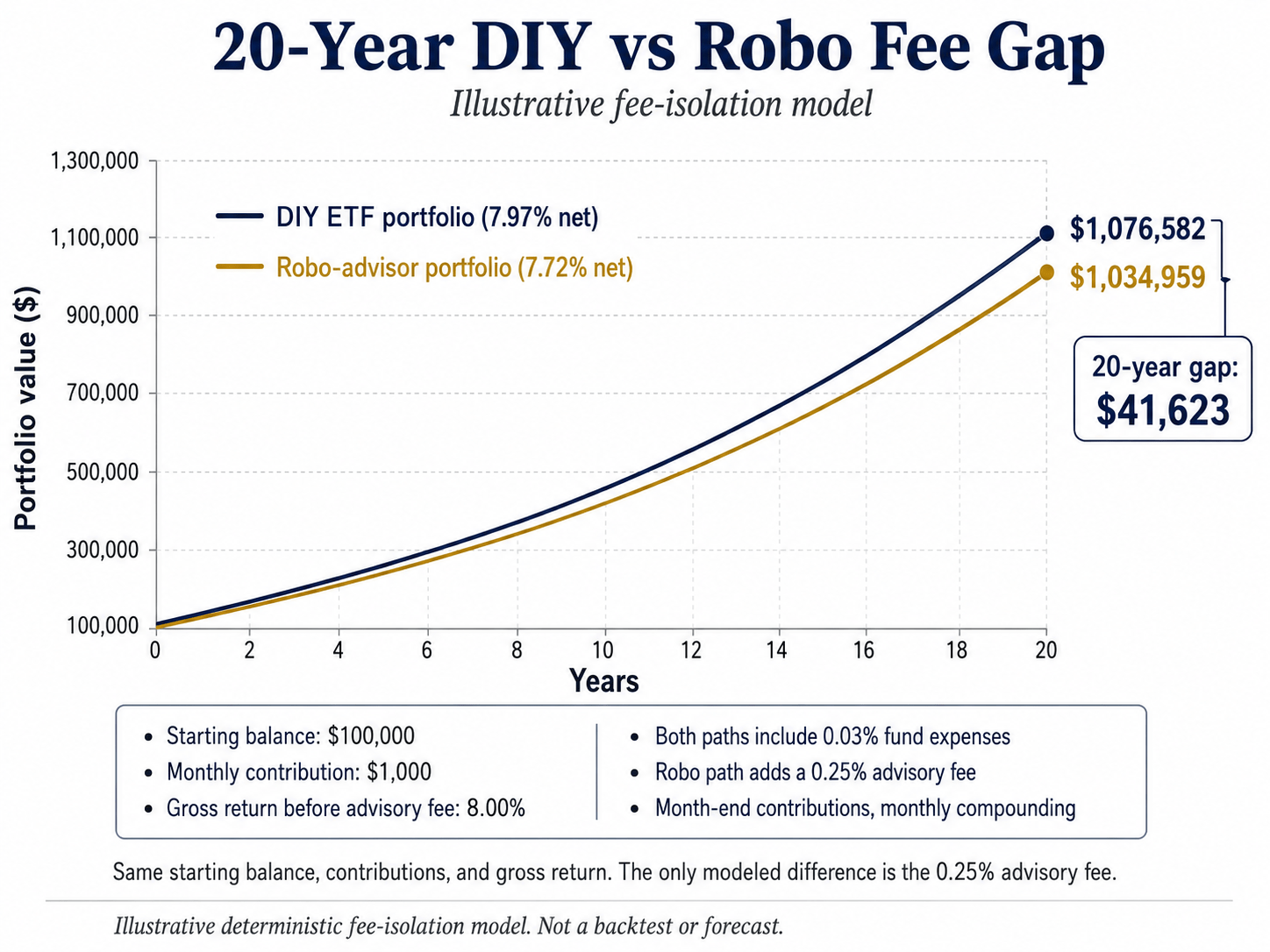
In this model, the robo path needs about $41,623 of added ending wealth from better behavior, tax management, or other benefits to finish even with DIY. For an investor who makes costly market-timing mistakes, behavior can matter more than the fee. For someone who already follows a low-cost plan, that hurdle is much harder to clear.
How can you switch to DIY without an avoidable tax bill?
Start with the receiving broker rather than selling everything. Investor.gov says a transfer usually starts when the customer gives a Transfer Instruction Form to the new firm. The new firm then sends the request through ACATS. An in-kind transfer can move eligible securities without a sale, though some holdings may not move intact.
- Save the records before the move. Download statements, holdings, cost basis, tax-lot details, and transaction history before you start. Save the target allocation with those records so you can compare the first statement at the new firm with the last statement from the old firm, as Investor.gov suggests.
- Ask which positions can move in kind. Check with both firms before you start. Betterment says ACATS can move whole shares, while leftover fractional shares are sold after a full transfer. Its fee page also lists a $75 outbound fee for each investing account. Other platforms use different rules and fees.
- Build the replacement plan before you trade. Write down the target mix, deposit schedule, rebalancing trigger, and tax-lot rule. A U.S. stock fund, international stock fund, and bond fund can be a simple starting point, but the mix should come from your asset allocation strategy rather than a copy of an app’s current weights.
- Replace each useful task the app handled. Set recurring deposits, automatic purchases where offered, dividend reinvestment, and a review date. Decide whether to rebalance on a calendar or only when a holding moves outside a set band. Lower fees do not make up for a process you stop following.
Before selling in a taxable account: estimate realized gains, identify the exact lots, and check whether an in-kind transfer is available. Small cash sales or fees can still occur during a transfer, so read the final statements instead of assuming the move was tax-neutral.
Frequently asked questions
Is a robo-advisor worth the fee?
A robo-advisor can be worth paying for when it gets you invested, keeps the portfolio on its target mix, runs rebalancing, or handles tax-aware trades. It can reduce the number of choices you have to make, but it cannot stop you from selling or withdrawing in a panic. It is less compelling when you already use a simple allocation, automate deposits, and follow written rules. Compare the fee with your real habits, not an ideal version of yourself.
Can I copy a robo-advisor portfolio myself?
You can usually recreate the broad asset exposure with low-cost stock and bond ETFs, but copying today’s percentages is only the first step. You also need a rule for future contributions, rebalancing, tax lots, and market stress. The portfolio is easy to imitate; the ongoing decision process is the part that determines whether DIY remains cheaper in practice.
Does tax-loss harvesting make a robo-advisor better than DIY?
Only for some taxable investors. The value depends on available losses, gains, tax rates, future gains, and activity in other accounts. It does not create a tax deduction inside an IRA. Outside accounts can also create wash sales that the platform may not see. Compare the after-tax benefit with the robo fee and any future tax created by a lower cost basis.
What is the biggest risk when switching to DIY?
The biggest risk is removing a working system without replacing it. Before the move, write down the target allocation, deposit schedule, rebalancing rule, and tax-lot approach. In a taxable account, also check which holdings can move in kind and which will be sold. DIY saves the fee only when the new process keeps working.
Bottom line: pay for the problem the automation fixes
In the robo-advisor vs DIY decision, pay for the tasks you are likely to neglect. A robo-advisor can get money invested, keep the mix on target, rebalance, and run tax-aware trades. Choose DIY when you can keep the same plan without changing course during stressed markets. The fee is worth paying only when the work it replaces is worth more than the fee.
Your decision: Which task would you actually pay to outsource: portfolio setup, rebalancing, tax-lot work, or simply having fewer decisions to make?
Write down the answer before comparing platforms. If the service does not solve that specific problem, the fee is probably buying convenience rather than a better investment process.
Sources, method, and evidence
- SEC / Investor.gov: The July 23, 2025 fee bulletin provides a six-figure, 4%, 20-year comparison at annual fees of 25 bps, 50 bps, and 1.00%. Source: How Fees and Expenses Affect Your Investment Portfolio.
- Betterment: Pricing checked against disclosures updated June 18, 2026. Digital pricing is 25 bps for qualifying balances or recurring deposits, otherwise $5 per month; outbound investing-account transfers carry a listed $75 fee. TLH limits were checked against Betterment’s disclosure updated July 31, 2026, including the external-account wash-sale limitation. Sources: fees, outbound ACATS guidance, and TLH disclosure.
- Investment robo-advice research: D’Acunto, Prabhala, and Rossi, The Promises and Pitfalls of Robo-Advising, The Review of Financial Studies 32(5), 2019. Source: Oxford Academic.
- Tax-loss harvesting: Khang, Paradise, and Dickson, Tax-Loss Harvesting: An Individual Investor’s Perspective, Financial Analysts Journal 77(4), 2021; IRS Topic 409 for the annual capital-loss deduction limit and carryforward; IRS Pub. 550 for wash-sale treatment involving substantially identical securities, a spouse, and IRA purchases. Sources: CFA Institute, IRS Topic 409, and IRS Pub. 550.
- Transfer process: Investor.gov explains that the receiving firm initiates the transfer and routes eligible assets through ACATS. Source: Transferring Your Brokerage Account.
Update history
- v1.5 2026-08-30 VISUAL + INTERACTIVE
Added the fee-hurdle calculator and a 20-year DIY-versus-robo fee-gap chart using the same fixed-input nominal-rate, monthly-compounding model.
- v1.3 2026-08-30 FACTUAL + STRUCTURE
Removed backtest-style framing from the SEO surface, tightened the 20-year fee interpretation, clarified the limits of robo behavior support, added current wash-sale and external-account TLH guidance, simplified the DIY switching steps, updated the About canonical link, and normalized the changelog markup.
- v1.2 2026-07-29 METHODOLOGY
Replaced deprecated internal link paths with current root-canonical URLs, clarified the nominal-rate convention used in the 20-year fee model, and added the required nearby and full methodology records.
- v1.1 2026-07-12 FACTUAL
Reverified the fee model; added dated Betterment pricing and transfer terms; clarified IRS capital-loss limits; strengthened the research and tax sections; and updated the comparison, switching checklist, sources, byline, and financial disclosure.