
📅 Originally Published: · Last Updated: · Data checked through: Betterment pricing and fee disclosures checked August 5, 2026; tax-loss-harvesting methodology updated August 4, 2026; SEC Investor.gov and IRS wash-sale guidance
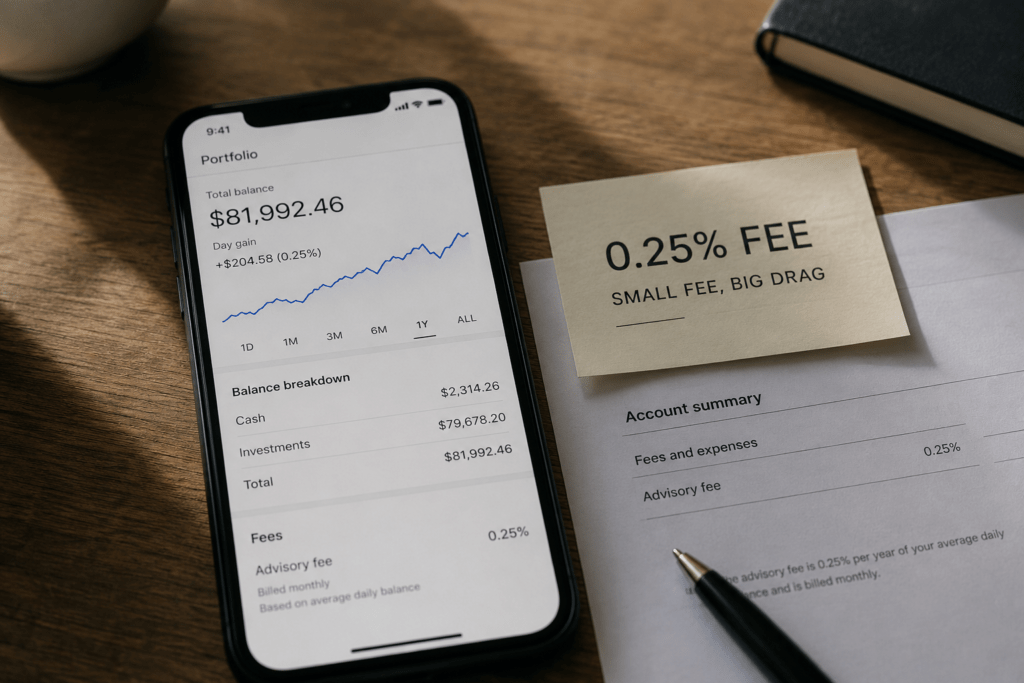
Answer first: The Betterment fee is not automatically cheap or automatically wasteful. For eligible Digital accounts, the current management fee is 0.25% per year; smaller balances that do not meet the recurring-deposit condition pay $5 per month instead. A quarter-percent fee can reduce long-run wealth by roughly six figures in a high-return, 30-year illustration, but the fair decision is whether Betterment’s automation, tax tools, and behavioral guardrails are worth more to you than the fee. This guide puts the fee in dollars and shows how to compare it with a self-directed account without pretending the services are identical.
Betterment fees honestly require two receipts: the dollar cost and the work the service performs. Looking only at the cost makes automation look pointless. Looking only at convenience hides a charge that compounds with the account.
A self-directed brokerage account can remove the management charge, but then you take over allocation, rebalancing, tax coordination, and the rules that keep you from changing course during a market decline. The decision is whether you can replace that system at lower cost and keep it working.
What Does the Betterment Fee Cost Jordan?
Jordan is 32, has $85,000 invested, adds $500 at the end of each month, and plans to invest for 33 more years. The portfolio earns a modeled 10% effective annual return before the management fee. The comparison holds the investments, deposits, and return assumption constant. The only difference is a 0.25 percentage-point annual fee modeled as a return drag.
This is not a forecast of Jordan’s retirement balance. A steady 10% return is unlikely, taxes are excluded, and real markets arrive in an uneven sequence. The model isolates how a recurring fee lowers compounding. It applies the fee as a 25-basis-point annual return reduction, while Betterment’s actual charge follows changing daily eligible balances.
| Year | No Management Fee | 0.25% Management Fee | Modeled Gap |
|---|---|---|---|
| 5 | $175,174 | $173,395 | $1,779 |
| 10 | $320,400 | $314,146 | $6,254 |
| 20 | $930,967 | $895,120 | $35,848 |
| 33 | $3,367,715 | $3,151,204 | $216,511 |
The first decade barely looks dramatic. The gap becomes large later because every fee deduction removes money that could have earned returns in subsequent years. By year 33, the modeled difference is $216,511.
Monthly deposits cannot be left out of this comparison. Each new contribution also pays the advisory fee and then loses the future growth that fee could have earned. The table includes the $85,000 starting balance and every $500 end-of-month deposit.
How Does the Betterment Fee Compound?
The cleanest base case starts with $100,000, no additional deposits, a 10% effective annual return, and a 30-year horizon. One path keeps the full 10%. The other earns 9.75% after subtracting the 0.25 percentage-point management fee.
Formula: Gap = P(1 + r)^t − P(1 + r − f)^t. Base case: P = $100,000 · r = 10% · f = 0.25% · t = 30 years. The fee path uses a 9.75% effective annual return.
Result: $1,744,940 without the Betterment fee versus $1,629,806 after the modeled fee, a difference of $115,134.
Scope: This fee-isolation model subtracts 0.25 percentage point from the assumed annual return. It excludes taxes, fund expenses, trading frictions, and service value. Betterment calculates fees from changing daily eligible balances and bills monthly, so actual invoices can differ.
That $115,134 is not the sum of the annual invoices. It includes the future growth those deducted dollars no longer earn. Measured against the model’s investment gains, the fee removes about 7.0% of the gains over 30 years.
The SEC uses the same mechanism in its fee bulletin. Its example starts with $100,000, assumes 4% annual growth for 20 years, and compares annual fees of 0.25%, 0.50%, and 1.00%. The SEC’s point is not that one return assumption is correct. It is that recurring fees reduce both the account balance and the amount left to compound. See the SEC Investor Bulletin on fees and expenses.
Betterment Fee Drag Calculator
Estimate the difference between a portfolio with no management fee and one paying the Betterment fee.
| Year | No Fee | After Fee | Gap |
|---|
The calculator is more useful than a single headline number because it lets you replace Jordan’s assumptions with your own. Lower balances, shorter horizons, and lower return assumptions reduce the dollar gap. Higher balances, regular deposits, and longer horizons increase it.
What Is Betterment’s True All-In Cost?
As checked August 5, 2026, Betterment’s Digital managed-investing pricing has two common paths. Accounts at or above $24,000, or accounts with at least $200 per month in qualifying recurring deposits, pay 0.25% annually. Smaller balances that do not meet the recurring-deposit condition pay $5 per month. Betterment calculates percentage fees from daily eligible balances and assesses them monthly. The current terms are on Betterment’s pricing page.
| Situation | Annual Charge | Effective Rate |
|---|---|---|
| $10,000, no qualifying recurring deposit | $60 | 0.60% |
| $20,000, no qualifying recurring deposit | $60 | 0.30% |
| $10,000 with $200+ monthly recurring deposit | About $25 on a flat balance | 0.25% |
| $100,000 eligible balance | About $250 on a flat balance | 0.25% |
Fund expenses sit on top of the management fee. Betterment states that, as of May 31, 2026, the weighted-average expense-ratio range for its Core portfolio was approximately 0.03% to 0.17%, depending on the stock-bond mix. That places the Core portfolio’s combined Betterment fee plus fund expense range around 0.28% to 0.42% for an account paying the 0.25% Digital fee. The dated fund-cost range is available in Betterment’s fund-fee disclosure.
IN PLAIN ENGLISH:
The ETF expense ratio is not a special Betterment penalty. You would still pay the fund’s internal expense if the same ETF moved to a self-directed brokerage account. The incremental Betterment cost is the Betterment fee, plus any portfolio-specific difference if you later choose different funds.
A Do-It-Yourself (DIY) account can have no advisory fee, but the ETFs inside it are not free unless they truly have a zero expense ratio. Compare the advisory charge separately from the fund expenses, then compare the actual funds you would hold in each account.
For a broader explanation of internal fund costs, see how expense ratios affect long-run returns. For the difference between a fund wrapper and an advisory service, see what an ETF actually is.
When Can the Betterment Fee Be Worth Paying?
Betterment fees explained only as compound drag would still leave the main decision unfinished. A fee can be worth paying when the service prevents a more expensive mistake or replaces work the investor will not perform reliably.
Automatic portfolio maintenance
Betterment selects an allocation, invests deposits, rebalances, reinvests distributions, and maintains the portfolio without requiring the investor to place each trade. A disciplined DIY investor can reproduce much of that with broad ETFs and written rules. An investor who repeatedly delays investing or changes the allocation during stress may not reproduce the same process.
That is why the fair comparison is not Betterment versus a perfect spreadsheet. It is Betterment versus the system you will actually maintain. A simple investment policy statement can make DIY more durable by fixing the target allocation, contribution schedule, and rebalancing rule before markets become emotional.
Tax-loss harvesting in taxable accounts
Tax-Loss Harvesting (TLH) can create value for some taxable investors, but it should not be treated as a guaranteed return bonus. Betterment’s methodology, updated August 4, 2026, says 69% of customers included in its 2022 and 2023 internal analysis had estimated tax savings that exceeded the Betterment fees charged on their taxable accounts. Betterment also explains that the value is mainly tax deferral, not permanent tax avoidance, and that outcomes depend on gains, tax rates, future liquidation, deposits, and holdings outside Betterment.
That statistic is company-generated, covers a defined historical customer group, and does not prove that tax-loss harvesting will cover your fee. It also has no value inside an IRA because losses inside the IRA are not claimed on your individual tax return. Read Betterment’s tax-loss harvesting methodology and compare the likely benefit with your actual taxable gains and tax bracket.
Behavioral guardrails
A poorly timed exit can cost more than one year of a 0.25% advisory fee, but this article does not estimate that behavioral cost or claim that Betterment prevents it. Behavior still belongs in the decision. If automation helps you follow a plan that you would otherwise abandon, the fee may be buying a useful guardrail.
PRO TIP: Before canceling a managed service, write down the replacement process. Name the funds, target percentages, monthly deposit rule, rebalancing trigger, and the conditions under which you are allowed to sell. Removing the fee without replacing the system is not a complete plan.
How Can You Transfer Without Avoidable Surprises?
An Automated Customer Account Transfer Service (ACATS) transfer can remove the ongoing advisory fee, but it is not always as simple as moving every position unchanged. Betterment’s current outbound process has several details that matter.
| Item | Current Betterment Disclosure | Why It Matters |
|---|---|---|
| Who starts the transfer? | The receiving firm initiates it | Use the new broker’s transfer workflow and your Betterment statement |
| Typical timing | 5 to 7 business days after Betterment approval | The account is locked during the transfer |
| Betterment fee | $75 for each investing account transferred | Multiple legal accounts can create multiple charges |
| Whole shares | Eligible shares can transfer through ACATS | An in-kind transfer generally avoids selling those whole shares |
| Fractional shares | Liquidated and sent as cash after a full transfer | A taxable account may realize a gain or loss on the liquidation |
| Cost basis | Sent within 15 days after completion | Verify every tax lot after it arrives |
Betterment says the receiving firm should initiate the request, transfers usually take five to seven business days after approval, and fractional shares remaining after a full transfer are liquidated. Cost-basis information is sent within 15 days after completion. Review the current instructions on Betterment’s outbound transfer page.
An in-kind transfer of whole shares is generally different from a sale, but do not describe the entire process as automatically tax-free. Fractional-share liquidation, incompatible holdings, cash movements, and later portfolio changes can create tax consequences. Confirm what will move in kind before submitting the request.
What about wash sales?
The transfer itself does not require an arbitrary 31-day waiting period. The real issue is whether a security is sold for a loss and a substantially identical security is purchased within the wash-sale window, including purchases in another account. IRS Revenue Ruling 2008-5 confirms that a taxable loss can be disallowed when an IRA or Roth IRA buys substantially identical securities within 30 days before or after the taxable sale.
Before moving a taxable account with recent tax-loss-harvesting activity, download the transaction history, identify replacement securities, pause overlapping purchases in outside accounts when appropriate, and review the plan with a tax professional. For the broader harvesting strategy, see our tax-loss harvesting guide. For timing, IRA, and replacement-share mechanics, see our wash-sale rule guide and the IRS ruling on IRA-related wash sales.
Self-directed retail brokerage accounts at firms such as Fidelity and Schwab can have no account-opening or maintenance fee, but fund expenses and other service charges can still apply. Compare the receiving firm’s full fee schedule, cash treatment, fractional-share policy, and available investments before choosing it.
Should You Stay, Switch, or Simplify?
Start with the service you need rather than a slogan about low fees.
| Your Situation | Likely Best Next Step | Reason |
|---|---|---|
| You automate deposits, never rebalance, and tend to change plans in falling markets | Stay for now and measure the service value | The guardrails may be worth more than the fee |
| You have a taxable account, meaningful gains, and can use TLH losses | Compare estimated tax value with actual fees | TLH can help, but the benefit is investor-specific and partly deferred |
| You hold a simple allocation, follow written rules, and can rebalance without improvising | Consider a self-directed transfer | You may be able to remove the management fee without removing discipline |
| Your balance is below $24,000 and you do not meet the recurring-deposit condition | Audit the $5 monthly effective rate first | The percentage cost can be materially higher than 0.25% |
| You want advice from a person, not only automated management | Compare Premium and outside advice separately | Premium currently uses a different service bundle and fee schedule |
Run the calculator with your balance and horizon. Then list the tasks you would inherit after leaving. If the dollar cost is high and the replacement process is already written, switching may be reasonable. If the managed system is the only thing keeping the portfolio consistent, remove the fee only after you have built a substitute.
The same logic applies to the broader robo-advisor versus DIY decision. The portfolio is often easy to copy. The maintenance process is where the real comparison lives.
Frequently Asked Questions
What are Betterment’s current Digital fees?
As checked August 5, 2026, managed investing generally costs $5 per month for balances below $24,000 that do not have at least $200 per month in qualifying recurring deposits. Eligible balances at or above $24,000, and smaller accounts meeting the recurring-deposit condition, pay 0.25% annually. Fees are calculated from daily eligible balances and assessed monthly. High-balance discounts and Premium pricing use separate tiers.
Are ETF expense ratios included in the 0.25% fee?
No. Betterment’s management fee and the funds’ expense ratios are separate. Betterment reported a weighted-average Core portfolio expense-ratio range of roughly 0.03% to 0.17% as of May 31, 2026. Those fund expenses reduce ETF returns whether the fund sits at Betterment or in a self-directed account.
Does Betterment show fees in dollars?
Yes. Betterment’s fee page, checked August 5, 2026, says customers can open Activity, filter by Fees for a chosen period, and download a CSV to total the charges. The platform does not provide your future compound-opportunity-cost estimate because that requires assumptions about returns, deposits, and time.
Does tax-loss harvesting automatically pay for the fee?
No. Betterment’s internal 2022 and 2023 analysis found estimated tax savings exceeded taxable-account fees for 69% of included customers, but that is not a universal or guaranteed result. The value depends on usable gains or income offsets, tax rates, future liquidation, deposits, outside holdings, and whether the account is taxable. Much of the benefit is tax deferral rather than permanent tax avoidance.
Will an ACATS transfer create a taxable event?
Whole eligible shares transferred in kind are not sold merely because they move between brokers. Betterment states that fractional shares remaining after a full ACATS transfer are liquidated and sent as cash, which can realize gains or losses in a taxable account. Incompatible positions or later portfolio changes can also require sales, so confirm the transfer inventory before submitting the request.
How long does a Betterment transfer take and what does it cost?
Betterment says outbound ACATS transfers typically take five to seven business days after approval and cost $75 for each investing account transferred. The account is locked during the transfer. Cost-basis information is generally sent to the receiving firm within 15 days after completion.
Betterment Fees Explained: The Bottom Line
The Betterment fee is small enough to ignore in a single month and large enough to matter over decades. In the $100,000 lump-sum return-drag illustration, it creates a $115,134 difference after 30 years. In Jordan’s monthly-contribution case, the modeled gap reaches $216,511 after 33 years.
Neither number proves that Betterment is a bad service. They show the price of the service under stated assumptions. The decision turns on whether automation, rebalancing, tax coordination, and behavioral friction solve a problem you would otherwise leave unsolved.
Keep the service when its automation solves a problem you are unlikely to manage well alone. Move to a lower-cost setup when the replacement process is already clear, documented, and realistic for you.
Your fee audit: What job is Betterment performing that you would have to replace?
Write down your annual fee in dollars, the tasks you would inherit, and the rule that would keep you from changing the portfolio during the next bear market. That three-line answer is more useful than deciding from 0.25% alone.
Sources, method, and evidence
- Betterment pricing: Digital managed investing currently uses a $5 monthly base price, with 0.25% annual pricing available when eligible balances reach $24,000 or qualifying recurring deposits total at least $200 per month. Checked August 5, 2026.
- Betterment fund expenses: The Core portfolio’s weighted-average expense-ratio range was approximately 0.03% to 0.17% as of May 31, 2026. The figure is dated because portfolio holdings and fund fees can change.
- Betterment transfers: Outbound ACATS instructions state a $75 fee per investing account, typical processing of five to seven business days after approval, liquidation of residual fractional shares, and cost-basis transmission within 15 days after completion.
- SEC fee evidence: Investor.gov’s July 23, 2025 bulletin demonstrates how ongoing percentage fees reduce the amount left to compound and lists the disclosures investors should review.
- Tax evidence: Betterment’s tax-loss-harvesting methodology, updated August 4, 2026, is treated as company-generated evidence, not a guaranteed return. IRS Revenue Ruling 2008-5 supports the cross-account wash-sale warning involving taxable sales and IRA purchases.
- Calculation method: The $100,000 base case uses annual effective compounding. Jordan’s case converts 10.00% and 9.75% effective annual returns to equivalent monthly rates and assumes $500 deposits at month-end. The calculation treats the fee as an annual return reduction rather than reconstructing Betterment’s daily billing path. All displayed outputs were independently recomputed and rounded to the nearest dollar.
Update history
- v2.1 2026-08-05 METHOD AND FRESHNESS PATCH
Clarified how the fee-drag model differs from Betterment’s daily balance-based billing and refreshed the pricing, transfer, and tax-loss-harvesting evidence.
- v2.0 2026-07-13 MAJOR CORRECTION
Corrected Jordan’s missing monthly contributions; updated Betterment’s $5, $24,000, and $200 pricing thresholds; dated the Core fund-cost range; removed unsupported AUM, revenue, childcare, and anti-platform claims; corrected ACATS, fractional-share, cost-basis, TLH, and wash-sale guidance. It also added a compatible fee-drag calculator and rebuilt the article around a case-led decision framework.
- v1.0 2026-03-25 PUBLISH
Original publication.