


📅 Originally Published: · Last Updated:
Answer first: check three brokerage account settings first: where idle cash goes, what happens to dividends on long-term holdings, and which tax lots a partial taxable sale will use. Start with the setting tied to money already moving through your account. Do not add the three examples into one universal cost because they measure different things.
Investors usually compare funds before they inspect the account holding them. That leaves a blind spot. A low-cost ETF can still sit beside idle cash earning almost nothing. Dividends can pile up in cash, and a partial taxable sale can use lots the investor never meant to sell.
These brokerage account settings do not deserve equal attention in every account. Someone with no idle cash has little reason to obsess over sweep rates. A retiree using dividends for expenses may have no reason to turn on automatic reinvestment. A person selling part of a taxable position, however, should inspect the actual lots before placing the order.
Start with the branch that matches what your account is doing now, fix that setting, and document the choice in your investment policy statement.
Which Brokerage Setting Should You Check First?
When reviewing brokerage account settings, use the account event rather than a generic checklist to decide where to begin.
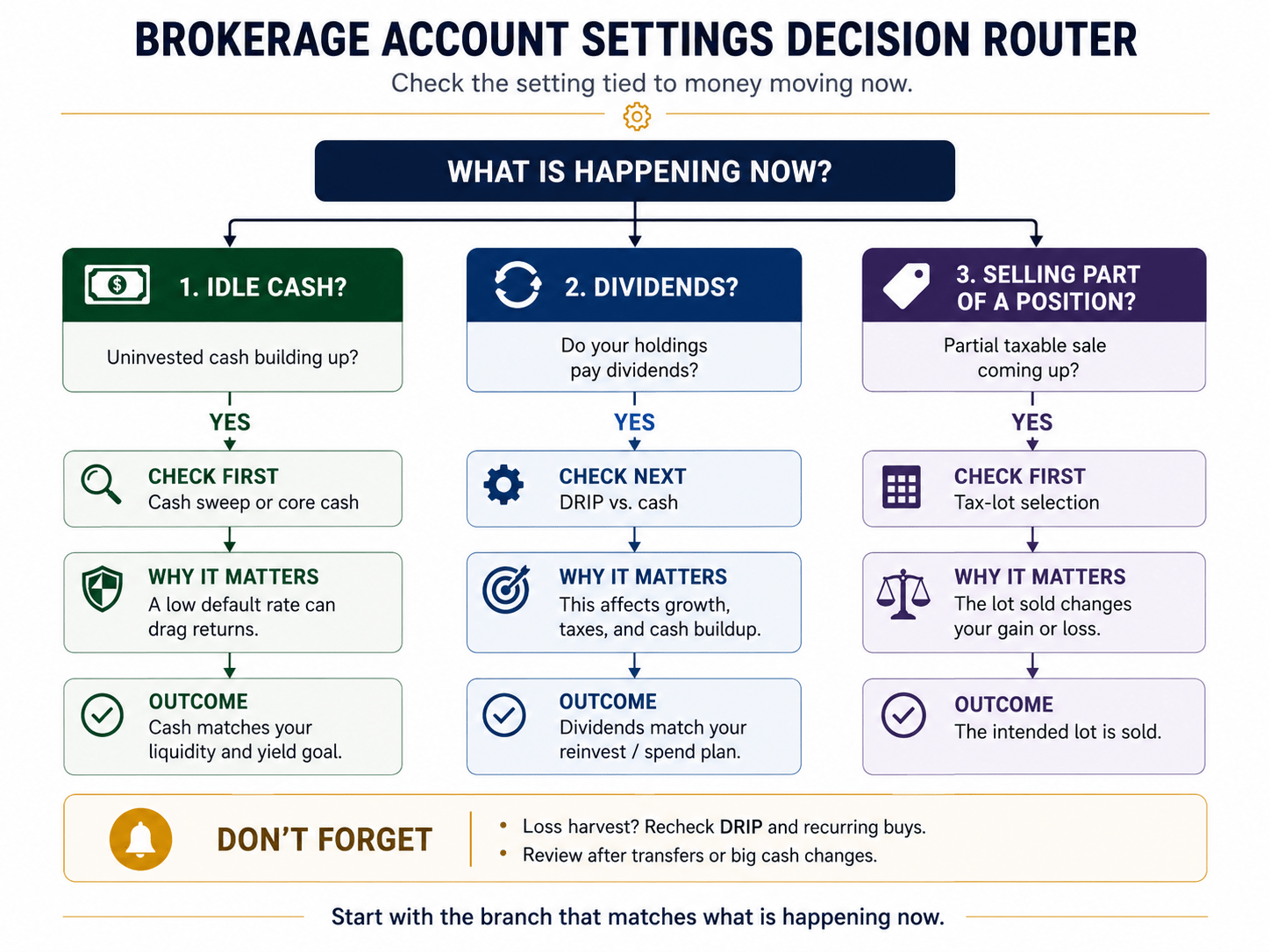
| What is happening in your account? | First setting to inspect | What you are trying to prevent | Related guide |
|---|---|---|---|
| A meaningful cash balance sits uninvested | Cash sweep or core position | Accepting a low displayed rate without comparing alternatives | Brokerage sweep account rates |
| Long-term growth holdings distribute cash | Dividend election for each holding | Accidental cash buildup when the plan was reinvestment | Dividend tax drag |
| You are about to sell part of a taxable position | Tax-lot selection on the trade ticket | Realizing a different gain or loss than intended | FIFO vs specific identification |
| You use dividends for spending | Cash distribution | Reinvesting money that was meant to fund expenses | Dividend tax drag |
| The assets are inside an IRA or 401(k) | Cash and dividend settings first | Spending time on taxable-lot mechanics that may not apply inside the account | Roth vs traditional IRA |
Brokerage account settings tell the broker where idle cash goes, whether dividends buy more shares, and which shares count as sold. They sit beside your asset allocation; they do not replace it.
Do not switch just because one page shows a higher rate. Check protection, access to cash, trading rules, taxes, fees, fund risk, and what the money is for.
Where Is Your Idle Cash Going?
The cash setting is the easiest one to measure. Cash enters after a deposit, dividend, interest payment, or sale, and the broker then follows its sweep or core rules. The SEC says firms may use money market fund sweeps, bank sweeps, or a free credit balance. What the cash earns and how it is protected can differ. SEC Investor Bulletin on cash sweep programs
A dated Schwab example shows the gap. When this article was checked on August 28, 2026, Schwab’s cash page showed 0.01% APY for uninvested brokerage cash. Schwab Asset Management showed SWVXX at a 3.52% 7-day yield as of August 27, 2026. APY and 7-day yield are different measures, so this is an illustration rather than an exact spread. It still shows why the cash destination deserves a check. Schwab cash investments · SWVXX fund page
About $176
A first-year illustration on $5,000, using the displayed 3.52% and 0.01% annualized rates: $5,000 × (0.0352 − 0.0001) = $175.50. This is a dated comparison, not a guaranteed annual return.
The math is transparent but limited. Both rates can change, and a money market fund may need a manual buy instead of an automatic sweep. It can also settle differently or carry different protection.
Coverage differs. A bank sweep may qualify for FDIC insurance through program banks, subject to the program’s rules and limits. A money market mutual fund is a security, not an FDIC-insured deposit. SIPC protection can cover missing cash or securities if a member broker fails; it does not cover market losses.
So do not ask only “Which yield is higher?” Ask where the cash sits, whether you can trade with it right away, what protection applies, whether a minimum or fee exists, and when you need the money. The guide to zero-commission broker hidden fees covers other costs that can sit behind a $0 trade ticket.
Should Your Dividends Reinvest Automatically?
A dividend choice often works one holding at a time. One ETF may reinvest while another pays cash. That makes a blanket assumption risky, especially after an account transfer or platform move.
For a growth holding, DRIP can keep the plan running without another decision. For an income holding, cash may be exactly what you want. The setting becomes a problem only when it conflicts with the job of the holding.
| Illustrative dividend path | Assumption | Value after 20 years |
|---|---|---|
| Dividends remain as non-earning cash | $1,000 paid at each year-end | $20,000 |
| Dividends are reinvested | $1,000 at each year-end, 6% annual return | $36,786 |
| Illustrative difference | Same distributions, different treatment | $16,786 |
This model does not say DRIP gives you a free $16,786. It assumes every $1,000 payment stays invested and the new shares earn 6% a year. Spend the cash, use it to rebalance, or invest it elsewhere, and the result changes.
In a taxable account, reinvesting a dividend usually adds basis to the new shares, but the dividend can still be taxable income. Keep the records because each DRIP buy can create another tax lot. IRS Publication 550
If you harvest a loss, also check DRIP and recurring buys. Buying the same or substantially identical security during the wash-sale window can change how the loss is treated. An unattended DRIP can therefore matter even when the sale ticket is right. Wash-sale rule
When cash is better: leave dividends in cash when they fund living costs, near-term spending, or a planned rebalance. Use DRIP when buying more shares fits the job of that holding.
Which Tax Lots Will Your Broker Sell?
Tax-lot choice matters most when you sell only part of a position in a taxable account. Shares bought on different dates can have different bases and holding periods. The same sale can report a different gain or loss depending on which shares count as sold.
IRS Publication 550 lets you use the basis of specific shares if you tell the broker which shares you are selling and receive written confirmation. The federal rule says to identify the shares by the earlier of the settlement date or the deadline under SEC Rule 15c6-1. A standing order for specific lots can also count as identification. If you do not identify the shares, FIFO usually applies. An allowed average-basis method can be an exception for qualifying mutual fund and DRIP shares. IRS Publication 550 · 26 CFR §1.1012-1
| Sale of 100 shares at $120 | Basis per share | Total basis | Realized gain |
|---|---|---|---|
| Older low-basis lot | $50 | $5,000 | $7,000 |
| Newer high-basis lot | $100 | $10,000 | $2,000 |
| Difference in current realized gain | Not applicable | $5,000 | $5,000 |
Specific identification gives you control, but “sell the highest-basis lot” is not a rule for every case. You may want a loss lot for harvesting, a long-term lot instead of a short-term lot, or a low-basis lot because you mean to realize gains. Gifts, estate plans, state taxes, and future sales can change the choice.
Before a partial taxable sale: open the lot screen, choose the shares, save the broker confirmation, and check the completed trade. A standing instruction for specific lots can meet the identification rule, but you should still check the actual order and keep the confirmation.
This branch connects directly to portfolio rebalancing strategy. Inside an IRA or qualified plan, trades usually do not create a current capital-gains bill, so tax-lot choice matters much less than it does in a taxable account.
Why Do Brokerage Defaults Stick?
Account settings feel passive because the account keeps working. Deposits settle, dividends arrive, and orders go through. The quiet part is that a platform rule has already picked the path.
The SEC tells investors to ask whether a cash-sweep default exists, what the cash earns, what other choices exist, and how protection changes. It also says to compare costs, risks, benefits, and fees. That does not mean every default is bad; it means the setting deserves a check. SEC cash sweep bulletin
In a 401(k) study, James Choi, David Laibson, Brigitte Madrian, and Andrew Metrick found that people often follow the “path of least resistance” and accept plan defaults. The study looked at employer plans, not retail broker menus, so it cannot tell us what a cash sweep or dividend setting costs. It does help explain why a preset choice can stay in place for years. NBER Working Paper 8655
The study supports the idea that people stick with defaults. It does not supply a dollar cost; that has to come from your own rate, cash balance, dividends, and trades.
What Do the Three Cost Examples Actually Show?
Do not add the three examples into one “wealth gap.” They cover different time spans and measure different things. Adding them would create a neat-looking number that no real account is promised to face.
| Setting | What is measured | Illustrative result | Main limitation |
|---|---|---|---|
| Cash destination | One year of displayed-rate difference on $5,000 | About $176 | Rates and cash balances change; the two displayed rate conventions are not identical |
| Dividend election | 20 years of $1,000 year-end payments, cash versus 6% reinvestment | About $16,786 | Return and distribution assumptions are hypothetical; cash may be spent or invested elsewhere |
| Tax-lot selection | Current realized gain on one hypothetical partial sale | $5,000 gain difference, or $750 at a hypothetical 15% rate | Usually a timing and lot-selection issue, not guaranteed permanent savings |
Method in brief: The cash example applies the dated Schwab figures above to a $5,000 balance. The DRIP example compounds $1,000 year-end payments for 20 years at an assumed 6%, while the cash benchmark earns nothing. The tax-lot example compares two 100-share lots under the same sale assumption and uses an assumed 15% tax rate only to show current tax timing. Fees, rate changes, other taxes, and future returns are left out; the three results measure different things and should not be combined.
Refresh the cash math from the broker’s current rate page. Rerun the dividend model with your own distributions and return assumption. For tax lots, there is no shortcut: use the shares you actually own.
The examples matter only when their inputs look like your account. Someone with $50 of idle cash and no taxable sales may gain almost nothing from this audit. A large partial sale with very different lot bases deserves much more care before you click “sell.”
Brokerage Account Settings FAQ
Does moving from a bank sweep to a money market fund remove FDIC insurance?
No. A money market mutual fund is not an FDIC-insured bank deposit. A bank sweep may get FDIC coverage through program banks, subject to the program’s rules and limits. SIPC can protect missing cash or securities when a member broker fails, but it does not cover market losses. Check the exact program, bank list, limits, access to cash, fund risk, and trade timing before switching only for yield.
Are brokerage cash defaults the same at every firm?
No. A firm may use a bank sweep, a money market core or settlement fund, another sweep, or a free credit balance. The choice can vary by account type, balance tier, or service model. Check the exact cash-position name or ticker on your statement and then check its current rate page. Recheck after an account transfer or platform change because the old cash choice may not carry over.
Does changing the default cost-basis method create a taxable event?
No. Changing the setting by itself usually does not sell shares. The tax result starts when shares are sold or otherwise disposed of in a taxable account. For specific identification, make sure the actual sale meets the share-identification rule; a standing instruction can qualify. Check the lot used on the completed trade and keep the broker confirmation. Use a tax professional if the account history or plan is complex.
Should every long-term investor turn on DRIP?
No. DRIP fits a holding meant to keep growing. Cash may fit better when dividends pay living costs, tax bills, near-term spending, or help with a rebalance. Reinvested dividends in a taxable account can still be taxable, and each buy can create another tax lot. Review the choice one holding at a time.
How often should I review brokerage account settings?
An annual review is fine for a stable account, but event-driven checks matter more. Check the cash setting after you open or transfer an account. Check the dividend choice after you buy a new income-paying holding, and check tax lots before a partial taxable sale. Recheck after a platform move or a notice that sweep terms changed. If a large cash balance will sit idle, compare rates then rather than waiting for the annual review.
A Practical Brokerage Settings Audit
Open the positions or balances page and write down the exact cash vehicle. Check its current rate and what protection applies. Then open the dividend settings and make sure each long-term holding sends cash where you want it.
For a taxable account, find the cost-basis menu before you need it. The key check comes right before a partial sale, when the broker’s default could pick a different lot from the one in your plan.
Once the brokerage account settings match the plan, leave them alone until the account or your needs change. Recheck after a transfer, a large cash buildup, a new dividend-paying holding, or before a partial taxable sale.
Download the Brokerage Account Settings Audit
Use the fillable checklist to record your cash vehicle, dividend election, and tax-lot instructions before your next review.
Download Audit PDFYour Turn
Check one screen now: the exact cash vehicle, the dividend election on your largest long-term holding, or the tax lots on the next taxable sale. Which setting was different from what you assumed?
- PrimarySEC Investor.gov, “Cash Sweep Programs for Uninvested Cash in Your Investment Accounts,” May 14, 2025: sweep types, default enrollment, rate differences, costs and risks, and FDIC/SIPC distinctions.
- IssuerCharles Schwab cash page checked August 28, 2026: 0.01% APY displayed for uninvested brokerage cash.
- IssuerSchwab Asset Management SWVXX page: 3.52% 7-day yield with waivers as of August 27, 2026.
- PrimaryIRS Publication 550: specific-share identification, written broker confirmation, FIFO when shares cannot be identified, average-basis rules for qualifying mutual fund and DRIP shares, and basis treatment for reinvested distributions.
- Primary26 CFR §1.1012-1: the timing rule for adequate identification and treatment of standing specific-identification instructions.
- ResearchChoi, Laibson, Madrian, and Metrick, NBER Working Paper 8655: default inertia in 401(k) plan design. Used only to explain behavior, not to estimate a brokerage-account dollar cost.
Update history
- v1.4 2026-08-30 READER TOOL
Added a visual guide and a fillable brokerage account settings audit worksheet to make the account review easier to follow and document.
- v1.3 2026-08-28 FACT CHECK
Refreshed the Schwab cash example to current issuer-displayed figures, clarified standing specific-identification instructions and average-basis exceptions, added the DRIP and wash-sale cross-check, and tightened the pre-sale routing and source notes.
- v1.2 2026-07-29 FACT CHECK
Refreshed the dated Schwab cash comparison to July 2026 figures, recalculated the illustration to about $174, clarified the SEC cash-sweep explanation, and improved the source and methodology notes.
- v1.1 2026-07-12 MAJOR UPDATE
Removed the combined $28,000 to $30,000 estimate because it added unlike cash, dividend, and tax-lot measures. Replaced it with three separate examples, clarified APY versus 7-day yield, limited the NBER inference to default behavior, and replaced the numerical chart with a settings screenshot.
- v1.0 2025-08-13 PUBLISH
Original publication.