
📅 Originally Published: · Last Reviewed: · Last Modified:
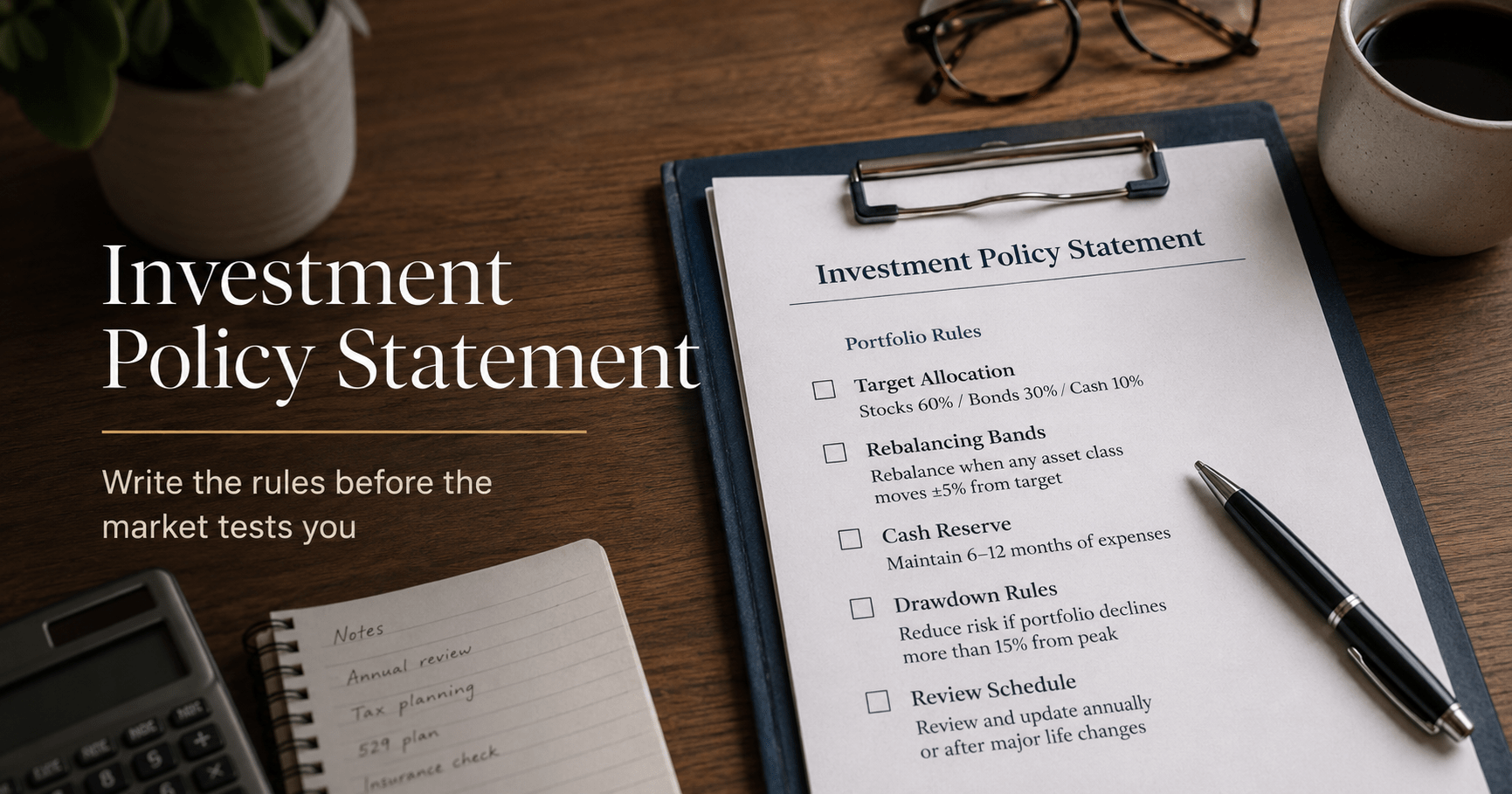
Answer first: an investment policy statement (IPS) is a written set of portfolio rules for allocation, rebalancing, cash needs, drawdowns, and review dates. It cannot guarantee higher returns. Its value is practical: it gives a frightened investor a pause before a short-term reaction replaces a long-term plan. The stress test below shows how a modeled return gap can compound over three decades. It is a scenario, not a promised IPS benefit.
Robin is a hypothetical investor who thought there was a portfolio plan: mostly global stock funds, a bond allocation, and enough cash for near-term needs. Robin understood diversification and intended not to panic, but none of the rules that would govern a stressful trade were written down.
When the portfolio dropped 18%, cash suddenly felt safer. Robin moved $22,000 from stock funds into a money market fund, waited three weeks, and bought back after prices had recovered. The trade was not catastrophic, which made it easy to excuse. A small mistake that feels harmless can be repeated until it becomes a habit.
An investment policy statement changes that moment. The question becomes less emotional and more concrete: did my goals, time horizon, liquidity needs, or risk capacity change? If the answer is no, the document tells me which action was already approved when the market was calm.
The Trade Robin Made Without Written Rules
Robin’s funds were not the problem. The missing piece was a decision standard.
A mental promise to “stay invested” still leaves four practical questions. How far may an asset class drift before rebalancing, and what counts as a real cash need? When may the target allocation change, and how long should a news-driven trade wait? If those answers are not written down, the market gets to ask them when the investor is least prepared to decide.
Suppose Robin’s IPS had said this:
IN PLAIN ENGLISH:
If the portfolio falls 15% or more, review the target allocation. Rebalance only when a written band is breached. Do not sell stock funds because of a market headline. Any discretionary allocation change waits 48 hours and requires a written reason.
That rule would not remove fear. It would force fear to compete with a document written under better conditions. Robin could still override it for a real cash need, a tax deadline, or a changed life plan. The IPS simply raises the standard for calling a bad week a new strategy.
The 30-Year Investment Policy Statement Stress Test
The model gives Robin a $150,000 starting portfolio and $1,000 of end-of-month contributions. The written-rule path uses a constant 7.00% nominal annual return; the behavior-drag path uses 5.50%, a 1.50-point gap. Both paths divide the nominal annual rate by 12 and compound monthly.
The 1.50-point input is the midpoint of Vanguard’s 2022 estimate that behavioral coaching may add 100 to 200 basis points in net return. That research is about advisor coaching, not the effect of writing an IPS alone. The midpoint is used only to test how a repeated return gap compounds.
| Year | Written-Rule Path | Behavior-Drag Path | Modeled Gap |
|---|---|---|---|
| Year 5 | $284,237 | $266,236 | $18,000 |
| Year 10 | $474,534 | $419,169 | $55,365 |
| Year 15 | $744,304 | $620,383 | $123,921 |
| Year 20 | $1,126,737 | $885,121 | $241,616 |
| Year 25 | $1,668,884 | $1,233,438 | $435,446 |
| Year 30 | $2,437,446 | $1,691,720 | $745,726 |
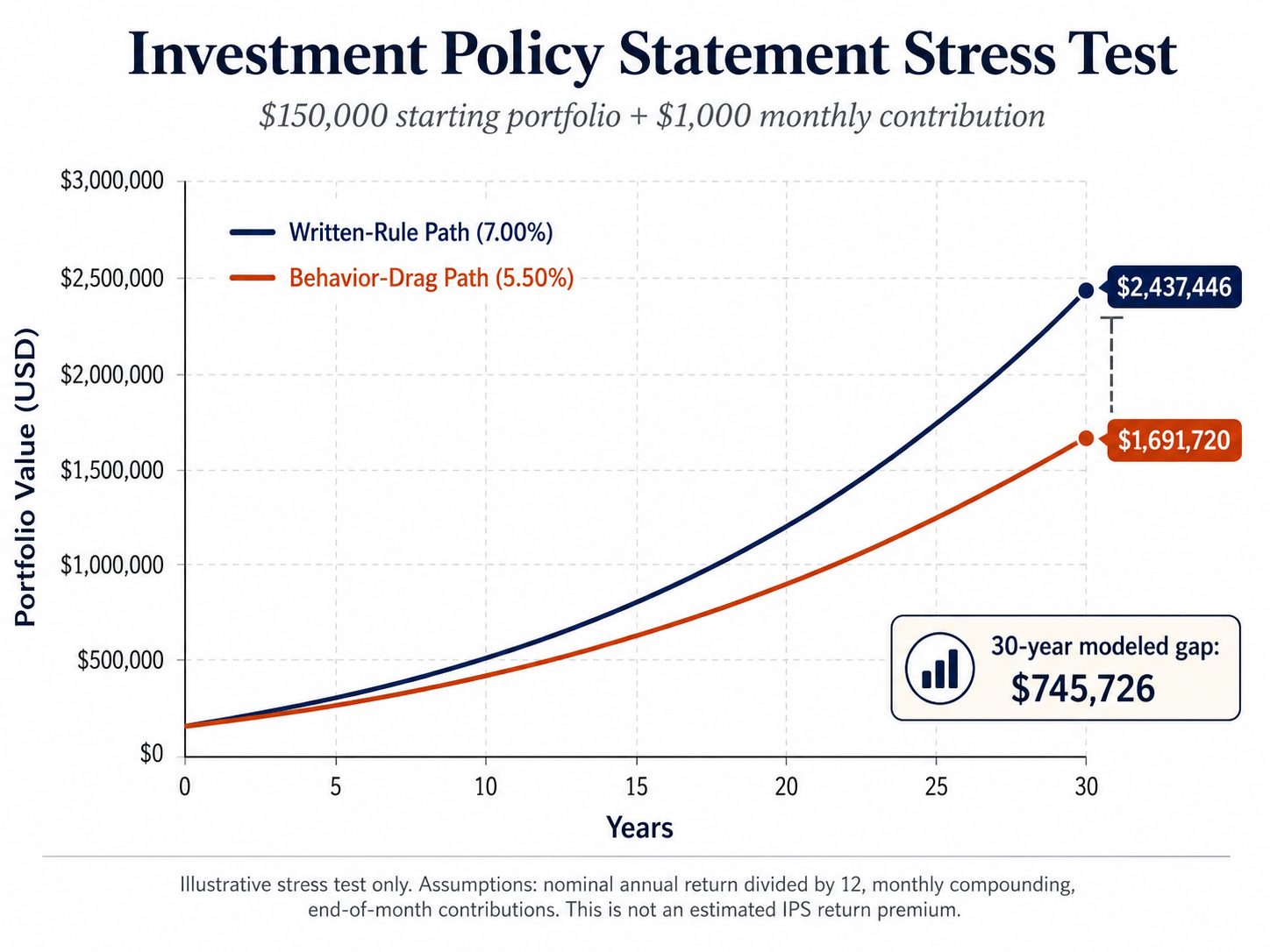
The exact result depends on the compounding convention. Treating 7.00% as an effective annual rate instead of a nominal annual rate would produce a smaller gap. That is why the headline and answer-first use rounded language while the table shows the exact output from the stated formula.
Does the conclusion survive a smaller assumption?
Yes, although the size changes a lot. The table below keeps the starting balance, contribution, 7.00% written-rule return, horizon, and monthly nominal compounding fixed. Only the annual return drag changes.
| Annual Drag | 30-Year Modeled Gap | How to Read It |
|---|---|---|
| 0.50% | $282,498 | A modest recurring gap still reaches six figures. |
| 1.00% | $529,544 | A one-point difference becomes a major planning cost. |
| 1.50% | $745,726 | Midpoint stress-test input from Vanguard’s coaching range. |
| 2.00% | $935,025 | A high-drag case, not a typical investor forecast. |
This does not establish that every investor without an investment policy statement loses 0.50%, 1.00%, or 1.50% each year. It shows why preventing even occasional behavior mistakes can matter over a long horizon.
What the Evidence Supports and What It Does Not
Vanguard’s 2022 Advisor’s Alpha paper supports two separate points. It says a sound plan begins with an investment policy statement that records objectives, allocation, contributions, spending needs, and time horizon. It also says behavioral coaching may add 100 to 200 basis points in net return.
Those points fit the same planning framework, but one does not prove the other. Vanguard did not test a one-page IPS against a no-IPS group. Advisor coaching also includes discipline, guidance, and help during hard markets, so the 1.50-point input cannot be treated as an IPS return estimate.
| Evidence | What It Supports | What It Cannot Prove Here |
|---|---|---|
| Vanguard Advisor’s Alpha, 2022 | A written IPS can anchor a sound plan; behavioral coaching may add 100 to 200 bps. | That writing an IPS by itself guarantees a 150 bps annual benefit. |
| Morningstar Gamma, 2013 | Structured retirement-income decisions can improve certainty-equivalent income under a model. | That an accumulation-stage IPS earns Gamma’s 1.59% return equivalent. |
| CFA Institute, 2010 | An IPS can guide an individual investor’s planning, review process, and actions during market disruption. | That a self-directed one-page IPS produces a fixed return premium. |
Morningstar’s Gamma paper sets another boundary. Its retiree model found a 22.6% gain in certainty-equivalent income and mapped that result to a 1.59% arithmetic return equivalent. The study deals with retirement withdrawals, not an investor who is still saving, so its result is not evidence for an IPS return premium.
The CFA Institute guide is a closer fit for this article. It describes an IPS as a strategic guide and says the document can give investors an objective course of action during market disruption. Its yearly-review wording comes from a sample policy, so once a year is a useful baseline, not a rule for every household.
Use the model correctly: start with a 0.50% drag, then test 1.00% and 1.50%. See whether the lower case is already large enough to justify writing rules before moving to the midpoint.
Five Practical Rules to Put in an Investment Policy Statement
A useful IPS should guide a trade and still be short enough to reread during a bad market week. Before the five rules below, state the portfolio goal, time horizon, and why the target fits your ability to bear risk. Then use the rules to govern what happens when markets or your life change.
| Decision | Weak Version | Written Rule |
|---|---|---|
| Target allocation | Keep the portfolio balanced. | Set percentages for stocks, bonds, and cash across the household portfolio. |
| Rebalancing | Check when the market feels unusual. | Schedule a routine review and rebalance when an asset class crosses a stated band. |
| Drawdown response | Try not to panic. | Review the plan after a major decline, but do not sell solely because prices fell. |
| Liquidity | Raise cash when the market looks risky. | Keep a separate emergency reserve and define which expenses may draw from investments. |
| Override process | Use judgment. | Write the reason, identify what changed, and wait 48 hours before a discretionary allocation change. |
1. Target allocation. Write the intended mix, not whatever the market has produced today. The target can cover the whole household while respecting limits in each account. A taxable brokerage account, 401(k), IRA, health savings account (HSA), and 529 plan may hold different assets but still serve one overall allocation. The asset allocation strategy should state the risk you chose before the portfolio starts drifting.
2. Rebalancing rule. Choose a calendar rule, a threshold rule, or both. One simple example is an annual review plus a 5-point band for major asset classes. The right band varies by portfolio. Taxes, trading costs, and account location matter, and new contributions can often rebalance the portfolio with less friction than selling. The separate portfolio rebalancing strategy explains how to carry out the trade.
3. Drawdown response. Define what happens after a large decline. The rule can require an allocation check, a cash-needs review, and a pause on news-driven sales. Also state what can justify a change, such as a shorter time horizon, lower ability to bear risk, a job loss, a major expense, or proof that the original allocation no longer fits.
4. Cash and liquidity. Write where emergency money sits and which expenses it covers. The right reserve depends on how steady income is, insurance, bills due soon, and household risk. Do not make the stock allocation double as an emergency fund. If bonds are part of the defensive side, the how bonds work guide explains the role they can play.
5. Review and override process. Set a routine review date, with annual review as a practical starting point, and list the life events that trigger an earlier review. Add a cooling-off period for discretionary allocation changes. The 48-hour rule is not meant to delay urgent liquidity, required distributions, tax deadlines, or fraud response. It is for the trade whose main justification is that the market suddenly feels unbearable.
How to Write an Investment Policy Statement in 45 Minutes
Skip the 12-page template and open a blank document. Answer the five prompts below; one page is enough for the first version.
Minutes 0 to 10: Define the money and the goal. List the accounts covered by the IPS, the primary goal, the time horizon, and any money that must be available within five years. Decide whether education assets, such as an overfunded 529 plan, belong inside the household allocation or follow a separate policy.
Minutes 10 to 20: Write the target and permitted range. Record the target percentages and the rebalancing bands. Name the fund categories or asset classes, not only ticker symbols, because tickers can change. The policy should survive a fund replacement without becoming obsolete.
Minutes 20 to 30: Write the bad-market instructions. Choose a drawdown threshold that triggers a review, then state what the review may and may not do. A practical line is: “A market decline alone does not authorize selling. Rebalancing follows the written bands unless goals, liquidity, horizon, or risk capacity changed.”
Minutes 30 to 40: Add cash, taxes, and account constraints. Record the emergency reserve, near-term spending, employer-plan limits, and tax-sensitive rules. Advanced actions such as tax-loss harvesting can live in a separate note so the core IPS stays readable.
Minutes 40 to 45: Sign, date, and schedule the review. Set the next review date, save the document somewhere visible, and share it with a spouse, partner, or advisor when useful. For this personal IPS, the signature is a commitment tool, not a claim that the document is a legal contract. It marks a decision made under calmer conditions for the next stressful market period.
Investment Policy Statement Gap Calculator
Use the calculator as a stress test, not a return forecast. The written-rule return and behavior drag are assumptions. The calculator divides each nominal annual rate by 12, compounds monthly, and adds contributions at month-end so its output matches the article tables.
IPS Gap Calculator
Estimate how a modeled return drag compounds against a written-rule portfolio path.
| Year | Written Rule | Modeled Drag | Gap |
|---|
Investment Policy Statement FAQ
What are five practical rules to include in a personal investment policy statement?
For this one-page version, use five practical rules: target allocation, rebalancing, drawdown response, cash and liquidity, and review or override rules. Before them, state the goal, time horizon, and why the allocation fits your ability to bear risk. Add tax, benchmark, permitted-investment, charity, or estate rules only when they matter to your situation.
Does an investment policy statement guarantee higher returns?
No. The article’s 1.50-point return difference is a stress-test input based on the midpoint of Vanguard’s coaching range. Vanguard studied advisor practices, not the return effect of writing an IPS alone. A written plan may help with panic selling and inconsistent rebalancing, but it cannot remove market risk or promise a fixed return gain.
Can an investment policy statement be only one page?
Yes. One page is often enough for a simple household portfolio. State which accounts the IPS covers, the goal and time horizon, target allocation, rebalancing bands, cash reserve, drawdown response, review date, and override process. Add extra pages only when taxes, concentrated stock, a business, trusts, charity, or several decision-makers create a real need.
How often should I review my investment policy statement?
Once a year is a practical review baseline for many investors. Review sooner after a major life change such as marriage, job loss, an inheritance, a home purchase, or a change in retirement timing. A market decline alone is a reason to read the IPS, not automatically rewrite it. Ask whether the goal, horizon, cash need, taxes, or ability to bear risk changed. If only prices and headlines changed, the original policy may still fit.
Should one IPS cover taxable and retirement accounts together?
Usually, set the household target across accounts, then keep tax and trade rules account-specific. A Roth IRA, traditional IRA, 401(k), HSA, taxable brokerage account, and 529 plan may hold different assets because their tax and withdrawal rules differ. The IPS can set the household target and note which actions apply only to certain accounts. Tax-loss harvesting, for example, belongs to taxable-account rules, not an IRA strategy.
Bottom Line
An investment policy statement will not make a risky portfolio safe or turn a poor allocation into a good one. Its job is narrower: preserve the logic of a suitable plan when the investor is under pressure.
Robin’s $22,000 trade looked small enough to dismiss, but repeated decisions of that kind can create a meaningful return gap. The long-horizon model shows how a recurring return difference compounds; it does not claim that writing an IPS causes that difference. Vanguard’s coaching estimate is only a bounded scenario input, not proof of guaranteed alpha from a one-page document.
Write the allocation, rebalancing bands, drawdown response, liquidity rule, and review process. Then keep the document where you will see it before the next urgent trade.
The rule written on a calm day deserves a hearing on the worst one.
Reader question
Which missing rule would help you most during the next sell-off: allocation, rebalancing, drawdown response, liquidity, or a cooling-off period?
Update history
-
v1.6
2026-08-26
RESOURCE UPDATEReplaced the printable resource with a spacious fillable Personal IPS Worksheet and finalized the publication-ready static stress-test chart. Asset URLs remain explicit placeholders until the files are uploaded to WordPress Media.
-
v1.5
2026-08-25
VISUALAdded a static 30-year divergence chart using the same monthly-compounding assumptions and values as the published stress-test table.
-
v1.4
2026-08-25
REMEDIATIONMigrated the bottom trust package to current components, tightened the scope of the five-rule framework, reduced micro-heading fragmentation, and rechecked the calculations and evidence boundaries.
-
v1.3
2026-07-28
SOURCE UPDATEReplaced a withdrawn Department of Labor bulletin with individual-investor guidance from CFA Institute, clarified annual review as a practical baseline, documented the Year 5 rounding difference, and converted internal links to full canonical URLs.
-
v1.2
2026-07-11
REBUILDRebuilt the article around a case-led walkthrough, clarified the evidence boundary, aligned the calculator’s monthly-compounding mode with the published tables, replaced the stale hero graphic, refreshed internal links, and rechecked sources and calculations.
-
v1.1
2026-04-05
REFRESHRefreshed the article and printable worksheet.
-
v1.0
2025-07-31
PUBLISHOriginal publication.