📅 Originally Published: · Last Updated:
Every 529 withdrawal screen carries the same posted sign. The number behind it stays hidden.
The Bottom Line, Up Front
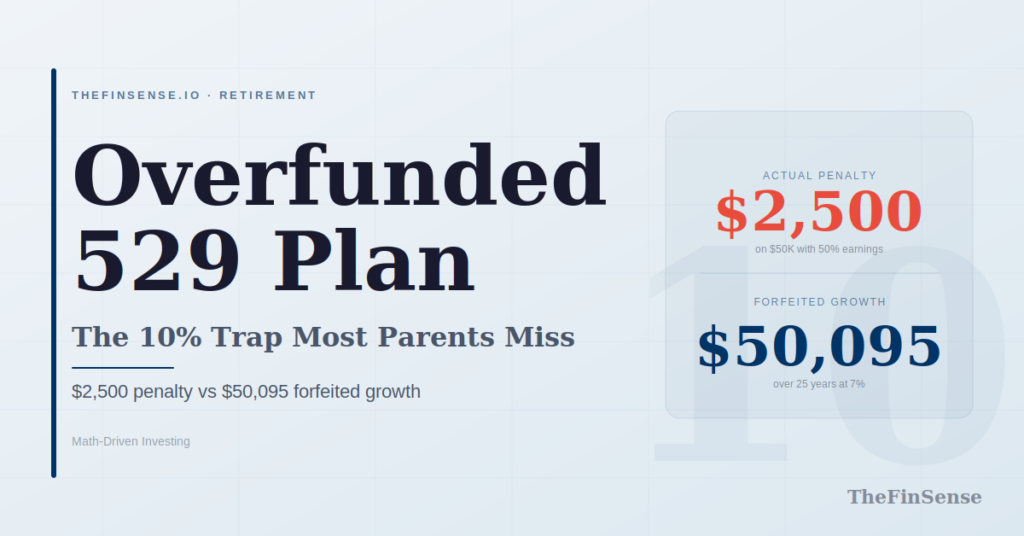
Most parents with an overfunded 529 plan see the 10% penalty and stop. The penalty on a $50,000 account with 50% earnings costs $2,500. Avoiding it by withdrawing to a taxable account forfeits $50,095 in tax-deferred growth over 25 years. The fear costs twenty times more than the toll.
An overfunded 529 plan sits in your account after your child graduates, and the withdrawal screen carries a 10% penalty label in red. That number stops conversations. SECURE 2.0 now permits $35,000 in penalty-free Roth IRA rollovers from these accounts, and the 2025 OBBBA raised qualified K-12 expenses to $20,000 per year. Two exit paths exist today that did not exist three years ago.
The penalty applies to earnings only, not the full balance.
On a $50,000 account with half in contributions, the actual cost is $2,500. The gap between keeping that overfunded 529 plan and withdrawing to a taxable account grows every year the money stays invested.
This analysis covers single-filer parents in the 22% federal bracket with $50,000 or less in excess 529 funds. Family plans, state clawback rules, and ACA subsidy interactions require separate calculations.
Why the 10% Penalty Scares Parents Away From an Overfunded 529 Plan
The penalty is real money, and a parent with a 5-year horizon or a bear market ahead has a legitimate reason to withdraw. Most parents with an overfunded 529 plan have 15, 20, or 25 years before they need the funds for retirement. The posted 10% on the withdrawal screen looks like a permanent barrier. For most of those parents, it is a speed bump on a highway they cannot see.
Inside a 529 account, the invested balance typically holds a mix of index funds and age-based ETF portfolios that compound without annual capital gains distributions.
The tax-deferred structure shields dividends and rebalancing gains from the 1.5% annual tax drag that the same investments would face inside a taxable brokerage account. That structural advantage accumulates quietly while the penalty label occupies the foreground.
Olivia S. Mitchell, Wharton School professor and NBER Research Associate, examined 529 plan allocation failures across 13.5 million accounts. Minjie Li, Wharton School doctoral researcher, co-designed the 2024 study with Hong Zhu. Their finding: $281 billion in 529 assets sat in suboptimally allocated plans in 2020. The annual cost to families reached $15.6 billion in expected losses (Li, Mitchell, and Zhu 2024).
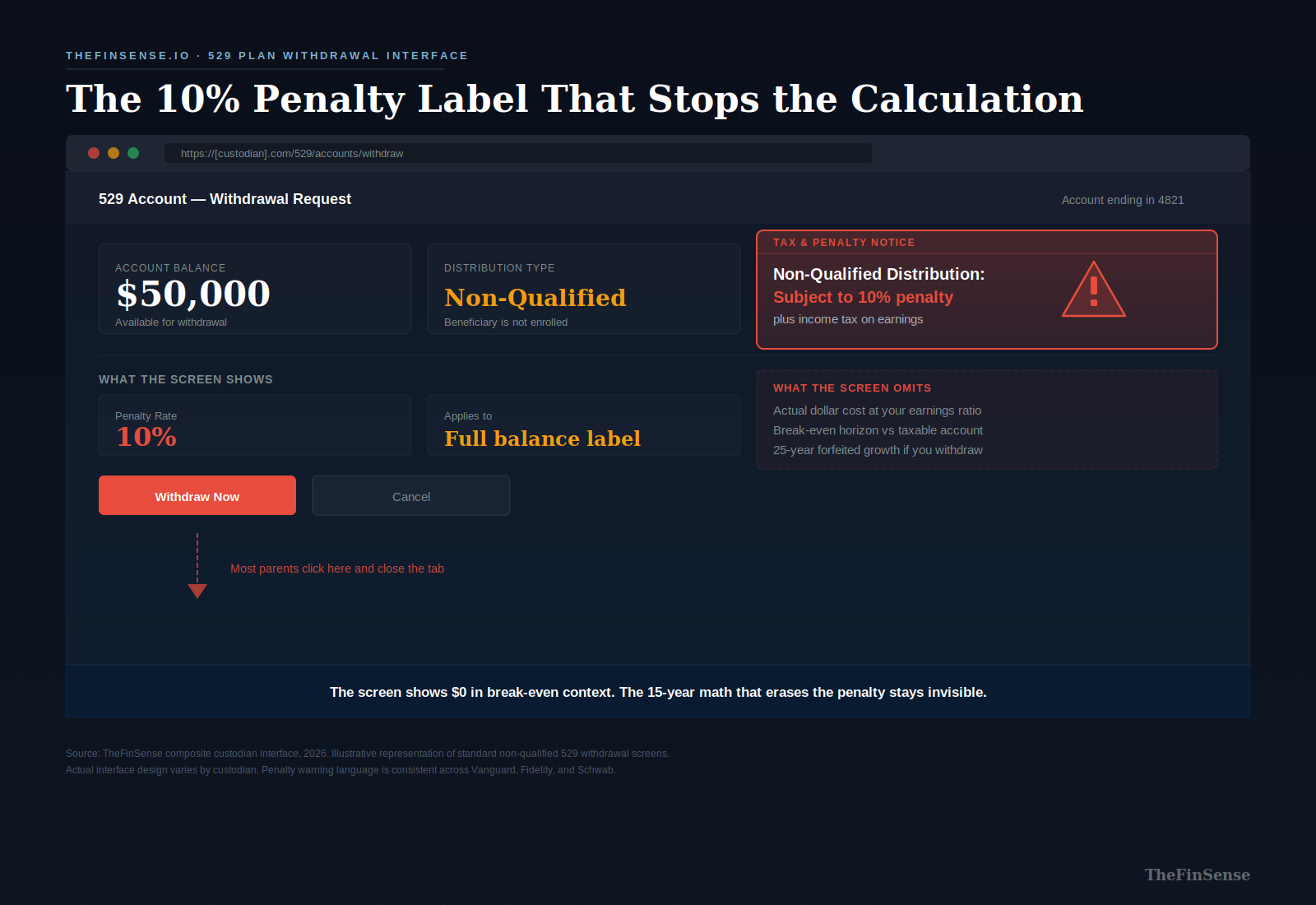
A parent logging in after graduation sees $50,000 remaining in the overfunded 529 plan. The withdrawal screen reads “Non-Qualified Distribution: Subject to 10% penalty plus income tax on earnings.” The parent closes the browser. The $50,000 stays frozen, not because the math favors withdrawal, but because the label stopped the calculation before it started.
A parent contributing $300 a month toward a newborn’s 529 faces the same question as a parent sitting on $200,000 after a scholarship surprise. Both watch the penalty line on the withdrawal screen. Both overestimate its weight. The parent who withdrew and reinvested in a taxable account did not make a catastrophic error; the gap narrows at lower balances and shorter horizons.
The penalty that scares parents off overfunding costs less than the plan selection errors they already made.
The 10% rate appears on every overfunded 529 plan withdrawal screen. The dollar amount it represents requires one piece of information the screen does not provide. How much does the penalty actually cost in dollars?
The Side-by-Side Comparison Wall Street Won’t Show You
The penalty applies to earnings only, not the full balance, and on a $50,000 account with 50% earnings, that number is $2,500. That distinction turns the 10% label into a 5% effective rate on an overfunded 529 plan. The table below traces what happens to both paths over 25 years at 7% gross and a 22% federal bracket.
| Time Horizon | 529 Kept (Net After Penalty) | Taxable Account (Net After LTCG) | 529 Advantage |
|---|---|---|---|
| Year 5 | $55,687 | $52,958 | $2,729 |
| Year 10 | $74,883 | $67,281 | $7,602 |
| Year 15 | $101,807 | $85,999 | $15,808 |
| Year 20 | $139,569 | $110,464 | $29,105 |
| Year 25 | $192,533 | $142,438 | $50,095 |
The $281 billion in suboptimally allocated 529 assets that Mitchell’s team documented represents 66% of the entire market (Li, Mitchell, and Zhu 2024).
Parents pulling money out of an overfunded 529 plan to avoid the penalty contribute to that number every quarter. The tax-deferred structure inside the 529 also helps protect savings from inflation over the same compounding horizon.
▶ Video: 529 Plan Withdrawal Strategy by Dave Zoller, CFP — Zoller walks through the penalty math that most custodian interfaces omit, validating the break-even framework Horan published in 2015.
I once watched $40,000 leave a Vanguard 529 because the 10% penalty line on the withdrawal screen stopped the conversation. Three months later, the break-even math proved the tax drag cost more than the penalty.
The $50,095 forfeited by overfunded 529 plan penalty avoidance exceeds the average 529 account balance of $30,900 by 62% (ISI/ICI 529 Plan Report 2024). At the median balance, the gap scales proportionally but stays positive across the same 25-year horizon. The break-even threshold holds at approximately 15 years regardless of starting amount. A parent who avoids the penalty today gives up more in future growth than most families hold in the account at all.
The calculation that follows uses a single balance and tax bracket, but the formula scales to any starting point.
The rate that sounds like it takes a tenth of the account takes five cents of every dollar contributed.
The gap at year 5 is $2,729. The gap at year 25 is $50,095. The distance between those two numbers is the compounding that penalty avoidance forfeits. At what year does the 529 with penalty definitively beat the taxable account?
How Tax-Deferred Compounding Absorbs the 10% Penalty in 15 Years
The crossover appears as early as year one, but the definitive threshold arrives at year 15. The mechanism behind that crossover is not a trick of accounting. It is the structural difference between a one-time penalty and a perpetual annual tax drag.
The Earnings-Only Rule: Why the Overfunded 529 Plan Penalty Is Smaller Than You Think
IRS Publication 970 defines the 10% penalty on non-qualified 529 distributions as applying exclusively to earnings.
Contributions return to the account holder tax-free and penalty-free. On a $50,000 account where $25,000 is original contributions, the penalty base is $25,000, not $50,000. The penalty: $2,500.
The overfunded 529 plan penalty rate shrinks further as the contribution-to-earnings ratio changes.
A recently opened account with 80% contributions and 20% earnings faces a penalty of 2% of total balance. A mature account with 30% contributions and 70% earnings faces 7%. The label reads 10% in both cases.
At 15 years, a $50,000 account at 7% grows to $137,952 with $112,952 in earnings. The penalty on those earnings is $11,295. The same $42,000 invested in a taxable account grows to $93,764.
The 529 net after full penalty and tax: $101,807. The taxable net after LTCG: $85,999. The 529 leads by $15,808 at the 15-year mark. At 25 years, the gap widens to $50,095.
The Break-Even Formula: 529 vs Taxable Terminal Wealth
In Plain English: This formula calculates how much a lump sum grows over a given number of years at a fixed annual return rate.
FV = P × (1 + r)t
Path A holds the overfunded 529 plan balance inside the tax-deferred account. At withdrawal, earnings face income tax at the holder’s marginal rate plus the 10% penalty. Path B withdraws immediately, pays the penalty and tax upfront, and reinvests the net proceeds in a taxable brokerage account.
Path A inputs: $50,000 principal, 7% annual gross, 25 years. Path A gross: $50,000 × (1.07)25 = $271,372. Earnings: $271,372 minus $25,000 basis = $246,372.
Tax plus penalty at 32%: $78,839, leaving Net A at $192,533.
Path B inputs: $42,000 after-tax withdrawal, 5.5% net return, 25 years. Path B gross: $42,000 × (1.055)25 = $160,162. Gain: $160,162 minus $42,000 = $118,162.
LTCG at 15%: $17,724. Net B: $142,438.
Result: Net A minus Net B = $50,095.
The Tax Drag You Cannot See: Annual Dividends vs One-Time Penalty
The taxable account charges approximately 1.5% annual dividend tax drag at a 22% federal bracket. That drag compounds every year for the life of the investment. The 529 account charges the 10% penalty once, at the moment of withdrawal, on earnings only.
One fee is visible and finite; the other is invisible and perpetual.
At year 1, the annual tax drag costs approximately $315 on a $42,000 taxable balance. At year 25, that same drag costs approximately $1,200 on a $160,000 balance. The cumulative drag over 25 years exceeds the one-time $2,500 penalty before the end of year 8.
Stephen M. Horan, CFA, CIPM, asked a harder question in a 2015 Journal of Financial Planning study. Horan and O’Shaughnessy modeled a penalized 529 compounding against a penalty-free taxable account. They tested every plausible combination of return rate, tax bracket, and time horizon. Their finding: the penalized account wins at approximately 15 years.
The account with zero penalty charges a silent fee every year; the account with the penalty charges once and stops.
Before 2015, the planning consensus treated the 10% penalty as a permanent loss. Horan and O’Shaughnessy proved that tax-deferred compounding absorbs the penalty in approximately 15 years. Vanguard confirmed in 2024 that the SECURE 2.0 Roth rollover further narrows the remaining risk. This calculation would have been controversial a decade ago. It is arithmetic now.
How we calculated this: TheFinSense Methodology
The formula works with any balance, any bracket, and any return rate. What does this look like for a real person?
Casey’s $50,000 Leftover 529: 25 Years of Math in Two Columns
Casey’s $50,000 balance carries a 10% warning. The next 25 years decide whether that warning is a wall or a mile marker.
Casey is 40, a single filer earning $95,000, sitting in the 22% federal bracket. The overfunded 529 plan holds $50,000, split evenly between original contributions and growth. No further contributions planned. Twenty-five years remain before Casey turns 65.
Estimate the 25-year cost of withdrawing $50,000 from a 529 to avoid the 10% penalty. Most parents guess $2,500 to $8,000.
Casey logged into the 529 dashboard the month after graduation. The balance read $50,000 remaining. The withdrawal screen showed one line: Non-Qualified Distribution, Subject to 10% penalty plus income tax on earnings. Casey closed the browser.
| 529 Kept (Path A) | Withdraw to Taxable (Path B) | |
|---|---|---|
| Starting Balance | $50,000 | $42,000 (after penalty + tax) |
| Growth Rate | 7.0% gross (tax-deferred) | 5.5% net (after dividend drag) |
| Year 25 Gross Value | $271,372 | $160,162 |
| Taxes and Penalties at Withdrawal | $78,839 (22% + 10% on earnings) | $17,724 (15% LTCG) |
| Net to Casey at Age 65 | $192,533 | $142,438 |
| Difference | $50,095 forfeited by withdrawing | |
Overfunded 529 Plan: $50,095 Growth Gap Over 25 Years
Casey, age 40, $50,000 initial balance, 7% gross, 22% bracket
The $50,000 and the 22% bracket belong to Casey, but the compounding trajectory follows every parent with leftover 529 funds. Your earnings ratio and your horizon produce different dollar amounts. The direction does not change: tax-deferred compounding inside an overfunded 529 plan outpaces the taxable alternative at every tested interval.
Twenty-five years of compounding produce two terminal balances for the same starting amount.
The penalty is $2,500. The gap it creates is $50,095. One number fits on a warning label. The other does not show up anywhere.
The withdrawal screen showed only one of those numbers.
$2,500 in penalty. $50,095 in forfeited growth. Same account. Same balance. Difference: one unchecked box on a withdrawal screen.
The mile marker on the screen carried the same number all along.
The $50,095 gap covers 27 months of rent at the national median of $1,850 (Census ACS 2024). The $2,500 penalty that triggered the withdrawal covers less than six weeks of the same rent. One is a rounding error on a tax return; the other is more than two years of housing.
📐 YOUR NUMBERS MAY DIFFER
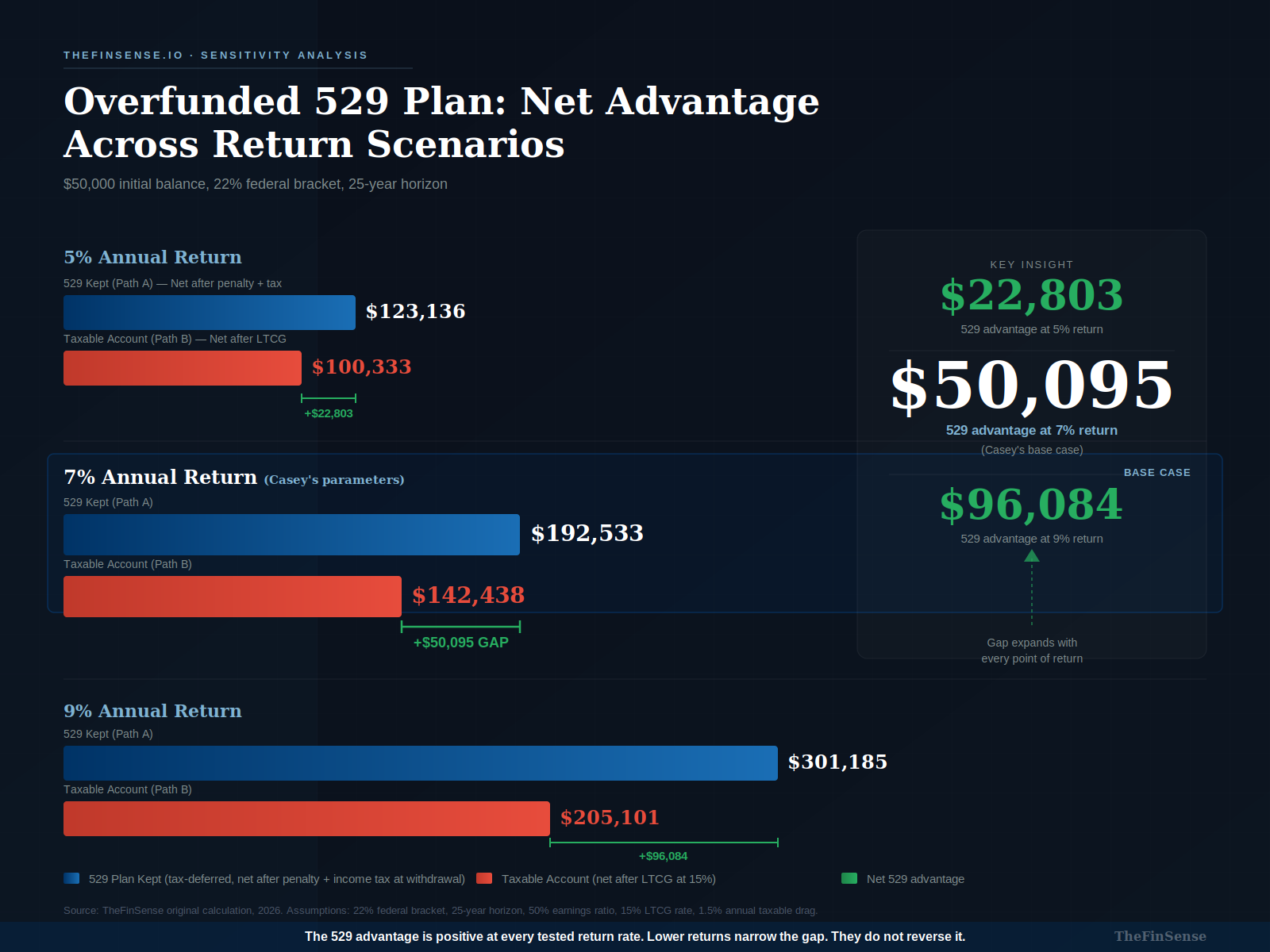
Casey’s calculation assumes 7% annual gross and a 22% federal bracket. Here is how the conclusion changes:
| Annual Return | 529 Net (Path A) | Taxable Net (Path B) | Gap |
|---|---|---|---|
| 5% | $123,136 | $100,333 | $22,803 |
| 7% (base case) | $192,533 | $142,438 | ✅ $50,095 |
| 9% | $301,185 | $205,101 | $96,084 |
At a 12% bracket, the gap widens to $66,253 because the lower marginal rate preserves more of the 529 balance at withdrawal. At a 32% bracket, the gap narrows to $33,936 but remains positive across every combination tested. The widening trajectory follows the same divergence visible when you visualize compound interest across two accounts with different effective rates.
The scenario where the penalty wins does not appear in any bracket, any return, or any horizon above 1 year.
What should I actually do with my leftover 529 balance?
The 529 Penalty Break-Even Test: 3 Paths in 15 Minutes
Three paths eliminate the penalty entirely or reduce it to a rounding error.
Path 1: Keep the 529 and Let It Compound (5 Minutes)
If your remaining horizon exceeds 15 years, the single strongest path for an overfunded 529 plan is no path at all. Leave the balance inside the account. The tax-deferred structure eliminates the annual dividend drag that costs the taxable alternative 1.5 percentage points every year. Over 25 years, that structural edge compounds into $50,095 at Casey’s parameters.
The same tax-deferred compounding advantage powers an HSA investment strategy, where the penalty risk drops to zero. The triple tax benefit widens the gap further.
Path 2: Roll Up to $35,000 Into a Roth IRA (8 Minutes)
SECURE 2.0 Section 126, effective January 2024, permits rolling up to $35,000 from a 529 plan into the beneficiary’s Roth IRA over the beneficiary’s lifetime. Three rules apply. The 529 account must have been open for at least 15 years. Annual transfers follow the Roth IRA contribution limit for that year, and the 529 beneficiary must be the Roth IRA account holder.
On Casey’s $50,000 balance with $25,000 in earnings, a $35,000 Roth rollover absorbs the largest eligible portion of the account. The remaining non-qualified earnings exposure shrinks after each annual transfer.
Path 3: Change the Beneficiary to a Family Member (3 Minutes)
The IRS permits changing the 529 beneficiary to any qualifying family member, including siblings, first cousins, parents, and descendants of the original beneficiary. The transfer carries no penalty and no tax. A parent with an overfunded 529 plan and a younger child redirects the balance without touching the withdrawal screen at all.
When to Withdraw: The Sub-10-Year Decision
If your horizon falls below 10 years and your earnings exceed 70% of the balance, the taxable account closes the gap to single digits. Withdraw the balance, pay the penalty and income tax on earnings, and invest the net proceeds in a total market index fund. The 15-year break-even math that favors the 529 weakens as the compounding runway shortens.
Overfunded 529 Plan Decision Tree: Three Paths to Resolve the Penalty
Choose based on time horizon and SECURE 2.0 eligibility
Run The 529 Penalty Break-Even Test with your overfunded 529 plan balance, your earnings ratio, and your remaining years. The path that produces the highest terminal wealth after all taxes and penalties is the correct path.
Your 529 custodian dashboard shows the split between contributions and earnings. On Vanguard, navigate to Account Overview and find the Cost Basis tab. On Fidelity NetBenefits, select the 529 account and open the Contributions and Earnings detail. On Schwab, check the Realized Gain/Loss report under the Tax Center.
Divide earnings by total balance to calculate your earnings ratio. That ratio determines how much of your balance faces the 10% penalty at withdrawal.
Saving for College’s guide to leftover 529 strategies lists additional options for parents weighing which of these three paths fits their specific situation.
Bogleheads forum threads on 529 overfunding follow a consistent pattern. The initial instinct is to withdraw immediately and avoid the penalty. The consensus shifts after users run the break-even calculation and confirm the 529 produces more at horizons of 12 or more years.
The objection that 7% is not guaranteed is valid; at 5% gross, the 529 still produces $22,803 more than the taxable alternative.
Fifteen minutes with a compound interest calculator separates $142,438 from $192,533.
The plan with three exits and one small fee is the plan every other account wishes it had.
When This Analysis Does Not Apply
This analysis holds for 80% of parents with excess 529 balances. Horan identified the break-even threshold at approximately 15 years. If your remaining horizon is under 10 years and your earnings exceed 70% of the balance, the taxable account closes the gap to single digits.
Run the Break-Even Test with your actual earnings ratio and years remaining. Below the 10-year threshold, withdraw and invest the net in a total market index fund.
The next time a parent stops contributing out of overfunding fear, one question resets the conversation. How many years remain before they would withdraw?
When the IRS publishes 2027 Roth IRA contribution limits, expected November 2026, the annual rollover cap in this framework adjusts accordingly. The current annual contribution limit caps each calendar year’s 529-to-Roth transfer amount. State-level 529 deduction recapture rules are also evolving as jurisdictions finalize SECURE 2.0 conformity. Both variables feed directly into the Break-Even Test parameters.
Overfunded 529 Plan FAQ: SECURE 2.0, Roth Rollovers, and State Rules
An overfunded 529 plan raises regulatory questions beyond the break-even math. SECURE 2.0 provisions, state tax recapture, and IRS beneficiary rules each apply differently depending on the path selected.
The answers below cover the five most common questions about an overfunded 529 plan after the break-even calculation is complete.
Can I roll over leftover 529 money into a Roth IRA to avoid the penalty
SECURE 2.0 Section 126 allows up to $35,000 in lifetime rollovers from a 529 to a Roth IRA, penalty-free. The 529 must be open at least 15 years. Annual transfers cannot exceed the Roth IRA contribution limit for that year. The beneficiary of the 529 must be the Roth IRA account holder.
Does the 10% penalty apply to contributions or only to earnings
Earnings only. IRS Publication 970 defines the 10% penalty as applying exclusively to the earnings portion of a non-qualified 529 distribution. Your original contributions return tax-free and penalty-free. On a $50,000 account where $25,000 is contributions, the penalty base is $25,000, making the actual cost $2,500.
What happens to my state tax deduction if I make a non-qualified withdrawal
Most states that offered an income tax deduction for 529 contributions will recapture that deduction on non-qualified withdrawals. The recapture amount and rules vary by state. Some states exempt Roth rollovers under SECURE 2.0 from recapture. Check your state 529 plan administrator for specific recapture rules before withdrawing.
Can I change the 529 beneficiary to myself for continuing education
The IRS allows the account holder to name themselves as beneficiary. Qualified expenses include graduate programs, professional certifications, and up to $10,000 annually for student loan repayment. The transfer carries no penalty. The Roth vs Traditional IRA comparison applies separately to retirement contributions during this period.
Does the One Big Beautiful Bill Act change anything for overfunded 529 plans
The 2025 OBBBA raised the annual qualified K-12 tuition expense limit from $10,000 to $20,000 per beneficiary. This expansion creates an additional qualified use for overfunded 529 balances if a younger sibling attends private K-12 schooling. The provision is pending final implementation rules. State conformity varies and should be verified before claiming.
The rules governing an overfunded 529 plan continue to evolve as SECURE 2.0 implementation guidance finalizes and states conform to federal provisions.
The Bottom Line on Your Overfunded 529 Plan
That 10% label on the withdrawal screen opened this analysis, and the math closed it.
The 10% penalty on an overfunded 529 plan costs $2,500 at Casey’s parameters. The fear of that penalty costs $50,095. Twenty years of tax-deferred compounding separates the parent who closed the browser from the parent who ran the calculation.
The $50,095 is the visible gap. The deeper cost is every parent with an overfunded 529 plan who saw the label and stopped contributing, forfeiting growth they had not yet started.
The warning sign that reads ‘penalty’ costs twenty times more than the toll itself.
The penalty is not a wall; it is a toll on a road that leads somewhere better.
The parent who runs the break-even test before closing the browser.
Your HSA has the same compounding advantage with zero penalty risk.
📌 Next Read: HSA Investment Strategy
Sixty-five-year-old Casey will trace $50,095 back to one withdrawal screen at age forty.
The post shrinks in the mirror.
YOUR TURN
How many years remain between your leftover 529 balance and the first withdrawal you plan to make?