
📅 Originally Published: · Last Reviewed and Updated:
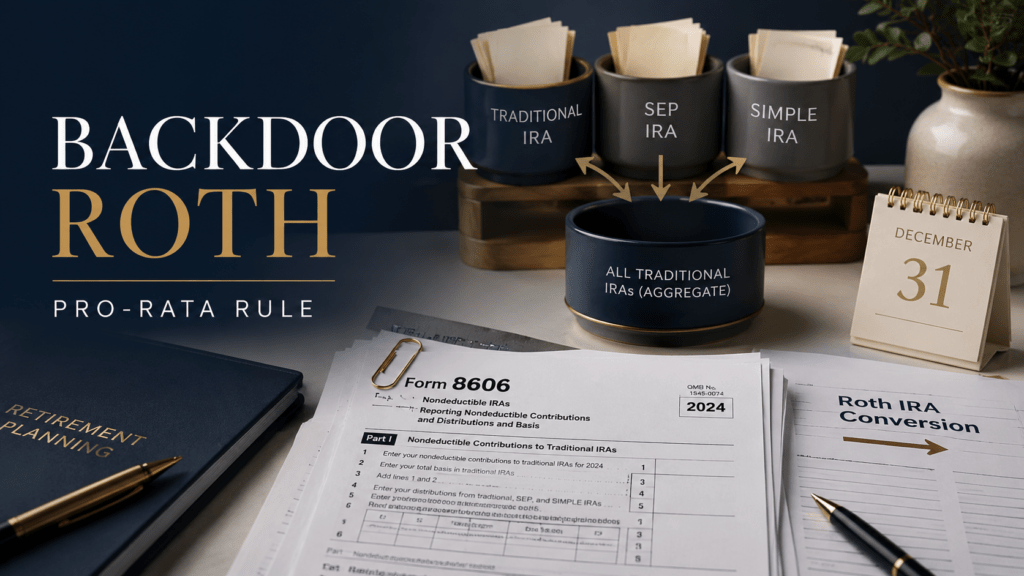
Backdoor Roth IRA rules do not promise a tax-free conversion. The IRS does not look only at the IRA you convert. Form 8606 compares your after-tax basis with the value and distributions from all of your traditional IRAs, including traditional SEP and traditional SIMPLE IRAs. If that pool still contains untaxed money, part of the conversion is usually taxable. A zero year-end balance in those IRAs is the cleanest setup, but it is not a legal requirement for a valid backdoor Roth.
A backdoor Roth IRA has two steps: make a nondeductible IRA contribution, then convert that amount to a Roth IRA. It is commonly used when income is too high for a full direct Roth contribution. For 2026, the direct Roth phaseout for single filers and heads of household runs from $153,000 to $168,000 of modified adjusted gross income. Total regular contributions across your traditional and Roth IRAs cannot exceed your taxable compensation for the year. The dollar cap is $7,500, or $8,600 if you are age 50 or older.
The contribution limit is simple. The conversion tax calculation is harder because the IRS looks beyond the account being converted. You cannot label one IRA as “after-tax” and ignore the others. The pro-rata rule combines the IRA types that count into one tax pool.
This matters to a large share of IRA owners. Investment Company Institute survey data published in June 2026 covered IRA ownership in mid-2025. It found rollover assets in 61% of households that owned Traditional IRAs. A rollover is not a problem by itself, but pre-tax rollover money changes the tax character of a later conversion.
Consider a simple case: You contribute $7,500 and convert it promptly, but a $60,000 rollover IRA is still sitting at another custodian at year-end. Your brokerage may show a $7,500 conversion; the federal basis form does not isolate that account. The rollover IRA still enters the pool that determines how much of the conversion is taxable.
Which IRA Balances Count?
The federal basis form ties the calculation together. It tracks after-tax contributions, prior basis, year-end IRA values, distributions, and Roth conversions.
The pro-rata calculation uses three broad inputs:
- Your cumulative after-tax basis: after-tax traditional IRA contributions that have not already been recovered tax-free.
- Your year-end IRA value: the total value of the IRA types that count, plus applicable outstanding rollovers. The latest complete instructions exclude one specific item from line 6: an outstanding rollover from a traditional IRA to a qualified retirement plan.
- Your IRA distributions and conversions during the year: including the net amount converted to Roth.
In plain English
The IRS asks what share of the entire IRA pool has already been taxed. That percentage, not the name of the account you converted, determines how much of the distribution is tax-free.
A 401(k), 403(b), or governmental 457(b) balance does not go on line 6. Moving eligible untaxed IRA money into a workplace retirement plan can therefore remove it from the pool used for the calculation. The receiving plan must accept incoming rollovers, and only eligible amounts can be transferred.
The practical target is often a $0 year-end balance across the IRAs that count. If the account has little or no investment growth and no complicating transactions, a prompt conversion of the after-tax contribution can be nearly tax-free. The reporting still needs to be correct.
How Much of One Conversion Becomes Taxable?
Even a modest untaxed IRA balance can make part of the conversion taxable. The table below shows a simplified one-year example using the full 2026 after-tax contribution and no prior basis. It assumes the balance does not change before conversion, there are no other distributions, and the federal tax assumption is 24%. Old basis, gains or losses, multiple conversions, and rollovers can change the real result.
| Year-End Pre-Tax IRA Balance | Taxable Share of Conversion | Taxable Amount | Estimated Federal Tax at 24% |
|---|---|---|---|
| $0 | 0.0% | $0 | $0 |
| $25,000 | 76.9% | $5,769 | $1,385 |
| $50,000 | 87.0% | $6,522 | $1,565 |
| $93,000 | 92.5% | $6,940 | $1,666 |
| $150,000 | 95.2% | $7,143 | $1,714 |
| $250,000 | 97.1% | $7,282 | $1,748 |
IRA Pro-Rata Calculator
Estimate the taxable share of a conversion when the IRA balance you enter is entirely pre-tax and you have no carried nondeductible basis.
Use the calculator only for the simplified setup above. If you already have basis from an earlier year, use the federal basis form and the worked example below. Do not treat this tool as a tax-return calculator.
The worked row shows the scale of the immediate tax issue. It does not tell you the lifetime value of the strategy. If the investor pays the tax from cash outside the IRA, the full conversion can remain in the Roth. If the same approach is repeated, cumulative basis and account values change, so this year’s taxable percentage should not be carried forward unchanged.
For the investor, the immediate consequence is current taxable income plus more basis tracking. Paying the tax from outside cash leaves the full conversion in the Roth. Withholding reduces what reaches the Roth. The withheld amount remains an IRA distribution and can create an early-distribution issue for investors under age 59½.
Which Backdoor Roth Route Fits Your Situation?
Your best route depends on what IRA money you already hold and whether a workplace plan can receive a rollover. Use this decision router before making the after-tax IRA contribution.
Route 1: No counted IRA money: This is the cleanest case, so make the after-tax contribution and convert promptly. If the conversion creates a small tax bill, consider paying it from non-IRA cash instead of withholding from the conversion. File the required tax form, and remember that small gains before conversion are generally taxable.
Before choosing Roth over other account types, compare the broader tax tradeoff in Roth vs. Traditional tax treatment.
Route 2: You have rollover money and an accepting workplace plan: One common fix is to move eligible IRA money into that plan. Ask the administrator whether it accepts this type of rollover. IRS guidance allows the transfer when the plan document permits it. A direct trustee-to-trustee transfer is usually cleaner than receiving the money personally.
Review the receiving plan before moving the balance. Investment options, fees, creditor protections, withdrawal rules, and service quality can matter. The account may also sit alongside employer contributions governed by the rules explained in 401(k) employer match and vesting.
Route 3: You have pre-tax IRA money but no accepting workplace plan: The approach can still work. You can accept a partly taxable conversion, delay the strategy, model a larger intentional conversion, or use other tax-advantaged space first. A business owner with no employees, or only a spouse working in the business, may be able to use a one-participant 401(k). The plan still needs to be set up correctly and permit the incoming rollover.
A Health Savings Account (HSA) can be another high-value account when you are eligible. The tradeoffs are covered in HSA investment strategy.
Route 4: Your IRA has untaxed money and old nondeductible basis. A simple “move the IRA into the 401(k)” instruction can be misleading here. For an IRA-to-workplace-plan rollover, only the part that would otherwise be taxable can generally move into the plan. Nondeductible basis stays behind. Pull prior Forms 8606 and account statements before moving anything so the remaining basis is not taxed twice.
Route 5: A mega backdoor Roth may be available: This route uses after-tax contributions inside an employer plan. It depends on that plan’s contribution, conversion, and rollover features. It is different from the IRA route discussed here; see the separate mega backdoor Roth guide.
What If Your Rollover IRA Already Contains Basis?
Old nondeductible basis changes the problem. Not every dollar in a rollover IRA is necessarily pre-tax. Before sending money to a workplace plan, separate what is eligible to move from what must stay behind.
Hypothetical federal example. Aris is 38, single, earns $200,000, and has no change in IRA value or other distributions during the example.
Aris has an $86,000 traditional rollover IRA. Prior Forms 8606 show $12,000 of carried nondeductible basis, so $74,000 is untaxed. Aris then makes a new $7,500 nondeductible contribution for 2026.
| Calculation Step | Amount |
|---|---|
| Rollover IRA value before the new contribution | $86,000 |
| Carried nondeductible basis | $12,000 |
| Untaxed amount inside the IRA | $74,000 |
| Total basis after the new contribution | $19,500 |
| Simplified denominator if Aris converts only $7,500 | $93,500 |
| Nontaxable percentage | 20.86% |
| Taxable part of the $7,500 conversion | $5,936 |
| Estimated federal tax at 24% | $1,425 |
If Aris simply converts $7,500, the old basis helps: about 20.86% of that conversion is nontaxable in this simplified example. But most of the conversion is still taxable because the $74,000 untaxed portion remains in the IRA pool.
An accepting workplace plan can create a cleaner route. Under the IRS special rollover rule, the amount sent to an eligible retirement plan is treated as coming first from the otherwise-taxable portion. One condition is that the amount left in the IRAs is at least equal to the basis. In this example, Aris could potentially move the $74,000 untaxed portion to an accepting qualified plan and leave the $19,500 of basis in the IRA.
If there are no gains, losses, or other IRA transactions in between, Aris could then convert the remaining $19,500 to Roth. That would recover the basis without the $74,000 pre-tax balance diluting it. This is not a universal instruction. The useful point is that basis changes what is eligible to move and what should remain behind. Pull prior Forms 8606 before requesting a reverse rollover.
Year-end timing still matters. If a transfer is in progress, use the instructions for the tax year being filed. Line 6 has a specific exception for an outstanding IRA-to-qualified-plan rollover. A transaction being marked “pending” does not by itself prove that the exception applies.
What Should You Check Before Year-End?
The process is easier when you know which accounts count and can find your basis records before making the contribution.
Step 1: Inventory every counted IRA: List your traditional IRAs at every custodian, including rollover IRAs and the traditional versions of SEP and SIMPLE IRAs. Leave Roth IRAs and employer-plan balances out of this tax pool. If you file jointly, your spouse’s IRA pool is reported separately. An inherited IRA with basis can require its own basis calculation instead of being combined with yours.
Step 2: Find basis from prior years: Pull every prior Form 8606 you filed because earlier nondeductible contributions can change the tax-free share. Missing records create a real risk of paying tax twice on the same contribution.
Step 3: Ask whether your plan accepts the rollover: A retirement plan can refuse incoming IRA money. Ask about eligible sources, documents, processing time, fees, and investment options, and start early enough to deal with delays.
Step 4: Confirm how a year-end rollover will be reported: The calculation uses year-end IRA values and can include applicable outstanding rollovers. One exception matters here: an outstanding rollover from a traditional IRA to a qualified plan is left off line 6. Check the instructions for the year you file and keep records from both institutions.
Step 5: File Form 8606 and keep the records: The form reports the after-tax contribution and calculates the taxable part of the conversion. IRS instructions say a $50 penalty can apply if a required filing is missing, unless reasonable cause is shown. Keep the filing and supporting records until all basis has been recovered.
Tax scope: This article explains the federal pro-rata framework. State taxation, community-property rules, inherited IRAs, required minimum distributions, SIMPLE IRA two-year restrictions, and unusual rollover timing can change the result. Get individualized tax advice when the balance or conversion is material.
Frequently Asked Questions
Do all counted IRAs need to be exactly $0?
A zero year-end balance across the IRAs that count is the cleanest setup for most investors. The tax law still uses a basis-to-total-pool ratio. A nonzero amount made entirely of previously taxed basis would not create the same result as untaxed money. Investment growth, separate distributions, and certain rollovers also matter.
Does a 401(k) count in the pro-rata rule?
No. Line 6 covers the counted IRA pool described above. That pool generally includes the traditional versions of SEP and SIMPLE IRAs. A 401(k), 403(b), or governmental 457(b) balance sits outside that IRA line. The plan must accept the incoming rollover before you can use it as a destination.
Is a backdoor Roth IRA legal?
Current federal law permits a nondeductible IRA contribution followed by a Roth conversion. “Backdoor Roth” is an informal name for that sequence, not a separate account type. Untaxed amounts converted to Roth are included in income, and the transaction is reported on the required tax form.
What are the two Roth IRA five-year rules?
The qualified-distribution five-year period generally starts with the first tax year for which you made a Roth IRA contribution or conversion. Each conversion also gets its own five-year period. That five-year clock can affect the 10% additional tax on an early withdrawal of the amount that was taxable when converted. The two five-year rules are related but not identical.
Can I do a backdoor Roth every year?
You can repeat the contribution-and-conversion sequence in years when you are eligible to contribute to an IRA. Each year requires fresh limit checks, accurate basis tracking, and tax reporting. Do not carry a fixed taxable percentage forward because account values and carried basis can change.
Can the contribution and conversion fall in different tax years?
Yes. A contribution made by the IRA deadline can be designated for the prior year. A Roth conversion, by contrast, is reported for the calendar year in which it occurs. So an early-year contribution for the prior year and its later conversion can land on different filings. Keep the contribution designation, Forms 1099-R and 5498, and the related basis forms aligned to the correct years.
Should I withhold tax from the conversion?
Withholding reduces the amount that reaches the Roth and leaves the withheld amount as an IRA distribution rather than converted Roth assets. Before age 59½, the taxable portion of that withheld distribution can also be subject to the 10% additional tax unless an exception applies. Paying the tax from outside funds can preserve more Roth assets. Cash-flow and estimated-tax needs still deserve a review with a tax professional.
Bottom Line
The pro-rata rule is an allocation formula, not an “allowed or disallowed” test. It divides a conversion between money already taxed and money that has not yet been taxed.
A large pre-tax rollover IRA can make most of a full-limit conversion taxable in one year. In the sensitivity table, a $93,000 pre-tax balance makes about $6,940 of a $7,500 conversion taxable, or roughly $1,666 of federal tax under a 24% assumption. Old basis can improve that ratio, but it also makes account routing more important.
List every IRA, recover your basis records, and ask whether a qualified plan accepts an eligible rollover. Then confirm how any year-end transfer is reported. The formula is mechanical; account routing is where mistakes often happen.
The conversion screen shows one account, but the tax calculation sees the whole IRA pool.
CHECK ONE NUMBER
What is the December 31 value of your pro-rata IRA pool, including the traditional versions of SEP and SIMPLE IRAs?
AI-assisted disclosure: AI tools supported source organization, arithmetic checks, and consistency review. Danny Hwang reviewed the final tax claims, calculations, and wording against the cited IRS materials. See the editorial policy.
Review ledger and update history
Last reviewed: August 10, 2026. The 2026 IRA limit and Roth phaseout were checked against the IRS. Pro-rata mechanics, IRA-to-plan rollover eligibility, line 6 treatment of outstanding rollovers, five-year rules, and the current ICI rollover-household estimate were rechecked.
August 10, 2026 update: Clarified the line 6 exception for an IRA-to-qualified-plan rollover and narrowed SEP/SIMPLE wording to the IRA types that belong in the pro-rata pool. Added the taxable-compensation ceiling and an early reader scenario. Added a simplified pro-rata calculator tied to the sensitivity model, plus a worked example showing how prior basis changes a reverse rollover. Also added spouse and inherited-IRA boundaries, tightened withholding and one-participant 401(k) language, and migrated internal links to the current canonical format.
July 14, 2026 update: Removed the unsupported $112,443 lifetime-loss claim and the fixed 25-year pro-rata projection. Also removed the Fidelity-default-withholding claim, the outdated 62% headline statistic, and the invalid flowchart. Rebuilt the article around one-year tax math and a situation-based decision router.
Calculation check: The $93,000 sensitivity row was recalculated as $93,000 ÷ $100,500 = 92.537% taxable, producing about $6,940 of taxable conversion income and about $1,666 of federal tax at 24%. The carried-basis example was separately recalculated as $19,500 ÷ $93,500 = 20.856% nontaxable; a $7,500 conversion therefore has about $5,936 taxable and about $1,425 of federal tax at 24%.
Limits: The latest complete Form 8606 instructions available at review were for tax year 2025. The core aggregation rule is durable, but readers should use the form and instructions for the tax year they file.