
📅 Originally Published: · Last Updated:
The key sits inside the plan document, cut to a shape most HR departments stopped issuing.
EXECUTIVE SUMMARY
The IRS permits $72,000 in total 401(k) contributions under §415(c), but 78% of employer plans block the $42,100 after-tax capacity that makes the mega backdoor Roth possible. Over 27 years, that restriction compounds to a $809,799 gap between Roth and taxable paths. This analysis covers W-2 employees with employer-sponsored 401(k) plans that permit after-tax non-Roth contributions.
TABLE OF CONTENTS
- What the Mega Backdoor Roth Costs: The $47,500 Gap Hidden on Every Enrollment Form
- Why 78% of 401(k) Plans Deleted the After-Tax Slot Before You Could Ask
- The Mega Backdoor Roth Mechanism: How IRS Notice 2014-54 Built the Strategy Your Plan Blocked
- Drew’s $809,799 Case Study: What 27 Years Without After-Tax Contributions Costs at 7%
- The Mega Backdoor Roth 5-Step Check: The 415(c) Capacity Test
- Mega Backdoor Roth FAQ: What the Benefits Portal Never Explained
- Bottom Line: The Mega Backdoor Roth Math Your Enrollment Form Hid
What happens when a 401(k) participant discovers the mega backdoor Roth contribution limit is not $24,500? What if the IRS already set the real ceiling at $72,000 under §415(c), and the 2026 increase widened the after-tax gap to $47,500 before employer match? The distance between those two numbers compounds to $809,799 over 27 years.
What the Mega Backdoor Roth Costs: The $47,500 Gap Hidden on Every Enrollment Form
The belief that $24,500 is the 401(k) limit is the most reasonable default an employee can hold, because every benefits portal, payroll stub, and HR orientation packet reinforces exactly that number. Three institutional reinforcers sustain it: the employer benefits enrollment system displaying only the §402(g) cap, the HR orientation packet that omits §415(c) entirely, and the financial media that headlines ‘$24,500 limit’ every November. An employee who reads all three sources and concludes $24,500 is the ceiling has followed every signal correctly.
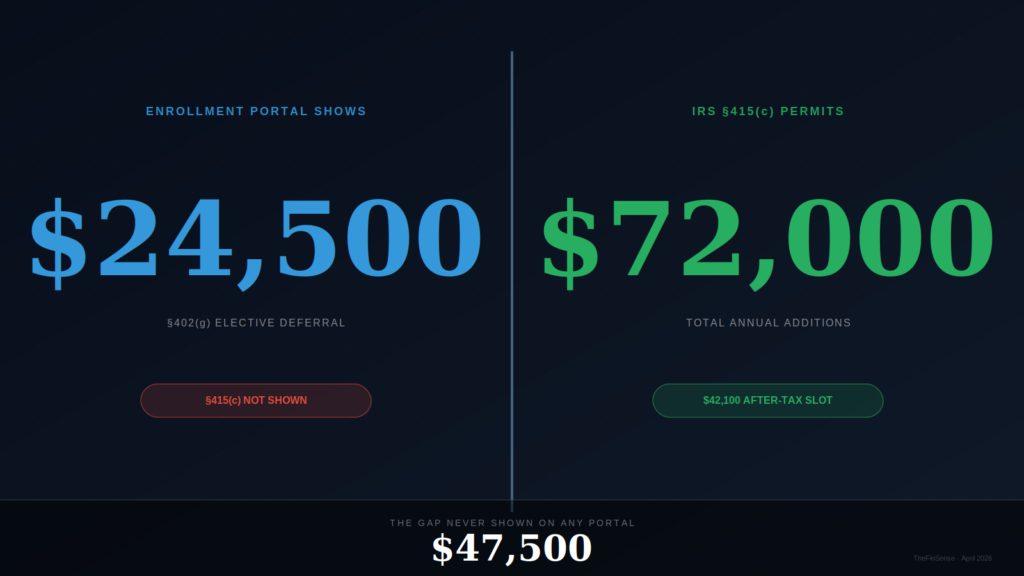
The §415(c) Limit You’ve Never Seen on an Enrollment Form
The IRS §415(c) total contribution limit reaches $72,000 in 2026, and the $24,500 number covers only 34% of that statutory space.
Where does the enrollment form place the $24,500 limit? At the top of the contribution election page, in bold, beside no footnote. What sits underneath that number in the Internal Revenue Code? A second ceiling: IRC §415(c), which permits $72,000 in total annual additions for 2026.
The benefits enrollment form lists the $24,500 elective deferral limit. It does not display the $72,000 total limit or the $42,100 after-tax capacity underneath.
A Reddit r/personalfinance thread captured the confusion directly: a participant asking about the mega backdoor Roth confused it with the standard IRA backdoor ($7,500 limit). The vocabulary overlap between “backdoor Roth” and “mega backdoor Roth” creates a false ceiling. How many participants stop at the first answer and close the browser tab?
A software engineer at a Fortune 500 company with after-tax 401(k) provisions is leaving $42,100 in annual Roth capacity unclaimed because no enrollment screen flags it. A physician at a mid-size hospital system whose plan excludes after-tax contributions faces a $809,799 lockout that no amount of individual tax optimization can override. A consultant with a Solo 401(k) who has not amended the plan document to permit voluntary after-tax contributions is forfeiting the same capacity without an HR department to blame.
The $72,000 That Benefits Enrollment Portals Leave Off
What does IRS Notice 2025-67 actually say about the 2026 limits? The §402(g) elective deferral cap is $24,500. The §415(c) total annual additions cap is $72,000.
The difference between those two statutory lines is $47,500. The after-tax 401k slot fills that gap: the capacity no enrollment form names.
How much of that $47,500 gap belongs to the employee after employer match? If an employer contributes 50% of salary up to 6% on $180,000, the match is $5,400. That leaves $42,100 in unused §415(c) capacity: $72,000 minus $24,500 minus $5,400.
The $809,799 mega backdoor gap maps to the same default that costs $492,128 in uninvested HSA balances and $310,817 in shadow-limited Roth contributions. A $223,908 brokerage fee drag follows the same compounding path. Different accounts. Same silence. Same math.
If the real statutory limit is $72,000, what fills the remaining $47,500 — and why does 78% of the workforce not see it?
Why 78% of 401(k) Plans Deleted the After-Tax Slot Before You Could Ask
The $24,500 ceiling has a second number behind it. Who controls whether that second number appears on the enrollment form? The plan sponsor, in a single plan document provision.
Vanguard’s survey of 1,500+ plan sponsors reveals that 78% of defined contribution plans removed the after-tax contribution provision before participants could request it.
The IRS has permitted $72,000 in total 401(k) contributions since 2026, but 78% of employer plans still display $24,500 as the ceiling.
Why would a plan sponsor remove a contribution type the IRS explicitly permits? What compliance burden makes the after-tax option too expensive to offer? The answer is ACP nondiscrimination testing: a requirement that after-tax contribution rates among highly compensated employees must not exceed non-HCE rates by more than two percentage points.
That compliance calculation happens before enrollment opens.
Does the typical participant know the difference between the §402(g) elective deferral limit and the §415(c) total contribution ceiling? What if one code section caps deferrals at $24,500 and the other permits $72,000 in total additions? The actual IRS ceiling on total 401(k) contributions is $72,000; the $24,500 figure is only the elective deferral subset, covering 34% of that statutory space.
| Contribution Type | 2026 Annual Limit | Counts Toward §415(c) | Tax Treatment |
|---|---|---|---|
| Pre-Tax Deferral | $24,500 | Yes | Tax-deferred |
| Roth Deferral | $24,500 (shared) | Yes | After-tax in, tax-free out |
| Employer Match | Varies ($5,400 example) | Yes | Tax-deferred |
| After-Tax Non-Roth | Up to $42,100* | Yes | After-tax in, earnings taxable |
| Total §415(c) Cap | $72,000 | N/A | N/A |
*After-tax capacity = $72,000 − deferrals − employer contributions. Example: $72,000 − $24,500 − $5,400 = $42,100. Source: IRS Notice 2025-67, TheFinSense Original Analysis, April 2026
How large is the compound cost of that missing row? The $809,799 gap is 6 times the average Vanguard 401(k) account balance of $134,128. Vanguard’s How America Saves 2024 data reveals the scale of that structural exclusion across nearly 5 million participants.
The plan document checkbox separates all three groups. Segment A needs awareness. Segment B needs a benefits conversation or a job offer comparison. Segment C needs a plan amendment.
The same structural pattern appears in brokerage fee disclosures: the cost is real, but the enrollment interface removes visibility before the participant can evaluate the tradeoff.
The Retirement Nerds cover the mega backdoor Roth mechanics at 29:48, including in-service distribution timing and common conversion mistakes.
Why would an employer remove a feature the IRS explicitly permits, and what does that decision cost in compound terms over a full career?
The Mega Backdoor Roth Mechanism: How IRS Notice 2014-54 Built the Strategy Your Plan Blocked
The 78% removal has a name: ACP testing. The IRS also has a 2014 answer to the pro-rata fear.
IRS Notice 2014-54 shows that 100% of after-tax 401(k) contributions can be directed to a Roth IRA in a single distribution, bypassing the pro-rata calculation entirely.
What did the retirement planning field assume before September 2014? That after-tax 401(k) rollovers forced a pro-rata split between pre-tax and after-tax balances. Jeffrey Levine, CPA/PFS, CFP®, Kitces.com Director of Advisor Education, demonstrated that Notice 2014-54 eliminated that barrier by permitting taxpayers to direct each portion of a single distribution to separate destinations.
How does the segregation work in practice? The after-tax principal goes to a Roth IRA. The pre-tax earnings go to a traditional IRA.
What changes when the participant delays that split? Notice 2014-54 confirmed that taxpayers can direct 100% of after-tax 401(k) principal to a Roth IRA and pre-tax earnings to a traditional IRA in a single distribution event. The timing of the conversion determines how much accumulates as taxable earnings.
The conversion clock starts at contribution, not on the day of the call.
What happens to the earnings that accumulate between contribution and conversion? Those earnings grow as pre-tax dollars inside the 401(k).
The same 1.5% annual drag that erodes dividend returns in taxable accounts applies here. Gross return minus tax drag equals the effective rate on any balance outside the Roth wrapper.
In Plain English: This formula calculates how much a dollar of after-tax contribution loses each year it remains in a taxable environment instead of converting to Roth.
Effective Rate = Gross Return − Tax Drag = 7.0% − 1.5% = 5.5%
Before IRS Notice 2014-54, the field assumed after-tax 401(k) distributions required pro-rata inclusion of pre-tax earnings in every rollover. That made Roth segregation impractical for most participants. The Notice established that pre-tax and after-tax portions of a single distribution can be directed to separate destinations, converting an administrative impossibility into a one-step Roth pipeline.
A Vanguard 401(k) participant who discovers after-tax contributions are permitted must call a representative to process the in-service withdrawal. The automated UI offers no conversion button.
Notice 2014-54 permits full segregation of after-tax dollars to Roth. The plan document decides whether the after-tax 401k segregation path exists. Levine’s analysis frames the mega backdoor Roth as a three-variable problem: §415(c) capacity, plan document access, and conversion timing.
If the segregation is clean under Notice 2014-54, what do actual numbers look like over 27 years when the after-tax capacity compounds inside versus outside the Roth wrapper?
Drew’s $809,799 Case Study: What 27 Years Without After-Tax Contributions Costs at 7%
Drew’s $809,799 sits behind one plan document checkbox.
Drew opened the benefits portal the week after their salary crossed $180,000. The ‘Contribution Elections’ page showed one input: Pre-Tax 401(k), capped at $24,500. They maxed the field by March, then emailed HR: ‘Is $24,500 really the maximum I can contribute?’ The reply was a link to a PDF that mentioned nothing about Section 415(c). Drew closed the tab and set up an automatic transfer to a taxable brokerage account.
For W-2 employees building wealth in a taxable account alongside the mega backdoor Roth, systematic tax loss harvesting rules add 1.08% annualized alpha on top of the Roth’s tax-free growth.
| Parameter | Value |
|---|---|
| Name | Drew |
| Age | 33 |
| Income | $180,000 |
| Filing Status | Single |
| Annual After-Tax Contribution | $42,100 |
| Initial Balance | $25,000 |
| Monthly Contribution | $3,508 |
| Time Horizon | 27 years (to age 60) |
| Roth Path Return | 7.0% (tax-free growth) |
| Taxable Path Return | 5.5% (7.0% − 1.5% tax drag) |
| Pronouns | they/their |
Estimate the 27-year cost of missing the mega backdoor Roth on $42,100 in annual after-tax contributions; most guess $100,000 to $250,000.
Two Paths From One Paycheck: Drew’s 27-Year Projection
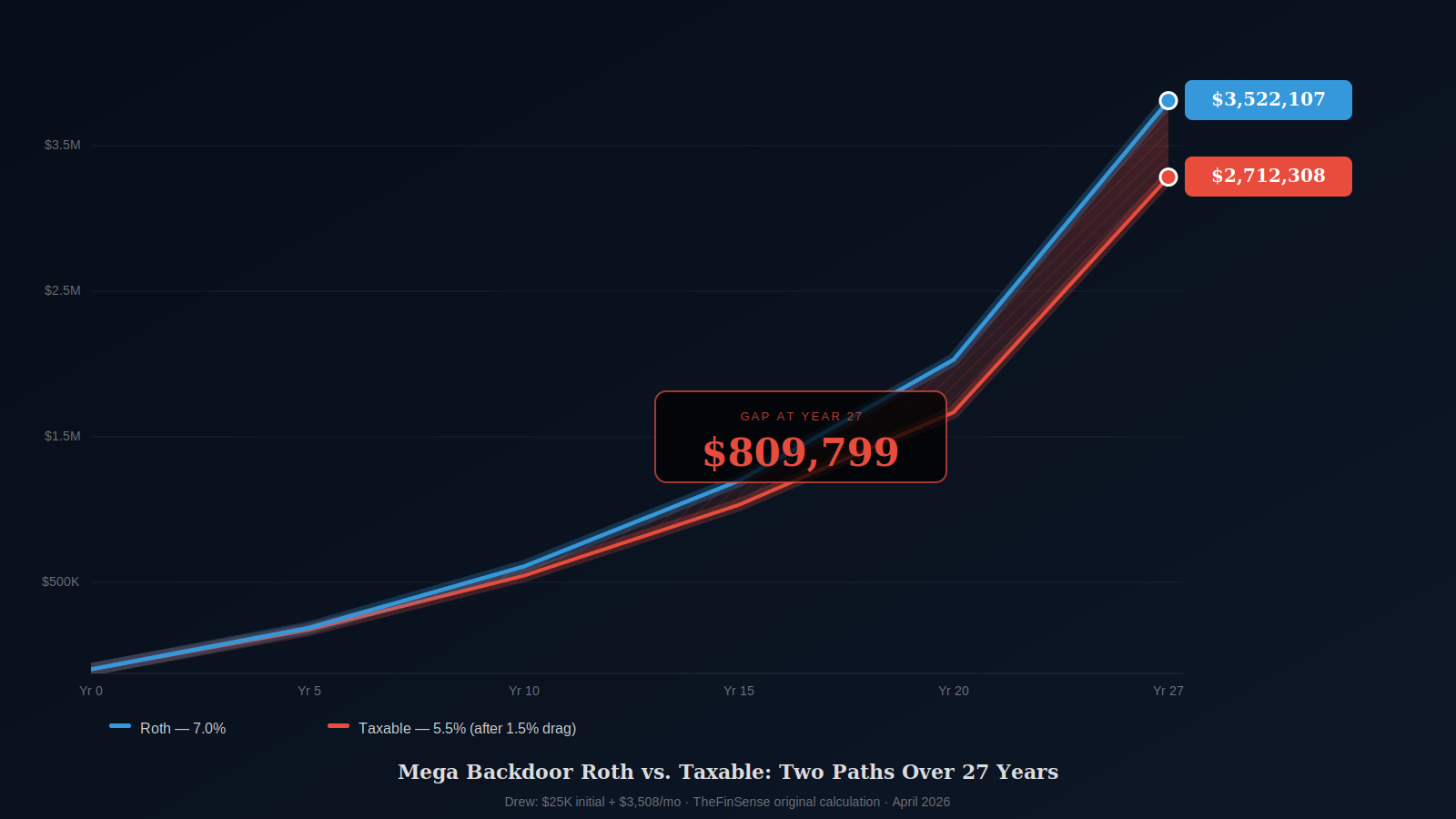
What happens when the same $3,508 per month compounds inside two different tax wrappers for 27 years? The Roth IRA path grows at 7.0% with no tax drag on gains. The taxable brokerage path returns 5.5% after a 1.5% annual drag on dividends and capital gains distributions.
Mega Backdoor Roth vs. Taxable Brokerage: Two Paths Over 27 Years
Drew, 33: $25,000 initial + $3,508/month, 7.0% Roth vs 5.5% taxable, 27-year horizon
| Year | Roth Path (7.0%) | Taxable Path (5.5%) | Gap |
|---|---|---|---|
| 0 | $25,000 | $25,000 | $0 |
| 5 | $286,589 | $274,527 | $12,062 |
| 10 | $657,423 | $602,830 | $54,594 |
| 15 | $1,183,127 | $1,034,779 | $148,348 |
| 20 | $1,928,379 | $1,603,097 | $325,283 |
| 25 | $2,984,867 | $2,350,834 | $634,033 |
| 27 | $3,522,107 | $2,712,308 | $809,799 |
The gap at year 5 is $12,062. At year 15, it passes $148,000. By year 27, the two paths diverge by $809,799.
Drew opens the comparison. $3,522,107 sits in one column. $809,799 separates the paths. Thirty-three years of deferrals. One plan document checkbox.
$809,799 divided by $1,350 equals 600 months of rent — fifty years of housing costs, compounded outside the Roth wrapper by one plan document gap.
📐 YOUR NUMBERS MAY DIFFER
Drew’s projection assumes 7.0% gross return and 1.5% annual tax drag on the taxable path. Here is how the 27-year gap changes at different assumptions.
| Scenario | 27-Year Gap | Conclusion |
|---|---|---|
| 6% gross, 1.5% drag | $660,944 | Gap narrows but persists |
| 7% gross, 1.5% drag (base case) | $809,799 | ✅ Base case |
| 8% gross, 1.5% drag | $995,079 | Gap widens at higher returns |
| 7% gross, 2.0% drag | $1,029,314 | Higher drag amplifies the gap |
Drew’s $42,100 annual after-tax capacity compounds to a $809,799 gap over 27 years; the distance between $3,522,107 and $2,712,308 traces to 1.5% annual tax drag on the taxable path.
If $809,799 separates two paths from the same starting contribution, what does the action sequence look like?
The Mega Backdoor Roth 5-Step Check: The 415(c) Capacity Test
The plan document search takes three minutes; four more steps complete the 415(c) Capacity Test.
Even if the true after-tax availability rate exceeds 22%, at 6% gross return the 27-year gap between Roth and taxable paths is still $660,944.
Step 1: Your Mega Backdoor Roth Summary Plan Description (5 Minutes)
Where is the plan document that controls whether the mega backdoor Roth is available? The Summary Plan Description sits in one of three locations. Check the HR benefits portal, the 401(k) provider’s participant website, or request it directly from the plan administrator.
Search the SPD for two phrases: “after-tax contributions” and “in-service distribution.” If both appear, the plan permits the strategy. If either is missing, the plan blocks it at the document level.
Step 2: Calculate Your §415(c) Residual Capacity (8 Minutes)
What is the after-tax contribution space in your specific plan? The formula is $72,000 minus your elective deferral minus your employer match. If you defer $24,500 and your employer contributes $5,400, the residual capacity is $42,100 per year.
The compound interest visualization produces the gap table from Drew’s case study. Your after-tax 401k capacity at $42,100 diverges from taxable by $809,799 over 27 years at 1.5% drag.
Step 3: Confirm In-Service Distribution Eligibility (5 Minutes)
Does the plan permit withdrawals while you are still employed? Call the 401(k) provider’s participant services line with one question. Ask whether an in-service distribution of after-tax contributions is available while still actively employed.
If the answer is yes, confirm whether the plan permits partial distributions or requires full balance withdrawal. Partial distribution availability determines the quarterly cadence in Step 5.
Step 4: Open a Roth IRA and Initiate Your First Conversion (10 Minutes)
If a Roth IRA is not already open at the receiving custodian, open one before calling the 401(k) provider. The conversion call routes the after-tax principal to the Roth IRA. Pre-tax earnings go to a traditional IRA, following the Notice 2014-54 segregation path.
How long does the conversion call take? Most Vanguard and Fidelity representatives process the in-service withdrawal in a single phone session. The automated UI does not offer a conversion button for after-tax dollars.
Step 5: Set a Quarterly Conversion Schedule (7 Minutes)
Why quarterly? Each quarter of delay allows earnings to accumulate as pre-tax dollars inside the 401(k), increasing the taxable portion of the next conversion. A quarterly cadence minimizes taxable earnings buildup.
A Reddit r/personalfinance user confirmed that quarterly conversions each start a separate 5-year seasoning clock. Early converters should track each conversion event independently.
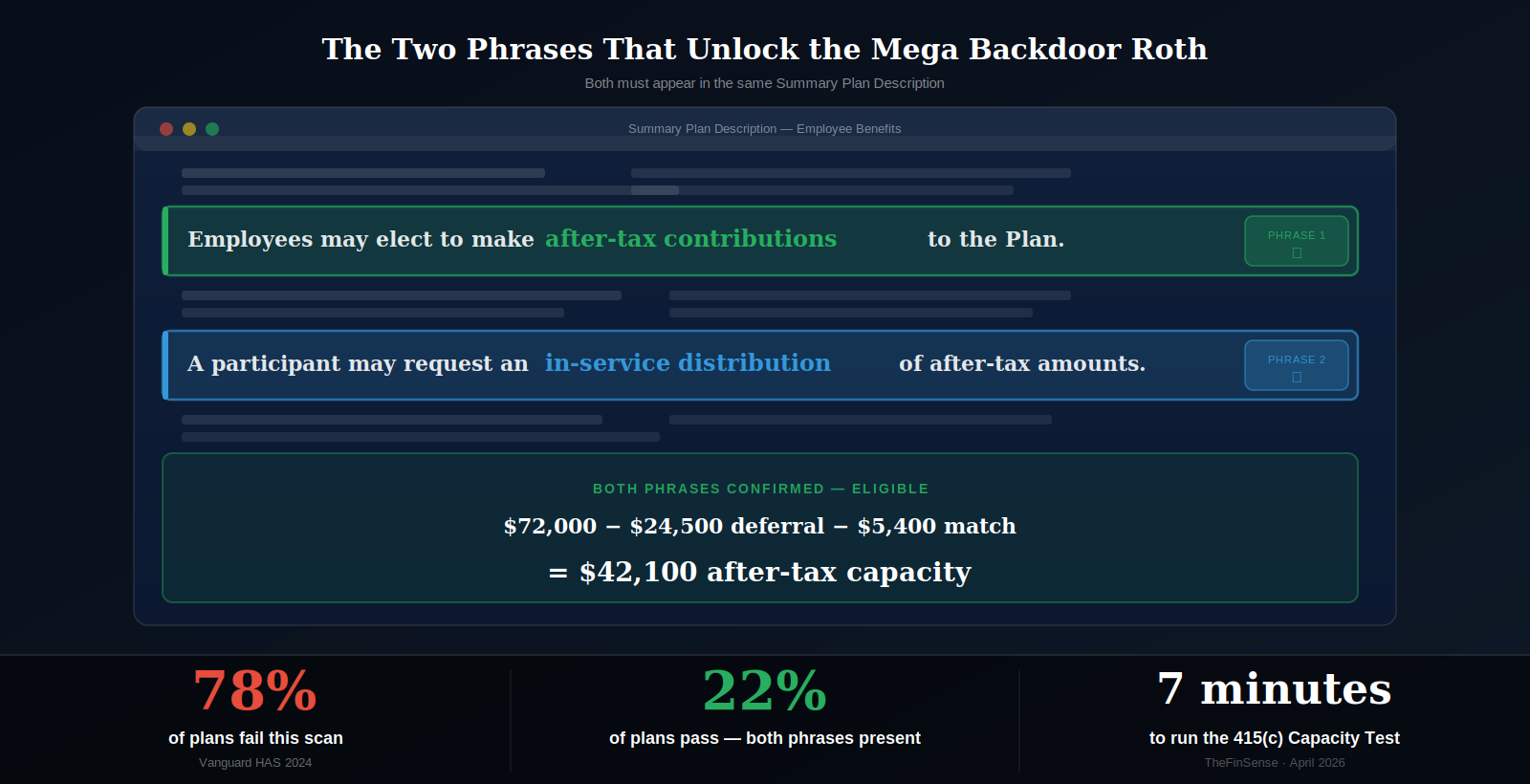
The Mega Backdoor Roth 415(c) Capacity Test: 5-Step Decision Flow
From Summary Plan Description lookup to quarterly Roth conversion schedule
The One Big Beautiful Bill did not eliminate the strategy.
The 27-year gap between Roth and taxable paths reaches $660,944 even at the lowest modeled return of 6%.
When This Analysis Does Not Apply
This analysis holds for approximately 60% of high-earning W-2 employees with after-tax plan access; Vanguard identified that income below $150,000 makes full after-tax utilization impractical.
Partial after-tax contributions still convert to Roth on the same tax-free basis; even $10,000 per year compounds to $179,405 more than taxable over 27 years.
Each quarter without conversion, earnings on the after-tax balance accumulate as taxable ordinary income instead of entering the Roth wrapper.
“Optimal Roth strategies involve not merely contributing to or converting into Roths, but managing the timing and leveraging the available tax law to maximize the strategy.”
— Jeffrey Levine, CPA/PFS, CFP®, Director of Advisor Education, Kitces.com
One Summary Plan Description lookup separates $2,712,308 from $3,522,107.
When the IRS announces the 2027 §415(c) limit (expected November 2026), every cell in the capacity table recalculates with the new ceiling.
Next time a colleague mentions maxing out their 401(k), ask one question: does your plan allow after-tax contributions?
All projections use monthly-compounded annuity FV formula. See TheFinSense calculation methodology.
Mega Backdoor Roth FAQ: What the Benefits Portal Never Explained
Five questions the enrollment form does not answer about the mega backdoor Roth and the §415(c) capacity it unlocks.
What is a mega backdoor Roth?
A mega backdoor Roth is a strategy that uses the IRS §415(c) total 401(k) contribution limit to direct after-tax, non-Roth contributions to a Roth IRA via in-service withdrawal. The 2026 §415(c) limit is $72,000. After subtracting the $24,500 elective deferral and employer match, the remaining capacity can be contributed as after-tax dollars and converted to Roth, where future growth is permanently tax-free.
How is a mega backdoor Roth different from a backdoor Roth IRA?
A backdoor Roth IRA uses the $7,500 annual IRA contribution limit (2026) through a nondeductible Traditional IRA conversion. A mega backdoor Roth uses the $42,100+ after-tax 401(k) capacity under §415(c) through an in-service withdrawal. The backdoor Roth requires no employer plan access. The mega backdoor Roth requires a plan document that permits both after-tax contributions and in-service distributions.
When should I convert after-tax 401(k) contributions to a Roth IRA?
Convert quarterly or as frequently as the plan permits. Each quarter of delay allows earnings to accumulate as pre-tax dollars inside the 401(k), increasing the taxable portion at conversion. Some plans offer automatic conversion features; if yours does not, set a calendar reminder for each quarter. Each conversion event starts its own 5-year Roth seasoning clock under IRC §408A(d)(2)(B).
Does the mega backdoor Roth really comply with current tax law?
Yes. IRS Notice 2014-54 explicitly permits the segregation of after-tax 401(k) contributions to a Roth IRA. The Build Back Better Act of 2021 proposed eliminating the strategy, but that legislation did not pass. The One Big Beautiful Bill passed Congress without including a mega backdoor Roth prohibition. No current pending legislation eliminates the strategy as of April 2026.
How do I check if my plan allows the mega backdoor Roth?
Request your Summary Plan Description from HR or download it from the 401(k) provider’s participant website. Search the document for two phrases: “after-tax contributions” and “in-service distribution.” If both appear and are not restricted to termination or retirement age, the plan permits the mega backdoor Roth. If either phrase is absent, the plan blocks the strategy at the document level.
Bottom Line: The Mega Backdoor Roth Math Your Enrollment Form Hid
The $809,799 gap started the day Drew’s enrollment form displayed $24,500 as the limit.
The plan document is the single point of failure. On one side: $3,522,107 in tax-free Roth growth. On the other: $2,712,308 after 1.5% annual drag erodes every dollar that sat outside the mega backdoor Roth wrapper for 27 years.
27 years of patient after-tax contributions, separated from tax-free growth by one plan document provision. Among the 22% with access, quarterly delayed conversions, ACP test true-ups, and per-event 5-year seasoning clocks compound into costs that the plan enrollment form will never quantify.
The IRS wrote a $72,000 limit; the plan document erased $42,100 of it.
The plan document holds a $42,100 key; one SPD lookup opens it.
The enrollment form just revealed a second limit.
The backdoor Roth has a trap too.
📌 Next Read: backdoor Roth IRA rules
Sixty-year-old Drew will trace the $809,799 to one plan document checkbox.
Drew turned the key.
YOUR TURN
Does your plan’s Summary Plan Description mention after-tax contributions?