
📅 Originally Published: · Last Updated:
The door has a name everyone in finance recognizes. The toll on the other side does not.
The backdoor Roth IRA rules are tax-free only when every pre-tax IRA balance equals $0 on December 31, yet 62% of traditional IRA households hold the rollover assets that trigger IRC §408(d)(2) pro-rata taxation. The result: $112,443 in lost Roth growth across 25 years of conversions, eliminated by one reverse rollover phone call.
- FOUNDATIONALReichenstein and Meyer (2020): Optimal Roth conversion timing adds up to 3% in net return for high-income households approaching retirement.
- FOUNDATIONALKitces (2015): IRC §408(d)(2) aggregates all traditional IRA balances into a single pool for pro-rata calculation regardless of custodian.
What Are the Backdoor Roth IRA Rules?
The backdoor Roth IRA rules require every pre-tax traditional, SEP, and SIMPLE IRA balance to equal $0 on December 31 for the conversion to qualify as tax-free; any non-zero balance triggers IRC §408(d)(2) pro-rata taxation on each conversion.
- 62% of traditional IRA households hold rollover assets that fail the $0 prerequisite for a tax-free backdoor Roth.
- One reverse rollover phone call to a current 401(k) plan administrator eliminates the pro-rata drag entirely.
- A $93,000 pre-tax IRA balance makes 92.5% of every $7,500 conversion taxable, compounding to $112,443 over 25 years.
Table of Contents
- The Backdoor Roth IRA Tax-Free Promise Has a Footnote
- The Pro-Rata Threshold Table: What Your IRA Balance Actually Costs
- How IRC §408(d)(2) Calculates Your Backdoor Roth IRA Rules Penalty
- Aris’s $93,000 Rollover: How $112,443 Disappeared in 25 Years
- Your 15-Minute Pro-Rata Threshold Test: Backdoor Roth IRA Rules Fix
- Backdoor Roth IRA Rules: Your Most Common Questions Answered
- Backdoor Roth IRA Rules: The $112,443 Door Swings Both Ways
The backdoor Roth IRA rules describe a two-step conversion that every personal finance site calls tax-free. The cost of getting it wrong: $112,443. The 2026 IRA contribution limit increased to $7,500, raising both the potential Roth benefit and the pro-rata penalty for anyone with a pre-tax IRA balance. The penalty compounds every year the mistake persists. This analysis covers single filers with MAGI above $168,000 who are ineligible for direct Roth contributions. Married-filing-jointly filers and partial phase-out calculations use different thresholds.
The Backdoor Roth IRA Tax-Free Promise Has a Footnote
The backdoor Roth IRA rules require every pre-tax IRA balance to equal $0 on December 31 for the conversion to qualify as tax-free. A $93,000 rollover IRA triggers IRC §408(d)(2) pro-rata taxation, making 92.5% of each $7,500 conversion taxable and costing $112,443 across 25 years of conversions.
Rolling a 401(k) into a traditional IRA for better investment options is standard financial advice. Your brokerage calls to suggest it, your HR exit packet recommends it, and every backdoor Roth tutorial describes the conversion as tax-free. Three layers of authority point toward the same two-step sequence.
The backdoor Roth IRA rules attach one prerequisite that most tutorials mention once and skip past. Every pre-tax traditional IRA balance must equal $0 on December 31 for the conversion to qualify as tax-free. The Investment Company Institute reported in 2024 that 62% of traditional IRA households hold rollover assets from previous employers. That majority cannot convert tax-free.
High earners face similar rule complexity across tax-advantaged accounts. The 2026 IRA contribution limit increased to $7,500, raising the stakes for every pre-tax balance still sitting in the aggregation pool.
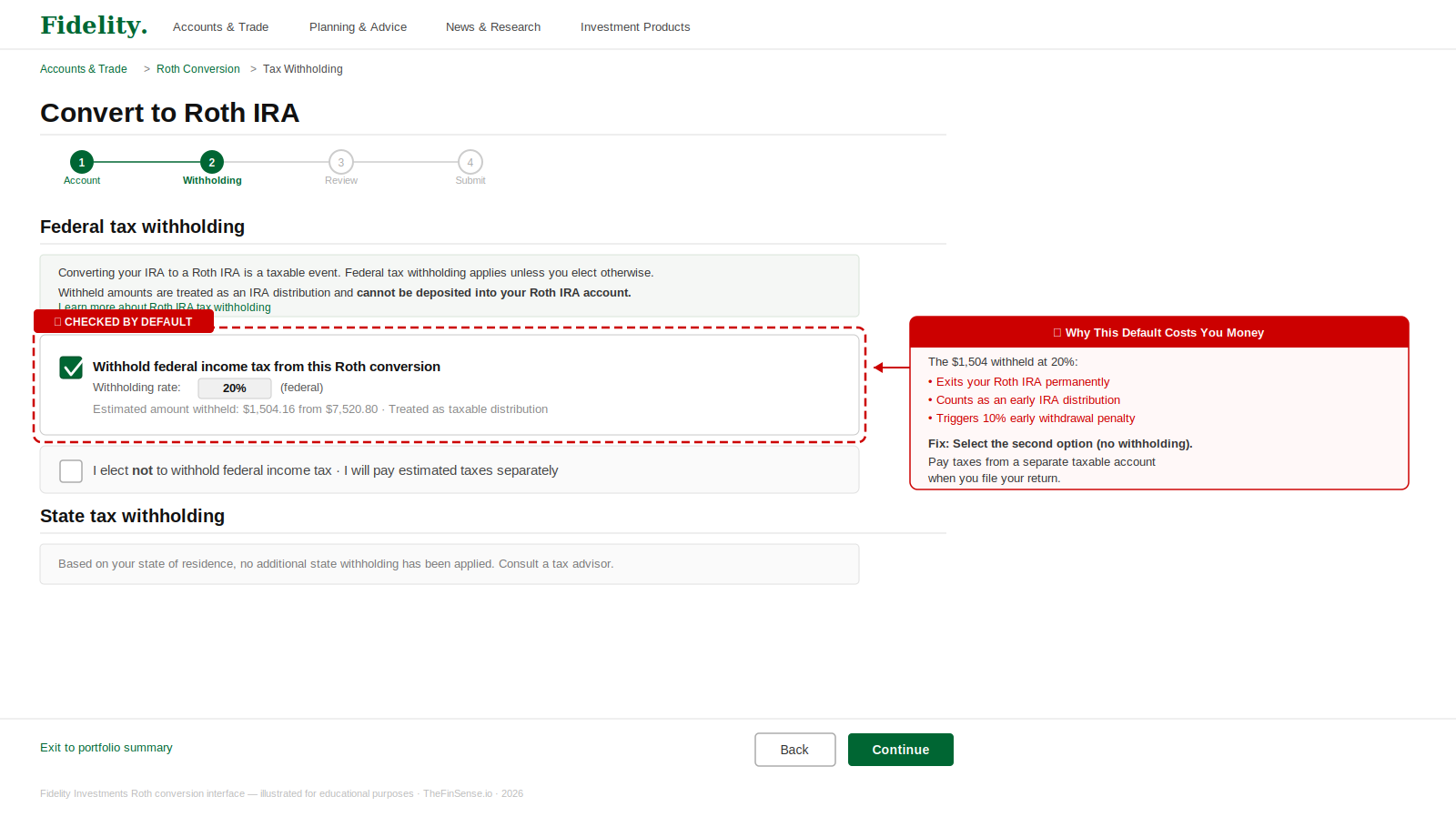
Fidelity’s Roth conversion screen displays a tax withholding checkbox that defaults to 20%. The withheld amount exits the IRA as a premature distribution, triggering a 10% early withdrawal penalty on top of ordinary income tax.
The software engineer who rolled a 401(k) into Fidelity three jobs ago faces the same pro-rata math as the physician with a $300,000 SEP IRA. The investor who dismissed $1,666 as a rounding error on a $200,000 salary has not compounded that error across 25 years of conversions. All three discover the same number at the same threshold.
The strategy 62% of IRA-owning households cannot execute tax-free is the one every financial publication describes as a loophole.
This guide applies to single filers with MAGI above $168,000, investors with rollover or SEP/SIMPLE IRA balances, and 24%+ federal bracket earners approaching year-end conversion decisions.
Does not apply to: married-filing-jointly filers, households expecting a 2+ bracket retirement drop, investors already at $0 pre-tax IRA balance, or state-specific Roth conversion treatment.
The question is not whether the backdoor Roth works. The question is what your December 31 IRA balance costs every time you convert.
The Pro-Rata Threshold Table: What Your IRA Balance Actually Costs
One number on December 31 decides whether your backdoor Roth costs $0 or $1,666 in taxes. That number is the total pre-tax balance across every traditional, SEP, and SIMPLE IRA you own. The table below maps each balance to its 25-year cost under current backdoor Roth IRA rules.
| Pre-Tax IRA Balance | Pro-Rata % Taxable | Annual Tax Cost (24%) | 25-Year Growth Gap |
|---|---|---|---|
| $0 | 0.0% | $0 | $0 |
| $25,000 | 76.9% | $1,385 | $93,470 |
| $50,000 | 87.0% | $1,565 | $105,662 |
| $93,000 | 92.5% | $1,666 | $112,443 |
| $150,000 | 95.2% | $1,714 | $115,725 |
| $250,000 | 97.1% | $1,748 | $117,972 |
The Congressional Research Service reported that $594.8 billion flowed into traditional IRAs via rollovers in 2020. That single year of rollovers represented 96.4% of all traditional IRA inflows nationwide. Every dollar that arrives as a rollover becomes a pre-tax balance the IRS counts on December 31.
The $112,443 gap equals 75% of the median rollover IRA balance nationwide. Investors locked out of Roth access can still pursue safe investments to beat inflation in taxable accounts. Roth capacity, however, is finite.
A single forgotten rollover IRA turns every future backdoor Roth conversion from tax-free to 92.5% taxable.
Most investors assume the pro-rata rule only becomes meaningful at six-figure IRA balances. The $594.8 billion in total rollovers obscures the individual cost: a $25,000 pre-tax IRA erases $93,470 in Roth growth across 25 years of conversions.
The pro-rata formula does not adjust for income, intent, or the number of accounts involved. The $0 row is the only row where the backdoor Roth conversion works as advertised.
A $25,000 rollover IRA generates a $93,470 gap across 25 years of backdoor Roth conversions.
The threshold table reveals the cost at each balance level. It does not show the formula that produces 92.5%.
How IRC §408(d)(2) Calculates Your Backdoor Roth IRA Rules Penalty
The IRS applies a single formula to every traditional IRA you own on December 31, regardless of which account made the after-tax contribution. That formula is IRC §408(d)(2).
The Pro-Rata Formula Under Backdoor Roth IRA Rules
Michael Kitces, CFP, Nerd’s Eye View publisher, documented the precise computation that determines every backdoor Roth conversion’s tax treatment. The IRS divides total pre-tax IRA balances by total IRA balances across all accounts. The resulting percentage applies to every dollar converted.
In Plain English: This formula calculates what percentage of your backdoor Roth conversion the IRS treats as taxable income.
Taxable Portion = (Pre-Tax IRA Balance ÷ Total IRA Balance) × Conversion Amount
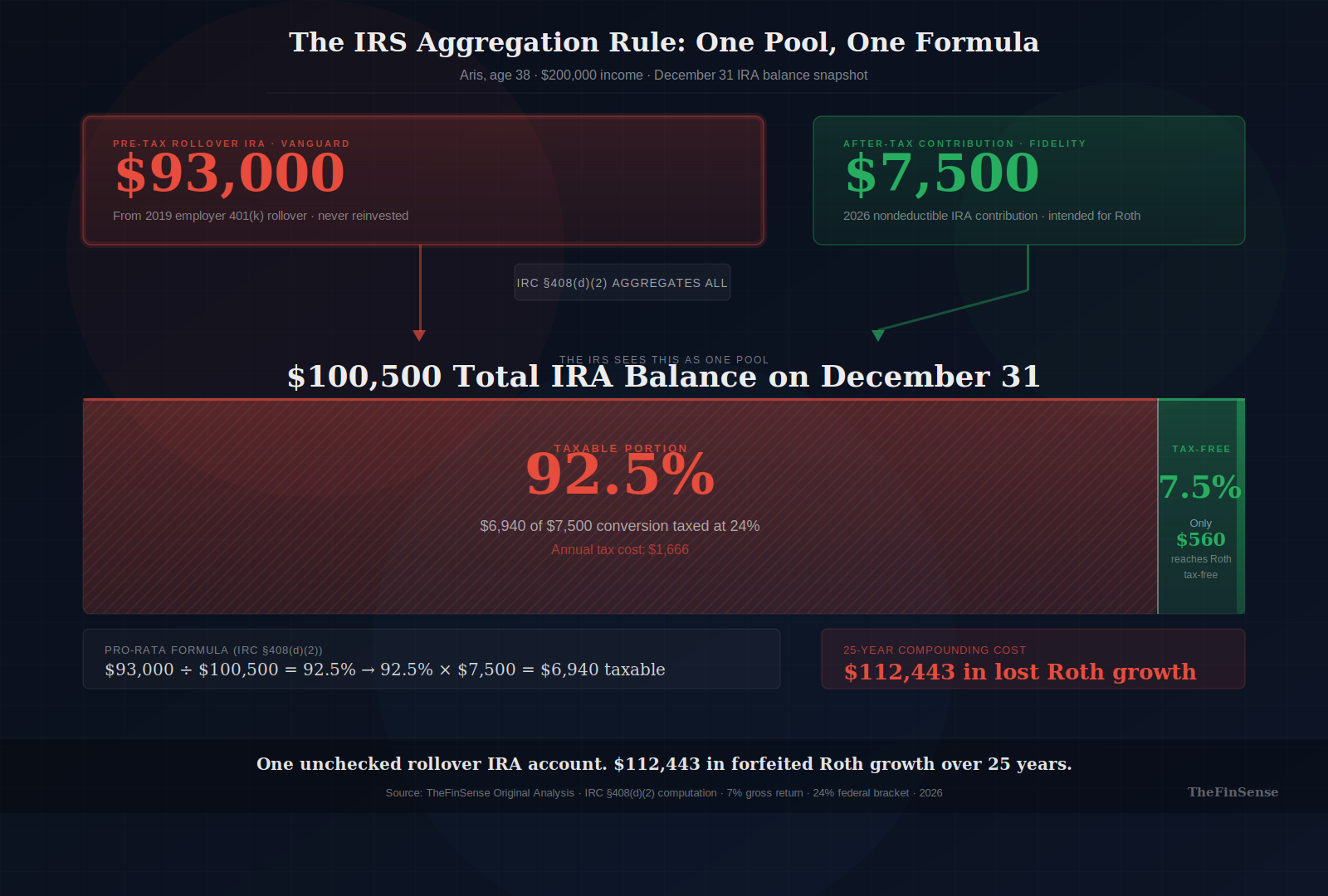
A $93,000 pre-tax IRA plus a $7,500 after-tax contribution creates a $100,500 total balance. $93,000 divided by $100,500 equals 92.5%. Of the $7,500 converted, only $560 qualifies as tax-free.
The remaining $6,940 is taxed at the investor’s ordinary income rate. At a 24% federal bracket, the annual tax cost of each backdoor Roth IRA rules conversion reaches $1,666 per year.
Before Kitces documented the IRC §408(d)(2) computation in 2015, the pro-rata rule was a practitioner secret buried in tax code annotations. His step-by-step mathematical deduction transformed the aggregation rule from obscure statute into the central checkpoint of every backdoor Roth tutorial. This calculation would have been inaccessible to most investors a decade ago.
The withheld $1,500 permanently exits the Roth growth path. The investor discovers the error at tax filing time, 4 to 15 months after the conversion. The fix takes 5 minutes: uncheck the withholding box, pay estimated taxes from a taxable account.
The December 31 Aggregation Rule
The IRS uses your December 31 balance across all traditional IRA accounts to calculate the pro-rata ratio. A rollover IRA at Vanguard and a traditional IRA at Fidelity are treated as one pool. SEP IRAs and SIMPLE IRAs are included in the same aggregation.
No custodian warns you about balances held at competing firms. The aggregation happens on Form 8606, not on the brokerage conversion screen. Compare this drag to what advisory fees compound to over the same period.
The Form 8606 Lock-In
Form 8606 Part I tracks your cumulative nondeductible IRA contributions. Part II reports the taxable portion of each Roth conversion using the December 31 aggregate balance. The pro-rata computation under backdoor Roth IRA rules produces a specific number on Line 19 that the IRS matches against your 1099-R.
William Reichenstein, CFA, Baylor University retirement tax researcher, co-authored a 2020 study with William Meyer, CEO of Retiree Inc.
Their research demonstrated that optimal Roth conversion timing adds up to 3% in net return for high-income households. The pro-rata rule eliminates that advantage for every contaminated conversion.
“Investors cannot isolate after-tax contributions in a separate IRA to avoid the pro-rata rule. The IRS aggregates all traditional IRA balances regardless of how many accounts or custodians are involved.”
— Ed Slott, CPA, America’s IRA Expert | Morningstar
An investor who opens a separate traditional IRA solely for the $7,500 after-tax contribution expects to convert that account in isolation. The IRS aggregates both accounts into one $100,500 pool, and 92.5% of the conversion is taxable regardless of which IRA held the after-tax money.
The IRS does not see two separate IRA accounts; it sees one pool of $100,500 where $560 qualifies as tax-free.
Formula: FV_total = PMT × [((1+r)^n − 1) / r] where PMT = $625/mo (Path A) or $486.19/mo (Path B), r = 0.07/12, n = 300 months
Model: LUMP_PLUS_CONTRIBUTION — two-path FV comparison; Path A (clean backdoor) vs Path B (contaminated with 92.5% pro-rata drag)
Assumptions: Initial Balance $0 / Annual Contribution $7,500 / Horizon 25 years / Gross Return 7% / Federal Bracket 24% / Pre-Tax IRA $93,000
Does not apply to: MFJ filers (different income thresholds), households expecting a 2+ bracket retirement drop, investors already at $0 pre-tax IRA balance
Regulatory catalyst: IRC §408(d)(2) (permanent); TCJA 2017 + OBBBA 2025 (backdoor Roth pathway preserved); IRS IR-2025-111 (2026 contribution limit $7,500)
Together, Reichenstein and Meyer’s FPA Journal research and Kitces’s IRC §408(d)(2) aggregation analysis establish both the theoretical Roth conversion value and the mechanical threshold that converts it into a 92.5% taxable event.
The formula exposes the mechanism. The cost of running it across 25 years of conversions remains uncalculated.
Aris’s $93,000 Rollover: How $112,443 Disappeared in 25 Years
Aris’s $93,000 rollover triggered the $112,443 gap.
Aris opened the Fidelity app the morning after their first $200,000 W-2 arrived. They had followed every backdoor Roth tutorial: contribute $7,500 to a traditional IRA, convert immediately, pay zero tax. They clicked Convert to Roth and watched the confirmation screen load.
The Convert to Roth confirmation loaded in green. No warning fired about the Vanguard rollover IRA sitting three tabs away.
Three tabs away sat their Vanguard rollover IRA statement from a job they left four years ago. They had not opened that tab in months.
| Parameter | Value |
|---|---|
| Age | 38 |
| MAGI (Single) | $200,000 |
| Pre-Tax Rollover IRA | $93,000 |
| Annual Backdoor Roth | $7,500 |
| Investment Horizon | 25 years (age 63) |
| Gross Return | 7% annually |
| Federal Tax Bracket | 24% |
Estimate the 25-year cost of the pro-rata rule on a $7,500 annual backdoor Roth. Most guess $5,000 to $20,000.
| Year | Path A: Clean Backdoor | Path B: Contaminated | Cumulative Gap | What That Gap Buys |
|---|---|---|---|---|
| 0 | $0 | $0 | $0 | — |
| 5 | $44,746 | $34,808 | $9,938 | ~2 years of monthly rent at the national average |
| 10 | $108,178 | $84,153 | $24,025 | ~1 year of childcare for a single child |
| 15 | $198,101 | $154,105 | $43,996 | ~8 years of monthly groceries |
| 20 | $325,579 | $253,271 | $72,308 | Full undergraduate tuition at a public in-state university |
| 25 | $506,295 | $393,852 | $112,443 | 19.7 years of groceries at the BLS single-person average |
Backdoor Roth IRA Rules: Two Growth Paths Over 25 Years
Aris, age 38, $200K income, $7,500/yr backdoor Roth, 7% gross return, 24% bracket
A Bogleheads forum user discovered the same arithmetic after executing a backdoor conversion without checking their IRA balances. The thread documented a rollover IRA from a previous employer rendering the conversion predominantly taxable. The realization arrived at tax filing time, months after the conversion was complete.
The pattern repeats across custodians and income levels. Every investor who carries a pre-tax IRA balance into a backdoor Roth conversion faces the same backdoor Roth IRA rules computation under IRC §408(d)(2). The individual circumstances vary. The formula does not.
The numbers close in. The gap stops being theoretical.
$506,295 in clean Roth growth. $112,443 vanishes to pro-rata tax.
The threshold Aris crossed each January carried a toll they calculated only now.
The $112,443 gap equals 19.7 years of groceries at the BLS single-person average for a single-person household. The cost did not arrive in a single year. It compounded across 25 consecutive conversions, each one losing $1,666 to a tax provision Aris could have eliminated with one phone call.
The same compounding drag that erodes returns through advisory fee drag operates here through the pro-rata rule. The difference: advisory fees require negotiation to reduce. The pro-rata drag requires one account transfer to eliminate entirely.
📐 YOUR NUMBERS MAY DIFFER
This calculation assumes 7% gross returns and a 24% federal bracket. Here is how the 25-year gap changes under different assumptions:
| Variable | Assumption | 25-Year Gap | Conclusion |
|---|---|---|---|
| Gross Return | 5% | $82,660 | Gap persists at lower returns |
| Gross Return | 7% | $112,443 | ✅ Base case |
| Gross Return | 9% | $155,618 | Higher returns amplify the gap |
| Tax Bracket | 22% | $103,073 | Slightly lower drag |
| Tax Bracket | 24% | $112,443 | ✅ Base case |
| Tax Bracket | 32% | $149,924 | ⚠️ Fix immediately at this bracket |
$1,666 per year becomes $112,443 across 25 years because the lost contribution compounds at the same rate as the Roth itself.
Your 15-Minute Pro-Rata Threshold Test: Backdoor Roth IRA Rules Fix
Eliminating the drag takes one phone call and one account balance check before December 31.
The IRC §408(d)(2) aggregation rule created the $112,443 gap. The same rule defines the exit: reduce total pre-tax IRA balances to $0 before year-end. The following four steps constitute the Pro-Rata Threshold Test. This 15-minute sequence converts every future backdoor Roth IRA rules conversion from contaminated to clean.
Step 1: List Every IRA Balance (3 Minutes)
Log into each brokerage where you hold a traditional, SEP, or SIMPLE IRA. Vanguard displays these under My Accounts; Schwab shows them under Accounts → Positions. Record the current pre-tax balance for each account. Include rollover IRAs from previous employers, even if the balance is small or the account has been dormant for years.
The IRS aggregates balances across all custodians on December 31. A $12,000 rollover IRA at a brokerage you no longer use carries the same pro-rata weight as a $200,000 SEP IRA at your primary custodian.
Step 2: Calculate Your Pro-Rata Percentage (5 Minutes)
Add all pre-tax IRA balances from Step 1. Add the $7,500 after-tax contribution you plan to convert. Divide the pre-tax total by the combined total.
If the result is 0%, your backdoor Roth IRA rules conversion is clean. Any percentage above 0% means the IRS will tax that portion of every dollar converted at your ordinary income rate.
Step 3: Initiate the Reverse Rollover (5 Minutes)
Call your current employer’s 401(k) plan administrator and request a reverse rollover of your traditional IRA pre-tax balance into the 401(k). Not all plans accept incoming rollovers. Confirm eligibility before initiating the transfer.
The reverse rollover moves pre-tax IRA dollars into the employer plan, removing them from the December 31 aggregation pool. The 401(k) that receives the rollover has its own vesting rules. The 401(k) balance does not count in the pro-rata calculation.
If your employer plan does not accept incoming rollovers, a solo 401(k) for self-employment income is the alternative destination. The objective is identical: $0 in traditional IRA pre-tax balances before December 31.
Backdoor Roth IRA Rules: The Pro-Rata Decision Tree
Check your December 31 IRA balance before every conversion
{“from”:”n1″,”to”:”n2″},{“from”:”n2″,”to”:”n3″,”label”:”Yes”},
{“from”:”n2″,”to”:”n5″,”label”:”No”},
{“from”:”n3″,”to”:”n4″},
{“from”:”n4″,”to”:”n5″}
]’
style=”width:100%;max-width:720px;”>