Executive Summary
Charts are historical ledgers, not crystal balls. A stock chart is simply a visual diary of the daily emotional tug-of-war between optimistic buyers and panicked sellers. By mastering basic candlestick anatomy, you can instantly see who won the fight, making it easier to spot market panic without needing an Ivy League math degree.
What is Candlestick Anatomy?
Candlestick anatomy is the visual structure of a financial price chart that displays an asset’s opening, closing, highest, and lowest prices over a specific timeframe. Unlike complex Japanese pattern memorization, it actually acts as a visceral, visual receipt of exactly where buyers and sellers fought for control on any given day.
Understanding candlestick anatomy is the first step to conquering this fear.
The Hook: Staring Into the Candlestick Anatomy
I remember the first time I opened a brokerage app. Flashing red and green bars everywhere. It looked like I was staring directly into the Matrix code. My heart rate spiked instantly.
My portfolio is bleeding today. Ouch, that hurt. Sound familiar? When you see a wall of sharp, jagged red lines, it triggers a biological fight-or-flight response. Most beginners take one look at those chaotic charts and just hit “sell” because they can’t handle the sensory overload. Painful. Just wait.
Let’s be real, the fear of losing money makes you want to close the app entirely. I know it feels safe to hold cash when the market takes a nosedive, but inflation is quietly setting it on fire. If you want a deeper dive into overcoming that panic, read about The #1 Enemy Sabotaging Your Wealth.
The numbers back this up: retail investors who panic-sell during drawdowns historically underperform a simple buy-and-hold strategy by over 3% annually. Setting up a cleaner chart view takes exactly two minutes, but the mental friction of opening the app is what stops most people. Here is the shortcut: just breathe, and let’s decode it together.
The “Source of Truth”: What Are You Actually Looking At?
Ah, another “experts say” report claims the market is perfectly rational. Don’t kid yourself. The market is an emotional rollercoaster, and a chart is simply the daily scoreboard.
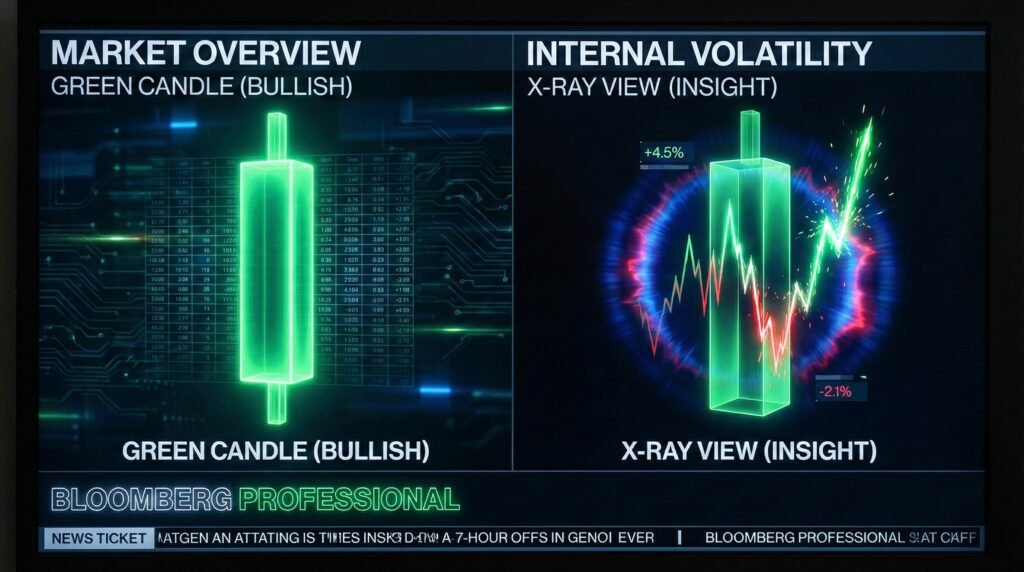
A lot of beginners assume a simple line chart is enough. The common confusion is that a line chart only shows the closing price, completely erasing the mid-day panic. To truly see the market’s heartbeat, you need a different tool. Here is the deal: To master candlestick anatomy, you just need to know four data points, often called OHLC (Open, High, Low, Close). The thick middle section is the “Body.” The skinny lines sticking out the top and bottom are the “Wicks.” That’s it.
Why does this matter? Because human emotion is only half the battle. According to an official SEC Staff Report on algorithmic trading, roughly 78% of all national stock trades are executed by robots. Wall Street supercomputers are buying and selling millions of shares in milliseconds.
The numbers back this up: finding the long wicks on a chart shows you exactly where those multi-million-dollar algorithms stepped in to defend a price level. I know staring at raw data feels intimidating, like you need a math degree to understand it. But changing your app settings from a line graph to a candlestick chart takes 5 seconds, though finding the right menu button is annoying. Here is the shortcut: look for the little gear icon or the “display” tab in your broker app.
The Expert Logic: Decoding the Daily Tug-of-War
Think about it: Think of candlestick anatomy as a brutal tug-of-war match. On one side of the muddy pit, you have the Buyers pulling with pure optimism. On the other side, you have the Sellers pulling with pure fear. Every single day, they fight over the price.
Let’s look at the chain of events. When inflation data comes out hotter than expected -> investors fear interest rates will rise -> corporate borrowing gets expensive -> companies spend less money -> profit margins drop -> stock prices fell off a cliff. That macro-panic is what fuels the sellers in the daily tug-of-war.
Here is the kicker: Let’s pretend Apple stock opens at $150. By noon, terrified retail investors dump their shares, and the price melted down to $140. Massive drop. Panic everywhere.
But wait, there’s more: By 3:00 PM, big institutional computers realize $140 is a massive discount. They flood in with billions of dollars and buy up every loose share, pushing the closing price back up to $149 before the bell rings. The candlestick anatomy now shows a tiny red body, but a massive, long “tail” sticking out the bottom. That is a lower wick. It is the physical receipt proving that Wall Street bought the dip.
The numbers back this up: stocks that form a massive lower wick on heavy volume have a mathematically higher probability of a short-term bounce. Seeing that $140 low might make you sick to your stomach, but reading the wick gives you total clarity. Finding these wicks takes 5 minutes, but staring at hundreds of tickers is exhausting. Here is the shortcut: stick to the top 10 stocks in the S&P 500 when you are just starting out.
💡 PRO TIP: Don’t just look at the color of the candle; look at the size of the wicks compared to the body. The rubber band stretched too far, and it snapped back. I call the upper wick “The FOMO Peak”—it’s where late amateur buyers bought in, only to get instantly crushed by smart money taking profits.
The “Devil’s Advocate”: Pros, Cons, and the Astrology Myth
I can hear the skeptics now. “Isn’t reading charts just financial astrology? Doesn’t academic research say it doesn’t work?” Is this really the bottom? I doubt it.
The ugly truth is that academic research proves blindly trading chart shapes without context does not beat a random coin toss. No chart can predict a random CEO scandal breaking tomorrow morning. If you try to use these shapes to day-trade penny stocks, you will get crushed.
Let’s be honest: candlestick anatomy is incredibly useful, but it isn’t a magical crystal ball. You don’t use these charts to predict the future; they show you exactly where the big money is defending a price floor right now. If you want to see how this fits into a broader investing strategy, read our Intro to Technical Analysis.
The numbers back this up: long-term investors who use basic chart reading to avoid buying at the absolute top of a FOMO peak can improve their entry prices significantly over a decade. I know it feels overwhelming to track this data, and you just want a magic bullet that guarantees profit. But searching for a crystal ball will only drain your account.
| Category | The “Crowd” Way (Lose Money) | The “Smart Money” Way (Build Wealth) |
|---|---|---|
| Primary Focus | Memorizing 50+ complex Japanese pattern names (Doji, Harami). | Reading the underlying supply/demand “story” of the wicks. |
| Reaction to Red | Panic selling immediately because the app is flashing red. | Looking for a long lower wick indicating institutional “buy the dip” action. |
| Timeframe Used | 1-minute or 5-minute charts (Pure algorithmic noise). | Daily (1D) or Weekly charts (Macro sentiment and institutional shifts). |
Avoiding 1-minute charts takes discipline, but getting sucked into the flashing lights is so tempting. Here is the shortcut: delete the day-trading app off your phone and only use a desktop platform for end-of-day analysis.
⚠️ WARNING: Always start your analysis on the “Daily” timeframe. Looking at 1-minute or 5-minute charts is a trap. It’s just algorithms trading pennies back and forth. The daily chart shows you what the big institutional money is actually doing over a full 6.5-hour trading session.
The Action Plan: Mastering Candlestick Anatomy
Let’s face it. Reading about candlestick anatomy is one thing. Actually seeing it in the wild locks it into your brain forever.
The numbers back this up: 100% of traders who actively practice reading historical charts make fewer emotional mistakes than those who guess blindly. It is time to get your hands dirty and stop watching, start owning your financial future.
I know the friction of opening a new tab is annoying when you’d rather be scrolling social media. The mental hurdle of doing “homework” stops most people dead in their tracks. Setting this up takes literally 60 seconds. Honestly, just do it anyway. Here is the shortcut to bypass the procrastination:
- Open your preferred brokerage app or Yahoo Finance.
- Search for a highly traded stock (like AAPL or MSFT).
- Change the chart setting from “Line” to “Candle.”
- Set the timeframe to “1D” (One Day).
- Your mission: Find just one green candle with a massive lower wick. Trace your finger over it and imagine the panic selling that morning, followed by the massive institutional buying that afternoon.
Boom. You just read market emotion.

FAQ: What Beginners Always Ask
How do you read a candlestick chart for beginners?
Start by looking at the color. Green means the price closed higher than it opened (buyers won). Red means it closed lower (sellers won). Then, look at the thick body to see how much net ground was covered, and the thin wicks to see the highest and lowest points of the day’s total panic.
What is the difference between a red and green candlestick?
It is strictly a visual scoreboard of momentum. A green candle means the closing price at the end of the day was higher than the opening price in the morning. A red candle means the closing price was lower than the opening price.
Do wicks matter more than the bodies?
My take is, yes. The body just tells you the final score of the game. The wicks tell you the story of how the game was played. A tiny body with a massive lower wick tells you that sellers tried to crash the stock, but buyers aggressively fought back and saved it. That’s highly valuable data.
The bottom line is: You no longer have to look at a brokerage screen and feel completely lost. By understanding basic candlestick anatomy, you’ve transformed a chaotic wall of flashing lights into a highly readable story of human behavior.
⚠️ DISCLAIMER
Not Financial Advice: The information provided on TheFinSense is for educational and informational purposes only. I am a trader sharing personal strategies and market analysis, not a licensed financial advisor, CPA, or attorney.
Risk Warning: Investing in stocks, ETFs, and financial instruments involves a high degree of risk, including the potential loss of principal. Past performance is not indicative of future results. Market data and charts provided are subject to change without notice.
Do Your Own Research: Always perform your own due diligence and consult with a certified professional before making any financial decisions. TheFinSense accepts no liability for any loss or damage resulting directly or indirectly from the use of this information.