📅 Originally Published: · Last Updated:
Two accounts sit side by side on every brokerage screen, each labeled $7,500. Both windows look identical. One of them has frosted glass.
The Bottom Line, Up Front
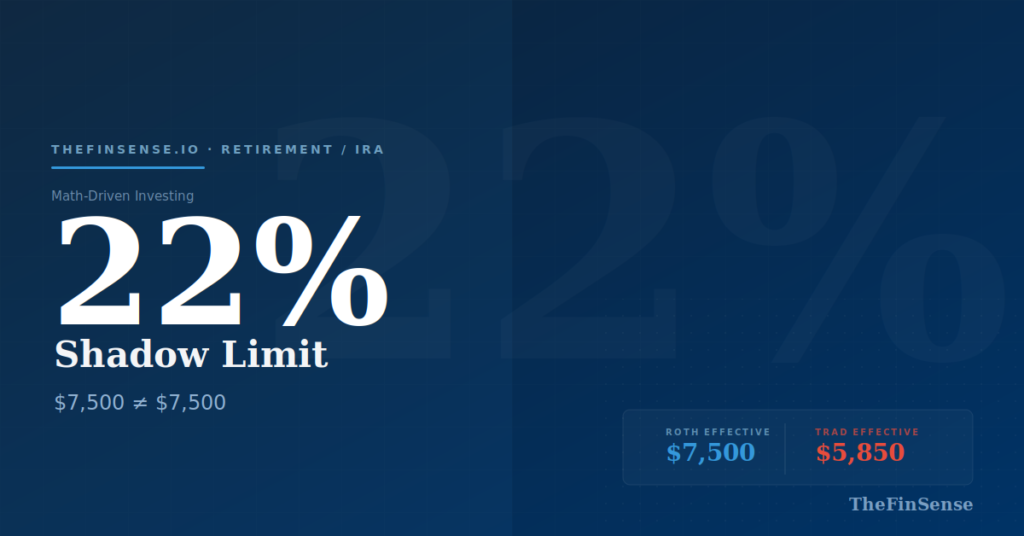
At the 22% federal bracket, a $7,500 Roth IRA contribution shelters $7,500 of retirement purchasing power. The same $7,500 in a Traditional IRA shelters only $5,850, because $1,650 belongs to the IRS at withdrawal. Over 30 years of maximum contributions compounding at 10% nominal, that 22% structural gap produces a $310,817 difference in net retirement wealth.
Every brokerage comparison table frames the Roth vs Traditional IRA decision as a tax-timing choice, and the first number both accounts share is $7,500. At the 22% bracket, that shared number conceals a structural gap in how much retirement wealth each account actually protects.
The 84.4% Assumption: Why Most IRA Investors Accept a 22% Capacity Gap
If your retirement tax rate drops to 12% and you invest every dollar of your annual $1,650 refund into a taxable brokerage for 30 years, the Traditional IRA path produces more retirement wealth than the Roth. The math works. The behavioral evidence that only 40% of Americans save or invest their refund determines whether it works for you.
The Congressional Research Service reports that 84.4% of the $13.6 trillion in U.S. individual retirement accounts sits in Traditional IRAs, with only 10.4% in Roth accounts (2024). The split reflects a reasonable assumption. The IRS publishes one limit, both accounts compound at the same rate, and every brokerage comparison screen confirms the match. Eight in ten IRA dollars accepted this framing as settled arithmetic.
What “Equal Contribution Limits” Actually Mean
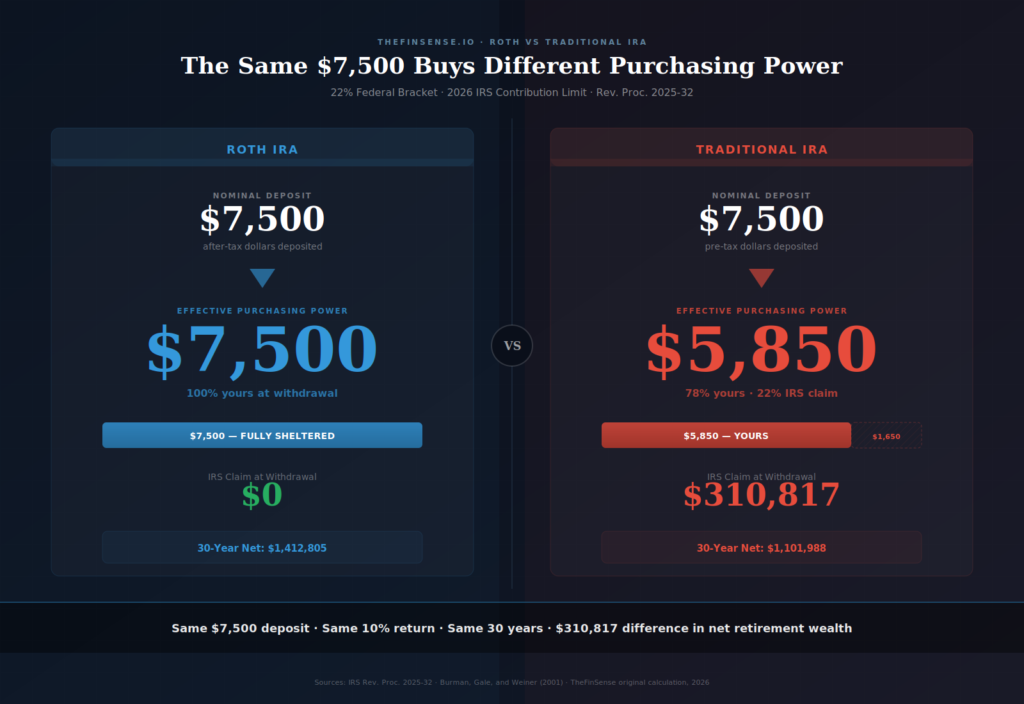
The IRS sets a single ceiling for both account types: $7,500 for 2026, per Revenue Procedure 2025-32, for filers under 50. A contributor in the 22% bracket depositing the maximum into a Roth IRA sends $7,500 of after-tax dollars. Every cent is theirs at withdrawal.
The same contributor depositing $7,500 into a Traditional IRA sends pre-tax income. At withdrawal, the 22% bracket reclaims its share: $1,650 per year of maximum contributions. The account’s effective purchasing power at the point of deposit was $5,850.
Leonard E. Burman, co-founder of the Tax Policy Center and Paul Volcker Chair in Behavioral Economics at Syracuse University, formalized this asymmetry in 2001. His arithmetic showed that back-loaded accounts shelter more real wealth per dollar of nominal limit at any positive bracket. For the 22% filer, every $7,500 Roth deposit buys 22% more retirement purchasing power than the same deposit into a Traditional. The limit is the same; the shelter is not.
The 84.4% Pattern: How 8 in 10 IRA Dollars Ended Up in One Account Type
Traditional IRAs launched in 1974. Roth IRAs arrived in 1998. Every 401(k) rollover defaults to a Traditional IRA. The annual deduction produces a benefit visible on every April return.
84.4% of $13.6 trillion in IRA assets sits in the account type with a 24-year head start and a default 401(k) pipeline. The concentration is not irrational. It is the market optimizing for the number it can see. The invisible number is the one that compounds.
Fidelity’s IRA comparison screen lists both accounts at the same $7,500 contribution ceiling, with no indication that one dollar in the Roth buys 22% more real retirement purchasing power than one dollar in the Traditional.
If both accounts truly sheltered the same wealth, the $13.6 trillion IRA market would not concentrate 84.4% of its assets in the account that contains a hidden 22% IRS claim.
The 35-year-old just starting to max out an IRA sees the $310,817 gap as 30 years of compounding ahead. The 50-year-old with $400,000 already in a Traditional IRA sees it as a conversion decision: pay the 22% now or let the shadow balance grow for 15 more years. The Bogleheads reader who models the refund reinvestment path still faces the behavioral question: do you actually reinvest every dollar, every year, without exception? All three readers share a single denominator: the $7,500 limit on every brokerage screen looks equal and is not.
The number on both contribution screens is $7,500. What does $7,500 actually buy inside each account?
The Shadow Limit: What Burman, Gale, and Weiner Found Inside the $7,500 Ceiling
At the 22% bracket, $7,500 buys $5,850 of retirement purchasing power in one account and $7,500 in the other.
| Account Type | Nominal Limit | Effective (22%) | Shadow Balance | 30-Yr Gap |
|---|---|---|---|---|
| Roth IRA | $7,500 | $7,500 | $0 | — |
| Traditional IRA | $7,500 | $5,850 | $1,650 | $310,817 |
No Roth vs Traditional IRA comparison in the current top-ten search results displays the number in the third column: the effective contribution limit. The IRS publishes the $7,500 nominal ceiling for 2026 in Revenue Procedure 2025-32. Both accounts show the same number. The purchasing power behind that number is not the same.
Multiply the nominal limit by the marginal bracket rate. At 22%, the IRS holds a claim on $1,650 of every $7,500 Traditional IRA deposit, collected at withdrawal. The Roth deposit owes nothing at withdrawal. The gap opens before a single dollar compounds.
▶ Video: Roth vs Traditional IRA by The Retirement Nerds — breaks down the tax-timing decision and when each account type wins.
I kept my Fidelity Traditional IRA at $625 a month for three years before looking through the Shadow Limit math. The 22% bracket had been routing $1,650 a year to the IRS. I opened a Roth the next January.
William G. Gale, Arjay and Frances Miller Chair in Federal Economic Policy at the Brookings Institution, co-authored the 2001 study. In a 2019 follow-up with Aaron Krupkin, he restated the finding:
“Investors who wish to shelter more income per dollar of deposit will find Roth accounts more attractive, owing to their higher effective contribution limits.”
— William G. Gale, Arjay and Frances Miller Chair in Federal Economic Policy, Brookings Institution
The advantage Gale describes is not a tax-bracket bet or a planning optimization. It is a structural feature of the contribution ceiling itself. At any marginal rate above zero, one Roth dollar shelters more retirement purchasing power than one Traditional dollar. The 22% bracket makes the difference $1,650 per year.
Every dollar you deposit into a Traditional IRA at the 22% bracket is 78 cents yours and 22 cents the IRS’s, compounding against you for 30 years.
The Shadow Limit applies at every bracket, but the 22% bracket is where most maxing-out IRA contributors sit, and where the arithmetic is easiest to verify.
The same number printed on both account setup screens produces $7,500 of purchasing power in the Roth and $5,850 in the Traditional, a 22% gap that no comparison table displays.
The mechanism is visible. The compound cost is not. How much does this gap cost over a full career?
How the Shadow Limit Compounds: The Roth vs Traditional IRA Formula
Over 30 years, the 22% gap compounds to $310,817.
The Shadow Limit Formula: How $625 a Month Becomes Two Different Numbers
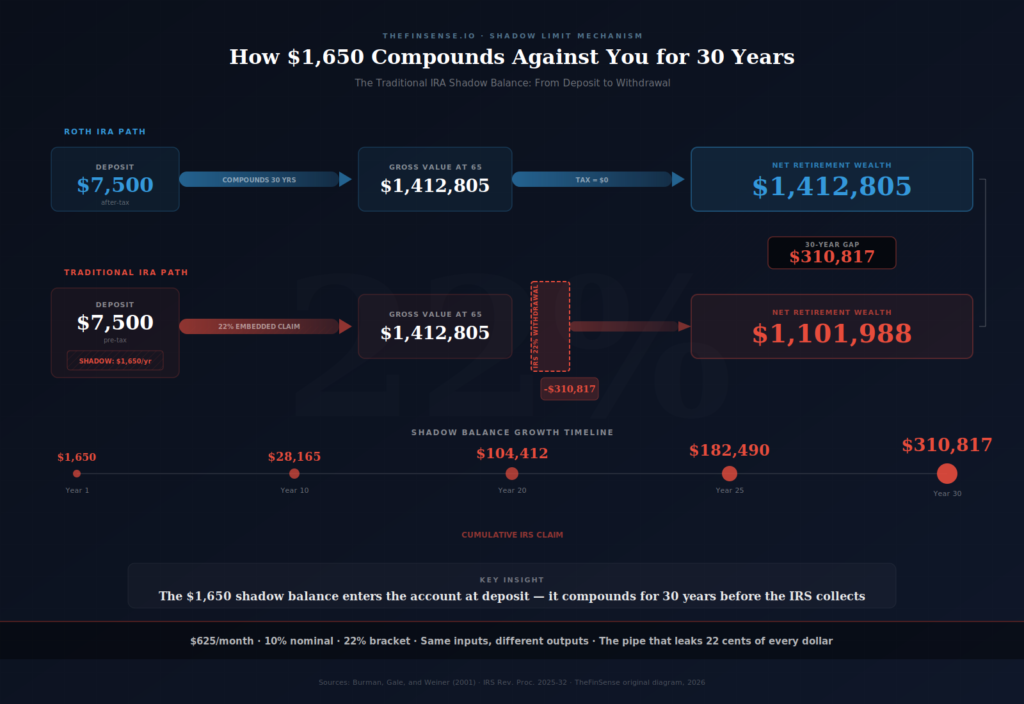
The future-value annuity formula converts a monthly deposit into a terminal balance: FV = PMT × [((1 + r)n − 1) / r]. A contributor depositing $625 per month at 10% nominal (0.8333% monthly) for 360 months hits a multiplier of 2,260.49. The product of $625 and that multiplier is $1,412,805 in gross portfolio value at the end of 30 years. Both accounts reach the same number.
The Roth contributor paid taxes before deposit, so the full $1,412,805 is after-tax purchasing power available at retirement. The Traditional contributor owes 22% at distribution: $1,412,805 × 0.22 = $310,817 returned to the IRS at withdrawal.
The remaining $1,101,988, roughly 78 cents of every dollar in the account, is the only portion that belongs to the retiree. Same deposit, different wealth.
The formula uses identical inputs for both accounts: the same $625 monthly deposit, the same 10% nominal return, the same 360-month horizon. The account that collected pre-tax dollars carries an embedded IRS claim that grows alongside the portfolio for three decades. The gap is $310,817.
Before Burman, Gale, and Weiner (2001), the field treated Roth and Traditional IRAs as interchangeable at equal tax rates. Their proof that back-loaded plans shelter more real wealth per dollar of nominal limit reframed the contribution ceiling as a hidden advantage. Duflo and colleagues (2006) confirmed the practical dimension: most households do not reinvest their tax savings systematically. The arithmetic is no longer disputed.
After running the Shadow Limit math, the next contribution decision takes five minutes instead of the usual auto-renew Traditional default.
What Happens When the Refund Disappears
The Traditional IRA’s theoretical defense relies on a single mechanism: the annual tax refund, reinvested in full, into a taxable account. A contributor in the 22% bracket depositing $7,500 pre-tax receives $1,650 per year in reduced tax liability. Redirecting that $1,650 into a brokerage account for 30 years should, in theory, offset the Shadow Limit entirely. The theory requires perfect execution.
Perfect execution means every refund dollar, every April, routed into an investment account for three decades without a single interruption. Survey data indicates fewer than half of American taxpayers save or invest their refunds at all. Esther Duflo, Nobel Laureate in Economics and MIT professor, tested direct savings incentives (2006) with 14,000 H&R Block clients in a randomized controlled trial. Even front-loaded matching produced only a 4.5x uplift in participation.
The gap between stated intention and actual execution does not narrow over a 30-year horizon, because each missed reinvestment year compounds the loss forward. The offset that makes both accounts equivalent on a spreadsheet requires a behavioral pattern that most American households do not sustain. The spreadsheet closes the gap. The behavior does not.
The refund reinvestment path narrows the gap in theory, but 60% of Americans spend their tax refund on bills and groceries, converting a mathematical offset into a $310,817 behavioral trap.
Roth vs Traditional IRA: The 30-Year Compound Gap Calculated
The compound arithmetic produces three terminal values at year 30. Roth after-tax purchasing power: $1,412,805, fully available at withdrawal with no IRS claim remaining. Traditional after-tax: $1,101,988, a gap of $310,817. The compound trajectory that produces this gap is the same force mapped in visualize compound interest.
The gap is not a rounding artifact, an aggressive assumption, or a product of cherry-picked inputs. Burman, Gale, and Weiner (2001) identified the effective capacity asymmetry that produces it, and the annuity formula confirms the compound output at any contribution level. The same structural principle operates inside every tax-advantaged account holding assets that generate taxable distributions. The parallel cost is dividend tax drag.
The formula is visible and the compound output is calculated. What does this cost a specific person?
Jordan, 35, and the $310,817 Traditional IRA Shadow: A 30-Year Case Study
At 65, Jordan’s Traditional account holds $1,101,988. The 22% bracket took $310,817. The frosted window lifts.
$625 a month over 30 years would produce roughly the same outcome either way. The difference between account types is a tax-rate bet, not a math outcome. Jordan selected the Traditional IRA at 35, informed by a comparison screen that displayed two identical $7,500 limits and no effective capacity column. The screen was not complete.
Jordan’s 30-Year Projection: Roth vs Traditional by the Numbers
Jordan files married filing jointly on $140,000 of household taxable income in the 22% federal bracket for 2026. The monthly contribution is $625, the annual maximum of $7,500 divided by twelve. The portfolio holds a three-fund index allocation compounding at 10% nominal for 30 years. Retirement target: age 65.
Both accounts accept the same $625 deposit and compound to the same gross terminal value of $1,412,805 at month 360. The paths split at distribution.
| Metric | Roth IRA | Traditional IRA |
|---|---|---|
| Monthly Deposit | $625 | $625 |
| Gross Value at 65 | $1,412,805 | $1,412,805 |
| Tax at Withdrawal (22%) | $0 | $310,817 |
| Net Retirement Wealth | $1,412,805 | $1,101,988 |
How the Roth vs Traditional IRA Shadow Limit Costs $310,817 Over 30 Years
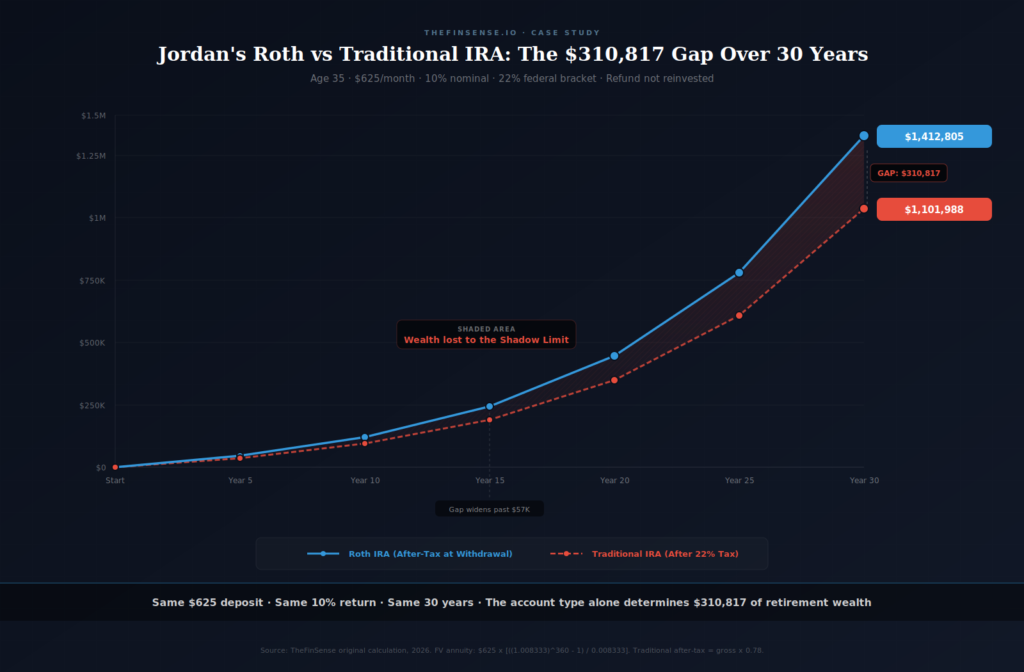
Jordan, 35 · $625/month · 10% nominal · 22% bracket · Refund not reinvested
The Roth line retains every dollar at withdrawal. The Traditional line surrenders 22% of its gross value to the IRS, arriving at $1,101,988. The gap between the two lines is the 30-year compound cost of the Shadow Limit.
The Moment the Gap Becomes Personal
Jordan’s bracket is not rare. The 22% federal rate applies to married filers earning between $100,800 and $211,400 in 2026. At the same contribution rate, the shadow balance accumulates identically for every max Traditional IRA contributor in that bracket. Employer, state, and fund selection do not change the outcome; the variable is the account type.
The calculation uses your bracket and your deposit schedule.
You contributed $625 per month for 30 years. The Roth account grew to $1,412,805. The Traditional account grew to the same $1,412,805, but $310,817 of it was the IRS’s share all along. The gap is not a projection. It is the 22% you agreed to return when you checked the Traditional box.
A $625 monthly contribution, the most ordinary number in retirement planning, generates a $310,817 gap by age 65 based on nothing more than which account type was selected at setup.
The frosted window clears at year 30, and the number behind it is $310,817 smaller than the one you were promised.
What $310,817 Means in Real Terms
Delay the correction by five years after discovering the gap, and the $310,817 compounds to $500,574 at 10% annual growth. The Shadow Limit does not pause while the account holder evaluates the conversion decision. Each year of inaction adds another $1,650 of shadow balance to the compounding base.
In household terms, $310,817 covers 253 months of childcare at the 2024 national average of $1,230 per month. That is 21.1 years of daycare determined by a single checkbox at age 35.
📐 YOUR NUMBERS MAY DIFFER
Jordan’s projection assumes the 22% marginal rate persists at withdrawal and the annual refund is not reinvested. Here is how the Roth vs Traditional IRA gap changes at other retirement brackets.
| Retirement Rate | Shadow Limit Gap | Conclusion |
|---|---|---|
| 12% (refund spent) | $169,537 (Roth wins) | Roth advantage narrows but holds |
| 22% (base case) | $310,817 (Roth wins) | ✅ Base case |
| 12% + perfect reinvestment | Traditional wins by ~$44,000 | Break point: verified annual reinvestment required |
The return rate shifts the gap in scale, not in direction. At 7% nominal, the Roth vs Traditional IRA gap narrows to approximately $145,000. At 12%, it exceeds $530,000. The Shadow Limit exists at any positive return and scales with compounding duration.
Before the Tax Cuts and Jobs Act of 2017, the equivalent bracket was 25%. At that rate, the annual shadow balance was $1,875 instead of $1,650. The gap is smaller today than it was eight years ago.
The projection is complete and the variables are mapped. The question that remains is not whether the gap exists, but what to do about it.
The Shadow Limit Calculator: Four Steps to Roth vs Traditional IRA Clarity
The Shadow Limit is calculable. Four steps close it.
Bogleheads forum contributors identified the Roth effective contribution limit advantage years ago. The recurring assumption in those discussions is that investing the Traditional IRA refund eliminates the gap entirely. The recognition is correct. The behavioral assumption is where the calculation breaks down.
Roth conversions trigger a visible tax bill in the current year. The Shadow Limit accumulates invisibly inside the Traditional account for decades. The Burman framework reverses the framing: the conversion tax is a known, one-time cost, and the shadow balance is an unknown, compounding one.
Roth vs Traditional IRA: The Shadow Limit Calculator Workflow
Four decision nodes from bracket identification to account selection
Step 1: Identify Your 2026 Marginal Bracket (5 Minutes)
Pull your most recent tax return or W-2. Subtract the 2026 standard deduction of $32,200 (MFJ) from household gross income. Locate the result on the IRS 2026 bracket table published in Revenue Procedure 2025-32. The number that matters is the marginal rate on the last dollar of taxable income.
For married filers, the 22% bracket covers taxable income between $100,800 and $211,400 in 2026. A household earning $140,000 in gross wages lands at $107,800 in taxable income after the standard deduction. That places Jordan, and most dual-income professionals maximizing IRA contributions, squarely in the 22% band.
Step 2: Calculate Your Personal Shadow Balance (5 Minutes)
Multiply the 2026 IRA limit by your marginal rate. At 22%: $7,500 × 0.22 = $1,650. That figure is your annual shadow balance, the portion of each Traditional IRA maximum contribution that belongs to the IRS at distribution. The Roth deposits the same $7,500 with a shadow balance of zero.
Every January, the first action is calculating the current year’s shadow balance before the contribution hits the account.
At 24%, the shadow balance rises to $1,800 per year. At 32%, it reaches $2,400. The effective capacity advantage of the Roth widens with every bracket increase because a larger fraction of each Traditional dollar is spoken for at withdrawal.
Step 3: Assess Your Refund Reinvestment Reliability (10 Minutes)
Open your bank or brokerage statements from the last three Aprils. Count the years in which the full tax refund was deposited into an investment account within 30 days of receipt. If the count is three out of three, the refund reinvestment offset is plausible for your household. If it is two or fewer, the behavioral gap identified by Duflo and colleagues applies.
The assessment is binary: either every refund dollar was invested every year, or the Traditional IRA’s theoretical equivalence was not achieved. Partial reinvestment narrows the gap. It does not close it. The compound cost of each missed year accumulates forward for the remaining horizon.
The conversion tax you pay this year to recover $1,650 of effective capacity is a one-time cost; the Shadow Limit compounds against you for every year you delay.
Step 4: Apply the Shadow Limit Decision (15 Minutes)
If your refund reliability is below three out of three years, contribute to the Roth first. This applies as long as your income falls within the Roth IRA eligibility limit. The effective capacity advantage requires no behavioral condition to sustain. The full $7,500 is yours at withdrawal.
If your modified adjusted gross income exceeds the Roth eligibility threshold ($230,000 MFJ in 2026), execute a backdoor Roth conversion. Make a non-deductible Traditional IRA contribution and convert to Roth promptly. The pro-rata rule applies if existing pre-tax IRA balances exist, so roll those into a 401(k) first if the plan allows it.
If your refund reinvestment record is verified at three out of three years, check your expected retirement bracket. If it falls at least 10 percentage points below your current rate, the Traditional path can produce a higher terminal balance. TheFinSense’s Shadow Limit Calculator distills this into a single comparison: effective capacity with verified reinvestment against effective capacity without it. The output is a dollar figure, not an opinion.
Once the IRA decision is settled, the same effective capacity logic applies to asset placement between tax-advantaged and taxable accounts. The structural principle that governs where bonds belong in a portfolio is covered in how bonds work. The vehicle you hold inside the IRA carries its own cost layer, covered in etfs vs mutual funds.
The same penalty calculus that governs an overfunded 529 plan applies to every tax-advantaged account with an early withdrawal cost.
When This Analysis Does Not Apply
This analysis holds for the 25-30% of IRA contributors who max out their annual limit. Burman, Gale, and Weiner identified that the effective capacity advantage vanishes for investors contributing below the $7,500 ceiling. If you contribute less than the maximum: the Roth vs Traditional decision reverts to a pure tax-rate comparison.
If your annual IRA contribution is below $5,000, skip the Shadow Limit calculation entirely and focus on whether your retirement tax rate will be higher or lower than today’s rate.
Roth vs Traditional IRA: Frequently Asked Questions
Is the Shadow Limit still real if I expect my retirement tax rate to be lower than 22%
The Shadow Limit scales with the bracket rate. At 12%, the effective capacity gap shrinks to $900 per year ($7,500 × 0.12), and the 30-year compound gap narrows to approximately $169,537. Traditional wins only if the retirement rate drops below the contribution-year rate AND the refund is reinvested annually for the full horizon. The gap exists at every bracket above 0%.
How does the backdoor Roth conversion work for high earners above the income limit
Open a Traditional IRA on your brokerage platform (Fidelity: Accounts > Open an Account > Traditional IRA). Contribute $7,500 as non-deductible, then convert to Roth within the same platform (Fidelity: Account > Transfer > Convert to Roth IRA). Execute within days to minimize taxable gains on the unconverted balance. The pro-rata rule applies if pre-tax IRA balances exist elsewhere. Roll those into a 401(k) first if the plan allows it.
Does the Shadow Limit calculation change if I have a 401(k) and a Traditional IRA simultaneously
The Shadow Limit calculation is IRA-specific. The $7,500 IRA limit and the $23,500 401(k) limit for 2026 are separate ceilings. If your employer plan is a Traditional 401(k), the same effective capacity asymmetry applies at that scale. Maximizing the Roth 401(k) option, if offered, recovers effective capacity at the employer-plan level. The calculator works identically for either account ceiling.
What is the 5-year rule for Roth conversions, and does it affect the Shadow Limit math
Converted amounts must stay in the Roth for five years before penalty-free withdrawal if you are under 59½. The rule creates a liquidity constraint, not a return constraint. Converted dollars still compound tax-free during the waiting period. For most contributors converting before 55, the five-year window closes well before retirement. The Shadow Limit math is unaffected.
At what marginal tax rate does the Traditional IRA become mathematically superior to the Roth, even without reinvesting the refund
It does not, at any bracket above 0%, without refund reinvestment. The Traditional IRA’s effective contribution limit is reduced by the marginal rate at every positive bracket. Without the refund reinvested, the Traditional contributor shelters less real wealth per dollar of nominal limit. The break point requires both a lower retirement rate and verified, systematic refund reinvestment sustained for the full compounding horizon.
Roth vs Traditional IRA: The Bottom Line on the Shadow Limit
The 22% shadow balance is $1,650 a year, compounding for 30 years.
At the 22% bracket with maximum IRA contributions, the Traditional IRA does not shelter the same wealth as the Roth. It shelters 22% less per dollar of nominal limit. Over 30 years, that difference compounds to $310,817. The number is a calculable output from IRS-published brackets and standard compound interest.
Traditional wins under one condition: the retirement tax rate drops at least 10 percentage points and every refund dollar is reinvested annually for 30 years. The behavioral evidence says most investors do not sustain that pattern.
The $310,817 is one household’s cost. Multiply it by the 84.4% of IRA assets locked in Traditional accounts, and the Shadow Limit becomes a national wealth transfer.
The contribution limit that looks equal protects $7,500 of your wealth in one account and only $5,850 in the other.
Multiply Jordan’s $310,817 by the 84.4% of $13.6 trillion in IRA assets concentrated in Traditional accounts. The Shadow Limit is not one household’s planning oversight. It is a structural feature of the retirement system, operating inside identical contribution screens. Real purchasing power transfers from account holders to future tax collections at a scale no single household can reverse.
The number on the contribution confirmation screen just became two different amounts.
What does dividend taxation extract from the same retirement account?
📌 Next Read: Dividend Tax Drag: The Hidden Cost Inside Your Retirement Portfolio
Look through the clear pane first.
YOUR TURN
What determined your Roth vs Traditional IRA choice: the comparison table on your brokerage screen, or the effective capacity math?