

📅 Originally Published: · Last Updated:
401k employer match vesting determines how much employer money you can keep when you leave a job. Your own elective deferrals are always fully vested. Employer matching and profit-sharing money may vest at once or under a cliff or graded schedule. Before you accept a new start date, check each employer contribution source, find the unvested amount, and compare it with the new offer. Future-value estimates can show the long-run stakes, but they are planning models rather than guaranteed costs.
Is the Employer Match Actually Yours?
A retirement-plan dashboard can mix money you own with employer money that is still conditional. Your salary deferrals and their earnings belong to you. Employer contributions may not. Check their vesting status apart from the total balance and from the contribution limits that govern how much can enter the plan. The IRS uses vesting to describe when your right to employer contributions becomes nonforfeitable.
That distinction is easy to miss. In a 2024 Vanguard survey of 1,018 current plan participants, only 33% knew whether their plan had a vesting schedule. Vanguard also reviewed 4.7 million job exits from 2010 through 2022. It found no clear retention effect from vesting, even though workers often gave up unvested money.
| Input status | Next step |
|---|---|
| Confirmed source balance and vested percentage | Calculate the unvested dollars for that source. |
| Confirmed fully vested source | Its vesting forfeiture amount is zero. |
| Unknown or conflicting percentage | Resolve the plan record before relying on a dollar result. |
Confirm the Inputs Before Using the Calculator
Use a confirmed current balance and vested percentage for each employer contribution source, with the same stated as-of date. Record future departure dates and vesting milestones separately. Keep your own salary deferrals out of the forfeiture amount. A hire anniversary alone does not establish the percentage you own.
If those inputs are unclear, ask the plan administrator to confirm the applicable schedule, credited service, and full-vesting rules under your plan documents. Return here with confirmed figures to calculate the immediate dollars at risk and compare the job offer.
To work out which contribution-source rule, credited service, and full-vesting exception apply before using this calculator, use the 401(k) vesting schedule and plan-record worksheet.
How Large Can One Forfeiture Become?
The immediate economic amount at risk is the unvested employer balance. The long-term planning gap is what that money might have grown to if it had stayed invested. Keep those figures separate. The first comes from plan records. The second depends on your return, time, tax, and investment assumptions.
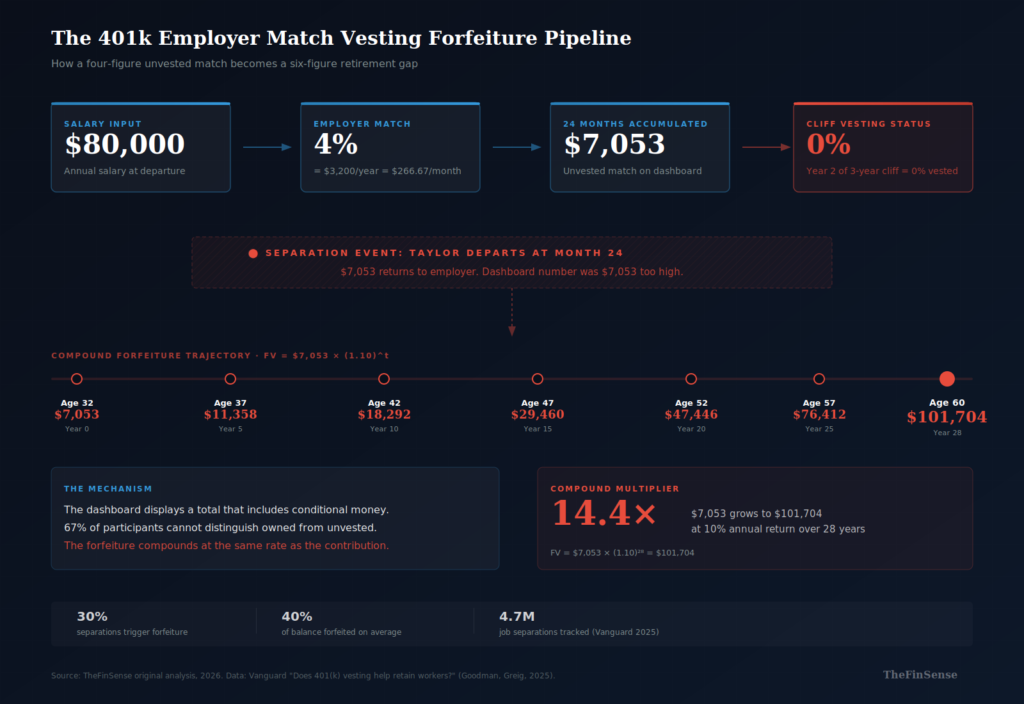
Consider Taylor, a hypothetical 32-year-old earning $80,000. The employer matches 100% of the first 4% of salary and credits the match monthly. The exact monthly input is $3,200 divided by 12, displayed as $266.67. For this model, Taylor has completed exactly two years of vesting service under the plan’s service-credit rules and leaves before the three-year cliff.
If each monthly match earns a nominal 10% annual return compounded monthly during those 24 months, the modeled employer account reaches about $7,052.51. Under the stated cliff assumption, all of that amount is unvested at departure. This is an illustration, not a Vanguard average. Real plan records can differ because of pay, contribution timing, returns, fees, and service-credit rules.
Method in brief: The model uses an $80,000 salary, a 4% annual employer match, the exact monthly contribution of $3,200 divided by 12, 24 end-of-month deposits, and a nominal 10% annual return divided monthly. The resulting $7,052.510764 balance is rounded to $7,052.51. The sensitivity table then compounds that same unrounded balance annually for each stated rate and horizon. Taxes, fees, pay changes, contribution timing differences, and market volatility are excluded, so the outputs are illustrations rather than forecasts.
| Model input | Taylor illustration |
|---|---|
| Age at departure | 32 |
| Annual salary | $80,000 |
| Match formula | 100% of the first 4% of pay |
| Monthly employer contribution | $3,200 ÷ 12 (displayed as $266.67) |
| Contribution period | 24 months; exactly two credited years of vesting service assumed |
| Vesting schedule | Three-year cliff |
| Modeled unvested balance | $7,052.51 |
| Years from age 32 to 60 | 28 |
Vesting Amount-at-Risk Calculator
Use the vested percentages from your plan records. Do not estimate them from calendar tenure alone.
If that balance then grew for another 28 years, it would reach about $46,891 at 7%, $101,704 at 10%, or $168,441 at 12%. These are pre-tax nominal values. The 10% case is deliberately aggressive and should not be treated as a forecast.
Sensitivity check
Future value of the same modeled forfeiture under different assumptions.
| Assumption | Modeled value | What it shows |
|---|---|---|
| 7% for 28 years | $46,891 | A lower return still leaves a material long-term gap. |
| 10% for 28 years | $101,704 | A high nominal return can push the result above six figures. |
| 12% for 28 years | $168,441 | This is an upside illustration, not a reasonable promise. |
| 10% for 20 years | $47,446 | A shorter horizon sharply reduces the compounding effect. |
| 10% for 35 years | $198,193 | A longer horizon magnifies assumption risk. |
For the mechanics behind those projections, see how to visualize compound interest. If a job change also affects IRA planning, review the backdoor Roth IRA rules before moving pre-tax money into an IRA.
How Should You Compare the Loss With a New Offer?
A vesting schedule should not trap you in a bad job. A raise, signing bonus, safer workplace, better career path, improved insurance, or shorter commute can outweigh the unvested match. The better question is what you give up and what the new job gives you in return.
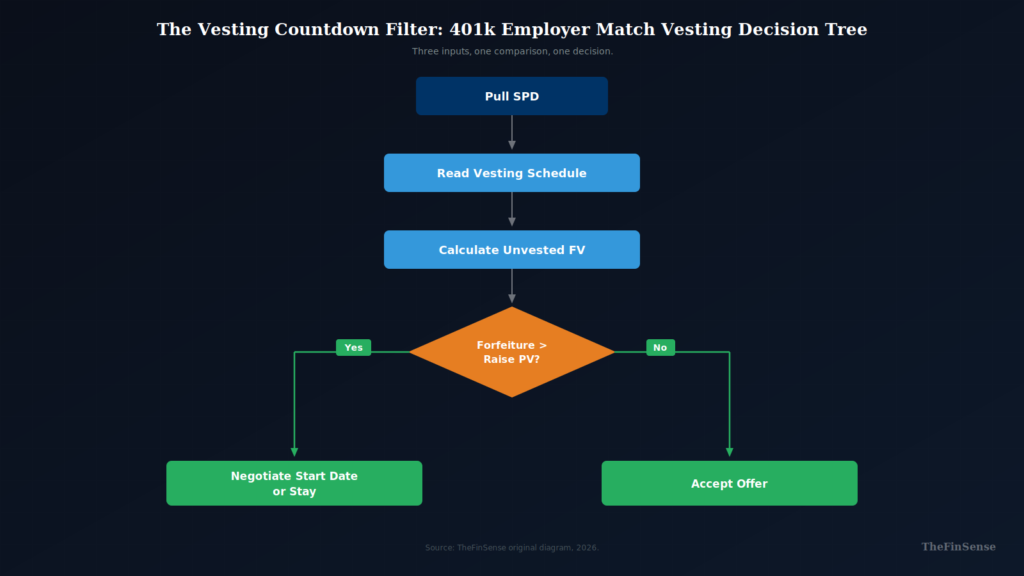
| Step | Question | Decision use |
|---|---|---|
| 1 | What is the unvested employer balance today? | Measures the immediate amount at risk. |
| 2 | When is the next vesting milestone under the plan’s service rules? | Shows whether a negotiated start date could change the result. |
| 3 | What cash pay, benefits, and retirement-plan value does the new offer add? | Keeps cash compensation and retirement-plan dollars distinct before you compare them. |
| 4 | What nonfinancial costs or risks change? | Accounts for health, burnout, commute, layoffs, and career value. |
Read the plan document before doing the math
Ask the plan administrator for each employer-source current balance and vested percentage as of the same stated date. Record any future departure date and next milestone separately. Current and projected values should not be mixed in the same calculation.
Price the immediate loss before the retirement projection
Do the math by contribution source, not on one combined employer balance. For each source, multiply its balance by its own unvested percentage, then add the results. Before a cliff, a covered source may be entirely unvested. You can then model future value with more than one return assumption. Writing the assumptions down, as you would in an investment policy statement, keeps a large projection from looking certain.
Compare both employers on the same basis
- Compare salary and a realistic after-tax estimate of any cash bonus.
- List the employer money that is at risk if you leave now.
- Check the new employer’s match, eligibility delay, and vesting rules.
- Compare health coverage, health savings account (HSA) access, paid leave, commute, and moving costs.
- Consider layoff risk, daily job quality, and long-term career value.
- Ask whether a later start date or signing bonus can offset the gap.
A new HSA can change the benefits comparison, so use the same assumptions in your HSA investment strategy. After you decide to move, review your rollover choices before moving the account.
When Should You Recheck the Calculator Inputs?
Pause the calculation if you cannot confirm a source’s vested percentage or if a plan event could change it. Full vesting leaves no unvested dollars for that source. Required employer contributions in a SIMPLE 401(k) are fully vested. If death or disability is relevant, ask whether your plan grants faster vesting; do not assume that it does. Ask the administrator to resolve any uncertainty before treating a projected forfeiture as a cost of leaving.
Ask the plan administrator to resolve schedule or full-vesting questions under your plan documents. Once the official percentage is clear, rerun the calculator and update the job-offer comparison. The calculator applies your inputs; it does not decide what the plan owes you.
401k Employer Match Vesting FAQ
What happens to an unvested 401(k) match when I leave?
Under the plan’s vesting rules, the unvested employer contribution is generally forfeited under the plan’s terms. Your own elective deferrals and their investment earnings remain fully vested. The plan may keep the forfeited amount in a forfeiture account and use it as permitted by the plan and applicable rules. Check the Summary Plan Description and your official vested-balance record before assuming the entire dashboard balance can be rolled over.
Does it matter whether I quit, am fired, or am laid off?
The circumstances can affect the plan’s treatment, so confirm your vested percentage with the administrator for the actual departure event and date. Do not assume that an earlier estimate still applies. Ask the plan administrator to check the applicable plan provisions if an exception may change the result.
Can an employer take back money I contributed?
No. Employee elective deferrals are always fully vested. The ownership issue concerns employer money, such as matching or profit-sharing contributions, when the plan applies a vesting schedule. Investment losses can still reduce the value of your own account, and plan fees can reduce it over time, but those are not vesting forfeitures.
Is leaving before vesting always a financial mistake?
No. Higher pay, a signing bonus, safer work, better benefits, a shorter commute, or a stronger career path can outweigh the unvested match. Price the employer money at risk first. Then compare cash pay, benefits, and retirement-plan dollars on a consistent basis without pretending they have the same tax timing.
What number should I calculate first?
Start with today’s unvested employer balance, not a future-value projection. That is the concrete amount at risk. Verify it against plan records, source by source, then test more than one future return. Keeping today’s balance separate from the modeled future value helps prevent a high return assumption from looking like a guaranteed loss.
Bottom Line
Employer-match vesting is an ownership rule, not a decorative line in the benefits package. The balance shown on screen may include employer money that is still conditional.
Before changing jobs, verify the schedule and service-credit method, then get the unvested balance for each employer contribution source. Compare those amounts with the new offer. Use future value only as a sensitivity test. A nearby cliff may support a later start date or signing-bonus request, but it should not keep you in a clearly worse job.
A match becomes yours when the plan says it is vested, not when it first appears on the dashboard.
Keep reading: If you are leaving the job, start with rollover to IRA choices. Then review your HSA investment strategy and investment policy statement.
YOUR TURN
Open your plan document and find the exact date or service milestone when your next portion of employer money becomes vested.
- Vanguard research note: Used for the October 2024 participant survey of 1,018 respondents, the 33% awareness result, the analysis of 4.7 million separations across 1,500 plans from 2010 through 2022, and the finding that the study did not detect a systematic retention benefit. Does 401(k) vesting help retain workers?
- Internal Revenue Service, accessed September 24, 2026: Used for SIMPLE 401(k) full vesting. 401(k) plan qualification requirements
- Internal Revenue Service, accessed September 8, 2026: Used for elective-deferral ownership and employer-contribution vesting requirements. Vesting schedules for matching contributions
- Internal Revenue Service, accessed September 8, 2026: Background for checking plan-specific vesting treatment before calculating dollars at risk. Retirement topics: Vesting and Partial plan termination FAQs
Calculator method: The calculator applies each entered vested percentage to that contribution source’s current balance, sums the unvested dollars across sources, and compounds only today’s at-risk total for the optional future-value illustration. It does not infer vesting from calendar tenure or project future contributions.
Scope: The Summary Plan Description and official plan records control an individual result. Contribution type, service-credit rules, normal retirement age, and whether a workforce event qualifies as a partial termination can change the answer.
AI assistance was used for editing and consistency checks. Final factual review, source selection, calculations, and publication responsibility remain with TheFinSense.
Update history
- v1.5 2026-09-24 UPDATE
Focused this article on current dollars at risk and job-offer comparisons, shortened repeated schedule explanations, and clarified dated calculator inputs while preserving the calculator and financial model.
- v1.4 2026-09-09 UPDATE
Aligned the calculator runtime key with the current delivery contract, removed repeated vesting-rule explanation, and simplified decision wording without changing the article’s conclusion.
- v1.3 2026-09-08 UPDATE
Added the vesting amount-at-risk calculator; clarified source-specific vesting math, Taylor’s credited-service assumption, job-offer comparisons, and trust markup.
- v1.2 2026-07-30 UPDATE
Clarified safe-harbor, QACA, additional-match, SIMPLE 401(k), normal-retirement-age, and partial-termination rules; documented the monthly model input; and refreshed supporting links.
- v1.1 2026-07-12 UPDATE
Recalculated the Taylor illustration and expanded service-credit and job-offer guidance.
- v1.0 2025-10-10 PUBLISH
Original publication.