
📅 Originally Published: · Last Updated:
This Guide Answers
- Why does reinvesting 100% of your dividends still generate an annual tax bill?
- What is the exact dollar cost of dividend tax drag on a $100,000 portfolio over 30 years?
- How do you eliminate the annual extraction without changing a single holding?
Every year, your brokerage sends the IRS a check on your behalf—and you almost certainly did not notice it leave. The dividend tax drag is not a line item on your account summary; it is a silent, structural extraction of compounding capital that most retail investors have never quantified. Your dashboard shows 100% reinvested. Your 1099-DIV shows a tax bill for money you never chose to receive. That gap between what you see and what you owe is exactly where the real cost of dividend investing lives—and over 30 years, it compounds into a $589,115 hole on a single $100,000 portfolio.
The mechanism that generates your passive income is the identical force handicapping your portfolio’s ability to compound. Understanding the Total-Return Tax Matrix—a three-step asset location framework—allows taxable investors to preserve dividend income without the annual extraction cycle. The math is not complicated. The cost of skipping it is.
The 1.5% Leak: How the Dividend Tax Drag Destroys Wealth
Most investors believe dividends are free passive income that accelerates wealth. The data shows annual dividend taxes create a compounding drag that strips away hundreds of thousands in terminal wealth. This forced inefficiency costs taxable investors nearly 35% of their potential portfolio value over a 30-year horizon.
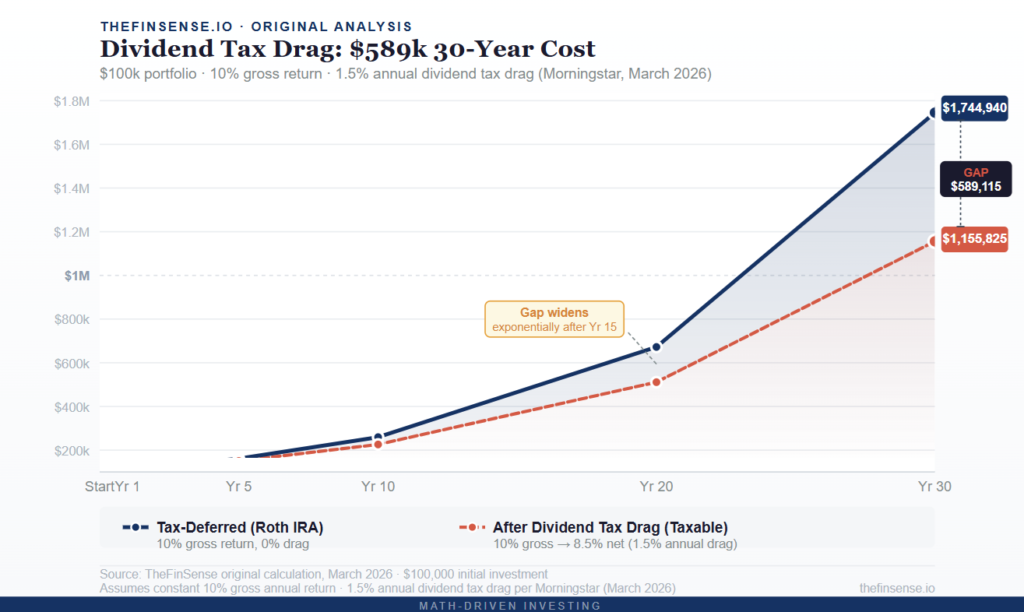
$589,115. That is the exact wealth gap between a taxable dividend investor and an identical investor compounding the same capital without annual tax interruption—not over a century, over 30 years, on a $100,000 starting portfolio. The mechanism producing that gap is not market risk, not bad stock picking, not a poorly chosen fund. It is a structural feature of how dividends are classified under the U.S. tax code, operating in the background of every brokerage account that holds dividend-paying securities.
Here is the part your brokerage statement will never show you: a dividend is not a bonus return appended to your total return. It is a forced distribution—the company or fund extracts cash from its own asset base and deposits it in your account, triggering a taxable event regardless of whether you wanted the cash, needed the cash, or had any intention of spending it. The underlying share price drops by the exact dividend amount on the ex-dividend date, a mechanical adjustment the market calls dividend capture. You received nothing the market did not simultaneously subtract from the share price.
The IRS does not treat this as a wash. Qualified dividends carry a maximum federal tax rate of 23.8% as of tax year 2026 per the IRS—a 20% long-term capital gains rate plus the 3.8% Net Investment Income Tax that kicks in above the NIIT threshold. Ordinary dividends—REIT distributions, most foreign dividends, any dividend from shares held fewer than 60 days—are taxed as ordinary income, with federal rates reaching 37%. Every year that extraction occurs, those tax dollars exit your compounding base permanently. They generate no future return. They do not visualize compound interest—they cease to compound at all.
1.5%
The annual dividend tax drag measured across diversified equity portfolios as of March 2026 per Morningstar—a number that sounds like a rounding error until you run it through three decades of compounding.
The forced distribution mechanism does not consult your financial plan. It does not check your tax bracket, your liquidity needs, or your intention to hold for 40 years. It fires automatically—every quarter, every distribution cycle—and the IRS issues the bill the following April. The question most dividend investors never stop to ask is the one that costs them the most: why am I being taxed on money I never chose to receive?
The Reinvestment Trap: Why DRIP Does Not Save You
The IRS does not care whether you wanted the cash or not. The moment a dividend is declared inside your taxable brokerage account, the tax obligation is created. What happens next—whether you spend it, reinvest it, or let it sit in a money market sweep—is irrelevant to the calculation that appears on your 1099-DIV in January.
This is the structural illusion behind Dividend Reinvestment Plans (DRIP): the portfolio dashboard shows 100% reinvested, creating the visual appearance of seamless, unbroken compounding. What the dashboard does not show is the parallel transaction happening off-screen. Every dollar of dividend reinvested in December still generates a taxable event in the eyes of the IRS. You owe tax on the gross dividend received, not on the net shares purchased. That tax payment comes from somewhere—and that somewhere is always either your checking account or your future compounding base. There is no third option.
The Invisible Cash Drain Behind 100% Reinvested
According to Morningstar’s analysis of dividend tax impact, the annual drag across diversified equity portfolios runs at approximately 1.5% as of March 2026. Investors who spend months analyzing a 0.03% expense ratio difference between two index funds are, simultaneously, absorbing a 1.5% tax drag in the same account without a second thought. The reason is straightforward: the expense ratio appears on the fund’s fact sheet. The tax drag appears nowhere—until April.
50×
The annual dividend tax drag (1.5%) is 50 times larger than the expense ratio of a low-cost index ETF (0.03%)—yet it receives a fraction of the analytical attention, because it appears on a different document, three months after the fact.
Your brokerage’s default DRIP setting is not designed against you. It is indifferent to your tax position. What it produces is a quiet annual extraction: you pay taxes on dividends that never hit your checking account, using cash you must source from somewhere else in your financial picture. That external cash drain is the fee drag comparison made concrete. Where the $23,647 fee drag of a high-expense mutual fund destroys wealth through visible cost, dividend tax drag destroys it through forced extraction on the gains themselves—while the account summary continues to show a climbing share count and a rising portfolio value. The two numbers are not the same story.
▶ Video: The Irrelevance of Dividends by Ben Felix (Common Sense Investing) — A rigorous breakdown of why dividend payments represent forced capital distributions with real tax consequences, not additional returns appended to total performance.
Ninety percent of DRIP investors have never traced the cash path of their reinvested dividend tax payment. The money did not come from the dividend. It came from somewhere else in their financial picture—and that somewhere carries a compounding cost of its own.
The Mechanics of the Tax Drag on Dividends
It comes straight out of your compounding base—or your checking account. Either way, a dollar leaves your wealth-building engine and routes to the federal treasury every single year. The mechanism operates in three distinct layers, each one invisible on its own and ruinous in combination.
Qualified vs. Ordinary Dividends: The Tax Rate Ladder
Not all dividends receive identical tax treatment, and the distinction is material to the drag calculation. Qualified dividends—paid by U.S. corporations or qualifying foreign companies, held for more than 60 days surrounding the ex-dividend date—are taxed at the preferential long-term capital gains rates of 0%, 15%, or 20% depending on taxable income, plus the 3.8% Net Investment Income Tax at higher income levels. A dividend investor in the 15% qualified rate bracket pays $150 in federal tax for every $1,000 of dividend income received. Those $150 exit the compounding base permanently.
Ordinary income treatment is worse. REIT distributions, master limited partnership income, money market fund dividends, and any dividend received from shares held fewer than 60 days around the ex-dividend date are taxed at ordinary income rates—up to 37% federally in 2026. A high-dividend REIT ETF yielding 4% inside a taxable account, for an investor in the 32% bracket, generates an effective after-tax yield of approximately 2.72% before state taxes.
The 1.28% haircut happens before a single dollar enters the reinvestment cycle. With the S&P 500 dividend yield sitting at 1.30% as of March 2026 per S&P Global, a diversified equity portfolio facing 1.5% annual tax drag is effectively surrendering more than an entire year’s dividend yield to the IRS in tax cost alone.
According to Vanguard Research on tax-efficient equity investing, taxes drag down broad market mutual fund returns by 1.0% to 1.2% annually, driven largely by unavoidable dividend distributions. The retail consensus treats fund expense ratios as the primary cost variable to analyze. The Vanguard data contradicts that priority directly: the tax drag on dividends is 33 to 40 times larger than the 0.03% expense ratio of a typical index fund, yet it receives a fraction of the analytical attention—because it appears on a different document, issued by a different institution, three months after the fact.
The Illusion of Yield on Cost
The dividend investing community has elevated yield on cost to the status of a long-term compounding signal. The thesis: as your cost basis stays fixed and annual dividends grow, your yield on that original investment climbs toward 8%, 10%, even 15% on cost—the compounding machine working exactly as designed. Scan any thread on r/dividends and you will find investors celebrating yield-on-cost milestones as evidence that time and patience have paid off.
Imagine you purchased 1,000 shares of a dividend blue-chip at $50 per share ($50,000 cost basis) a decade ago. The stock now trades at $80, and the dividend has grown from $1.50 to $3.00 per share annually—a 6% yield on cost. Your statement shows $3,000 in annual dividend income and a $30,000 capital gain.
What yield on cost cannot see is what happened in the ten years between purchase and today: ten separate 1099-DIV events, ten years of annual tax payments extracted from your compounding base, and ten years of that extracted capital sitting outside your portfolio—unable to generate any return. The yield on cost metric is mathematically blind to total after-tax wealth. At retirement, your account balance is the only number that pays your bills.
The Warren Buffett $0 Math
Warren Buffett has never paid a Berkshire Hathaway shareholder a dividend in the company’s modern history. The financial media frames this as a philosophy. It is arithmetic. Every dollar retained inside Berkshire compounds without triggering an annual taxable event for shareholders. No 1099-DIV. No external cash drain. No compounding capital permanently routed to the IRS before it can generate future returns. Shareholders who need liquidity can sell a fractional position and manufacture their own “synthetic dividend”—triggering a capital gains event only on the appreciated portion, only when they choose, at the tax lot of their selection.
The formula that governs terminal wealth makes the difference precise:
Terminal Wealth = P × (1 + (R − Tax Drag))^N
Where P is initial principal, R is gross annual return, Tax Drag is the annualized drag from dividend tax extraction, and N is years held. At R = 10% and Tax Drag = 0%—no dividend, tax-deferred compounding—the 30-year multiplier is (1.10)^30. At R = 10% and Tax Drag = 1.5%—a standard dividend portfolio in a taxable account per Morningstar—the 30-year multiplier drops to (1.085)^30.
The arithmetic difference between those two exponents is not 1.5%. It is exponential divergence. The exact dollar value of that divergence is what the next section quantifies. But before you see the terminal number, ask yourself this: when that annual extraction fires in Year 1, does it cost you $1—or does it cost you something much larger that no tax form will ever print?
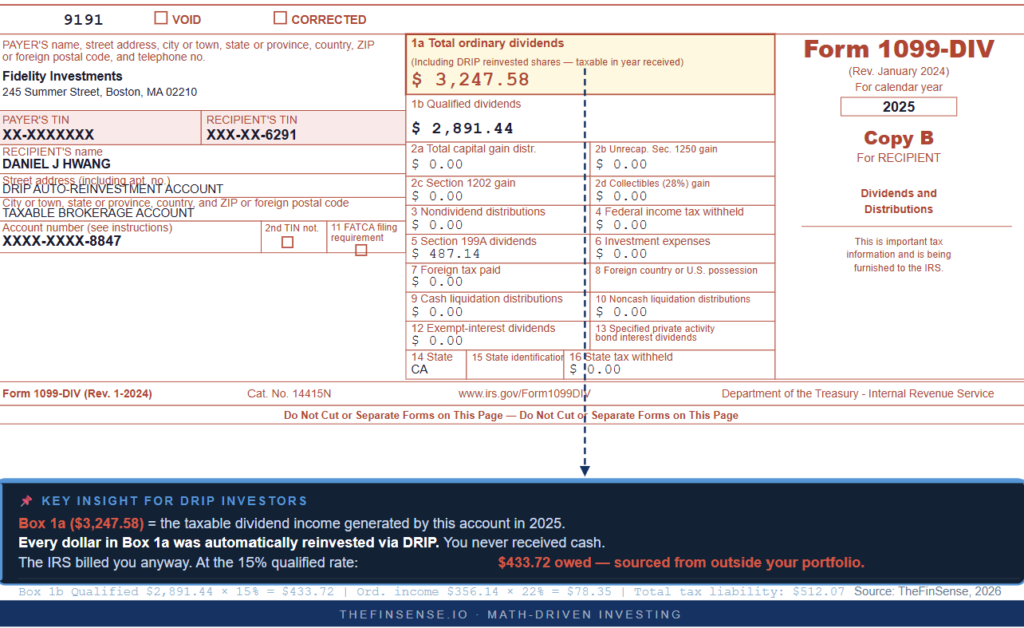
💡 PRO TIP: Before your next dividend cycle, open your brokerage’s tax documents page and locate last year’s 1099-DIV. Compare Box 1a (Total Ordinary Dividends) against your DRIP reinvestment total for the same period. The tax liability on reinvested dividends almost always exceeds what investors estimate—because it appears on a different document than the one showing reinvestment activity.
The two multipliers—(1.10)^30 versus (1.085)^30—look like a minor rounding difference on a calculator. In real portfolio dollars on a $100,000 starting balance, the spread between them is not a rounding error. It is the number that should follow every dividend investor into their next portfolio review.
The $589,115 Cost of Doing Nothing
You received a $1,500 tax bill for dividends you never actually saw, because your brokerage automatically reinvested them before they ever hit your checking account. That sentence describes the annual firing of a mechanism that, extended across 30 compounding years on a $100,000 portfolio, produces a gap most retail dividend investors have never calculated and would reject as implausible before they ran the arithmetic themselves.
The calculation is not complicated. It is relentless. Two investors — identical portfolios, identical gross return, identical 30-year horizon — diverge by half a million dollars based on a single structural variable: whether the annual forced-distribution tax event fires every year or compounds tax-deferred inside an account wrapper that eliminates it entirely. What separates them at year 30 is not strategy, not fund selection, not market timing. It is the account type those dividends were generated inside.
The Tax-Deferred Base Case
Strip out the annual tax event entirely — as a Roth IRA does automatically — and $100,000 compounding at a 10% gross annual return for 30 years reaches $1,744,940. This is the reference point: every dollar of return stays inside the compounding base, cycles through the next year’s calculation, and generates its own return in every subsequent period. No forced distributions. No quarterly 1099-DIV obligations. The formula runs cleanly: $100,000 × (1.10)^30 = $1,744,940.
This is not a theoretical ceiling. It is the actual realized outcome for investors who hold dividend-paying funds inside tax-advantaged accounts — the identical securities, the identical yields, the identical quarterly distributions, but none of the annual tax extraction. Every dollar of the gross 10% return compounds forward uninterrupted, year after year, without a single dollar diverted to the IRS before the next calculation cycle begins.
The Dividend Tax Drag Reality
In a taxable brokerage account, the 1.5% annual drag measured by Morningstar as of March 2026 functions as a permanent reduction in the effective compounding rate. Instead of $100,000 × (1.10)^30, the taxable-account investor compounds at the net rate: $100,000 × (1.085)^30. The terminal value of that calculation is $1,155,825. The dollar difference between the two outcomes is the number stated in the opening section of this article — and it is now supported by the full arithmetic, not asserted as a thesis.
| Time Horizon | Tax-Deferred ($) | After Dividend Tax Drag ($) | Dollar Difference |
|---|---|---|---|
| Year 1 | $110,000 | $108,500 | −$1,500 |
| Year 5 | $161,051 | $150,366 | −$10,685 |
| Year 10 | $259,374 | $226,098 | −$33,276 |
| Year 20 | $672,750 | $511,205 | −$161,545 |
| Year 30 | $1,744,940 | $1,155,825 | −$589,115 |
📐 BREAK POINT: This math reverses only if your effective annual dividend tax rate falls to approximately 0% — achievable by holding dividend-producing assets inside a Roth IRA, traditional IRA, or 401(k), or by qualifying for the 0% qualified dividend bracket (2026 income thresholds: $47,025 single / $94,050 married filing jointly per IRS Publication 550). Below that threshold, the drag shrinks. In any taxable account with a bracket above 0%, it compounds.
The 1.5% annual drag — measured empirically across diversified equity portfolios as of March 2026 per Morningstar — represents 33.7% of 30-year terminal wealth permanently redirected to the IRS on a $100,000 base. $589,115 permanently removed from the compounding base is the equivalent of roughly 84 months of maximum Roth IRA contributions at the 2026 annual limit of $7,000 — capital that generates zero future return not through failed analysis or poor fund selection, but because a structural tax mechanism executed its quarterly extraction 120 times while the share count on the dashboard kept climbing.
In 2022, when the S&P 500 fell approximately 18%, taxable dividend investors absorbed this compounding insult at exactly the worst moment: taxes owed on the full pre-decline gross dividend, extracted from a capital base that had simultaneously contracted — forcing the highest-drag tax event at the precise moment portfolio recovery needed every retained dollar to rebuild.
You almost certainly already have the documentation for this in your tax history. Pull any prior-year 1099-DIV from your brokerage’s tax documents page and locate Box 1a — Total Ordinary Dividends. Add that figure across every year you have held dividend-paying securities in a taxable account. That running sum is a working estimate of capital permanently extracted from your compounding base, one quarterly distribution at a time, without a single discretionary action on your part. The mechanism did not ask whether you needed the cash. It fired anyway.
$589,115
A 1.5% annual dividend tax drag doesn’t lower your wealth by 1.5%—mathematically, it confiscates $589,115 from a $100,000 portfolio over 30 years.
The drag is not linear. It is exponential. And it has been running in your taxable account since the first dividend was declared.
📐 YOUR NUMBERS MAY DIFFER
The base case assumes the 15% qualified dividend federal tax rate (Morningstar’s 1.5% empirical drag baseline). Here is how the 30-year terminal wealth gap shifts across tax brackets — the most actionable variable in this calculation:
| Your Dividend Tax Rate | Annual Drag | 30-Year Terminal (per $100k) | Conclusion |
|---|---|---|---|
| 0% (Roth IRA / 0% income bracket) | 0.0% | $1,744,940 | No drag — full base case preserved |
| 15% qualified rate (base case) | 1.5% | $1,155,825 | ✅ Base case — $589,115 permanently lost |
| 23.8% max rate (NIIT bracket) | ~2.4% | ~$903,800 | ~$841,140 permanently lost — relocate immediately |
The Total-Return Tax Matrix
The $589,115 gap is not a forecast. It is the running tab on your current account structure. The fix does not require selling a single holding. The same forced-distribution mechanism that has been executing quarterly extractions in your taxable account requires no new trigger to stop — only the account type those assets live inside needs to change. The securities you hold, the dividend yields they generate, the total return profile of the portfolio — none of that needs to change. What needs to change is the account type those assets live inside. Asset location is the highest-leverage, zero-cost structural adjustment available to any taxable investor who has identified this drag running in their own 1099-DIV history.
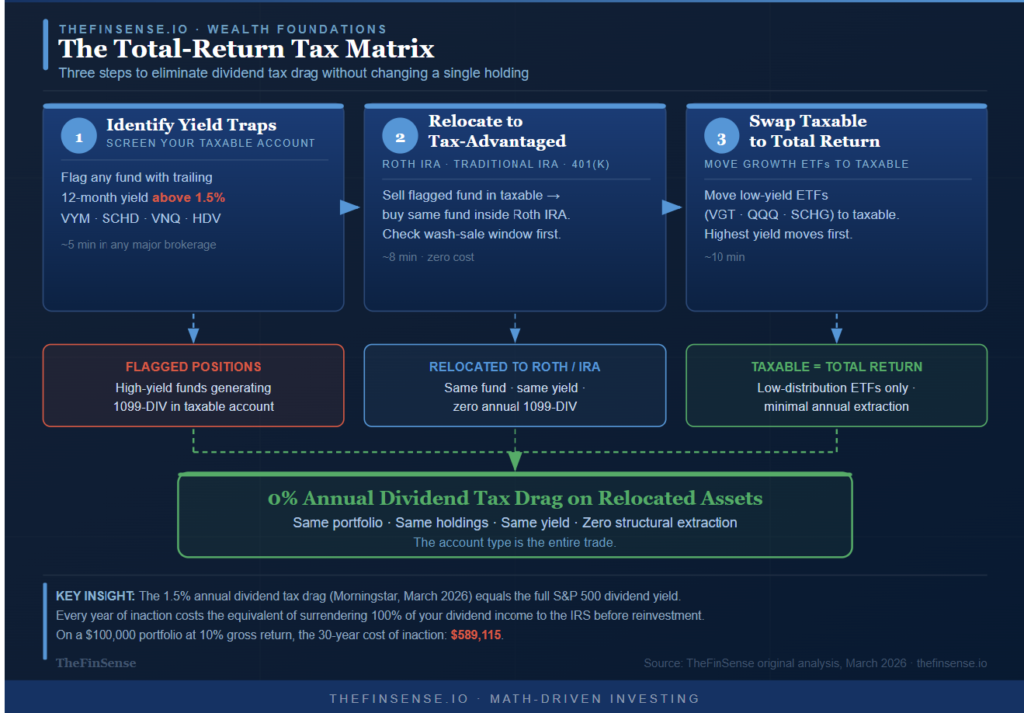
The Total-Return Tax Matrix is the decision framework for executing that adjustment: three steps that identify which specific assets are generating the highest annual extraction, relocate them to account types where forced distributions compound without annual tax friction, and rebalance the remaining taxable holdings toward instruments that minimize quarterly extraction by structural design. The dividend income does not disappear — it simply routes through the account wrapper that does not penalize it every year for existing.
“Capital retained inside a business and allowed to compound tax-free creates dramatically more long-term wealth than the same capital distributed to shareholders as a dividend — where it is immediately taxed before a single dollar can be reinvested.”
— Warren Buffett, Chairman, Berkshire Hathaway — 2012 Annual Shareholder Letter
Step 1: Identify Your Yield Traps
Failing to identify which specific funds are generating the highest distribution yield in taxable accounts means targeting relocation efforts at the wrong positions — leaving the actual drag source fully operational while reorganizing holdings that contribute negligibly to the annual tax extraction. The goal is surgical precision: flag the positions driving the 1099-DIV and move those first.
If your taxable account contains any fund with a trailing 12-month distribution yield above 1.5%: Go to Fidelity (or your brokerage equivalent) → Accounts → Portfolio → click each ETF or fund position → navigate to the Research or Details tab → locate the trailing 12-month yield. Flag any position above 1.5% as a primary relocation candidate. High-dividend equity ETFs (VYM, SCHD, HDV), REIT ETFs (VNQ, SCHH), and high-income bond funds consistently surface here. This takes approximately 5 minutes.
Step 2: Relocate to Tax-Advantaged Accounts
Dividend income generated inside a Roth IRA compounds completely free of annual federal tax extraction — eliminating 100% of the effective drag on relocated assets for every future year, without changing a single underlying holding. The identical VYM position that generates a 1099-DIV obligation every quarter in a taxable account generates no taxable event inside a Roth IRA. The security is identical. The account wrapper is the entire structural difference.
If Roth IRA or traditional IRA contribution space, rollover capacity, or backdoor Roth access is available: Go to Fidelity → Accounts → Transfer → sell the flagged dividend fund in the taxable account → purchase the equivalent fund inside the Roth IRA. Verify no wash-sale conflict first — the same security or a substantially identical security must not have been sold at a loss within 30 calendar days prior to this transaction. If a conflict exists, wait out the 30-day window or use a non-substantially-identical substitute fund (for example, VYM replaced temporarily with DVY). This takes approximately 8 minutes.
One important boundary: tax loss harvesting tools at Wealthfront and Betterment automatically offset capital gains — but the IRS caps net capital loss deductions against ordinary income at $3,000 annually. Dividend income in the qualified bracket is taxed as capital gains and can be offset directly, but only up to the amount of realized gains in the same tax year. TLH reduces the annual damage on gains. It does not stop the forced-distribution mechanism from firing on income that may exceed your harvested losses in a given year.
Step 3: Prioritize Total Return in Taxables
Holding high-yield dividend assets in taxable accounts while keeping low-yield growth ETFs in Roth accounts inverts the tax efficiency hierarchy: you pay the highest-friction annual extraction on income you did not choose to receive, while the positions generating capital gains you can time and control sit in the account that also shelters those gains completely. That double inefficiency compounds in both directions — the taxable account bleeds more than it should, and the tax-advantaged account compounds less than it could (because low-yield growth funds generate minimal taxable events even outside the shelter).
If your Roth IRA currently holds low-dividend growth funds (VGT, QQQ, QQQM, SCHG, or similar): Go to Fidelity → Accounts → Trade → execute the swap — move high-dividend ETFs (VYM, SCHD, HDV, VNQ, any REIT position) from the taxable account to the Roth IRA; move low-dividend growth ETFs from the Roth IRA to the taxable account. Prioritize relocation by yield — the highest-yielding fund moves first. See the Vehicle-Tax Matrix for the full asset location priority ranking across all fund types. This takes approximately 10 minutes.
Frequently Asked Questions
Are qualified dividends tax-free?
No. Qualified dividends receive preferential federal rates — 0%, 15%, or 20% depending on taxable income, plus a potential 3.8% Net Investment Income Tax above the NIIT threshold as of tax year 2026 per the IRS. Only dividends earned inside a Roth IRA or traditional IRA escape current taxation entirely. In a taxable brokerage account, every qualified dividend distribution triggers a 1099-DIV obligation regardless of whether the investor immediately reinvests or holds the cash.
Should I turn off DRIP in my taxable account?
Turning off automatic reinvestment does not eliminate the annual tax liability. The IRS 1099-DIV obligation is created when the dividend is declared, not when it is reinvested. Holding the cash rather than reinvesting only changes where the dollars sit temporarily — the tax bill arrives regardless. The effective fix is asset location: move high-yield funds to a Roth IRA or traditional IRA where distributions compound without triggering annual federal tax events.
Why does Warren Buffett refuse to pay Berkshire Hathaway dividends?
Every dollar retained inside Berkshire compounds tax-free at whatever internal rate Buffett can achieve. A dollar distributed as a dividend immediately loses 15–23.8% in federal tax in the shareholder’s hands before it can be reinvested. Shareholders who need income can sell fractional shares and trigger a capital gain only on the appreciated portion — a taxable event they control in timing and size. Buffett’s no-dividend policy is arithmetic, not philosophy.
Does tax loss harvesting fully offset dividend taxes?
Partially. Tax loss harvesting generates capital losses that offset capital gains dollar-for-dollar. Qualified dividend taxes are treated as capital gains taxes and can be offset directly — but only up to the amount of realized gains in the same tax year. The IRS caps net capital loss deductions against ordinary income at $3,000 annually. Tax loss harvesting reduces the annual damage; it does not eliminate the structural forced-distribution mechanism that creates the drag in the first place.
Is a 2% dividend yield worth the tax drag in a taxable account?
At the 15% qualified rate, a 2% gross yield generates approximately 1.70% after-tax yield — a 0.30 percentage point annual haircut that compounds into a significant terminal wealth gap over decades. At the 23.8% NIIT bracket, after-tax yield drops to approximately 1.52%. In most taxable account scenarios, a low-dividend total-return ETF with comparable gross return and minimal annual distribution outperforms the dividend fund on after-tax terminal wealth over any horizon above 15 years.
💬 YOUR TURN
Open your brokerage’s tax documents and locate last year’s 1099-DIV — what is your Box 1a total ordinary dividends figure from your taxable account?
Drop a comment below 👇
Dividend Tax Drag: Final Verdict
The $589,115 gap we opened with is not a hypothetical — it is the exact premium retail investors pay for the illusion of free money. Every quarter, the same structural mechanism that deposits a dividend into the taxable account simultaneously files a 1099-DIV obligation with the IRS — invisible on the brokerage dashboard, absent from the portfolio summary, and fully real on the tax document that arrives in January. That is what the dividend tax drag actually is: not a rate, not a percentage, but a recurring structural extraction with a 30-year compounding tail attached to every dollar it removes.
The Asymmetry That Persists
Most investors spend more analytical attention on a 0.03% expense ratio differential between two near-identical index funds than on the 1.5% annual extraction running in the same account simultaneously. That asymmetry is not irrational — the expense ratio appears on the fund fact sheet the moment you open a position; the tax drag surfaces three months later on a different document issued by a different institution. Visibility determines optimization priority. The mechanism exploits that sequencing perfectly.
The asset location fix does not require abandoning dividend income, restructuring the entire portfolio, or accepting a lower total return. It requires moving assets across account wrappers — a transaction that takes under ten minutes at any major brokerage and permanently eliminates the annual extraction on relocated assets. The same position, the same yield, zero annual 1099-DIV obligation. The account type is the entire trade.
The true cost of a dividend is never the 15% tax you pay today; it is the three decades of compounding that 15% will never experience. The question planted in the mechanics section has an answer: a dollar extracted in Year 1 does not cost $1. It costs $17.45 — the compounded value of $1 at 10% for 30 years. That is the actual unit of measurement for this drag, and it appears on no brokerage statement, no fund fact sheet, and no tax form ever issued.
The exact mechanism generating your passive income is the identical force permanently handicapping your portfolio’s ability to compound. The math proves that the ultimate luxury in investing isn’t receiving a dividend check; it’s deciding exactly when you want to be taxed.
📌 Next Read: Vehicle-Tax Matrix