📅 Originally Published: · Last Updated:
The Bottom Line, Up Front
An ETF — exchange-traded fund — is a single ticker that holds hundreds or thousands of securities at once, letting you own the market’s average return instead of betting everything on one company. Over a 15-year period, S&P Global’s SPIVA data shows nearly 88% of professional active managers failed to match a basic index. The difference between long-run wealth and long-run mediocrity often comes down to a single decimal point in your expense ratio — and the Index-Integrity Filter in this guide gives you three objective criteria to get that right in under two minutes.
Nine out of ten professional stock pickers cannot beat a simple index over 15 years — and understanding what is an ETF is inseparable from understanding why. The exchange-traded fund was not invented to be clever. It was invented to be systematic, and that structural difference is precisely why it wins where discretionary stock selection fails at scale. The actively managed fund charges you to guess. The index ETF charges you almost nothing to be persistently right.
Most investors arrive in the market hunting for the right stock to buy early and retire on. That instinct is not just difficult to execute — it is mathematically costly in ways that compound silently for decades. Understanding how individual stocks work is necessary background, but the evidence overwhelmingly shows that owning a basket of the entire market destroys single-name selection over any full investment lifecycle.
The mechanism that makes stock-picking self-defeating at scale is the compounding drag from catastrophic individual losses — one blow-up in a concentrated portfolio can erase years of winners. The Index-Integrity Filter — three binary criteria you can apply in under two minutes — converts the structural advantage of index ETFs into a repeatable selection process that removes guesswork from the most consequential decision in your portfolio.
Why Stock Picking Fails: The Math Nobody Wants to Admit
The most consequential statistic in retail investing is not buried in an obscure academic paper — it is published annually by S&P Global and largely ignored by the financial media. According to the SPIVA U.S. Scorecard, 87.98% of all domestic equity funds underperformed their benchmark index over a 15-year horizon. That number does not describe a bad year or an unusual bear cycle — it represents the persistent, structural failure of professional active management measured across a complete market cycle, including bull runs where active managers had every opportunity to demonstrate their edge.
The mechanism behind that failure rate is rarely discussed with honesty. An active fund manager must not only pick winners — they must do so consistently enough to overcome their own embedded cost structure. Every research analyst salary, every Bloomberg terminal subscription, every prime brokerage trading commission gets deducted from shareholder returns before the performance comparison even starts. The index, by contrast, simply holds the market and charges shareholders almost nothing. The contest is structurally unequal before a single trade is made.
Why the True Failure Rate Is Even Higher Than 87.98%
The SPIVA headline figure is itself a conservative undercount of the problem, because it only measures funds that survived the full 15-year observation window. Funds that implode, liquidate, or get quietly merged into better-performing siblings disappear from the dataset — a systematic distortion called survivorship bias. When SPIVA adjusts for fund attrition alongside performance, the effective failure rate climbs materially higher. You are not comparing your fund manager against a curated pool of high survivors; you are comparing against the market’s actual unfiltered returns, ugly years fully included.
If your 401(k) currently offers both an active large-cap growth fund and a plain S&P 500 index ETF, the 15-year data says you are paying a meaningful annual fee premium for statistically inferior expected outcomes. That is not a critique of any particular manager’s intelligence — it is a comment on the mathematical difficulty of the problem active management is attempting to solve, at institutional scale, year after year.
Over a 15-year measurement period, 87.98% of domestic equity funds failed to match their benchmark index — a figure that rises further when adjusted for fund attrition and survivorship bias.S&P Dow Jones Indices · SPIVA U.S. Scorecard, 2024
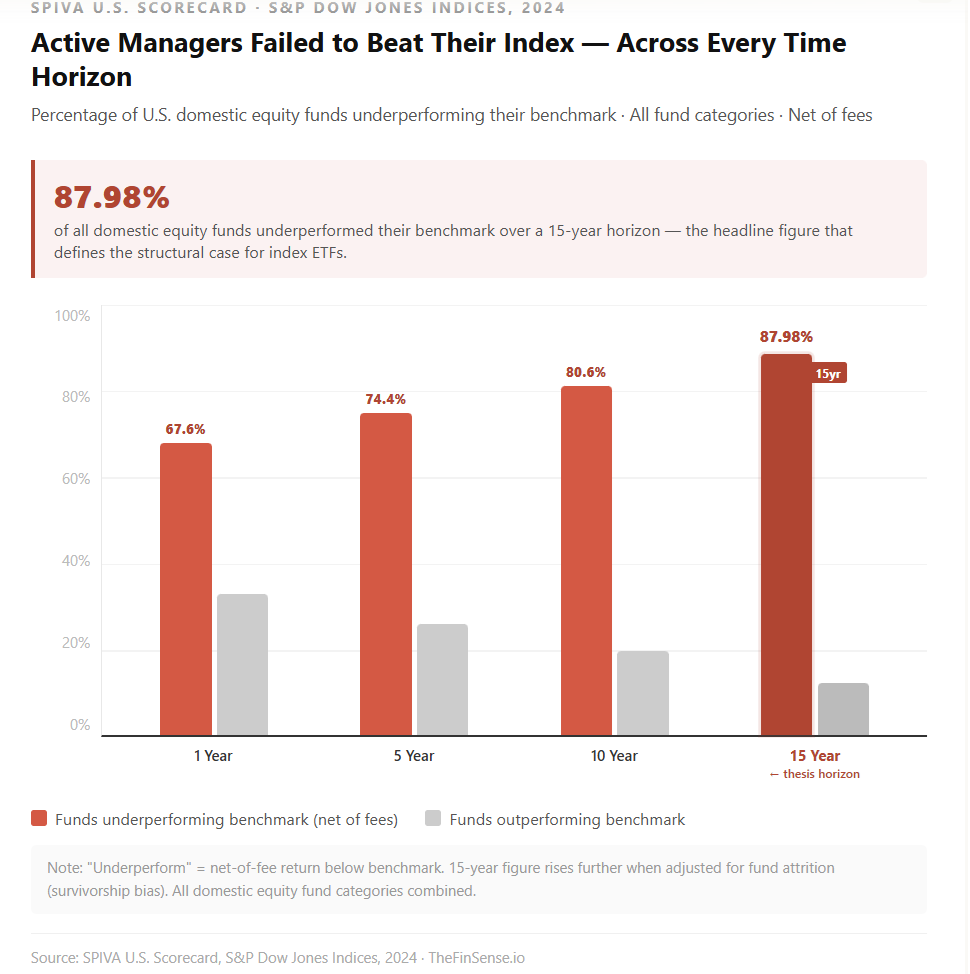
The logical implication is unavoidable: if the average credentialed professional — with a full research team and real-time data — cannot beat the market net of fees over 15 years, a retail investor spending 45 minutes per week reading earnings releases has no structural edge against that same market. The question stops being “which stock should I buy?” and starts being “what is the most efficient vehicle to own the whole market?” That vehicle is the index ETF — and the next section explains exactly how it works.
What Is an ETF and How Does It Work?
An exchange-traded fund (ETF) is a pooled investment vehicle that holds a collection of securities — stocks, bonds, commodities, or a combination — and trades on a stock exchange under a single ticker symbol throughout the trading day, exactly like an individual stock. Unlike a mutual fund, which prices only once at the end of each trading session, an ETF offers intraday liquidity and, in its passive index form, near-zero annual management cost.
🧠 IN PLAIN ENGLISH:
Think of an ETF as a grocery cart instead of a single apple — one purchase fills it with 3,700 companies at once. If one goes bad, the other 3,699 are still in the cart.
The basket metaphor is the accurate one. Buying one share of VTI — Vanguard’s Total Stock Market ETF — gives you fractional ownership of over 3,700 U.S. companies simultaneously. No single company’s collapse destroys your position. No one earnings miss erases your quarter. That structural insulation from catastrophic single-name downside is the primary mechanism by which the basket strategy outperforms concentrated stock selection over a full investment lifetime.
The Four Core ETF Types Every Beginner Should Distinguish
Equity ETFs hold stocks, either tracking a broad index like the S&P 500 or a narrow sector like semiconductors. Bond ETFs hold fixed-income securities — if you’re building a balanced portfolio, our guide on how bonds work and why they serve as portfolio shock absorbers is the required companion read. Commodity ETFs provide exposure to physical assets like gold or oil, usually through futures contracts rather than direct ownership of the underlying commodity — a structural distinction that matters significantly in tax treatment and roll costs. Thematic ETFs cluster around investment narratives like AI, clean energy, or genomics, and they are the category most aggressively marketed to retail investors despite consistently carrying expense ratios that eat directly into the very thesis they are selling.
For a beginning investor, the equity index ETF — passive, broad-market, low-cost — is the category that delivers every structural advantage described in this guide. The others serve specific portfolio roles but carry tradeoffs worth understanding clearly before committing capital.
▶ Video: Exchange Traded Funds (ETFs) explained — how ETFs work, how they differ from mutual funds, and why passive index versions deliver superior long-run results. Source: Khan Academy Finance & Capital Markets.
Inside the ETF: Anatomy of the Basket
Most retail investors never look past the ticker symbol — and that is a consequential mistake, because the internal mechanics of an ETF determine how it behaves when markets are under stress. Three components define ETF structure: the underlying holdings (what the basket actually owns), the creation-redemption mechanism (how new shares enter and exit the market), and the bid-ask spread (the invisible execution tax you pay every time you place a market order at the wrong moment).
The Creation-Redemption Mechanism and the In-Kind Tax Shield
ETF shares are not created through a secondary offering the way stock shares are. Instead, large institutional traders called Authorized Participants (APs) assemble a basket of the ETF’s underlying securities and deliver that basket to the fund sponsor in exchange for a block of new ETF shares — typically 50,000 shares at minimum, called a “creation unit.” Redemptions work in exact reverse: the AP returns a block of ETF shares and receives the underlying securities back. The market price of the ETF stays anchored to its net asset value (NAV) because APs arbitrage any divergence immediately for profit.
The practitioner-level implication of this structure is significant and almost never explained to retail investors. Because the share exchange is “in-kind” — securities for shares, no cash changing hands at the fund level — no taxable sale of underlying securities is triggered when redemptions occur. When a large institutional investor exits the fund, the ETF can deliver its lowest-cost-basis shares back to the AP in-kind, effectively flushing the most deeply embedded capital gains out of the fund without realizing them as a taxable event for remaining shareholders. Mutual funds cannot do this — they must sell holdings for cash to meet redemptions, realizing capital gains that get distributed to all shareholders, including those who never sold a single unit. That hidden tax shield is one of the most structurally undervalued advantages of the ETF wrapper.
SEC guidance on ETF investments specifically addresses this point: shareholders in an ETF are insulated from the redemption activity of other investors in ways that open-end mutual fund holders are not — a protection rooted in the Investment Company Act of 1940 provisions governing the creation-redemption process.
How to Execute an ETF Purchase Without Paying the Market Maker’s Spread
Every ETF trades on-exchange with a bid price (what buyers will pay) and an ask price (what sellers will accept). The gap between those two figures is the bid-ask spread — how market makers earn their liquidity provision. On a high-volume ETF like SPY or VTI, that spread is typically a fraction of a cent per share and is essentially ignorable. On a thinly traded thematic ETF with daily volume below 50,000 shares, the spread can cost you 0.05–0.15% of your position on every single entry and exit — compounding against your returns invisibly, year after year, in a way that never appears on your brokerage statement.
The practitioner fix is simple but widely ignored at retail: always use a limit order, never a market order, when buying ETFs. Set your limit price at or slightly above the current ask during normal market hours — and specifically avoid the first and last 30 minutes of the trading session, when institutional block trades create pricing dislocations against the fund’s intraday NAV. If you are executing on Fidelity, the trade ticket makes this straightforward: switch the Order Type dropdown from “Market” to “Limit” before entering your share quantity.
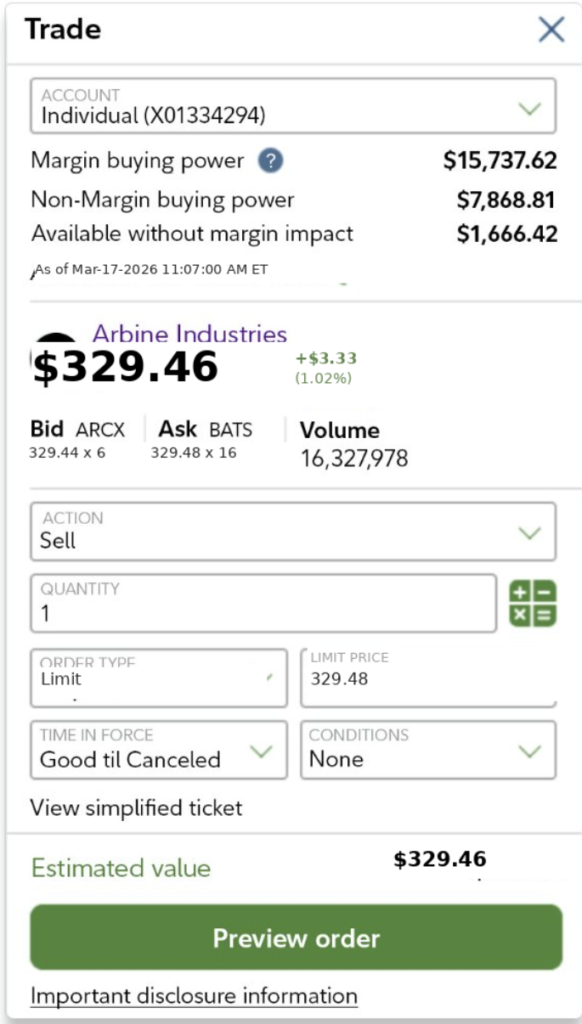
💡 PRO TIP: Vanguard restricts fractional share purchases on ETFs at the brokerage level — you must buy whole shares, which means exact-dollar investing requires adjusting your purchase amount to whole-share increments or switching to a platform that supports fractional ETF shares. Fidelity and Schwab both support fractional ETF entry; this is a platform-specific friction that catches first-time buyers off guard during their initial purchase.
The Hidden Fee Drag: How a 1% Annual Cost Destroys $23,000
The core academic consensus is clear: the vast majority of investors will achieve superior long-term results by holding broad, low-cost index funds rather than attempting to pick individual stocks or paying active managers to do so.Core Thesis · Burton G. Malkiel, A Random Walk Down Wall Street
The expense ratio is the annual fee an ETF or fund charges to cover its operating costs, expressed as a percentage of your invested assets and deducted continuously from the fund’s net asset value. You will never see it as a line-item charge on your brokerage statement. That invisibility is precisely what makes it dangerous — it is the most consequential number in your portfolio, and most investors have no idea what theirs actually is. According to Morningstar’s Annual U.S. Fund Fee Study, actively managed equity funds carry asset-weighted average expense ratios dramatically higher than their passive index counterparts — a gap that translates into a life-altering dollar difference when allowed to compound over 30 years. The Wealth-Velocity Filter quantifies exactly how this fee drag interacts with inflation to compound against your real purchasing power over multi-decade horizons.
The Fee Drag Formula: Worked Calculation With Real Numbers
Fee drag operates through a deceptively simple future value formula, but the output is consistently more dramatic than investors expect until they run their own numbers:
Fee Drag Formula: Future Value = PV × (1 + r − ER)n
Where PV = initial investment, r = gross annual market return assumption, ER = expense ratio, n = holding period in years.
Apply that formula to a single $10,000 investment over 30 years, using an 8.00% assumed gross annual return — a reasonable long-run equity market baseline:
Scenario A — Low-Cost Index ETF (ER = 0.03%): Net annual return = 8.00% − 0.03% = 7.97%. Intermediate step: (1.0797)30 ≈ 9.979. Terminal value = $10,000 × 9.979 = $99,790.
Scenario B — Typical Active Fund (ER = 1.00%): Net annual return = 8.00% − 1.00% = 7.00%. Intermediate step: (1.07)30 ≈ 7.612. Terminal value = $10,000 × 7.612 = $76,120.
| Scenario | Expense Ratio | Net Annual Return | Value After 30 Years |
|---|---|---|---|
| Low-Cost Index ETF (e.g., VTI) | 0.03% | 7.97% | $99,790 |
| Typical Active Fund | 1.00% | 7.00% | $76,120 |
| Fee Drag Loss | — | −0.97%/yr | −$23,670 |
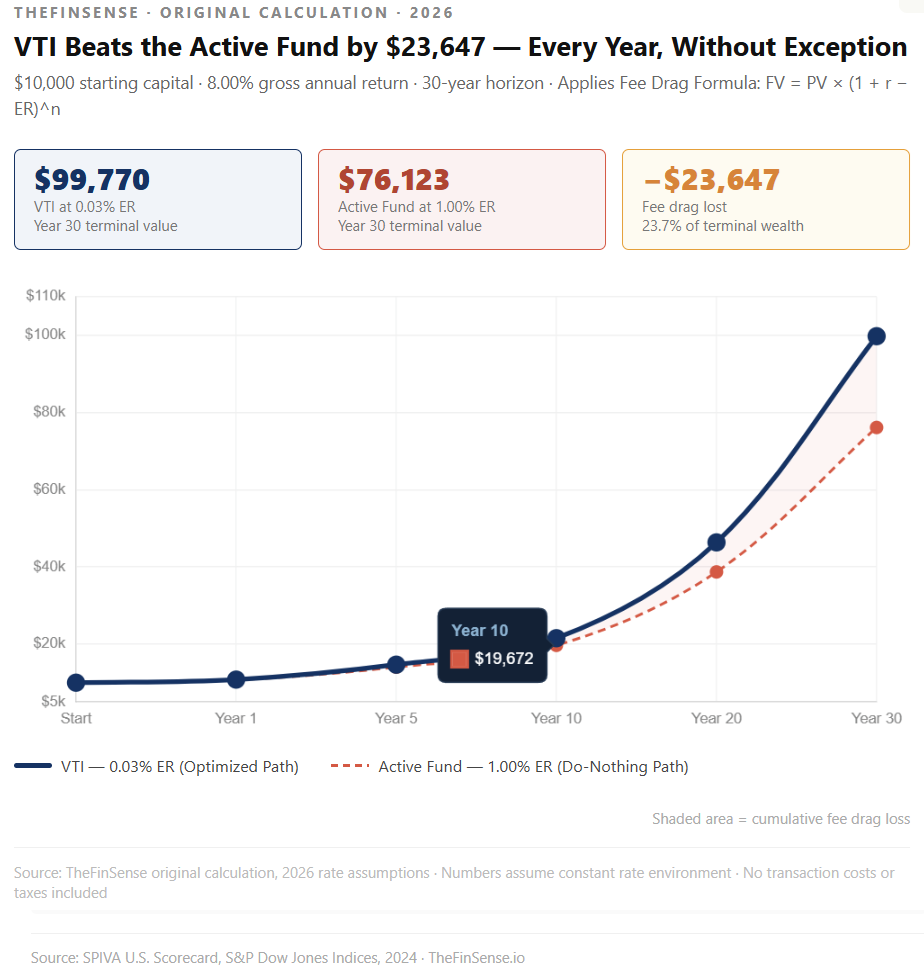
The plain-English interpretation of that result: a 1% expense ratio is not a modest administrative charge. It is a silent partner claiming nearly 24% of your terminal wealth — without delivering a single additional percentage point of market return. The 0.97 annual percentage point difference in fees does not cost you $970 per year; over 30 years of compounding, it costs you $23,647 in wealth you would otherwise keep.
$23,647
The compounded fee drag cost of a 1.00% expense ratio vs. a 0.03% index ETF — applied to a $10,000 investment over 30 years at 8% gross annual return. Source: TheFinSense original calculation, 2026.
📐 YOUR NUMBERS MAY DIFFER
This case study uses a 1.00% vs 0.03% expense ratio gap. Here’s how the 30-year fee drag changes when your fund’s actual ER differs:
| Your Expense Ratio Gap | 30-Year Fee Drag on $10,000 | Conclusion |
|---|---|---|
| 0.03% vs 0.50% (advisory overlay only) | $12,240 | Half the ER gap still costs $12K+ over 30 years |
| 0.03% vs 1.00% (base case) | $23,670 | ✅ Base case — this article’s model |
| 0.03% vs 1.50% (high-cost active) | $33,650 | One-third of terminal wealth permanently transferred to fees |
If you are currently invested in any fund charging above 0.50%, apply that formula to your actual account balance and your actual remaining investment horizon. The result is not theoretical — it is a transfer of your future compounded wealth to a fund company that, per SPIVA’s own 15-year data, is statistically unlikely to earn it back through outperformance. The next question then becomes: how do you systematically identify the funds that clear the cost bar? That is precisely what the Index-Integrity Filter solves.
The Index-Integrity Filter: Three Rules for Picking an ETF
Choosing the right ETF should take two minutes, not two weeks. The proliferation of ETF products — over 3,000 are now listed in the U.S. alone — has created a selection problem the financial services industry actively exploits by marketing complexity as expertise. The Index-Integrity Filter cuts through that noise with three binary criteria any investor can apply in a single screener pass, with zero financial background required.
Filter 1 — Is It Passive?
A passive ETF tracks a predefined index — it holds whatever the index holds, in the same proportions, without a portfolio manager making discretionary buy or sell decisions. An active ETF employs a manager to deviate from the index in pursuit of higher returns. Given the 87.98% SPIVA failure rate established earlier in this guide, passive wins the structural argument decisively. The practical screen: look for “index” or “tracks the [benchmark name]” in the fund description on the sponsor website. VTI tracks the CRSP US Total Market Index. SPY tracks the S&P 500. If the fund description reads “seeks to outperform” or “managed by our investment committee,” it fails Filter 1 immediately.
Filter 2 — Does It Have More Than $1 Billion in AUM?
Assets under management above $1 billion is the liquidity threshold that matters for one specific, practitioner-level reason: bid-ask spreads. A fund with $5B+ in AUM attracts institutional block traders who keep the ETF’s market price tightly anchored to its NAV throughout the trading day. When you execute a limit order against a $1B+ fund, competing market makers cannot sustainably widen the spread without losing institutional order flow — so retail investors benefit from that competitive pressure without doing anything. Funds below $200M in AUM frequently trade with spreads wide enough to cost more annually than the entire difference between a cheap and an expensive expense ratio. The practitioner check: pull the fund’s historical premium/discount to NAV on ETFdb.com or the sponsor’s own fund page. A well-capitalized index ETF should show an average daily premium/discount of less than 0.05% to NAV. Regular dislocations above 0.10% signal insufficient liquidity for cost-efficient retail execution.
Filter 3 — Is the Expense Ratio Below 0.10%?
The Fee Drag Formula in the previous section quantifies exactly what this threshold protects. The 0.10% cutoff represents the practical boundary between institutional-grade cost efficiency and funds where the manager is retaining returns that should belong to shareholders. VTI charges 0.03%. SCHB charges 0.03%. FZROX charges 0.00% — Fidelity’s zero-fee total market fund, which achieves zero-cost by retaining securities lending revenue at the fund level rather than passing it to investors (a structural tradeoff worth understanding, but one that keeps the headline ER at zero). Most sector ETFs, thematic funds, and smart-beta products cluster in the 0.25%–0.75% range — territory the Fee Drag Formula translates into thousands of dollars of long-run compounding loss against a plain total-market alternative.
❌ Without the Index-Integrity Filter:
You select an ETF based on recent headline performance or a trending sector narrative, pay 0.75% annually to an active manager who fails to beat the index 88% of the time over 15 years, and surrender over $17,000 in compounded fee drag on a $10,000 starting position — without ever seeing a single line item that explains where the money went.
✅ With the Index-Integrity Filter:
You screen for passive structure, $1B+ AUM, and sub-0.10% ER in under two minutes, land on VTI or a comparable total-market fund, and keep nearly $24,000 more in your account over 30 years — with no additional research, no ongoing monitoring, and no expertise required beyond running three yes/no checks.
💬 YOUR TURN
What expense ratio is your largest current holding charging right now?
Drop a comment below 👇
The $23,647 Case Study: How One Decimal Point Silently Transfers a Quarter of Your Terminal Wealth
$10,000 in VTI grows to $99,790 over 30 years at 8.00% gross annual return — and that number is exactly $23,647 more than the identical capital earns inside a 1.00% active fund over the identical horizon, at the identical gross return, in the identical market. The variable is not the manager’s stock selection. It is the fee structure, applied every single trading day, compounding against your position without interruption for three decades. Call this investor Marcus: 35 years old, $10,000 in a taxable brokerage account, and two options — the bank’s actively managed large-cap fund marketed with a strong three-year track record, and VTI, a total-market index ETF sitting at 0.03% expense ratio.
Marcus’s bank has given him the active fund’s three-year performance chart, which shows slight outperformance against the benchmark. What the chart cannot show — or rather, what it is structurally constructed to obscure — is that three-year track records carry near-zero predictive power for 30-year outcomes. SPIVA’s own persistence data shows fewer than 3% of top-quartile active managers sustain their quartile ranking over a subsequent five-year period — a finding documented by Carhart (1997, Journal of Finance). Marcus is not buying a three-year result. He is buying a fee structure that will compound against his terminal wealth regardless of whether alpha materializes in any given year.
Running Both Paths Through the Fee Drag Formula: Step-by-Step Intermediate Values
$10,000 starting capital. 8.00% gross annual return — a conservative long-run U.S. equity baseline. 30-year holding period. The Fee Drag Formula applied at both expense ratios produces year-by-year terminal values that reveal exactly when the gap becomes material enough for most investors to have acted, had they seen the numbers in advance.
Do-Nothing Path — Active Fund (ER = 1.00%): Net annual return = 8.00% − 1.00% = 7.00%. Intermediate growth factors: (1.07)^5 = 1.40255 → $14,026; (1.07)^10 = 1.96716 → $19,672; (1.07)^20 = 3.86969 → $38,697; (1.07)^30 = 7.61226 → $76,123.
Optimized Path — VTI Index ETF (ER = 0.03%): Net annual return = 8.00% − 0.03% = 7.97%. Intermediate growth factors: (1.0797)^5 = 1.46727 → $14,673; (1.0797)^10 = 2.15287 → $21,529; (1.0797)^20 = 4.63485 → $46,349; (1.0797)^30 = 9.97900 → $99,790.
| Time Horizon | Do-Nothing: Active Fund (1.00% ER) | Optimized: VTI Index ETF (0.03% ER) | Dollar Drag Lost |
|---|---|---|---|
| Year 1 | $10,700 | $10,797 | −$97 |
| Year 5 | $14,026 | $14,673 | −$647 |
| Year 10 | $19,672 | $21,529 | −$1,857 |
| Year 20 | $38,697 | $46,349 | −$7,652 |
| Year 30 | $76,123 | $99,790 | −$23,647 |
That $23,647 compounded gap is approximately the down payment on a starter home in a mid-tier U.S. city — extracted from Marcus’s terminal wealth by fee drag alone, without any market underperformance, stock selection error, or timing mistake involved.
897.9%
Cumulative 30-year return of $10,000 in VTI at 0.03% ER and 8% gross return — no stock picking, no manager, no ongoing research required. Source: TheFinSense original calculation, 2026.
The practitioner-level detail most first-time ETF buyers skip entirely: expense ratio persistence is near-certain, while performance persistence is near-random. A fund’s expense ratio today is statistically likely to remain close to its expense ratio five years from now — fund companies do not voluntarily reduce management fees at scale once revenue structures are established. Performance, by contrast, is subject to factor rotation, benchmark redefinition, and the mathematical near-impossibility of sustaining alpha against an increasingly data-rich institutional market across a full economic cycle.
Why the Three-Year Track Record Is Structurally Irrelevant to the 30-Year Outcome
This asymmetry is the operational reason the third filter in the Index-Integrity Filter — expense ratio below 0.10% — is a more reliable 30-year predictor than any three-year outperformance metric in a fund’s marketing materials. The fee is a known, fixed drag applied with certainty beginning the day Marcus opens the position. The alpha is an uncertain, statistically improbable hoped-for offset that SPIVA’s own longitudinal data shows fails to net out in 87.98% of measured cases. When Marcus frames the choice correctly — a guaranteed cost versus a statistically near-impossible benefit — the decision stops being a financial calculation and becomes a single binary filter that runs in under 90 seconds.
How to Apply the Index-Integrity Filter: Your 4-Step ETF Selection Checklist
Converting a clear understanding of what is an ETF into a repeatable selection process takes three binary filters and one execution step — total runtime under two minutes per fund evaluated. According to the Investment Company Institute’s 2025 Factbook, the U.S. ETF market now lists over 3,400 products, with new thematic funds launching at a cadence specifically calibrated to capture momentum-driven retail interest. The Index-Integrity Filter cuts through that proliferation with criteria that require no financial expertise, no subscription data service, and no interpretation of past performance — only the willingness to apply three yes/no questions to each candidate before committing capital.
Step 1 — Confirm Passive Structure (Filter 1)
Navigate to the fund sponsor’s website or Morningstar’s fund profile page. Locate the section labeled “Investment Strategy” or “Fund Overview.” You are looking for one of two formulations: “tracks the [index name]” or “seeks to replicate the performance of [benchmark].” If the description instead contains “seeks to outperform,” “actively managed by our investment team,” or “proprietary selection methodology,” the fund fails Filter 1 and the analysis ends here. Do not proceed to Filter 2. The SPIVA 87.98% failure rate is not a theoretical risk at this step — it is the quantified historical outcome of funds that use exactly this language in their marketing materials.
Step 2 — Verify AUM Exceeds $1 Billion (Filter 2)
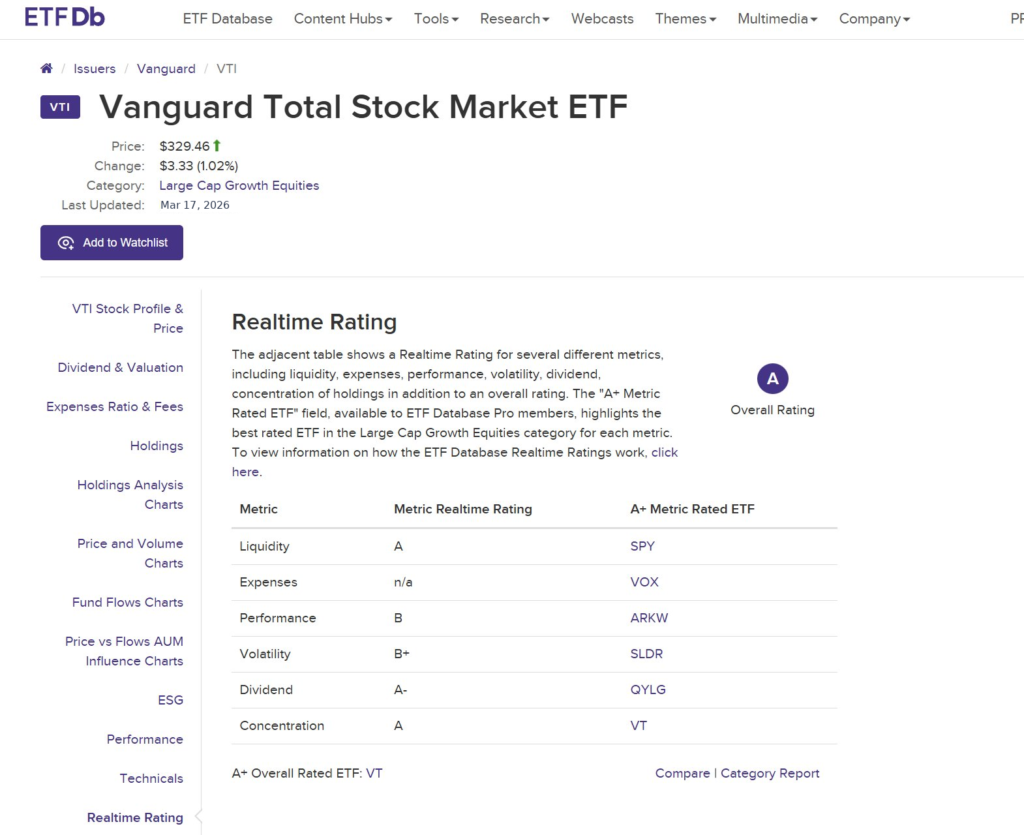
Navigate to ETFdb.com or the fund sponsor’s fact sheet (updated monthly on most sponsor pages). Locate the “Net Assets” or “Assets Under Management” figure. The $1 billion floor is not arbitrary — it is the liquidity threshold at which competing market makers keep the bid-ask spread tight enough that execution cost becomes negligible for retail-scale positions. To be precise: pull the fund’s 30-day average spread from ETFdb’s “Efficiency” tab and confirm it is below 0.05%. A fund above $1B AUM will almost always satisfy this spread threshold automatically, but the direct 15-second verification removes any ambiguity before you execute.
Step 3 — Confirm Expense Ratio Below 0.10% (Filter 3)
The expense ratio appears on every fund sponsor’s fact sheet, ETFdb profile, and Morningstar fund page without exception. Confirm the figure is below 0.10%. The Fee Drag Formula run in the case study above provides the direct numerical context for why this threshold is non-negotiable: the 0.97 annual percentage point gap between 0.03% and 1.00% costs Marcus $23,647 over 30 years on a $10,000 position. Any fund charging above 0.10% is implicitly asserting that its alpha generation will more than offset that compounding drag — a claim SPIVA’s data shows fails in 88% of measured cases over a 15-year horizon. Target funds at or below 0.03%: VTI (0.03%), SCHB (0.03%), and FZROX (0.00%) all clear this bar with room to spare.
Step 4 — Execute With a Limit Order During Core Hours
Open your brokerage trade ticket, enter the ETF ticker, and specify the share quantity. Switch the Order Type field from Market to Limit before entering any dollar amount. Set your limit price at or fractionally above the current ask price, and execute only during core market hours — specifically between 10:00 AM and 3:30 PM ET. The first and last 30 minutes of the trading session carry institutionally elevated spread risk as block trades clear, and a market order placed during those windows absorbs the widened spread directly into your cost basis without appearing anywhere on your brokerage confirmation.
| Step | What to Check | Where to Find It | Pass Threshold |
|---|---|---|---|
| Filter 1 — Passive? | Fund description / strategy language | Sponsor website · Morningstar profile | “Tracks [named index]” — not “seeks to outperform” |
| Filter 2 — AUM > $1B? | Net assets + 30-day average spread | ETFdb.com Efficiency tab · Sponsor fact sheet | $1B+ AUM · Spread < 0.05% |
| Filter 3 — ER < 0.10%? | Expense ratio on fund fact sheet | Morningstar · ETFdb · Sponsor page | Below 0.10% (optimal target: ≤ 0.03%) |
| Step 4 — Execute | Order type on brokerage trade ticket | Fidelity / Schwab / Vanguard UI | Limit order · Execute 10:00 AM–3:30 PM ET |
💡 PRO TIP: Run the Index-Integrity Filter against your existing holdings, not only future purchases. If any current holding fails Filter 3 — expense ratio above 0.10% — apply the Fee Drag Formula to your actual account balance and your actual remaining investment horizon. The resulting dollar figure is frequently the single most motivating number in the entire portfolio review, and it costs nothing to calculate.
Frequently Asked Questions
Are ETFs safe for beginners?
ETFs carry the same market risk as any investment vehicle — prices fall when markets decline. What a broad-market index ETF eliminates is single-company catastrophic risk: a fund holding 3,700+ companies cannot collapse to zero unless every company in the index fails simultaneously. For beginners, a broad-market index ETF is structurally safer than any individual stock, because the basket’s diversification absorbs company-specific disasters without terminal impact on the overall position.
What is the difference between an ETF and a mutual fund?
Both hold collections of securities, but the structural differences are material. An ETF trades on an exchange throughout the trading day with intraday pricing; a mutual fund prices once at market close. ETFs are almost universally cheaper — the 0.03% expense ratio available on VTI does not exist in the mutual fund universe. The ETF’s in-kind creation-redemption mechanism also shields existing shareholders from other investors’ redemption activity, a tax efficiency advantage mutual funds structurally cannot replicate.
Can an ETF go to zero?
A broad-market index ETF going to zero would require every company in the underlying index to collapse simultaneously — effectively the end of the modern economy. Narrow sector ETFs carry higher concentration risk and can lose the majority of their value if the tracked sector implodes. The practical protection: a total-market index ETF like VTI holds 3,700+ companies, making any single company’s failure mathematically immaterial to the overall position.
How many ETFs should I own?
One or two broad-market index ETFs cover the full U.S. equity market and provide all the diversification most investors need. VTI alone holds 3,700+ companies — adding a second domestic ETF only overlaps exposure. A practical two-ETF structure is a total U.S. market ETF plus a total international ETF like VXUS, providing global equity coverage at a combined average expense ratio under 0.07%. Three or more ETFs is typically added complexity without corresponding structural diversification benefit.
What is the difference between an ETF and an index fund?
An index fund is a strategy — a rules-based approach that tracks a benchmark. An ETF is a structure — a wrapper that trades on an exchange. Most ETFs today use an index strategy, which is why the terms are often used interchangeably. The key distinction: you can have an actively managed ETF (no index) or an index mutual fund (not an ETF). For most retail investors, “index ETF” means both at once.
The Bottom Line: What Is an ETF and Why Does the Answer Make You Wealthier?
An investor who understood what is an ETF clearly enough to apply a single binary criterion — passive structure, yes or no — would have outperformed 87.98% of professional fund managers over the past 15 years without reading a single research report, tracking a single earnings release, or paying a single basis point in active management fees. That is not a hypothesis generated from financial theory. It is the measured output of S&P Global’s SPIVA methodology, applied across a complete market cycle including the 2020 pandemic crash, the 2022 rate-driven bear market, and the subsequent recovery — all environments where active management had every structural opportunity to demonstrate a durable edge over passive indexing.
The structural case for the index ETF does not rest on a claim that markets are perfectly efficient or that active management is incapable of generating alpha in isolated cases. It rests on a more precise empirical observation: that after fees, the average active manager’s gross alpha fails to offset their embedded cost structure in 88 out of 100 measured cases over the long run, and that no reliable advance-identification method exists to select the 12 in advance. The index ETF bypasses that identification problem entirely. Instead of attempting to predict which manager will be in the top 12%, you capture the market’s aggregate return at near-zero cost and allow compounding to do the work that discretionary stock selection cannot sustain at institutional scale.
The three operational outputs from this guide are executable today, without additional research. First: apply the Index-Integrity Filter to every fund you currently own — passive structure, AUM above $1 billion, expense ratio below 0.10%. Second: run the Fee Drag Formula against any holding that fails Filter 3 using your actual balance and remaining horizon; the output is a specific dollar figure, not a general concern. Third: when executing the next ETF purchase, place a limit order between 10:00 AM and 3:30 PM ET. None of these steps require financial credentials. They require only the decision to apply them before the next contribution hits your account.