📅 Originally Published: · Last Updated:
You log into your brokerage account and see a cash buffer anchoring your portfolio. You have no idea it has been quietly running down a hidden drain.
Executive Summary
- Default Rates Span 331:1: Brokerage sweep account rates range from 0.01% (Schwab bank sweep) to 3.31% (Vanguard VMFXX) on identical idle cash as of March 2026.
- Cash Funds 49% of Broker Revenue: Schwab’s 2025 net interest revenue reached $11.8 billion, nearly half its total revenue, generated primarily from the sweep spread.
- One Setting Change Recaptures Full Yield: Switching from bank sweep to money market fund eliminates the 330-basis-point extraction in under fifteen minutes.
Quick Answer: Most brokerage sweep accounts pay 0.01% on idle cash. Money market alternatives at the same broker pay 3.30%+. That gap costs $19,198 per $50,000 over 10 years. The fix is one trade under 5 minutes.
Key Takeaways
- Schwab’s default sweep pays 0.01%; Fidelity (SPAXX) pays 3.30%; Vanguard (VMFXX) pays 3.31%.
- The 10-year cost on $50,000 idle cash: $19,198 in lost yield.
- At Schwab, buy SWVXX manually. At Fidelity, change core position to SPAXX. At Vanguard, verify VMFXX.
- The sweep spread funds 49% of Schwab’s $23.9B annual revenue.
Brokerage sweep account rates at the largest U.S. platform start at 0.01%. Most investors never notice.
Two competitors default to 3.31%. That single difference extracts $19,198 from a $50,000 cash position over ten years.
The gap is not a rounding error. It is an architectural choice backed by a $453.7 billion balance sheet.
The fix: move idle cash from the default bank sweep to a money market fund like SWVXX or SPAXX. One trade, under five minutes.
What Are Brokerage Sweep Account Rates?
Brokerage sweep account rates are the yields your platform pays on uninvested cash between trades. Unlike the assumption that brokerages store cash neutrally, the default sweep setting actively routes your dollars into a vehicle chosen by the platform.
| Brokerage | Default Sweep Type | Rate (March 2026) | 10-Year FV ($50K) | How to Check |
|---|---|---|---|---|
| Charles Schwab | Bank Sweep (affiliated) | 0.01% | $50,050 | Accounts → Cash & Money Market → Schwab Bank Sweep |
| Fidelity | Money Market (SPAXX) | 3.30% | $69,155 | Accounts → Core Position → dropdown |
| Vanguard | Money Market (VMFXX) | 3.31% | $69,248 | My Accounts → Portfolio Watch → Settlement Fund |
Defaulting to an FDIC-insured bank sweep is not inherently irrational. FDIC protection has genuine value. Except it ceases to be a feature when the cost of that insurance extracts nineteen thousand dollars from your portfolio over a decade.
Charles Schwab’s default sweep rate sits at 0.01% as of March 2026. Vanguard’s default rate is 3.31%.
Same idle cash. Same brokerage industry. A 331:1 yield ratio.
The table looks like a data discrepancy. It is not.
Each rate reflects a deliberate default chosen during platform architecture. The cash lands where the brokerage decides it lands.
Investors on the Bogleheads forum discovered this firsthand. Multiple users reported checking their Schwab cash allocation for the first time. They found 0.01%.
The confusion was universal. Every poster assumed the platform handled yield allocation automatically.
Even investors who actively track high-yield rates are losing thousands in their brokerage accounts. Not because they don’t understand how interest rates work. Because knowing the benchmark rate is entirely useless if you assume your platform is automatically applying it to your cash.
$453.7 Billion
Total client cash sitting in Charles Schwab’s transactional sweep program as of Q4 2025, per Schwab’s earnings release. That balance grew $28.1 billion in a single quarter.
That $453.7 billion earns what the platform decides, not what the market offers. A silent reallocation runs beneath every portfolio holding cash.
The yield you lose funds returns that never reach your account. If cash is not neutral, who collects the 330-basis-point spread?
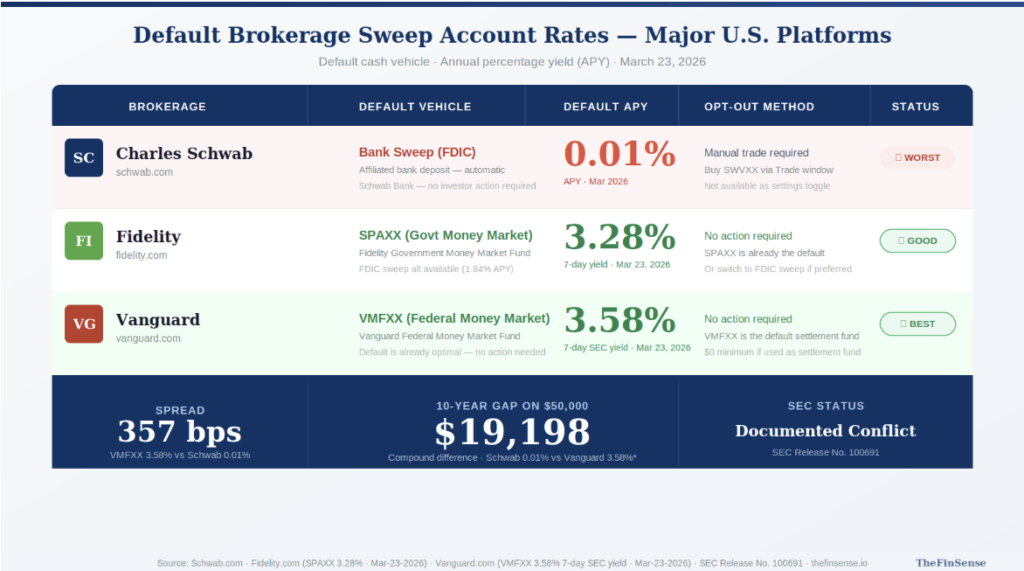
default VMFXX pays 358 a 357 basis point gap on identical idle cash
Source Schwabcom Fidelitycom Vanguardcom March 2026
How Do Brokers Make Money From Your Idle Cash?
Charles Schwab reported $23.9 billion in 2025 net revenue. Nearly half ($11.8 billion) came from a single line item that appears nowhere on your account dashboard.
You might already know that money market funds yield over three percent. The problem is that knowing the rate exists is exactly what makes the platform’s silent 0.01% default so effectively invisible.
In 2023, I held $42,000 in Schwab’s default bank sweep for eleven months. The routing protocol returned $4.20. The same balance in VMFXX would have delivered $1,160.
The line item is net interest revenue. Schwab’s 2025 earnings report breaks it down.
The firm collects market-rate interest on client deposits swept to affiliated banks. It pays clients 0.01%. The difference produced $11.8 billion in a single year.
That figure: 49% of total net revenue. Not from commissions or advisory fees.
From the spread on cash that clients assumed was dormant.
The 0.01% rate is not an oversight. It is the single largest revenue driver at the largest U.S. brokerage. The platform profits when your cash sits still.
Schwab earns 49% of its revenue not from trades but from paying you 0.01% on cash and pocketing the 3.3% spread.
Commission-free trading created a perception shift. Investors believe brokerages now earn less per account.
The revenue moved. It migrated from visible trade fees to invisible yield extraction on idle cash.
Three brokerages. Three default cash destinations. Three radically different yields on the same idle dollar.
▶ Video: How Brokerages Profit From Your Cash by Finder. Explains the sweep mechanism from the platform’s revenue perspective.
The revenue architecture is visible. The extraction formula is not.
What structural mechanism produces a 330-basis-point gap between platforms?
How 330 Basis Points Disappear From Your Cash
The revenue split is not a market outcome. It is an architectural decision coded into the account opening workflow.
Brokerage sweep account rates depend on one routing choice made during account creation. That choice sends your idle cash down one of two paths. Each path produces a radically different yield.
How Bank Sweep Routes Your Cash to Affiliated Banks
The Default Routing Protocol operates in three steps.
Cash enters the account. The platform default routes it to an affiliated bank. The bank pays 0.01% APY.
The SEC’s enforcement action (Release No. 100691) formally documented revenue-sharing arrangements in sweep programs capturing up to 400 basis points. The finding confirms cash routing is a revenue strategy, not a custody function.
At Schwab, the alternative is SWVXX. It yields 3.30%. Purchasing it requires a manual mutual fund trade.
The platform does not surface SWVXX as a cash preference. It appears as a separate investment.
💡 PRO TIP: At Schwab, search “SWVXX” in the trade window and purchase it as a mutual fund. This is not a settings change. It is a buy order the interface treats as an investment decision.
The friction is the feature. A manual trade feels like an active investment.
A default feels like doing nothing. The architecture relies on that distinction.
Why Money Market Funds Pay 331 Times More
A government money market fund holds short-term Treasury securities. It passes the yield directly to shareholders.
The 3-month T-bill yields 3.55% as of March 19, 2026, per FRED. VMFXX yields 3.31%. The fund captures most of the benchmark rate.
The bank sweep captures almost none. The formula for compound growth: FV = P × (1 + r)^t. The variable that changes is r.
At 0.01%, r is functionally zero. At 3.31%, r compounds.
Year one on $50,000: the bank sweep generates $5. The money market fund generates $1,655.
The annual spread: $1,650. That gap widens every year as compound interest accelerates.
One variable controls the entire outcome.
The SEC’s Documented Conflict of Interest
The SEC did not characterize sweep routing as a market inefficiency. The agency documented it as a conflict of interest with enforcement consequences.
Revenue-sharing arrangements of up to 400 basis points operated between brokerages and affiliated sweep destinations. The yield difference between brokerages is not different market conditions. It is a structural choice with regulatory consequences.
“Cash sweeps represent a systemic transfer of wealth from customer to brokerage firm, totaling billions of dollars industry-wide.”
— Robert C. Finkel, Senior Partner, Wolf Popper LLP
The regulatory record confirms the mechanism. The industry litigation validates the scale.
The SEC has penalized the exact arrangement that routes your cash to a 0.01% affiliated bank instead of a 3.31% government money market fund.
The formula is exposed. The architecture is documented. What did this cost you personally over the last decade?
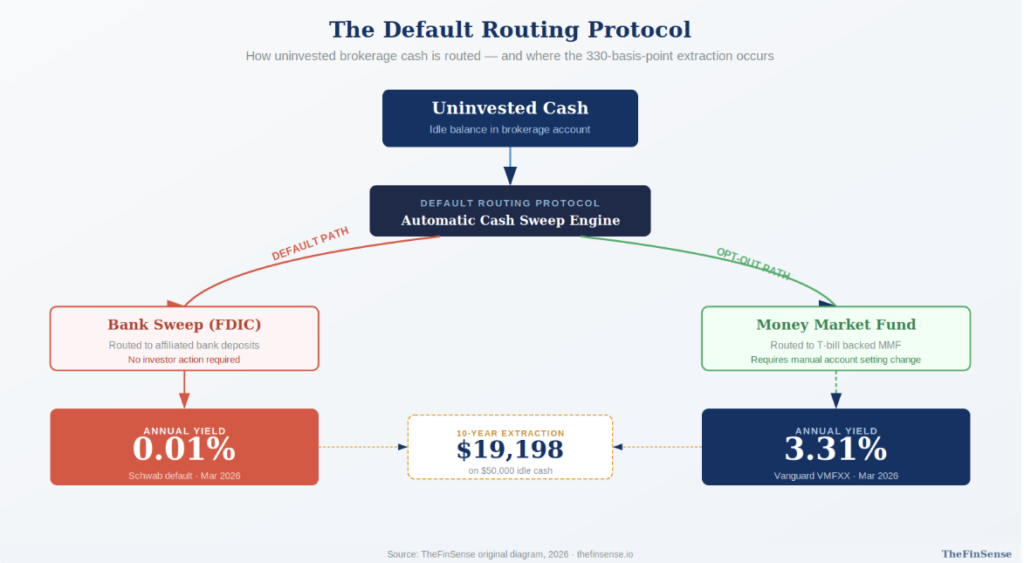
architectures an affiliated bank sweep at 001 or a money market fund
at 331 The default is always the former
Source TheFinSense original diagram 2026
How Much Does a Brokerage Sweep Account Cost You?
A Schwab investor opened a standard brokerage account in March 2016. That investor kept $50,000 in cash at the default 0.01% sweep rate for a decade.
No withdrawals. No additions. No trades. The cash sat in the platform’s default vehicle for ten full years.
A $50,000 cash position at 0.01% produces $50 of total interest over an entire decade. The same cash at 3.31% produces $19,248 in interest. One is what you earned. The other is what you could have earned.
Year-by-Year Compound Breakdown
The formula is future value: FV = P × (1 + r)^t. The principal is $50,000. The time horizon is 10 years. The only variable is the rate.
At 0.01%, the math produces almost no movement. At 3.31%, compound interest accelerates the gap every year.
| Year | Bank Sweep (0.01%) | Money Market (3.31%) | Cumulative Gap |
|---|---|---|---|
| 1 | $50,005 | $51,655 | −$1,650 |
| 2 | $50,010 | $53,365 | −$3,355 |
| 3 | $50,015 | $55,131 | −$5,116 |
| 4 | $50,020 | $56,956 | −$6,936 |
| 5 | $50,025 | $58,841 | −$8,816 |
| 6 | $50,030 | $60,790 | −$10,760 |
| 7 | $50,035 | $62,804 | −$12,769 |
| 8 | $50,040 | $64,886 | −$14,846 |
| 9 | $50,045 | $67,038 | −$16,993 |
| 10 | $50,050 | $69,248 | −$19,198 |
The bank sweep produced $50 over a decade. The money market fund produced $19,248. The gap is $19,198 on the same principal.
Year one looks small. By year five, the loss crosses $8,000. By year ten, it crosses $19,000. The curve does not flatten.
The $19,198 Brokerage Sweep Account Rates Gap Over 10 Years
$50,000 idle cash, bank sweep default (0.01%) vs money market fund (3.31%), annual compounding
The chart shows two lines diverging from the same starting point. One climbs. One flatlines.
The divergence is not random. It traces directly to the component structure of the gap.
| Component | Future Value | % of Total |
|---|---|---|
| Original Cash Principal | $50,000 | 72.2% |
| Broker’s Allowed Yield (0.01%) | $50 | 0.1% |
| Extracted Spread (Lost Yield) | $19,198 | 27.7% |
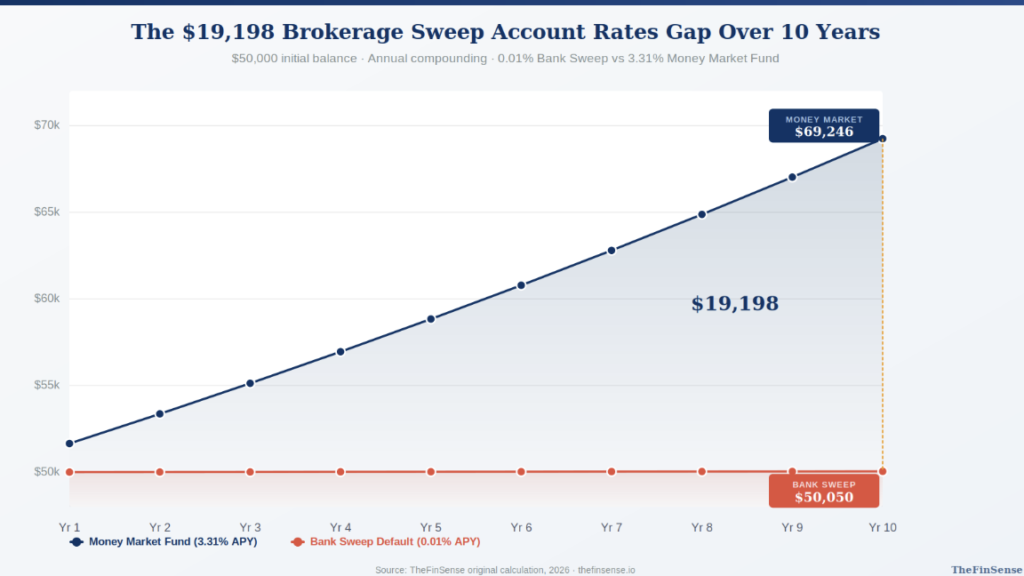
Of the $69,248 that the money market fund would have produced, $19,198 vanished into the spread. That is 27.7% of the total outcome. Your principal sat intact. Your yield did not.
The Consequence Chain: From $19,198 to $74,279
The $19,198 is the first-order loss. It measures what the sweep spread extracted directly.
The second-order loss measures what that extracted capital could have earned. If the $19,198 had been invested for twenty additional years at a 7% real return, the compound interest would have grown it to $74,279.
The platform’s default architecture extracts $19,198 from a standard fifty-thousand dollar cash position over a decade.
The default chose the rate. Your platform kept the spread. Ten years ran the calculation. No alert appeared on screen.
This is not a slow drain; it is a precision-bore siphon calibrated to extract exactly $19,198 from your cash reserves over a decade.
That $19,198 grows to $74,279 when invested for twenty more years at a 7% real return. Nearly three years of mortgage payments erased. Surrendered to a routing default.
📐 YOUR NUMBERS MAY DIFFER
This calculation assumes a 3.31% money market rate and $50,000 in constant idle cash. At $10,000, the ten-year loss is still $3,840.
| Money Market Rate | 10-Year Gap ($50K) | Conclusion |
|---|---|---|
| 2.00% | ≈ $10,900 | Five-figure loss persists |
| 3.31% | $19,198 | ✅ Base case |
| < 1.00% | < $5,000 | Gap negligible only here |
The extraction is $19,198 on $50,000. The mechanism is documented. The question is whether you can stop it.
How to Switch From Bank Sweep to Money Market Fund
The $19,198 is already lost for anyone who waited a decade. The fix takes less than fifteen minutes.
The fix does not require a new account, a financial advisor, or a platform switch. It requires one interaction with a dropdown menu or a single mutual fund purchase that takes less time than brewing coffee.
The Sweep-Spread Filter is a three-branch decision rule. It identifies and neutralizes the Default Routing Protocol at any U.S. brokerage.
Each branch targets one platform architecture. One question determines the branch: does your brokerage default to a bank sweep or a money market fund?
If Bank Sweep Default (Schwab): Purchase SWVXX Manually
Schwab’s default routes cash to affiliated banks at 0.01%. The alternative is SWVXX (Schwab Value Advantage Money Fund) at 3.30%.
SWVXX is not a settings toggle. It requires a manual purchase through the trade window.
Log into Schwab. Open the trade screen. Search “SWVXX.” Enter the dollar amount of your idle cash. Execute the buy order.
The entire process takes under five minutes. The yield difference is 3.29 percentage points per year on every dollar moved.
💡 PRO TIP: At Fidelity, verify your core position reads “SPAXX” (money market), not “FDIC” (bank sweep). The selection is buried in the account features dropdown. Choosing the wrong option at account creation costs 3.29% annually.
If Money Market Default (Fidelity/Vanguard): Verify You Are Not in FDIC Sweep
If Fidelity: Confirm Core Position Is SPAXX
Fidelity defaults most accounts to SPAXX (3.30%). Verify by navigating to Accounts & Trade → Account Features → Core Position. The dropdown shows your active selection.
If it reads “FDIC-Insured Deposit” instead of SPAXX, select SPAXX from the dropdown and confirm. No trade required. The switch takes under two minutes.
If Vanguard: Confirm Settlement Fund Is VMFXX
Vanguard routes uninvested cash to VMFXX (3.31%) by default. Verify by navigating to My Accounts → Portfolio Watch → Settlement Fund. The fund name should read “Vanguard Federal Money Market Fund.”
If it reads anything else, contact Vanguard support directly. Vanguard does not offer a self-service core position toggle — the change requires a representative.
The 50-Basis-Point Threshold Rule
The Sweep-Spread Filter uses a single quantitative trigger. Compare your default sweep rate against the 3-month T-bill rate (3.55% as of March 2026).
If the spread exceeds 50 basis points, act. Move to the money market alternative. The 50-bps threshold identifies every bank sweep default on the market.
Schwab’s spread: 354 basis points. The threshold catches it immediately. Fidelity and Vanguard clear the filter with spreads under 30 bps.
This single action does more to protect savings from inflation than any high-yield savings account comparison. The yield recapture is permanent for every dollar held in cash.
The Default Routing Protocol operates across asset types. The same extraction logic that routes cash to 0.01% applies wherever financial platforms set defaults on your behalf.
Brokerage Sweep Account Rates FAQ
Are money market funds safe for idle cash?
Not identical to FDIC insurance, but the practical difference is negligible on a $50,000 cash buffer. FDIC insurance covers up to $250,000 per depositor per institution against bank failure. Government money market funds hold short-term Treasuries backed by the U.S. government and have maintained a stable $1.00 NAV in all but two instances since 1971. The yield difference over ten years is $19,198.
Do sweep account rates drop when the Fed cuts rates?
Both bank sweep and money market rates decline when the Fed reduces the federal funds rate. The gap narrows in absolute dollars, but the ratio persists. If money market yields drop to 2.0%, the ten-year gap on $50,000 is still approximately $10,900. The extraction mechanism operates at any positive rate level above the bank sweep floor.
Can you lose money in a money market fund?
Technically possible but extremely rare. Only two money market funds in U.S. history have broken the $1.00 NAV, and neither was a government-only fund. Government money market funds hold Treasury obligations and agency debt. The $1.00 NAV has remained stable through every modern financial crisis including 2008 and 2020.
Is switching from sweep to money market taxable?
Generally, no. Bank sweep balances are not securities with a cost basis, so moving them into a money market fund is not a taxable disposition. The purchase of money market shares establishes a new cost basis at $1.00 per share. Ongoing interest and dividends from either vehicle are taxable as ordinary income in the year received regardless of the sweep type.
Why is my brokerage cash earning so little?
Because the spread is the business model. Regulation D allows banks to receive intercompany transfers from affiliated brokerages without individual depositor restrictions. This legal framework lets the affiliated bank pay near-zero rates while earning market rates on the same deposits. Revenue-sharing arrangements between broker and bank lock in the extraction. Routing cash to the highest yield would eliminate the platform’s largest revenue line.
The Bottom Line on Brokerage Sweep Account Rates
That 0.01% on your account statement is not a rounding error. It is the most precisely engineered number on your entire dashboard.
The default cash sweep at the largest U.S. brokerage pays 0.01% while two competitors pay 3.31%. The difference is $19,198 on $50,000 over ten years. This is not a market outcome. It is a revenue model.
The broker is not failing to pay you; they are successfully charging a 3.3% invisible management fee on your safest asset.
The cash you hold to protect your portfolio is the single most profitable asset your broker owns.
The platforms that eliminated trading commissions did not eliminate fees. They relocated revenue extraction to the one asset class investors monitor least. The zero-commission era made trading free by making holding expensive.
You will never trust a default setting with your money again.
Not all safe investments protect your cash equally; some quietly repeat the same extraction.
📌 Next Read: safe investments to beat inflation
One setting change plugs the drain permanently.
💬 YOUR TURN
What is your brokerage’s current default sweep rate, and how long has your cash been sitting there?
Drop a comment below 👇