
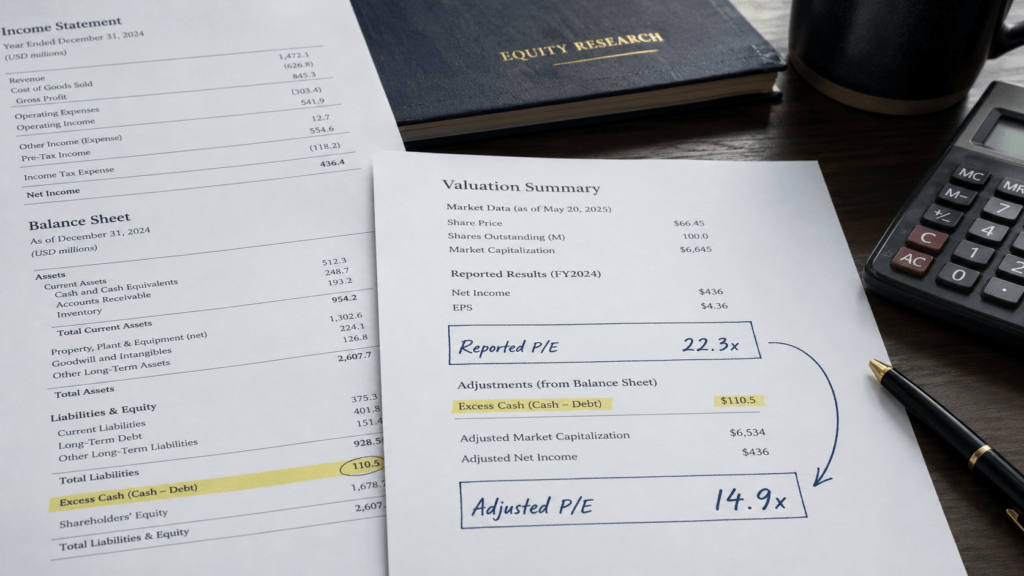
An adjusted P/E ratio is not one fixed formula. In this guide, the cash-adjusted version removes excess cash from the market value of equity and removes the interest earned on that cash from earnings, so both sides still measure the same equity claim. In McKinsey’s Circuit City example, that adjustment moved the multiple from 22.3x to 14.9x; it was a company-specific peer-value correction, not a forecast of a 33% stock loss.
A stock screener gives you one clean number, but the filing often gives you several reasons not to trust it yet. That gap is where the real check starts.
P/E still earns its place, but reported earnings can include interest income, asset-sale gains, restructuring charges, pension effects, and other items that blur a peer check. Cash and debt can also make P/E and enterprise multiples point in different directions.
The useful question is narrower than “Is this P/E low?” Ask what sits on the value side, what sits on the earnings side, and whether both cover the same equity claim. Get that wrong and you can rank the wrong peer as cheapest or treat a non-core asset as part of the business.
The Circuit City Case That Explains the Adjusted P/E Ratio
McKinsey’s 2005 analysis compared Circuit City with other retailers. Circuit City traded at 22.3 times projected earnings, which made it look more expensive than Best Buy on P/E. The enterprise-value comparison pointed the other way.
The reason was nearly $1 billion of cash inside a company with an equity value of about $2.7 billion. That cash earned little income, so it contributed a large amount to equity value but very little to earnings.
| Step | Numerator | Denominator | P/E |
|---|---|---|---|
| Reported | Equity value | Projected earnings | 22.3x |
| Cash-adjusted | Equity value minus excess cash | Projected earnings minus after-tax interest income | 14.9x |
| Difference | Same operating business, narrower valuation frame | About one-third lower | |
The arithmetic is real: (22.3 − 14.9) ÷ 22.3 = 33.18%, but the lesson is narrower. McKinsey did not show a future 33.18% loss for Circuit City investors, and it did not say every cash-rich stock should fall by that amount. The point was that reported P/E gave a poor view of the retailer because a large non-core asset sat inside the stock-market value.
The adjustment changes the peer check; it cannot forecast the next price move.
What Adjusted P/E Actually Means
The adjusted P/E ratio is not one fixed accounting measure. Analysts use the label for cleanups such as removing excess cash or normalizing one-time earnings. Forward P/E is a separate choice of earnings period, not the same balance-sheet adjustment.
A sound adjustment follows one rule: change the same economic item on both sides of the ratio.
Both the value (the numerator) and the standardizing variable (the denominator) should be to the same claimholders in the firm.Aswath Damodaran, NYU Stern
For P/E, the value side is the market value of common equity and the earnings side belongs to common shareholders. For an enterprise multiple, the value side covers debt and equity, so the earnings side must be measured before financing claims.
Plain English
Keep the slice consistent. If you subtract cash from the stock-market value, also remove the income earned on that cash. If you value debt and equity together, pair that value with profit measured before financing costs.
Which Valuation Route Fits the Balance Sheet?
There is no fixed 5% or 10% cutoff that makes reported P/E valid or invalid. What matters is whether the adjustment changes your peer ranking, your view of normal earnings, or your investment decision.
| What you find | Primary check | Why |
|---|---|---|
| Large excess cash balance | Cash-adjusted P/E plus EV/EBIT | Separate the operating business from a low-return nonoperating asset. |
| Meaningful debt or lease obligations | P/E plus EV/EBIT or EV/EBITDA, debt ratios, and interest coverage | P/E is after financing costs; enterprise multiples examine the operating business before financing. |
| One-time gain, impairment, or restructuring charge | Normalized or forward P/E | Trailing earnings may not show ongoing earning power. |
| Negative or near-zero earnings | Do not rely on P/E | A tiny or negative denominator makes the ratio unstable or meaningless. |
| Clean balance sheet and recurring earnings | Reported or forward P/E with matched peers | The simple ratio can work when the accounting and capital structure are genuinely comparable. |
Peer selection still matters. McKinsey recommends comparing companies with similar growth and returns on invested capital. A lower multiple is not a bargain by itself if the other company has stronger economics or faster growth.
For the direct contrast between the two most common frames, see EV/EBITDA vs. P/E ratio. P/E and EV/EBITDA place value and earnings at different levels of the capital structure, so a gap between them can tell you something useful.
How to Calculate a Cash-Adjusted P/E Ratio
You can rebuild this cash-adjusted P/E from public filings, but the hard part is deciding how much cash is truly excess. Cash needed for payroll, inventory, working capital, near-term debt, or planned investment should stay in the business.
- Match the starting P/E: use market capitalization and earnings from the same period, and explain any intentional date mismatch.
- Estimate cash the business no longer needs: read the balance sheet, liquidity notes, debt schedule, and capital-allocation plans. A shortcut such as “three months of operating expenses” is only a rough screen.
- Remove the earnings tied to that cash: if cash comes out of the stock-market value, take the related after-tax interest out of earnings too so both sides stay on the same basis.
- See whether the peer ranking changes: recalculate the multiple and compare it with the original figure and suitable peers. A large shift should lead to more questions before you trade.
(Market capitalization − excess cash) ÷ (net income − after-tax interest income on excess cash)
Use: compare the core business of a cash-rich company with similar peers. Do not use it as a price target, return forecast, or substitute for cash-flow work.
Cash-Adjusted P/E Calculator
Compare reported P/E with a cash-adjusted P/E while removing the after-tax interest tied to the cash you classify as excess. Change the excess-cash input to test how sensitive the multiple is to that judgment.
| Calculation | Reported | Adjusted |
|---|---|---|
| Equity value | ||
| Earnings | ||
| After-tax interest removed | N/A | |
| Excess cash / market cap | N/A |
⚠️ Scope of this tool:
- Excess cash is an assumption: do not treat the entire cash balance as excess without checking operating, debt, and investment needs.
- Match periods: market value, net income, and interest income should be intentionally aligned and dated.
- Positive earnings only: negative or near-zero earnings can make P/E unstable or meaningless.
- Tax is simplified: the input applies one tax rate to the interest income you remove and does not model jurisdiction-specific tax effects.
- Not a return forecast: the percentage result is the change in the valuation multiple, not an expected gain, loss, or target price.
For earnings cleanups, use the income statement analysis framework to separate one-time gains, impairments, interest items, and tax effects before you treat reported earnings as recurring.
Why Debt Is Not Simply Added to P/E
A common shortcut is to add net debt to market capitalization while leaving net income on the earnings side. That is not a valid adjusted P/E. Adding debt moves the value side toward an enterprise framework, but a full EV bridge can also include other claims and subtract cash.
Debt can affect P/E through interest expense, taxes, share repurchases, risk, and the market’s required return. McKinsey shows one case in which leverage raises P/E when the all-equity P/E exceeds one divided by the cost of debt. Debt alone therefore cannot tell you whether P/E is too high or too low.
Do not infer valuation from debt alone. AT&T reported $117.4 billion of net debt at December 31, 2025. That debt load is a reason to check EV multiples, interest coverage, and normal earnings. By itself, it cannot prove that AT&T’s P/E was too low, too high, or about to reprice.
For a debt-heavy company, keep the equity and enterprise views side by side:
- P/E: what equity investors pay for earnings after financing costs.
- EV/EBIT or EV/EBITDA: what all capital providers pay for operating profit before financing costs.
- Interest coverage and debt maturities: whether the capital structure is sustainable.
- Free cash flow: whether reported earnings convert into cash available for debt service and owners.
The cash flow statement shows whether the earnings story holds up in cash. A low P/E backed by recurring cash generation is different from one built on one-time income or weak cash conversion.
Common Adjusted P/E Ratio Mistakes
Four errors that change the answer
- Treating one historical case as a fixed correction. Circuit City’s one-third change came from its own cash balance and earnings mix.
- Turning a multiple change into a return forecast. A lower adjusted multiple does not mean an equal one-time price loss.
- Mixing claimholder levels. Pair enterprise value with business-level profit and stock value with earnings for common shareholders.
- Calling every dollar of cash excess. Working cash, planned investment, and debt maturities can make a large cash balance necessary.
There is also a broader limit: multiples are relative pricing tools. They can show that two companies are priced differently, but they cannot tell you whether the whole peer group is fairly valued. A discounted cash-flow model or scenario test may still be needed when the decision depends on intrinsic value.
Adjusted P/E Ratio: Frequently Asked Questions
Is adjusted P/E the same as Shiller CAPE?
No. Shiller CAPE smooths market earnings over ten inflation-adjusted years. This guide covers company-level changes for excess cash, one-time earnings, and capital structure.
Should debt be added to market cap when calculating an adjusted P/E ratio?
No. Adding debt moves the value measure toward EV, but full EV may also add other claims and subtract cash. Pair EV with EBIT, EBITA, EBITDA, or another business-level earnings measure rather than common-share net income.
How much cash counts as excess cash?
There is no fixed percentage. Review working cash needs, debt maturities, planned spending, regulatory needs, and management’s capital-allocation plans. Cash left after those needs is the amount you can test as excess.
Does a lower adjusted P/E mean the stock is undervalued?
Not by itself. The lower figure may improve the peer ranking, but value still depends on growth, return on invested capital, risk, cash conversion, and the quality of the peer set.
When is reported P/E good enough?
Reported or forward P/E works best when earnings are positive and recurring, financing differences are modest, non-core items are small, and the peer companies have similar economics.
The Bottom Line
Treat the adjusted P/E ratio as a consistency check. If you remove a non-core asset from value, remove the earnings tied to it too. Make earnings cleanups only when you can document and repeat them. If you need to value debt and equity together, switch to an EV multiple.
Circuit City’s 22.3x-to-14.9x change remains useful because it shows how much one balance-sheet item can change a peer ranking. It cannot support a fixed one-third haircut, a 30-year loss model, or a rule that debt always makes P/E look cheap.
The ratio works best when every number describes the same business and the same capital claim.
YOUR TURN
Which part of a company’s P/E would you check first: excess cash, one-time earnings, or debt?
- McKinsey, “The right role for multiples in valuation” (2005): Circuit City’s 22.3x reported P/E and 14.9x cash-adjusted P/E; discussion of leverage, enterprise multiples, and non-core adjustments.
- Mauboussin & Callahan, Morgan Stanley Investment Management (2024): analyst-use survey and the distinction between levered P/E and unlevered EV/EBITDA.
- Aswath Damodaran, NYU Stern: claimholder-consistency rule for valuation multiples.
- AT&T fourth-quarter and full-year 2025 release: $117.4 billion net debt at December 31, 2025, used only as a dated leverage example.
Method: TheFinSense independently recalculated the Circuit City percentage change as 33.18% from McKinsey’s published 22.3x and 14.9x figures. The calculator separately computes reported P/E, subtracts user-estimated excess cash from equity value, removes the after-tax interest tied to that cash from earnings, and then recomputes P/E. Its default inputs are hypothetical and are not presented as Circuit City filing data. No stock-return, price-target, or long-horizon compounding claim is derived from a multiple change.
Limitations: The Circuit City figures are a historical company-specific example. “Excess cash,” normalized earnings, and appropriate peers require judgment. Banks, insurers, REITs, and loss-making companies generally need different valuation frameworks.
Primary links: McKinsey · Morgan Stanley · NYU Stern · AT&T
AI-assisted tools supported drafting, calculation checks, and consistency review. Danny Hwang reviewed the cited source material, reasoning, and final article. See the editorial policy.
Update history
-
v2.2
2026-08-16
UPDATEAdded an interactive cash-adjusted P/E calculator with matched numerator-and-denominator adjustments, an explicit excess-cash assumption, invalid-input handling, and a warning that multiple changes are not return forecasts.
-
v2.1
2026-08-16
UPDATEClarified the cash-adjusted P/E scope and EV bridge, simplified the calculation workflow, replaced redirect-form internal links with root-canonical URLs, and aligned the bottom trust components with the current site contract.
-
v2.0
2026-07-17
CORRECTIONRebuilt the article around claimholder consistency. Removed the unsupported $214,818 compounding scenario, the claim that debt always compresses P/E, fixed percentage gates, the secondary-source AT&T P/E figures, and the video embed. Added a decision router, a reproducible Circuit City calculation, primary-source limits, and a dated correction record.
-
v1.0
2026-04-16
PUBLISHOriginal publication.