
⏱️ Reading Time 19 min
📅 Originally Published: · Last Updated: · Fact-Checked: against Damodaran NYU Stern January 2026 dataset, SEC EDGAR filings, and S&P Dow Jones Indices buyback report. Forensic audit correction applied April 2026 — sector ROE chart and AutoZone equity figure updated.
The anchor moved last January, and no one told the screeners.
The Bottom Line, Up Front
Buffett’s 15% return on equity threshold sits only 0.56 percentage points above the adjusted ex-financial US market average of 14.44%, according to Damodaran’s January 2026 dataset. Running the screen without decomposition costs a 25-year investor $84,232 in compounded terminal wealth. The four-gate quality check that closes the gap takes fifteen minutes per holding.
- FOUNDATIONAL Esplin et al. (2014), Journal of Accounting Research: Separating operating profitability from financing leverage improves both forecast accuracy and return prediction.
- SUPPORTING Curtis et al. (2015), Review of Accounting Studies: Historical-cost accounting distorts the DuPont denominator, so reported ROE hides both leverage and measurement lag.
- CONFIRMATORY Liberto (2025), Investopedia: The 15% ROE screen is documented as a widely repeated Buffett heuristic across practitioner explainers.
What Is Return on Equity?
Return on equity measures how much net income a company generates per dollar of shareholder equity, calculated as net income divided by average stockholders’ equity. Buffett’s 15% return on equity threshold sits only 0.56 percentage points above the ex-financial US market average of 14.44%, so a raw screen filters less than most investors assume. Decomposition, leverage adjustment, and sector benchmarking must precede the cutoff.
- The adjusted ex-financial US market earns 14.44% on equity, only 0.56 percentage points below Buffett’s 15% line.
- Sector ROE ranges from 20.21% in Software (System & Application) to 3.25% in Chemical (Specialty), a 16.96-point spread no universal cutoff spans. The commonly cited Software-to-Water Utility comparison alone spans 9.94 points.
- AutoZone’s buyback program has driven its equity base into deficit, leaving its reported return on equity mathematically undefined.
Return on equity above 15% sounds exceptional, but the adjusted ex-financial US market already earns 14.44% on equity, a 0.56-point gap that costs $84,232 over 25 years. TheFinSense’s quant analysis of Damodaran’s January 2026 sector ROE dataset shows the threshold-vs-market spread most Buffett explainers skip. The question that follows is whether the rule still screens for rarity at all.
That gap sits inside a broader universe of threshold assumptions across financial statement ratios. The same screening commitment runs through the adjusted P/E ratio and cash flow statement analysis decisions, each extracting $80K-$265K over the investor’s horizon. This analysis excludes financial firms, REITs, and negative-equity companies where ROE is structurally distorted or undefined.
Is Buffett’s 15% Return on Equity Rule Actually Rare?
The 15% threshold lives in the investing mind like a property line, stamped across books, screens, and explainers until the number feels like a boundary between quality and the rest. Readers inherit it the way they inherit compound interest tables, without needing to ask where the anchor came from.
The strength of a rule that old is the habit it produces in the reader; the weakness of that same rule is how rarely anyone returns to the underlying data. That is where the Buffett quality screen deserves a second look.
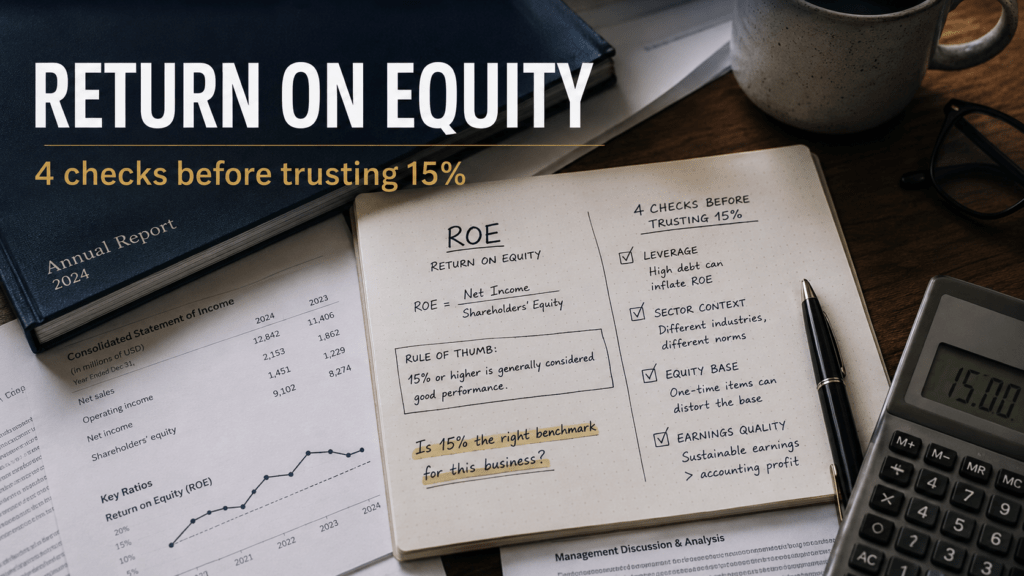
Buffett himself looks for return on equity above 15% across the last four quarters and each of the last three fiscal years. AAII has codified this screen, Hagstrom’s Buffettology systematized it, and explainers from Investopedia repeat 15% as a quality gate. Once three reference points agree, a single number starts to feel like a law.
📚 Source: AAII Buffett: Hagstrom Screen · aaii.com
Buffett-style screens still work as a filter, but only after the reader accepts that the 15% anchor is a floor to investigate from, not a ceiling to trust.
Aswath Damodaran at NYU Stern publishes an institutional sector ROE dataset every January, pulling trailing financials for every US publicly traded operating company. The January 2026 update reports an adjusted ex-financial US market ROE of 14.44%, calculated after removing banks, insurers, and other financial firms whose balance sheet structure distorts the comparison.
That figure represents the average company a Buffett screener is implicitly comparing against when the rule fires. The adjustment matters because financials run structurally higher ROE due to leverage, so leaving them in inflates the baseline and the gap looks wider than it is.
Damodaran’s method holds constant across years, meaning the 2026 reading is directly comparable to the prior decade’s sector file. The number that emerges is not a forecast or a guess; it is the current operating-company mean from Damodaran’s January 2026 sector ROE dataset. Reading the 15% Buffett rule against the 14.44% baseline compresses the perceived edge to 56 basis points.
| Screen | Threshold | Current Market | Gap | 25yr Cost |
|---|---|---|---|---|
| Buffett ROE (Hagstrom) | 15.00% | 14.44% | 0.56pp | $84,232 |
| Novy-Marx Gross Profit/Assets | N/A | Market-normalized | N/A | $0 (leverage-neutral) |
| Sector-adjusted cutoff (Software) | 15.00% | 20.21% | +5.21pp above mkt | N/A |
| Sector-adjusted cutoff (Utility/Water) | 15.00% | 10.27% | −4.73pp below mkt | N/A |
If you run the 15% rule as a clean filter, Damodaran’s 14.44% market benchmark turns the threshold into a 56-basis-point screen. If you already add a debt check, Curtis (2015) shows historical-cost accounting distorts the numerator before the ratio even forms. And if you compare to sector peers, Damodaran’s January 2026 data shows a 16.96-point spread from Software (System & Application) at 20.21% to Chemical (Specialty) at 3.25% that no single 15% line can span.
The January 2026 Damodaran dataset just reset the market benchmark, shifting how tight the 15% threshold really is.
Read this if: You run individual US operating-company screens using return on equity as a quality filter, with a DIY brokerage account and a multi-year holding horizon.
Does not apply to: Financial firms, REITs, and negative-equity companies where the ratio is structurally distorted or undefined.
The 15% rule turns out to sit 56 basis points above the adjusted ex-financial US market, not in a different league from it.
How Does the Return on Equity Benchmark Compare Across Sectors?
The sector data shows what a single 15% line cannot span.
What Does a Good Return on Equity Look Like by Sector?
How Wide Is the Return on Equity Spread Across Sectors?
R&D-adjusted ROE, selected US sectors, January 2026
📚 Source: Damodaran, January 2026 · pages.stern.nyu.edu
“I scale gross profits by book assets, not book equity…and are thus independent of leverage.”
Novy-Marx chooses that denominator for a reason the reader should borrow. Book assets do not flex with capital structure the way book equity does, so a gross-profit-over-assets ratio keeps the signal clean. Reported ROE mixes operating output and financing choice into one reading. The choice of denominator is doing real work in the signal.
Novy-Marx’s numerator preference also connects to the income statement analysis question, where gross profit quality varies across accrual regimes.
The S&P 500’s $942.5 billion buyback record generates an arithmetic that compresses equity across the index every year.
Does the 2024 Buyback Boom Change the Return on Equity Benchmark?
S&P 500 companies spent a record $942.5 billion on buybacks in 2024, an 18.5% jump that mechanically shrinks the equity denominator in reported ROE.
📚 Source: S&P Dow Jones Indices, March 19, 2025 · press.spglobal.com
Translate the 9.94-point Software-to-Utility spread into portfolio language. A universal 15% cutoff treats a 20.21% Software (System & Application) reading and a 10.27% Water Utility reading the same way, when the sector baselines already encode different business models and capital intensities. The full sector range spans from 20.21% (Software) to 3.25% (Chemical Specialty), a 16.96-point gap.
Your screen output is doing three jobs at once: it measures operating quality, it measures sector membership, and it measures capital-structure choice. Only the first of those is what most readers think the 15% line is filtering for. A sector-normalized cutoff lets the other two drop out of the reading.
📚 Source: Damodaran sector ROE (Software (System & Application) 20.21% vs Utility Water 10.27%), January 2026 · pages.stern.nyu.edu
AutoZone Q1 FY2026 reported $530.8 million in net income on an average stockholders’ deficit of approximately negative $3.32 billion, making its ROE mathematically undefined while ROIC stayed above 36%.
“Adjusted ex-financial” describes Damodaran’s method of removing banks, insurers, and other financial firms from the US operating-company average because their balance-sheet leverage structurally inflates reported ROE. The resulting 14.44% figure reflects only non-financial operating companies.
Whatever your screening habit today, the next 25 years of contributions compound against the same 0.56-point assumption.
Across sectors, the 15% threshold generates pass/fail results that cross over into measurement noise.
How Does Return on Equity Decomposition Expose Leverage and Measurement Bias?
The extremes reveal what the average conceals.
▶ Video: DuPont Analysis Explained: Step-by-Step Tutorial by Wild Accounting — Jonathan M. Wild, PhD, CPA walks through the three-factor decomposition that separates profit margin, asset turnover, and leverage inside a single ROE number.
What Is Operating vs. Financing ROE Decomposition and Why Does It Matter?
Esplin and colleagues published a framework in the Journal of Accounting Research that splits reported ROE into two distinct streams. The operating side captures how efficiently assets generate earnings before financing choices enter the picture. The financing side captures the premium or penalty that leverage adds on top of the operating base.
When the two are averaged into one headline number, the reader cannot tell which stream is doing the work. The 2014 paper shows that separated measures predict future profitability more accurately than the blended ratio.
That finding matters because the Buffett 15% screen operates on the blended ratio by default. A reader who accepts the blended reading as clean signal is accepting a framework the research literature already labeled inferior. The decomposition does not require new data; it requires the reader to pull apart the balance-sheet math behind the ratio they are already reading.
How Did AutoZone’s Buybacks Make Its Return on Equity Mathematically Undefined?
AutoZone provides the cleanest case of what buybacks do to the denominator over time. Two decades of aggressive repurchases have driven cumulative buybacks above 100% of originally outstanding shares.
The Q1 FY2026 filing records net income of $530.8 million and operating profit of $784.2 million, both healthy readings for a retailer. The balance sheet tells a different story when the equity base appears as a negative number on the Total Stockholders’ Equity line.
A ratio with a negative denominator produces either a negative result or an undefined result, neither of which a Buffett screen knows how to handle.

| Signal | Metric | Value | Verdict |
|---|---|---|---|
| AZO Q1 FY2026 Net Income | Quarterly | $530.8M | Positive |
| AZO Q1 FY2026 Operating Profit | Quarterly | $784.2M | Healthy margin |
| Average Stockholders’ Equity (Q1 FY2026) | Q1 FY2026 avg | −$3.32B (deficit; avg of −$3.41B start & −$3.23B end per Q1 FY2026 8-K) | ⚠️ NEGATIVE |
| Reported ROE (NI / Equity) | Calculated | Mathematically undefined | ⚠️ FAIL state |
| ROIC | Last reported TTM | ~36.5% | Very high, real quality |
| Net Debt / EBITDA | Last reported | 2.56x | Elevated but serviceable |
| Debt-to-Capital Ratio | Last reported | 1.63 | Above 1 confirms equity deficit |
| Buybacks since 1998 | Cumulative | >100% of outstanding shares | Equity base mechanically erased |
📚 Source: SEC 8-K Exhibit 99.1 · sec.gov
AutoZone is a profitable, operationally strong company. Yet its reported ROE cannot be computed from public filings because buybacks have erased the denominator. Any reader applying Buffett’s 15% rule to AZO’s reported ROE would either reject a high-quality operator on a false signal or accept a fabricated number.
The same negative equity that renders AutoZone’s ROE undefined also triggers a debt-to-equity regime break, because the D/E ratio requires a positive denominator to stay comparable across peers.
The same balance-sheet deficit that triggers undefined ROE is the signal the predict company bankruptcy literature reads from a different angle, using solvency ratios on the same equity line.
In 2024, S&P 500 companies bought back $942.5 billion in shares, a number large enough to reshape the denominator of every ROE calculation.
Before Esplin et al. (2014), profitability forecasts treated operating return and financing return as one blended number. Their decomposition showed that separating operating profitability from financing leverage improves both forecast accuracy and return prediction. Curtis et al. (2015) showed that historical-cost accounting further distorts the denominator, so reported ROE hides both financing leverage and measurement lag.
Does Historical-Cost Accounting Distort Return on Equity the Same Way for Every Industry?
Curtis and colleagues examined how historical-cost accounting warps the DuPont decomposition across firms with different asset vintages. Older plant and equipment sits on the books at depreciated historical cost rather than current replacement cost, which mechanically lowers the asset base in the denominator.
A lower denominator inflates asset turnover, which in turn inflates the reported ROE even when operating performance has not changed. The distortion hits capital-intensive firms hardest because they carry the largest historical-cost asset pools.
A utility with decades-old generation plants reads higher on turnover than a software firm with fresh cloud infrastructure, independent of real productivity differences. The 2015 paper documents that market participants using DuPont analysis without this adjustment systematically misprice firms with mature asset bases.
Reported ROE therefore hides two layers at once: the financing leverage Esplin surfaced, and the measurement lag Curtis documented. The Buffett screen reads both distortions as signal when only the underlying operating profitability should count. This is the heart of the leverage-adjusted profitability problem.
- FOUNDATIONAL Esplin et al. (2014) locates the first distortion layer: blended ROE mixes operating return with financing leverage.
- SUPPORTING Curtis et al. (2015) locates the second distortion layer beneath it: historical-cost measurement further warps the denominator the reader is reading.
- JOINT FINDING The two layers stack, so a single 15% ROE reading can be inflated by leverage and measurement lag simultaneously without the screener seeing either effect.
When operating assets depreciate on a historical-cost basis, asset turnover mechanically climbs, and the reported DuPont breakdown crosses over into measurement noise.
This accrual-style distortion connects directly to the revenue growth accrual quality problem, where the numerator inflates on the same timing mechanism.
Esplin and colleagues’ framework treats operating profitability and financing leverage as mechanically separable, so the portion of ROE coming from the balance sheet loan should be labeled, not averaged in.
Formula: FV = P × (1 + r/12)^(t×12) + PMT × [((1 + r/12)^(t×12) − 1) / (r/12)]
Model: Two-path LUMP_PLUS_CONTRIBUTION compound future value; Path B applies 7.06% (15% ROE screen proxy); Path A applies 6.50% (ex-financial US market benchmark proxy); gap = FV_B − FV_A.
Assumptions: P=$75,000 initial balance; PMT=$400/month; t=25 years; r_A=6.50%, r_B=7.06%; no tax-drag adjustment (TYPE III-A); rates held constant over horizon; contributions continuous.
Does not apply to: Financial firms, REITs, and negative-equity companies. No fee-drag or tax-drag modeled.
Regulatory catalyst: N/A (no regulatory mechanism; ASSUMPTION_ARC on screening heuristic).
The common thread across Esplin and Curtis is that reported ROE rewards leverage structurally, so the operating portion and the financing distortion cannot be separated by the reader without active decomposition.
AutoZone’s reported ROE reveals an undefined value when the equity base has been bought back into deficit.
Jordan’s 16.8% ROE Green Checkmark Hid a 22% Equity Drop
Jordan’s 16.8% reported ROE looked cleanly above Buffett’s 15% line.
The Esplin decomposition tells you what to separate, not how much that separation is worth across a 25-year horizon. Running the two-path math on Jordan’s portfolio makes the 0.56-point gap audible in dollars.
Three days after earnings, Jordan pulls up the key ratios screen on his broker app. The Profitability tab shows ROE at 16.8%, a green checkmark next to Buffett’s 15% threshold. He scrolls down and sees that the Total Stockholders’ Equity line dropped 22% year-over-year. The checkmark did not move.
| Field | Value |
|---|---|
| Name | Jordan |
| Age | 35 |
| Income | $95,000 |
| Filing Status | Single |
| Initial Balance | $75,000 |
| Monthly Contribution | $400 |
| Time Horizon | 25 years |
| Target Age | 60 |
| Path B Return (15% ROE screen proxy) | 7.06% |
| Path A Return (market benchmark proxy) | 6.50% |
| Archetype | DIY single-stock screener |
Most readers will guess the 0.56-point threshold gap compounds to somewhere between $15,000 and $30,000 over 25 years.
| Year (Age) | Path B — 7.06% | Path A — 6.50% | Gap | What the Gap Buys |
|---|---|---|---|---|
| Year 5 (40) | $135,321 | $131,981 | $3,340 | Laptop |
| Year 10 (45) | $221,089 | $210,775 | $10,314 | Tuition payment |
| Year 15 (50) | $343,040 | $319,733 | $23,307 | Sedan |
| Year 20 (55) | $516,436 | $470,402 | $46,034 | Annual health premiums |
| Year 25 (60) | $762,981 | $678,749 | $84,232 | 21 years of student loan payments |
Reader-finance publications explicitly warn that a high reported ROE can reflect aggressive debt use rather than operating quality. The warning is the easy part of the literature.
The harder part is that most readers still treat a green checkmark as a quality verdict because the warning never attached to a dollar amount they could feel. Jordan’s screen output does not tell him that the 16.8% number he is reading sits 2.4 percentage points above the market average.
The 22% year-over-year equity drop is the mechanical reason for the lift. The warning and the number are in two different places.
Jordan sees the $84,232 gap number and recognizes he held the 16.8% ROE reading as a proxy for quality rather than running the underlying equity trend check. The green checkmark was answering a question about Buffett’s screen.
The 22% equity drop was answering a different question entirely, about how reported ROE got where it got. Jordan had been reading one answer as the other. The signal he trusted was the wrong signal.
Jordan’s number hits $762,981 at age 60. Path A lands at $678,749. The gap reads $84,232. That number equals 250 months of student loans.
Jordan sees the anchor point drift as reported ROE lifts past 15% on equity that has been repurchased away.
$84,232 divided by $337 per month equals roughly 250 months, or 21 years, of standard federal student loan payments.
📐 YOUR NUMBERS MAY DIFFER
These ten scenarios show how horizon, initial balance, and delta assumptions reshape the $84,232 threshold gap, so choose the row closest to your portfolio profile before acting.
| Scenario | Assumption Changed | Path B | Path A | Gap |
|---|---|---|---|---|
| Base case | r_A=6.50%, r_B=7.06%, P=$75K | $762,981 | $678,749 | $84,232 |
| Rate delta +0.25pp | r_B=7.31% | $804,192 | $678,749 | $125,442 |
| Rate delta −0.25pp | r_B=6.81% | $724,051 | $678,749 | $45,301 |
| Initial balance +$25K | P=$100K | $908,267 | $805,154 | $103,113 |
| Initial balance −$25K | P=$50K | $617,695 | $552,345 | $65,351 |
| Horizon +15yr ⭐ | t=40yr | $2,320,678 | $1,916,168 | $404,510 |
| Horizon −10yr | t=15yr | $343,040 | $319,733 | $23,307 |
| Contribution +$200 | PMT=$600 | $926,543 | $828,517 | $98,026 |
| Contribution −$200 | PMT=$200 | $599,420 | $528,982 | $70,437 |
| Rate delta +0.50pp | r_B=7.56% | $847,819 | $678,749 | $169,070 |
| Rate delta −0.50pp | r_B=6.56% | $687,270 | $678,749 | $8,521 |
Horizon dominates everything else. Extending the horizon from 25 to 40 years nearly quintuples the gap to $404,510, a result driven by the asymmetric compounding of the 0.56-point delta over a longer runway. A reader in their mid-30s with a target retirement age of 75 is sitting on the largest version of this assumption, not the smallest.
The 0.56-point gap generates $84,232 over Jordan’s 25 years, a number that discovers the real cost of the Rarity Rule assumption.
How to Apply the 4-Gate Return on Equity Quality Check
The check costs nothing and takes four gates.
Gate 1: Does Reported Return on Equity Clear the Market Benchmark?
The first gate takes two minutes and reframes the baseline Jordan was using. Pull the company’s trailing twelve-month ROE from any broker ratios page. Compare it against the 14.44% adjusted ex-financial US market average, not against the 15% Buffett line.
The question Gate 1 answers is not whether the firm is exceptional; it answers whether the firm even clears the operating-company mean. A reading of 15.5% passes Gate 1 but only by 1.06 points, which is a signal to investigate further, not a signal to stop. A reading below 14.44% fails Gate 1 outright and the remaining gates are not worth the reader’s time. Gate 1’s job is triage.
Gate 2: What Is the ROE vs. ROIC Spread and Why Does It Reveal Leverage?
Gate 2 takes five minutes and addresses the financing distortion Esplin documented. Open stockanalysis.com, navigate to /stocks/[ticker]/statistics/, and read the 10-year ROE trend alongside the ROIC trend.
If ROIC tracks within 3 to 5 percentage points of ROE, the company is funding its operations mostly from equity and the reported ROE is close to the operating truth. If ROIC trails ROE by 10 points or more, financing leverage is doing structural work inside the ratio and the reader is reading a capital-structure result, not a quality result. Jordan’s Gate 2 reading showed a 9-point ROE-ROIC gap, which flagged the leverage contribution he had missed.
Gate 3: Is the Equity Base Shrinking Year Over Year?
Gate 3 takes three minutes and catches the AutoZone failure mode before it catches you. Pull the last three years of Total Stockholders’ Equity from the balance sheet tab.
A company shrinking its equity by more than 10% per year is mechanically lifting its ROE denominator without changing its operating output. A company with negative equity produces a ratio that is mathematically undefined, regardless of what the screening page reports.
If the equity line is falling fast and net income is stable, the reported ROE is rising for reasons that have nothing to do with the operating franchise. Gate 3 is the buyback-distortion check.
Gate 4: How Does Return on Equity Compare to the Sector Peer Group?
Gate 4 takes five minutes and places the reading inside its sector context. Pull the Damodaran January 2026 adjusted sector ROE for the firm’s industry.
A Software (System & Application) firm clearing 15% is below its sector average of 20.21% and has no particular distinction. A Water Utility clearing 15% is dramatically above its sector average of 10.27% and represents real operating outperformance.
Jordan’s Gate 4 check revealed that his company’s 16.8% reading, benchmarked against a sector average of 18%, was below-average performance dressed in above-threshold clothing. Gate 4 is the sector-normalization step Damodaran’s dataset makes possible.

Value-investing communities, particularly long-running forums around Pat Dorsey’s Morningstar moat framework and the economic moat durability screen, have been migrating toward ROIC as the primary quality metric. The shift reflects how directly ROIC neutralizes the debt-distortion problem that Gate 2 catches.
The 15% rule still filters out many weak businesses, even if it fails to identify the rarest ones.
PRO TIP: When the ROE-to-ROIC spread exceeds 15 points, treat the reported ROE as a financing result, not an operating result. That spread is the leverage premium Novy-Marx removes by switching the denominator from book equity to book assets.
Running the decomposition before you buy preserves an $84,232 terminal wealth gap over the 25-year horizon.
Adding ROIC to the screen costs zero, and the delta between ROE and ROIC reveals the leverage premium immediately.
When Does the 15% Return on Equity Rule Still Work as a First Filter?
A standalone 15% return on equity still works for firms without meaningful debt or buybacks, approximately 20% of S&P 500 operating companies.
Pair the 15% return on equity screen with return on invested capital and a debt-to-equity check before treating the number as exceptional.
This benchmark applies to US publicly traded operating companies in Damodaran’s sector dataset and may differ for private firms or international markets.
The 15% threshold is a practitioner heuristic amplified by secondary explainers, not an effect size established in peer-reviewed empirical work.
Next time you see a 15% ROE headline, ask: is this margin quality or equity that got repurchased away?
This article updates when Damodaran releases the January 2027 sector ROE dataset or when S&P reports the full-year 2026 buyback total.
Return on Equity FAQ
What is return on equity?
Return on equity divides a company’s net income by its average shareholders’ equity, expressing operating output as a percent of the equity base funding it. A 14% reading means $14 of annual net income per $100 of book equity. The ratio condenses margin, asset efficiency, and leverage into a single number, which is both its appeal and its blind spot.
Is a 15% return on equity actually good?
Buffett’s 15% threshold sits only 0.56 percentage points above the adjusted ex-financial US market ROE of 14.44% per Damodaran’s January 2026 dataset. That proximity means the rule filters a narrow slice at the top of a continuous distribution, not an exceptional tier. Sector baselines vary widely — from 20.21% for Software (System & Application) to 3.25% for Chemical (Specialty) — so a universal cutoff misreads sector-driven differences as quality signals.
What should I use instead of ROE to measure quality?
Start with return on invested capital, which uses total invested capital rather than equity as the denominator. ROIC is immune to leverage and buyback distortion, so a company with shrinking equity cannot game the ratio. Pair ROIC with gross profitability scaled by total assets, the Novy-Marx metric that separates operating quality from capital structure before either ratio enters the screen.
How do buybacks affect return on equity?
Share buybacks reduce shareholders’ equity on the balance sheet by the amount spent to retire stock. A smaller denominator inflates the reported ROE even when net income stays flat. AutoZone’s cumulative buybacks exceed 100% of originally outstanding shares, which has pushed its equity base into deficit territory — approximately negative $3.32 billion on a Q1 FY2026 average basis — making the computed ratio mathematically undefined despite strong operating performance.
What do professional investors use instead of ROE?
The practitioner consensus has shifted toward return on invested capital as the primary moat-quality metric. Pat Dorsey’s Morningstar framework treats ROIC as the structural indicator because it neutralizes leverage. Robert Novy-Marx scales gross profit by total assets rather than book equity in his 2013 Journal of Financial Economics paper, a choice that keeps the numerator clean of capital-structure noise.
The Bottom Line on Return on Equity
The 0.56-point gap does not disappear when you understand it.
The mechanism Esplin and colleagues documented and the market benchmark Damodaran publishes together dissolve the rarity framing that holds the Buffett 15% rule in place. The math says the threshold sits 56 basis points above the operating-company mean; the intuition wants it to mean exceptional quality. One of those readings is load-bearing, and it is not the intuition.
An ROE that survives the equity base test can still mask an irreversible leverage ratchet. Twenty-five years of disciplined contributions, one earnings release to trust an inflated 15%.
Pull ROE and ROIC for one holding today. If the gap exceeds 15 points: investigate the leverage.
A 15% return on equity only looks rare until you compare it to the market average that already clears 14.44%.
The ROE screen’s 56-basis-point proximity to the market average is not a flaw in Buffett’s framework — it is the Rarity Rule’s measured distance from the starting line.
A reader who decomposes the ratio, checks the equity trend, and benchmarks against the sector peer group is not running a more complex screen. They are running the same screen with the denominator verified.
You become the investor who benchmarks the threshold before trusting the signal.
📌 Next Read: Company bankruptcy signal — the Z-Score perspective
Educational use only. This analysis is for informational and educational purposes; it is not personalized investment advice and does not constitute a recommendation to buy, hold, or sell any security.
Sources Consulted
- Damodaran, A. (January 2026). Return on Equity by Sector (US). NYU Stern School of Business. Link
- Esplin, A., Hewitt, M., Plumlee, M., & Yohn, T. L. (2014). Disaggregating operating and financial activities. Journal of Accounting Research, 52(3).
- Curtis, A., Hobson, J., Jackson, A., & Weinstein, M. (2015). Historical Cost Measurement and the Use of DuPont Analysis by Market Participants. Review of Accounting Studies, 20(3).
- Novy-Marx, R. (2013). The Other Side of Value: The Gross Profitability Premium. Journal of Financial Economics, 108(1).
- S&P Dow Jones Indices (March 19, 2025). S&P 500 Q4 2024 Buybacks Increase 7.4% and 2024 Expenditure Sets New Record by Increasing 18.5%. Link
- U.S. Securities and Exchange Commission (2025). AutoZone Q1 FY2026 Form 8-K Exhibit 99.1. Link
- American Association of Individual Investors. Buffett: Hagstrom Screen. Link
Written and fact-checked by Danny Hwang, Lead Quant Analyst at TheFinSense.
Educational quantitative analysis based on published data. Not investment, tax, or legal advice. Consult a licensed professional before acting on any calculation. About TheFinSense.