
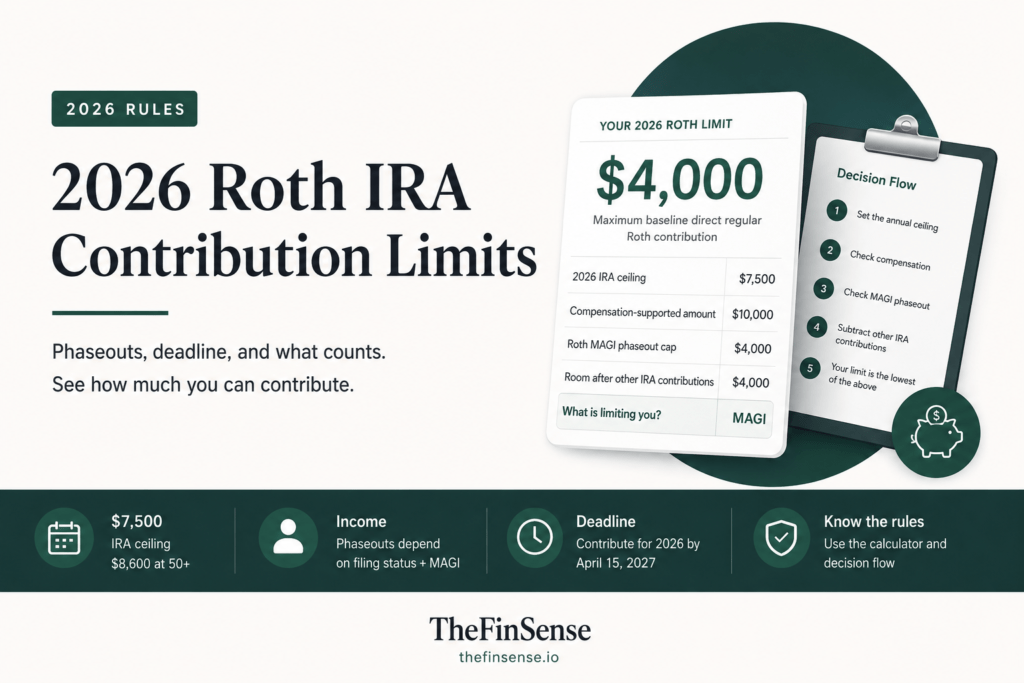
For 2026, Roth IRA contribution limits start with a $7,500 IRA ceiling if you are under 50, or $8,600 if you are 50 or older. But that ceiling is not automatically your personal Roth limit. Taxable compensation, regular contributions to IRAs other than Roth IRAs, and the Roth MAGI phaseout can reduce your direct Roth room all the way to $0.
One concrete example: suppose you are single and under 50, with at least $7,500 of taxable compensation and no regular contributions to other IRAs. If your 2026 Roth-purpose MAGI is $160,000, your direct Roth contribution limit is $4,000—not $7,500.
Tax year 2026 reference. This guide covers direct regular Roth IRA contributions that use your individual IRA room. It does not cover Roth-vs.-Traditional account choice or backdoor Roth mechanics.
How 2026 Roth IRA contribution limits are set
The headline number is simple: the 2026 IRA contribution ceiling is $7,500 if you are under 50. If you are age 50 or older, the $1,100 catch-up raises it to $8,600.
Your personal Roth limit takes a few more steps. The ceiling can be reduced by your taxable compensation, by regular contributions already made to IRAs other than Roth IRAs for the same person, and by the Roth MAGI phaseout. Think of $7,500 or $8,600 as the starting point, not the answer.
For 2026, the Roth MAGI phaseout bands are:
- Single or head of household: $153,000 to $168,000.
- Married filing jointly or qualifying surviving spouse: $242,000 to $252,000.
- Married filing separately and lived with a spouse at any time during the year: $0 to $10,000.
If you file MFS but lived apart from your spouse for the entire year, use the non-married phaseout rules instead of the $0-to-$10,000 band.
2026 thresholds: IRS 2026 retirement-plan limit announcement.
Before you calculate, make sure this path fits your case
The calculator below is for a 2026 direct regular Roth contribution: an ordinary annual contribution made directly to a Roth IRA and charged against one person’s IRA room.
Use Roth-purpose MAGI, not salary or raw AGI. Roth eligibility uses modified AGI after the adjustments required for Roth IRA purposes. Salary alone can point you to the wrong answer.
If you file MFS, the calculator also needs to know whether you lived with your spouse at any time during 2026 because that changes the phaseout rule.
Two cases deliberately stop the numeric path. A same-year section 529 QTP-to-Roth rollover has special annual-room rules, and a contribution that relies on a spousal-compensation allocation needs a separate joint-return analysis. In either case, the calculator returns a guard state instead of guessing.
Calculate your 2026 direct Roth contribution room
Enter the facts that actually control your annual room. If your case falls into one of the guarded branches above, the calculator will stop rather than force a special case through the baseline formula.
Estimate the maximum baseline direct regular Roth contribution after compensation, shared IRA room, and the 2026 MAGI phaseout.
| Limit check | Amount |
|---|---|
| 2026 IRA ceiling | Pending |
| Compensation-supported amount | Pending |
| Roth MAGI phaseout cap | Pending |
| Room after other IRA contributions | Pending |
The calculator was checked against 16 boundary and edge cases, and all 16 passed. Those checks cover both phaseout bounds, the age-50 catch-up, low compensation, shared IRA room, MFS living-status branches, the $10 round-up rule, the positive $200 phaseout floor, and the 529 guard.
Calculator scope: federal tax year 2026 direct regular Roth contribution room only. It does not model same-year 529-to-Roth rollovers or spousal-compensation cases. It also excludes disaster or combat-zone extensions, account-choice decisions, and personal tax advice.
Why the limit matters: excess Roth IRA contributions can trigger a 6% excise tax. The correction timing is different from the regular contribution deadline; the exact rule is explained below.
- Recalculate if your taxable compensation, Roth-purpose MAGI, filing status, or other regular IRA contributions change.
- Recalculate for a different tax year because the indexed dollar thresholds can change.
- Do not rely on the numeric result if a same-year 529-to-Roth rollover or spousal-compensation allocation puts your case on a guarded path.
Before funding: confirm the tax year, Roth-purpose MAGI, taxable compensation, other regular IRA contributions, and whether a guarded special case applies.
Once those inputs are settled, use the calculator result as the baseline direct regular Roth limit for that person and that tax year.
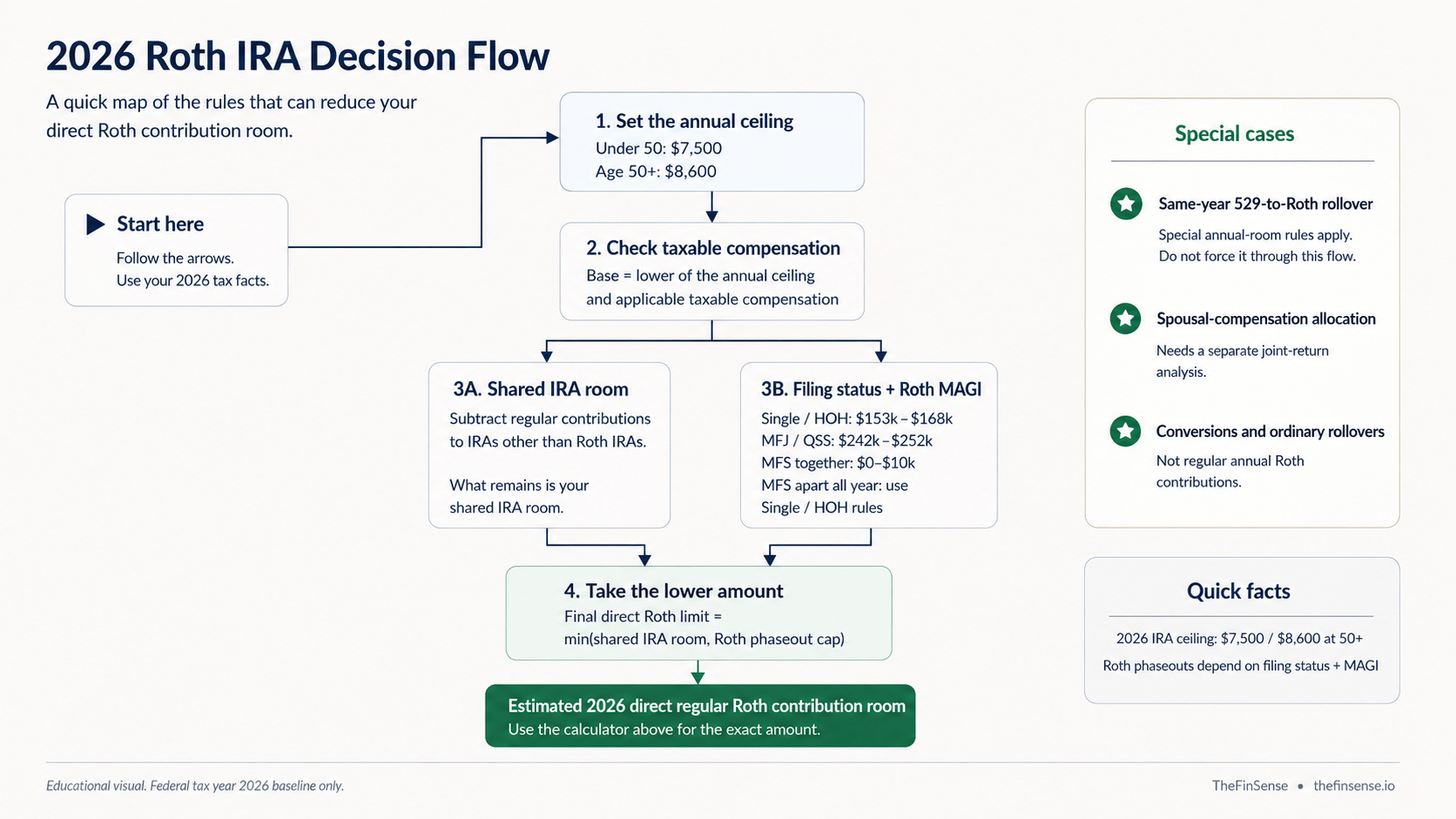
Step 1: compensation and other IRA contributions set your available room
Start with the smaller of your age-adjusted annual ceiling and your applicable taxable compensation:
base = min(age-adjusted annual cap, applicable taxable compensation).
If you are under 50 and have at least $7,500 of applicable taxable compensation, the base can be the full $7,500. If your compensation is only $3,200, your base is $3,200. The headline ceiling cannot create contribution room that your compensation does not support.
Then account for regular contributions already made to IRAs other than Roth IRAs for the same person:
remaining shared IRA room = max(0, base − prior regular contributions to IRAs other than Roth IRAs for the same individual).
Traditional and Roth IRA contributions share the annual individual room. So if your base is $7,500 and you already contributed $2,500 to a Traditional IRA for 2026, only $5,000 of shared room remains.
Keep that number separate from the Roth phaseout cap. The IRS worksheet applies the MAGI reduction to the compensation-limited base, calculates the other-IRA reduction on its own line, and then takes the lower result at the end.
Step 2: apply the Roth MAGI phaseout, then take the lower limit
Now compare your Roth-purpose MAGI with the phaseout band for your filing status. At or below the lower bound, the phaseout does not reduce the compensation-limited base. At or above the upper bound, the direct Roth phaseout cap is $0.
Inside the band, the IRS worksheet reduces the compensation-limited base by the phaseout fraction. It then rounds the reduced maximum up to the next $10. If that positive reduced maximum would otherwise be below $200, the worksheet uses a $200 phaseout floor.
That $200 rule is easy to misread. It belongs to the phaseout calculation; it is not a $200 minimum for every final Roth answer.
The last step is simply:
final direct regular Roth limit = min(phaseout cap, remaining shared IRA room).
That is why you should not phase out whatever happens to be left after a Traditional IRA contribution. The IRS worksheet keeps the phaseout calculation and the shared-room calculation separate, then chooses the lower result.
Worked example. Assume you are single, under 50, have at least $7,500 of taxable compensation, make no regular contributions to other IRAs, and have $160,000 of Roth-purpose MAGI. You are $7,000 into a $15,000 phaseout range, so the worksheet reduces the $7,500 base and produces a $4,000 direct Roth limit after the required rounding.
Calculation method: IRS Publication 590-A, 26 U.S.C. § 408A, 26 U.S.C. § 219, and the IRS IRA contribution-limit guidance.
In practice: start with the age-adjusted 2026 IRA ceiling and the taxable-compensation ceiling. Then calculate shared IRA room separately, apply the Roth MAGI phaseout to the compensation-limited base, and contribute no more than the lower final amount.
Fund the right tax year by April 15, 2027
For most taxpayers, a regular 2026 Roth IRA contribution can be made through April 15, 2027. That contribution deadline does not get extended just because you receive an extension to file your tax return.
The January-to-April overlap is easy to mislabel. If you contribute between January 1 and April 15, 2027, tell the IRA custodian whether the money is for 2026 or 2027. The deposit date alone does not make it a prior-year contribution.
Keep one separate correction rule in mind. If you contributed more than your allowed Roth amount, IRS Publication 590-A says the 6% excise tax applies to excess contributions. A timely corrective withdrawal of the excess plus attributable earnings by the return due date, including extensions, can keep that withdrawn amount from being treated as a contribution for the excess-contribution calculation.
This guide uses the regular federal baseline and does not model special disaster or combat-zone postponements.
Deadline and excess-contribution rules: IRS Publication 590-A and 2026 Instructions for Forms 1099-R and 5498.
Know what uses annual Roth contribution room—and what does not
A regular contribution is the annual contribution covered by the limit on this page. Not every dollar that enters a Roth IRA belongs in that bucket.
Conversions and ordinary rollovers are different transaction types. They should not be counted as regular annual Roth contributions simply because the money ends up in a Roth IRA.
A 529 QTP-to-Roth rollover is a special boundary case. It interacts with annual-room rules in a way this baseline calculator does not model, which is why that input triggers a guard instead of a numeric answer.
Transaction classification: 26 U.S.C. § 408A and 2026 Instructions for Forms 1099-R and 5498.
If your real question is how to use a backdoor Roth after direct Roth room is constrained, use the backdoor Roth rules guide. If you are deciding which IRA type fits you, use the Roth vs. Traditional IRA guide. Those are separate decisions from the direct contribution room calculated here.
Once you know the transaction type and the tax year, use the limit produced by the inputs for that specific case.
YOUR TURN
Which rule is actually limiting your 2026 Roth contribution: compensation, MAGI, or other IRA contributions?
Primary evidence used in this guide
- Foundational IRS 2026 retirement-plan limit announcement for the annual IRA ceiling, catch-up amount, and 2026 Roth phaseout bands.
- Foundational 26 U.S.C. §§ 408A and 219 and IRS Publication 590-A for the contribution sequence, compensation rule, phaseout method, rounding, floor, shared IRA room, and excess-contribution treatment.
- Supporting 2026 Instructions for Forms 1099-R and 5498 and IRS IRA guidance for contribution-year designation and special-case boundaries.
Update history
-
prepub
2026-08-22
EDITORIAL REVIEWReworked the answer-first flow, moved the calculator earlier, added a reconciled result breakdown that shows which limit is binding, added a 2026 Roth IRA decision flow, added a fully specified phaseout example and excess-contribution context, reduced repetitive source and warning copy, and rechecked the 2026 thresholds and baseline calculation sequence.