

The highest-basis lot is not always the cheapest lot to sell. Suppose you own two 100-share lots of the same stock. You bought the older lot at $40 per share and the newer lot at $70. The stock is now $100. Selling the $70 lot creates only a $3,000 gain, versus $6,000 on the $40 lot. Now assume the old lot is long-term at 15% and the new lot is short-term at 32%. The old lot produces about $900 of simplified current federal tax, while the newer lot produces about $960. The gain is smaller, but the modeled tax is higher.
Bottom line: compare adjusted basis and holding period together before a taxable partial sale. Specific identification gives you control over which eligible lot is treated as sold, so use it when the chosen lot better fits the result you want and you can document the choice correctly. FIFO is perfectly reasonable when the earliest-acquired lot already fits. For broker-held stock, make any specific-lot identification no later than the applicable settlement deadline and keep the broker’s written or electronic confirmation.
How FIFO and specific identification work
First-in, first-out (FIFO) and specific identification do not use different tax formulas. They decide which shares count as the shares you sold when you own several lots of the same stock.
With specific identification, you choose the eligible shares you want treated as sold. For broker-held stock, the federal timing rule uses the earlier of two cutoffs: the settlement date or the settlement time required by the applicable securities rule. A standing lot instruction can also qualify. Keep the broker’s written confirmation; the required record may be electronic.
If you do not identify the shares under these rules, the oldest shares you own supply the basis and holding period unless another permitted basis method applies. That is the FIFO fallback discussed here. For ordinary FIFO stock sales, the oldest eligible shares are treated as sold first. Mutual funds and some dividend-reinvestment-plan shares can use average basis, so this guide stays with ordinary stock lots where FIFO and specific identification are the relevant choices.
Before comparing lots, make sure the inputs are real. Use adjusted basis, not just the original purchase price, and confirm the holding period and the number of shares available in each lot. Stock splits, spin-offs, return-of-capital adjustments, wash sales, and transferred positions can affect or complicate basis records. If a lot looks incomplete or unusual, reconcile it before using that number in the comparison.
| Question | FIFO fallback | Specific identification |
|---|---|---|
| Which lot is treated as sold? | The earliest-acquired shares when adequate identification is absent, except where another permitted basis method applies. | The eligible lot you validly identify. |
| What control do you have? | No separate lot choice for that sale. | You choose the eligible lot to use. |
| What determines whether the choice helps? | Adjusted basis, holding period, sale amount, the tax rate applied to the modeled gain, and tax constraints outside the simple comparison. | |
Why the highest-basis lot can lose
Go back to the two 100-share lots from the opening. Both are sold at $100 per share. The older lot has a $40 adjusted basis and is long-term. The newer lot has a $70 adjusted basis and is short-term.
| Lot | Basis per share | Gain on 100 shares | Assumed federal rate | Simplified current tax |
|---|---|---|---|---|
| Older long-term lot | $40 | $6,000 | 15% | $900 |
| Newer short-term lot | $70 | $3,000 | 32% | $960 |
The higher-basis lot looks better if you stop at the gain. It has only half as much realized gain. But the rate difference reverses the answer: in this example the lower-basis long-term lot is cheaper by $60. That is why “always sell the highest-basis lot” is not a reliable rule.
Try the same comparison with your own assumptions. The calculator below uses the same positive-gain current-sale model as the example.
Tax Lot Choice Calculator
Compare two positive-gain stock lots using adjusted basis and an assumed federal rate for each lot.
How to use it: enter the modeled federal rate that applies to each lot after you have determined its holding period and your relevant tax assumptions. The calculator compares the two lots; it does not determine your tax bracket for you.
Where the answer flips
So where does the newer, higher-basis lot finally become the cheaper one to sell? Keep the example simple: use equal share quantities, assume each share is sold for $100, use a $40 long-term basis, and apply assumed rates of 15% and 32%. Compare the gain on each lot after applying its assumed rate.
Break-even model
For lot i, use Ti = (P − Bi) × ri. Here, P is the amount received per share, B is adjusted basis per share, and r is the assumed federal rate applied to that gain. For a long-term lot L and short-term lot S, break-even occurs at BS* = P − (P − BL) × (rL / rS).
| Short-term basis BS | Long-term amount TL | Short-term amount TS | Lower amount |
|---|---|---|---|
| $60.00 | $9.00 | $12.80 | Long-term lower-basis lot |
| $70.00 | $9.00 | $9.60 | Long-term lower-basis lot |
| $71.875 | $9.00 | $9.00 | Break-even |
| $80.00 | $9.00 | $6.40 | Short-term higher-basis lot |
| $90.00 | $9.00 | $3.20 | Short-term higher-basis lot |
Below a $71.875 short-term basis, the long-term $40-basis lot has the lower simplified current-tax amount. Above $71.875, the higher short-term basis overcomes the rate disadvantage. At exactly $71.875, both equal $9.00 per share when each share is sold for $100, or $900 on the 100-share example.
The same-rate case is simpler. If both compared lots use the same modeled marginal rate and the same sale quantity, the higher adjusted basis produces the lower simplified current-tax amount. With both rates set to 20% in the example above, break-even occurs when the two lots have the same basis.
This comparison ranks the current sale only. Selling one lot leaves a different basis and holding-period mix in the shares you keep, so lower tax today can still lead to a different lifetime tax result.
When this comparison stops working
The break-even model is useful because it isolates one question: basis versus holding-period rate on positive-gain lots. Stop using it as the answer when other tax rules change the problem.
- Loss lots and wash sales: a realized loss can be disallowed or deferred when replacement shares trigger the wash-sale rules, and the replacement shares’ basis can change.
- Annual gain-and-loss netting: short- and long-term gains and losses interact on the annual return, so a single-lot calculation is not your final federal tax bill.
- Rate crossings, net investment income tax (NIIT), and state or local tax: the example uses fixed federal rates. Your actual marginal result can differ.
- Different sale quantities or portfolio goals: normalize the quantities before comparing the math, and do not let a tax shortcut override diversification, cash needs, or risk constraints.
If a loss or wash-sale issue drives the trade, use the tax-loss harvesting guide instead of forcing this model to answer it. For the broader gain, basis, and rate sequence, use the capital gains tax guide.
Can your broker actually identify the lot?
A tax-preferred lot is useless if the broker does not record the instruction correctly. Check the current lot-selection screen, confirm the basis and share count, and make the specific-lot identification by the applicable settlement deadline. Then keep the broker’s written or electronic confirmation.
Do not assume you can repair the lot assignment after the trade has settled. Major brokers generally impose a settlement cutoff for changing or assigning lots, but the exact screen, default method, and workflow vary by platform. A standing instruction may also control the lot selection, so check your account’s current default before you trade.
For broader account setup outside this lot-choice task, use the brokerage account settings guide.
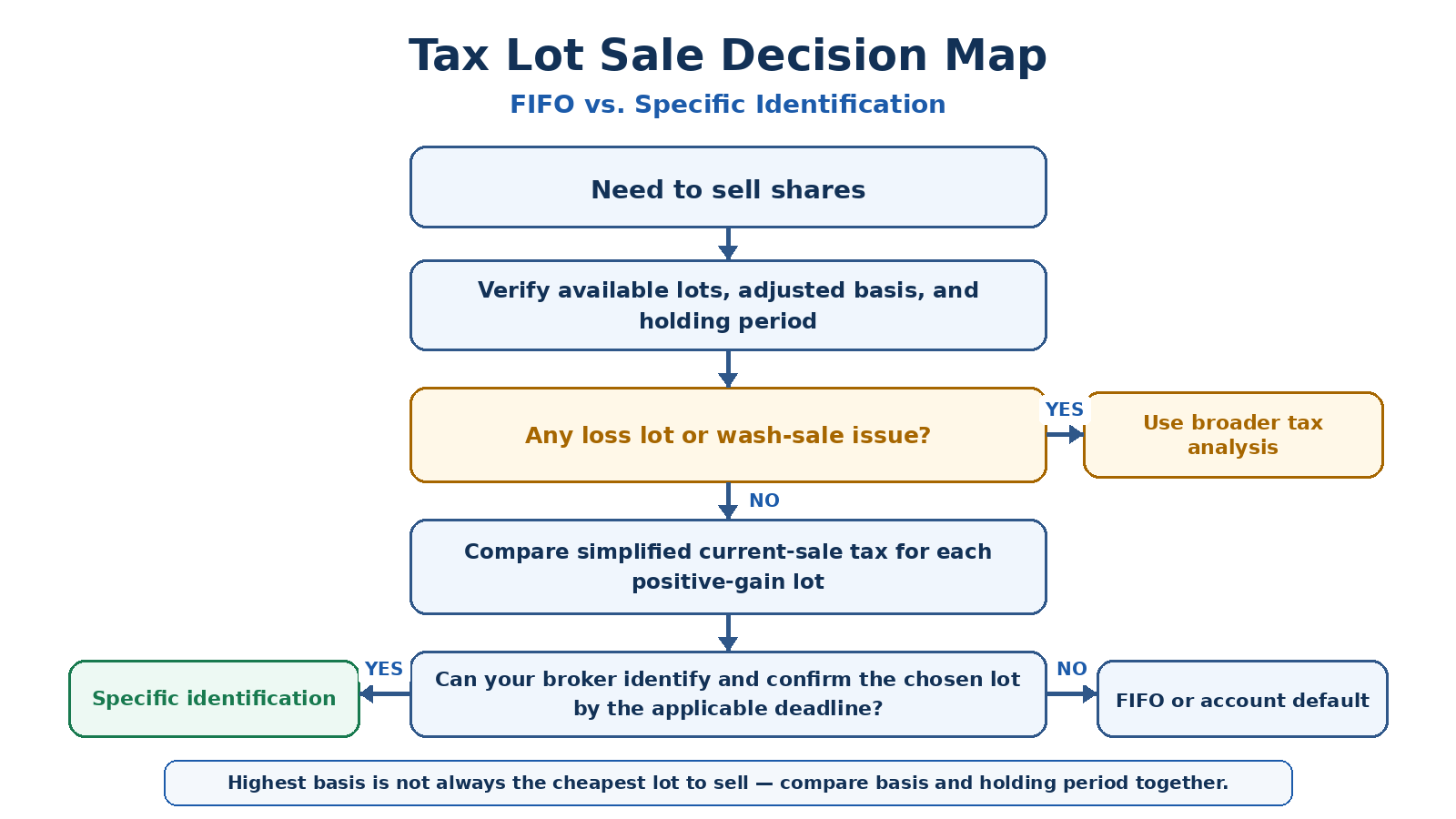
Which tax lot should you sell?
The best lot is not automatically the oldest lot or the highest-basis lot. Before you sell, make sure four things are true:
- You know which lots and share quantities are actually available.
- The adjusted basis and holding period for those lots are correct.
- Losses, wash sales, annual netting, or other tax constraints do not invalidate the simple comparison.
- Your broker can identify and confirm the lot you chose within its current workflow.
Then compare basis and holding period together. Use specific identification when a chosen lot better fits the result you want and you can document it. Use FIFO when the oldest eligible shares already fit.
Before you place the trade, verify the lot, the tax constraint that matters, and the broker’s current execution steps.
YOUR TURN
If you sold 100 shares today, which available lot would produce the lower modeled current tax after you apply its basis and holding period?
- 26 CFR §1.1012-1: federal lot identification, earliest-acquired fallback, settlement timing, standing instructions, and written/electronic records.
- IRS Publication 550 (2025): gain, adjusted basis, holding period, average-basis situations, wash-sale treatment, and annual capital-gain/loss netting.
- Broker workflow examples: Vanguard, Fidelity, and Charles Schwab. Broker screens and cutoffs can change, so verify the current process before trading.
- TheFinSense break-even model and calculator: the formula, table, and interactive calculator use the stated example assumptions and the same positive-gain current-sale model. The arithmetic has been independently recalculated for this article; neither the model nor the calculator is a tax-return calculation.
Update history
-
v1.1
2026-08-20
FEATUREAdded an interactive two-lot current-sale calculator and a tax-lot decision map; the positive-gain model scope is unchanged.
-
v1.0
2026-08-20
PUBLISHOriginal publication.