
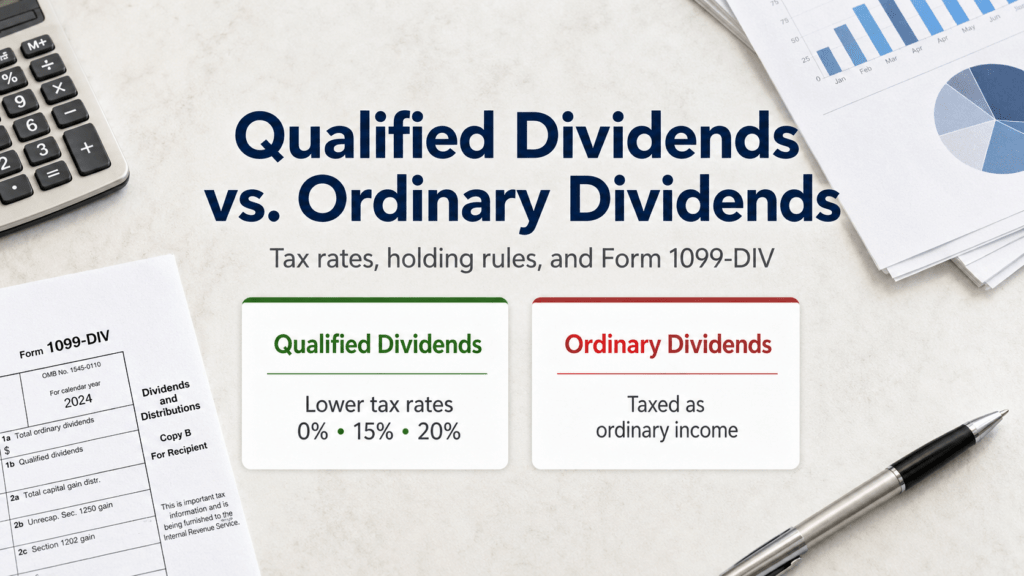
Qualified dividends can receive lower federal tax rates, but an amount in Form 1099-DIV Box 1b does not automatically settle the question. Box 1b is already included in Box 1a, and your own holding period can still change how much qualifies. Before looking at the 2026 tax-rate table, answer two questions first: was the dividend eligible, and did you hold the stock long enough?
Qualified vs. ordinary dividends: what actually changes
The cash itself does not change. What changes is its federal tax treatment. When a dividend qualifies, it can use the preferential federal rates that also apply to long-term capital gains. When it does not qualify, that preferential qualified-dividend treatment is unavailable.
That is why the rate table comes later, not first. Two investors can receive the same dollar dividend and end up with different federal tax treatment because the distribution itself and the investor’s holding facts both matter.
| Quick comparison | Qualified treatment | Ordinary treatment |
|---|---|---|
| 2026 federal rate framework | 0%, 15%, or 20% maximum rates after the qualification rules are met | Regular individual income tax rates, currently 10% through 37% |
| What decides it | Eligible payer and distribution, plus the applicable holding period test | The preferential rate is unavailable for the portion that does not meet the qualified dividend requirements |
| Form 1099-DIV | Box 1b is the payer-reported qualified portion already included in Box 1a | Box 1a is the total ordinary-dividend amount; it includes Box 1b and is not the nonqualified remainder |
The key distinction: for an amount reported as an ordinary dividend in Box 1a, any portion that does not satisfy the qualified dividend rules generally remains ordinary dividend income. Some other distributions, including capital gain distributions and payments in lieu of dividends, follow separate rules. Box 1b is part of Box 1a; it is not an extra dividend amount.
The IRS explains these distinctions in Publication 550, while the Form 1099-DIV instructions explain how Box 1a and Box 1b are reported.
Can the dividend qualify in the first place?
Holding a stock for a long time is not enough by itself. The payment must first be eligible for qualified treatment. Extra holding days cannot turn an ineligible payment into a qualified dividend.
For the usual stock dividend path, the payer generally must be a U.S. corporation or a qualified foreign corporation. The payment also cannot fall into an IRS category excluded from qualified treatment, and you must satisfy the applicable holding period rule. Publication 550 lists examples such as capital gain distributions, certain deposit-related amounts, and payments in lieu of dividends.
This article follows the common taxable account path. Certain preferred stock dividends use a different holding threshold, and days when your risk of loss was diminished may not count. An IRA or 401(k) changes the immediate federal tax question, so this taxable account sequence does not apply in the same way.
If the payment is eligible, the next question is much more personal: did you hold the shares long enough? Before counting days, though, your 1099-DIV tells you where to start.
Box 1a vs. Box 1b: what your 1099-DIV tells you
Box 1a and Box 1b are easy to misread. Box 1a is the ordinary-dividend amount reported on this part of the form. Box 1b is the payer-reported qualified portion already included inside Box 1a. You do not add Box 1b on top of Box 1a.
But Box 1b is not always the final word. The IRS payer instructions allow Box 1b reporting even when it is impractical for the payer to determine whether a shareholder satisfied the holding period rule. The final qualified amount can therefore still depend on your own holding facts.
Example: suppose Box 1a shows $600 and Box 1b shows $450. You have $600 of reported ordinary dividends, not $1,050. The $450 is the qualified portion reported by the payer inside the $600 total. If you sold the shares too soon around the ex-dividend date, some or all of it may fail your holding test. That does not automatically mean the payer made an error; your own trade dates still matter.
Use Box 1b as the payer’s starting classification, then check your own holding record. Publication 550 gives the taxpayer holding rules, while the Form 1099-DIV instructions explain what the payer reports in Box 1b.
The 61-day rule around the ex-dividend date
The common-stock rule is more precise than “hold it for two months.” You must hold the stock for more than 60 days during the 121-day period that begins 60 days before the ex-dividend date.
The counting convention matters: do not count the day you acquired the stock, but do count the day you disposed of it. That sounds minor until a trade lands right on the edge.
Here is the edge case. Suppose the ex-dividend date is June 15, 2026, and you bought the stock on June 14. The relevant 121-day window runs from April 16 through August 14. If you sell on August 14, the purchase date does not count but the sale date does, giving you 61 qualifying holding days from June 15 through August 14. Sell one day earlier, on August 13, and the count falls to 60. For the general common-stock rule, that one day changes the result.
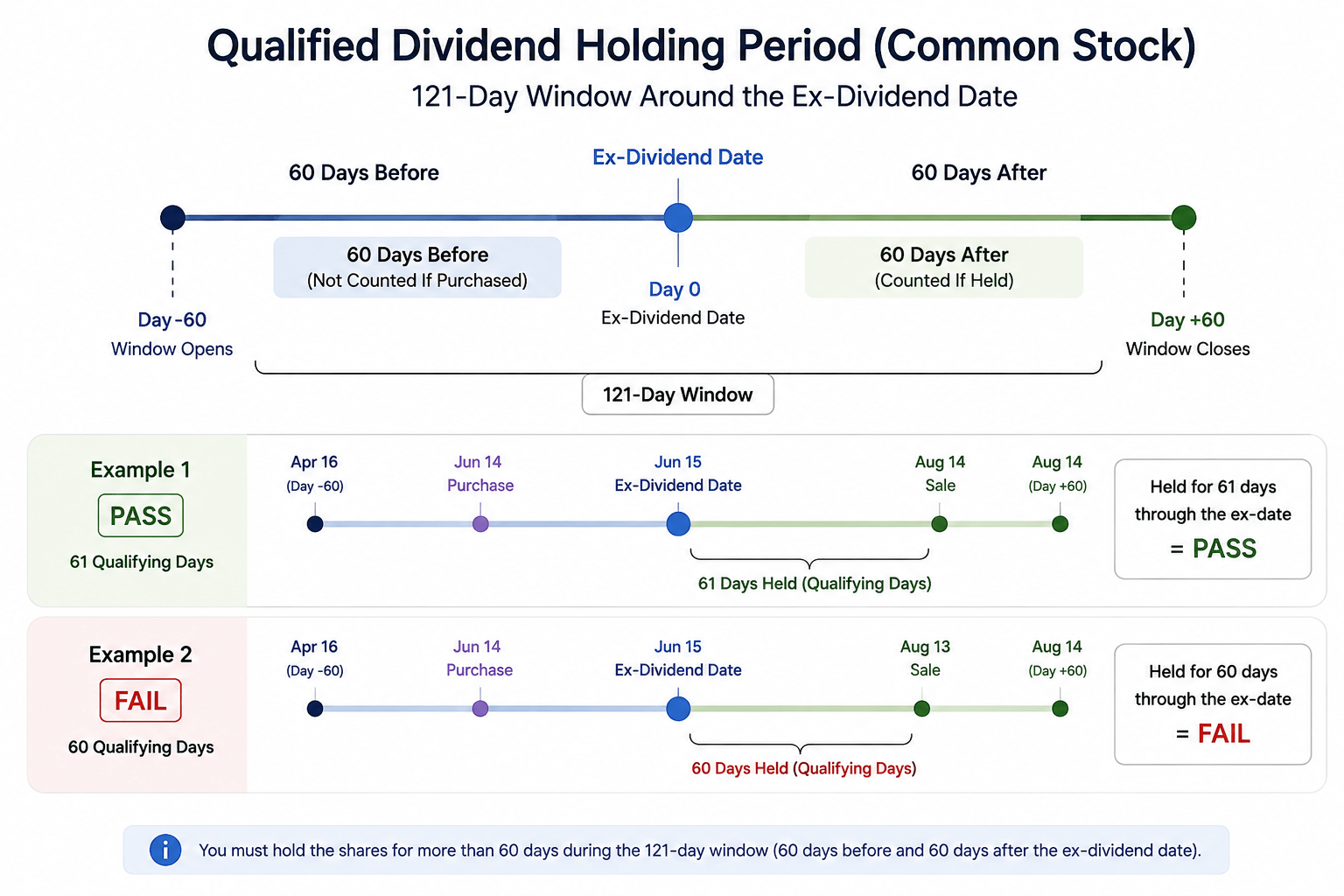
Now return to the $600 / $450 example. If the $450 reported in Box 1b is otherwise eligible and those shares clear the holding test, that amount can remain in the qualified-dividend calculation. If the shares reach only 60 qualifying days, the qualified-dividend preference does not apply to the affected amount.
Not every calendar day automatically counts. Days when your risk of loss was diminished can be excluded. Certain preferred stock dividends also use a separate test: more than 90 days during a 181-day period when the dividend is attributable to a period longer than 366 days. Those are exceptions to the common stock path, not the default rule.
IRS Publication 550 provides the common stock test and the acquisition and disposal day-count convention. It also covers diminished-risk days and the separate preferred stock rule.
Check your dates: Use the calculator below to count the common-stock holding-period test with your own ex-dividend, acquisition, and sale or count-through dates. It checks the holding rule only; payer and distribution eligibility still have to be confirmed separately.
Qualified Dividend Holding-Period Checker
Count the IRS common-stock holding-period test around the ex-dividend date using your actual dates.
If you still hold the shares, use the date through which you want the checker to count.
For diminished-risk days, enter only days within the 121-day window that you already know should be excluded under the IRS rule, such as days involving an option, short sale, contractual sale obligation, or related position that reduced your risk of loss. If none apply, leave the field at zero.
Method: The checker builds the IRS common-stock window around the ex-dividend date. It counts the overlap from the day after acquisition through the disposition or count-through date, then subtracts the diminished-risk days you enter. The holding-period test passes only when at least 61 qualifying days remain. Preferred-stock special rules are not modeled; see IRS Publication 550 for the governing holding-period rules.
2026 qualified dividend tax rates
Once the dividend qualifies, the next question is the rate. That rate is not determined by the dividend amount alone. Your filing status, total taxable income, and other capital gains can affect how much of the qualified dividend falls into the 0%, 15%, or 20% range.
The 2026 thresholds below are a reference point, not a dividend-only tax calculator. The qualified dividend computation works inside your broader taxable income calculation.
| 2026 filing status | Taxable income ceiling for 0% rate | Taxable income ceiling for 15% rate |
|---|---|---|
| Married filing jointly / surviving spouse | $98,900 | $613,700 |
| Married filing separately | $49,450 | $306,850 |
| Head of household | $66,200 | $579,600 |
| All other individuals | $49,450 | $545,500 |
Why total taxable income matters: keep the same $450 qualified dividend example. Assume a single filer has $49,750 of total taxable income, including that $450, with no other net capital gain or worksheet adjustment. The rest of taxable income is $49,300. Because the 2026 0% ceiling for “all other individuals” is $49,450, only $150 of the $450 fits below that ceiling. The remaining $300 moves into the 15% range. The dividend amount by itself does not tell you the rate.
The practical order is simple: determine what amount actually qualifies, then apply the current-year thresholds within the full taxable income calculation. Revenue Procedure 2025-32 publishes the 2026 zero-rate and 15%-rate breakpoints. Publication 505 shows qualified dividends inside the broader tax computation rather than as a stand-alone bracket lookup.
Two narrower rules can also matter. Higher-income taxpayers may owe the separate 3.8% Net Investment Income Tax on dividend income. Also, if you elect to include qualified dividends in investment income for the investment interest deduction, the elected amount can lose the preferential qualified dividend rate. See IRS guidance on the Net Investment Income Tax and Publication 550 for the investment interest election.
Bottom line: Box 1b is a useful starting point, not a substitute for the holding rule. Confirm that the payment is eligible, check the 121-day window for common stock, and only then move to the 2026 rate thresholds. That sequence answers the question the rate table cannot answer by itself: how much of your dividend actually qualifies for preferential treatment.
YOUR TURN
If you sold shares near an ex-dividend date, do you have the purchase date, sale date, and ex-dividend date needed to count your qualifying days?
- IRS Publication 550: qualified dividend eligibility, the common stock holding rule, the acquisition/disposal day-count convention, diminished-risk days, preferred stock exceptions, and the investment interest election.
- Instructions for Form 1099-DIV: Box 1b is the qualified portion reported inside Box 1a and may include dividends when the payer cannot practically determine whether the shareholder met the holding period requirement.
- IRS Revenue Procedure 2025-32: 2026 individual ordinary-income rates and the 0% and 15% capital-gain/qualified-dividend thresholds used in the tables and worked example.
- Method: the June 15 ex-dividend example was day-counted under the IRS convention, and the $49,750 taxable-income example was recomputed from the 2026 $49,450 zero-rate ceiling. The calculator uses the IRS common-stock window from sixty days before through sixty days after the ex-dividend date, counts from the day after acquisition through the disposition or count-through date, subtracts user-entered diminished-risk days, and passes the holding test only when at least 61 qualifying days remain. Preferred-stock special rules are not modeled. Primary-source figures were rechecked on August 24, 2026 (America/New_York).
Update history
-
v1.3
August 25, 2026
UTILITY FIXFinalized the holding-period checker runtime and input handling without changing the article’s tax rules, examples, or 2026 rate figures.
-
v1.2
August 24, 2026
UTILITYAdded a common-stock qualified-dividend holding-period checker using the IRS day-count convention, explicit diminished-risk-day input, future-date protection, and PASS, NOT YET, and FAIL states.
-
v1.1
August 24, 2026
CLARITYClarified the Box 1a/Box 1b relationship, added the 61-versus-60-day edge case and taxable-income stacking example, and refreshed the bottom trust package against current IRS sources.
-
v1.0
Pre-publication
ASSEMBLYInitial article assembly and reader-facing review.