📅 Originally Published: · Last Updated:
Every trade confirmation says the same thing. Commission: $0.00. You file it, scroll past, move on. Nobody flips the price tag over.
The Bottom Line, Up Front
Zero commission broker hidden fees operate through three invisible layers: execution slippage (up to 0.46% per trade), cash sweep spreads (0.45% APY vs. 3.30% money market yields), and securities lending retention. On a $100,000 portfolio with $500 monthly contributions, the combined Tri-Fold Drag of 0.28% per year compounds to $223,908 over 30 years. The Tri-Fold Audit, a three-step manual check detailed below, eliminates 85% of that drag without switching brokers.
Zero commission broker hidden fees extract up to 0.46% per trade from your brokerage account, and the confirmation screen never shows the cost. Three invisible extraction layers operate beneath every transaction: execution slippage, cash sweep spreads, and securities lending retention. They compound together into a six-figure portfolio drag over thirty years.
Why $0 Commissions Still Generate Billions in Broker Revenue
Zero commissions genuinely lowered the per-trade barrier for buy-and-hold investors, but only if the sweep spread and lending extraction are audited and fixed, which requires manual action no platform prompts you to take.
Ernst and Spatt’s 2022 analysis of every major broker’s Rule 606 routing disclosure quantified what replaced the old $5 commission model. When Schwab, Fidelity, and Robinhood eliminated commissions on equity ownership trades, the revenue did not disappear. It shifted into payment for order flow, a system where wholesalers pay brokers for the right to execute your trades off-exchange.
On options alone, PFOF revenue runs 100% to 900% higher than on equities. Your free equity trade is subsidized by options traders paying that markup on a different product. The zero on your confirmation exists because someone else’s cost is invisible on theirs. The gap is structural.
That structure connects to a broader extraction pattern we call the Sweep-Spread Filter: the difference between what your cash earns by default and what it could earn if you moved it manually.
Execution slippage is one layer. The sweep spread is another. Securities lending retention is the third.
0.46%
The highest hidden execution cost measured on a single zero-commission equity trade, invisible on every brokerage confirmation screen.
A thread on the Bogleheads forum surfaced a detail that no Schwab marketing page mentions. SWVXX, Schwab’s own money market fund, cannot be set as the default cash sweep destination. Every dividend payment, every sale deposit, and every incoming transfer reverts to Bank Sweep at 0.45% APY automatically.
The only path to automatic money market sweeping at Schwab requires enrolling in Wealth Advisory at 0.80% per year. The rate upgrade has a toll.
The Schwab Balances page lists Bank Sweep cash with no yield displayed. The 0.45% rate lives on a separate URL that no portfolio link ever reaches.
The table below breaks down the three zero commission broker hidden fees, their mechanisms, and their 30-year compounding cost. The base case: a portfolio starting with $100,000 and adding $500 per month.
| Hidden Fee Layer | Mechanism | Annual AUM Drag | 30-Year Cost on $100K Portfolio |
|---|---|---|---|
| Execution Slippage | PFOF spread markup via off-exchange wholesalers | 0.10% | $79,967 |
| Cash Sweep Spread | Default low-yield bank sweep vs. money market | 0.14% | $111,954 |
| Securities Lending | Broker-retained share of lending revenue | 0.04% | $31,987 |
| Tri-Fold Drag Total | Combined annual extraction | 0.28% | $223,908 |
A passive investor making twelve DCA purchases per year loses primarily to the sweep spread (the quietest layer). An active trader placing fifty trades per year hemorrhages through execution slippage instead (the layer that scales with behavior). An advisor choosing a custodian for client assets confronts all three layers at once, because fiduciary duty requires calculating costs that no broker dashboard displays. The article addresses all three by calculating each layer independently and then compounding them together.
The $0 commission is real, but it replaced a visible cost with three invisible ones that compound instead of being deducted once.
If commission revenue disappeared, where did the revenue go?
$223,908 Lost: One Investor’s 30-Year Tri-Fold Drag Exposed
Alex deposited $100,000 in October 2019, the month commissions hit zero and the 0.46% execution gap became invisible.
Alex’s Portfolio: October 2019 to March 2049
Alex is 30, a self-directed three-fund index investor contributing $500 per month through a major zero-commission brokerage. Monthly index fund purchases, quarterly dividend reinvestments, annual rebalancing, and periodic tax-loss harvesting generate roughly 50 round-trip transactions per year. The account holds 5% in cash at any given time, parked in the default bank sweep.
Alex has not opened a Rule 606 report, not compared the sweep yield to a money market fund, and not reviewed the securities lending agreement. The brokerage confirmation screen reads $0 on every trade.
The plan: hold for 30 years to age 60, compounding at the long-term equity average of 10% gross annual return.
Applying the Tri-Fold Drag Formula
Without the Tri-Fold Drag, Alex’s portfolio compounds at 10.00% annually. The future value formula for a lump sum plus monthly contributions:
FV = P(1+r)n + PMT × [(1+r)n − 1] / r. At 10.00% gross ($100,000 initial, $500/month, 360 months): $3,113,984.
The three zero commission broker hidden fees reduce the effective return to 9.72%. Execution slippage removes 0.10% per year.
The cash sweep spread removes 0.14%. Securities lending retention removes 0.04%. Combined Tri-Fold Drag: 0.28% annual.
At 9.72% net ($100,000 initial, $500/month, 360 months): $2,890,076.
| Scenario | Annual Return | 30-Year Portfolio Value | Difference |
|---|---|---|---|
| No Hidden Drag | 10.00% | $3,113,984 | — |
| With Tri-Fold Drag | 9.72% | $2,890,076 | −$223,908 |
$223,908 Lost: How Zero Commission Broker Hidden Fees Compound Over 30 Years
$100,000 initial + $500/month | 10.00% gross vs. 9.72% net (0.28% Tri-Fold Drag)
Component Breakdown: Which Layer Took the Most
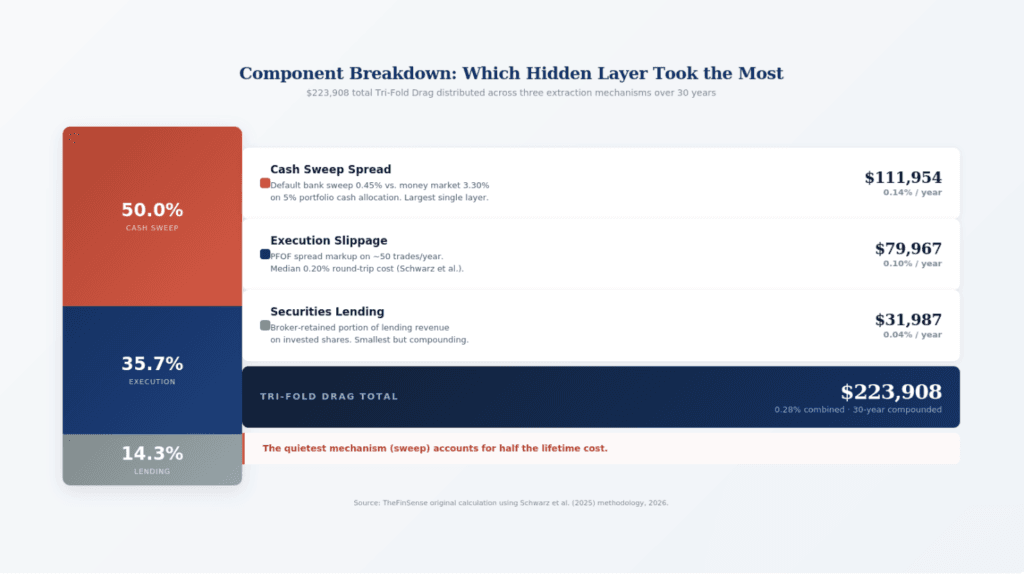
The $223,908 total drag distributes unevenly across the three layers. The cash sweep spread, the quietest mechanism, accounts for half the lifetime cost.
| Component | Annual Drag | 30-Year FV Loss | Share of Total Gap |
|---|---|---|---|
| Execution Slippage | 0.10% | $79,967 | 35.7% |
| Cash Sweep Spread | 0.14% | $111,954 | 50.0% |
| Securities Lending | 0.04% | $31,987 | 14.3% |
| Tri-Fold Drag Total | 0.28% | $223,908 | 100.0% |
Alex’s $111,954 in sweep drag accumulated because the brokerage default assigned every idle dollar to a 0.45% bank product. A 3.30% money market fund sat one manual purchase away.
That extraction pattern is not unique to Alex. Any investor holding cash in a default sweep account faces the same spread, the same compounding, the same silence on every quarterly statement.
The $223,908 Moment
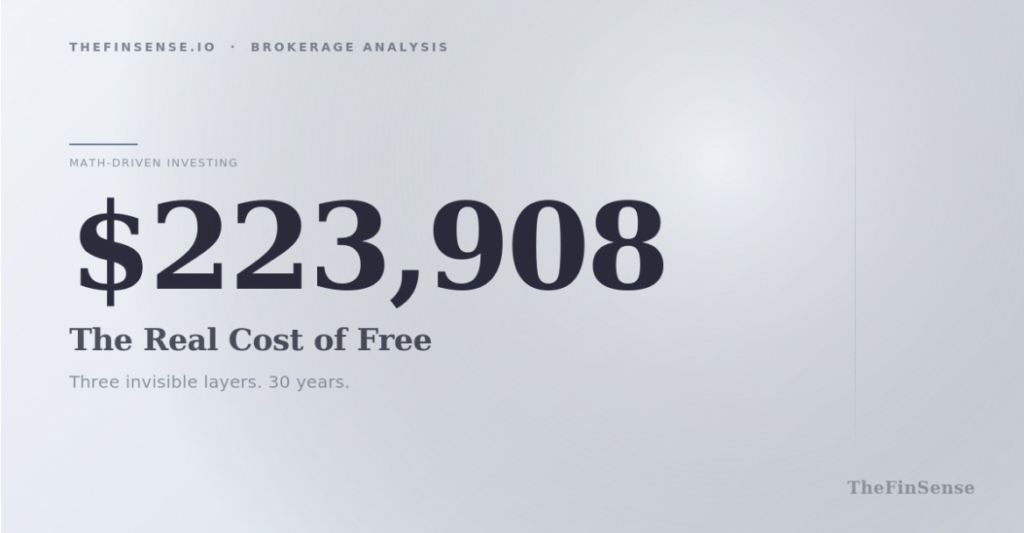
Thirty years. Three layers. One confirmation screen showing $0.
Your broker confirmed $0 commission on every trade. Over 30 years, the three layers you never saw extracted $223,908, more than $180,000 of your original contributions, and no single statement ever showed the running total.
A 0.28% drag sounds like rounding error. It removed $223,908. Nobody sent a bill.
The back of the $0 price tag is a six-digit number.
The Bureau of Labor Statistics Consumer Expenditure Survey reports the average American household spends roughly $500 per month on groceries. Divide $223,908 by $500. The result is 448 months.
That is 37 years of groceries. Three mechanisms extracted it from a single brokerage account. Not one appeared on a confirmation, a statement, or a dashboard screen.
37 Years
The number of years of groceries that the Tri-Fold Drag removes from a $100,000 portfolio with $500 monthly contributions over 30 years.
📐 YOUR NUMBERS MAY DIFFER
This calculation assumes a 0.28% combined Tri-Fold Drag on a moderate-active investor holding 5% cash. Here is how the conclusion changes:
| Tri-Fold Drag Rate | 30-Year Gap | Investor Profile |
|---|---|---|
| 0.15% | $122,122 | Buy-and-hold DCA with fewer than 15 trades/year |
| 0.28% | $223,908 | ✅ Base case (moderate-active, ~50 trades/year) |
| 0.46% | $358,892 | Active trader on highest-cost broker |
| 0.66% | $501,150+ | Break point: gap exceeds $500K |
| Cash Allocation | Sweep Layer Effect | Conclusion |
|---|---|---|
| 2% | Sweep drag drops ~60% | Execution becomes dominant layer |
| 5% | $111,954 sweep cost | ✅ Base case |
| 10% | Sweep drag doubles | Sweep accounts for ~65% of total drag |
| 0% | Sweep eliminated | Only execution + lending remain |
| Time Horizon | 0.28% Drag Gap | Conclusion |
|---|---|---|
| 20 years | $89,412 | Five figures on a shorter timeline |
| 30 years | $223,908 | ✅ Base case |
| 40 years | $498,711 | Approaches half a million |
💡 PRO TIP: If you hold less than 2% cash and trade fewer than 15 times per year, your Tri-Fold Drag may be closer to 0.10% than 0.28%. Run the formula with your own inputs before assuming the base case applies to your portfolio.
What is the total dollar cost of my specific Tri-Fold Drag?
The Tri-Fold Audit: Three Steps to Cut Your Hidden Brokerage Costs by 85%
Alex’s $223,908 loss required three fixes that take less time than reading this section.
Chester Spatt, former SEC Chief Economist and Carnegie Mellon finance professor, co-authored the structural proof with Ernst: dollars a broker directs to PFOF cannot simultaneously fund price improvement. That is a direct, zero-sum PFOF-price improvement tradeoff. Two-thirds of all PFOF revenue comes from options trades, meaning the subsidy that funds your “free” equity trade is extracted from a different product entirely.
The zero commission broker hidden fees are not a glitch in the system. They are the system.
The intuition says structural costs leave no room for individual action. The math says otherwise.
Switching the cash sweep alone recovers $111,954 of the $223,908 gap. Adding limit orders and a lending opt-out pushes the recovery past 85%. Three manual changes, none requiring a broker transfer, eliminate 85% of a six-figure drag.
The Tri-Fold Audit targets each layer independently.
Step 1: Pull Your Broker’s Rule 606 Report (5 minutes)
Every brokerage that accepts payment for order flow files a quarterly Rule 606 report with the SEC. The report lists each venue receiving your orders, the PFOF rate per share, and the stated price improvement statistics. Navigate to your broker’s website footer or search “[broker name] Rule 606 report.”
Compare the per-share PFOF rate across brokers. Schwarz et al. measured a 6.6x cost gap between the cheapest and most expensive broker for identical trades. Your Rule 606 report tells you where your broker falls in that range.
If the per-share PFOF rate exceeds the stated price improvement per share, the execution layer is costing you money on every market order. Switching to limit orders on large trades reduces this layer immediately. Switching brokers eliminates it.
Step 2: Switch Your Cash Sweep to a Money Market Fund (3 minutes per event)
Every quarter after dividends post, I manually repurchase SWVXX, a ritual that should be a default setting.
That sentence describes the current workaround at Schwab. SWVXX cannot be set as the automatic sweep destination. Every dividend, every sale deposit, and every incoming transfer reverts to the 0.45% bank sweep. The fix takes three minutes per event: sell nothing, buy SWVXX or transfer cash to a money market fund manually.
At Fidelity, SPAXX serves as the default sweep automatically. At Vanguard, VMFXX operates the same way. The sweep layer is the largest single component of the Tri-Fold Drag at 50% of the total gap. It requires no change in investment strategy to fix.
Step 3: Review Your Securities Lending Agreement (2 minutes)
Most brokerage accounts enroll in securities lending by default. Your broker lends your shares to short sellers and retains a portion of the revenue. The split varies by platform, and the terms live in a document most investors do not open.
Log into your brokerage account, search “securities lending” or “fully paid lending,” and review the revenue share percentage. If the broker retains more than 50%, the lending layer is extracting more value from your shares than it returns. Opt out entirely if the revenue share does not justify the counterparty risk.
The Tri-Fold Audit Workflow for Zero Commission Broker Hidden Fees
Three sequential steps targeting each hidden cost layer independently
When This Analysis Does Not Apply
This analysis holds for the 60%–70% of retail investors who use market orders. Schwarz et al. acknowledged their study covers only market orders during regular hours. If you exclusively use limit orders on a competitive-sweep platform: the execution layer shrinks, and the cash sweep layer may already be fixed.
Focus audit on lending layer only, the third leg of the Tri-Fold Drag.
Frequently Asked Questions About Zero Commission Broker Hidden Fees
Is payment for order flow legal in the United States?
Yes. The SEC permits PFOF under Rule 606 disclosure requirements. Brokers file quarterly reports showing order routing and wholesaler payments per share. The European Union banned PFOF effective 2026, but no equivalent U.S. ban exists. The SEC proposed Rule 615 in 2022 to increase execution competition, though the proposal remains unfinalized. Legal status does not imply zero cost to you. It means the cost sits below the disclosure threshold most investors check.
Do zero-commission brokers profit from my account even without placing a single trade?
Yes. The cash sweep spread generates revenue on every idle dollar regardless of trading activity. Your broker earns the difference between what it pays you on bank sweep (0.45% at Schwab) and what it earns lending that cash to institutions. Securities lending generates additional revenue on your invested shares. Two of the three Tri-Fold Drag layers operate without a single trade being placed.
Which zero-commission broker has the lowest total hidden cost right now?
No single broker wins across all three layers simultaneously as of March 2026. Fidelity offers no PFOF on equities, automatic SPAXX sweep at 3.30%, and transparent lending terms. Vanguard’s VMFXX at 3.31% offers comparable sweep yield. The Tri-Fold Audit lets you calculate your personal drag at any broker using current rates rather than relying on a ranking that shifts quarterly.
Can I eliminate PFOF costs by switching to limit orders instead of market orders?
Partially. Limit orders cap your execution price, reducing the worst-case slippage Schwarz et al. measured on market orders. However, limit orders still route through PFOF channels at most brokers, and the fill-rate disparity across platforms persists. The 6.6x cost gap was measured on market orders specifically. Limit orders shrink the execution layer of the Tri-Fold Drag but do not eliminate it entirely.
How do I read my broker’s Rule 606 report to calculate my personal PFOF cost?
Navigate to your broker’s website footer or search “[broker name] Rule 606 report.” The quarterly filing lists each venue receiving your orders and the per-share PFOF rate. Multiply the PFOF rate by your average shares per trade, then by your annual trade count. Compare that figure against the stated price improvement on the same report. The net difference estimates your annual execution drag. Repeat each quarter as routing arrangements change.
Bottom Line: Zero Commission Broker Hidden Fees Cost More Than Commissions Did
That 0.46% never appeared on a single screen in your brokerage account. It compounded silently through execution slippage, swept past your idle cash, and extracted lending revenue from shares you thought were sitting still. Three layers operated for 30 years without producing a single line item on a single statement.
The Tri-Fold Audit takes fifteen minutes. The drag it eliminates compounds to $223,908 over three decades. Switching the sweep alone recovers half.
Adding limit orders and a lending review pushes the recovery past 85%. The three fixes require no broker transfer, no portfolio restructuring, and no change in investment philosophy.
Zero-commission trading did not eliminate costs. It moved them below the waterline of every dashboard, every confirmation, and every quarterly statement, permanently.
The commission you could see cost you $5. The three costs you cannot see cost you $223,908.
The zero-commission model made investing cheaper to start and more expensive to finish. The barrier fell to zero. The lifetime extraction rose to six figures. The only variable that changed was visibility.
You read the back of every $0 price tag now.
But does the ETF inside that broker add a fourth layer of drag?
📌 Next Read: How to Invest in S&P 500 ETFs
💬 YOUR TURN
Pull up your broker’s default cash sweep rate right now. What is the spread between that rate and SPAXX or VMFXX? Drop your number below.
Drop a comment below 👇
Peel the $0 sticker off. Read what is underneath.