
📅 Originally Published: · Last Updated:
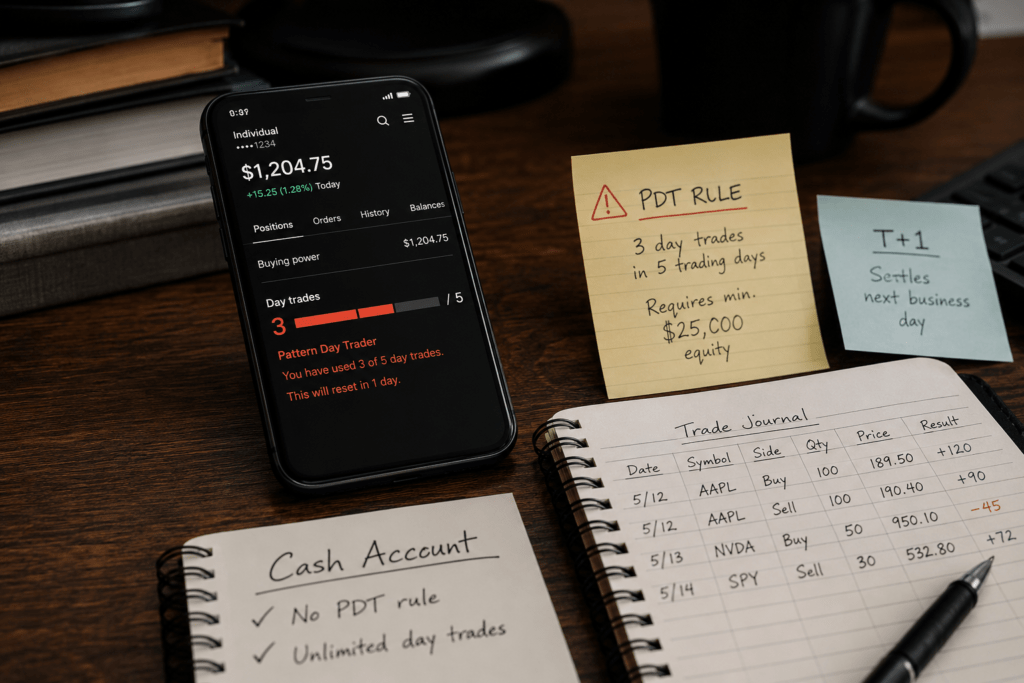
Answer first: The pattern day trader rule is being phased out, but the change does not reach every brokerage account on the same day. The Financial Industry Regulatory Authority’s (FINRA) replacement standards became effective June 4, 2026, and firms may transition as late as October 20, 2027. A cash account still avoids margin-based day-trade limits, but T+1 settlement does not automatically cut buying power in half or create a fixed long-term return loss. It limits how many times you can reuse the same settled cash within one trading day.
For years, the choice looked simple. Keep a margin account and stay under the old day-trade limit, add enough money to clear the old equity minimum, or move to a cash account.
That three-way choice is now outdated. The old rule is disappearing, the timing depends on your broker, and the real cash-account constraint is smaller and more specific than the usual “half your buying power” warning.
What Changed in June 2026?
The SEC approved FINRA’s replacement for the old day-trading margin provisions on April 14, 2026. FINRA made the amendments effective on June 4, 2026. The new framework removes the day-trade count used to label a customer as a pattern day trader and removes the old rule’s separate minimum equity requirement.
The implementation date at your brokerage can be later. FINRA gave firms an 18-month phase-in period ending October 20, 2027. A broker may already use the new intraday margin system, or it may temporarily continue applying the old pattern day trader rule.
Check your broker before acting. A general article can explain the FINRA transition, but only your firm’s current margin disclosure and account screen can tell you which system applies to your account today.
How Large Was the Old Pattern Day Trader (PDT) System?
FINRA’s rule filing included a dated snapshot from January 17, 2025. Ten firms, which FINRA estimated represented more than 85% of pattern day trader accounts, reported about 1.3 million customers carrying the designation. Those customers represented 2.4% of roughly 54 million margin-account customers in the sample.
That figure describes the old system at a specific point in time. It should not be read as a current nationwide count after firms began migrating to the new rules.
Cash Account vs. Margin Account: The Real Trade-Off
The pattern day trader rule no longer makes account choice a clean contest between “three trades” and “unlimited trades.” The useful comparison is settled-cash flexibility versus borrowed-money risk.
| Question | Cash Account | Margin Account |
|---|---|---|
| Can you borrow from the broker? | No. Purchases must be fully paid. | Potentially. Borrowing depends on the security, account equity, and firm requirements. |
| Does the old PDT count apply? | No. Cash trading is governed by payment and settlement rules. | Possibly during the transition. Firms that have migrated use the new intraday margin framework. |
| What limits same-day turnover? | The amount of settled cash still available. | Intraday margin requirements, firm risk controls, and available equity. |
| Main operational risk | Freeriding or good faith violations from using unsettled funds incorrectly. | Margin deficits, forced liquidation, higher house requirements, and losses beyond the initial deposit. |
| Best fit | Traders who can size positions within settled-cash limits and want no borrowing. | Traders who need repeated intraday capital reuse and understand the added risk. |
Regulation T generally allows a broker to lend up to 50% of the purchase price for a marginable equity security at the time of purchase. That does not guarantee every account a permanent 2x multiplier. Brokers can impose stricter initial or maintenance requirements, exclude securities from margin, and reduce buying power when risk rises.
A cash account does not “lose” a second account balance simply because the same-size margin account might be allowed to borrow. It gives up borrowing. Whether borrowing would have increased or destroyed wealth depends on the trades, financing costs, price path, and risk controls. A rule-mechanics article cannot turn that choice into a guaranteed annual return difference.
Trading costs also extend beyond commissions. Bid-ask spreads, options contract fees, margin interest, order quality, and idle-cash rates can matter. The related analyses on zero-commission broker hidden fees and brokerage sweep account rates cover those separate cost channels.
How Does T+1 Actually Limit a Cash Account?
Most equity trades in the United States (U.S.) settle on the next business day, commonly written as T+1. In a cash account, a purchase used for an intraday trade must be fully funded with settled cash. After you sell, those proceeds generally become settled cash on the next business day.
That timing creates an intraday reuse limit, not an automatic 50% haircut. A trader who commits the entire account to one round trip may be able to repeat that full-account process on the next business day after settlement. The same trader generally cannot keep recycling the identical sale proceeds several more times before that day’s settlement cycle completes.
A $15,000 Settled-Cash Example
Assume the account starts the morning with $15,000 of settled cash and each position is fully opened and closed the same day. The maximum number of fully funded round trips before settlement is the account’s settled cash divided by the cash committed to each trade, rounded down.
| Cash Committed per Round Trip | Fully Funded Round Trips Before Settlement | Settled Cash Used |
|---|---|---|
| $15,000 | 1 | $15,000 |
| $7,500 | 2 | $15,000 |
| $5,000 | 3 | $15,000 |
| $3,750 | 4 | $15,000 |
| $3,000 | 5 | $15,000 |
| $1,500 | 10 | $15,000 |
Plain English
T+1 controls how quickly sale proceeds become settled again. Position size controls how many cash-funded round trips fit inside the day. Neither fact tells you what return the strategy will earn.
What Causes a Good Faith Violation?
A good faith violation can occur when you buy a security with unsettled sale proceeds and then sell the new security before the funds used for the purchase have settled. Freeriding is a different payment violation that occurs when a purchase is sold before it has been fully paid for.
There is no single broker-independent number of good faith violations you should treat as “allowed.” Firms track cash-account violations under Regulation T and their own procedures, and the resulting restriction, lookback period, and terminology can differ. Check your broker’s cash-trading policy instead of applying another firm’s threshold to your account.
What Does the New Intraday Margin Rule Change?
Once a brokerage migrates, the old pattern day trader rule designation, five-day trade count, and separate $25,000 minimum no longer control the account. FINRA’s replacement measures the risk created by positions during the trading day and requires firms to monitor whether the account has enough equity for that exposure.
FINRA states that $2,000 is the minimum equity required to use borrowed funds in a margin account. A customer can have less than $2,000 in a margin account but must trade without borrowing. Firms may set higher house minimums, and the required equity can change with the securities held and the risk created during the day.
If trading activity creates an intraday margin deficit, the firm can require a deposit or liquidation. Under FINRA Rule 4210(d)(2)(D), the 90-day restriction applies when a customer makes a practice of not satisfying intraday deficits promptly and leaves one deficit unsatisfied through the close of the fifth business day after it occurs. The firm must then restrict transactions that create or increase a short position or debit balance for 90 calendar days after that fifth business day, or until the deficit is satisfied, whichever comes first. Small deficits and extraordinary circumstances can be excluded when the firm determines whether a pattern exists.
The former fixed threshold is no longer the universal decision point. During the transition, the useful questions are whether your firm has migrated, how it calculates intraday margin, which securities receive margin treatment, and what house requirements it adds.
What Does the Day-Trading Research Actually Show?
Two frequently cited studies offer a warning about active trading, but neither can price the cash-account workaround.
- Barber and Odean (2000) studied 66,465 U.S. household brokerage accounts from 1991 through 1996. The most active households earned materially lower net returns than the market. This was an active-investor study, not a cash-versus-margin day-trading experiment.
- Chague, De-Losso, and Giovannetti (2020) studied people who began day trading Brazilian equity futures between 2013 and 2015. Among those who persisted for more than 300 days, 97% lost money. The market, instrument, and population differ from U.S. stock traders.
These papers support caution about frequent trading and overconfidence. They do not show that a U.S. cash account loses a fixed percentage each year, and they do not show that adding margin would recover a predictable return gap.
Which Account Fits Your Trading Pattern?
The pattern day trader rule no longer gives every active trader one universal threshold. Start with the activity you actually plan to perform, then compare it with settlement capacity, broker rules, and loss tolerance.
| Your Situation | Likely Starting Point | What to Verify |
|---|---|---|
| One full-account round trip per business day | Cash may be operationally sufficient. | T+1 availability, holidays, and the broker’s settled-funds display. |
| Several same-day round trips using the same capital | Margin may offer more intraday reuse. | Migration status, intraday margin formula, house requirements, and borrowing costs. |
| Positions usually stay open overnight or longer | Settlement may be less important than account risk and strategy needs. | Whether any planned options or short sales require margin approval. |
| You cannot tolerate forced liquidation or loss beyond deposited cash | Cash is the safer operational boundary. | Cash-trading violations and position sizing. |
| Trading is a small speculative sleeve beside a long-term portfolio | Either account can work if the sleeve has a hard limit. | Written allocation rules and a separate risk budget. |
A Four-Step Account Check
- Confirm the broker’s current system. Find out whether it still applies the old PDT framework or has moved to the new intraday margin standards.
- Measure typical cash per trade. Divide settled cash by the amount normally committed to one round trip.
- Price the full account. Include spreads, contract fees, margin interest, tax consequences, and idle-cash rates instead of treating commission as the only cost.
- Cap the trading sleeve. A written investment policy statement can separate speculative trading capital from emergency savings and long-term holdings.
Opening several cash accounts can divide settled cash into more buckets, but it does not change T+1, remove trading risk, or create extra capital. It also makes cash tracking and tax records harder.
Pattern Day Trader Rule FAQ
Is the pattern day trader rule gone in 2026?
FINRA’s replacement standards became effective June 4, 2026, but firms may phase in implementation through October 20, 2027. Your broker may already use the new system or may still apply the old rule during the transition.
Can you day trade in a cash account?
Yes. You can buy and sell a security on the same day in a cash account when the purchase is fully paid with settled funds. The practical limit is the settled cash available for additional purchases.
Does T+1 cut cash-account buying power in half?
No. T+1 determines when sale proceeds settle. The number of fully funded intraday round trips depends on settled cash and position size. It does not create a universal 50% buying-power loss or annual return penalty.
What is the minimum account size under the new system?
FINRA identifies $2,000 as the minimum equity required to use borrowed funds in a margin account. A brokerage can require more, and risk-based intraday requirements can demand additional equity for specific positions or trading activity.
How many good faith violations are allowed?
FINRA’s general investor guidance does not set one universal number that every broker treats as “allowed.” Cash-account restriction procedures, lookback periods, and terminology can differ, so confirm the rule in your broker’s current cash-trading policy.
Is margin automatically better for an active trader?
No. Margin can increase intraday capital reuse, but it also adds financing costs, margin deficits, forced liquidation risk, and the possibility of losing more than the original deposit. The better account depends on the actual trading pattern and risk capacity.
The Bottom Line on the Pattern Day Trader Rule
The pattern day trader rule transition is broker-specific even though the old fixed-minimum framework is leaving. Check the firm’s current rules before funding, converting, or placing a fourth day trade if the broker still uses the former system.
A cash account has a real trade-off. It limits intraday reuse of unsettled sale proceeds and removes access to broker credit. That cost is measured in settlement capacity and missed trades, not a universal 50% return cut or a fixed ten-year dollar loss.
For the example account, position size tells you how many fully funded round trips fit into the day. Broker policy tells you which margin regime applies. Trade results, financing costs, and risk determine the eventual wealth outcome.
What does your broker show?
Check the account disclosure or buying-power screen and note whether the firm still references the former PDT minimum or has moved to intraday margin. The date of that disclosure matters as much as the headline rule.
- FOUNDATIONAL FINRA Regulatory Notice 26-10: June 4, 2026 effective date, removal of the former PDT count and separate $25,000 minimum, and the October 20, 2027 phase-in deadline.
- FOUNDATIONAL FINRA Rule 4210(d)(2): intraday margin deficits, the fifth-business-day trigger, the 90-day restriction, and stated exceptions.
- FOUNDATIONAL SEC Release No. 34-105226: approval of SR-FINRA-2025-017 on April 14, 2026.
- SUPPORTING FINRA rule filing SR-FINRA-2025-017: the January 17, 2025 snapshot of approximately 1.3 million designated PDT customers reported by ten firms.
- SUPPORTING FINRA frequent intraday trading guidance: settled-funds requirements, T+1, cash violations, intraday deficits, and margin risks.
- SUPPORTING FINRA intraday margin guidance: the $2,000 baseline for leveraged trading and broker house requirements.
- SUPPORTING SEC Investor.gov margin-account bulletin: Regulation T’s general 50% initial-margin ceiling and the ability of brokers to impose stricter requirements.
- CONTEXT Barber and Odean (2000) and Chague, De-Losso, and Giovannetti (2020): active-trading outcome evidence used only within the article’s stated market, instrument, period, and sample limits.
Settlement-capacity method: floor(starting settled cash / cash committed per round trip). The worked example divides $15,000 by position sizes from $15,000 to $1,500, assuming each position is opened and closed the same day, the purchase uses settled cash, and the full stated amount is committed.
What this leaves out: Price changes, partial fills, fees, deposits, withdrawals, holidays, short sales, options settlement differences, and broker-specific cash displays. A return backtest is not appropriate because the article tests rule and settlement mechanics, not a trading strategy. The academic findings provide risk context but do not estimate a cash-versus-margin return gap.
The article keeps rule facts, broker-dependent implementation, arithmetic examples, and research context distinct. See the Editorial Policy.
Update History
- v2.1 August 5, 2026 Targeted rules and trust update Clarified the fifth-business-day trigger for the new 90-day margin restriction, replaced broker-specific good-faith-violation counts with firm-policy guidance, linked the cited studies, and updated canonical internal links and trust markup.
- v2.0 July 14, 2026 Major factual update Updated the article for SEC approval and FINRA’s active transition period. Removed the unsupported assumption that T+1 automatically halves buying power or annual return, replaced the fixed ten-year projection with settled-cash capacity math, corrected the scope of the cited trading studies, and added broker-dependent implementation guidance.
- v1.0 March 26, 2026 Original publication Initial article published.