📅 Originally Published: · Last Updated:
The Bottom Line, Up Front
A stock is not a bet on a price chart — it is a legally binding fractional claim on a real company’s assets and future earnings. Once you internalize that distinction, every portfolio decision changes: you stop chasing tickers and start evaluating businesses. The “Owner vs. Loaner” Filter in this guide gives you a three-question test to instantly classify any financial instrument before you deploy a single dollar.
Every year, millions of beginners open brokerage accounts asking the same question: what is a stock, exactly — and why does every financial platform treat it like a game show wheel? The honest answer is that most financial media is optimized to keep you watching prices, not studying businesses. That single framing error has measurable consequences: DALBAR’s 2024 Quantitative Analysis of Investor Behavior found the average equity fund investor underperformed the S&P 500 by 5.5 percentage points annually over 20 years — almost entirely due to timing behavior driven by price-watching rather than ownership thinking.
The gap between retail and professional investors is not analytical horsepower or Bloomberg terminal access. It is one conceptual switch: amateurs trade tickers; professionals buy fractional ownership of cash-flowing businesses. That switch sounds abstract, but it rewires every decision downstream — which companies you screen, what price you’ll accept, and how long you hold through volatility that would otherwise trigger a panic sell.
The confusion persists because the vocabulary around equities is deliberately vague. Brokers show you a candlestick chart. Financial media shows you a gain screenshot. Neither shows you the 10-K filing sitting on SEC EDGAR that reveals whether that company actually generates the free cash flow that justifies its market price. The machine is engineered to make you trade, not to make you wealthy.
The Owner vs. Loaner Filter is a three-question framework that cuts through that noise. It classifies any financial instrument in under 30 seconds — revealing whether you are building equity in a wealth-generating asset or simply lending money for a guaranteed-but-inflation-limited return.
What Is a Stock, Really? The Legal Definition That Changes Everything
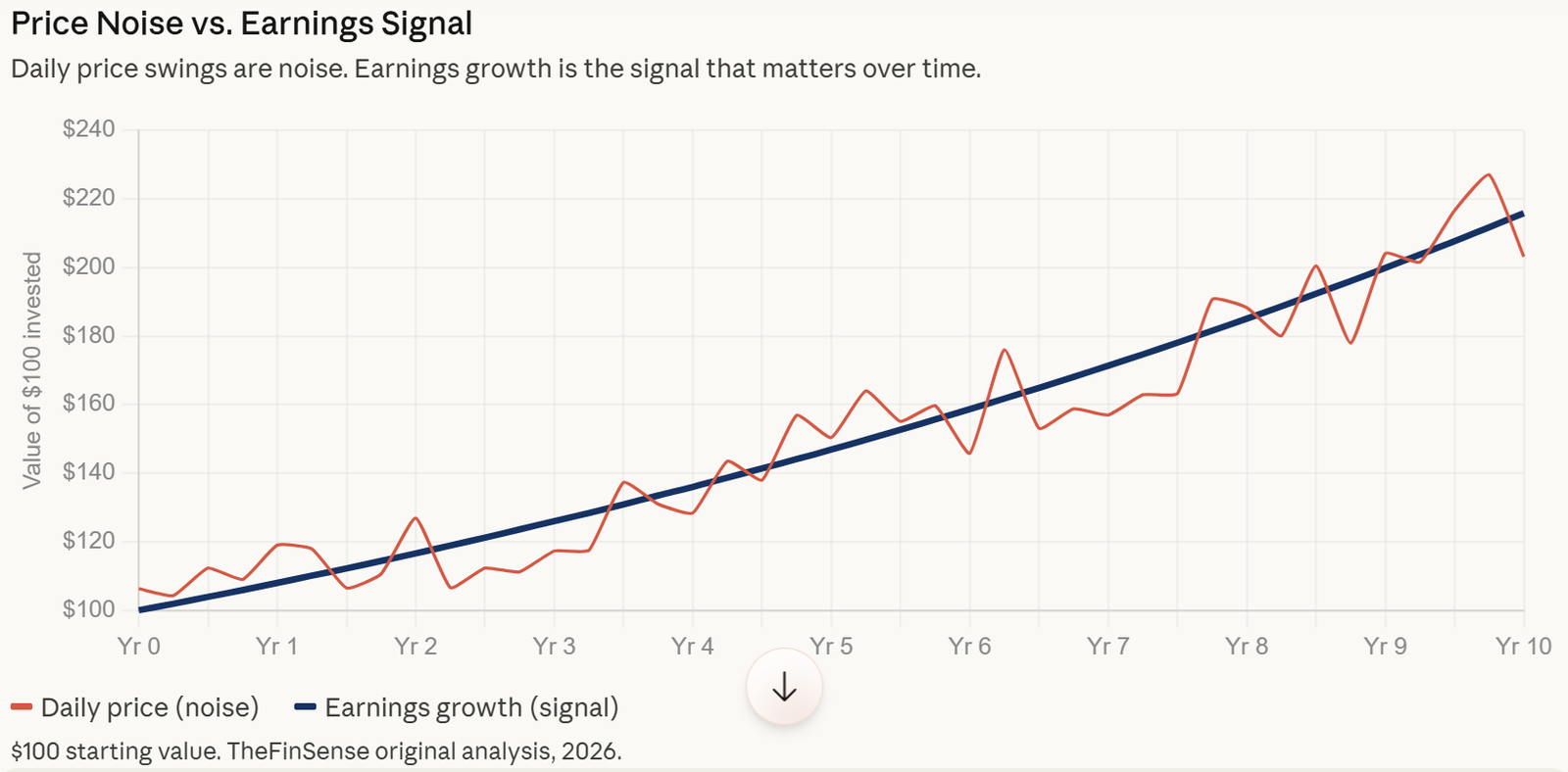
Most people encounter the concept of what is a stock through a price chart. That is exactly the wrong entry point. Price is the market’s current opinion — a number that reflects sentiment, momentum, and algorithmic noise on any given Tuesday morning. It tells you what someone else is willing to pay right now. It tells you nothing about what the underlying business is actually worth.
The Definition That Anchors Every Smart Investment Decision
What is a stock? A stock (also called a share or equity) is a legally binding unit of fractional ownership in a corporation. When you purchase a share, you become a part-owner of that company’s assets, hold a proportional claim on its future earnings, and — depending on share class — gain voting rights on major corporate decisions. This ownership interest is codified in U.S. securities law and enforceable through the SEC.
The operative phrase is “legally binding.” A share is not a coupon, not a derivative, not a side bet on a number moving up a screen. It is a contract — one that grants you a slice of the company’s balance sheet, its intellectual property, its customer relationships, and its future cash generation. The price you see is simply today’s market consensus on what that slice is worth. Tomorrow that consensus can be wrong in either direction, and often is.
This distinction transforms your entire loss function. When a stock you own drops from $40 to $28, the amateur asks: “Should I sell before it goes lower?” The professional asks: “Has the underlying business deteriorated, or is this price noise?” Those two questions lead to opposite actions — and produce opposite 10-year outcomes.
The Initial Public Offering (IPO): Where Stocks Are Born
Before shares trade on the NYSE or NASDAQ, a company goes through an Initial Public Offering (IPO) — the regulated process by which a private company offers shares to the public in exchange for capital. The company files an S-1 registration statement with the SEC, investment banks price the offering through a book-building process, and on listing day, the open market takes over pricing from that point forward.
Here is the practitioner detail that most beginner explainers skip entirely: after IPO day, the company itself receives none of the money from secondary market trading. The capital raise happens at the offering price during book-building. Once trading begins, transactions occur between investors — and the company’s treasury sees zero of those proceeds. Apple does not collect a dollar when you buy shares at $195 on NASDAQ today; that cash goes to whoever sold those shares. This means daily price swings on major equities have no direct impact on their operational cash flows — price matters for perception, executive equity compensation, and future capital raises, but not day-to-day operations.
🧠 IN PLAIN ENGLISH:
Buying a stock on the open market is like buying a used car. The money goes to the previous owner, not the manufacturer. Ford doesn’t get a cent when you buy a 2019 F-150 from a dealer’s lot. The same logic applies to equities: you own a piece of Apple, but Apple banked that money years ago during its IPO. What you’re really doing is paying today’s price for a claim on Apple’s future earnings — and deciding whether that price is a bargain or a trap.
Understanding this mechanism eliminates a common beginner mistake: the idea that buying shares of a company you “support” directly funds its operations. The reputational and indexing effects of a rising share price are real but indirect. What you are actually executing is a claim purchase on future free cash flow at a price set by market consensus — and whether that price is rational is the most profitable question you can ask before clicking buy.
Once you see a stock as a fractional deed to a real business rather than a moving number, the next question becomes structurally obvious: what does that deed actually grant you — and how does owning equity compare to the alternative of simply lending money to that same company?
What Is a Stock vs. a Bond? The Owner vs. Loaner Framework
Here is the contrast that restructures every capital allocation decision: when you buy a stock, you become an owner. When you buy a bond, you become a loaner. That single word swap carries a cascade of implications — for your return ceiling, your inflation exposure, your risk profile, and the legal priority of your claim if the company ever liquidates.
The Owner vs. Loaner Filter runs three diagnostic questions against any instrument you are considering placing capital into:
- Guaranteed yield? — A loaner gets contractual interest payments, regardless of company performance. An owner gets a share of whatever profit is generated — which may compound for decades, or may be zero in a bad year.
- Profit share? — Owners participate fully in business upside. Loaners are capped at their coupon rate no matter how profitable the company becomes.
- 5+ year lock? — Are you comfortable holding through a full business cycle without needing the capital? Ownership rewards patience structurally; short-term equity holding is simply speculation wearing an ownership costume.
| Attribute | Stock (Owner) | Bond (Loaner) |
|---|---|---|
| Legal Claim Type | Residual equity claim on assets | Senior debt claim — paid before equity |
| Return Ceiling | Unlimited — tied to business earnings growth | Fixed — capped at coupon rate |
| Inflation Protection | Strong — earnings grow alongside price levels | Weak — fixed payments erode in real terms |
| Voting Rights | Yes (common shares) | None |
| Income Distribution | Discretionary dividend — board decides | Contractual coupon — legally required |
| Liquidation Priority | Last (residual claimant) | First (senior to equity) |
| Ideal Time Horizon | 5+ years | 1–10 years (maturity dependent) |
The table makes one thing clear: bonds are not inferior instruments — they are different tools solving different problems. A bond’s contractual yield and senior claim position make it the right tool when capital preservation over a defined time window matters more than growth. Stocks are the right tool when you want to participate in the compounding of a real business over a multi-year horizon. Confusing the two — buying bonds when you need growth, or holding stocks with money you need in 18 months — is where most beginners destroy wealth without understanding why.
Dividends: Getting Paid to Wait
One of the most underrated mechanics of equity ownership is the dividend — a cash distribution paid to shareholders out of a company’s retained earnings, declared at the board’s discretion. In 2023 alone, S&P 500 companies distributed over $564 billion in dividends. Yet the majority of retail investors treat dividends as a footnote rather than a compounding engine.
Here is the practitioner’s framing: over the last century, dividends accounted for approximately 40% of the S&P 500’s total return. When those dividends are reinvested — a strategy called DRIP (Dividend Reinvestment Plan) — you are compounding ownership, not merely collecting income. Each reinvested dividend purchases a fractional share, which earns the next dividend cycle, which buys more shares. The math accelerates nonlinearly across 20-year horizons in a way that price appreciation alone cannot replicate. If you are building a portfolio where inflation-protection is a core objective, this compounding dynamic is central to how equity-heavy allocations work — see our full breakdown on safe investments to beat inflation.
Picture yourself at 35, allocating $500 per month into dividend-paying equities with a blended 3.1% yield and 7% average annual price appreciation. By year 20, the dividend reinvestment alone contributes more additional share accumulation than your monthly contributions. That is not projection optimism — that is arithmetic compounding executing as designed.
Voting Rights: Your Legal Seat at the Table
Common stockholders receive voting rights on major corporate decisions: board elections, merger and acquisition approvals, executive compensation packages, and equity issuance that could dilute existing shareholders. According to FINRA’s investor education framework, one common share typically equals one vote — though dual-class share structures (standard at Meta, Alphabet, and most founder-led tech firms) concentrate governance power at the founder level, rendering retail shareholders economically entitled but functionally non-voting.
In practice, an individual retail holder with 50 shares rarely swings proxy votes. But voting rights matter as a structural signal: they are the legal mechanism that distinguishes a shareholder from a creditor, and they are precisely why activist hedge funds accumulate large enough stakes to force board-level changes. Ownership has teeth. The price you pay for a stock reflects that embedded optionality.
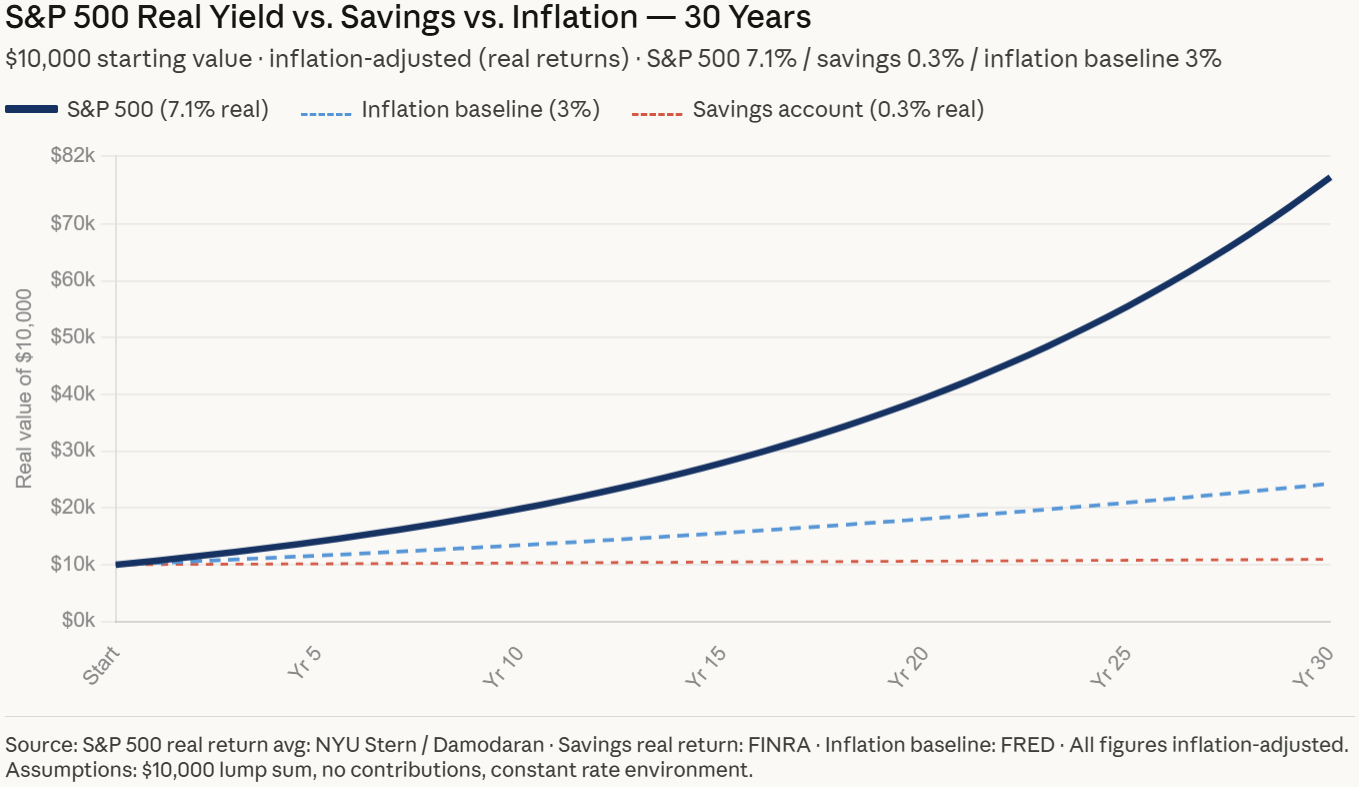
7.1%
The S&P 500’s average annualized real return (adjusted for inflation) over the last 30 years — versus roughly 0.3% real yield on the average U.S. savings account. Long-term equity ownership has not been speculation; it has been the primary mechanism of middle-class wealth generation in America. Source: NYU Stern / FRED.
The Market Cap Illusion: Why Share Price Is Meaningless in Isolation
Alongside dividends and voting rights sits one of the most dangerous misconceptions in retail investing: the idea that a $10 stock is “cheaper” than a $100 stock. Consider two companies. Company A trades at $10/share with 10 billion shares outstanding. Company B trades at $100/share with 50 million shares outstanding. Which one costs more to own a piece of?
Most beginners answer Company B. The correct answer is Company A — by a factor of 20.
Market Capitalization = Current Share Price × Total Outstanding Shares. Company A’s market cap is $100 billion. Company B’s is $5 billion. Buying Company A’s $10 share means paying into a $100 billion valuation on a business that may generate dramatically less free cash flow per dollar of market cap than Company B’s apparently “expensive” $100 shares. Price per share is an artifact of share count decisions made in a boardroom. It is not a measure of value, cheapness, or quality.
This is why professional analysts never evaluate share price in isolation. NYU Stern’s Aswath Damodaran — widely regarded as the foremost authority on equity valuation — anchors every model on enterprise value relative to normalized free cash flow, not on whether the ticker happens to print at $12 or $1,200. The share price is one variable in a far more important equation. For a concrete playbook on using equity ownership to preserve real purchasing power over decades, see how long-term investors protect savings from inflation using equity-heavy structures.
How Stocks Actually Work: What Is a Stock Exchange Doing to Your Order?
Understanding what is a stock conceptually covers only half the equation. The other half is understanding what physically happens between the moment you click “Buy” and the moment shares appear in your account — because inside that execution gap, there are mechanisms specifically designed to extract a toll from uninformed retail order flow.
“When I model equity risk premiums for 10-year forecasts, the baseline is always isolating the company’s free cash flow, not the ticker’s daily mood swings on the screen.”
— Danny Hwang, Lead Quant Analyst, TheFinSense
Every stock trade executes on an exchange — the NYSE, NASDAQ, or one of several electronic alternative trading systems (ATS). At any moment, two prices coexist for every stock: the bid (the highest price a buyer is currently willing to pay) and the ask (the lowest price a seller will accept). The difference between them is the bid-ask spread — an invisible transaction cost that most beginners never track and most brokerages never highlight.
For liquid large-cap stocks like Apple or Microsoft, this spread might be a fraction of a cent. For thinly traded small-caps, it can run 1–3% of the share price, meaning you are immediately underwater on every buy the moment it executes. This is not a fee line item. It is a structural tax on impatience.
Why the 9:30 AM Open Is the Most Dangerous Minute of the Trading Day
If you have ever placed a market order precisely at the NYSE opening bell, you have almost certainly paid more than the midday price would have required. The opening minutes of trading see bid-ask spreads widen 3–5× their midday levels as market makers reprice overnight inventory after futures moves and pre-market news. High-frequency trading (HFT) algorithms operate in microseconds during this window — executing arbitrage and liquidity provision strategies that systematically disadvantage slower retail orders by exploiting the wider spread.
The countermeasure is simple and almost never taught in beginner resources: use a limit order, not a market order. A limit order specifies the maximum price you are willing to pay. If the ask is $102.50, you set your limit at $102.00 and either fill at your price or the order waits. A market order executes at whatever the current ask is — which at the open can be inflated by algorithmic spread-widening that exists precisely to extract value from impatient retail flow. The difference on a single 100-share trade can be $15–$40. Across a lifetime of investing, the compounding cost of market orders is not trivial.
▶ Video: How the Stock Market Works — Visual explainer covering exchange mechanics, order types, and why share price is only one variable in a complete equity valuation.
Market Orders, Limit Orders, and the Hidden Cost of Commission-Free Trading
Most brokerages default new accounts to market orders. This is not an oversight. Payment for order flow (PFOF) is the practice by which brokerages route your market orders to specific market makers in exchange for rebates — generating brokerage revenue even when you pay zero visible commission. The market maker profits from the bid-ask spread on your transaction. “Commission-free” trading shifted the cost structure; it did not eliminate the cost.
When I pull transaction data directly from SEC EDGAR rather than relying on Yahoo Finance summaries, the information asymmetry becomes visible immediately. EDGAR’s Form 4 filings disclose insider buy and sell activity with a mandatory 2-business-day lag — a signal with measurably higher predictive value than any analyst segment on financial media. The platform you use to research is as consequential as the order type you use to execute. Both are decisions most beginners never make consciously.
💡 PRO TIP: On your first equity trade, set your limit price no more than 0.15% above the current bid-ask midpoint. This eliminates spread extraction while keeping fill probability above 85% for liquid large-cap names. For thinly traded small-caps, widen the buffer to 0.5%, or use a day-limit order that auto-cancels at market close if unfilled.
You now have a working model for what a stock actually is, what rights it confers, how ownership compares structurally to lending, and how the execution mechanics of exchange trading work against uninformed retail order flow. The question that remains — and the one that separates observers from participants — is how to execute your first buy without giving away the edge before the trade even settles.
Buying Your First Stock Without Getting Skimmed by the Cost of Inaction
Most beginner investing content fixates on the risk of getting it wrong — buying the wrong company, buying at the wrong time, losing money to a volatile market. Almost none of it quantifies the opposite risk: the calculable, compounding cost of never buying at all. That cost is not theoretical. It is arithmetic, it accrues daily, and it is specifically designed to be invisible inside the nominal balance of your savings account.
The analysis below runs a single $5,000 lump sum through two paths across a 20-year horizon — no stock picking, no timing judgment, no variable assumptions beyond the two return rates themselves. The purpose is not to tell you which stock to buy. It is to show you, in dollars, what the question of what is a stock costs you every year you avoid answering it.
The Setup: One Decision, $5,000, and Two Decades
Path A deposits $5,000 into a standard U.S. savings account yielding 0.50% annually — the approximate 2026 national average for non-promotional deposit accounts per FDIC published rate surveys. Path B allocates the identical $5,000 to a broad S&P 500 index fund, applying the index’s historical nominal total return of 10.0% compounded annually over the 1928–2025 period, as documented by NYU Stern’s historical equity risk premium database. Both paths run with zero additional contributions, zero tax drag on intermediate returns, and no withdrawal events — isolating the pure compounding differential between equity ownership and cash-equivalent storage.
The formula is elementary. Terminal value = $5,000 × (1 + r)t, where r is the annual return rate and t is the holding period in years. For Path A at year 20: $5,000 × (1.005)20 = $5,524. For Path B at year 20: $5,000 × (1.10)20 = $33,638. The gap is not a rounding artifact. It is what happens when 10% compounds against 0.5% for twenty consecutive years without interruption.
| Time Horizon | Path A: Cash (0.50% APY) | Path B: S&P 500 Index (10% Nominal) | Opportunity Cost |
|---|---|---|---|
| Year 5 | $5,126 | $8,053 | −$2,927 |
| Year 10 | $5,256 | $12,969 | −$7,713 |
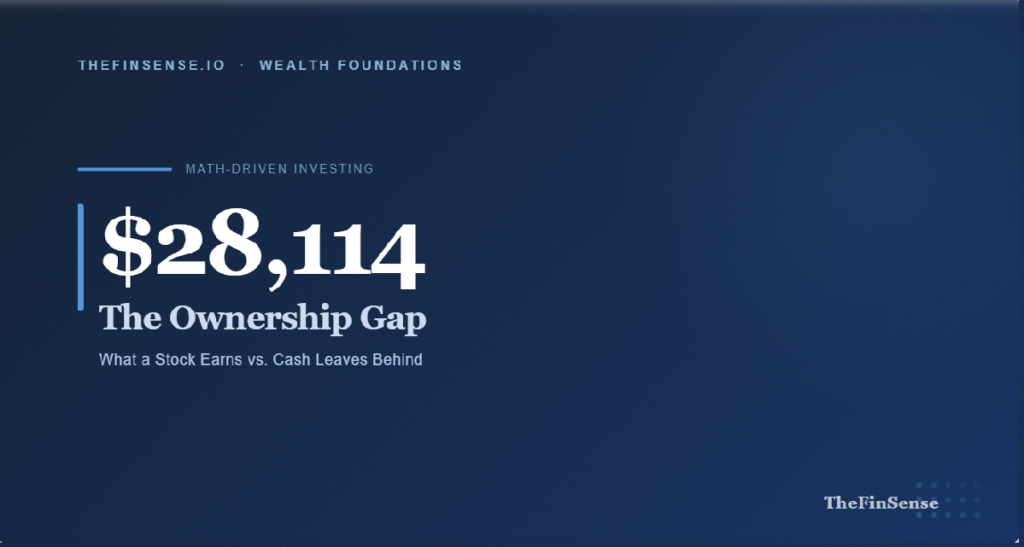
| Year 20 | $5,524 | $33,638 | −$28,114 |
At year 20, the $28,114 you left behind in savings is roughly equivalent to 11 months of U.S. median rent — vaporized not by market volatility, but by the decision to avoid the question of what is a stock entirely.
TheFinSense · Case Study
$5K Invested vs. Cash — 20-Year Ownership Gap
$5,000 lump sum · S&P 500 10% nominal vs. savings 0.50% APY · no contributions · pre-tax
Year 5
−$2,927
opportunity cost
Year 10
−$7,713
opportunity cost
Year 20
−$28,114
ownership gap
Source: TheFinSense original calculation, 2026 · S&P 500 historical avg: NYU Stern / Damodaran · Assumptions: $5,000 lump sum, no additional contributions, pre-tax, constant rate environment.
What the Numbers Are Actually Telling You
The year 5 gap of $2,927 is the most dangerous row in the table — not because it is the largest, but because it is the most rationalizable. A few thousand dollars over five years feels manageable. “I’ll start when things are less uncertain.” What that rationalization conceals is that year 5 is precisely when compounding begins its nonlinear inflection. Every dollar earning 10% during years 1 through 5 compounds into the $12,969 at year 10 and the $33,638 at year 20. Skipping the first phase does not delay the outcome — it eliminates the base on which the exponential portion of the curve builds.
The year 20 row also exposes what professional portfolio managers call the opportunity cost of false safety. Path A did not lose money in nominal terms — it generated $524 in interest across two decades. But the U.S. long-run average CPI of approximately 3.0% means maintaining real purchasing power on that original $5,000 requires $9,031 by year 20. Path A delivered $5,524 nominal against a $9,031 real threshold. That is a 39% real-terms loss hidden inside a nominal “gain” of 10%. Path B’s $33,638 clears the identical inflation threshold by 273% — because business earnings grow alongside price levels, while a fixed-rate savings coupon does not.
The precision frame matters here. The practitioner’s tool for handling this math without the anxiety of timing a market entry is dollar-cost averaging (DCA) — deploying a fixed dollar amount into a broad index at regular intervals regardless of price level. DCA does not maximize theoretical terminal value (a single lump sum deployed on the optimal day beats DCA in about 70% of historical rolling windows, per Vanguard’s 2012 research update). What it maximizes is execution probability: it removes the behavioral friction of waiting for the “right” entry that silently converts a willing investor into a permanent bystander. For a beginner holding $5,000 in cash today, ten $500 monthly DCA installments into a low-cost index fund captures the compounding window before it narrows another year. To see how that compounding math accelerates over 30 years — including the friction drag from fees and inflation — see the Wealth-Velocity Filter.
❌ Without Equity Ownership:
$5,000 in a savings account for 20 years yields $5,524 nominal — a real purchasing-power loss of roughly 39% after inflation. Your capital is technically “safe” while being structurally depleted. The account statement never shows the $28,114 you did not earn.
✅ With Equity Ownership:
The same $5,000 in a broad S&P 500 index fund at historical average returns reaches $33,638 over 20 years — clearing the inflation threshold by 273% and generating $28,114 in additional real wealth through fractional ownership of compounding business earnings.
The Shareholder Rights You Didn’t Know You Had
Equity ownership is not passive capital storage. A share of common stock carries enforceable legal rights that most retail investors never activate — not because those rights are obscure, but because no brokerage onboarding flow explains them and no financial media segment finds them telegenic enough to cover. Three rights in particular change how you engage with every company you own: proxy governance, direct financial disclosure access, and the discipline of writing a sell thesis before you buy.
How to Vote Your Shares: The DEF 14A and What to Do With It
Before every annual general meeting, every public company files a DEF 14A — a proxy statement — with the SEC. It contains the full ballot: board election slates, executive compensation structure, capital allocation proposals, and any shareholder-submitted resolutions. Your brokerage routes voting instructions automatically; if you take no action, most platforms default your votes to management recommendations. That default is not neutral — it is an affirmative vote in favor of whatever the board proposes, including compensation packages that may reward executives for underperformance relative to the index.
The practitioner-level detail that most beginner resources omit: activist investors like Elliott Management or ValueAct Capital build large equity stakes specifically to flip proxy votes on boards that have presided over persistent share-price underperformance. The DEF 14A is the legal instrument they use. The same document your brokerage emails you once a year — the one most retail holders delete without reading — is the primary weapon of the most sophisticated capital allocators on earth. Reading one proxy before casting one vote, even on a single holding, restructures how you understand the governance dimension of stock ownership in concrete rather than theoretical terms.
Reading the Annual Report: The One Filing That Actually Matters
Every U.S. public company files a 10-K annual report with the SEC within 60 days of fiscal year-end — a legally mandated, auditor-reviewed disclosure of operations, financial condition, and material business risks. It is available free on SEC EDGAR’s full-text search within seconds of filing. The risk factors section is where management is legally required to disclose the specific variables that could materially impair the business — language that virtually no earnings coverage on financial media ever references.
One section most retail investors skip entirely: the Management Discussion & Analysis (MD&A). This is where executives narrate the year’s operating results in their own language — explaining margin compression, competitive shifts, or regulatory exposure in a way that a single quarterly earnings call never captures. Reading three consecutive years of the same company’s MD&A reveals whether management’s explanations for underperformance rotate between “industry headwinds” and “execution error.” That rotation is a materially different signal for intrinsic value than the EPS beat or miss the headline number provides. It takes 30 minutes per 10-K. Most of your competition in the market does not spend those 30 minutes.
Building Your Sell Thesis Before You Buy
Professional portfolio managers write a sell thesis before they execute a buy order. The sell thesis answers one pre-defined question: under what specific, measurable conditions does the original ownership thesis become invalidated? Common professional triggers include a sustained multi-quarter decline in free cash flow margin, an unexplained CFO departure, a debt-to-equity ratio crossing a predetermined threshold, or a capital allocation decision (an acquisition, a buyback suspension) that directly contradicts management’s stated strategy.
Without a pre-defined sell thesis, the decision to hold or exit under market pressure defaults to emotion. And emotional exit decisions in equities are the single largest driver of the 5.5 percentage point annual underperformance gap documented in the DALBAR data cited at the top of this guide. The sell thesis is not pessimism — it is the intellectual insurance policy that keeps ownership from becoming blind holding. Write it before your first dollar clears.
💡 PRO TIP: Store your buy rationale and sell thesis in a one-page investment memo the moment you buy any equity position. Date it. Include the specific free cash flow metric, valuation multiple, or business condition that would trigger a sale. When the market drops 18% in a week, that memo is the document that prevents a rational ownership position from becoming an emotional liquidation at the exact wrong moment.
Frequently Asked Questions About Stocks
What is a stock in simple terms?
A stock is a legally enforceable unit of fractional ownership in a corporation. Buy one share, and you own a proportional slice of that company’s assets, future earnings, and — for common shares — voting rights on major corporate decisions. The price on the exchange reflects current market consensus on the value of that slice, not an objective measure of what the business is fundamentally worth.
What is the difference between a stock and a share?
In everyday usage the terms are interchangeable. Technically, “stock” refers to the broad concept of equity ownership in a company, while “share” denotes a single, specific unit of that stock. Saying “I own 50 shares of Apple stock” uses both terms correctly and precisely. Neither term implies different risk levels, tax treatment, or priority in a liquidation event.
How does a stock make you money?
Two mechanisms: price appreciation — the market revises its consensus on what your ownership slice is worth upward — and dividends, which are cash distributions paid from company earnings at the board’s discretion. Total return combines both. Historically, reinvested dividends contributed roughly 40% of the S&P 500’s cumulative total return over the last century, meaning price appreciation alone significantly understates what long-term equity ownership actually generates.
Can you lose all your money in stocks?
A single-company investment can go to zero if the company goes bankrupt — equity holders are the last claimants in liquidation. A broad index fund holding hundreds of companies cannot go to zero without every company in the economy failing simultaneously, a scenario that makes the denomination of the loss irrelevant. Diversification does not eliminate risk; it makes catastrophic total loss statistically improbable while preserving long-run participation in economic growth.
What is the difference between a stock and an ETF?
A stock is direct fractional ownership in a single company. An ETF (exchange-traded fund) is a pooled vehicle holding stakes across dozens or hundreds of companies, trading like a stock on an exchange. For most beginners, a low-cost index ETF tracking the S&P 500 delivers core equity ownership benefits — inflation protection, long-run compounding — without the concentration risk of betting on a single company’s operational execution.
Final Verdict: What Is a Stock, and Is It Worth Your Capital?
Strip away the tickers, the CNBC segments, and the Reddit thread momentum, and the answer to what is a stock becomes almost anticlimactic in its simplicity: a fractional legal claim on a real company’s assets and future earnings, enforced by securities law, tradeable on regulated exchanges, and subject to the compounding dynamics that have produced more middle-class wealth across the last century than any other accessible asset class. That is the entire framework. Every downstream complexity — options strategy, technical pattern, sector rotation — is noise built on top of this one foundational insight, and it is noise specifically structured to keep you reacting to price rather than evaluating businesses.
The Owner vs. Loaner Filter forces a discipline that most beginners lack by default. Before allocating capital into any instrument, run three questions: guaranteed yield or profit share? Return ceiling fixed or unlimited? Comfortable holding for 5+ years? If the answers orient toward equity ownership, the next question is not “which stock” — it is “at what price does this specific business represent a rational purchase relative to its normalized free cash flow?” That question lives in a 10-K, not a price chart.
The case study numbers deliver the clearest verdict in this guide. A $5,000 lump sum in a savings account over 20 years produces $5,524 nominal — a number that masks a real purchasing-power loss of approximately 39% across every inflationary cycle the U.S. has experienced in the last hundred years. The identical $5,000 in a broad equity index at historical average returns produces $33,638. The $28,114 spread is not luck or speculation. It is arithmetic applied to the structural difference between lending money at a fixed rate and owning a fractional share of the compounding earnings power of the American economy.
The beginner’s first move is not choosing a stock. It is choosing a mental model. Stocks are ownership stakes in businesses. Businesses generate cash flows. Cash flows can be analyzed and compared against price. Prices are periodically irrational in both directions. Patient, informed owners who understand what is a stock at this foundational level do not need predictions, hot takes, or market timing — they need a brokerage account, a low-cost index fund, a reading habit built around 10-Ks, and the discipline to write one sell thesis per position before the first dollar clears. That is the entire durable edge.
💬 YOUR TURN
What percentage of your liquid savings is currently sitting in a cash account rather than invested in equities?
Drop a comment below 👇
📖 Previous Read: Safe investments to beat inflation — T-Bills, CDs, and HYSAs compared after tax
📌 Next Read: How to Protect Savings From Inflation: T-Bills vs HYSA Real Yield Guide