📅 Last Updated:
Executive Summary
- Support and resistance are not lines — they are liquidity zones: Every bounce and breakdown on your chart maps directly to dense clusters of institutional limit orders sitting on the order book, not abstract psychological barriers.
- Your stop-loss is algorithmic fuel: Over 70% of retail stop-loss and take-profit orders cluster at round numbers, and institutional algorithms are mathematically designed to sweep those exact zones to fill massive buy positions.
- Trade the zone, not the line: By replacing exact-price entries with a Volume Profile–based liquidity zone approach and waiting for the false breakout to clear, you align your capital with smart money instead of against it.
What Is a Support and Resistance Strategy?
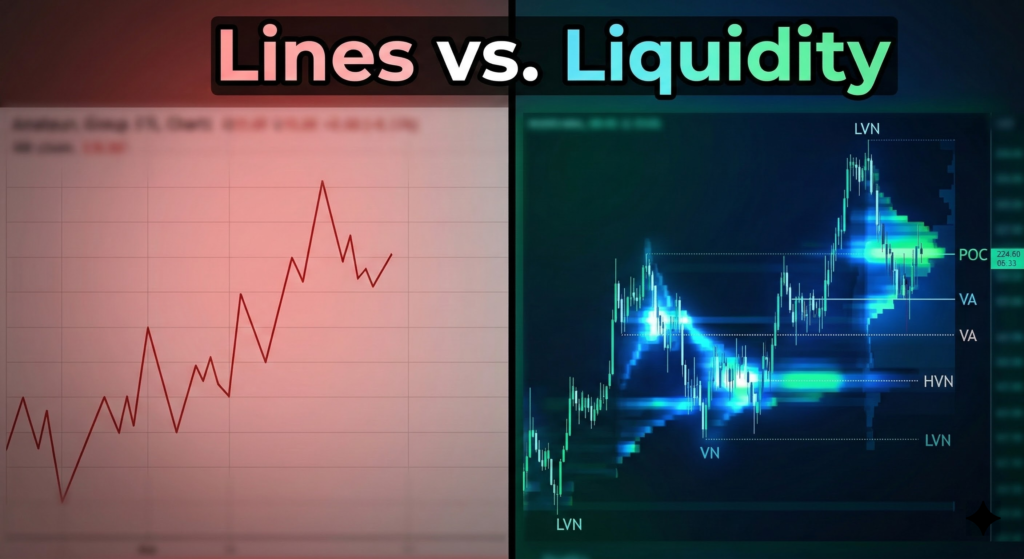
Support and resistance refers to specific price zones where historical supply and demand have created dense liquidity pools on the institutional order book. Unlike the common misconception that these are exact, single-pixel lines on a chart, they actually represent broad clusters of limit orders that mechanically halt or reverse the current price trend based on real order flow data.
The Beginner’s Trap: Why Your Support Line Keeps Failing
You draw the perfect support line at exactly $150.00 and place your stop-loss at $149.90 — just a dime below, for safety. The next morning, the stock violently dips to $149.50, triggers your sell order for a loss, and immediately reverses to $160 without you on board.
Sound familiar? That scenario plays out in thousands of retail trading accounts every single week. And it is not random bad luck.
Beginners fall into this trap because they treat support and resistance as fixed, unbreakable walls. A stock touched $150 three times last month, so $150 must hold again. Right? The brain craves certainty. Psychologists call this Anchoring Bias — the tendency to latch onto a single reference number and treat it as gospel, even when the market is a probabilistic system that operates in messy, volatile ranges.
Why Exact Lines Are a Losing Game
If you have ever placed a stop-loss one cent below a round number and watched the market take your money before reversing, you already know the answer — you just haven’t had the vocabulary for it yet. The problem is structural, not emotional. Institutions and algorithms do not see a “line.” They see a supply and demand zone stretching 2–3% around that number, packed with limit orders and resting liquidity. Your stop at $149.90 sits right in the kill zone.
Understanding why emotional trading patterns destroy portfolio returns is half the battle. But the other half — the half most educators skip — is understanding the mechanical reason your line breaks.
⚠️ WARNING: If your stop-loss is placed within 1% of a major round number (like $50, $100, $150, $200), you are statistically positioned in the highest-probability liquidation zone on the order book. Algorithms are programmed to sweep this exact area.
So if exact lines are traps, what are institutions actually looking at? The answer sits inside the order book — and it changes everything about how you approach entries and exits.
The Smart Money Reality Behind Support and Resistance
According to market microstructure research published by the Federal Reserve Bank of New York, over 70% of retail stop-loss and take-profit orders cluster heavily around round numbers — prices ending in 0, like $50, $100, or $200. That single statistic reshapes the entire conversation about how support and resistance form in modern markets.
The Round Number Blind Spot
Here is a number that changes everything: because human brains are lazy with precision, we default to round figures when setting orders. I’ll sell at $100. I’ll cut my losses at $50. That cognitive shortcut — amplified across millions of traders — creates enormous, predictable liquidity pools at those exact price points. Institutional algorithms know this. They are mathematically designed to exploit it.
A $500 million hedge fund cannot simply click “buy” at the market price. Doing so would spike the stock and destroy their average entry cost through slippage. To accumulate millions of shares quietly, they need millions of sell orders to match against. And where is the densest concentration of sell orders? Right below the obvious support line, where all the retail stop-losses are resting.
“Support and resistance are not psychological barriers. They are algorithmic battlegrounds on the limit order book.”
Liquidity Hunting: How Institutions Use Your Fear
Professionals do not draw lines and hope for a bounce. They map liquidity zones — broad bands where the order book shows dense concentrations of resting orders. When the price dips below the “obvious” support level, amateurs panic and sell. Professionals? They are buying every share those panicked sellers dump.
This process has a name in market microstructure: the false breakout, sometimes called a bear trap. And it is not conspiracy theory territory. Research from the Review of Financial Studies (Kavajecz & Weaver) demonstrated that support and resistance zones align mathematically with peaks in the limit order book. The bounce is not magic. It is order flow mechanics.
Most people — including some professionals — miss this: the very act of millions of traders anchoring to the same round-number support line is what creates the liquidity wall that makes that level meaningful. But it also makes it a target. Every perfectly visible support level has a bullseye painted on it for algorithmic stop-hunts.
🧠 IN PLAIN ENGLISH:
A grocery store with one checkout lane can handle a trickle of shoppers. But if 500 people rush the exit at once, the whole system jams. Round-number support levels are that single checkout lane — institutional algorithms deliberately cause the stampede to scoop up cheap inventory while everyone else is scrambling.
Knowing this changes your entire approach to setting entries. But how does the role reversal mechanism actually work when a resistance level flips to support?
Core Mechanics: How Support and Resistance Actually Work
Have you ever wondered why a broken resistance ceiling magically transforms into a new support floor? It is not magic, and it is not crowd psychology alone. Three moving parts make this work — and each one ties back to real order flow on the limit order book.
Part 1: The Supply and Demand Imbalance
Every price level on a stock chart represents a tug-of-war between buyers (demand) and sellers (supply). When demand overwhelms supply at a certain price zone, the price bounces upward. That zone becomes “support.” When supply overwhelms demand, the price rejects downward. That zone becomes “resistance.” Simple enough. But what determines why demand clusters at that specific zone and not $2 higher?
Order flow data. Not feelings.
Institutional traders place massive limit buy orders at specific prices where their quantitative models identify value. Those orders — sometimes representing hundreds of thousands of shares — create an invisible floor. Your charting software shows you the result (a bounce), but it hides the cause (the wall of resting buy orders underneath).
Part 2: The Role Reversal Phenomenon
According to Fidelity Investments’ research on supply and demand dynamics, when a stock breaks above a strong resistance level, the traders who sold short at that level are now sitting on losing positions. Many of them set their stop-losses just above the zone they sold at. As the price rises further, those stops trigger — converting sellers into forced buyers — and the old resistance zone now has a fresh wave of buy orders propping it up.
That is role reversal in mechanical terms. No mysticism required.
💡 PRO TIP: After a confirmed breakout above resistance (verified by a daily candle close and above-average volume), watch for a “retest” pullback to the old resistance zone. If the price holds that zone as new support with declining sell volume, that is your highest-probability long entry. Professionals call this the “breakout-retest” pattern, and it is one of the most reliable setups in price action and technical analysis.
Part 3: Volume Confirmation — The Truth Serum
Every support or resistance zone on your chart is only as strong as the volume behind it. A bounce off support on thin volume is a weak signal — it means few institutional participants are defending that level. A bounce on heavy volume, with a clear spike on the Volume Profile, tells you that serious money is positioned there.
During Q1 2026, the S&P 500 demonstrated this principle repeatedly near the 5,800–5,850 range, where volume profile data showed massive institutional accumulation nodes that retail chartists drawing simple horizontal lines would have entirely missed.
Without volume confirmation, you are guessing. With it, you are reading the order book’s fingerprints. And that distinction separates the traders who get stopped out from the traders who buy the stop-outs.
Real-World Case Study: Four Traders, One Support Zone
The most reliable and visually perfect support lines are actually the most dangerous places to put your money. Why? Because everyone else is staring at them too — and that predictability is what algorithms feed on.
Picture a large-cap stock trading at $200 with an “obvious” support level at $190, visible on every retail charting platform in the world. Four traders approach this setup with wildly different strategies. Only one walks away profitable.
Scenario A — The Quant Trader (Best Case)
She does not buy at $190. Instead, she loads the Volume Profile and identifies the true high-volume node at $186–$188. She places a limit buy order at $187.50 — right inside the institutional liquidity pool, below the obvious retail line. When the algorithmic stop-hunt sweeps through $190 and triggers a cascade of retail panic selling, her order fills. The stock reverses from $186.80 and climbs to $215 over three weeks. She captures a 14.6% gain while everyone else was licking their wounds.
Scenario B — The Amateur Trader (Common Mistake)
He buys at exactly $190.00 with a stop-loss at $189.50. The algorithmic sweep pushes the price to $188.30. His stop triggers. Gone. He watches from the sidelines as the stock rallies 15%. He suffered from Herding Behavior — buying where everyone else bought, and getting liquidated where everyone else got liquidated. The consensus was the trap.
Scenario C — The FOMO Trader (Worst Case)
Between watching the stock rally from $190 to $210, she cannot take the emotional pressure anymore and buys at $212 — right at resistance. Naïve Realism convinces her that if the price is going up, it will keep going up. The stock immediately reverses. Over six months, it grinds down to $170. She holds through a 20% drawdown because selling would mean admitting the mistake, and the Status Quo Bias keeps her paralyzed in a losing position.
Scenario D — The Do-Nothing Trader (The Hidden Bleed)
But it gets worse.
Consider the trader who never learns liquidity mechanics at all. He has a $50,000 portfolio and gets stopped out at obvious support lines roughly three times per year — each time eating a 3% loss before the reversal. That is approximately $4,500 bled annually from his account.
The Compound Cost of Getting Stopped Out
Now, I will admit — $4,500 a year sounds survivable. Except when you compound what that money could have earned if it stayed invested at an 8% annualized market return:
- After 10 years: ~$65,200 in lost wealth
- At the 20-year mark: ~$205,000 in lost wealth
- Over 30 years: ~$509,700 in lost wealth
Half a million dollars. Not from a single catastrophic trade. Not from fraud. From repeatedly placing stops at the wrong location because of Anchoring Bias — the stubborn insistence on trading exact lines instead of probabilistic liquidity zones. The cost of ignorance compounds just as aggressively as wealth does.
| Category | The Amateur Way (Lose Money) | The Pro Way (Build Wealth) |
|---|---|---|
| Defining the Level | Draws an exact, single-pixel line based on past price wicks. | Identifies a 2–3% broad liquidity zone using the Volume Profile and order book data. |
| Stop-Loss Placement | Places the stop exactly on or 1 cent below the support line. | Places the stop significantly below the structural liquidity pool — outside the sweep zone. |
| Reaction to Breakouts | Panic-sells immediately when the line is breached. | Waits for the daily candle close to confirm whether the break is a bear trap or genuine. |
| Primary Indicator | Relies purely on historical price action and diagonal trendlines. | Relies on Volume Profile, order flow data, and institutional accumulation signals. |
Half a million over 30 years — all from a problem that takes about 20 minutes to fix once you understand the mechanics. So what does the fix actually look like in practice?
Step-by-Step Action Plan: Trading Liquidity Zones
It is 8:30 AM, and the opening bell is approaching fast. Instead of blindly drawing diagonal lines on a blank chart, you open your platform, load the Volume Profile indicator, and identify exactly where the algorithmic block trades are sitting. Here is your three-step framework.
Step 1: Map the Volume Profile to Find Hidden Liquidity Nodes
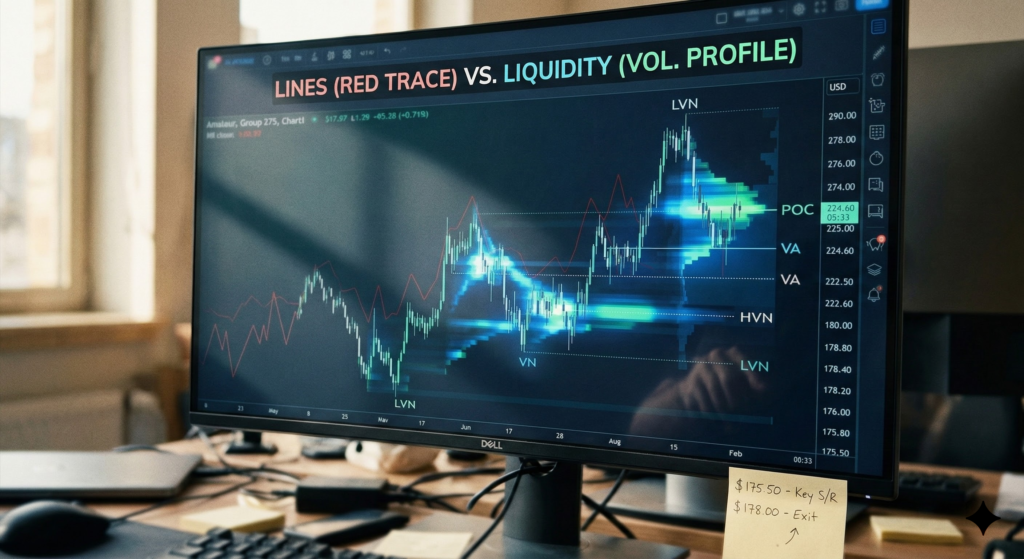
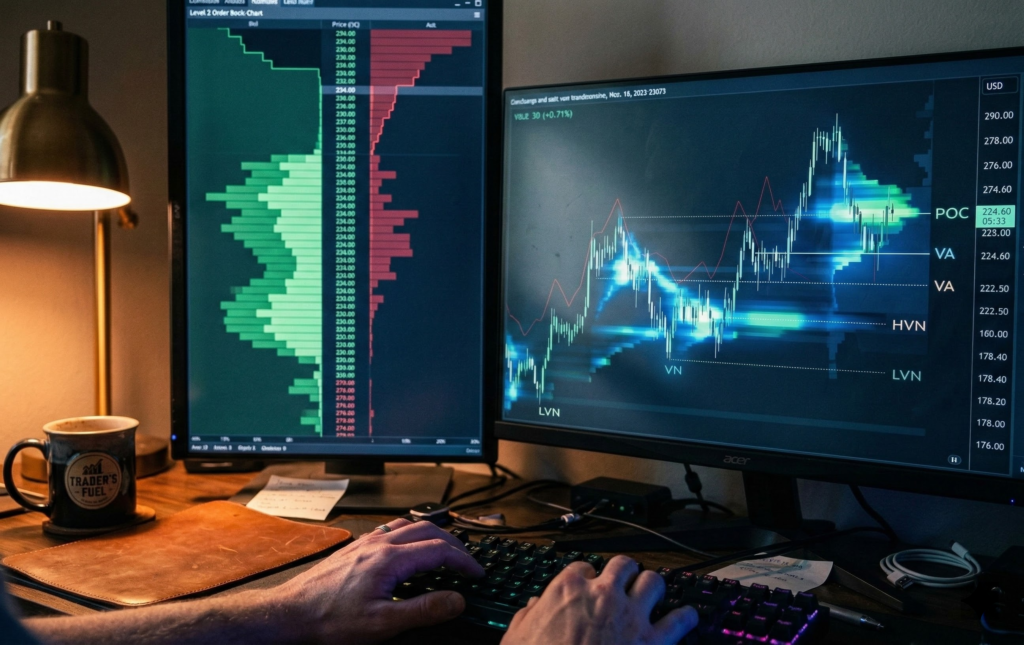
On TradingView or your preferred charting platform, enable the “Visible Range Volume Profile” indicator. Look for the High Volume Nodes (HVN) — the long, protruding horizontal bars that show where the most shares changed hands. Those nodes are your real support and resistance zones. Ignore the wicks. Ignore the exact highs and lows. Focus on where the volume is densest.
Step 2: Identify the Round Number Traps
Cross-reference your volume nodes with nearby psychological levels — round numbers ending in 0, 50, or 00. If a High Volume Node overlaps with a round number (say, the HVN sits at $98–$101 and the round number is $100), that is your highest-conviction zone. But your entry order goes below the round number, not on it. You are positioning yourself to catch the stop-hunt sweep, not to be part of it.
Step 3: Set Limit Orders Below the Obvious Line — and Wait
Place your limit buy order 1.5–2.5% below the round-number support level, inside the deeper liquidity zone identified by your volume profile. Set your stop-loss below the entire structural zone — not one cent under the line, but a full ATR (Average True Range) below the zone’s low. Patience is the weapon here. You might miss 3 out of 10 entries because the sweep never reaches your order. But the 7 entries that do fill will have dramatically better risk-to-reward ratios than any retail line-buyer ever achieves.
💡 PRO TIP: If you find yourself adjusting your limit order upward because you are afraid of missing the trade… stop. That impulse is Anchoring Bias pulling you back to the comfortable round number. Trust the zone, not the urge.
Frequently Asked Questions
Still unsure how to stop falling for institutional traps and start trading with a professional edge? These are the three questions I get asked most often.
What is the most accurate indicator for support and resistance?
The Volume Profile consistently outperforms traditional methods. Unlike moving averages — which only track past price averages — the Volume Profile maps exactly how many shares were traded at every specific price level. Those high-volume clusters are the actual institutional liquidity pools where smart money is positioned. A horizontal line based on a historical wick tells you where price was. Volume tells you where the money is.
Why does my support line always break before going up?
Because algorithmic trading programs are designed to execute a stop-hunt. They push the price just below obvious support levels to trigger retail stop-loss orders, generating the sell-side liquidity institutions need to accumulate massive long positions without causing upward price slippage. Your line breaks because the algorithms need it to break — temporarily.
How do you trade breakouts successfully?
Wait for volume confirmation and a daily candle close above the resistance zone. Buying the exact moment a line is crossed often means falling for a bull trap. Professionals wait for the broken resistance to be retested as new support — with declining sell volume on the pullback — before entering. That confirmation step alone filters out a massive percentage of false breakouts.
The Bottom Line
Stop trading lines and start trading liquidity. Support and resistance are mathematical battlegrounds on the order book — not psychological feelings on a chart — and recognizing that distinction is what separates traders who build wealth from traders who fund institutional positions. Load your Volume Profile today. Place your bids where smart money is actually waiting.
📊 QUICK POLL
How do you currently identify support and resistance levels?
A) I draw horizontal lines at historical highs/lows
B) I use moving averages as dynamic support
C) I use Volume Profile and order flow data
Vote in the comments 👇 I will share the results next week.
TheFinSense Editorial Team — Quantitative research verified against primary sources cited in this article.
⚠️ DISCLAIMER
Not Financial Advice: The information provided on TheFinSense is for educational purposes only. I am not a licensed financial advisor.
Do Your Own Research: Always consult with a certified professional before making financial decisions.

Written by Dong Woo
Lead Quant Analyst & Founder of TheFinSense. Virginia Tech, B.Com in Statistics (Quantitative Finance Society, Data Analytics Club). Specializing in statistical modeling, algorithmic market trends, and ETF valuation gaps — he translates complex Wall Street data into actionable, math-driven investment strategies for retail investors. View Full Bio →