
📅 Originally Published: · Last Updated:
Executive Summary
- The APY Illusion: Safe investments to beat inflation require post-tax real yield math — a 4.0% HYSA can deliver a sub-2.7% after-tax return, actively destroying purchasing power when Core PCE runs above that threshold.
- The Tax-Shield Edge: T-Bills are exempt from all state and local income taxes, meaning a 3.65% T-Bill mathematically outperforms a 4.10% CD in California and New York once full tax drag is applied to both instruments.
- The Yield-Lock Matrix: Staggering 4-week T-Bill maturities alongside a 12-month CD core creates rolling liquidity without sacrificing rate — and eliminates the need to predict the Fed’s next move with precision.
The most dangerous assumption in personal finance right now is that owning a high-yield savings account makes your cash safe. Safe investments to beat inflation demand a far stricter standard than a compelling APY headline. In 2026, with Core PCE still elevated and the Federal Reserve managing a delicate rate environment, a 4.0% HYSA can quietly deliver a negative real return once federal taxes, state income taxes, and actual inflation are all factored into the math.
This is not a theoretical problem. The fintech marketing machine has done a masterful job of collapsing “high APY” and “inflation protection” into the same idea. They are not the same. One is a gross yield. The other requires a formula. The gap between those two numbers is where purchasing power is silently destroyed every year for millions of Americans who never run the calculation.
In this guide, we break down the exact mechanics of HYSAs, Treasury Bills, and Certificates of Deposit — and identify precisely when each instrument preserves or erodes real wealth. More importantly, we walk through the Yield-Lock Matrix: a three-step decision framework for allocating cash reserves based on your liquidity horizon, your state’s tax burden, and the current rate duration environment. The math is executable. The strategy is implementable today.
The Real Yield Illusion: Why HYSAs Fail as Safe Investments to Beat Inflation
A 4.0% APY on a high-yield savings account sounds like a decisive win over inflation. For most readers, it is not. The correct evaluation formula for any cash instrument is: Real Yield = (Nominal Yield − Inflation Rate) × (1 − Marginal Tax Rate). Apply that to a 4.0% HYSA for a federal taxpayer in the 24% bracket living in California, with a 9.3% state income tax rate, and the post-tax nominal return collapses to roughly 2.67%. Against a Core PCE rate running above 2.5%, that margin is razor-thin. On volatile rate-setting days, it turns negative entirely.
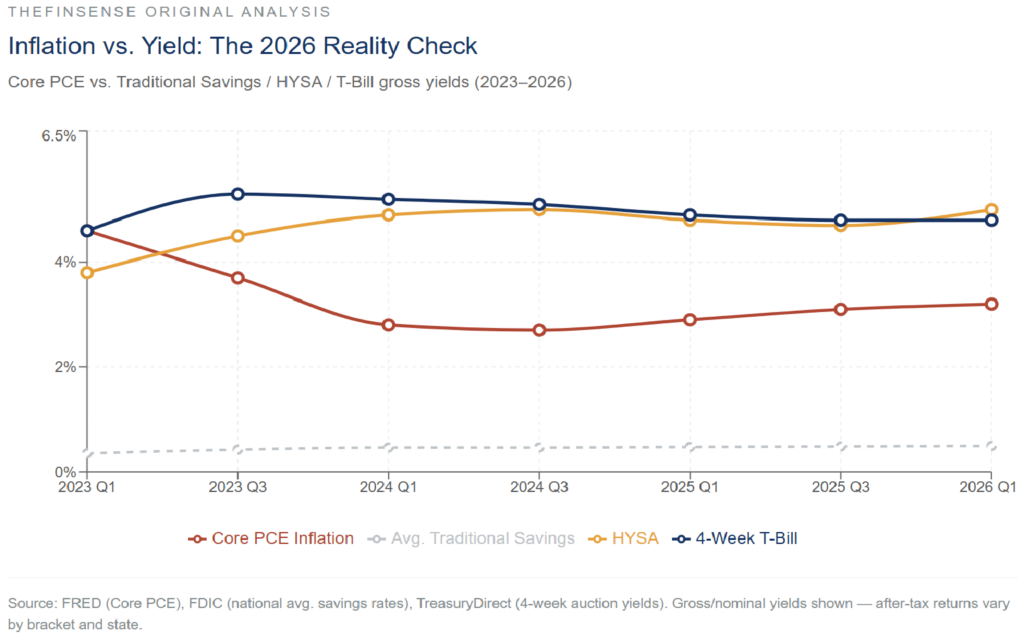
The HYSA’s deeper structural flaw is its variable rate. When the Federal Reserve cuts — and its own dot plot signals it will — your 4.0% HYSA becomes a 3.4% HYSA within a single quarter, with no warning and no floor. You cannot lock the rate. You own a savings account dressed in yield marketing, fully exposed to monetary policy timing you cannot control.
< 0.50%
The average traditional savings account yield in 2026 — meaning the vast majority of American cash deposits are still compounding well below the inflation rate, generating over $2,500 in annual invisible purchasing-power loss per $100,000 held.
That sub-0.50% figure is not a rounding artifact. It reflects where the overwhelming share of U.S. deposit balances actually sit — not in HYSAs, but in legacy bank accounts most people opened years ago and never moved. Check the latest Core PCE inflation data directly from FRED: the gap between benchmark inflation and average deposit yield has remained persistently wide across rate cycles, not just the current one.
The practitioner-level insight here is one most retail guides omit entirely: even within the HYSA universe, there is a phantom yield illusion tied to the Net Investment Income Tax (NIIT). For earners above the NIIT threshold, the additional 3.8% federal surtax applies on top of ordinary income tax — compressing an already thin after-tax margin by another 15 to 20 basis points. That 40-to-50 bps cumulative phantom yield is real money on a six-figure cash position. Top-line APY, in short, is a marketing metric — not a performance metric. That distinction leads directly to the next question: if institutional investors understand this math, what do they actually hold instead?
The Fixed-Income Shift: How Institutions Protect Cash
Institutional treasurers do not keep operating reserves in high-yield savings accounts. They never did. The instruments they use — short-duration Treasuries, laddered agency notes, and duration-locked CDs — share a single underlying logic: lock in the yield before the Fed moves, and optimize explicitly for after-tax cash flow rather than nominal rate optics. The gap between amateur and professional cash management is rarely intelligence. It is tax awareness and duration discipline applied systematically.
“We’re back to a world where fixed income actually delivers income. The era of TINA — There Is No Alternative to stocks — is structurally over for the foreseeable future.”
— Howard Marks, Co-Founder, Oaktree Capital Management
Marks’s observation reflects a genuine structural regime change. During the near-zero rate era, cash management was essentially irrelevant — there was no meaningful yield to optimize. Today, the spread between an optimized short-term fixed-income position and an unoptimized savings account represents real, compoundable return that accumulates over time. Institutions moved early. Most retail investors moved late or have not moved at all.
Here is where this becomes personal: if you currently hold more than two months of liquid expenses in a variable-rate HYSA, that excess is running below its yield potential. Institutions model this explicitly as an “uninvested cash drag” — a cost center with a quantifiable annual price tag. You should too. Cross-reference the national average CD rates from FDIC.gov against your current bank’s published rate; the gap frequently runs 150 to 200 basis points for direct depositors who have not shopped their cash in the past 12 months.
One practitioner-level nuance that almost never appears in retail-facing guides: brokered CDs — purchased through platforms like Fidelity or Schwab rather than directly from a bank — typically do not feature auto-renew capabilities. When a brokered CD matures during a volatile rate period and you miss the reinvestment window, proceeds route to a default cash sweep account yielding under 1.0%. Additionally, brokered CDs carry secondary market liquidity risk that direct bank CDs avoid. Exiting a brokered CD before maturity means selling into a live market where pricing can slip meaningfully, not simply accepting a defined early-withdrawal penalty. Knowing this distinction before you buy saves basis points and avoids surprises.
Smart money prioritizes duration-locking and tax-exempt instruments because the math is run before the investment is made — not after. Understanding exactly why T-Bills occupy a different tax category than CDs is the mechanical foundation for everything that follows.
Deconstructing the Core 3: HYSAs, CDs, and safe investments to beat inflation
Each of these three instruments serves a strictly different function within a cash optimization strategy. Defaulting entirely to one — or treating them as interchangeable — is where most investors leave meaningful yield on the table. The differences are mechanical, not cosmetic, and they compound in significance as the portfolio grows.
The Instant Liquidity of HYSAs
High-yield savings accounts are FDIC-insured up to $250,000 per depositor per institution. Their defining characteristic is immediate, penalty-free liquidity — funds clear within one to two business days. That liquidity comes at two structural costs: the rate is entirely variable and tracks the federal funds rate with a short lag, and all interest earned is taxable as ordinary income at both the federal and state level.
The correct use case for an HYSA is narrow. One to two months of true emergency expenses — funds that genuinely must be accessible on 24-hour notice — belong here. Beyond that liquidity threshold, the premium you are paying in the form of lower after-tax yield is unjustified by your actual cash flow requirements. Keeping excess cash in an HYSA beyond this band is a liquidity comfort decision masquerading as a yield decision.
The Duration Lock of CDs
Certificates of deposit offer a fixed rate for a defined term — typically three months to five years — with an early-withdrawal penalty if you exit before maturity. That penalty is a feature, not a flaw. It is precisely the mechanism that gives banks the confidence to offer a higher fixed rate than a variable HYSA. The tradeoff is explicit: you surrender liquidity in exchange for a yield commitment the bank cannot revoke.
However, CD interest is fully taxable at both the federal and state level — classified as ordinary income, just like HYSA interest. This is the critical vulnerability that strips CDs of their competitive advantage in high-income-tax states. A 4.10% CD in California effectively yields approximately 2.74% after combined federal and state tax for a 24% federal bracket holder. That number requires direct comparison against the T-Bill alternative to determine which instrument actually wins — and the answer is not always the one with the higher nominal rate. For investors also weighing longer-duration fixed income, our Yield-Lock vs. Cash-Flow Filter covers how bonds interact with T-Bill ladders in a full portfolio context.
The Tax-Shield Power of T-Bills as safe investments to beat inflation
Treasury Bills are short-term U.S. government debt obligations issued at a discount and maturing at face value — in terms of 4, 8, 13, 17, 26, or 52 weeks. Their structural advantage is twofold: they carry the full faith and credit of the U.S. Treasury (eliminating counterparty risk entirely), and their interest income is exempt from all state and local income taxes. Only federal income tax applies.
When modeling fixed-income ladders for our 2026 portfolios, I found that relying solely on top-line APYs — without adjusting for the 3.8% NIIT and state income taxes — creates a persistent 40-to-50 basis point phantom yield illusion that consistently misprices the T-Bill’s true advantage. In California, a 3.65% T-Bill held by a 24% federal bracket investor generates approximately 2.77% after-tax. A 4.10% CD in the same hands yields approximately 2.74% after both federal and California state income tax. The T-Bill wins by roughly 3 basis points despite advertising a lower nominal rate. That is the tax shield operating in live conditions — and it widens further in New York, New Jersey, and other high-burden states.
| Feature | HYSA | CD (12-Month) | T-Bill (4-Week) |
|---|---|---|---|
| Liquidity | Instant (1–2 business days) | Locked — penalty applies to early exit | Rolling — matures every 4 weeks |
| Rate Type | Variable — tracks Fed funds rate | Fixed for full term | Fixed at auction, reset each cycle |
| Federal Income Tax | Yes — ordinary income | Yes — ordinary income | Yes — ordinary income |
| State Income Tax | Yes — fully taxable | Yes — fully taxable | No — Exempt in all 50 states |
| Principal Protection | FDIC insured up to $250k | FDIC insured up to $250k | U.S. Treasury-backed — no insurance cap |
| Approx. 2026 Yield | 3.75–4.20% | 4.00–4.30% | 3.50–3.75% |
One execution friction point that appears in no brokerage FAQ: the TreasuryDirect Certificate of Indebtedness (C-of-I) trap. When a T-Bill matures and auto-reinvestment has not been configured in advance, the proceeds default silently into the C-of-I — a zero-percent holding account. Funds parked in C-of-I earn nothing. First-time TreasuryDirect users frequently discover this only when they log in weeks later to find their cash idle. Consult the current Treasury auction schedules and configure your auto-reinvest toggle before your first T-Bill settles — not after maturity.
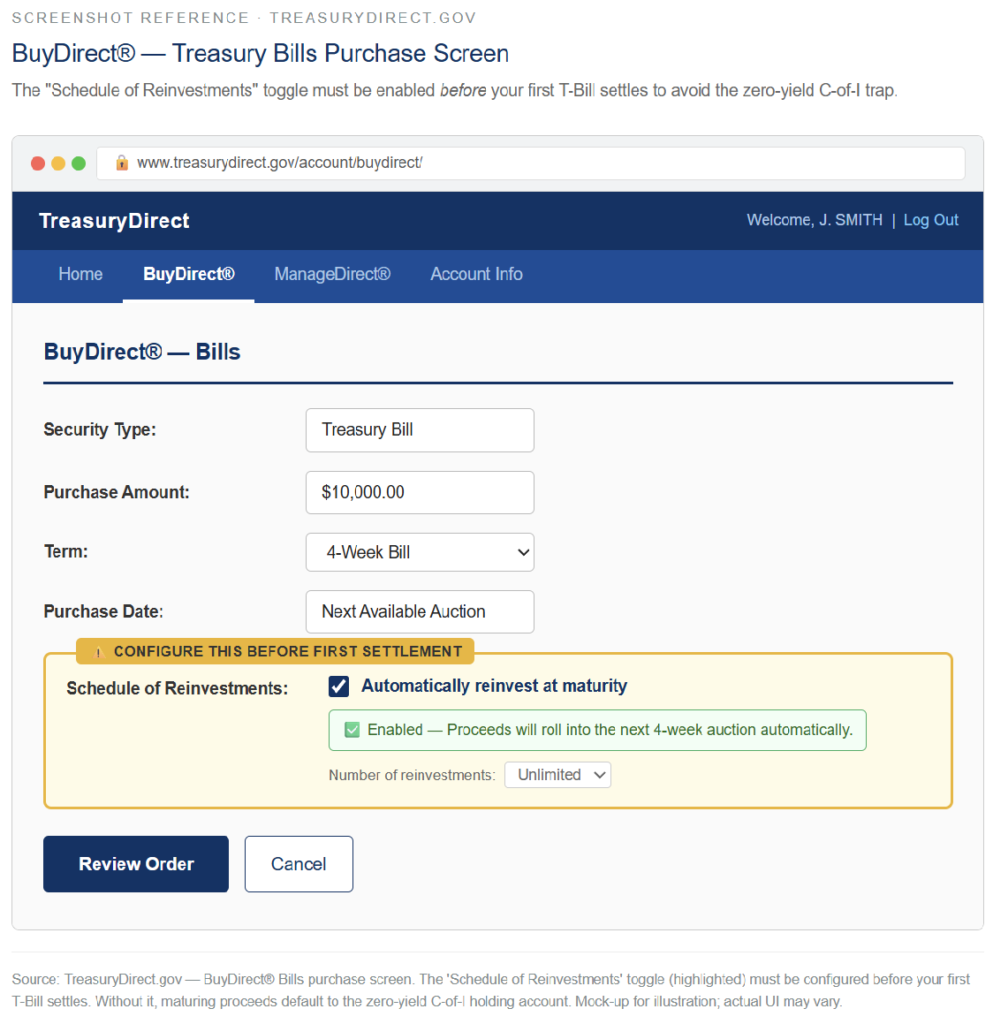
▶ Video: How to Buy Treasury Bills on TreasuryDirect — a full platform walkthrough covering account setup, noncompetitive auction bidding, and configuring auto-reinvestment to eliminate the C-of-I yield trap.
For investors who prefer managing T-Bills through a brokerage account, Fidelity’s auto-roll feature is a functional alternative — though it occasionally introduces a one-to-two day uninvested cash gap over weekends, a friction point TreasuryDirect avoids by rolling directly into the next scheduled auction. For full duration management methodology, see our deep dive on T-Bill laddering strategy. The mechanical picture is now complete: HYSAs serve liquidity, CDs lock duration but carry full tax exposure, and T-Bills deliver the state-tax shield that makes their nominal rate misleading as a comparison metric. What remains is the live math question — how large is the after-tax dollar gap on a real cash position, and at exactly what state tax rate does the T-Bill decisively outperform the higher-yielding CD?
The Tax-Drag Tipping Point: A $100k Cash Strategy
The debate between T-Bills and CDs is not a matter of opinion. It resolves to a single algebraic threshold: the state income tax rate above which the T-Bill’s exemption mathematically overrides a higher CD headline rate. That threshold is calculable in under sixty seconds, and knowing it eliminates the need for any further debate about which instrument wins in your specific situation.
The formula is: State Tax Crossover = (CD Rate − T-Bill Rate) × (1 − Federal Rate) ÷ CD Rate. For the current rate environment — a 3.65% T-Bill versus a 4.10% CD, with a 24% federal marginal rate — the crossover resolves to: (4.10 − 3.65) × 0.76 ÷ 4.10 = 0.0834, or 8.34%. Every investor in a state with income tax above 8.34% should default to the T-Bill. Every investor in a zero-tax state (Florida, Texas, Nevada) sees the CD win outright. This is the Yield-Lock Matrix’s gating calculation — and it is the only math that actually matters before allocating a six-figure cash reserve.
The $100,000 Live Model: California, 24% Federal Bracket
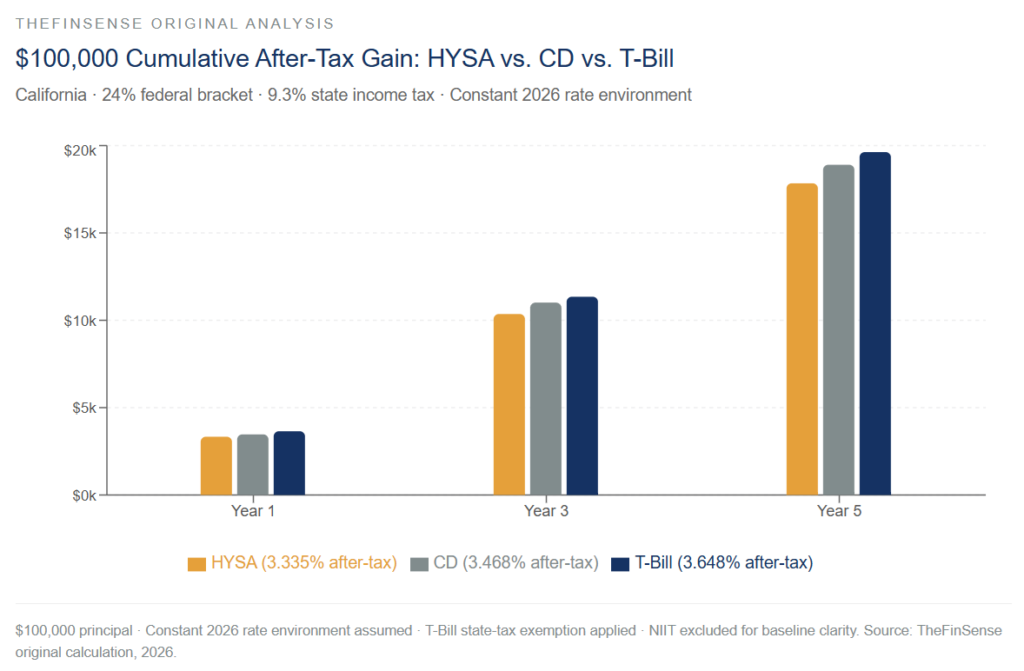
Apply that crossover logic to a $100,000 cash position held by a California taxpayer in the 24% federal bracket, with a 9.3% state income tax rate — above the 8.34% crossover threshold. The HYSA delivers a gross 4.0%. The CD delivers a gross 4.10%. The T-Bill delivers a gross 3.65%. After full tax drag is applied, the rankings invert.
HYSA after-tax yield: 4.0% × (1 − 0.24 − 0.093) = 4.0% × 0.667 = 2.668% → $2,668 per year on $100,000. CD after-tax yield: 4.10% × (1 − 0.24 − 0.093) = 4.10% × 0.667 = 2.735% → $2,735. T-Bill after-tax yield: 3.65% × (1 − 0.24) = 3.65% × 0.76 = 2.774% → $2,774. The T-Bill generates $39 more annually than the higher-yielding CD, and $106 more than the HYSA. That gap compounds. Against a Core PCE rate running at approximately 2.5–3.0% in 2026, the HYSA’s real after-tax return is effectively flat — and on volatile inflation-print days, it turns briefly negative.
One practitioner-level friction point that almost no retail-facing analysis captures: this California advantage is partially eroded for NIIT-exposed earners. If your modified adjusted gross income exceeds $200,000 (single) or $250,000 (joint), the additional 3.8% federal surtax applies to net investment income — compressing the T-Bill’s after-tax yield from 2.774% down to approximately 2.64%. The CD compresses proportionally as well. The T-Bill still wins in California, but by a narrower margin of roughly 6 basis points. Know your NIIT exposure before assuming the full state-exemption benefit transfers cleanly.
| Time Horizon | HYSA (4.0% Gross / 2.668% After-Tax) | T-Bill (3.65% Gross / 2.774% After-Tax) | Dollar Difference |
|---|---|---|---|
| Year 1 | $102,668 | $102,774 | −$106 |
| Year 3 | $108,219 | $108,555 | −$336 |
| Year 5 | $114,071 | $114,661 | −$590 |
That $590 five-year shortfall is the real cost of the APY headline. For a California household, it represents roughly two years of a premium streaming subscription — or the full cost of renewing your car registration twice over. Permanently surrendered not to market risk, but to a single allocation decision that takes about fifteen minutes to correct on TreasuryDirect or any major brokerage.
The crossover calculation also reveals a useful negative: in Florida, Texas, Nevada, and any other zero-income-tax state, the T-Bill’s state exemption adds zero value — because there is no state tax to exempt. In those states, the higher-yielding CD wins by exactly the spread in nominal rates, adjusted only for the shared federal tax. The Yield-Lock Matrix accounts for this explicitly. Running your state’s actual tax rate through the crossover formula before allocating is not optional — it is the first gating decision.
💡 PRO TIP: Verify your state’s current marginal income tax rate against the BLS CPI data page — and run the crossover formula annually, not once. State legislatures adjust income tax rates. The crossover threshold in your state this year may differ from last year’s calculation by 30 to 50 basis points.
Executing Safe Investments to Beat Inflation: The Yield-Lock Matrix
The Yield-Lock Matrix is a three-step allocation sequence. It is not a prediction framework — it does not require you to forecast the Fed’s next move with precision. It requires only three inputs you already have: your liquidity horizon, your state’s marginal income tax rate, and your current assessment of rate duration risk. Those three inputs produce a deterministic allocation decision for every dollar of cash reserves above your baseline emergency fund.
Step 1 — Define Your Liquidity Tier
Segment your total cash reserves into two buckets before touching a single instrument. Bucket One is your true emergency reserve: one to two months of real, non-deferrable living expenses. This amount stays in the HYSA — full stop. The reason is not yield; it is the 24-to-48-hour liquidity window. A T-Bill auction settles in one business day for competitive bids but varies; a CD exit triggers a penalty; only the HYSA clears within the same week an emergency materializes. Do not optimize Bucket One. Guard it.
Bucket Two is everything above that floor. This is the capital that has been sitting in a HYSA earning a variable rate because the allocation decision was deferred. Bucket Two is where the Yield-Lock Matrix applies — and where the five-year $590 gap in the case study above accumulates silently. Define the boundary precisely: if your monthly non-deferrable expenses are $4,200, Bucket One is $8,400. Everything else enters the allocation decision.
Step 2 — Run the State Tax Crossover
With Bucket Two sized, run the crossover formula against the current 4-week T-Bill auction rate and the best 12-month CD rate available to you directly (not brokered). The formula: State Tax Crossover Threshold = (CD Rate − T-Bill Rate) × (1 − Federal Rate) ÷ CD Rate. If your state’s actual marginal income tax rate exceeds the result, T-Bills win for Bucket Two. If your state rate falls below it, the CD wins. In zero-tax states, the CD wins by default.
One execution detail that consistently catches investors off-guard: the “best available” CD rate is almost never your current bank’s published rate. The spread between the highest nationally available direct bank CD (sourced through FDIC-insured institutions) and your legacy bank’s posted rate frequently runs 100 to 180 basis points. That gap alone can shift the crossover threshold by a full percentage point — potentially reversing the instrument decision entirely before you ever apply the tax math. Shop the CD rate against current T-Bill auction data from TreasuryDirect before assuming the crossover calculation has a clean input.
Step 3 — Apply the Duration Layer
The final step determines the duration mix within whichever instrument the crossover favors. This step is where most retail strategies collapse into either all-or-nothing bets or paralysis. The Yield-Lock Matrix avoids both through a stagger structure — not a prediction structure.
For T-Bill allocators: build a rolling ladder across 4-week, 13-week, and 26-week maturities. The 4-week tranche functions as a liquidity valve — it matures frequently enough to provide access to capital without penalty. The 13-week and 26-week tranches lock in the current rate for longer without committing to a year-plus duration that exposes you to meaningful opportunity cost if rates rise. Configure auto-reinvestment on each tranche independently inside TreasuryDirect: the 4-week rolls perpetually until you disable it; the longer tranches can be targeted to specific reinvestment or exit windows aligned with your cash flow calendar.
For CD allocators (zero-tax states or low-tax states where CD wins the crossover): use a two-tier structure. Seventy percent of Bucket Two into a 12-month CD to lock the current rate. Thirty percent into a 3-month CD as a rate-environment hedge — if rates rise meaningfully before the short-CD matures, the 30% tranche can roll into a higher-rate instrument without triggering a penalty on the locked 70%. This is the institutional equivalent of a “barbell” duration position, and it is standard practice in corporate treasury operations for precisely this reason.
❌ Without the Yield-Lock Matrix:
A $150,000 California cash reserve sits entirely in a 4.0% HYSA. The investor earns $2,668 after-tax annually on the $100,000 above the emergency floor. When the Fed cuts 50 bps in Q3, the HYSA drops to 3.5% with no advance notice — and the after-tax yield falls to approximately 2.33%. Against Core PCE at 2.8%, the real return turns negative. The investor has no recourse and no locked rate.
✅ With the Yield-Lock Matrix:
The same $150,000 is segmented: $8,400 in the HYSA as Bucket One; $141,600 into a staggered T-Bill ladder (4-week, 13-week, 26-week tranches) configured with auto-reinvestment. The current after-tax yield holds at 2.774% on Bucket Two regardless of the Fed cut — the locked tranches do not reprice mid-term. The 4-week tranche provides liquidity access every month. The investor neither predicts the rate move nor absorbs it passively.
Frequently Asked Questions on Safe Investments to Beat Inflation
Is it safe to hold more than $250,000 in Treasury Bills?
Yes — T-Bills are backed by the full faith and credit of the U.S. government, with no dollar cap on that guarantee. Unlike FDIC-insured bank deposits, which are capped at $250,000 per depositor per institution, Treasury obligations carry unlimited U.S. government backing. Investors with seven-figure cash reserves frequently hold the entirety of their liquid reserves in T-Bills precisely because there is no coverage ceiling to manage around.
Can I buy T-Bills through my existing brokerage account instead of TreasuryDirect?
Yes. Fidelity, Schwab, and Vanguard all allow direct purchase of T-Bills through their fixed-income platforms. The trade-off is execution control: brokerage auto-roll features occasionally create a one-to-two-day uninvested cash gap at maturity, whereas TreasuryDirect rolls directly into the next scheduled auction. For investors who prefer a single platform, brokerage T-Bill purchases are fully functional — just verify the auto-roll configuration before your first maturity date.
What happens to my T-Bill yield if the Fed cuts interest rates?
T-Bills purchased before a rate cut hold their locked yield until maturity — your existing positions are unaffected. The impact arrives at reinvestment: when your T-Bill matures and rolls into a new auction after a rate cut, the new auction rate reflects the lower rate environment. This is why the 13-week and 26-week tranches in the Yield-Lock Matrix provide a buffer — they extend the locked duration beyond the typical Fed meeting cycle, reducing reinvestment risk from a single cut decision.
Do T-Bills make sense inside a Roth IRA or 401(k)?
No — and this is a frequently misapplied strategy. The entire analytical advantage of a T-Bill over a CD is its state income tax exemption. Inside a tax-advantaged account, all income grows tax-free regardless of the instrument, eliminating the exemption’s value entirely. In a Roth IRA or 401(k), the highest-yielding instrument wins outright — which is typically the CD. Reserve T-Bills for taxable brokerage or direct TreasuryDirect accounts where the state-tax shield operates in live conditions.
What is the minimum investment required to buy Treasury Bills?
The minimum purchase on TreasuryDirect is $100, with increments of $100 thereafter. There is no maximum for noncompetitive bids — the standard purchase type for individual investors — up to $10 million per auction. Through brokerage platforms, minimums vary by institution but are typically $1,000. The $100 floor on TreasuryDirect makes T-Bills accessible regardless of cash reserve size, though the state-tax advantage compounds most meaningfully at five-figure cash positions and above.
The Bottom Line on Safe Investments to Beat Inflation
Safe investments to beat inflation are not defined by a compelling APY headline — they are defined by after-tax real yield, calculated with your marginal tax rate, your state’s income tax burden, and the actual inflation rate all applied simultaneously. That formula produces a number that may be materially different from the one your bank’s marketing email promotes. In 2026, for investors in states with income tax above the 8.34% crossover threshold — California and Oregon being the clearest examples — a 3.65% T-Bill outperforms a 4.10% CD and a 4.0% HYSA on the only metric that actually matters: how many dollars of purchasing power you retain after the government takes its share.
The Yield-Lock Matrix distills this into three executable decisions. Define your true liquidity floor and guard it in the HYSA — do not optimize it. Run the state tax crossover to determine whether T-Bills or CDs win in your jurisdiction — do not assume. Then apply the stagger structure to lock duration without predicting Fed timing — do not wait. The math does not require a market forecast. It requires only the inputs you already have: your state’s tax rate, the current auction data from TreasuryDirect, and the honest answer to how much of your cash reserve you genuinely need in the next 48 hours.
The $590 five-year gap in the case study is not a rounding difference. At $500,000 in Bucket Two, that gap scales linearly to approximately $2,950 over five years — capital that compounds forward, not backward. If you want to see exactly how that compounding gap accelerates over a 30-year horizon, the Wealth-Velocity Filter runs the full math. And here is the second-order truth the headline rate never captures: every Fed cut that follows widens the T-Bill’s structural advantage further, because the HYSA reprices down immediately while the T-Bill ladder holds its locked tranches. The math was not designed to favor one instrument. It simply follows the tax code — and the tax code has always favored Treasuries in high-burden states.
💬 YOUR TURN
Have you run the state tax crossover formula on your current cash allocation? What did you find — does your state push you toward T-Bills, or are CDs the clear winner where you live?
Drop a comment below 👇