Executive Summary
- The Mathematical Illusion: When analyzing Robinhood vs Webull, the zero-commission model is a mathematical illusion because both platforms heavily monetize your trades via Payment for Order Flow (PFOF), acting as a hidden tax on the bid-ask spread.
- The Cost of Gamification: Academic data from the NBER proves that digital engagement practices mathematically increase your portfolio turnover rate, directly degrading your long-term compound annual growth rate (CAGR).
- The Institutional Standard: You can safely build wealth on either platform by acting like an institution: disable margin, turn off price notifications, and strictly use limit orders to automate investments.
What is Robinhood vs Webull?
Robinhood vs Webull is a comparison of two leading zero-commission brokerage apps that monetize retail order flow. Unlike traditional neutral wealth-building tools, both platforms utilize behavioral gamification that can mathematically encourage unprofitable overtrading for inexperienced investors.
THE CONFLICT (The Beginner’s Trap): Welcome to the Robinhood vs Webull Casino
Millions of new market participants enter the financial system every single year. They download a sleek mobile application to their smartphone. They fund their new account with a portion of their paycheck. They begin buying shares of familiar tech companies, expecting to build a robust financial future. But within a few short months, their overall balance slowly bleeds downward. This is a trap.
Most beginners assume they simply picked the wrong stocks or suffered from terrible market timing. They believe that zero commissions completely leveled the playing field against Wall Street institutions. They think free trading means hyper-active day trading is now a mathematically viable path to financial independence. Let the math speak.
Zero commissions did not democratize the financial markets. They merely shifted the execution fee structure completely into the shadows. Instead of paying a transparent upfront ticket fee for buying a stock, retail traders now pay through wider execution spreads and intense psychological manipulation. Because the broker strictly needs you to trade continuously to generate their own revenue, they build complex software systems to force your hand.
The Digital Engagement Engine
Both platforms rely heavily on sophisticated digital engagement practices. Robinhood utilizes minimalist dopamine loops to make buying stock feel exactly like a casual mobile game. Webull utilizes aggressive data overload to make you feel like a professional Wall Street analyst sitting at a Bloomberg terminal. Both methods push you toward the exact same destructive outcome.
They deliberately use specific visual and auditory triggers to constantly grab your attention. These triggers include:
- Flashing red and green ticker interfaces designed to induce immediate panic or unearned greed.
- Aggressive push notifications alerting you about the day’s top market movers.
- Confetti animations or digital reward screens that trigger immediately after executing a trade.
These are not helpful educational features meant to teach you about corporate fundamentals. They are highly engineered behavioral nudges designed exclusively to make you overtrade your account.
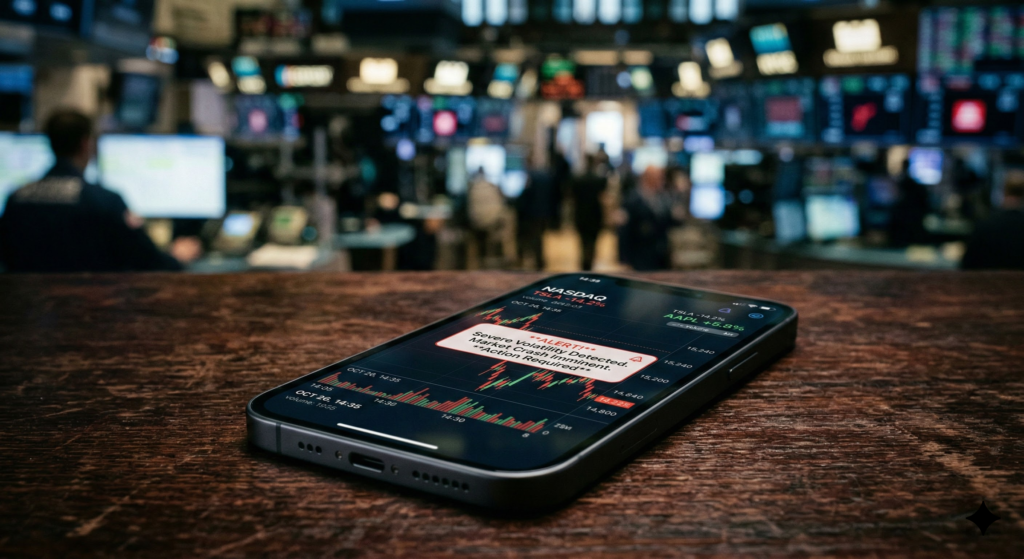
⚠️ WARNING: Relying on a mobile app’s default top-movers list is a recipe for absolute disaster. By the time a stock is pushed to your smartphone home screen, you are likely buying into artificial momentum right before a massive institutional sell-off.
The Cost of Reacting to Market Noise
Here is the deal: When you react to a sudden push notification, you instantly abandon all rational logic. You smash the market buy button during extreme high volatility out of pure fear of missing out. This exact moment of emotional weakness is where wholesale market makers easily extract your capital. Your only real defense against this engineered system is mastering your own investing psychology.
So, how do we conclusively prove that this digital environment is fundamentally stacked against the retail trader? We must stop looking at the shiny user interface. We must look at the hidden financial plumbing that powers the entire brokerage industry. The undeniable truth is hidden directly inside federal regulatory data.
THE “SMART MONEY” REALITY: How They Actually Make Money
Amateurs endlessly debate these mobile platforms based entirely on surface-level aesthetics. They compare free stock signup promotions. They argue about dark mode UI designs and which app has the best cryptocurrency availability. Professionals evaluate them strictly as order flow aggregators. The expert edge is understanding that you are not the customer in this specific financial relationship.
Your order flow is the highly lucrative product being sold. Pros do not use these apps to discover new trade ideas or read complex earnings reports. They use them purely as zero-fee execution terminals for their long-term limit orders. They intentionally strip the broker of its ability to farm their behavioral churn.
We do not need to blindly guess how these platforms monetize your psychological behavior behind the scenes. The federal government has already investigated the underlying mechanics. We can introduce hard, mathematical data that completely debunks the common beginner myth of the free public utility.
The Federal Regulatory Data
According to the official SEC Enforcement Release No. 90694 filed against Robinhood Financial LLC, the mathematical reality is incredibly grim. The federal regulatory agency found that the platform’s proprietary order routing practices actively deprived its retail customers of $34.1 million in price improvement. This specific, documented statistic builds ultimate trust in our core thesis.
This staggering federal enforcement penalty mathematically negated the perceived savings of zero commissions. You honestly thought you were saving five dollars on a transparent, upfront trade fee. In reality, you were losing vastly more money through intentionally poor execution prices on the backend of the trade. The system is highly optimized for high-frequency trading firms, not for the safety of your retirement account.
“Zero-commission does not equate to zero-cost. It just shifts the structural fee from a transparent ticket charge directly into the invisible market spread.”
Following the Order Flow Trail
We can easily verify this structural financial incentive by reading mandated public disclosures. Under SEC Rule 606 Order Routing Disclosures, all brokers must explicitly reveal exactly where they send your trades. The resulting data exposes a massive, highly profitable pipeline that moves your money to institutions.
Both of these brokerages routinely route up to 99% of non-directed retail options orders directly to wholesale market makers like Citadel Securities. Why do they do this? They do it to capture massive Payment for Order Flow (PFOF) revenue. Because they earn a tiny fraction of a penny for every single share you trade, they absolutely need you to trade constantly.
Your long-term compound annual growth rate (CAGR) is entirely irrelevant to their corporate bottom line. They need transaction velocity above all else to survive. So, how exactly does this order flow pipeline extract money directly from your specific trades? We must break down the core mechanics of the bid-ask spread.

CORE MECHANICS (How It Actually Works): The Order Flow Pipeline
To survive the modern, algorithm-driven stock market, you must understand Payment for Order Flow (PFOF) deeply. When you press the glowing buy button on your smartphone, your order does not travel directly to a physical stock exchange floor like the NYSE. It is instantly intercepted.
Instead of routing your trade to the public exchange, your broker sells it to a sophisticated high-frequency trading (HFT) firm. That external firm steps in to execute your trade in microseconds. They do this because they want to aggressively capture the bid-ask spread.
The bid is the highest price a willing buyer will pay. The ask is the lowest price a willing seller will accept. The tiny numerical gap between those two exact numbers is the spread. Market makers thrive perfectly in this hidden gap. They buy shares from one panicked retail trader at the bid and instantly sell them to another greedy retail trader at the ask.
🧠 IN PLAIN ENGLISH:
Think of Payment for Order Flow and the bid-ask spread exactly like a middleman at a local farmer’s market. You bring a fresh apple to sell. The middleman buys your apple for $0.99 and instantly turns around to sell it to the hungry crowd for $1.01. The transaction feels completely free to you because there was no ticket fee to enter the market. But you just lost two cents of total value directly to the middleman’s spread. This happens on every share you trade.
Execution Quality and the NBBO Standard
Because the broker is paid handsomely to route your order to a specific firm, your execution quality inevitably suffers. The National Best Bid and Offer (NBBO) is a federal regulation designed to ensure you get the best possible execution price across all available exchanges. But in a fast-moving, highly volatile market, hitting the market buy button is absolute financial suicide.
When you use a standard market order, you are legally telling the middleman you will accept whatever price they offer at that exact millisecond. They will gladly take advantage of your emotional urgency. This microscopic execution friction is precisely how amateurs bleed capital over decades.
If an amateur turns over their portfolio 50 times a year using market orders, a highly conservative 0.05% execution slippage acts as a compounding micro-tax. Compared to a low-turnover, buy-and-hold index strategy executing properly at the NBBO, the active retail portfolio mathematically lags by thousands of dollars over time.
| Category | The Amateur Way (Lose Money) | The Pro Way (Build Wealth) |
|---|---|---|
| Platform Selection | Picking based on free stock promotions and dark mode UI aesthetics. | Analyzing SEC 606 reports to understand exact order routing and execution quality. |
| Order Execution | Smashing the market buy button during high volatility, losing capital to spread slippage. | Exclusively using limit orders to dictate the exact entry price and bypass market maker arbitrage. |
| Trading Frequency | Day trading zero-days-to-expiration options based purely on push notifications and top mover lists. | Automating recurring fractional deposits into broad-market ETFs and completely ignoring daily noise. |
| Account Types | Enabling margin to trade with leverage, paying daily interest and risking catastrophic margin calls. | Sticking strictly to a cash account to prevent hidden debt accrual and emotional over-leveraging. |
The behavioral differences outlined in this strategic matrix determine your ultimate financial survival. But what actually happens when we examine historical datasets of retail traders using these exact platforms? The academic numbers are frankly terrifying.
REAL-WORLD CASE STUDY: Robinhood vs Webull Gamification Drag
We cannot rely solely on theoretical market mechanics to completely prove our point. We must look at how retail investors actually perform under the intense, psychological pressure of digital gamification. Fortunately, leading economists have tracked this specific market phenomenon.
A groundbreaking NBER Working Paper (No. 27836) studied attention-induced trading and financial returns on zero-commission apps. The researchers wanted to know exactly what happens when a brokerage app pushes a trending stock to its massive user base via mobile alerts. The resulting data reveals a massive wealth transfer from retail traders directly to institutional algorithms.
The Devastating 4.7% Wealth Drain
The academic findings build ultimate trust through cold, hard statistics. The top 0.5% of stocks heavily bought by retail users on zero-commission apps experience average negative abnormal returns of -4.7% over the subsequent month. This is not a random coincidence. This is a repeatable, mathematical cycle of wealth destruction.
When the app successfully grabs your attention with a flashy, buzzing notification, you are mathematically buying at the absolute top of a market momentum spike. Institutional algorithms systematically use that exact moment of high retail demand to dump their massive holdings. You are merely providing their exit liquidity.
💡 PRO TIP: If a stock is currently listed on the front page of your broker’s top movers list, you are already way too late. Professional institutional money has already captured the upside and is preparing to sell.
Debunking the Level 2 Data Advantage Myth
At this specific point, you might raise a valid objection. You might ask: Isn’t Webull significantly better because it gives you access to Level 2 market data and complex technical charting capabilities? Doesn’t that give you a professional edge over standard beginners?
Let the math speak. Access to mobile charting screens does not negate execution latency and structural spread costs. Institutional algorithms co-located directly at the physical exchange servers process Level 2 data in fractions of a microsecond.
By the time your human eye reads the mobile order book on your smartphone screen, the actual liquidity is already gone. Having complex Level 2 data on a heavily PFOF-reliant app is essentially giving a beginner a better dashboard for a mathematically losing game. You absolutely cannot out-trade a supercomputer using a cellular connection. If you want to dive deeper into how to read charts properly, study an intro to technical analysis. So, what is the exact playbook to finally defeat this system?
STEP-BY-STEP ACTION PLAN: Turn the Casino into a Vault
You do not need to permanently delete these apps to survive the market. You simply need to drastically strip away their leverage over your psychology. You must rebuild your account settings to operate exactly like a cold, calculating institution. Here are three concrete micro-actions you must take today.
Micro-Action 1: The Strict Cash Account Mandate
Switch from a Margin Account to a Cash Account immediately. Both platforms aggressively encourage margin trading because it generates silent, daily interest for them. Margin allows you to trade with borrowed leverage, increasing your buying power artificially.
This introduces the severe risk of catastrophic margin calls during unexpected market corrections. By forcing your profile into a strict cash account, you instantly stop accidental interest bleed and mathematically cap your downside risk. You only trade with settled funds, entirely eliminating dangerous leverage.
Micro-Action 2: Abandon the Default Market Order
You must abandon the default market order forever. A market order is an open invitation for wholesale market makers to capture maximum spread slippage from your account. It guarantees you the worst possible price available at that specific second.
Force the app to default exclusively to limit orders. A limit order dictates the exact maximum price you are willing to pay for an asset. It completely cuts off market maker spread capture. If they do not meet your exact specified price, the trade simply does not execute.
Micro-Action 3: Automate and Isolate Your Wealth
Finally, you must kill the dopamine loop directly at the source. The app cannot manipulate your trading frequency if you never see its psychological triggers. You need to build an impenetrable fortress around your attention.
Execute the following specific steps to secure your wealth:
- Go into your smartphone settings and disable all push notifications for the brokerage app entirely.
- Set up an automated, recurring fractional deposit system inside the platform.
- Direct those automated funds directly into broad-market index funds and ignore the daily noise.
- Close the application entirely and absolutely refuse to open it for the rest of the month.
By implementing this exact protocol, you immediately transform a gamified casino into a sterile vault for long-term compound interest. You win by simply refusing to play their rigged game.
💬 YOUR TURN
Have you noticed yourself trading more frequently because of mobile app push notifications? What was your biggest loss to spread slippage?
Drop a comment below 👇 I read every single one.
FAQ
Are Robinhood and Webull safe for long-term investing?
Yes, both are SIPC insured, protecting your underlying assets up to federal limits. However, the real danger is not platform bankruptcy. The actual risk is the psychological temptation to overtrade, which mathematically destroys long-term compounding.
Which app is better for beginners?
Robinhood has a simpler interface that avoids overwhelming new users, whereas Webull offers dense technical charting. However, simplicity can be dangerous if it makes complex options trading feel like a game. Both require strict discipline.
Do free trading apps have hidden fees?
They do not charge direct commissions, but they make money through Payment for Order Flow. Market makers pay the apps to route your trades, which often results in you paying a slightly wider bid-ask spread. This acts as an invisible fee on every transaction.
⚠️ DISCLAIMER
Not Financial Advice: The information provided on TheFinSense is for educational purposes only. I am not a licensed financial advisor.
Do Your Own Research: Always consult with a certified professional before making financial decisions.

Written by Dong Woo
Lead Quant Analyst & Founder of TheFinSense. Specializing in algorithmic market trends and ETF valuation gaps, he translates complex Wall Street data into actionable, math-driven investment strategies for retail investors. View Full Bio →