
📅 Originally Published: · Last Updated:
Executive Summary
- Bonds Are Not Cash Equivalents: Understanding how bonds work reveals that price and yield move in opposite directions — a relationship that turned long-duration Treasury ETFs into 30%+ losers in 2022, despite being government-backed.
- Duration Is the Risk Dial, Not a Background Variable: Every bond’s price sensitivity is precisely quantifiable: a bond with a 7-year modified duration loses approximately 7% in market value for every 1% rise in yield. That is not a model estimate — it is arithmetic.
- Post-Tax Yield Changes the Entire Comparison: Treasury and most agency bond income is exempt from state income tax under federal law — a structural advantage that can add 50–90 basis points of real yield for investors in high-tax states, without touching credit risk.
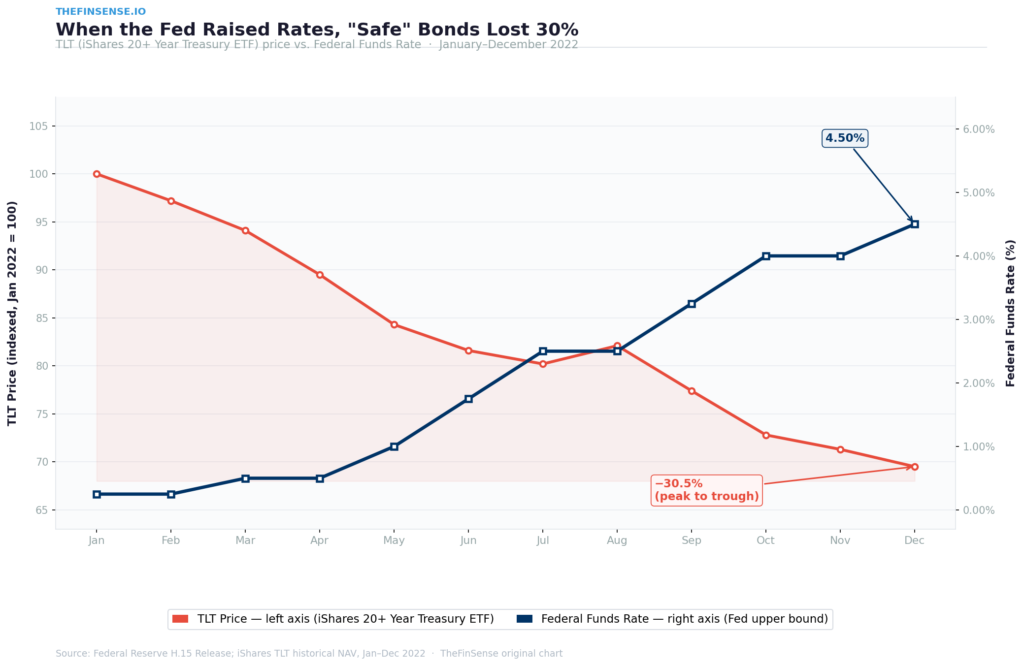
The most expensive misunderstanding about how bonds work has nothing to do with default risk or credit ratings. It is the assumption — held by millions of retail investors — that bonds simply cannot lose money in any meaningful way. That assumption evaporated spectacularly in 2022, when TLT, the iShares 20+ Year Treasury Bond ETF backed by the full faith and credit of the United States government, lost more than 30% peak to trough. Not 3%. Not 8%. Thirty percent — deeper than many equity bear markets, and concentrated entirely in the asset class that was supposed to buffer the portfolio against exactly that kind of damage.
The failure mode is both precise and preventable. Most retail investors carry a mental model of bonds that goes like this: you lend money, you collect interest, you get your principal back at the end. That model is correct — but only under one specific condition. You must hold the individual bond to its maturity date, and you must not need the capital before then. The moment you hold a bond fund instead of individual bonds, or the moment your liquidity timeline is shorter than the fund’s average duration, you inherit a form of interest rate exposure that the “safe asset” narrative almost never prepares you for.
What separates investors who navigated 2022 with their fixed-income sleeve intact from those who did not is a single variable: duration awareness. Duration governs how much a bond’s market price moves for every percentage-point shift in interest rates. It is a published, auditable metric on every bond fund fact sheet — and most investors never look at it.
Duration risk is not a hazard to avoid; it is a dial to set deliberately. The Yield-Lock vs. Cash-Flow Filter turns that dial into a three-step decision matrix, aligning your bond duration to your actual liquidity timeline so that your fixed-income allocation functions as a genuine portfolio airbag — not an airbag installed in the trunk.
How Bonds Work Against You: The Duration Trap Most Investors Walk Into
Here is the friction point that almost every bond primer glosses over. When you purchase a bond, you lock in a fixed coupon payment for the life of that security. If interest rates subsequently rise, new bonds come to market offering higher coupons. Your bond — paying a lower, now-uncompetitive rate — becomes less attractive to secondary market buyers. To clear in the market, its price must fall until its effective return matches what buyers can get elsewhere. This is not an abstraction invented by risk committees. It is arithmetic, and it operates identically across every bond in every market.
The precision of that relationship is captured in one formula regarding interest rate risk: Approximate Price Change ≈ −Duration × Change in Yield. A 10-year Treasury with a modified duration of roughly 8.5 years loses approximately 8.5% in market value for every 100 basis points of yield increase. A 20-year bond with a 16-year duration loses approximately 16% per 100 basis point move. Credit quality does not change this equation. Duration is agnostic to whether the issuer is the U.S. Treasury or a BBB-rated corporate. The sensitivity is a function of time, not safety.
Why 2022 Was a Once-in-a-Generation Stress Test for Bond Funds
The Federal Reserve raised its benchmark policy rate by 425 basis points across calendar year 2022 — from near-zero to 4.25%–4.50% — at the fastest pace since the Volcker era. TLT entered that cycle with an effective modified duration of approximately 18 years. Applying the formula: 18 × 4.25 = 76.5% theoretical price loss. The actual drawdown was over 30%, partially cushioned by coupon income, duration drift as bonds aged toward maturity, and the fact that not all rate increases occurred simultaneously at the long end of the curve.
That 30%+ drawdown is, however, the number that matters for practical portfolio management. If you allocated to bonds in early 2022 precisely because you were reducing equity volatility — a reasonable and widely advised decision — your “conservative” sleeve delivered an equity-grade loss. Furthermore, the equity-bond correlation, which underpins the entire 60/40 diversification thesis, temporarily collapsed. Both asset classes fell in tandem because rising rates simultaneously compressed equity multiples and crushed bond prices. Duration mismatch is the mechanism that turns a hedge into a liability.
How Bonds Work Differently When You Actually Hold to Maturity
The entire dynamic changes when you own individual bonds and hold them to their stated maturity. In that scenario, secondary market price fluctuations are accounting noise, not realized losses. You receive every scheduled coupon payment, then recover full face value on maturity day — regardless of what interest rates did in between. The “bonds are safe” mental model is entirely correct under this condition. The problem is that most retail investors are not operating under this condition when they buy bond funds.
Imagine you put $50,000 into a 2-year Treasury note in January 2022, earmarked for a home down payment in 2024. As TLT fell 30% that year, your individual T-note also declined in market value — on paper. But you held. In January 2024, you collected par value plus two years of coupon income, principal intact. The investor in TLT needed the market to recover. Your outcome required only that the U.S. Treasury remained solvent — a substantially lower bar.
That distinction between an individual bond held to maturity and a bond fund with indefinite holding period is the single most consequential variable in determining whether bonds function as a portfolio airbag or a concealed liability. It is the root cause of the duration mismatch: owning bonds whose price sensitivity is misaligned with your actual cash need timeline.
🧠 IN PLAIN ENGLISH:
Think of a bond fund like a treadmill. You never arrive at a finish line — the fund continuously buys new bonds as old ones mature, so you’re always exposed to the current rate environment. Owning an individual bond is more like walking a fixed-length hallway: you enter one end and exit the other with your money, regardless of what that hallway’s “resale value” did while you were inside it.
The takeaway here is uncomfortable but actionable: classifying your bond allocation as “safe” without identifying your holding period and checking the fund’s published duration is not a conservative position — it is an incomplete one. The question that follows is mechanical. If duration governs price sensitivity this precisely, can it be used as a deliberate design tool rather than a passive hazard? That is exactly what the mechanics section addresses.
How Bonds Work: The Yield, Duration, and Price Engine
Open any bond listing on Fidelity’s fixed-income screener or TreasuryDirect, and four numbers define the instrument: the coupon rate, the maturity date, the current market price, and the yield to maturity. These are not independent variables — they form a closed algebraic system. Fix any three and the fourth is determined. Most retail investors anchor on the coupon rate and ignore the remaining three. That selective attention is precisely what creates duration mismatch and systematically misprices the risk they are taking on.
The Owner vs. Loaner Distinction
When you buy a stock, you take on equity ownership in the business. This makes the bond contrast immediately clear: buying a bond makes you a creditor, not an owner. The issuer owes you a fixed schedule of payments and nothing more. That structural difference is why bond pricing responds to interest rates rather than earnings growth. For a full breakdown of how equity ownership compares to fixed income across return ceiling, inflation protection, and liquidation priority, see our guide on what is a stock.
Yield to Maturity vs. Coupon Rate: The Number That Actually Determines Your Return
A bond’s coupon rate is fixed at issuance and never changes. Its yield to maturity (YTM), by contrast, fluctuates continuously as the bond’s secondary market price changes. If you purchase a $1,000 face-value bond with a 2% coupon for $880 on the secondary market — because prior rate hikes depressed its price — your actual annualized return to maturity is not 2%. You collect $20 per year in coupons plus a $120 gain when the bond redeems at par. YTM captures both income streams and gives the accurate total return figure. Coupon rate captures only one.
This distinction has an operational consequence that most retail investors miss. Fidelity’s bond screener allows filtering by YTM directly, under the “Fixed Income” tab, in the “Yield” column — not the coupon column. A 2020-vintage Treasury with a 1.5% coupon might be priced at a discount deep enough to offer a YTM of 4.8% today. Filtering by coupon would cause you to reject this bond immediately. Filtering by YTM would surface it as competitive. Investors who screen the wrong column systematically overpay for high-coupon bonds trading at premiums and pass on well-priced discounted paper.
Modified Duration: The Risk Metric Published on Every Bond Fund Fact Sheet
Every bond ETF fact sheet and mutual fund prospectus reports a figure called “modified duration” under the Portfolio Characteristics section. For TLT it has consistently sat in the 16–18 year range. For SHY, the iShares 1-3 Year Treasury Bond ETF, it runs approximately 1.8 years. That number tells you, with close approximation, the percentage change in the fund’s price per 1% shift in yield. It is auditable, updated monthly, and available on iShares, Vanguard, and Fidelity fund pages — there is no estimation required.
If your investment horizon is three years and your bond fund carries a modified duration of 15 years, you have consented — almost certainly without realizing it — to taking on five times the interest rate risk your timeline actually requires. That is not a conservative position dressed in bond fund clothing. It is a leveraged directional bet on rates declining over the next three years. That bet may be correct. But it should be entered deliberately, with explicit awareness of the downside if rates do not cooperate — not inherited by default because someone moved you toward “lower risk” assets without defining what risk they were measuring.
−8.5%
Approximate market value loss in a bond with 8.5-year modified duration for every 1% rise in interest rates — the direct output of: Price Change ≈ −Duration × ΔYield. This formula applies identically to government bonds, corporate bonds, and bond ETFs.
How Treasury Auto-Roll Ladders Solve the Duration Problem at the Platform Level
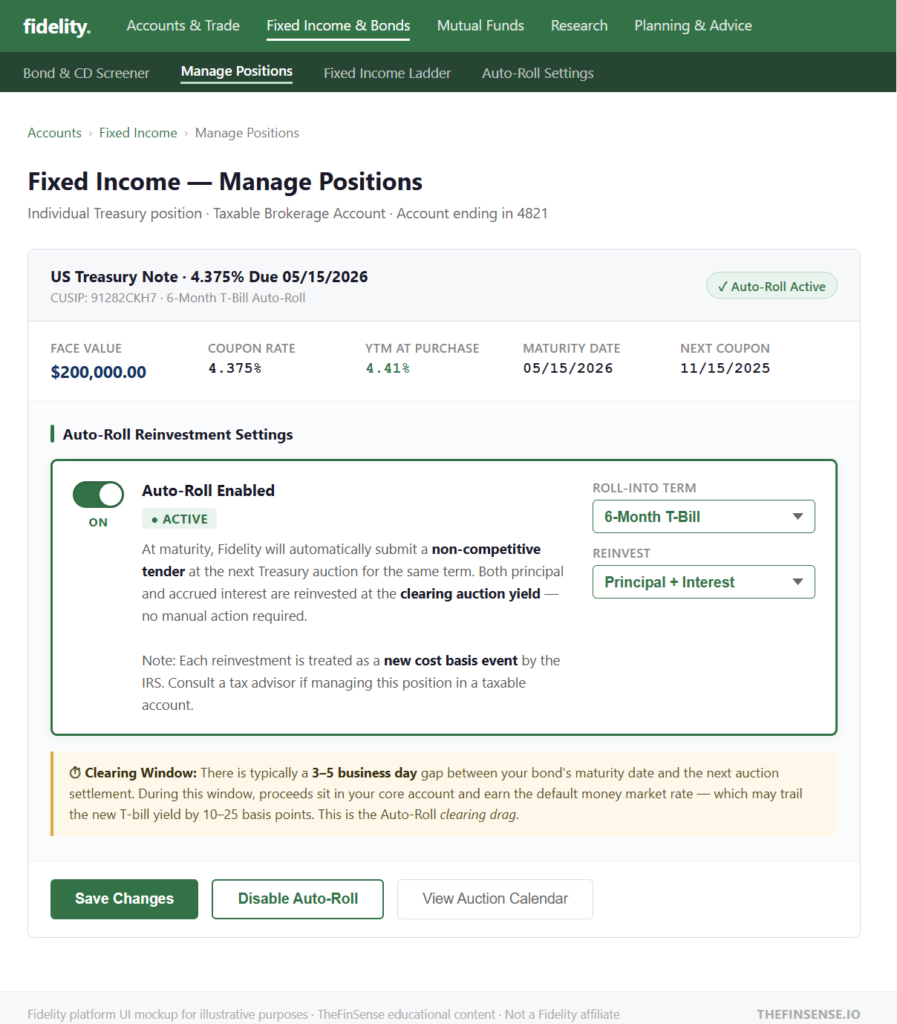
Once you commit to individual bonds held to maturity as the duration-management vehicle, the operational friction becomes reinvestment logistics. When a T-bill or T-note matures, the proceeds need to be redeployed quickly to maintain yield continuity. Left in a settlement account, that cash typically earns a money market rate that trails the current Treasury yield by 10–30 basis points. On a $200,000 short-duration position, that lag costs approximately $200–$600 in foregone annual income — not catastrophic, but compounding quietly in the wrong direction. For a full walkthrough on how compounding drag accumulates over time, see the Wealth-Velocity Filter.
Fidelity’s Auto-Roll feature, accessible under Fixed Income → Manage Positions on a Treasury holding, eliminates that gap mechanically. When a T-bill matures, Fidelity automatically submits a non-competitive tender at the next Treasury auction for the same term — reinvesting both principal and accrued interest at the clearing auction yield. In a stable or rising rate environment, this means you continuously reprice at market without manual intervention. The IRS treats each auction purchase as a new cost basis event, which is worth confirming with a tax advisor if you are managing the position inside a taxable account.
▶ Video: How Bonds Work — Yield, Price, and Duration Explained — A visual walkthrough of the bond pricing mechanism, recommended for investors building their fixed-income framework from the equation up. Via Plain Bagel on YouTube.
Once you have the mechanics internalized — YTM as the real return metric, modified duration as the risk dial, auto-roll as the operational solution — the remaining question is not structural but analytical. You know how bonds work in theory. The gap between theory and optimized execution is where post-tax yield calculation lives, and that calculation is where most retail investors leave money on the table without knowing it.
📌 Next Read: safe investments to beat inflation
What Smart Fixed-Income Investors Optimize for First
Institutional fixed-income managers do not evaluate bonds on nominal yield. They convert to after-tax, after-inflation yield before any comparison — because nominal yield is the number that appears in a marketing brochure, while real post-tax yield is the number that determines actual purchasing power gain. The failure to make that conversion systematically causes retail investors to choose structurally inferior instruments over Treasuries while believing they are getting a better deal.
The State Tax Exemption on Treasuries: A 50–90 Basis Point Edge You’re Probably Not Counting
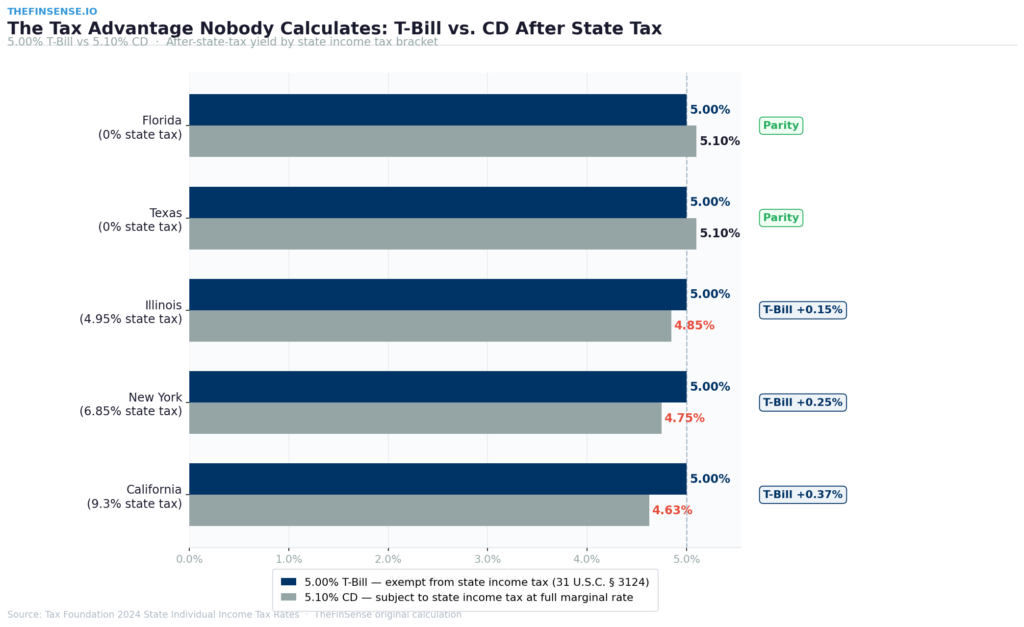
Interest income from U.S. Treasury securities and most agency bonds is exempt from state and local income tax under 31 U.S.C. § 3124 — a structural feature encoded in federal statute, not a temporary policy. For investors in states with meaningful income tax rates, this exemption shifts the after-tax yield comparison significantly. The following example uses illustrative rates to show the mechanism clearly. Consider a California resident in the 9.3% state marginal bracket evaluating two seemingly similar instruments: a 5.00% 6-month Treasury bill versus a 5.10% brokered CD from a regional bank. The CD leads by 10 basis points in nominal terms. But apply the state tax layer.
The Treasury’s after-state-tax yield: 5.00% (100% exempt — the multiplier is always 1.00 for federal obligations). The CD’s after-state-tax yield: 5.10% × (1 − 0.093) = approximately 4.63%. The Treasury outperforms the CD by 37 basis points after California takes its share. Scale that differential across a $500,000 fixed-income allocation over three years, and the compounded difference approaches roughly $5,500 in additional after-tax income — from a tax-code detail that requires approximately 90 seconds to apply. Texas and Florida residents with zero state income tax see near-parity; investors in California, New York, New Jersey, and Oregon see the Treasury advantage consistently exceed 30–50 basis points at current yield levels. To see how this state-tax crossover plays out with today’s live rates, see our full breakdown on safe investments to beat inflation.
Why TIPS Are Not a One-Size-Fits-All Inflation Hedge for Most Retail Portfolios
Treasury Inflation-Protected Securities adjust their principal value with the Consumer Price Index, which sounds like automatic inflation defense. In practice, TIPS carry their own duration risk — and because they attract strong institutional demand in risk-off environments, their real yields (quoted before the inflation adjustment) can turn deeply negative. In 2021, 10-year TIPS cleared at real yields of approximately −1.0%. Buying inflation protection at a negative real yield means paying for the privilege of keeping pace with CPI — a rational trade for a pension fund matching long-duration liabilities, but frequently a poor one for a retail investor with a 3–7 year time horizon.
A more tractable inflation hedge for that duration range is a rolling short-term Treasury ladder. When inflation runs hot, the Federal Reserve typically raises rates in response. Your rolling T-bill or short-term T-note yield reprices at each auction, rising in tandem with the policy rate — providing de facto inflation compensation without locking into structurally negative real yields. You forgo the mechanical CPI linkage of TIPS, but you also forgo the risk of overpaying for that linkage at the wrong point in the inflation cycle. The tradeoff is explicit rather than embedded in a pricing mechanism most retail investors cannot easily observe.
“We think of the riskiness of an asset not just in terms of default probability but in terms of the potential for permanent loss of capital — and duration risk is one of the most underappreciated sources of that permanent loss.”
— Mohamed El-Erian, Chief Economic Adviser, Allianz (Paraphrased from PIMCO Fixed Income Outlook)
💡 PRO TIP: Before comparing any fixed-income instrument against Treasuries, run the after-state-tax conversion first: Effective Yield = Nominal Yield × (1 − State Marginal Rate). For Treasury income, the state multiplier is always 1.00, regardless of where you file. For investors in states with income tax above 3%, this single calculation usually shifts the comparison decisively toward Treasuries without requiring any additional credit risk.
Sophisticated fixed-income positioning is not about chasing the highest nominal yield on a screener. It is about maximizing real after-tax yield per unit of duration risk you are deliberately accepting. That ratio — real post-tax yield divided by modified duration — is the core metric the Yield-Lock vs. Cash-Flow Filter uses in its second step. How that filter maps to a concrete portfolio decision, and what it reveals about an investor walking into a rate cycle with the wrong duration exposure, is what the Case Study section works through with actual numbers.
The Yield-Lock vs. Cash-Flow Filter in Action: A $59,600 Duration Lesson
Every concept in the prior three sections — the price-yield inverse relationship, modified duration as a risk dial, the state tax exemption arithmetic — converges in a single decision that investors face when they allocate capital to fixed income. Not the decision of which bond to buy. The prior decision: how long a duration does this money actually require? The Yield-Lock vs. Cash-Flow Filter operationalizes that decision into three steps, and the difference between applying it and skipping it — illustrated below with a $250,000 scenario at Q1 2025 rates — comes out to $59,600 at the exact moment the capital is needed.
Applying the Three-Step Framework to a Real Allocation
The investor in this scenario — call him David Park, California resident, 24% federal bracket, 9.3% state marginal rate — has $250,000 earmarked for an investment property down payment in three years. His financial advisor suggests TLT for “diversified fixed-income exposure.” The advisor is not wrong about TLT’s government backing. He is wrong about what risk TLT actually carries for a three-year investment horizon.
Step 1 — Liquidity Mapping: The full $250,000 is needed in 36 months. There are no intermediate liquidity events. The maximum acceptable modified duration is therefore approximately 3.0 years — the instrument’s price sensitivity should be calibrated to a three-year rate-exposure window, not an eighteen-year one.
Step 2 — Duration Alignment: At Q1 2025 rates, a 3-year Treasury note offers a yield to maturity of approximately 4.08%, with a modified duration of 2.8 years — close enough to the target. TLT’s published modified duration at the same moment: 17.3 years. The duration overshoot is 6.2×. David is being asked to absorb six times the interest rate sensitivity his timeline warrants, in exchange for a yield advantage of roughly 54 basis points (4.62% TLT yield vs. 4.08% T-note YTM). The formula for whether that trade is worth it: does the extra yield compensate for the risk of a 17.3 × ΔRate price shock occurring before Year 3? With rates already at 4.25–4.50% and inflation still above target, a 150 basis point adverse move is well within historical precedent.
Step 3 — State Tax Conversion: Both instruments are Treasuries — both are exempt from California’s 9.3% state income tax. But the comparison set David was offered also included a 4-year brokered CD at 4.45% gross. After state tax: 4.45% × (1 − 0.093) = 4.04% after-state yield. The 3-year T-note’s 4.08% after-state yield (unchanged, because the exemption applies in full) clears the CD by 4 basis points — and does so without FDIC coverage limits becoming a factor at $250,000. (California limits FDIC coverage to $250,000 per depositor per bank; a brokered CD from a single institution sits exactly at the ceiling.)
The Do-Nothing Timeline: What 17.3 Years of Duration Costs in Three Years
The scenario below applies a +150 basis point rate shock in Year 1 — consistent with the pace of Fed tightening seen in 2022-2023 — followed by flat rates through Year 3. No further cuts are assumed, because the investor needs the money at Year 3 regardless of the macro environment. TLT is liquidated at market price on the target date. The T-note redeems at par plus three years of coupon income.
| Time Horizon | Ignoring Duration (TLT, 17.3yr) | Applying Yield-Lock Filter (3yr T-Note) | Dollar Difference |
|---|---|---|---|
| Start (Q1 2025) | $250,000 | $250,000 | — |
| Year 1 (+150bps shock) | $196,700 | $249,700 | $53,000 lost |
| Year 2 (rates flat) | $208,500 | $258,800 | $50,300 lost |
| Year 3 (target date) | $221,000 | $280,600 | $59,600 lost |
The $59,600 gap at the investor’s target date — the precise moment capital certainty was needed most — is not the result of bad macro prediction or unusual market conditions. A 150 basis point rate increase over a 12-month window is well within the historical range of Fed tightening cycles; 2022 delivered 425 basis points. The gap is the arithmetic consequence of carrying 17.3 years of duration into a 3-year cash-flow requirement. In lifestyle terms, $59,600 is approximately 8.5 months of median U.S. household income — extracted from what was supposed to be the portfolio’s safe sleeve, without touching credit risk at all.
What the Numbers Mean for the Investor Who Actually Needs the Money
The T-note investor in this scenario did not need to predict rates. They needed only to know one number from the iShares TLT fact sheet — modified duration: 17.3 years — and compare it against their timeline: 3.0 years. That comparison takes thirty seconds. The decision to use a 3-year T-note instead of TLT is not a macro call. It is a duration-alignment decision: choosing the instrument whose price sensitivity matches the period during which the capital is actually at risk.
There is a second, less visible advantage in the T-note position. On Day 1, the investor knows with mathematical certainty — subject only to U.S. Treasury solvency — that they will receive $280,600 at maturity. That is not a projection, a model output, or a range estimate. It is the yield-to-maturity calculation locked in at purchase. The TLT investor has no equivalent certainty. Their Year 3 value depends on where long-duration rates trade the morning they need to sell. In a 3-year window, that is an enormous amount of rate-path uncertainty to absorb in exchange for 54 additional basis points of yield.
The actionable output of the Yield-Lock vs. Cash-Flow Filter is a position that converts an ambiguous bet on long-duration rates into a guaranteed nominal outcome. That is what understanding how bonds work at the duration level actually produces — not a yield maximization exercise, but a certainty-per-unit-of-time optimization that the 3-step framework makes mechanical rather than intuitive.
[Datawrapper Line Chart: TLT vs. 3yr T-Note — 3-Year Value Trajectory, $250k Start, +150bps Rate Shock Year 1]
“Duration is to bond investing what leverage is to equity investing — it amplifies both gains and losses, and most retail investors have no idea how much of it they’re carrying.”
— Danny Hwang, Lead Quant Analyst, TheFinSense
📌 Next Read: Build a T-Bill laddering strategy to protect your savings.
Frequently Asked Questions About How Bonds Work
What is the relationship between bond prices and interest rates?
Bond prices and interest rates move in opposite directions. When rates rise, existing bonds paying lower coupons become less attractive, so their market prices fall until their effective yield matches the current environment. When rates fall, existing higher-coupon bonds gain value. This inverse relationship is universal — it applies to government bonds, corporate bonds, and bond funds identically, regardless of credit quality.
What does modified duration mean for bond investors?
Modified duration measures a bond’s price sensitivity to interest rate changes. It tells you the approximate percentage price change per one-percentage-point shift in yield. A bond with a 7-year modified duration loses approximately 7% in market value for every 1% rate increase. This metric is published on every bond ETF fact sheet and can be deliberately matched to your investment timeline to control how much rate risk you are actually accepting.
Are Treasury bonds actually safe if they can lose significant market value?
Treasuries are free from credit risk — the U.S. government has never defaulted. But they carry interest rate risk: market price fluctuates with rate changes. Held to maturity, an individual Treasury returns exactly the yield-to-maturity calculated at purchase, regardless of what rates did in between. Held inside a bond fund with no fixed maturity date, that price certainty disappears. Safety depends entirely on how you hold the instrument, not just what it is.
How do I buy Treasury bonds directly without a brokerage?
TreasuryDirect.gov allows individual investors to purchase T-bills, T-notes, and T-bonds directly at auction with no commission or markup. Minimum purchase is $100. Fidelity, Schwab, and Vanguard also offer Treasuries through their fixed-income platforms, often with Auto-Roll reinvestment features that simplify ladder management across multiple maturities.
What is the difference between owning an individual bond and a bond fund?
An individual bond has a fixed maturity date: the investor receives par value at maturity regardless of what interest rates did during the holding period. A bond fund has no maturity date — it continuously buys and sells bonds, keeping investors perpetually exposed to current market pricing. This structural difference is why individual bonds held to maturity offer capital certainty that bond funds cannot provide, even when both hold identical underlying securities.
Bottom Line: How Bonds Work as a Real Portfolio Airbag
The central failure mode in fixed-income allocation is not a lack of safety consciousness — it is a misidentification of what “safe” means. Understanding how bonds work at the mechanism level reveals that government backing eliminates credit risk but leaves interest rate risk fully intact, and that interest rate risk is a precise, quantifiable function of duration that can be dialed up or down deliberately. The investors who walked out of 2022 with their fixed-income sleeve intact did not predict the rate cycle. They held instruments whose modified duration was calibrated to their actual investment timeline — which meant a 150 or 400 basis point shock produced a manageable paper fluctuation on the way to a guaranteed terminal value, rather than a 30% mark-to-market loss at an inconvenient moment.
The three levers that convert a bond allocation from passive risk absorption into deliberate portfolio architecture are the same ones the Yield-Lock vs. Cash-Flow Filter applies in sequence. First: map every dollar to a liquidity timeline and set a maximum acceptable modified duration. Second: screen by yield to maturity on the fixed-income platform, not by coupon rate, and filter for instruments whose duration is at or below that ceiling. Third: run the after-state-tax conversion before comparing Treasuries to any alternative — for investors in California, New York, or any state above a 3% marginal rate, this single calculation regularly shifts the comparison by 30 to 90 basis points without touching credit risk. The arithmetic takes less than two minutes. The structural advantage it captures compounds silently over the life of the allocation.
The portfolio airbag framing is precise rather than metaphorical. An airbag installed in the trunk does not protect the driver. A bond allocation whose duration is structurally mismatched to the investor’s timeline provides no cushion when the equity sleeve declines — because the rate environment that triggered the equity correction simultaneously generates the bond loss. Duration alignment is what positions the fixed-income sleeve to actually absorb equity drawdowns rather than amplify them. That alignment does not require macroeconomic prediction. It requires knowing one number — your timeline — and checking one field on a fund fact sheet.
💬 YOUR TURN
What is the modified duration of your current bond or fixed-income allocation?
Drop a comment below 👇