📅 Originally Published: · Last Updated:
A map left folded in a glove compartment still marks a route that every wrong turn misses.
The Bottom Line, Up Front
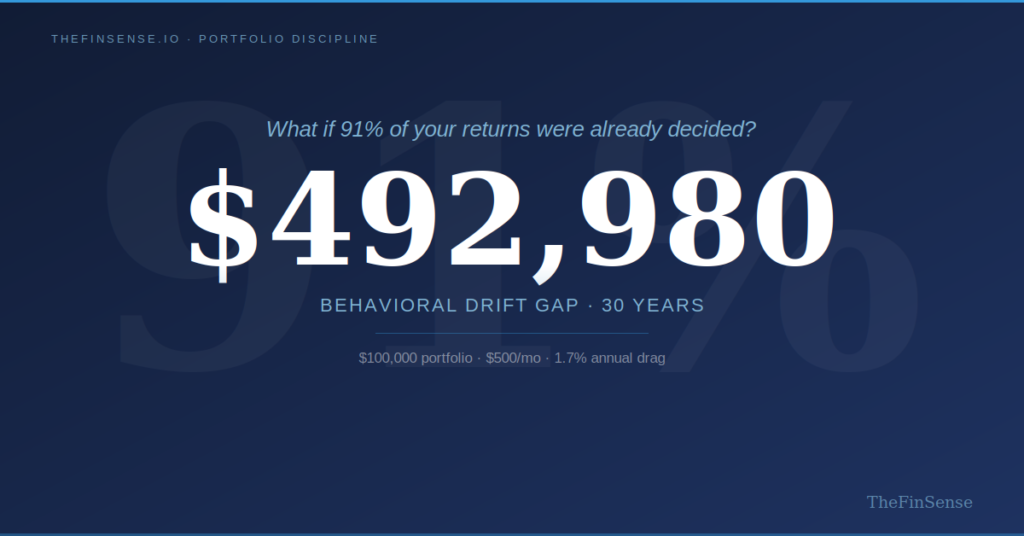
Most investors optimize the wrong 9% of their portfolio decisions. Vanguard research shows asset allocation strategy explains 91.1% of return variability. The 1.7% annual behavioral gap compounds to $492,980 over 30 years.
Does your asset allocation strategy determine more of your portfolio outcome than every fund you will ever pick? What if 91% of the return variance was already locked in the day you set your first target? Ibbotson and Kaplan found that allocation policy explains approximately 90% of return variability across decades of balanced fund data.
The $492,980 allocation drift gap extends the same arithmetic behind the $394,246 behavioral alpha gap and the $226,487 advisory fee gap. The $223,908 brokerage hidden cost gap runs on the same compound engine. The mechanism differs, but the compounding does not.
How much does that arithmetic cost a real investor over 30 years? The 1.7% annual behavioral gap identified by Morningstar compounds to $492,980 for a $100,000 portfolio with $500 monthly contributions. This analysis applies to US self-directed brokerage and retirement accounts holding diversified index funds.
Asset Allocation Strategy: The 91% Decision You Already Made
The belief that active adjustment protects a portfolio is reasonable. Financial media rewards tactical shifts, advisors build careers on fund rotation, and every correction feels like proof that staying still costs money. The instinct is not wrong; the arithmetic behind it is.
The instinct to adjust was reasonable. A written target is how it executes without cost.
How many hours do self-directed investors spend researching individual stocks before adding them to an existing asset allocation strategy? Does that research change the outcome when those same stocks already sit inside the index allocation? A 2023 Bogleheads discussion revealed that investors who added blue-chip holdings to indexed portfolios consistently underestimated that their allocation already contained those stocks.
“A stable asset allocation policy is far better than most of us are going to do because most of us are going to react the wrong way.”
— Roger G. Ibbotson, PhD, Professor Emeritus of Finance, Yale School of Management
What happened when the April 2025 tariff correction arrived? Did investors with written allocation targets react differently from those without one? The correction exposed that portfolios lacking a documented target had no rebalancing anchor to hold them in place.
The recent graduate splitting a first paycheck between three ETFs shares one arithmetic with the 42-year-old who moved 15% into bonds after a single headline. So does the 58-year-old rotating sectors each quarter to protect a retirement date. 91.1% of the variance was locked in the moment they set their first allocation. The remaining 8.9% absorbed every trade, every rotation, and every late-night rebalancing session.
The fund that outperformed last quarter already compounds inside an allocation that explains 91% of the journey.
If one decision explains 91% of the outcome, what does 30 years of tinkering cost in real dollars?
What Your Asset Allocation Strategy Actually Controls (The 91.1% Number)
That 91% is not a rounding error. What does that number mean when five portfolio decisions compete for explanatory power? The table below separates asset allocation strategy from security selection across the factors that matter.
| Decision Factor | Strategic Allocation (91%) | Security Selection (9%) |
|---|---|---|
| Return Variability Explained | 91.1% (Scott et al. 2017) | 8.9% |
| Funds with Significant Alpha | 96% zero or negative | 4% positive |
| Behavioral Investor Gap | 0% (set-and-hold) | 1.7% annual (Morningstar 2023) |
| 30-Year FV ($100K + $500/mo) | $1,421,635 | $928,655 |
| Action Required | Set once, automate rebalancing | Continuous research + trading |
Asset Allocation Strategy: Variance Explained (91.1% vs. 8.9%)
US balanced funds, 1990–2015 (Scott et al. 2017)
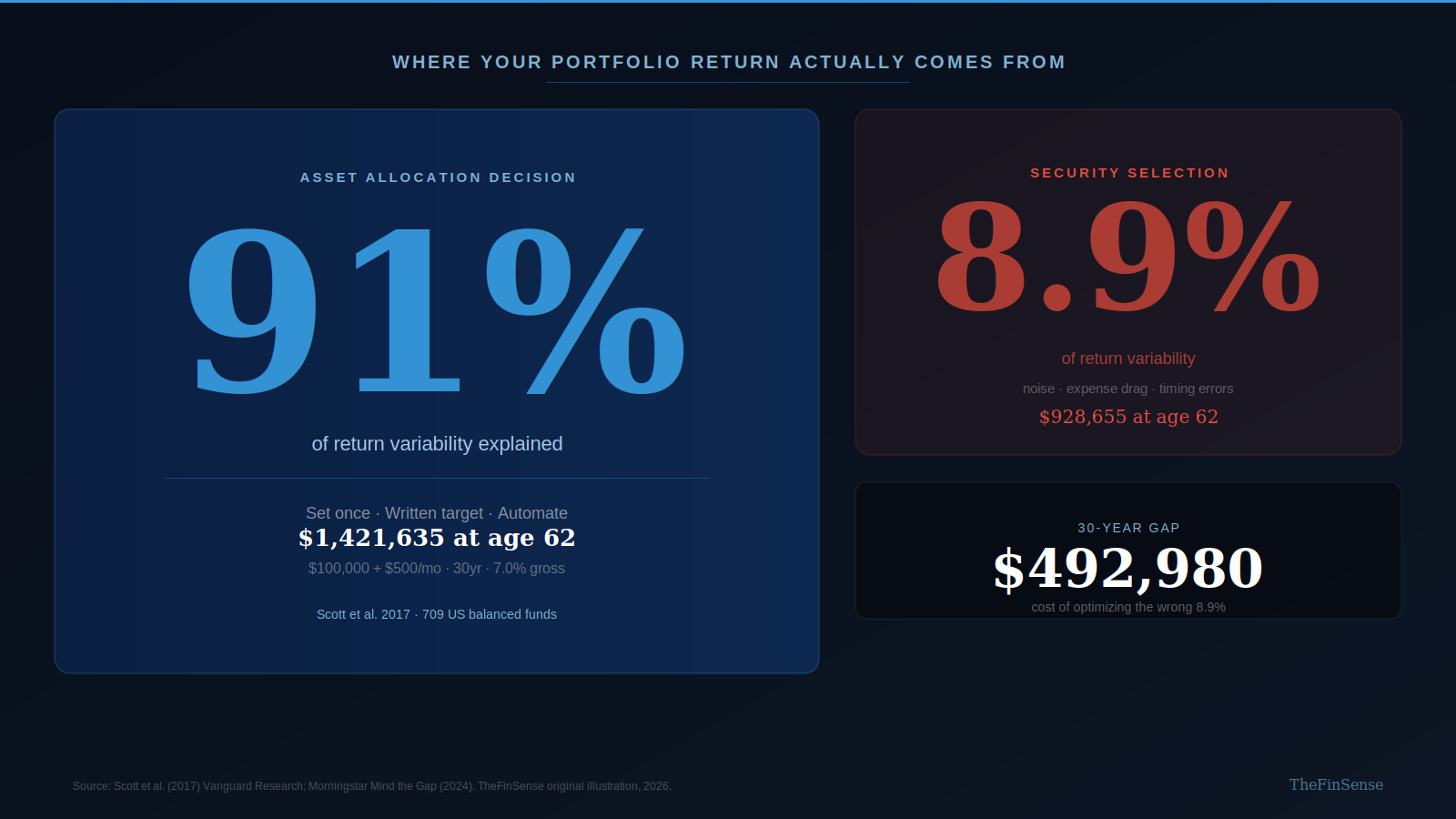
What happens when investors focus their energy on the 8.9% residual instead of the 91% driver? Does the behavioral cost show up across independent annual studies? DALBAR’s 2025 QAIB report found the average US equity investor underperformed the S&P 500 by 848 basis points in 2024, the second-largest behavioral gap in a decade.
Does the fund type explain that 848-basis-point gap? How much changes when the comparison shifts from ETF versus mutual fund selection to the underlying asset allocation strategy? Vanguard’s global study found that only 4% of actively managed balanced funds generated statistically meaningful outperformance.
The remaining 96% produced zero or negative alpha over the full measurement period.
Morningstar’s 10-year study reveals investors who traded more captured less of their own funds’ returns.
Whether the portfolio holds $10,000 or $500,000, the regression coefficient is the same. Does the scale of the portfolio change the arithmetic? What does 1.7% lost every year look like after three decades of compounding?
How Asset Allocation Strategy Explains 91.1% of Your Returns (The Regression)
1.7% sounds small until the regression runs. What happens when researchers strip every variable except the allocation decision and measure what remains? Two landmark studies, separated by 17 years, produced the same structural conclusion.
What the 90% Finding Actually Measured
What did Ibbotson and Paul D. Kaplan, Morningstar Quantitative Research, measure when they decomposed returns for 94 balanced mutual funds and 58 pension funds? Did individual stock selection explain the performance differences, or did the asset allocation strategy decision? Their 2000 Financial Analysts Journal paper found that allocation policy explained approximately 90% of each fund’s return variability over time.
Before Ibbotson and Kaplan (2000), the field attributed portfolio differences to individual manager skill. Their decomposition revealed that skill explains roughly 40% of cross-fund variation, while the allocation decision explains 90% of each fund’s own return path.
How large is a $492,980 gap relative to what most Americans have saved? Does the number represent an outlier, or does it dwarf the typical retirement balance? $492,980 exceeds the median American retirement savings of $87,000 by 5.7 times, per Federal Reserve 2022 data.
The regression does not adjust for portfolio size.
Why Your Asset Allocation Strategy Explains 91.1%, Not Your Fund Picks
What changed when Brian J. Scott, CFA, Vanguard Investment Strategy Group, ran the same regression 17 years later with a larger dataset? Did the 90% figure hold, or did it shift? Their 2017 Vanguard study analyzed 709 US balanced funds from 1990 to 2015 and confirmed that an asset allocation strategy decision explains 91.1% of return variability.
Does the cross-sectional data tell the same story? What fraction of the variation between funds traces to allocation versus manager skill? Cross-sectional R-squared dropped to 22.7%, confirming that between-fund differences are predominantly allocation-driven.
Only 4% of actively managed US balanced funds produced statistically significant alpha over 25 years.
▶ Video: Choosing an Asset Allocation by Ben Felix (Common Sense Investing) — demonstrates that asset allocation, not fund selection, drives long-term performance outcomes.
Why the 9% Residual Is Not an Opportunity
If R² captures 91.1%, what does the remaining 8.9% contain? Is that 8.9% where active management skill lives? Scott’s team found that fewer than 4% of the 709 funds produced statistically significant positive alpha over the full 25-year period.
The 8.9% residual absorbs noise and expense drag.
Does the asset allocation strategy regression hold universally, or does it break in different markets? What did the cross-country analysis reveal beyond US balanced funds? The same regression produced R-squared values from 80.5% in the UK to 89.1% in Australia, with Canada at 86.0%, confirming the mechanism is structural.
What does the cross-sectional R-squared of 22.7% mean for investors who believe specific fund choices matter? Does fixing the allocation remove most between-fund variation, including drag from factors like dividend reinvestment tax costs? The 91.1% variance figure conceals a sharper truth: cross-fund return differences shrink to 22.7% once allocation is fixed.
91.1% of a US balanced fund’s return variability shows one allocation decision, not the hundreds of trades that followed.
What does this math mean for a specific person with real money invested right now?
Casey’s $492,980 Asset Allocation Strategy Gap: The Two-Path Case Study
Casey’s $100,000, split across three index funds, will separate into a $492,980 gap between two versions of the same portfolio by age 62. You chose the allocation. The math below shows what that choice produces over 30 years.
Casey navigates to the Asset Allocation tab the morning after the first 10% correction headline. The Holdings screen reads $100,000 spread across three index funds. No target allocation is written anywhere.
Casey scrolls through the positions six times, calculating whether the drop in small-cap means the allocation needs fixing.
What separates Casey’s two possible outcomes over the next three decades? Does the portfolio diverge because of a fund swap, or because of the allocation decision itself? The table below isolates every input that drives the gap.
| Parameter | Value |
|---|---|
| Name | Casey |
| Age | 32 |
| Income | $120,000 |
| Initial Balance | $100,000 |
| Monthly Contribution | $500 |
| Time Horizon | 30 years |
| Target Age | 62 |
| Static Allocation Return | 7.0% (documented target, no drift) |
| Tinkering Return | 5.3% (7.0% minus 1.7% behavioral drag) |
Most investors estimate the lifetime cost of adjusting their allocation at $5,000 to $20,000.
How far apart do these two paths grow when compound interest runs for 30 years? Does the 1.7% behavioral drag stay small, or does it accelerate? The milestone table below tracks both paths at five-year intervals.
| Year | Path A: Static Allocation (7.0%) | Path B: Active Tinkering (5.3%) | Behavioral Drift Gap |
|---|---|---|---|
| 5 | $177,559 | $164,532 | $13,027 |
| 10 | $287,509 | $248,595 | $38,913 |
| 15 | $443,376 | $358,102 | $85,274 |
| 20 | $664,337 | $500,754 | $163,583 |
| 25 | $977,578 | $686,582 | $290,996 |
| 30 | $1,421,635 | $928,655 | $492,980 |
❌ Path B: Active Tinkering (5.3%)
$928,655 at age 62. Casey adjusts quarterly, rotates sectors after headlines, and trusts that each trade improves the allocation. The 1.7% behavioral drag compounds silently into a $492,980 shortfall.
✅ Path A: Static Allocation (7.0%)
$1,421,635 at age 62. Casey documents a target allocation once, automates annual rebalancing, and eliminates behavioral drift entirely. The written target replaces the impulse to adjust.
Asset Allocation Strategy: The $492,980 Gap Over 30 Years
Casey, age 32 → 62 | $100,000 initial + $500/mo | Static 7.0% vs. Tinkering 5.3%
Does the visual separation between those two curves remind you of the compound growth pattern behind every long-term projection? That compound interest visualization follows the same exponential divergence that drives Casey’s gap from $13,027 at year five to $492,980 at year thirty.
$928,655 at retirement. $1,421,635 sits in one column. The gap is $492,980. That number is not a projection. It is the cost of adjusting.
The route was always printed. Casey had not opened it.
Is Casey’s $492,980 gap unique to one set of inputs, or does every investor who tinkers face the same arithmetic? $492,980 divided by $1,350 in monthly rent equals 365 months — more than 30 years of housing payments erased by behavioral drift alone.
📐 YOUR NUMBERS MAY DIFFER
This calculation assumes a 7.0% gross return, 1.7% behavioral drag, and 30-year horizon. Here is how the gap changes when each assumption shifts:
| Assumption Changed | Scenario | Static FV (Path A) | Tinkering FV (Path B) | Behavioral Drift Gap |
|---|---|---|---|---|
| Base Case | 7.0% gross, 1.7% drag, 30yr | $1,421,635 | $928,655 | $492,980 |
| Behavioral Drag Lower | 1.0% drag | $1,421,635 | $1,104,515 | $317,120 |
| Behavioral Drag Higher | 2.4% drag | $1,421,635 | $783,107 | $638,528 |
| Gross Return Lower | 5.0% gross | $862,904 | $575,591 | $287,313 |
| Gross Return Higher | 9.0% gross | $2,388,429 | $1,534,966 | $853,463 |
| Horizon Shorter | 20 years | $664,337 | $500,754 | $163,583 |
| Horizon Longer | 40 years | $2,943,548 | $1,654,782 | $1,288,766 |
The $492,980 gap separating Casey’s two paths costs more than 20 years of maximum retirement contributions.
Given this arithmetic, what is the one action that eliminates the $492,980 gap?
Asset Allocation Strategy: The 4-Step Documentation Plan
One allocation target, documented once, closes the gap. You saw the math that separated Casey’s two paths by $492,980. The four steps below convert that knowledge into a written plan that removes behavioral drift from the equation.
Step 1: Document Your Current Weights (10 min)
Does the tinkering superiority assumption hold for your account when you can see the actual numbers? What percentage of your portfolio sits in each asset class right now, before any adjustment? Open your brokerage and record the current split between stocks, bonds, and cash to the nearest whole percent.
Where do Vanguard, Fidelity, and Schwab display the allocation breakdown? Vanguard shows it under My Accounts followed by Portfolio Watch; Fidelity places it in the Positions tab under Asset Allocation; Schwab lists it in the Portfolio Performance section. Each platform generates the percentage split automatically.
Write the percentages in a spreadsheet or plain document. The act of recording creates the baseline that every future rebalancing decision references.
Step 2: Set Your Written Target (5 min)
What target allocation matches your timeline and risk tolerance? Does the current split reflect a deliberate decision, or the residue of past trades? Write three numbers: the percentage assigned to US stocks, international stocks, and bonds.
Does a 32-year-old with a 30-year horizon need the same bond allocation as a 55-year-old? The target depends on when you need the money, not on the latest headline. A common starting framework subtracts your age from 110 to set the equity percentage.
Document the target percentages in the same file where you recorded the current weights. Date the entry. This written record is the rebalancing anchor that prevents behavioral drift from compounding.
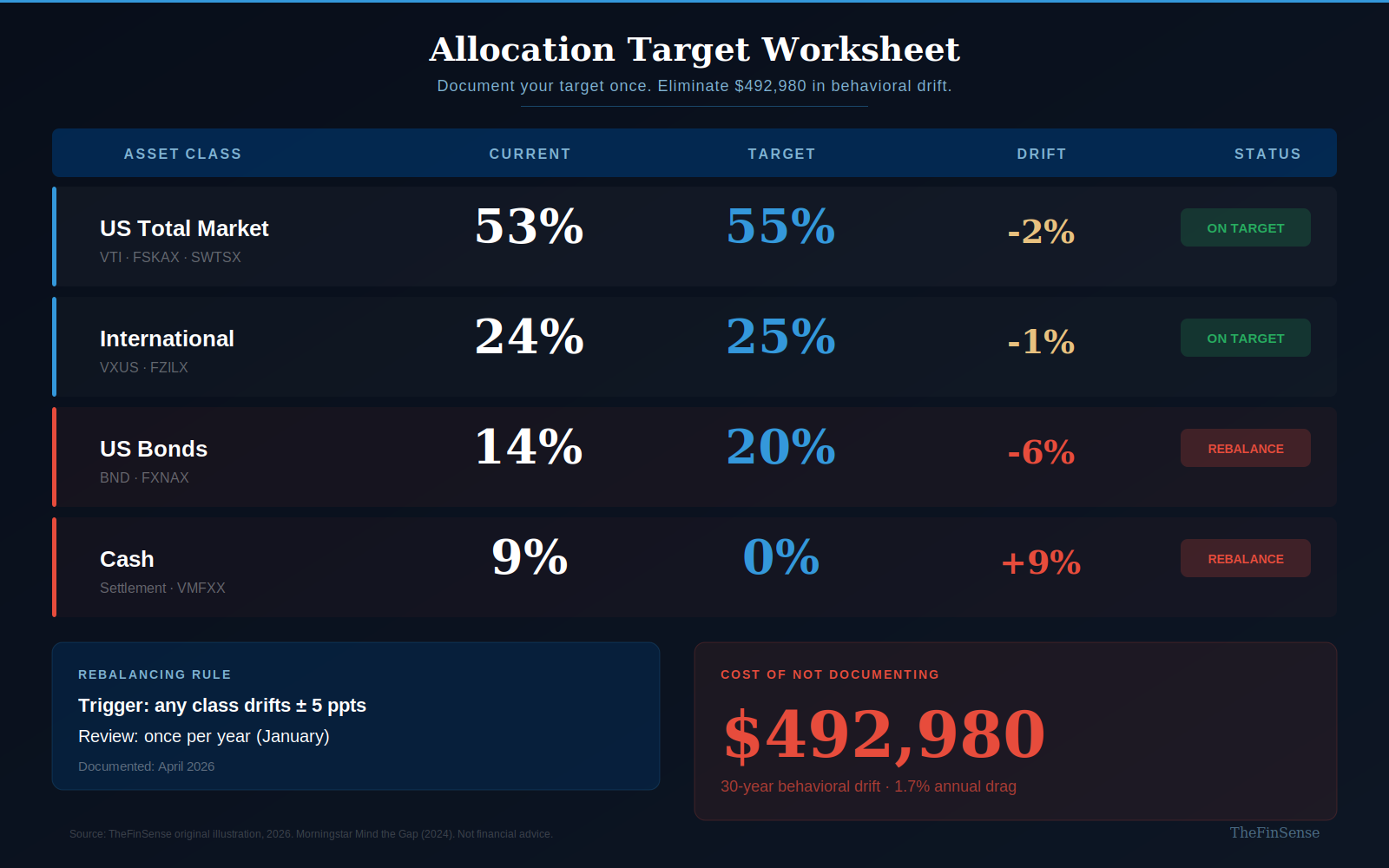
Step 3: Choose Your Rebalancing Rule (5 min)
What triggers a rebalancing event? Does the portfolio drift on a calendar schedule or a percentage threshold? A percentage-based rule fires only when any asset class drifts more than 5 percentage points from the written target.
Which approach produces fewer unnecessary trades? Calendar rebalancing (once per year) works for investors who want simplicity. Threshold rebalancing (at plus or minus 5%) works for investors who want precision.
Both eliminate the discretionary judgment that creates behavioral drag.
Write the chosen rule next to the target allocation. The rule converts an abstract intention into a mechanical trigger that executes without emotional input.
Step 4: Automate the Review (5 min)
How does the plan execute when the next correction arrives? Does the review happen automatically, or does it wait until a headline triggers the impulse to adjust? Set one calendar reminder per year to compare current weights against the written target.
Does the review require a trade? Only if the drift exceeds the threshold from Step 3. Most years, the review confirms that the allocation sits within bounds and no action is required.
The annual check takes five minutes when the target is already documented.
Connect the reminder to the same platform where you recorded the target. When the annual review arrives, the only question is whether any asset class has crossed the threshold.
Asset Allocation Strategy: The 4-Step Documentation Decision Tree
25-minute plan to eliminate behavioral allocation drift
▼
▼
▼
▼
Download the Allocation Target Worksheet
Record your current weights, target percentages, rebalancing rule, and review date in one printable document.
Use the Allocation Drift Calculator below to see your own gap.
Allocation Drift Calculator
Calculate the dollar cost of behavioral allocation drift on your portfolio over time.
| Year | With | Without | Gap |
|---|
What does the Bogleheads community data confirm about tinkering costs? Does the 1.7% behavioral drag hold across different investor profiles? A Bogleheads forum analysis confirmed that tinkering costs 1% to 2% annually for self-directed investors, matching the Morningstar data even when fees stay low and market timing is avoided.
Does the allocation documentation matter when the portfolio includes asset classes beyond stocks and bonds? How does the decision tree above apply when real estate sits alongside equity and fixed income in the allocation? The same four steps apply: document, target, rule, automate.
Even if the behavioral drag drops to 1.0%, a $100,000 portfolio with $500 monthly contributions still loses $317,120 over 30 years to allocation drift.
Setting a target allocation once and automating rebalancing is the only fork between $1,421,635 and $928,655.
One documented allocation target produces higher returns than four years of quarterly tactical rotation.
When This Asset Allocation Strategy Does Not Apply
This analysis holds for the majority of buy-and-hold index investors; Scott et al. noted the finding assumes no severe behavioral deviation.
If your risk tolerance changes after a major life event, adjust your target allocation once and document the reason.
Morningstar sector fund data confirms the directional difference: allocation fund investors captured 97% of their own fund returns; sector investors lost 2.6 percentage points annually to behavioral gaps.
Next time a market correction drops your portfolio 10%, check whether you have a written allocation target before changing any position.
When Morningstar publishes an updated Mind the Gap behavioral cost estimate, this analysis updates.
Asset Allocation Strategy: 5 Questions That Actually Matter
What is the best asset allocation strategy for my age?
No single age-based formula works for everyone. A common starting point subtracts your age from 110 to set the equity percentage. A 30-year-old might target 80% stocks and 20% bonds. A 50-year-old might shift to 60% stocks and 40% bonds. The target depends on when you need the money, your risk tolerance, and whether the portfolio is your only retirement asset. Document whatever target you choose. The written record matters more than the specific percentages.
How much of my portfolio return comes from asset allocation?
Vanguard research by Scott et al. (2017) measured 91.1% of return variability in US balanced funds explained by the asset allocation decision alone. Security selection, market timing, and expense ratios account for the remaining 8.9%. Earlier research by Ibbotson and Kaplan (2000) found approximately 90% using a different fund sample. Your allocation choice drives roughly nine times more of your return outcome than every fund swap combined.
Is it true that asset allocation determines more of your return than fund selection?
Yes. The evidence spans 25 years and 709 US balanced funds. Scott et al. (2017) confirmed that asset allocation explains 91.1% of return variability — roughly nine times more than security selection. Ibbotson and Kaplan reached the same conclusion independently in 2000 using a different dataset. The finding has survived two major bear markets and two decades of replication across five countries.
Asset allocation vs. diversification: what is the actual difference?
They overlap but are not the same. Diversification spreads risk across multiple holdings to reduce the impact of any single loss — it answers which securities to hold. Asset allocation vs. diversification is really about level: allocation sets the percentage split between broad categories (stocks, bonds, cash) based on timeline and risk tolerance, while diversification handles the mix within each category. A diversified portfolio can still drift without a written allocation target.
When should I change my asset allocation strategy?
Change your target only after a major life event: marriage, an income shift of 25% or more, or a retirement date change of five years or more. Market corrections and quarterly performance are not valid triggers. Even low-cost tinkering costs 1% to 2% annually per Bogleheads community data. To check your current allocation on Vanguard, navigate to My Accounts, then Portfolio Watch, and review the asset allocation breakdown. One documented change per life event.
Bottom Line: Why Asset Allocation Strategy Is the Only Decision That Compounds
The $492,980 answer was always the allocation, not the fund selection.
Every tactical trade belongs in the 8.9% residual that Vanguard’s regression measured across 709 US balanced funds. The documented allocation target is the only decision that compounds across a full investment career. 96% of actively managed balanced funds produced zero or negative alpha over 25 years.
The 1.7% behavioral gap compounds silently for every year the target goes unwritten. The arithmetic never adjusts; the instinct to tinker was the only variance.
Rebalancing drift compounds silently when no target exists to trigger a correction. 30 years of compounding, erased by quarterly adjustments that each looked harmless in isolation.
The allocation you set once explains more of your outcome than every trade you will ever make.
The portfolio follows the allocation map, not the hand that keeps adjusting the wheel.
You chose the allocation; the documented target is the missing piece.
Asset allocation explained, the behavioral drift calculated, the rebalancing rule written.
📌 Next Read: Visualize Compound Interest
Casey at 62, holding $492,980 more than the version that tinkered.
The territory was always the allocation.
YOUR TURN
What is the gap between your portfolio’s actual weights and the allocation target you wrote down?