
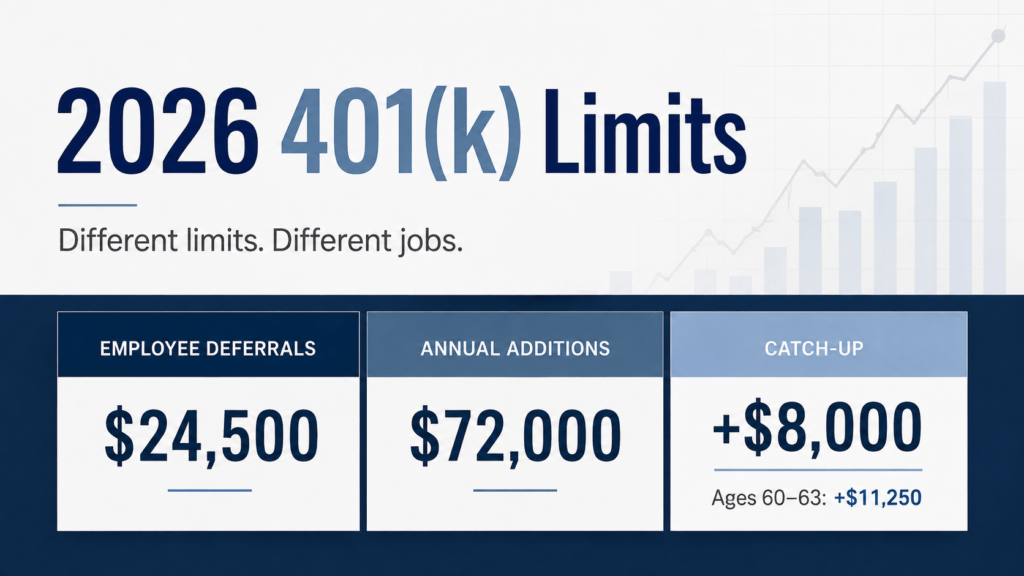
The 2026 401k contribution limits can look contradictory at first. Search “2026 401(k) limit” and you may see three different numbers: $24,500, $72,000, and sometimes $83,250. None of those numbers is wrong, but they answer different questions. The key is figuring out which limit applies to the money you are actually trying to put in.
That distinction matters in practice.
For 2026, the base employee elective-deferral limit for a standard 401(k) is $24,500. The separate section 415(c) annual-additions ceiling is the lesser of 100% of compensation or $72,000. Catch-up-eligible participants may have another $8,000 of deferral room, or $11,250 if they attain age 60, 61, 62, or 63 during 2026.
2026 401k Contribution Limits at a Glance
The confusion starts because “401(k) limit” can mean more than one thing. Your elective deferral is the money you choose to send from your paycheck into the plan. Annual additions use a different section 415(c) ceiling that includes the contribution types counted under that rule, such as regular employee deferrals, employer contributions, and employee after-tax contributions. Catch-up can add extra deferral room on top when you qualify.
2026 standard 401(k) statutory limits
| Layer | 2026 amount | What it controls |
|---|---|---|
| Employee elective deferrals | $24,500 | Your base employee-deferral ceiling across covered plans. |
| Annual additions | Lesser of 100% of compensation or $72,000 | The separate 415(c) ceiling for contributions counted within the relevant employer scope. |
| Catch-up, if eligible | $8,000 general; $11,250 if attaining age 60–63 | Extra deferral room when the catch-up rules apply. |
If compensation and plan terms allow the full statutory room, the combined ceiling can reach $80,000 with the general catch-up or $83,250 for someone attaining age 60–63 in 2026. That does not mean you can defer $80,000 or $83,250 from salary. Those totals combine the $72,000 annual-additions ceiling with catch-up, which sits outside that ceiling.
YOUR DEFERRALS
MONEY THAT COUNTS
EXTRA ROOM
YOUR ACTUAL LIMIT
Reusable rule: Keep the limits separate: classify the contribution, choose the right aggregation scope, then add catch-up only when you qualify.
Which contributions use which 401(k) limit?
Seeing $72,000 and thinking “I can put that much of my salary into a 401(k)” is the easiest way to mix up the rules. The $72,000 figure controls annual additions, not your paycheck deferrals by themselves.
Employee elective deferrals: the participant-wide ceiling
Your regular elective deferrals use the participant-wide section 402(g) ceiling. If you contribute through more than one covered plan, another account does not give you another $24,500 base employee limit. The limit follows you across those plans.
Employer and after-tax contributions: the annual-additions ceiling
Employer contributions and employee after-tax contributions do not use up the section 402(g) employee-deferral ceiling the way regular salary deferrals do. Instead, the amounts counted under section 415(c) are tested against the annual-additions ceiling within the relevant employer scope.
Example: Suppose you defer the full $24,500 in 2026, your employer contributes $12,000, and you add $20,000 in after-tax contributions. Your regular employee deferral is already at its $24,500 limit, but your annual additions total $56,500, still below the $72,000 section 415(c) ceiling. If you are also catch-up eligible, the applicable catch-up amount can sit on top of that calculation.
Two questions sort most contributions quickly: Is this money an employee elective deferral, and does it count toward annual additions for this employer? Once you answer both questions, the right ceiling usually becomes clear.
Catch-up limits for age 50+ and ages 60–63
Turning 50 does not create a second version of the $24,500 limit. Catch-up is extra room on top of the base employee-deferral limit, and the rules that make it available still have to be satisfied.
For 2026, the general catch-up limit is $8,000 for a participant who is age 50 or older by the end of the calendar year and otherwise qualifies. If you attain age 60, 61, 62, or 63 during 2026, the higher catch-up limit is $11,250.
Example: You turn 62 in September 2026. For the 2026 age test, that puts you in the 60–63 band for the year. Your statutory employee-deferral room can therefore be $24,500 + $11,250 = $35,750, assuming the catch-up rules apply and you have enough compensation to make the contributions. The $11,250 catch-up is separate from the $72,000 annual-additions ceiling.
In a typical single-employer 401(k), the plan must permit catch-up contributions before you can use that extra room. IRS guidance provides a different catch-up treatment for certain situations involving plans of unrelated employers, which is why “if eligible” is safer than treating plan permission as a universal rule.
Why your plan may allow less than the statutory maximum
Here is the frustrating part: the IRS can allow a number that your plan still will not let you use in full. Plan terms may set a lower limit, compensation can restrict how much you can contribute, and nondiscrimination testing can reduce what some participants may defer. A SIMPLE 401(k) also uses a separate, lower set of limits from the standard 401(k) figures above.
So the federal ceiling is the starting point, not always the finish line. Payroll settings, the summary plan description, or the plan administrator may show a lower usable amount without changing the federal limit itself.
At this point, the big picture is simple: $24,500 answers the employee-deferral question; $72,000 answers the annual-additions question; catch-up can add another layer. The remaining sections cover the situations that can make that otherwise simple math branch.
Multiple employers and solo 401(k)s: how the limits aggregate
The 2026 401k contribution limits do not reset just because you have a second 401(k) account. This catches people who switch jobs midyear or contribute to both a workplace plan and another covered plan.
Example: You change jobs in March after already deferring $10,000 into your old employer’s 401(k). At the new company, you do not get a fresh $24,500 base limit. You have $14,500 of regular employee-deferral room left for 2026 before considering any catch-up amount that may apply.
Unrelated employers can change the annual-additions scope
The section 415(c) calculation uses a different scope. Annual additions are tested within the relevant employer and related-employer context, so truly unrelated employers can require separate annual-additions checks even though the employee-deferral ceiling still follows you across covered plans.
A solo 401(k) does not change that order. First total the employee deferrals that count toward your participant-wide limit. Then apply the annual-additions test to the correct employer scope.
Whether two businesses must be treated as the same employer can depend on the facts. If you are unsure whether the businesses count together for plan purposes, ask the plan administrator or a benefits professional before applying the section 415(c) limit.
The 2026 Roth catch-up rule for higher-wage participants
The tricky part here is the timeline: the Roth catch-up requirement can matter in 2026 even though the final Treasury and IRS regulations generally apply later. Those two dates describe different pieces of the rule.
Whether you may make catch-up contributions and whether those catch-up contributions must be Roth are separate questions. For 2026, the Roth catch-up rule generally matters if you had more than $150,000 of 2025 FICA wages from the employer maintaining the plan. Check that wage test only after you know catch-up otherwise applies.
The final Treasury and IRS regulations generally apply to contributions in taxable years beginning after December 31, 2026. Before 2027, plans may use a reasonable, good-faith interpretation while implementing the rule. That later general applicability date does not erase the 2026 Roth catch-up requirement in the law.
If the wage rule may apply to you, confirm how your plan is administering 2026 catch-up contributions before the final payroll of 2026.
2026 401(k) Limit Checker
Keep the participant-wide employee-deferral limit separate from the employer-scope annual-additions limit, then check catch-up and the Roth wage flag.
Work through the limits on paper
Use the fillable worksheet to work through the 2026 401k contribution limits: the participant-wide 402(g) check, the employer-scope 415(c) check, catch-up eligibility, the Roth catch-up wage flag, and plan-specific items.
A step-by-step way to find your binding 401(k) limit
Once the layers are separated, the calculation stops looking like three competing “maximums.” Use the same order every time:
- Classify the money before comparing limits: separate regular employee elective deferrals from employer contributions and employee after-tax amounts.
- Add employee deferrals across all covered plans: compare that participant-wide total with the section 402(g) ceiling.
- Run the annual-additions check for each relevant employer scope: total every contribution that section 415(c) counts within that scope.
- Apply catch-up only after the base check: use the correct age band, then confirm the catch-up rules and available compensation.
- Check whether the plan creates a lower usable ceiling: review plan terms, compensation, testing, and plan type before acting.
- Review special branches only when they apply to you: multiple employers, a solo 401(k), or the 2026 Roth catch-up rule can change one part of the calculation.
- Match year-to-date records to the correct limit bucket: keep payroll deferrals in the employee check and employer or after-tax amounts in the annual-additions check when section 415(c) counts them.
If there is already an excess, the correction route depends on which limit was exceeded. IRS instructions for excess elective deferrals use an April 15 correction deadline, while a section 415(c) excess annual addition is handled through a different plan-correction process. The category matters as much as the dollar amount.
That is the payoff of understanding the 2026 401k contribution limits as separate layers. Instead of asking “What is the 401(k) maximum?”, identify the exact limit you are testing and the money that counts toward it. Then confirm any plan-specific fact that can still change the result.
For employer-match formulas or vesting, see the separate 401(k) employer match and vesting page. For mega backdoor Roth steps, see the mega backdoor Roth page.
- IRS 401(k) contribution-limit guidance: employee elective-deferral limits, annual additions, multi-plan aggregation, plan-level limits, and excess-deferral timing.
- IRS Notice 2025-67: official 2026 elective-deferral and catch-up amounts.
- IRS catch-up contribution guidance: age-based catch-up rules and the 2026 Roth catch-up wage threshold.
- IRS final Roth catch-up regulations: general applicability after 2026 and pre-2027 implementation treatment.
- IRS section 415(c) correction guidance: annual-additions categories and correction framework.
Update history
-
v2.0
2026-08-29
UPDATEUpdated the 2026 limit guide and added the contribution-limit checker and fillable worksheet.