

Capital gains tax on stocks starts with the sale, not the rate table. For a taxable stock sale, first find your adjusted basis and holding period. Then net the year’s capital gains and losses and choose the filing path. Apply the current-year capital-gains rate and any Net Investment Income Tax (NIIT) only after those steps.
Start With the Sale and the Account, Not the Tax Rate
Start with two questions. Did you sell the stock, and did the sale happen in a taxable account? If both answers are yes, the sale enters the federal capital-gain process.
The account type can change the tax path before any capital-gain rate matters. A traditional IRA is a clear example: gains inside the account generally are not taxed until distribution. If you are still sorting out the account rules, see brokerage account vs. IRA.
For shares sold in a taxable brokerage account, the sale starts the chain. If the shares are in another tax-advantaged account, review that account’s rules first.
Calculate the Gain From Amount Realized and Adjusted Basis
For capital gains tax purposes, start by comparing the amount realized from the sale with adjusted basis. A broker’s headline gain, or your memory of what you paid, may not be the tax answer.
For purchased stock, basis usually starts with the purchase price plus acquisition costs. Later events can change that number, so adjusted basis is not always the same as original purchase price. Gifts, inheritances, and some corporate actions can have different basis rules.
Compare the broker’s basis with your own records before filing. If Form 1099-B reports a wrong basis to the IRS, do not silently replace that figure on the return. The final filing-year instructions explain how to show the broker figure and the needed correction.
Resolve or flag a basis mismatch before moving on. Otherwise every later step starts with a number you already doubt.
Use the Holding Period to Classify the Sale as Short- or Long-Term
Once you can support the basis, classify the sale by time. A capital asset held for more than one year is generally long-term, while one year or less is short-term.
For securities traded on an established market, use trade dates for the usual holding-period endpoints. The holding period starts the day after the purchase trade date and runs through the sale trade date. Settlement date is not the usual endpoint for this rule.
Special holding-period rules can apply to some transactions. If your position falls under one of them, use that rule instead of the general trade-date rule.
At this point, you should know whether this is a taxable sale, what basis you can support, and whether the gain or loss is short- or long-term. If the position has multiple lots, FIFO vs. specific identification determines which shares supply those basis and holding-period facts. Next, combine it with the rest of the year’s capital results.
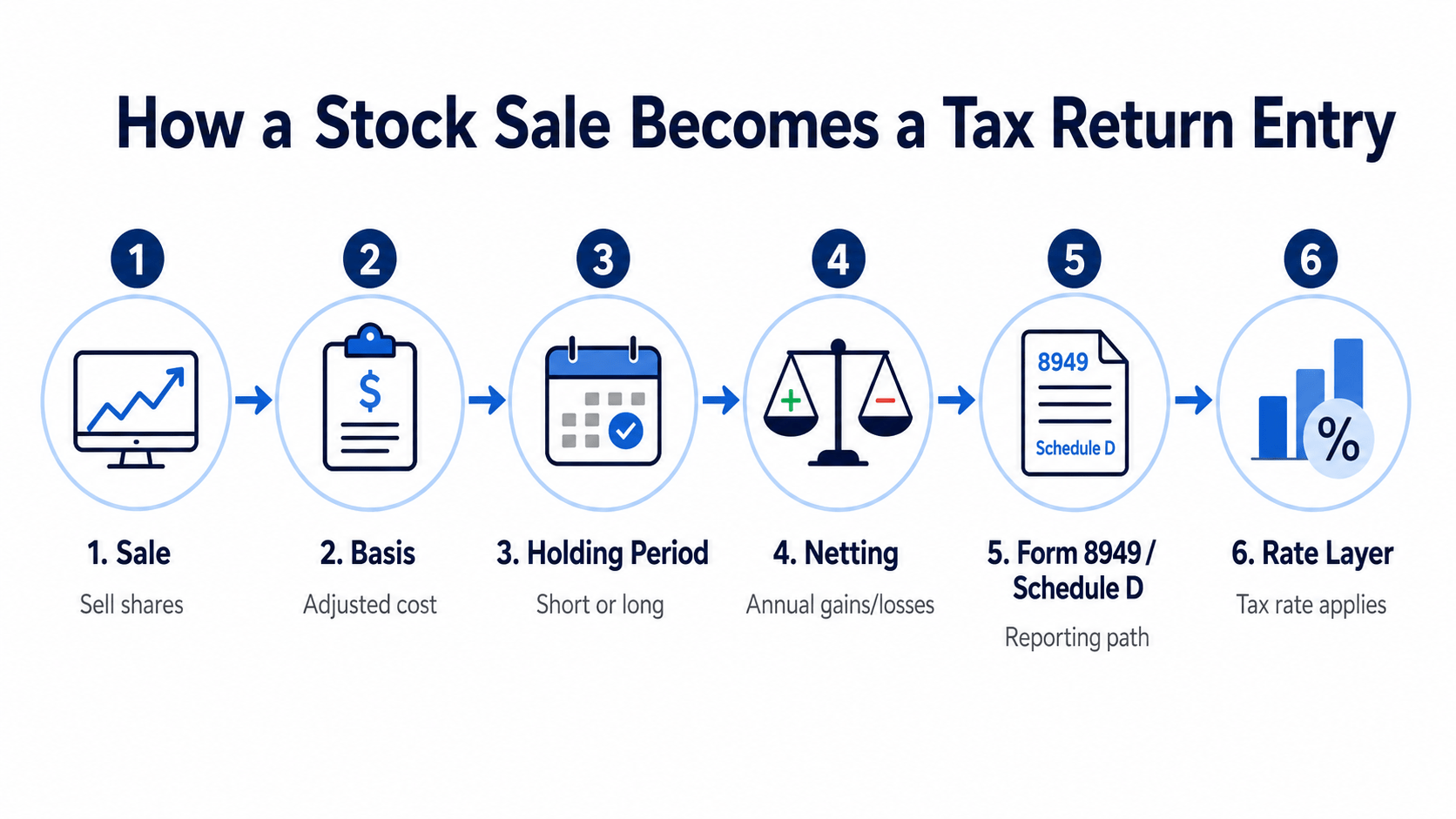
| Step | Question to answer | What changes next |
|---|---|---|
| 1 | Was the stock sold in a taxable account? | If not, review the account wrapper before using this process. |
| 2 | What was the amount realized? | This is the sale-side input for the gain or loss. |
| 3 | What is the supportable adjusted basis? | A wrong basis changes the reported gain or loss. |
| 4 | Is the result short- or long-term? | The holding period sets the capital-gain bucket. |
| 5 | What are the year’s net short- and long-term results? | Losses and other gains can change the taxable result. |
| 6 | Did the broker report basis, and is an adjustment needed? | Those facts help determine the reporting route. |
| 7 | Does the sale meet every final Exception 1 condition? | If yes, direct Schedule D aggregation may be available. |
| 8 | Which filing path applies? | Use the detailed sale form or the direct Schedule D path. |
| 9 | Which annual rate and NIIT rules apply? | Apply the tax layer only after the earlier facts are settled. |
Use the first row you cannot answer as the next issue to resolve. This sequence is a routing tool, not a tax-liability calculator.
STOCK SALE TAX PATH CHECKER
Find the next step before you estimate the tax
Start at Step 1 and stop at the first answer that changes your route. This is a filing-path checker, not a complete tax-return calculator.
Stock Sale Tax Path Checker
-
Was the stock sold in a taxable brokerage account rather than held inside a tax-advantaged wrapper?
Yes: continue to Step 2 and identify the actual sale details. No or unsure: stop here and check the account wrapper first. Gains inside an IRA or another tax-advantaged account can follow a different tax path.
-
Do you have a realized sale and the sale proceeds?
Yes: continue to Step 3. No: a price increase by itself is not enough for this stock-sale workflow. Identify the actual sale and amount realized before calculating the gain or loss.
-
Can you support the adjusted basis?
Yes: continue to Step 4. No or the broker basis looks wrong: stop and reconcile your records with Form 1099-B. If the broker-reported basis needs correction, use the final filing-year instructions rather than silently replacing the reported figure.
-
Is the sale short-term or long-term?
For the general rule, more than one year is long-term and one year or less is short-term. For established-market securities, use the applicable trade-date holding-period rule described above. Once classified, continue to Step 5.
-
What happens after you combine the year’s capital gains and losses?
Keep short- and long-term results in their proper buckets and apply the federal netting rules. If losses remain after netting, the excess-loss deduction and carryforward rules can matter. Then continue to Step 6.
-
Does the sale qualify for direct Schedule D aggregation?
Check whether basis was reported to the IRS, whether an adjustment is needed, and every other condition in the final Form 8949 Exception 1 instructions for the filing year. If every condition is met, direct Schedule D lines 1a or 8a may be available. Otherwise follow the Form 8949 route required by the final instructions.
-
Which rate layer comes last?
After the transaction and reporting mechanics are settled, use the current-year taxable-income bands for long-term gains or the ordinary-income layer for short-term gains. Check NIIT separately when the broader income facts make it relevant.
Your next action: resolve the first step above that you cannot answer confidently. Once that input is settled, move to the next step instead of estimating the final tax from a headline rate.
Stock Sale Tax Worksheet: From 1099-B to Schedule D
Use the fillable or printable worksheet beside your broker statement to record sale proceeds, adjusted basis, holding period, annual netting, the filing-route check, and the current-year tax-band reference.
Net Short-Term and Long-Term Results Before You Use a Rate
Capital gains tax is not determined from one stock sale in isolation. Federal rules first combine the year’s gains and losses in separate short-term and long-term groups, then apply the capital-loss netting rules.
This is where the $3,000 loss limit is often misunderstood. It does not cap how much capital loss can offset capital gains. The limit matters after netting, when an individual still has an excess net capital loss. Up to $3,000 can generally reduce other income for the year, or $1,500 if married filing separately, and unused excess carries forward.
So an $8,000 loss on one stock does not mean only $3,000 can matter. First combine the year’s capital results, then determine whether an excess net loss reaches the annual deduction limit.
Use 1099-B Facts to Choose the Federal Filing Path
After basis, holding period, and netting are clear, move to reporting with Form 1099-B. Check whether basis was reported to the IRS and whether the sale needs a correction or another adjustment.
The detailed sale form is not required for every stock sale. The latest final instructions provide an exception for some qualifying transactions that can be grouped directly on Schedule D. Basis reporting and the lack of an adjustment are important gates, but they are not the whole test.
When Can a Stock Sale Go Directly to Schedule D?
Use direct Schedule D lines 1a or 8a only when the sale meets every condition in Form 8949 Exception 1 for the filing year. Do not reduce the rule to “the broker reported basis, so I can skip the detail form.” If one condition fails, use the reporting path required by the final instructions.
As of August 13, 2026, the latest final instructions used for this branch are the 2025 Form 8949 and Schedule D instructions. IRS draft material is not filing authority, so check the final 2026 instructions before filing a 2026 return.
Filing-year sources: IRS sale-form instructions · IRS Schedule D instructions · IRS draft-form policy
Check 2026 Capital Gains Tax Rates After the Sale Mechanics
Now the rate layer becomes useful. Net short-term capital gain stays in the ordinary-income tax layer. Net long-term capital gain can qualify for lower federal rates, commonly 0%, 15%, and 20%.
These rates work through taxable-income bands, not as three choices based only on the size of the stock gain.
| Filing status | 0% band ceiling | 15% band ceiling | Above the 15% ceiling |
|---|---|---|---|
| Single | $49,450 | $545,500 | 20% layer |
| Married filing jointly / Qualifying surviving spouse | $98,900 | $613,700 | 20% layer |
| Married filing separately | $49,450 | $306,850 | 20% layer |
| Head of household | $66,200 | $579,600 | 20% layer |
How to read the table: These are 2026 taxable-income thresholds from the IRS capital-gain worksheet. The gain itself does not get one rate just because it is below a threshold. Other taxable income can fill lower bands first, so different parts of the gain can fall into different rate layers.
Some taxpayers must also account for the Net Investment Income Tax. NIIT is 3.8% of the lesser of the applicable net investment income base or the excess of modified adjusted gross income over the filing-status threshold. Capital gains can be part of net investment income, but NIIT is not a flat 3.8% charge on every stock gain.
Some capital-gain categories can also face special 25% or 28% maximum-rate rules. Those categories are outside this stock-sale foundation and are another reason not to treat 0%/15%/20% as a universal menu.
2026 rate sources: IRS Publication 505 (2026) · IRS NIIT guidance
Apply the Sale-to-Return Sequence to Your Next Stock Sale
To work through capital gains tax on your next taxable stock sale, use the same order. Confirm the account and sale, verify basis, classify the holding period, and net the year’s short- and long-term capital results.
Then review the broker’s basis and adjustment facts and choose the reporting route supported by the final filing-year instructions. Only after that should you apply the annual capital-gain rate and any NIIT.
If the broker statement, holding period, or filing branch is still unclear, use the path checker above and resolve that point before applying a rate. The printable worksheet is designed for the same job when you are working directly from Form 1099-B or broker records.
Once the foundation is clear, strategy becomes a separate job. Questions about realizing losses on purpose belong in the tax-loss harvesting rules guide. For wash-sale timing, replacement shares, ETF pairs, and IRA purchases, use the wash-sale rule guide.
Keep the sequence with your tax records. For the next taxable stock sale, verify the transaction facts and reporting route before reaching for a rate table.
- IRS Topic No. 409: capital-gain/loss classification, netting, excess-loss deduction limits, and carryforwards.
- IRS Topic No. 703 and IRS Publication 550: basis, holding periods, trade-date timing, and stock-sale reporting mechanics.
- IRS Form 8949 Instructions and IRS Schedule D Instructions: broker-basis corrections and the Exception 1 reporting branch.
- IRS Publication 505 (2026): the 2026 taxable-income thresholds shown above.
- IRS Net Investment Income Tax guidance: the conditional 3.8% NIIT calculation.
Method: The article separates transaction rules that usually persist from filing-year forms and annual rate inputs. The 2026 threshold table reproduces the filing-status values in IRS Publication 505. It is a reference table, not an individualized tax calculation.
Update history
-
v1.0
2026-08-13
PUBLISHAdded 2026 federal long-term capital-gains thresholds, clarified broker-basis corrections and the Schedule D reporting route, and added a stock-sale path checker plus downloadable worksheet placement.