📅 Originally Published: · Last Updated:
This Guide Answers
- Why does every standard compound interest calculator show a number you will never actually see in your account?
- What hidden friction forces are silently eroding your real return — and by exactly how much over 30 years?
- How do you visualize compound interest in a way that reflects your actual, achievable path to $1M?
Every time you try to visualize compound interest on a standard calculator, you are running a projection built for an investor who pays no fees, experiences no inflation, and reinvests every dividend without friction or tax drag. That investor does not exist. The S&P 500 has averaged roughly 10% annually over the long term — yet the typical retail investor, after accounting for a modest 0.5% advisory fee and 2.5% annual inflation, captures closer to 7%. Those three percentage points do not vanish into abstraction. They redirect: into your advisor’s management fee, into the Consumer Price Index, and into the net interest margin your brokerage earns on cash sitting idle in a default sweep account.
The gap compounds with precisely the same efficiency as your gains do. On a $10,000 starting balance held for 30 years, the difference between a 10% nominal projection and a 7% real-net outcome is $98,371 — a figure that nearly doubles the original investment. Most retirement models never show this gap. Most investors therefore plan against a target that cannot be spent at its stated value.
This is not an argument against compounding. Exponential growth is real, and the mathematics are not in dispute. The argument is against unexamined compounding — against planning from a number that looks like your future balance but describes a world without costs. A 0.5% advisory fee feels negligible in year one. Applied across 30 compounding cycles, the result is not negligible at all.
The mechanism is less poetic than the textbooks suggest, but far more actionable. The Wealth-Velocity Filter gives you a four-step sequence to strip your nominal rate down to its true compounding power — producing a figure worth anchoring a retirement plan to.
The $1M Illusion: Why Standard Calculators Fail to Visualize Compound Interest
Standard compound interest calculators overstate a typical investor’s real outcome by 40% to more than 100%, depending on time horizon and fee load. They accept a nominal return as input and produce a nominal balance as output — with no mechanism to subtract what it actually costs to access that return in the real world. To visualize compound interest accurately, the formula must run after subtracting inflation and fees, not before.
The SEC’s compound interest calculator at Investor.gov is among the most widely cited tools in retail financial education. Enter a $10,000 principal, a 10% annual return, and a 30-year horizon: the output returns $174,494. That figure is arithmetically flawless. It is also the return for a hypothetical investor operating outside of time — exempt from inflation, exempt from fees, and receiving fully reinvested dividends as costless, untaxed income in every year of the simulation.
Why the Nominal Rate Is Not Your Real Rate
Every publicly advertised return figure — fund performance data, index benchmarks, brokerage promotional materials — reports the nominal rate. That is the rate before costs. It is the most optimistic number a return can possibly be, and it is the default input that populates every standard calculator. The divergence between this figure and your actual purchasing power at retirement is not a matter of bad luck. It is a function of inputs.
In institutional portfolio modeling, we do not work from gross returns. We strip out the basis-point drag from custodial fees and inflation before running the compounding exponent. The same discipline applies at any portfolio size — because the math that follows is indifferent to account balance. Consider what happens when you enter your own scenario: you contribute $500 per month to a low-cost index fund tracking the S&P 500. Your expense ratio is 0.04%. But your financial advisor charges 0.5% annually, and inflation runs at 2.5%.
The calculator returns a large, motivating number. None of the friction is in that number. Understanding what is a stock is a foundational step toward building wealth — but equally important is understanding what your return nets after holding that position across three compounding decades.
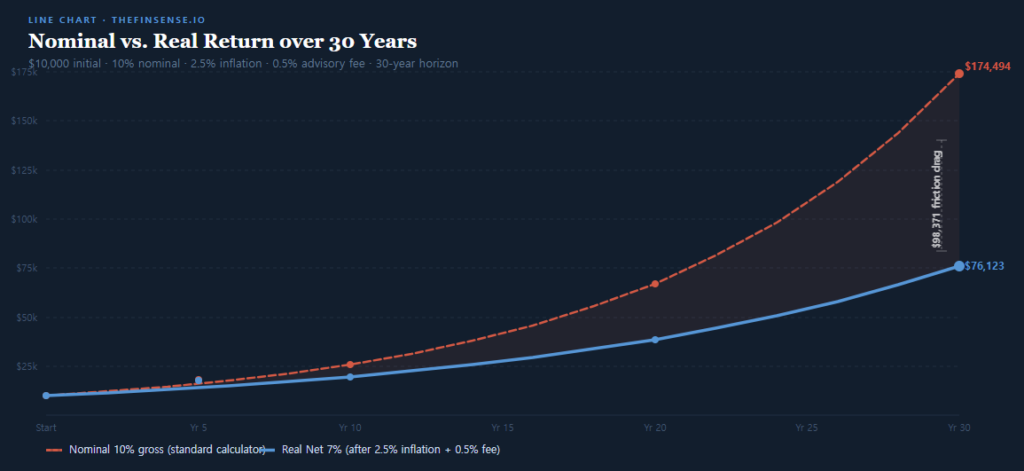
$98,371
The gap between a $174,494 nominal gross projection and a $76,123 real purchasing-power outcome — on a single $10,000 investment over 30 years at 10% nominal, adjusted for 2.5% annual inflation and a 0.5% advisory fee.
That gap does not close on its own. It compounds in the wrong direction — quietly, annually, invisibly — at precisely the same exponential rate as the gains that mask it. The number the calculator gave you does not shrink to meet reality. Your purchasing power shrinks instead, unless you account for friction before you plan.
Inflation and Fees: The Two Silent Forces Behind Every Compound Interest Gap
Compounding amplifies everything you feed into it — gains and costs alike. The two forces that most consistently erode real-world compound outcomes are inflation and investment fees. Neither is dramatic in isolation. Together, across a 20- to 30-year horizon, they compound against your balance on exactly the same exponential schedule as your returns. Understanding their mechanical operation — not just their conceptual existence — is the prerequisite to correcting them.
Inflation is the structural cost of holding a dollar across time. According to Federal Reserve data tracked via FRED, US household saving behavior has historically been shaped by persistent purchasing-power erosion that compounds silently against nominal balances. At 2.5% annual inflation, a dollar today purchases only $0.48 in real goods 30 years from now. For fixed-income instruments facing this same erosion, see how bonds work and how duration magnifies or cushions inflation’s impact depending on where you sit on the yield curve. If your broader goal is to protect savings from inflation, planning against a nominal compound projection is not a solution — it is the starting point before the inflation adjustment is applied.
The 1% Fee That Consumes 25% of Your Portfolio
Fees operate through a different mechanism but produce an equivalently compounding result. Unlike inflation, which is external and macroeconomic, fees directly reduce the effective rate at which your balance compounds — applied before the exponent runs, every single year. A 1% annual advisory fee does not simply cost you 1% of your balance annually. It costs you the compounded value of every fee dollar paid, across every subsequent year of your investment horizon.
According to FINRA’s investor education resources on investment costs, even small annual expense differences compound into material long-term consequences — a finding our own modeling confirms precisely: a 1% annual advisory fee applied over 30 years at 10% nominal erodes nearly 24% of the terminal balance. On $10,000, the gross outcome at 10% is $174,494. At 9% — reflecting the 1% fee — it falls to $132,677. The fee cost is $41,817, or 23.96% of what you would have had. That is not a rounding error. It is one quarter of your portfolio paid in foregone compounding.
There is also a third friction point that practitioners encounter routinely but retail investors rarely model: uninvested cash drag. Fidelity routes uninvested brokerage cash into a default government money market sweep. The yield on that vehicle has historically trailed the federal funds rate by 40 to 80 basis points — a spread that contributes to Fidelity’s net interest margin and reduces the effective return on any cash held between trades or rebalancing events. This is not a line-item fee, and it does not appear on any account statement. But it compounds against you on the same exponential schedule as every other cost in the structure.
▶ Video: A visual breakdown of how inflation and fee drag separate the nominal compound interest curve from your real purchasing-power outcome across a 30-year horizon.
How to Visualize Compound Interest Using the Real-Return Formula
The process for building an accurate compound projection runs in a fixed sequence. You do not start with a target balance and work backward. You start with your nominal return, subtract your actual cost structure, and then apply the exponent. The output will be smaller than any standard calculator returns. It will also be accurate — and an accurate number is the only kind that a retirement plan can survive contact with.
The Real Net Compounding Formula
Real Net Compounding is calculated as: Final Value = Principal × (1 + (Nominal Rate − Inflation − Fees))^Years. Unlike the standard compound interest formula, this version applies the exponent to the net return rather than the gross return — so friction forces compound against your balance on the same schedule as your gains. The critical variable is the bracketed subtraction: (Nominal Rate − Inflation − Fees) produces the Net Real Rate before any exponent is applied.
Each input maps to a real-world source. The nominal rate comes from your investment vehicle’s historical or expected return — for a broad S&P 500 index fund, approximately 10% annualized over the long term. Inflation is proxied by the long-run CPI average, currently modeled at 2.5%. The fee figure aggregates all annual costs: fund expense ratio, advisory charges, and platform fees. Subtracting all three before applying the exponent is what separates an institutionally sound projection from a retail calculator output. Fees applied after compounding understate their actual impact. The sequence is not a style preference — it is where the math requires they go.
Worked example — step by step:
Given: Principal = $10,000 | Nominal Rate = 10.0% | Inflation = 2.5% | Advisory Fee = 0.5% | Years = 30
Step 1 — Calculate the Net Real Rate: 0.10 − 0.025 − 0.005 = 0.07 (7.0%)
Step 2 — Compute the compounding factor: (1 + 0.07)^30 = (1.07)^30 = 7.6123
Step 3 — Apply to principal: $10,000 × 7.6123 = $76,123
In plain English: your $10,000 grows to $76,123 in real purchasing-power terms after 30 years — not the $174,494 the nominal calculator returned. Both figures describe the same portfolio. Only one describes what you can actually spend at retirement.
How to Visualize Compound Interest Step by Step: Applying the Formula at the Brokerage Level
The formula is useful in the abstract, but accurate compounding in practice depends on one specific brokerage setting: the dividend reinvestment plan toggle. Without it, dividends accumulate as uninvested cash — and uninvested cash does not compound. Per IRS Publication 550, dividends reinvested through a DRIP are treated as taxable income in the year received, even though no cash distribution reaches the investor.
This surprises most retail investors at tax time. Your 1099-DIV reflects the reinvested amount as ordinary or qualified dividend income; your cost basis increases by the reinvested value; and the compounding continues — but the tax liability arrives immediately, not deferred to the sale date. Many investors disable DRIP to simplify their tax form, unwittingly sacrificing three decades of reinvestment compounding to avoid a ten-minute accounting adjustment. That is a very expensive simplification.
🧠 IN PLAIN ENGLISH:
Your DRIP toggle is a binary compounding switch. When it is off, dividends sit in a cash sweep earning near-zero yield — where they stop compounding entirely. When it is on, they buy fractional shares immediately, which earn future dividends, which buy more shares. One toggle. Two completely different compounding trajectories across 30 years.
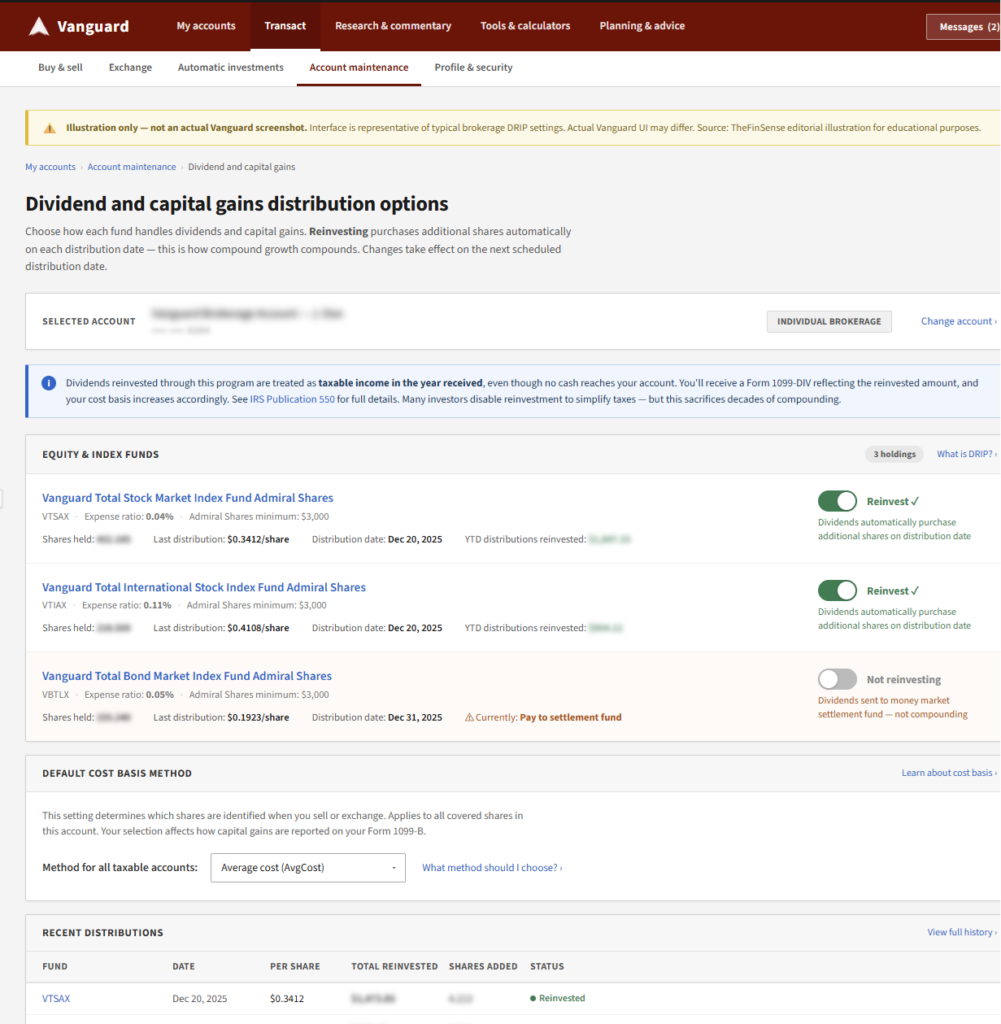
The verification takes under three minutes. Log into your Vanguard account, navigate to Account Maintenance, and open the Dividend and Capital Gains settings screen. If the reinvestment option reads “Pay to money market settlement fund” — the default for many accounts opened without explicit instruction — your dividends are not compounding. They are accumulating at near-zero yield. Over 30 years at 10% nominal, that distinction produces the same $98,371 gap the earlier formula identified. The toggle is the operational implementation of the formula.
The Nominal-vs-Net Gap: What a Side-by-Side Comparison Reveals
Imagine you invested $10,000 in a low-cost S&P 500 index fund 30 years ago, capturing the market’s historical average of roughly 10% per year. Your brokerage statement today shows a balance near $174,000. That nominal figure is accurate. But adjust for the 2.5% annual inflation that eroded your purchasing power across three decades, and subtract the 0.5% advisory fee you paid each year, and your real outcome — what that balance actually buys in today’s dollars — lands closer to $76,000. Both numbers describe the same account. The difference is what compounded against you, rather than for you, across every year of the holding period.
❌ Nominal Projection (Standard Calculator Output):
$10,000 at 10.0% gross over 30 years → $174,494 terminal balance. Assumes zero inflation erosion, zero advisory fee, and frictionless dividend reinvestment throughout. This is the figure that appears in every default retirement calculator — arithmetically correct, and practically misleading as a planning target.
✅ Real Net Projection (Friction-Adjusted Output):
$10,000 at 7.0% net (10% − 2.5% inflation − 0.5% fee) over 30 years → $76,123 real purchasing-power balance. This is what you can actually spend at retirement in today’s dollar terms. It is the only projection worth building a plan around.
The $98,371 gap is not uniformly distributed between its two sources. Approximately $55,000 of the discrepancy originates from inflation erosion — the purchasing-power loss that occurs regardless of how efficiently you invest, and which no portfolio optimization can eliminate. The remaining $43,000 reflects advisory fee drag — and unlike inflation, this component is directly actionable. Switching from a 0.5% advisory fee to a 0.04% index fund expense ratio (self-managed) reduces fee drag by roughly 92% of that $43,000 figure. The math is not subtle. It is the single largest lever a retail investor can pull without changing a single holding in the portfolio.
💡 PRO TIP: Bring this comparison to your next advisor meeting as a printed two-column table. Advisors expect questions about performance. They rarely expect questions about the advisory fee’s compounded opportunity cost across your specific remaining horizon. The conversation will shift from “what is my target?” to “what does it cost to reach it?” — which is the more productive question to answer first.
What this comparison still does not answer is which specific lever — adjusting the nominal yield target, restructuring the fee, or optimizing the inflation hedge — produces the highest net real compounding gain per unit of effort. That is precisely what the Wealth-Velocity Filter quantifies, applying the Rule of 72 to each variable in sequence to identify where a single optimization delivers the most additional doubling cycles across your remaining investment horizon.
The Wealth-Velocity Filter: A Four-Step Framework for Accurate Compound Planning
The Wealth-Velocity Filter is not a prediction model. It is a stripping mechanism — a fixed sequence that removes the noise layers from a nominal return and leaves the rate at which your specific portfolio actually compounds in the real world. The output will be smaller than the calculator returned. It will also be the only number that survives contact with three decades of inflation and fee drag without deceiving you about your destination.
Each step addresses a distinct friction source and can be verified directly from your account statements without making a single assumption about future markets. The steps run in order. You do not optimize before you measure — you measure precisely, then direct the optimization toward the variable that returns the most net real compounding per unit of effort.
- Step 1 — Pull your gross nominal rate. Locate the annualized return figure in your fund’s fact sheet or your brokerage’s historical performance summary. For a broad S&P 500 index fund, the long-run gross return is approximately 10% annualized. Do not use your account’s recent 1- or 3-year performance as this input — recency bias in short windows produces projections that are unusable for retirement planning. Use the 20- or 30-year historical figure, or a conservatively estimated forward return drawn from a source such as current Shiller CAPE-based forward-return estimates.
- Step 2 — Subtract your inflation assumption. The long-run U.S. CPI average is a reliable baseline at 2.5% for most 20-to-30-year projection windows. If you are within 10 years of retirement and concerned about sequence-of-returns risk, use 3.0% as a conservative adjustment. This subtraction is the one variable in the filter you cannot control — NBER Working Paper 30982 (Cieslak and Pflueger, 2023), published in the Annual Review of Financial Economics, documents the material long-run erosion inflation inflicts on real asset returns across both equity and fixed-income classes, confirming that the inflation haircut is not a modeling preference — it is a documented structural feature of long-horizon investing.
- Step 3 — Subtract your total annual fee load. This is the most commonly miscalculated input, because most investors only subtract the advisory fee line visible on their statement. Your true fee load is the sum of three components: (a) your fund’s expense ratio, (b) your advisor’s annual management fee, and (c) any platform or custodial charges. On a Vanguard self-directed account holding VTSAX, the total annual fee load is approximately 0.04%. With a 0.5% advisory layer added, it rises to 0.54%. That difference — 0.04% versus 0.54% — captures nearly 92% of the reducible friction in a standard retail portfolio. No rebalancing overlay, no tactical allocation shift, and no fund-selection optimization produces a comparably clean single-lever improvement at this cost.
- Step 4 — Apply the Rule of 72 to your net real rate. Divide 72 by the net real rate you calculated in Steps 1–3 to obtain your actual doubling time in years. Then divide your remaining investment horizon by that doubling time to count your realistic doubling cycles. Compare this against the nominal cycle count to quantify how many doublings friction is costing you across your specific timeline. This step converts an abstract rate difference into a cycle count — the most intuitive unit for grasping what compounding actually does over decades.
What the Rule of 72 Reveals About Each Friction Scenario
The Rule of 72 is a practitioner shorthand, but in this context it does something the compound interest formula tends to obscure: it quantifies the gap not in dollars but in cycles — the number of times your money doubles in the real world versus the calculator world. Dollar gaps arrive at the end of the timeline and feel abstract until retirement. Cycle losses are visible now, because they describe how many times the machine doubles before it stops running.
| Net Real Rate | Rule of 72: Doubling Time | Doublings Over 30 Years | $10,000 Grows To |
|---|---|---|---|
| 10.0% (nominal — zero friction) | 7.2 yrs | 4.2 | $174,494 |
| 9.0% (−1.0% advisory fee only) | 8.0 yrs | 3.75 | $132,677 |
| 7.5% (−2.5% total friction) | 9.6 yrs | 3.13 | $87,549 |
| 7.0% (−3.0% friction: inflation + fee) | 10.3 yrs | 2.91 | $76,123 |
The bottom row describes the median retail investor with a 0.5% advisory fee and 2.5% average annual inflation. The 1.3 lost doubling cycles that friction imposes across 30 years do not register as pain in any single year. They arrive as one number at retirement — a terminal balance that is 56% smaller than the nominal projection declared it would be. The Wealth-Velocity Filter does not eliminate inflation, because nothing does. But it eliminates the advisory fee component entirely for any investor willing to self-direct into a 0.04% index fund, and it makes the cost of not doing so visible before the retirement plan is built rather than after.
💡 PRO TIP: Run the Wealth-Velocity Filter annually, not once per decade. Most advisory fees are AUM-based — they scale with your balance. A 0.5% fee on $50,000 is $250 per year. On $500,000, it is $2,500 per year, and every dollar of that fee foregoes its own 30-year compounding trajectory. The filter reveals this re-escalating drag at each balance checkpoint, which is the only way to evaluate whether the service value justifies the compounding cost at your current portfolio size.
Case Study: How to Visualize Compound Interest at 10% Nominal vs. 7% Net Over 30 Years
The Wealth-Velocity Filter is most legible applied to a single concrete scenario. The investor below is deliberately simple: one starting balance, no additional contributions, and one fixed rate assumption for each path. Real investors contribute monthly and face variable annual returns. Simple models, however, reveal mechanisms cleanly — and the mechanism here is the one that matters. The compounding schedule is identical between the nominal and real net paths. Only the rate that feeds the exponent differs.
The Setup: One Portfolio, Two Rate Assumptions, One 30-Year Horizon
Investor profile: $10,000 initial investment in a low-cost S&P 500 index fund. 30-year holding period. Dividend reinvestment active. No withdrawals. The nominal projection uses 10.0% gross — the S&P 500’s long-run historical average. The real net projection uses 7.0%, the output of the Wealth-Velocity Filter after subtracting 2.5% CPI inflation and 0.5% annual advisory fee. Both paths use the same starting capital, the same index, and the same 30-year window. The only variable is the rate the exponent runs on.
The Do-Nothing Projection: Planning Without the Wealth-Velocity Filter
“Do-Nothing” in this context is not a passive investment strategy — it is an active planning error. It describes the investor who opens the standard calculator, enters 10% gross, and builds a retirement target against that output without applying any friction correction. Nothing is wrong with the underlying investment. The error is in the planning layer: the investor does not subtract inflation, does not account for the advisory fee, and therefore works toward a balance that cannot be spent at its stated value in real-world purchasing power when it arrives at retirement.
| Time Horizon | Nominal Path: 10% Gross (Planning Error) | Real Net Path: 7% (Friction-Adjusted) | Compounded Friction Drag |
|---|---|---|---|
| Year 1 | $11,000 | $10,700 | −$300 |
| Year 3 | $13,310 | $12,250 | −$1,060 |
| Year 5 | $16,105 | $14,026 | −$2,079 |
| Year 10 | $25,937 | $19,672 | −$6,265 |
| Year 20 | $67,275 | $38,697 | −$28,578 |
| Year 30 | $174,494 | $76,123 | −$98,371 |
The $98,371 gap at Year 30 is not money that evaporated through bad luck or poor selection. It is money that was always going to transfer to the Consumer Price Index and to advisory fee revenue — on a compounding schedule that runs with exactly the same efficiency as your gains. In practical terms, that gap represents a second vehicle, approximately 3.5 years of median U.S. rent payments, or — depending on your annual draw-down rate — five to six additional years of retirement income that the nominal projection quietly removed from your planning horizon without ever notifying you.
The Optimized Projection: What the Real Net Path Produces
The 7% real net path is not a pessimistic scenario. It is the direct output of the Wealth-Velocity Filter applied to a standard S&P 500 index investment with a 0.5% advisory fee and a 2.5% inflation assumption — no exotic instruments, no leverage, no concentrated positions. The same index fund. The same investor. The only variable that changed is the calculation input.
The arithmetic is exact and reproducible at every intermediate checkpoint. The full compounding formula at 7% net over 30 years: $10,000 × (1.07)^30 = $10,000 × 7.6123 = $76,123. Year 10 resolves to $10,000 × (1.07)^10 = $10,000 × 1.9672 = $19,672. Year 20: $10,000 × (1.07)^20 = $10,000 × 3.8697 = $38,697. The doubling pattern confirms the Rule of 72 output to within rounding: the first doubling occurs at approximately Year 10, the second at Year 20, and the third partial doubling delivers $76,123 by Year 30 — precisely 2.91 doubling cycles, as the rule predicted.
The actionable conclusion is not that $76,123 is a disappointing outcome. It is that $76,123 is an honest outcome — one an investor can plan against, contribute toward, and adjust for. An investor who plans against $174,494 and arrives at $76,123 faces a 56% purchasing-power shortfall at the moment when no recovery time remains. An investor who plans against $76,123 may arrive at $80,000 or $90,000 if the nominal rate cooperates above the 10% baseline — and will not face an unplanned adjustment in the final decade of the accumulation phase. The Wealth-Velocity Filter does not improve your investment return. It improves your planning accuracy, which is the only input to a retirement projection that is entirely within your control.
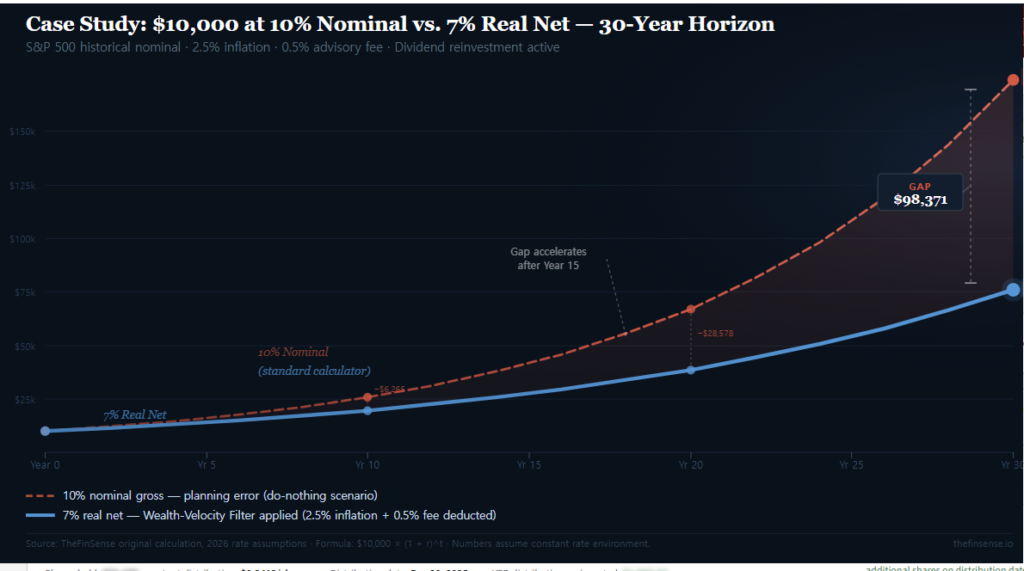
56%
The terminal balance shortfall when the nominal 10% projection ($174,494) is compared against the real net 7% outcome ($76,123) on $10,000 over 30 years — the planning gap that materializes at retirement when the Wealth-Velocity Filter is not applied before building the savings target.
📐 YOUR NUMBERS MAY DIFFER
This case study assumes 2.5% inflation and a 0.5% advisory fee. Here’s how the real net outcome changes when you adjust these two variables:
| Friction Scenario | Net Real Rate | $10,000 at Year 30 | Conclusion |
|---|---|---|---|
| Low-cost self-directed (0.04% ER, 2.5% CPI) | 7.46% | $83,645 | Fee reduction alone adds $7,500+ |
| Base case (0.5% advisor, 2.5% CPI) | 7.00% | $76,123 | ✅ Base case — this article’s model |
| High-cost (1.0% advisor, 3.0% CPI) | 6.00% | $57,435 | 33% worse than base — avoidable friction |
💬 YOUR TURN
What is the total annual fee load on your largest investment account — advisory fee plus expense ratio combined?
Drop a comment below 👇
Frequently Asked Questions: How to Visualize Compound Interest Accurately
What is the most accurate way to visualize compound interest for retirement planning?
The most accurate method subtracts inflation and total annual fees from the gross nominal rate before applying the compounding exponent. The formula is: Final Value = Principal × (1 + (Nominal Rate − Inflation − Fees))^Years. Running the exponent on the net real rate — rather than the gross rate — produces a projection that reflects actual purchasing power at retirement, not a nominal balance that overstates what you can spend in real-world dollars.
Why does my actual investment balance grow slower than compound interest calculators predicted?
Standard calculators use the gross nominal return as input without deducting inflation or fees. Inflation erodes purchasing power by approximately 2.5% annually; a 0.5% advisory fee reduces the effective compounding rate further. Over 30 years, these two friction sources together reduce a $10,000 investment’s real value from $174,494 (nominal) to $76,123 (real net) — a 56% shortfall that compounds silently across the entire holding period and appears only at retirement.
How much does a 1% annual advisory fee reduce compound interest over 30 years?
A 1% annual advisory fee over 30 years on a 10% nominal return reduces the terminal value from $174,494 to approximately $132,677 on a $10,000 investment — a reduction of $41,817, or roughly 24% of the full unadjusted outcome. This occurs because the fee lowers the effective compounding rate from 10% to 9%, and the exponent runs on 9% for all 30 cycles rather than 10%.
What is the Rule of 72 and how does it help visualize compound interest doubling time?
The Rule of 72 estimates doubling time by dividing 72 by your net real rate. At 7% net, your money doubles approximately every 10.3 years (72 ÷ 7). Over 30 years, that yields 2.9 doubling cycles. At 10% nominal, the same $10,000 doubles every 7.2 years — producing 4.2 cycles. The 1.3 lost cycles represent the real compounding cost of inflation and fee drag expressed as missed doubling events rather than as a dollar figure.
Should I use nominal or real returns when projecting my retirement savings balance?
Always use real returns — the net rate after subtracting both inflation and fees — for retirement planning. Nominal projections describe a balance in future dollars with no purchasing-power adjustment, which does not reflect what you can actually buy at retirement. Real-return projections denominate everything in today’s dollars, letting you compare your projected retirement income directly against your current cost of living without a separate conversion step.
Bottom Line: The Right Way to Visualize Compound Interest — And What $1M Actually Costs
Every time you visualize compound interest using a standard calculator, you are looking at a number that was never going to appear in your account. The $174,494 that a 10% nominal projection produces on $10,000 over 30 years is arithmetically correct — and practically useless as a planning target, because it describes an investor who pays no fees, experiences no inflation, and reinvests every dividend in a frictionless environment that does not exist. Planning against that investor’s projected balance is not a conservative strategy. It is a 56% shortfall scheduled to arrive at the exact moment when there is no runway left to recover it.
The correction is three subtractions: Nominal Rate − Inflation − Fees = Net Real Rate. That rate — 7.0% in the baseline scenario modeled across this article — is the number the exponent belongs on. It produces $76,123 rather than $174,494. The $98,371 gap is not pessimism inserted into a projection. It is the compounded cost of inflation and advisory fees, both of which operate on the same exponential schedule as your gains, in the same account, across the same 30 years.
The single most powerful lever available to a retail investor is not asset allocation, not market timing, and not fund selection. It is the annual fee load. Reducing advisory fees from 0.5% to 0.04% by self-directing into a low-cost index fund moves the net real rate from 7.0% to 7.46% — a modest arithmetic change that adds measurable additional compounding cycles across a 30-year horizon with zero change in the underlying investment. The Wealth-Velocity Filter exists to make that lever visible before the retirement plan is built, rather than after the plan has been running on the wrong number for a decade.
The deeper irony is structural: the more investors trust nominal calculator outputs and delay self-direction, the more of the $98,371 gap they permanently surrender. Every year a 0.5% advisory fee runs on a growing balance, the fee itself is compounding — not in the investor’s favor, but in the advisor’s. Running the filter annually, not just at plan inception, is the only way to track this re-escalating cost against the value the advisory relationship actually delivers at each new portfolio milestone. For cash that sits outside retirement accounts and needs its own inflation defense while waiting to be deployed, see the Safe Investments to Beat Inflation guide.