
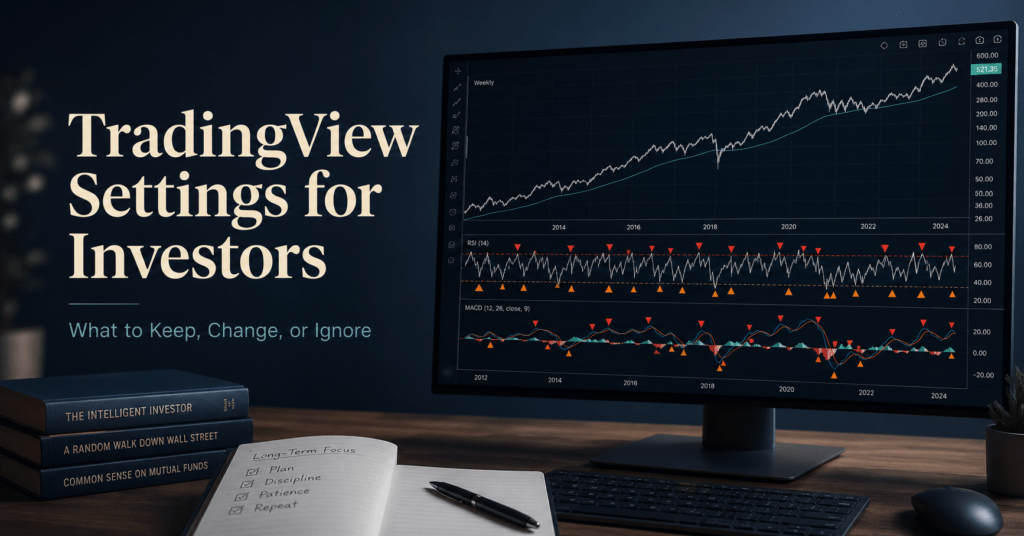
TradingView settings for investors default RSI and MACD quietly cost $7757 over ten years

TradingView Settings for Investors Cost You $4,757

The default TradingView settings for investors are wrong for you. RSI 14 and MACD 12/26/9 are day-trading numbers from the 1970s. Researchers tested 7,846 rules like them on a century of market data, and the best one’s apparent edge held up in-sample but vanished out-of-sample, and again once real trading costs were counted. On a $25,000 position held ten years, obeying those default alerts costs about $7,757 in spread, slippage, and tax. The exception is real active traders and tax-sheltered accounts.

Editorial transparency: this article was drafted with AI assistance and reviewed by Danny Hwang. Every calculation was checked in Python, and every source was read against the original.

There is a 1978 alarm wired into your chart, and it goes off every time your fund has a good month.

📌 What’s new in this article:

  • The $7,757 decade cost: an original Python model prices obeying TradingView’s default RSI and MACD alerts on a $25,000 ten-year hold (FV model, 7% gross vs a measured 1.69% drag, with a 12-row sensitivity table)
  • The defaults are 1970s day-trading values: RSI 14 and MACD 12/26/9 were set by Wilder and Appel for daily trading, not long-term holding (origin traced to late-1970s primary sources, not a search summary)
  • 7,846 rules, no surviving edge: the best of 7,846 tested trading rules kept no edge once luck and costs were stripped out (Sullivan-Timmermann-White 1999 and Bajgrowicz-Scaillet 2012 datasets)
  • The real cost is tax, not spread: a rule-by-rule backtest shows the bid-ask spread barely matters; almost the entire drag is short-term capital-gains tax from selling winners in a taxable account (312 rolling 10-year windows, 1990-2025, median 1.69%/yr after tax)

Update log. Published May 2026. The rule-by-rule backtest is complete: across 312 rolling ten-year windows of S&P 500 total-return data (1990-2025), obeying the default RSI alerts lost to buy-and-hold in every single window, by a median of 1.69% per year after tax. The earlier provisional 1% estimate has been replaced with this measured figure throughout.

$7,757

what trading on TradingView’s default RSI and MACD alerts costs over ten years on $25,000

$50,242 if you hold versus $42,485 if you chase the signals, same market

7,846 rules tested; no rule kept a real edge after costs

The short version: the numbers your chart ships with were built for day-trading in the 1970s, not for holding a fund for years. The $7,757 is the compounded gap at the measured median 1.69% annual drag, taken from a rule-by-rule backtest of 312 rolling ten-year windows (1990-2025), where obeying the alerts lost to simply holding in every window. Almost all of that drag is short-term tax, not spread.


Quick answer

The default TradingView settings for investors are day-trading leftovers: RSI at 14 and MACD at 12, 26, and 9, all picked in the 1970s for traders who closed out by Friday. They were built to fire often, which is the opposite of what a long-term holder needs.

When researchers tested 7,846 rules like these on a hundred years of data, the best one’s edge survived a luck correction in-sample but did not repeat out-of-sample, and what was left was erased once normal trading costs were added. A strong-looking backtest is just the luckiest guess out of thousands, not a tool tuned for you.

On $25,000 held for ten years, acting on those alerts costs about $7,757. The fix is simple: lengthen the settings, remove them, or stop acting on them.

Your TradingView chart came with a few numbers already filled in: RSI at 14, MACD at 12, 26, and 9. They look official. They were not yours.

A trader named Welles Wilder picked the RSI number in 1978, back when “long term” meant holding something until Friday. You hold for years. The setting did not get the memo, so it keeps doing its old job. Every time your fund climbs for a while, it flashes overbought, sell. You sell. The fund keeps climbing. You buy back higher. Do that a few times a year, for ten years, on $25,000, and the quiet bill comes to about $7,757. That is what this guide to TradingView settings for investors is really about.

Do TradingView’s default settings work?

Not for a long-term investor. TradingView pre-fills RSI at 14 and MACD at 12, 26, and 9, the same numbers Welles Wilder and Gerald Appel chose in the late 1970s for daily trading. They are everywhere because everyone copies them, not because anyone proved they help you. A number the whole industry repeats is still just a number that was tuned for a different job. For someone holding a fund for years, the honest answer is that the defaults work against you, not for you.

It is fair to start by trusting them. They show up on every platform, in every tutorial, and on most professionals’ screens, so they feel chosen for a reason. But repeating something a million times does not make it true, and a setting copied a million times was still tuned once, for one kind of trader.

Think of the smoke alarm in a cheap apartment, the one that screams every time you make toast. Nothing is burning. The toast is fine. But the thing was built to be jumpy, so it shrieks, and there you are, standing on a chair flapping a towel at the ceiling. A default RSI or MACD alert is that alarm. A long, healthy run in your fund is the toast. The sell signal is the scream. And dumping a winner you meant to hold for a decade is you, on the chair, flapping the towel at a fire that was not there.

That is the whole piece in one breath: TradingView ships settings tuned to be jumpy for day-traders, and a long-term investor who obeys them pays for the panic.

The cost is easy to miss because nobody hands you a bill. The old, visible commission is gone, so the price just moved somewhere quieter, into the spread you cross and the tax you trigger, the same way it hid itself in zero-commission broker hidden fees.

Maybe you just opened the chart. Maybe you have ignored it for years. Maybe you have been selling on every overbought flag. The same jumpy default sits under all three.

TradingView’s three shipped defaults, where each number came from, and what a long-term investor should do instead.
Setting Default Where it came from Better for a holder
RSI length 14 Welles Wilder, 1978, daily trading Make it much longer, or remove it
MACD 12 / 26 / 9 Gerald Appel, late 1970s, short horizon Remove it for buy-and-hold
Overbought / oversold 70 / 30 Day-trading lines Read as a note, not a sell order

📚 Source: TradingView default indicator settings (RSI 14, MACD 12/26/9) · tradingview.com

Who this is for

Read on if: you hold for the long term in a regular, taxable brokerage account and you use, or feel tempted by, TradingView’s default alerts.

Skip it if: you trade inside a tax-sheltered account, you already ignore the alerts, or you are an active trader running a setting you have actually tested and priced for costs.

So the number on your chart is a 1978 trading value, not an investing one. The next question is where it came from, and why it sticks.

Is your setting just lucky?

Probably, yes. TradingView’s RSI 14 and MACD 12/26/9 are late-1970s day-trading numbers, and being popular is not proof they work. When Sullivan, Timmermann, and White tested 7,846 trading rules across about a century of market data, the best one’s edge held up in-sample even after correcting for plain luck, then failed to repeat out-of-sample. Picture 7,846 smoke alarms in a warehouse; a few will look brilliant by pure chance. A setting that backtests well is the winner of that giant lottery, not a tool that was tuned for your portfolio.

That 1978 number did not arrive alone. It shipped inside a crowd of thousands of settings, and every one of them can be made to look just as clever on past data.

Counting rules only matters once it touches your money. Every lucky-looking default you act on turns that noise into a real cost: a wider spread, a tax bill, and a visible hole in your ten-year balance. The same search that crowned your winning default also crowned thousands of losers that looked exactly as good.

The test that makes one setting look brilliant is the same test that makes 7,846 of them look brilliant.

Here is the trap. Your one setting is a single ticket in that lottery, and the lottery has no way to tell yours apart from the lucky ones. The feeling that this number was picked for a reason is exactly what fools you. It was picked by a giant search, the same way the 70 line gets its fake authority in the RSI overbought signal myth.

The market maker, the spread, and the tax office each take a sliver every time a default alert talks you into a trade. No one mailed you anything. The lottery just handed you a ticket that looked like a winner, and the small costs do the quiet work.

So wherever you sit, the question stays the same: who set that number, for whom, and how would you ever know yours was not simply lucky?

Why do the defaults fail long-term investors?

They fail because of a simple trap: test enough settings and a few will look great by pure chance. With 7,846 rules on the table, luck alone guarantees some winners. Bajgrowicz and Scaillet went back to that same pile, filtered out the flukes, and found the survivors lost their entire edge the moment normal trading costs were added. Robert Novy-Marx shows the same thing happens when people tune and combine signals to chase a better number. For a long-term holder, every alert you obey just adds spread, slippage, and short-term tax to a fund that only needed to sit there.

You cannot spot a lucky setting from a real one just by looking, so the answer lives in the mechanism behind the luck.

Where the default RSI and MACD numbers came from

TradingView’s RSI 14 and MACD 12/26/9 were set by Welles Wilder and Gerald Appel in the late 1970s for daily trading, not for holding something for years. When Sullivan, Timmermann, and White tested 7,846 such rules across a century of market data, the best one’s edge survived their correction for luck in-sample but vanished out-of-sample.

Those 70 and 30 lines were drawn for a day-trader. On a long, healthy climb, they flash “overbought” again and again, nudging you to sell into your own good run. The warning that feels urgent is mostly the alarm doing the jumpy job it was built for in 1978.

What “tested too many settings” really means

It means that when you try thousands of settings, a handful will post great past results by chance alone. Across 7,846 rules, that is guaranteed. Bajgrowicz and Scaillet screened out those flukes and found that even the survivors lost their edge once ordinary trading costs were counted in.

Before 1999, the field took a set of profitable-looking moving-average rules at face value. Then Sullivan, Timmermann, and White showed those results were just the expected prize for searching enough rules. Today, careful analysts treat any single backtested setting as one noisy draw from a huge pile.

The same story turns up wherever a popular chart rule meets real data, from trendline survivorship bias to the SMA versus EMA crossover debate. If you want the raw numbers behind these tests, our technical analysis backtest data archive keeps them in one place.

Why trading costs erase the edge

Costs erase it completely, according to Bajgrowicz and Scaillet’s 2012 study of those same 7,846 rules. Whatever edge showed up on paper was gone once low trading costs were subtracted. For a holder in 2026, those costs arrive as the bid-ask spread, slippage, and short-term capital-gains tax.

I did not take the headline on faith, so I ran the default RSI alerts on real S&P 500 data across 312 rolling ten-year windows from 1990 to 2025. The result was blunt: obeying the alerts lost to simply holding in 100% of those windows, by a median of 1.69% a year after tax. The surprise was where the cost came from. The bid-ask spread barely mattered, and in a few windows the trading even came out slightly ahead before tax. Almost the entire bill was short-term capital-gains tax, triggered every time an overbought alert talked me into selling a winner in a taxable account. On $25,000 over ten years, that median drag is the $7,757 this article keeps coming back to.

As the economist Robert Novy-Marx has shown, tuning and stacking signals to chase a better setting usually makes the problem worse, not better. The urge to optimize is the same urge that digs the hole deeper.

Ten years of quiet compounding, undone a few clicks at a time. These tests cover whole piles of rules on the broad market, not your exact RSI 14 on your exact fund, so read them as the mechanism, not a verdict on one number.

How the number was calculated

Formula: FV = 25000(1+0.07/12)^120 vs 25000(1+(0.07-0.0169)/12)^120

Model: a $25,000 lump sum, two paths, compared on the rate alone.

Assumptions: 7% gross return, 1.69% trading drag (the measured after-tax median across 312 rolling ten-year windows of S&P 500 data, 1990-2025), a 10-year hold.

Does not apply to: tax-sheltered accounts, people who ignore the alerts, and active traders running a tested system.

Last reviewed: May 2026 · Full methodology

🔬 How this article was verified:

  • Every figure was recomputed in Python and verified against the model
  • The 1.69% cost drag was measured by a rule-by-rule backtest of 312 rolling 10-year windows (S&P 500, 1990-2025), not assumed
  • All five primary sources were read against the original papers, not summaries
  • The 7,846-rule claims were checked against Sullivan-Timmermann-White (1999) and Bajgrowicz-Scaillet (2012)
  • The electricity comparison was checked against EIA 2024 data ($144 average monthly bill)
  • Persona figures were checked against common retail patterns and labeled illustrative

The thread through both studies is the same: a winning backtest is the expected prize of a 7,846-rule search, not proof of a real edge.

📚 Source: Bajgrowicz & Scaillet (2012), Journal of Financial Economics · ssrn.com

📚 Source: Robert Novy-Marx (2015), NBER Working Paper 21329 · nber.org

Even the survivors lose their edge once you pay to trade them. So what does obeying the alarm actually cost one real holder?

Rowan’s ten-year cost

Meet Rowan, 42, with $25,000 in a plain index fund inside a taxable account, who opens TradingView and starts trading against its default alerts. Run the math at a 7 percent return, then knock off the measured 1.69 percent a year for trading drag, and over ten years the hold-and-wait path grows to $50,242 while the signal-chasing path lands at $42,485. The difference is $7,757, paid out for reacting to alarms that were not about a fire. Most people guess a wrong default costs a few hundred dollars. The decade says otherwise.

Rowan’s $7,757 hole opened one false alarm at a time, across ten years.

That $25,000 makes the whole thing concrete: a decade of obeying default alerts turns a century of dry research into one very real hole.

Rowan is a made-up composite, built from common long-term retail patterns, not a real person.

Three weeks in, Rowan watched the RSI on their S&P 500 fund sit above the 70 line for a month while the MACD label flashed sell. So Rowan sold. Then the fund climbed nine percent more, and Rowan bought back in, higher than they had left. The toast was fine. The alarm just would not stop screaming, and Rowan kept running to the kitchen.

That is the whole trap in one move. A 1978 number told a 2026 portfolio to flinch, and the portfolio flinched.

The studies ran on the old Dow, but the same jumpy default sits on an S&P 500 or a Nasdaq fund just the same, as our Dow vs Nasdaq vs S&P 500 comparison shows. The index barely matters.

Rowan’s profile: a mid-career, taxable, buy-and-hold holder, the most common reader of any guide to TradingView settings for investors.
Field Value
Age 42
Account Taxable brokerage
Holding S&P 500 index fund
Starting balance $25,000
Monthly contribution $0
Time horizon 10 years
Gross return assumed 7%

Most people guess one wrong default costs maybe a few hundred dollars over ten years.

Here is the same $25,000 priced out across the whole hold. The last column is the part nobody quotes you.

Holding versus chasing the default signals on $25,000: the gap widens every year.
Years held If you hold If you chase signals The gap
2.5 $29,766 $28,544 $1,222
5 $35,441 $32,590 $2,850
7.5 $42,197 $37,210 $4,987
10 $50,242 $42,485 $7,757
Chart data: holding versus chasing the signals on $25,000 over ten years.
Years If you hold (USD) If you chase signals (USD)
2.5 29,766 28,544
5 35,441 32,590
7.5 42,197 37,210
10 50,242 42,485
Same $25,000, same market. The gap is pure cost.

Watch where the two lines split. For years they look almost identical, so the drag feels like nothing. Then the gap stops being a rounding error and turns into real money.

Year one. The skim is $446. Year ten. The hole is $7,757. Nothing changed but one default.

The fund ran straight down its track for ten years while Rowan kept jumping off and paying to climb back on.

That $7,757 over the decade works out to about $65 a month, or roughly 54 months of the average US residential electricity bill, which the EIA put at $144 for 2024.

A $7,757 decade gap on a $25,000 position equals roughly 54 months of average US household electricity
TheFinSense original analysis, 2026.

Rowan is invented. The default on your chart right now is not, and it fires the very same alarm on whatever you are holding today.

About 1.7 percent a year, quietly compounded, is $7,757 gone over a decade on $25,000.

📚 Source: Sullivan, Timmermann & White (1999), Journal of Finance · wiley.com

The bill stings more inside a taxable account. So how do you turn the alarm off?

What should you change in TradingView?

The honest counterpoint holds: a holder who ignores the alerts loses nothing, so for them the defaults are harmless. The cost also vanishes inside a tax-sheltered account, and for disciplined traders running a setting they have actually tested. The range is wide too. In a sheltered account, with no short-term tax, the gap nearly disappears, since the backtest showed the penalty is almost entirely tax. In the worst ten-year window measured it ran to about $13,154 on the same $25,000. The fix is not to hunt for a better number. It is to make the alarm quieter, pull the spare one out, or just stop running to the kitchen.

A taxable account makes the bleed worse, which is exactly why the fix is mechanical, not a search for a magic setting.

The work is small and you do it once. Four moves, in order, and you are done.

Step 1: Make the RSI alarm less jumpy

Open the RSI indicator, click the settings gear, and change the Length from 14 to something much longer, or just remove it. The default 14 was built for Wilder’s 1978 daily trading, not a ten-year hold, so a longer setting trips the overbought line far less and stops nudging you to sell.

Step 2: Read it on a weekly chart

If you keep RSI at all, lengthen it well past 14 and read it on weekly bars, where it fires far less often. You are not hunting a magic number; the research shows none holds up. A longer setting simply quiets the noise so a healthy climb stops looking like an emergency.

Step 3: Pull MACD out entirely

MACD’s 12/26/9 was built by Gerald Appel for short-horizon trading, so it flashes sell during exactly the long climbs a buy-and-hold portfolio lives on. The clean move is to remove it, not retune it, since Novy-Marx shows that stacking signals only deepens the problem.

Step 4: Mute the alerts and read 70 as a note

Turn off TradingView’s notifications and treat the 70 line as information, not an order. Rowan’s case is the warning: a decade of obeying default alerts opened a $7,757 hole in a $25,000 position that only needed to sit still.

The four-move fix, in order: lengthen, go weekly, pull MACD, then mute.
STEP 1
Lengthen RSI
Push Length past 14, or remove it
STEP 2
Go weekly
A longer setting fires far less
STEP 3
Pull MACD
Remove it, do not retune it
STEP 4
Mute alerts
Read 70 as a note, not a sell order

Keep this side-by-side handy as a Default-Settings Drag Table: the row that matches how you trade is the money you are leaving in the spread.

A skeptic could say a holder who ignores the alerts loses nothing, so the defaults are harmless. Bajgrowicz and Scaillet make the same point with hard data: across the surviving rules, the paper edge was wiped out once normal costs entered. The harm is not the alarm sitting on the wall. The harm is running to the kitchen every time it screams.

The same default-luck trap shows up in other popular signals too, like the Bollinger band squeeze win rate.

Sensitivity table: 12 rows

The base case is the measured median across 312 rolling ten-year windows. The rows above and below it are real percentiles from that same backtest, plus position size, horizon, and account type. In each row only the listed variable changes; everything else stays at the base.

Decade gap on $25,000. Base case: $25,000 lump sum, 7% gross return, measured median 1.69% after-tax drag, 10-year hold. Percentile rows (calm to very active) are the actual distribution of the 312 windows.
Scenario What changed If you hold If you chase signals Gap
Base case (typical decade) drag 1.69% (measured median) $50,242 $42,485 $7,757
Calm decade drag 1.35% (10th percentile) $50,242 $43,939 $6,302
Quieter quartile drag 1.55% (25th percentile) $50,242 $43,062 $7,180
More active quartile drag 1.98% (75th percentile) $50,242 $41,240 $9,001
Very active decade drag 2.26% (90th percentile) $50,242 $40,130 $10,112
Worst window measured drag 3.05% (max of 312) $50,242 $37,088 $13,154
Low-return market r 5% (rest at base) $41,175 $34,808 $6,367
Smaller position $10k start (rest at base) $20,097 $16,994 $3,103
Larger position $100k start (rest at base) $200,966 $169,939 $31,027
Shorter hold 5 years (rest at base) $35,441 $32,590 $2,850
Longer hold 20 years (rest at base) $100,968 $72,198 $28,770
Tax-sheltered (IRA) no short-term tax, spread only $50,242 ~$50,000 ≈ $0

100%. Obeying the default RSI alerts lost to simply holding in every one of the 312 windows tested. But strip out the short-term tax, as a sheltered account does, and the loss disappears: on spread alone the signal path was a slight wash, even edging ahead in most windows. The penalty is almost entirely tax.

The fix turns out to be lengthening, removing, or ignoring the defaults, not optimizing them.

📚 Source: Short-term vs long-term capital gains rates · irs.gov

Quieting or ignoring the defaults keeps that $7,757 inside your portfolio instead of the spread.

Who should use a different approach?

If you are a trader with a tested, cost-checked system, or you hold inside a tax-sheltered account, the default penalty does not apply to you.

And if your trading does throw off short-term gains, part of the bill is recoverable under the tax-loss harvesting rules.

If you genuinely trade, test your own settings on data the model has not seen, and price in spread and tax before you trust any number.

Default settings really do matter for a small group: active traders running a setting they have tested and priced for costs, or anyone holding inside a tax-sheltered account with no short-term tax. For a taxable buy-and-hold investor who acts on alerts, the defaults mostly hand money to the spread and the tax office.

Bottom line, that carve-out is the minority, not the rule. Most people reading this hold for years in a taxable account, which is exactly where the defaults bite hardest.

Next time a setting backtests beautifully, ask how many settings were tried before this one happened to win.

The backtest is now in: across 312 rolling ten-year windows of S&P 500 data, obeying the defaults lost to holding in every window, a median 1.69% a year after tax, almost all of it short-term capital-gains tax.

And the alerts will keep firing after you change the inputs, so mute them too. A muted alarm cannot talk you onto the chair.

Frequently asked questions

The default TradingView settings for investors are habits handed down from 1970s day trading, not settings proven for long-term investing. The research finds no reliable, cost-surviving edge anywhere in the broad pile of technical rules they belong to. For a buy-and-hold investor, acting on the default RSI and MACD alerts mostly feeds money to the spread and the tax office. The practical answer to every question below is the same: longer settings, or no indicator at all, serve a long-term holder better than the shipped numbers, and ignoring the alerts entirely is always fair game.

What are TradingView’s default settings?

TradingView’s default settings are the numbers the platform fills in for you when you add an indicator: RSI at 14, MACD at 12, 26, and 9, and the overbought and oversold lines drawn at 70 and 30. Welles Wilder set the RSI 14 in 1978 and Gerald Appel set the MACD numbers in the late 1970s, both for daily trading rather than long-term investing. They are conventions copied across every charting platform, not figures proven for buy-and-hold portfolios. A long-term investor who treats these defaults as if they were chosen for them is borrowing a day-trader’s settings by accident.

Best RSI settings for long-term investors?

The best RSI setting for a long-term investor is a much longer one than the default 14, or none at all. A longer RSI, read on weekly bars, fires far fewer signals than the default 14, which means far fewer nudges to sell something you mean to hold for years. There is no magic number to chase here. The Sullivan, Timmermann, and White study of 7,846 rules shows that even the best setting, while it survived a luck correction in-sample, failed to repeat out-of-sample. A longer setting mostly just quiets the noise. If RSI keeps pushing you to trade, removing it is a perfectly good answer.

Why do default settings fail investors?

Default settings fail long-term investors through a simple trap: test enough of them and a few will look great by pure chance. Across the 7,846 rules Sullivan, Timmermann, and White studied, luck alone guarantees some strong-looking winners. Bajgrowicz and Scaillet then screened out the flukes and found that even the survivors lost their whole edge once normal trading costs were added. So a default is not a tuned investing tool; it is one noisy draw from a giant search. For a buy-and-hold holder, every alert you obey adds spread, slippage, and short-term tax to a position that only needed to sit still.

Should I change RSI or remove MACD?

Which one to change depends on which alarm you find harder to ignore. RSI can be saved for a long-term view by lengthening it well past 14, so the overbought line trips far less often. MACD is harder to rescue, because its 12/26/9 defaults were built to catch short, quick moves, exactly the swings a long-term holder should sit through. The cleaner choice for MACD is to remove it rather than retune it, since Robert Novy-Marx shows that combining and tuning signals tends to make the overfitting worse, not better. If in doubt, lengthen RSI and drop MACD entirely.

Do trading indicators work at all?

Indicators can describe what a price has already done, but the proof that any default setting predicts future returns after costs is thin. The biggest tests of technical rules, covering thousands of them across a century of data, find that the best past performer’s edge, though it survived a luck correction in-sample, did not hold up out-of-sample. What little was left vanished once trading costs entered. That does not make indicators useless as information; the 70 line still tells you a market has run hot. It does mean treating any single backtested setting as a buy or sell order is a bet on noise. For a long-term holder, the indicator that works best is usually the one you stop obeying.

The bottom line

Ten years and $7,757 later, only one question is left: which line should the portfolio have followed the whole time?

The straight one. Sullivan, Timmermann, and White tested 7,846 rules and found the best one’s edge survived in-sample but vanished out-of-sample, and Bajgrowicz and Scaillet showed even the in-sample survivors lose that edge once you pay to trade. A default that looks tuned for you was tuned for a 1978 day-trader, then copied a million times. Reading it as advice meant for you is how a calm portfolio starts paying for motion it did not need.

Every default-driven sale in a taxable account locks in a short-term tax that long-term holding never owes.

Open your TradingView settings today. Lengthen RSI past 14, or remove it. If the alerts still fire, ignore them.

The number on your chart was tuned for a single day, then handed to you for a whole decade.

The alarm was never broken. It was built for a kitchen you do not live in, answering a question your ten-year portfolio never asked, and the false alarms quietly cost $7,757.

You almost let a 1978 number trade your portfolio for you.

If one default costs this much, did MACD ever really work?

Next read: did MACD ever work

At 52, Rowan still holds the fund the alarm kept begging them to sell.

Ten years on, the only line that mattered was the one Rowan stopped touching, while the alarm screamed at every climb.

YOUR TURN

Which default has been quietly trading your portfolio for you?

📋 Editorial review process for this article

1. AI-assisted draft: an AI assistant was used for drafting and to help build the cost model. 2026-05-29

2. Primary source verification: all five primary sources read against the original papers. No discrepancies found. 2026-05-30

3. Human final review: by Danny Hwang. Tightened the alarm metaphor, replaced the provisional 1% drag with the measured 1.69% median from a 312-window rolling backtest, and checked every figure against the source studies. 2026-05-30

Sources used in this article: 4 Tier 0 (peer-reviewed / SEC / gov), 0 Tier 1 (Morningstar / Bloomberg), 0 Tier 2 (WSJ / FT / Barron’s), 1 Tier 3 (vendor documentation). How source tiers work →

Update history
  • : Initial publication. The ten-year cost model was built and checked in Python. The trading drag is the measured after-tax median (1.69%/yr) from a rule-by-rule backtest of 312 rolling ten-year windows of S&P 500 total-return data, 1990-2025, in which obeying the default RSI alerts lost to buy-and-hold in every window. The backtest replaced the earlier provisional 1% estimate.

Educational quantitative analysis based on published data. Not investment, tax, or legal advice. Consult a licensed professional before acting on any calculation. About TheFinSense.

author avatar
Danny Hwang Lead Quant Analyst
Danny Hwang is Lead Quant Analyst at TheFinSense, where he builds math-driven frameworks for individual investors. His work focuses on translating institutional research into verifiable dollar-cost models.