📅 Originally Published: · Last Updated:
A grain of sand on a scale shifts nothing visible for months.
The Bottom Line, Up Front
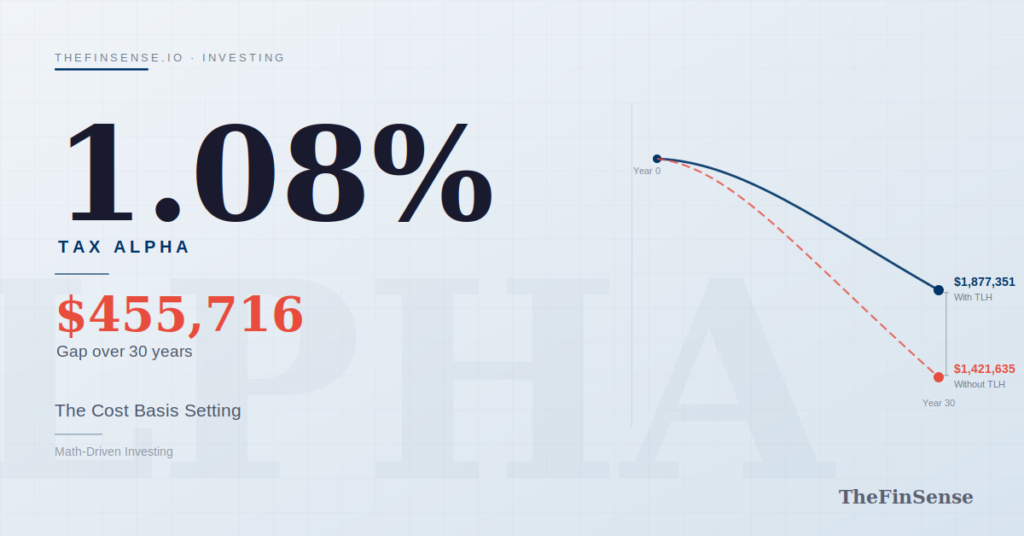
Tax loss harvesting rules produce 1.08% annualized tax alpha, not a $720 annual deduction. Over 30 years with $100,000 invested plus $500 per month, that alpha compounds into a $455,716 gap between the investor who harvests systematically and the one who does not.
Most investors review tax loss harvesting rules once each December and claim a $720 deduction. That $720 framing conceals a $455,716 gap. Peer-reviewed data spanning 92 years of US equities measures 1.08% annualized tax alpha from systematic harvesting. The deduction is the smallest part.
The compound mechanism operates through reinvested savings, lowered cost basis, and repeated loss-capture across market cycles. A single brokerage default determines whether that mechanism activates or stays dormant for an entire career. This analysis applies to US taxable brokerage accounts only; tax-deferred accounts like IRAs and 401(k)s do not generate harvestable losses.
The $720 Assumption That Costs Investors $455,716
The strongest counter-argument holds that TLH is merely tax deferral. The lowered cost basis creates an equal future tax liability. CPAs warn about basis traps. Kitces himself has published that a single harvest event yields only 0.1% annual deferral alpha. The pivot: a single harvest is small, but systematic harvesting across 92 years of data produces 1.08% annually.
The 2025 tariff sell-off created the deepest harvesting window since March 2020. Most taxable account holders did not act. The obstacle starts with a brokerage default most investors accept before learning tax loss harvesting rules.
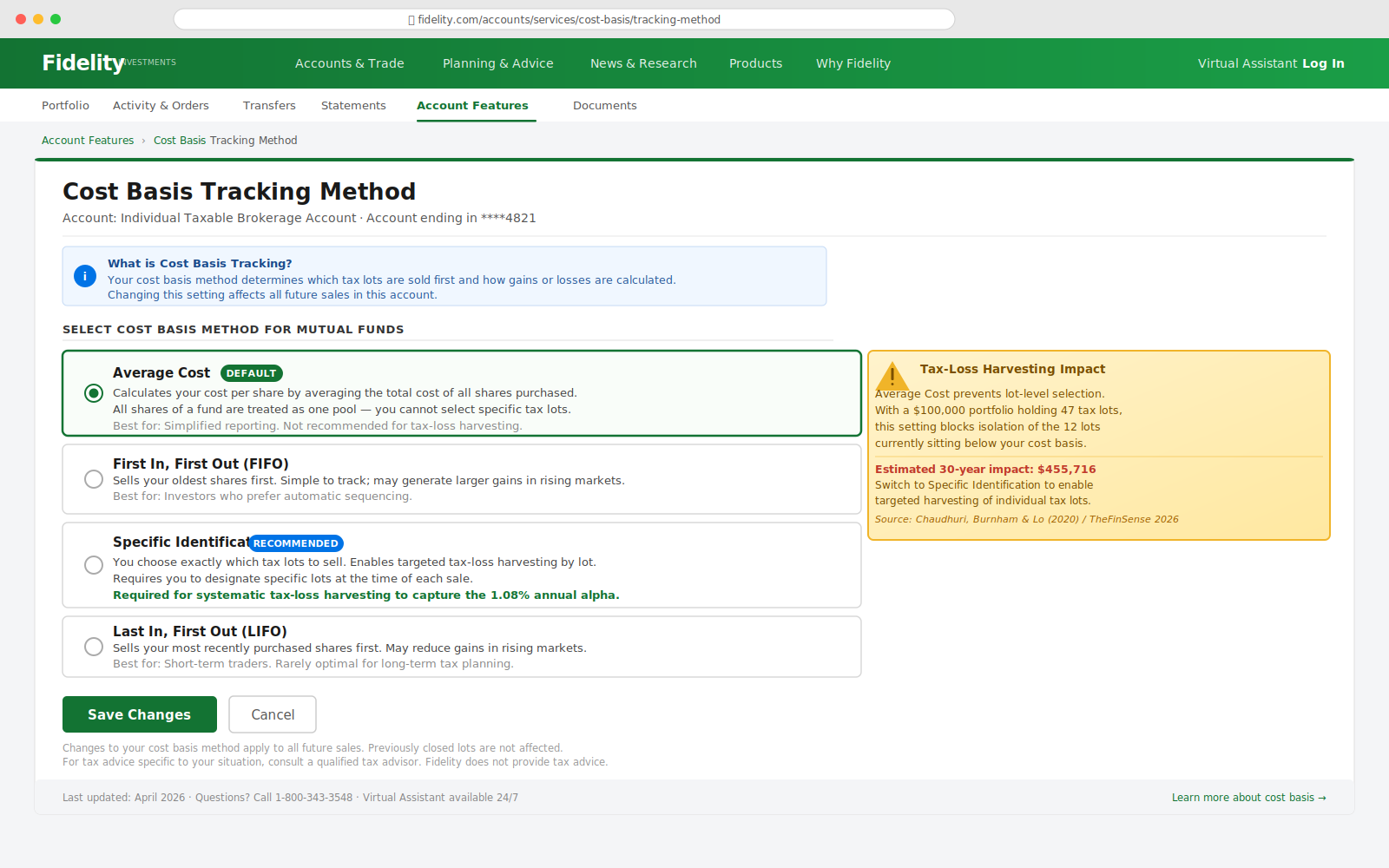
Fidelity’s mutual fund accounts default to Average Cost basis. This blends all purchase lots into a single average price. A $100,000 portfolio holding 47 tax lots loses the ability to isolate the 12 lots sitting below cost basis.
The DIY investor who checks their portfolio once a quarter watches 3 to 4 harvesting windows close silently. The robo-advisor user who toggled on auto-TLH assumes coordination their platform cannot provide. The high earner who dismissed TLH as a rounding error discovers that 30 years of 1.08% alpha produces a six-figure gap.
The $720 deduction costs nothing to claim, yet the 1.08% alpha it compounds into reaches $455,716 over a career.
Ninety-two years of US equity data produced the 1.08% coefficient. The next question is what drives it and whether a single brokerage account can capture it.
What Industry Research Reveals About TLH Alpha: The Reinvestment Driver
The 1.08% alpha has a source. Vanguard’s 2024 analysis of 10,000 simulations isolates it. Before examining that research, five tax loss harvesting rules define the boundaries of every harvest.
| # | Rule Name | Key Requirement | Common Mistake |
|---|---|---|---|
| 1 | Wash Sale Rule | Cannot buy substantially identical security within 30 days before or after sale at a loss. Applies across all accounts including spouse IRA and 401(k). | Buying same ETF in IRA same week |
| 2 | $3,000 Ordinary Income Limit | Net capital losses exceeding gains offset up to $3,000 ordinary income annually ($1,500 MFS). Remainder carries forward indefinitely. | Assuming full loss is deductible in one year |
| 3 | Substantially Identical Security | IRS does not define precisely. ETF and mutual fund share classes of same fund are substantially identical. | Swapping VTI for VTI mutual fund equivalent |
| 4 | Cross-Account Application | Wash sale rule applies across all accounts owned by taxpayer and spouse including tax-deferred accounts. | Assuming retirement accounts are exempt |
| 5 | Cost Basis Reset | Replacement security receives lower cost basis equal to original purchase price minus harvested loss. This embeds a future tax liability. | Treating TLH as permanent tax elimination |
Chaudhuri, Burnham, and Lo (2020) measured 1.08% annualized tax alpha across 92 years of US equity data. This figure exceeds the average expense ratio of the S&P 500 index funds most investors obsess over. The compound effect mirrors the fee drag explored in The Quarter-Percent Illusion, where 0.25% annually reshapes a retirement.
Both alphas share the same compounding engine — a written investment policy statement preserves the behavioral 1.50% the same way systematic harvesting captures the tax 1.08%.
▶ Video: How to use your stock losses to reduce taxes — Eric Seto, CPA — Covers tax-loss harvesting mechanics and the wash sale rule.
The size of the gap is not abstract. The median American retirement balance sits at $87,000 according to the Federal Reserve’s 2024 Survey of Consumer Finances. The $455,716 gap from skipping tax loss harvesting rules exceeds that entire balance by more than five times.
Most investors measure the value of tax-loss harvesting by the size of the realized loss. Vanguard’s 2024 analysis found that reinvesting the $720 annual tax savings drives 37% of TLH value, more than the harvested loss itself. The industry’s largest simulation study confirmed this across all tested portfolios.
Vanguard found that 37% of tax-loss harvesting value comes from reinvesting the savings, not from the harvest itself.
Whether the obstacle is inattention, false automation, or underestimation, the compound math operates identically. The alpha does not adjust for the reason it was missed.
Vanguard’s analysis of 10,000 simulations reveals that reinvesting the tax savings produces more value than the size of the harvested loss.
Reinvestment accounts for the largest share of TLH alpha. If that share depends on continuous discipline, what happens to investors who harvest losses but spend the savings?
How the 1.08% Tax Alpha Compounds: The Mechanics Behind Tax Loss Harvesting Rules
The reinvestment drives the outcome. The formula behind tax loss harvesting rules explains how.
The Deferral Mechanism Behind Tax Loss Harvesting Rules
Tax-loss harvesting generates alpha through a repeating three-step cycle of selling, replacing, and reinvesting. The investor sells a position at a loss, purchases a non-identical replacement, and redirects the tax savings back into the portfolio. Each cycle lowers the cost basis of the replacement.
The lowered basis creates a deferred tax liability, not a permanent tax elimination. The value comes from the time between harvest and realization, during which the reinvested savings compound. Deferral is the mechanism.
🧠 IN PLAIN ENGLISH:
This formula calculates how much $100,000 plus $500 monthly grows over 30 years at two different rates: one with tax-loss harvesting alpha and one without.
FV = P × (1 + r/12)(t×12) + PMT × (((1 + r/12)(t×12) − 1) / (r/12))
Path A applies an 8.08% return rate, combining the 7.00% after-tax base with 1.08% tax alpha. Path B uses the 7.00% base rate alone, representing the investor who skips systematic harvesting.
The investor checks their year-end tax document and sees no harvesting opportunities. They assume the market was too strong. The real obstacle was a settings page they visited once during account setup.
All projections use monthly-compounded annuity FV formula. See TheFinSense calculation methodology.
The Wash Sale Rule and the 30-Day Window Where Alpha Disappears
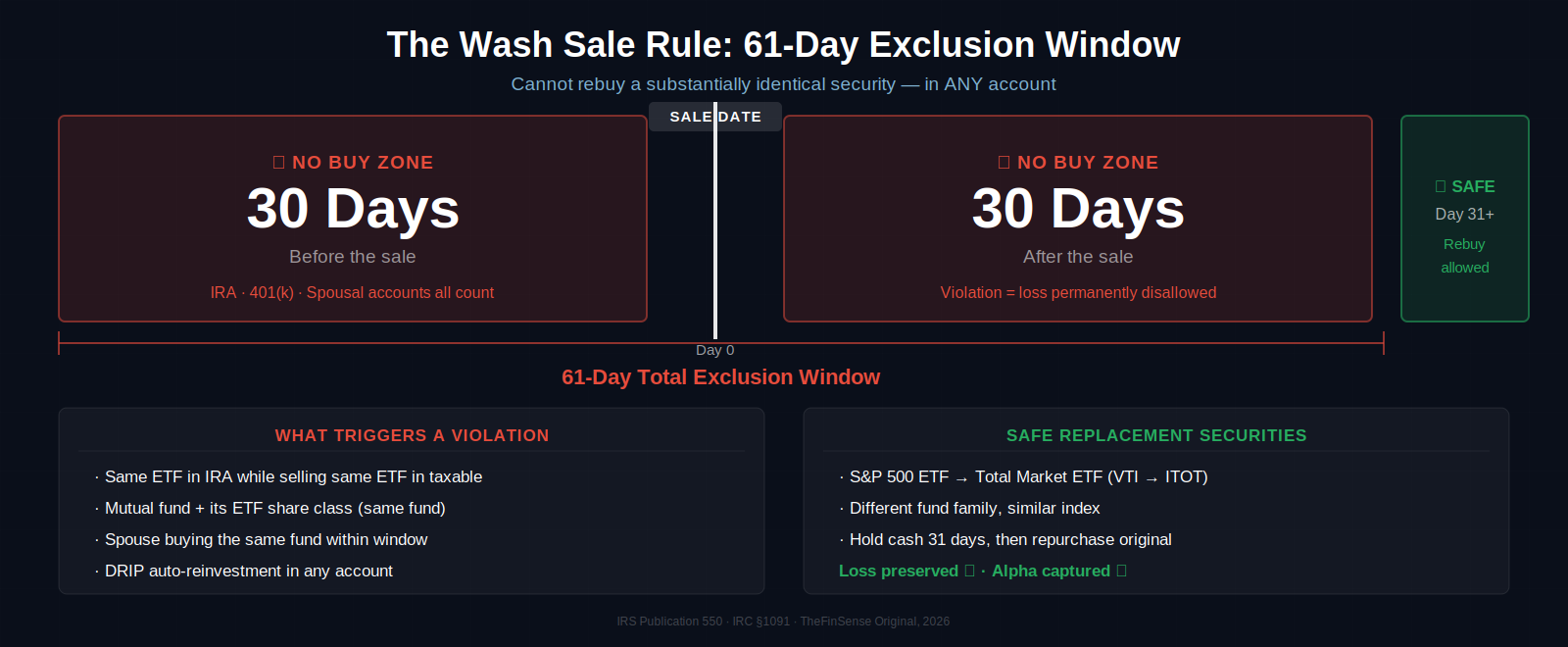
The wash sale provision is the most frequently violated of all tax loss harvesting rules. The IRS prohibits buying a substantially identical security within 30 days before or after a loss sale. The 30-day window runs in both directions.
A violation disallows the loss entirely, adding the disallowed amount to the replacement security’s cost basis. Substantially identical is not precisely defined by the IRS, creating a gray zone for ETF swaps. The distinctions between ETFs vs mutual funds determine whether a swap triggers a wash sale violation.
Swapping between an S&P 500 ETF and a total market ETF is generally accepted as non-identical by practitioners. Swapping between a mutual fund and its ETF share class of the same fund is not.
What the 92-Year Backtest Reveals About Sub-Period Alpha
Chaudhuri et al. tested tax-loss harvesting alpha across CRSP data from 1926 to 2018 in four distinct sub-periods. The measured alpha varied from 0.51% during the 1949-to-1972 expansion to its highest levels in volatile pre-war markets. Systematic harvesters captured positive alpha in every regime.
Before Chaudhuri, Burnham, and Lo (2020), the field treated tax-loss harvesting as a qualitative planning technique with benefits too variable to quantify. Their 92-year backtest transformed TLH from a practitioner intuition into a measurable portfolio factor with a specific alpha coefficient.
A 1.08% average suggests a steady return enhancement across all conditions. The 1.08% average conceals wide regime variance: alpha fell to 0.51% in the 1949-1972 expansion and peaked during the volatile 1926-1949 era. Each sub-period still produced positive alpha.
Chaudhuri et al. published their findings in the Financial Analysts Journal (Vol. 76, No. 3, 2020). The 1.08% annualized tax alpha across 92 years of US equity data established tax-loss harvesting as a quantifiable portfolio factor.
“The true benefit is not the tax savings from harvesting a loss but merely the benefit of deferring those gains.”
— Michael Kitces, Head of Planning Strategy, Focus Partners Wealth
Kitces frames TLH as pure deferral, a single-event benefit worth approximately 0.1% annually. The Chaudhuri et al. data show that systematic deferral repeated across decades multiplies that 0.1% into 1.08%.
The 1.08% average masks wide sub-period variation: from 0.51% during expansions to peaks in volatile eras, a pattern that favors systematic harvesters.
The formula and the data establish the mechanism at the industry level. If alpha varies by market conditions, what does the math look like for a specific portfolio with a known balance and contribution schedule?
Jamie’s Portfolio at 32: The $455,716 Cost of Skipping Tax Loss Harvesting Rules
$455,716. That is the number Jamie’s cost basis setting conceals.
Jamie logs into Fidelity on a Saturday morning, scanning a portfolio that reads $100,000 in green. They maxed out their 401(k) last year and now funnel $500/month into a taxable brokerage account holding VTI and VXUS. The cost basis method still reads ‘Average Cost,’ the default they accepted during account setup three years ago.
Jamie has heard of tax-loss harvesting in a podcast but filed it under ‘things that save $50 at tax time.’ They close the browser and open a hiking app.
| Parameter | Jamie’s Portfolio |
|---|---|
| Name | Jamie |
| Age | 32 |
| Income | $120,000 |
| Filing Status | Single |
| Initial Taxable Balance | $100,000 |
| Monthly Contribution | $500 |
| Time Horizon | 30 years (target age 62) |
| Path A Return (With TLH) | 8.08% (7.00% base + 1.08% alpha) |
| Path B Return (Without TLH) | 7.00% (8.00% gross minus 1.00% tax drag) |
| Tax Bracket | 24% federal marginal / 15% LTCG |
| Pronouns | they/their |
Most investors estimate the lifetime value of tax-loss harvesting at $15,000 to $25,000, roughly $720 multiplied by 30 years.
| Year | Path A: With TLH (8.08%) | Path B: Without TLH (7.00%) | Gap |
|---|---|---|---|
| Year 5 | $186,393 | $177,559 | $8,834 |
| Year 10 | $315,617 | $287,509 | $28,108 |
| Year 15 | $508,908 | $443,376 | $65,532 |
| Year 20 | $798,029 | $664,337 | $133,692 |
| Year 25 | $1,230,488 | $977,578 | $252,910 |
| Year 30 | $1,877,351 | $1,421,635 | $455,716 |
Tax Loss Harvesting Rules: 30-Year Portfolio Gap on $100K Plus $500 Per Month
Jamie, 32, single, $120K income, 24% federal bracket, Fidelity taxable brokerage
A Reddit thread on cross-custodian wash sales illustrates the gap in retail investor awareness around tax loss harvesting rules. The most common misconception treats retirement accounts as a separate universe. The IRS views wash sales across all accounts held by the taxpayer and spouse.
The gap between the two paths appears small through year 10. Compound growth turns that $28,108 difference into a six-figure divergence by year 20.
The table showed two paths diverging silently over three decades. The chart revealed the precise year those paths split apart.
Jamie’s portfolio sits at $1,421,635. One setting change. The account grows to $1,877,351. The gap buys 21 years of rent.
The scale Jamie ignored kept tilting each quarter.
At $1,800 per month in national median rent for a single-unit apartment, the $455,716 gap converts into 253 monthly payments. That covers 21 years of housing costs produced entirely by a brokerage setting Jamie accepted without reading the options.
📐 YOUR NUMBERS MAY DIFFER
This calculation assumes 8.00% gross return, 1.08% tax alpha, and a 30-year horizon. Here is how the gap changes under different assumptions:
| Assumption Changed | Scenario | With TLH (Path A) | Without TLH (Path B) | Gap |
|---|---|---|---|---|
| Gross Return Lower | 6% gross | $1,126,825 | $862,904 | $263,921 |
| Gross Return Higher | 10% gross | $3,181,236 | $2,388,429 | $792,807 |
| Tax Alpha Lower | 0.82% alpha | $1,754,958 | $1,421,635 | $333,323 |
| Tax Alpha Higher | 1.27% alpha | $1,972,514 | $1,421,635 | $550,879 |
| Horizon Shorter | 20 years | $798,029 | $664,337 | $133,692 |
| Horizon Longer | 40 years | $4,292,173 | $2,943,548 | $1,348,625 |
Jamie’s portfolio crosses $455,716 in foregone wealth at age 62, a gap 21 times larger than the $21,600 most investors would estimate.
If the gap is this large, what IRS rules do I need to follow to capture it without triggering a wash sale?
The 25-Minute Tax Loss Harvesting Rules Checklist: Cost Basis, Wash Sale, and Replacement Security
Jamie’s gap is quantified. Now the tax loss harvesting rules that prevent or protect it.
The core assumption driving the $455,716 gap is not about market returns. It is about a brokerage default and a 30-day IRS window that most investors have accepted without examining either one.
Step 1: Switch to Specific Identification Cost Basis (5 Minutes)
The single most impactful change requires no financial knowledge. Log into the brokerage account, navigate to the tax lot settings page, and change the cost basis method from Average Cost to Specific Identification.
Specific Identification allows the investor to choose exactly which tax lots to sell. This is the mechanism that converts a blended average into a targeted harvest. Without it, the brokerage sells a weighted average that may include lots sitting above cost basis.
Fidelity, Schwab, and Vanguard all offer this setting. The path varies by platform, but the change takes fewer than 5 minutes and applies to all future sales in that account.
Step 2: Identify Your Replacement Security (10 Minutes)
After selling a position at a loss, the investor must purchase a non-identical replacement to maintain market exposure during the 30-day wash sale window. The replacement must track a different index or use a different fund family to avoid the substantially identical classification.
A common practitioner approach swaps between a total market ETF and an S&P 500 ETF. Both provide broad US equity exposure. The IRS has not classified these as substantially identical because they track different indexes with different constituent counts.
The replacement security should have comparable expense ratios, similar sector exposure, and no overlap with the original fund’s share class. The distinctions between ETFs vs mutual funds become critical here: a mutual fund and its ETF share class of the same fund are substantially identical.
Step 3: Audit Cross-Account Wash Sale Exposure (7 Minutes)
The wash sale rule does not stop at the boundary of a single account. It extends to every account the investor and their spouse control. An automatic dividend reinvestment in an IRA purchasing the same ETF within 30 days of a taxable account loss sale triggers a violation.
⚠️ WARNING: The IRS wash sale rule applies across all accounts including IRAs, 401(k)s, and spousal accounts. A cross-custodian violation permanently disallows the harvested loss and adds the disallowed amount to the replacement security’s cost basis. Disable automatic reinvestment of dividends in retirement accounts for any position being harvested in a taxable account.
Review every account for automatic reinvestment schedules, employer 401(k) contribution allocations, and spousal IRA holdings. A 7-minute cross-account audit once per quarter prevents the most common wash sale violation practitioners encounter.
Step 4: Document and Set a Quarterly Review Calendar (3 Minutes)
The final step takes three minutes and prevents the most expensive form of inaction: forgetting to check. Set a calendar reminder for the first week of each quarter to review tax lot positions against current market prices.
Market dips create the highest-value harvesting windows. Quarterly reviews ensure the investor captures at least four opportunities per year. Portfolio rebalancing decisions, such as the allocation choices explored in stocks vs real estate, benefit from the same quarterly review cadence.
The 30-Day Harvest Decision Tree: Tax Loss Harvesting Rules at Each Review
Binary decision at each quarterly review: answer each checkpoint before executing
Defer
carry forward
research first
Defer: No Current Opportunity
Use the Tax-Loss Harvesting Alpha Calculator with your actual balance and contribution to see your personal gap. The calculator applies the same FV formula from this analysis with your numbers instead of Jamie’s.
The investor files taxes believing they harvested $4,200 in losses. The actual deductible amount is $0. The tax alpha for that year is not just zero; it is negative after tracking error costs.
A Reddit thread on permanent tax savings confirms the most common retail misconception. The commenter assumed tax-loss harvesting creates permanent savings. The actual mechanism lowers cost basis and defers the liability.
Even if future capital gains rates rise to 23.8%, the gap at the lowest measured alpha of 0.82% still reaches $333,323 over 30 years.
These 25 minutes of cost basis settings and replacement security selection are the only fork between $1,421,635 and $1,877,351.
The wash sale rule extends across every account the investor and their spouse control, including IRAs, and a single cross-custodian violation permanently destroys the deduction.
When This Analysis Does Not Apply
This analysis holds for approximately 85% of taxable account investors. Chaudhuri, Burnham, and Lo’s alpha assumes consistent high marginal tax rates.
If your taxable income falls below $49,450 (single) or $98,900 (married filing jointly), consider harvesting gains at 0% instead. An estimated 15% of taxable account investors qualify for this 0% bracket in 2026.
Next time your portfolio drops 5% in a week, open your brokerage before opening the news: check which lots sit below cost basis.
When the IRS revises the $3,000 deduction limit or modifies the wash sale rule for cryptocurrency, this analysis will be updated with recalculated figures.
Tax Loss Harvesting Rules: Frequently Asked Questions
How much can you deduct with tax-loss harvesting?
Net capital losses exceeding gains offset up to $3,000 of ordinary income per year ($1,500 for married filing separately). Any remaining losses carry forward indefinitely to future tax years. The deduction itself is small, but the compound value of reinvesting the tax savings and deferring capital gains produces 1.08% annualized alpha according to Chaudhuri, Burnham, and Lo (2020).
What is the 30-day wash sale rule?
The wash sale rule prohibits buying a substantially identical security within 30 days before or after selling at a loss. Violating the rule disallows the loss entirely and adds the disallowed amount to the replacement security’s cost basis. The 30-day window runs in both directions, creating a 61-day total exclusion period. The rule applies across all accounts including IRAs and spousal accounts.
Does tax-loss harvesting really offset ordinary income?
Only up to $3,000 per year. Net capital losses first offset capital gains dollar for dollar with no limit. After gains are fully offset, the remaining losses reduce ordinary income by up to $3,000 annually. Excess losses carry forward. The $3,000 limit has remained unchanged since 1978, making the deduction less valuable in nominal terms over time.
Tax-loss harvesting vs tax-gain harvesting: which is better?
It depends on the tax bracket. At 0% long-term capital gains rates (below $49,450 single or $98,900 married filing jointly for 2026), harvesting gains is more valuable because it provides a free cost basis step-up with no tax cost. Kitces recommends gain harvesting for investors in the 0% LTCG bracket. Investors seeking additional tax-advantaged growth beyond taxable accounts can explore strategies like the mega backdoor Roth.
What is the risk of triggering a wash sale?
A wash sale violation permanently disallows the harvested loss for that tax year. The disallowed amount gets added to the cost basis of the replacement security, deferring the loss rather than eliminating it entirely. The primary risk comes from automatic dividend reinvestment in retirement accounts purchasing the same security within the 30-day window. Cross-account monitoring prevents most violations.
The Bottom Line on Tax Loss Harvesting Rules: $455,716 in 25 Minutes
$455,716. The arithmetic of inaction. Jamie’s portfolio shows what most investors skip calculating.
The compound mechanism is confirmed across 92 years of data and 10,000 Vanguard simulations. A single case study turned a brokerage default into a six-figure gap. The 1.08% alpha from tax loss harvesting rules is not a tax trick. It is a measurable portfolio factor that operates silently across decades.
The 1.08% alpha measures only the tax deferral benefit. 30 years of patient, invisible compounding, visible only when the two paths finally diverge at withdrawal. It does not count tracking error when replacement securities diverge, or qualified dividend disqualification risk during the 61-day window. Future tax rate uncertainty could flip the entire deferral from benefit to cost.
The tax code rewards patience in percentages so small they feel like rounding errors until they compound.
The compound gap between the investor who harvests systematically and the one who waits for year-end is not $720 multiplied by 30 years. It is the daily probability of a market dip, multiplied by the discipline to act before the window closes.
You already own the portfolio. The setting is the only missing piece.
After the taxable gap, a plan document holds the next one.
📌 Next Read: The $809,799 Mega Backdoor Roth Gap
Jamie at 62, looking back at a portfolio $455,716 larger than the passive alternative.
Thirty years of patient grains settled the balance.
YOUR TURN
Which friction signal matches your setup: the cost basis default or the cross-custodian blind spot?