
📅 Updated:
SIPC vs FDIC coverage depends on what failed and where the asset is actually held, not the account wrapper. SIPC can protect missing customer cash or securities when a SIPC-member broker fails, while FDIC insures eligible deposits when an insured bank fails. This matters most for brokerage cash sweeps because money shown on one brokerage screen can sit at a program bank, remain broker cash, or be invested in a money market fund. Fidelity’s current sweep example can reach $4 million of FDIC coverage under program rules, versus SIPC’s $250,000 cash sublimit, but those figures protect different failure events. Identify the failed institution, legal holder, and asset form before applying any limit.
What decides whether SIPC or FDIC applies?
The 16x contrast cannot tell you which rule applies. The real test is what failed, who holds the asset, and what kind of asset it is.
FDIC deals with eligible deposits when an insured bank fails. SIPC deals with missing customer cash or securities when the failed broker is a SIPC member. SIPC excludes a normal drop in market value.
Start with two checks: what failed, and who holds the asset? Then name the asset. An insured-bank deposit, broker cash, and a money-market mutual fund can all look cash-like on one screen but follow different rules.
Source: SIPC protection scope and limits · SIPC
After that, use your brokerage account settings to check how idle cash is routed. Compare rates only after you know the rule that applies.
How do cash-like holdings map to SIPC or FDIC?
Cash-like holdings are easier to sort when you place each one beside its real holder. Match that holder to the event that caused the loss.
SIPA means the Securities Investor Protection Act.
| Holding | Failure event | Actual holder or location | Protection path | Limit or condition | Not covered |
|---|---|---|---|---|---|
| Bank deposit | Insured bank fails | FDIC-insured bank | FDIC | $250,000 standard maximum per depositor, per insured bank, per ownership category, subject to the rules | Nondeposit investments and market losses |
| Brokerage free-credit cash | SIPC-member broker fails and customer property is missing | Broker-dealer | SIPC | Up to $500,000 total, including a $250,000 cash sublimit, subject to SIPA | Ordinary investment-value losses |
| Bank-sweep deposit | Program bank fails | Program bank after the sweep | FDIC | FDIC rules apply at the receiving bank, including ownership, records, and same-bank aggregation | The broker wrapper creates no additional FDIC coverage |
| Money market mutual fund | SIPC-member broker fails and the security is missing | Brokerage securities account | SIPC as a security | Falls within the SIPC customer-property framework, subject to the total limit and SIPA | FDIC insurance and market-value declines |
| Other securities | SIPC-member broker fails and protected securities are missing | Broker-dealer custody | SIPC | Up to the applicable SIPC customer limit, subject to SIPA | Market losses or a bad investment |
At Fidelity, $4 million divided by the $250,000 SIPC cash sublimit equals 16. Those figures belong to different failure contexts.
That scale comparison is only a check. It cannot make one rule sixteen times safer or turn one limit into the other.
One brokerage screen can contain an insured deposit and a security. Those two cash-like balances can follow different protection rules.
In both systems, the headline limit can depend on other facts. Check those facts before you use the number.
Source: FDIC rules and SIPC definitions · eCFR §330.1 · 12 CFR 330.3 · SIPC
How can a brokerage cash sweep become FDIC-insured?
A cash sweep can move idle cash from the broker to one or more program banks. The screen may look the same, but the bank now holds the deposit.
The confusing part of a cash sweep is that the brokerage screen can look familiar after the cash path changes, so the label does not settle the protection rule. That is why this section follows the holder and asset form from broker cash to a program-bank deposit before returning to the Fidelity example and its limits.
The same broker can send idle cash to program banks while a money-market fund stays in the securities account. The two balances may sit side by side but follow different rules.
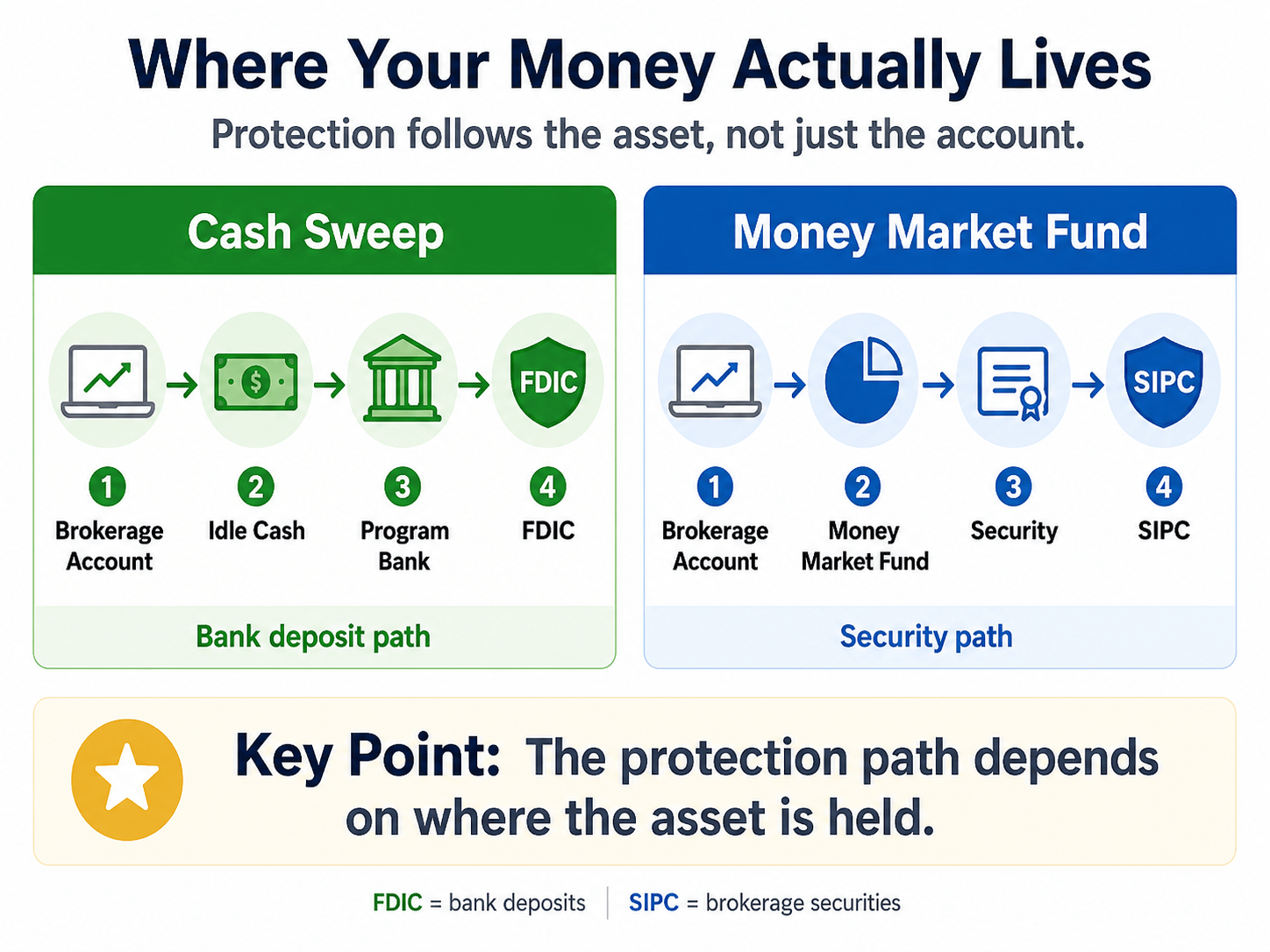
Fidelity now says some eligible Cash Management and IRA sweep cash can get FDIC coverage up to $4 million when bank space is available and the program rules are met. The 16x comparison comes from that figure and SIPC’s $250,000 cash sublimit. It is not a general promise.
A SIPC cash limit is not the rule for a deposit that has already moved to a program bank. Once you know the path, compare brokerage sweep account rates as a separate choice.
Source: Fidelity sweep mechanics and SIPC scope · Fidelity Cash Management Account · Fidelity account safeguards · SIPC
What does SIPC actually do when a broker fails?
A broker failure is not the same event as a bank failure. SIPC is built around missing customer cash and securities at a failed member broker, not a normal fall in market price.
If you classify cash by the brokerage screen alone, headline cash limits can look interchangeable. They may protect different failure events.
SIPC’s history page says at least 99% of eligible people get their investments back with its help. It also says $3.6 billion advanced since 1970 helped recover $143.8 billion in assets. Those are past totals, not a promise for the next failed broker.
One screen can hide two legal holders. One failure can trigger different protection rules.
Use your brokerage cash-routing settings to identify which cash vehicle the account is actually using. Then compare sweep rates after coverage checks, not before them.
The label fades once the failed bank or broker comes into view. The legal holder then shows which protection path applies.
Source: Broker-custody rules and SIPC recovery history · FINRA customer asset protection · SIPC history
Why does $250,000 mean different things under SIPC and FDIC?
A limit is useful only after you know who holds the asset and which rule applies. For a bank sweep, records and other deposits at the same bank can also matter.
Use four checks before you rely on a number:
- Find the holder. Is the asset at the broker, at a program bank, or in a mutual fund?
- Check the rule. Confirm FDIC status for the bank or SIPC membership for the broker.
- Check the records. A broker-run deposit may need the right agency or fiduciary records for pass-through treatment.
- Add same-bank deposits. Deposits for the same owner at the same insured bank and in the same ownership category may be grouped for FDIC purposes.
The shortcut can work when the account label and legal holder already match, such as a plain deposit held directly at one insured bank. When the holder is ambiguous, use the broker’s sweep disclosure and program-bank list instead of guessing from the account name.
A dashboard may hide the real holder. The sweep notice and program-bank list are often the best place to check.
Classify the failure and asset first. Then use the right limit and same-bank rules. Recheck the official rules when the cash vehicle, banks, or ownership setup changes.
Source: FDIC ownership, recordkeeping, pass-through, and aggregation rules · 12 CFR 330.5 · 12 CFR 330.7 · 12 CFR 330.3 · FDIC coverage guidance
When the simple account-label shortcut can work
A simple account label can work when the facts all point the same way. The label, holder, asset, and rule must align.
A plain deposit held at one insured bank is the easy case. The bank holds a deposit, so FDIC rules are the right place to start. A broker case can also be clear when a failed broker with SIPC membership is missing customer cash or securities and the claim fits the customer-property rules.
A legal study in the Columbia Business Law Review also treats deposit insurance and SIPA broker liquidation as separate legal regimes. It notes, though, that broker cases can turn on who counts as a customer and what counts as customer property.
The shortcut is useful only when the facts line up. If there is a sweep, a money-market fund, an unclear holder, or cash at the same bank through more than one path, stop and check the details.
The shortcut works only when the account label matches the legal asset location. Both signals must point to the same protection rule.
Source: Distinct bank-deposit and broker-customer-property regimes · SIPC · 12 CFR 330.3 · Columbia Business Law Review
SIPC vs FDIC coverage: questions readers still ask
The 16x contrast is useful only if the edge cases leave the classification rule unchanged. The questions below test those edge cases while keeping each figure tied to its own failure event and asset path.
Does SIPC cover cash in a brokerage account?
SIPC can cover broker-held cash when a SIPC-member broker fails, customer cash is missing, and the claim fits SIPA rules. The limit is up to $500,000 per customer, with a $250,000 cash sublimit. But a cash label on the screen is not proof that SIPC applies. A bank sweep may move cash to a bank, while a money market mutual fund stays a security. Check who holds the cash and what the asset is before you use the SIPC number for your account.
Is a Fidelity cash sweep FDIC-insured?
A Fidelity cash sweep can get FDIC insurance when eligible cash is sent to program banks and the FDIC rules are met. Fidelity now says some eligible Cash Management and IRA sweep cash can get coverage up to $4 million when bank space is available. That amount is tied to Fidelity’s program and can change. Check the latest sweep notice and bank list. Also count deposits you already have at the same bank, because those balances can affect how much of the cash is insured.
Does SIPC cover money market mutual funds?
SIPC can cover that fund as a security when customer property is missing after a member broker fails. The fund remains a security rather than becoming an FDIC deposit just because it is used like cash in a brokerage account. Mutual funds lack FDIC insurance, and SIPC excludes a normal drop in the fund’s market value. Look at the legal form of the asset. An insured deposit and a money market fund can sit on one screen but follow different rules.
What happens if a broker fails but my investments are still there?
If a broker fails but your investments are still there as customer property, the case is different from a market loss. Broker rules focus on how customer cash and securities are kept, and SIPA liquidation focuses on getting customer property back and filling some covered shortfalls. SIPC says most eligible customers have received their investments back with its help, but that history is not a promise. First ask whether any customer property is missing. Do not treat a fall in price as the same event.
How do I check whether my cash is under SIPC or FDIC?
Start with what failed: the bank or the broker. Then check who legally holds the cash or security and what the asset is. Confirm that the bank has FDIC insurance or the broker is a SIPC member before you use a dollar limit. For a bank sweep, read the current sweep notice and bank list, then check other deposits you have at the same bank and the ownership category. For broker-held property, remember that SIPC excludes normal market losses. That money market fund is a security, not an FDIC deposit.
Source: Current SIPC, FDIC, and Fidelity classification rules · SIPC · 12 CFR 330.1 · Fidelity account safeguards
The rule to remember when the wrapper changes
$250,000 changes meaning when the holder changes.
Open your broker’s cash settings and name the holder and the asset. Use those two facts before you trust any coverage number on the screen.
The wrapper is an interface. Protection follows the failed institution, legal holder, and asset form.
The 16x comparison only becomes meaningful after you identify what failed, who holds the asset, and its legal form. To reproduce the comparison, divide the cited Fidelity sweep ceiling by the cited SIPC cash sublimit, keeping the two failure contexts separate.
Your job is to trace where the cash or security sits.
After that check, compare sweep rates and cash options.
When the broker changes its cash choices, run the holder-and-asset check again. Do that before you compare yield across the broker’s available cash choices.
Trace the asset path before trusting the account label.
YOUR TURN
Which line in your brokerage cash settings tells you who legally holds the balance today?
- SIPC: protection scope, customer limits, and broker-failure recovery context used throughout the article.
- 12 CFR Part 330 and FDIC guidance: deposit limits, ownership, recordkeeping, pass-through, and same-bank aggregation rules.
- Fidelity disclosures: the current bank-sweep example and program-bank mechanics behind the bounded 16x comparison.
- Columbia Business Law Review: supporting legal context for keeping bank-deposit protection separate from SIPA broker liquidation.
Update history
- v1.0 2026-08-08 PUBLISH
Original publication.