
📅 Originally Published: · Last Updated:
Three trades in five days. The PDT rule builds a cage around small accounts, and every forum on the internet says a cash account is the open door.
This Guide Answers
- What does the pattern day trader rule actually cost when you switch to a cash account to bypass it?
- How does T+1 settlement halve your buying power, and what is the 10-year dollar gap?
- Should you fund to $25K, accept the drag, or wait for FINRA’s proposed rule change?
The pattern day trader rule tells every account under $25,000 the same thing: three day trades per rolling five-business-day window, or the account freezes. The 50% buying power reduction that follows the most popular workaround does not appear on any warning screen.
Most traders read the restriction and reach the same conclusion. A cash account removes it. The forums confirm it.
The brokerages offer a one-click conversion button. What none of them calculate is the compounding cost of the fix itself.
What the Pattern Day Trader Rule Actually Blocks
Cash accounts genuinely remove the 3-trade cap, eliminate the 90-day PDT freeze risk, and cap downside exposure by halving leverage. For the 97% of day traders who lose money, that reduced leverage is protective, not punitive.
That sentence is the strongest case for switching. It is also the last piece of the argument that the switching advice gets right. The missing piece is a number.
What Is the Pattern Day Trader Rule?
The pattern day trader rule is a FINRA regulation that designates any margin account executing four or more day trades within five business days as a “pattern day trader,” requiring a minimum equity of $25,000 to continue trading. Unlike a portfolio minimum, this threshold must be maintained before each trading day, and falling below it triggers a 90-day restriction to liquidation-only transactions.
Robinhood’s Day Trade Limit counter shows trades remaining but does not display the $900 annual cost of switching to a cash account to bypass the restriction.
Does the rule block unprofitable trades? Does it block profitable ones? Fernando Chague, Professor of Finance at Sao Paulo School of Economics (FGV EESP), tracked 19,000 day traders across two years in a 2020 study.
The data: 97% of those who persisted beyond 300 days lost money. The account type did not change the outcome.
The assumption that more trades equals more profit has a 97% failure rate before the account type is even considered.
The under-$25K trader staring at 3 remaining day trades wonders if a cash account is the answer. The trader who already switched checks their account balance and sees the same $15,000 they deposited, not the $30,000 they used to deploy. The trader above $25K scrolls past the PDT counter and does not realize what it cost to get there.
The Bogleheads community documents what happens next. Multiple users report triggering Good Faith Violations after converting to cash accounts, resulting in 90-day restrictions identical to the PDT freeze they were trying to escape. One poster was advised to switch back to margin.
97%
Of day traders who persist beyond 300 days lose money, regardless of whether they trade in a margin or cash account (Chague et al., 2020).
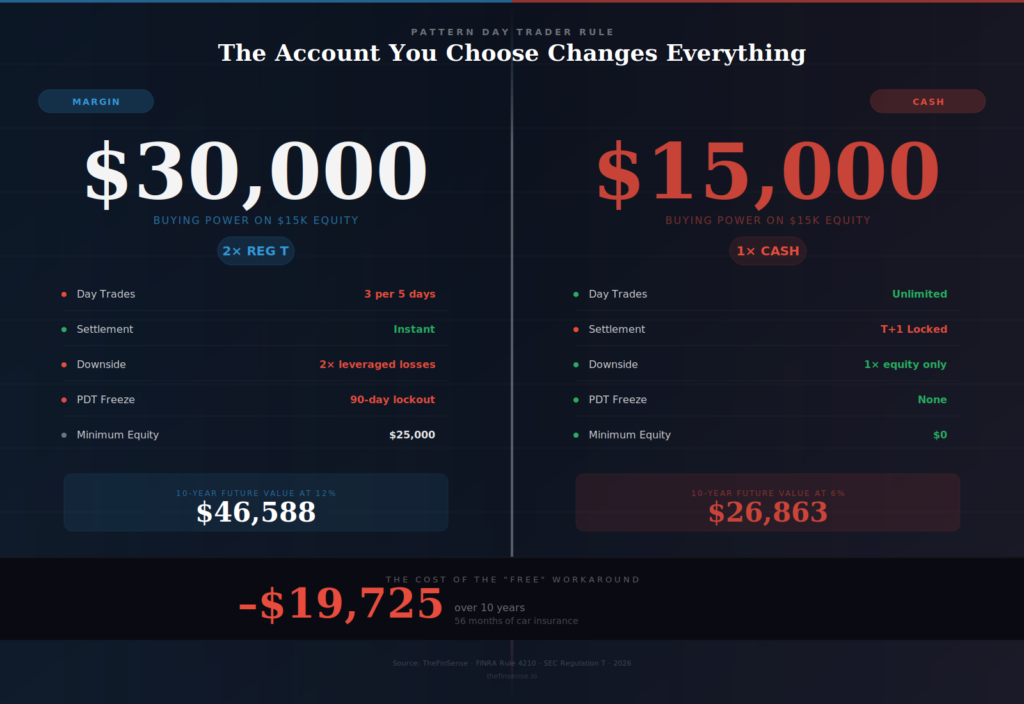
Source TheFinSense original infographic based on FINRA Rule 4210 and SEC margin guidelines 2026
If the strategy fails 97% of the time at full capacity, what happens at half capacity?
1.3 Million Accounts and the $25,000 Line
At half capacity, the math gets worse, and 1.3 million traders are running it.
How many traders carry the PDT designation? How many of them converted to cash accounts thinking the problem was solved? FINRA answered the first question in SR-FINRA-2025-017, filed with the SEC on December 29, 2025: approximately 1.3 million customers across ten reporting firms hold the pattern day trader flag.
That represents 2.4% of 54 million total margin accounts.
The “niche” workaround affects 1.3 million flagged accounts, and the PDT rule restricts 2.4% of all margin traders in the United States.
The FINRA filing revealed something else. The agency proposed replacing the $25,000 minimum entirely with risk-based intraday margin calculations per trade. The SEC comment period opened January 14, 2026.
The rule remains in force pending approval, but the regulatory assumption behind it is under formal review for the first time since 2001.
1.3 million accounts carry the pattern day trader flag, and the most popular escape route costs $19,725 over a decade.
Those 1.3 million flagged accounts sit on one side of the $25,000 threshold. The traders who converted to cash accounts sit on the other. Brad M. Barber, Distinguished Professor Emeritus of Finance at UC Davis and FINRA Economic Advisory Committee member, measured what happens to active traders even with full buying power intact.
The $25,000 minimum that sits in the account between trades earns the same 0.01% default sweep rate — a second layer of cost the brokerage sweep account rates comparison makes visible.
The commission line on your trade confirmation reads $0.00, but the zero commission broker hidden fees extend beyond the obvious.
The math does not care which side of the $25,000 line you stand on.
What exactly does the cash account give back, and what does it take away?
The 50% Buying Power Drop Nobody Calculates
The cash account gives back unlimited trades and takes away exactly half of every dollar you can deploy.
Reg T Margin: The 2x Multiplier
What does a margin account provide under Regulation T? The Federal Reserve’s Reg T framework allows brokerages to lend up to 50% of a securities purchase. For a $15,000 account, that means $30,000 in total buying power.
The trader deposits $15,000. The brokerage extends $15,000 in margin.
A cash account receives no margin extension. The same $15,000 deposits $15,000 in buying power. The multiplier drops from 2x to 1x.
After the flag triggers, the trader converts to a cash account and loses an entire trading week during conversion, then discovers T+1 settlement halves their deployable capital permanently.
T+1 Settlement: The Cash Account Speed Limit
Why does the cash account lose more than the margin figure suggests? In a margin account, proceeds from a sale are available immediately for the next trade. Margin absorbs the settlement delay.
In a cash account, proceeds settle one business day later under T+1 rules.
What does T+1 mean for a trader making 3-4 round trips per week? Monday’s sale proceeds settle Tuesday. If you deployed your full $15,000 on Monday morning, zero dollars are available Monday afternoon.
The capital is locked until Tuesday’s open.
Margin accounts mask this delay by lending against unsettled proceeds. Cash accounts expose it completely.
The Pattern Day Trader Rule Buying Power Formula
The arithmetic is two lines. Margin account buying power under Reg T: equity × 2. Cash account buying power with daily trading: equity × 1, minus any unsettled proceeds.
For a $15,000 account trading daily round trips, effective deployable capital drops from $30,000 to $15,000 or less.
🧠 IN PLAIN ENGLISH:
A margin account lets you trade with borrowed money while your sale proceeds settle. A cash account makes you wait for the cash to arrive. On daily trades, that waiting period cuts your firepower in half.
Barber, along with Terrance Odean, Rudd Family Foundation Professor of Finance at UC Berkeley Haas School of Business, asked a harder question in their 2014 study of the entire day trader population in Taiwan from 1992 to 2006: what happens to returns when traders have full access to leverage? The most active traders underperformed by 6.5 percentage points annually. Less than 1% earned predictable positive returns after fees.
The cash account removes the trade count restriction but replaces it with a 50% reduction in per-trade buying power that compounds every year.
Before 2000, the assumption was that active traders could outperform through skill. Barber and Odean measured 66,465 accounts and found the most active traders underperformed by 6.5 percentage points. Chague and colleagues confirmed the finding across 19,000 traders in 2020: 97% of persistent day traders lose money. This arithmetic is no longer debated.
“Trading is hazardous to your wealth.”
— Brad M. Barber, Distinguished Professor Emeritus of Finance, UC Davis; FINRA Economic Advisory Committee member
Barber measured 66,465 household brokerage accounts. The market returned 17.9% annually during the study period. The most active quintile earned 11.4%.
That 6.5 percentage point gap was the cost of overtrading with full margin access. Halving the buying power does not halve the gap. It compounds it, the same way the Liquidity-Leverage Filter exposes hidden drag in other asset comparisons.
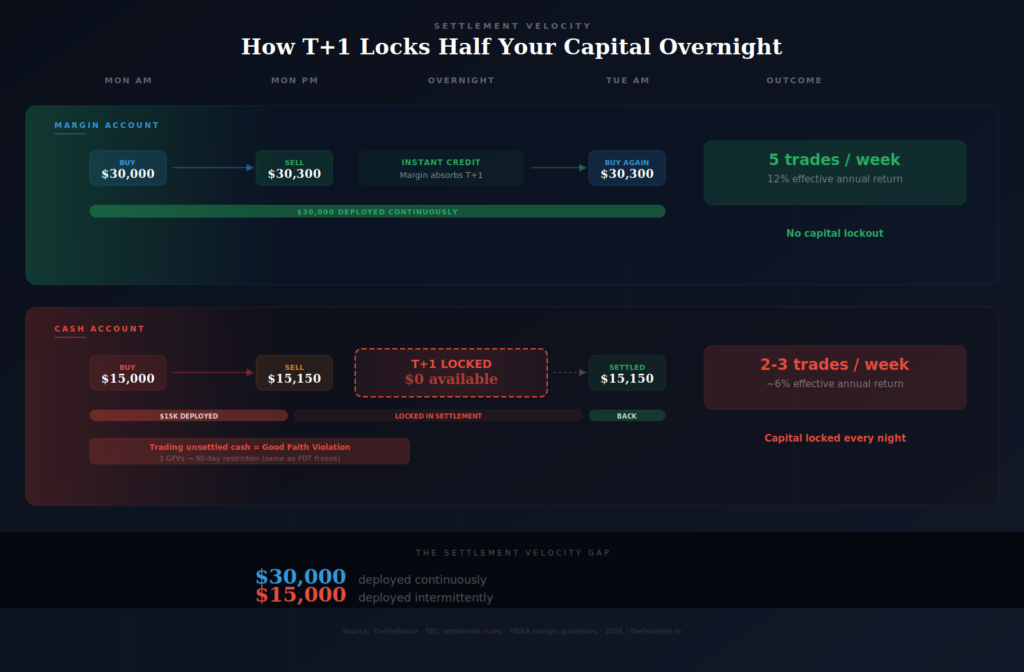
💡 PRO TIP: If your brokerage shows “buying power” in a cash account, confirm whether it includes unsettled funds. Trading with unsettled cash in a cash account triggers a Good Faith Violation, and three GFVs within 12 months result in a 90-day restriction to settled-cash-only trading.
How much does that 50% cost over 10 years?
$19,725: Ten Years of Trading in a Smaller Room
Riley switched to a cash account six months ago, and the 50% buying power drop has compounded on every trade since.
Riley’s First Six Months
Riley, 27, deposited $15,000 into a Robinhood margin account to trade momentum stocks. After the fourth round trip in five days triggered the PDT flag, Riley followed the advice every trading forum repeats: switch to a cash account.
The conversion took six business days. When trading resumed, the account balance still read $15,000. The pattern day trader rule restriction was gone.
What the balance did not show was the buying power that disappeared with it.
| Account Feature | Margin Account (Before) | Cash Account (After) |
|---|---|---|
| Equity Deposited | $15,000 | $15,000 |
| Buying Power | $30,000 | $15,000 |
| Day Trade Limit | 3 per 5 business days | Unlimited |
| Settlement Speed | Instant (margin covers T+1) | T+1 (proceeds locked 1 day) |
| Downside Exposure | 2x (leveraged losses) | 1x (equity only) |
Riley chose the cash account based on reasonable advice: more trades, no PDT freeze, reduced leverage risk. Six months of trading at half capacity did not feel different because the constraint was invisible.
The account balance stayed near $15,000. No fee line appeared. No warning flagged the drag.
What does that invisible drag look like when stretched across a decade?
The Ten-Year Projection
Assume Riley’s $15,000 generates 12% gross annual return on deployed capital. In the margin account, Reg T doubles the deployable capital to $30,000, and the full 12% accrues to equity. In the cash account, half the capital is locked in T+1 settlement on any given trading day, and the effective return on equity drops to approximately 6%.
The FV calculation: $15,000 × (1.12)^10 = $46,588 on margin. $15,000 × (1.06)^10 = $26,863 on cash.
| Year | Margin Account (12%) | Cash Account (6%) | Cumulative Gap |
|---|---|---|---|
| 0 | $15,000 | $15,000 | $0 |
| 1 | $16,800 | $15,900 | $900 |
| 3 | $21,074 | $17,865 | $3,209 |
| 5 | $26,435 | $20,073 | $6,362 |
| 7 | $33,160 | $22,555 | $10,605 |
| 10 | $46,588 | $26,863 | $19,725 |
How the Pattern Day Trader Rule Cash Workaround Costs $19,725 Over 10 Years
$15,000 initial equity, 12% gross annual return, daily round-trip trading
Riley is one account. The 1.3 million flagged accounts represent the same arithmetic at different dollar amounts and different return assumptions.
A 50% drag on a $15,000 account that sounds negligible becomes $19,725 when compounded over a decade.
A $15,000 margin account targeting 12% gross grows to $46,588 over 10 years. The same $15,000 in a cash account, with half the buying power, grows to $26,863. The gap of $19,725 is the cost of the “free” workaround.
The walls of the cash account close in tighter with each compounding year.
Translate that $19,725 into a unit Riley recognizes. At the national average of $350 per month for auto insurance, the gap covers 56 months of car insurance payments (ValuePenguin, 2025).
The first year’s $900 drag does not stay $900. Compounded at 12% over the remaining nine years, that single year of lost buying power becomes $2,795 by Year 10.
What Changes When the Numbers Change
The $19,725 figure rests on three assumptions: 12% gross return, 50% effective buying power utilization in the cash account, and positive returns throughout the period. Each variable shifts the gap.
📐 YOUR NUMBERS MAY DIFFER
This calculation assumes 12% gross annual return with 50% buying power utilization in the cash account. Here is how the conclusion changes:
| Gross Annual Return | 10-Year Gap | Conclusion |
|---|---|---|
| 8% | $10,180 | Five figures even at conservative returns |
| 12% | $19,725 | ✅ Base case |
| 16% | $33,788 | Five-figure drag widens sharply |
| 0% | $0 | Break-even (no return, no drag) |
Buying power utilization matters too. If the cash account deploys 75% of capital instead of 50% (possible with fewer, larger trades and longer holds), the gap narrows to approximately $8,900 over ten years.
The $19,725 gap assumes profitable execution. If your gross return is negative, margin amplifies losses and the cash account functions as a loss limiter. For the 97% of day traders who lose money, the halved leverage is not a penalty. It is a structural brake.
Is there a way to keep the flexibility without paying this cost?
The Settlement Velocity Filter
One calculation answers that question before a single trade is placed.
Every morning before market open, the cash account trader checks which portion of their balance is settled, a ritual that replaces the leverage they lost.
TheFinSense’s Settlement Velocity Filter converts the margin-versus-cash decision into three inputs: your buying power gap, the cost of closing it, and your actual trade frequency.
Calculate Your Buying Power Gap
Start with your current equity. Multiply by 2 for margin buying power under Reg T. Multiply by 1 for cash buying power (or less, depending on how often you encounter T+1 lockouts).
Apply your realistic gross annual return to each figure. Compound over your intended time horizon. The difference is your buying power gap.
For Riley’s $15,000 at 12% over 10 years, the gap was $19,725. Your equity, return, and time horizon produce a different number, and that number is the actual cost of the pattern day trader rule workaround for your account.
Fund Up or Accept the Drag
Compare your 10-year gap to the deposit needed to reach $25,000. Riley’s gap of $19,725 exceeds the $10,000 needed to fund from $15,000 to $25,000. Funding up costs less than the drag.
If you cannot fund up, the math does not change, but the decision does. Accept the T+1 drag and limit round trips to days when your full balance has settled. Partial deployment reduces the effective drag below the 50% worst case.
FINRA has already filed to eliminate the $25K minimum, and the SEC comment period is open right now.
SR-FINRA-2025-017 proposes replacing the flat $25,000 threshold with risk-based intraday margin per trade. If approved, the binary choice between margin restriction and cash account drag disappears entirely. The filing does not guarantee approval, and no effective date has been published as of March 2026.
💡 PRO TIP: If your 10-year buying power gap exceeds the deposit needed to reach $25,000, the math favors funding up. Riley’s $19,725 gap versus the $10,000 deposit makes the answer a 2:1 ratio. Run the same comparison with your own equity and return target before converting.
When This Analysis Does Not Apply
This analysis holds for 75-85% of traders who actively attempt same-day round trips. Barber et al. (2014) identified that a significant portion of self-described day traders actually execute multi-day holds. If your average holding period exceeds one trading day, T+1 settlement does not reduce your buying power, and a cash account carries no drag.
If your trades consistently settle before your next entry (holding period greater than 1 business day), a cash account is the correct choice with zero buying power penalty.
Pattern Day Trader Rule Explained: Your Questions
Can I use multiple brokerage accounts to bypass the pattern day trader rule?
FINRA tracks the pattern day trader designation per account, not per person. A second margin account at a different brokerage provides 3 additional day trades per week. If that account triggers 4 or more day trades in five days, it receives its own PDT flag. Cash accounts at separate brokerages avoid the flag entirely but carry the same T+1 buying power drag at each brokerage.
What happens to my PDT flag if my account balance drops below $25,000?
The PDT designation persists once triggered. If equity drops below $25,000 through losses or withdrawals, the brokerage issues a day-trade margin call. You receive five business days to restore the balance. Failing to meet the call restricts the account to liquidation-only transactions for 90 days, the same freeze that prompted the cash account switch in the first place.
Is the FINRA proposal to eliminate the PDT rule likely to pass in 2026?
FINRA filed SR-FINRA-2025-017 in December 2025, proposing risk-based intraday margin per trade to replace the $25,000 minimum. The SEC comment period opened January 14, 2026. Historical FINRA rule changes require 6 to 18 months from filing to implementation. No approval or denial has been issued as of March 2026. Trading decisions should assume the current threshold remains active until an official effective date is published.
Does T+1 settlement affect swing traders the same way it affects day traders?
T+1 settlement locks proceeds for one business day. If your holding period exceeds one trading day, proceeds settle before your next entry. A swing trader holding positions 2 to 10 days encounters minimal cash lockup because previous trades have already settled. The buying power drag applies specifically to same-day round trips requiring immediate reinvestment of sale proceeds.
How do professional traders handle the PDT threshold with accounts under $100K?
Most professional traders deposit above $25,000 specifically to retain full Reg T margin access. Those below the threshold typically fund up, trade through a proprietary trading firm that pools capital above the minimum, or accept cash account constraints while focusing on multi-day positions. The Settlement Velocity Filter calculation determines which path costs less over your intended time horizon.
The Bottom Line on the Pattern Day Trader Rule
The 50% buying power gap that began with a forum recommendation ends at $19,725.
The cash account workaround does what it promises: it removes the 3-trade cap and eliminates the 90-day PDT freeze. What it does not advertise is the compounding cost of trading at half capacity. The Settlement Velocity Filter converts that hidden cost into a number specific to your equity, your return target, and your time horizon.
The $19,725 is the buying power cost for the 3% who trade profitably. For the 97% who lose money, margin doubles the speed of those losses, and the cash account they resent is the only structural limit standing between them and faster ruin.
The rule built to protect small traders pushes them into a structure that costs more than the risk it was designed to prevent.
The FINRA 2025 filing to replace the pattern day trader rule shifts the question from a $25K binary to risk-based intraday margin per trade. Under the proposed framework, calculating your buying power gap before choosing an account type matters more, not less.
The buying power number means something different than it did ten minutes ago.
The $0 commission on each trade hides three more costs.
📌 Next Read: Zero Commission Broker Hidden Fees
The trader who calculates is locked in neither room.
YOUR TURN
What is the 10-year buying power gap for your account size and gross annual return target?