
📅 Last reviewed: · Data checked through: DALBAR 2026 QAIB, Morningstar 2026 Mind the Gap plus its 2025 comparison sample, Financial Analysts Journal 2026, J.P. Morgan 2026 Guide to Retirement, Investor.gov, and IRS Topic 409
Answer first: Investing psychology is less about personality than process. Fear, FOMO, regret, and boredom are inevitable; the question is whether they reach the order ticket without passing through a written rule. Recent measures often grouped under the “behavior gap” label are not apples-to-apples. Morningstar’s 2026 study found an 8.7% annual investor return versus a 9.9% aggregate fund return over the 10 years ended Dec. 31, 2025, a 1.2-point gap. DALBAR reported a 0.72-point equity-investor gap for 2025, while a 2026 Financial Analysts Journal study estimated poor timing at 0.10% per year using Morningstar’s prior 2015-2024 sample. Before an emotional trade, review your plan, cash needs, tax cost, and what actually changed.
Most emotional trades sound responsible while you are placing them. “I am reducing risk” may be true. It may also be the story fear tells when you want the red numbers to stop.
The market does not record how reasonable the decision felt. It records the price you sold, the price you paid if you returned, the taxes or losses created along the way, and whether the trade moved you closer to the plan you had before the headlines changed.
So this guide starts where the damage usually happens: the minute before a trade. Run the decision through the check below before opening the order ticket.
The Mood-to-Rule Router: What Should You Do Before Trading?
Better investing psychology does not require perfect calm. It requires a small pause between the feeling and the transaction. The rule should exist before the market scares or excites you, because that is when you are least likely to invent a fair one.
| What you feel | What it often becomes | Rule before action |
|---|---|---|
| Fear after a market drop | Sell first, explain later | Wait 72 hours unless you need cash inside your written liquidity window, your allocation rule already calls for a change, or a security-specific thesis has genuinely broken. |
| FOMO after a rally | Buying the asset that already ran | Compare the trade with your target allocation. If it is speculation, it must fit inside a capped play-money sleeve. |
| Regret over a losing position | Holding only to avoid admitting the mistake | Use the fresh-cash test: “Would I buy this today with new money?” If not, review the thesis rather than the purchase price. |
| Boredom during a calm market | Unnecessary tinkering | Trade only on a scheduled review date or when a written rule is triggered. Do not create a trade simply because the account has been quiet. |
| Near-term cash need | Calling a planning problem a psychology problem | Move the money into the right risk bucket. Willpower cannot turn volatile assets into dependable short-term cash. |
Use this decision check before a discretionary buy or sell. It does not give buy, sell, or hold advice. It helps you separate a mood-driven trade from a rule-driven decision.
What Is Investing Psychology?
Investing psychology is the way emotion, habit, and mental shortcuts shape money decisions under uncertainty. It explains why someone can understand diversification on a calm day and abandon the same plan after one ugly week.
A falling balance is supposed to get your attention. The problem begins when that attention turns into urgency and skips the planning step.
Someone with strong investing psychology still feels fear, envy, and regret. The difference is practical: the portfolio has rules that remain in force when the account is down, the headlines are loud, and online commentators sound more certain than the evidence allows.
How Much Can Poor Investing Behavior Cost?
There is no single annual behavior tax that applies to every investor. Investor-return gaps are worth taking seriously, but their size and meaning depend on the period, asset class, cash-flow pattern, benchmark, and calculation method.
| Source | Reported finding | How to read it |
|---|---|---|
| DALBAR 2026 QAIB press release | 2025 equity investor gap: 0.72 percentage points. 2024 gap: 8.48 percentage points. | The annual result can swing sharply. The disputed mistake is treating one year, or the gap itself, as a permanent bill caused only by panic selling. |
| Morningstar Mind the Gap 2026 | Average dollar earned 8.7% per year versus a 9.9% aggregate annual fund return for the 10 years ended Dec. 31, 2025: a 1.2-point gap. | This is the latest Morningstar estimate. It reflects the timing and size of fund flows and should not be read as a pure panic-selling cost. |
| Morningstar Mind the Gap 2025 | Average dollar earned 7.0% per year versus an 8.2% aggregate fund return for the 10 years ended Dec. 31, 2024. | This older sample stays here because the 2026 Fulkerson study reanalyzed this same 2015-2024 period. |
| Fulkerson, Jordan, Riley & Yan, 2026 | Poor timing estimated at 0.10% per year using Morningstar’s 2015-2024 sample. | The 1.2-point Morningstar gap is not a settled estimate of panic-selling damage. Measurement choices explain much of the disagreement. |
| J.P. Morgan Guide to Retirement 2026 | $10,000 fully invested in the S&P 500 from Jan. 2, 2006 to Dec. 31, 2025 grew to $80,619. Missing the 10 best days left $35,866. | Strong rebounds often sit close to severe declines, so leaving and returning requires two well-timed decisions. |
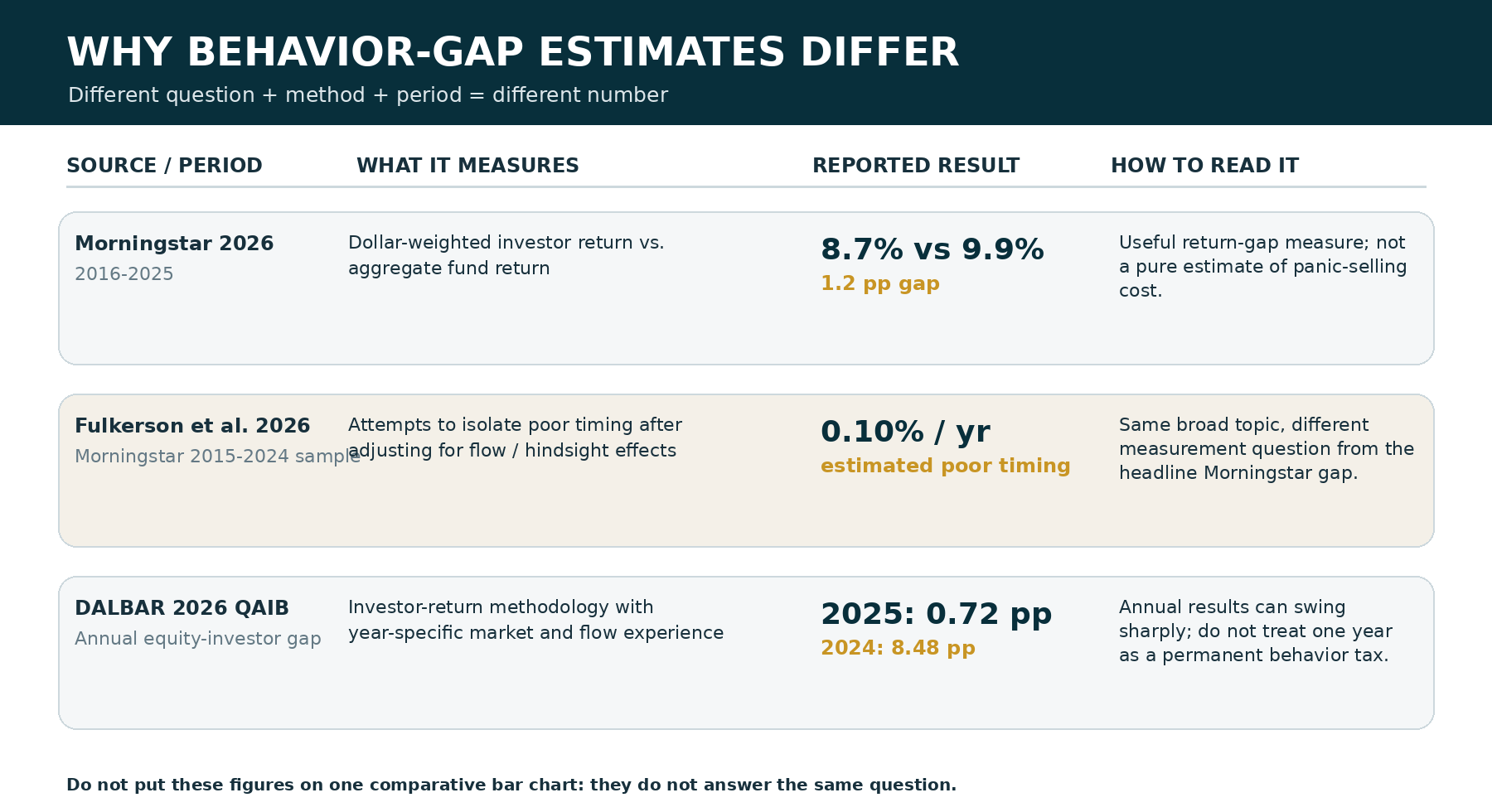
Reality check: the old “4% annual behavior tax” framing is too blunt. Poor timing, performance chasing, and panic selling can hurt, but a dollar-weighted return gap is not automatically a pure measure of those choices.
Why the same data can produce different conclusions
Dollar-weighted returns account for when money entered and left a fund. That comparison is informative, but it becomes tricky beside a fund’s time-weighted return, which assumes the original investment stayed in place. Simon Hayley’s research on the “hindsight effect” showed that prior returns can influence later investment flows, making part of a measured gap appear even when investors did not mistime future returns in the usual sense.
The 2026 Fulkerson study applies that critique to Morningstar’s 2015-2024 sample and arrives at the much smaller 0.10% estimate. That is why the 2025 Morningstar result remains useful here even though a newer edition now exists. Behavior can still hurt returns, but the evidence does not support one universal percentage for every account.
The “missing the best days” example is a warning, not a strategy test
J.P. Morgan’s example shows the cost of missing a small number of strong S&P 500 days. Over the 20 years from Jan. 2, 2006 through Dec. 31, 2025, $10,000 grew to $80,619 when fully invested and $35,866 after removing the 10 best days.
The example uses hindsight, gross index returns, and no real-world trading costs. It does not prove that every sale is wrong. Its value is narrower: market exits create a second decision, and the return often comes when staying out still feels emotionally comfortable. J.P. Morgan reports that six of the 10 best days occurred within two weeks of the 10 worst days.
Taxes can turn one emotional decision into a longer cleanup
A sale in a taxable brokerage account can create a capital gain or capital loss. The IRS classifies the result as short-term or long-term based on the holding period, and the tax effect depends on basis, income, losses, and personal circumstances.
That makes “sell now and buy back when things settle down” more complicated than it sounds. Retirement accounts follow different tax rules, but the planning problem remains: after selling, you still need a rule for returning.
Why Do Market Drops Feel So Urgent?
A market decline is abstract, but the loss on the screen is personal. It can narrow your attention to the next hour and make immediate action feel safer than waiting.
Daniel Kahneman shared the 2002 Nobel Memorial Prize for research on judgment under uncertainty. His work helped establish prospect theory. For investors, the practical takeaway is modest: losses can carry more psychological weight than comparable gains, so a vague plan is easier to override when the portfolio falls.
Stress changes what looks reasonable
During a selloff, each new headline can feel like fresh evidence that the original plan is obsolete. Charts, alerts, social feeds, analyst clips, and trading apps create a stream of reasons to act. More input can help when you are testing a specific thesis. When the decision rule is unclear, it often gives anxiety more material to work with.
This is why the plan has to be written before a selloff: following it gets hardest when the screen is red.
Four Investing Biases That Commonly Trigger Costly Trades
Action bias: the urge to do something because waiting feels careless. During a decline, it says, “At least sell a little.” During a rally, it says, “At least buy some before it is too late.”
The trade may relieve tension, but it also creates another timing decision. Once you leave, you need a return rule. Without one, you have exchanged an uncomfortable portfolio for an open-ended market-timing problem.
Herd behavior: the comfort of moving with the crowd. Buying the asset everyone praises or selling the one everyone mocks can feel safer because the social risk is lower.
A crowd can contain real information. Popularity, however, is not a valuation method. When the full thesis is “everyone is talking about it,” social pressure has taken the place of analysis.
Recency bias: the latest market environment can feel permanent. After a long rally, risk can look smaller; after a crash, recovery can look remote.
A written plan helps because it was created before the newest data point became emotionally dominant. The plan may still need an update, but the update should be tied to goals, cash needs, allocation, or new evidence rather than the intensity of this week’s mood.
Loss aversion and sunk cost: loss aversion can make an ordinary drawdown feel intolerable. The sunk cost fallacy works differently: it keeps you attached to a weak position because selling would turn an old decision into an acknowledged mistake.
The fresh-cash test helps here. Ask whether you would buy the position today at its current price, with the information you have now. A “no” does not automatically mean sell, but it tells you that the purchase price is doing too much of the reasoning.
How Do You Build a Better Investing Psychology System?
You do not need to eliminate emotion. You need fewer situations where a temporary emotion can change a long-term portfolio without explaining itself.
Step 1: Write the sell rules before you need them
Create a one-page investment policy statement. Keep it plain: target allocation, emergency cash, review schedule, rebalancing rule, and the conditions that permit a discretionary sale.
“I rebalance when stocks move five percentage points from target” is testable. “The market feels dangerous” is not. Feelings still matter, especially when they reveal that the portfolio was too risky from the start, but they need translation into a planning decision.
Step 2: Automate the decisions that do not need fresh judgment
Investor.gov defines dollar-cost averaging as investing equal portions at regular intervals regardless of market ups and downs. A schedule can reduce the number of times you must decide whether today feels safe enough to invest.
Dollar-cost averaging is a process, not a guarantee of higher returns. Its investing psychology benefit is continuity: contributions keep moving while your mood changes.
Step 3: Put friction between emotion and execution
Use a 72-hour cooling-off rule for discretionary trades. The number is a practical circuit breaker, not a scientific threshold. Urgent cash needs, fraud, account security, expiring options, and other time-sensitive situations require a different response.
For an ordinary fear or FOMO trade, write four lines before acting:
- What changed in the investment or in my own financial situation?
- Which written rule permits this trade?
- What taxes, spreads, fees, or opportunity costs could this trade create for me?
- What evidence would make me reverse the decision?
If the case still holds after the pause, evaluate it seriously. When the explanation collapses after a night’s sleep, the trade was probably solving a feeling rather than a portfolio problem.
Step 4: Separate core investing from speculation
If you enjoy stock picking, crypto, options, or tactical trades, isolate them from the core portfolio. Give the speculative sleeve a fixed cap and decide in advance how losses will be handled.
A 90% core and 10% speculative sleeve is one example, not a recommendation. What matters is the boundary: a bad idea in the play-money account should not quietly become a retirement-plan decision.
Step 5: Review the portfolio on a schedule
Frequent checking can make normal volatility feel like urgent feedback. Choose a review rhythm that matches the job. Monthly may suit an active savings plan; quarterly may be enough for a simple diversified portfolio.
When your allocation actually drifts, use a written portfolio rebalancing strategy instead of relying on the emotion of the day. A scheduled review gives new information a place to be considered without turning every notification into a referendum on the plan.
Practical rule: move brokerage apps off the home screen, turn off nonessential price alerts, and keep the written plan near the device you use to trade. These small barriers slow down a serious decision without hiding the risk from you.

FAQ: Investing Psychology
Why do I hold losing stocks for too long?
You may be protecting yourself from the discomfort of admitting the original decision was wrong. Loss aversion and the sunk cost fallacy can both contribute. Start with the fresh-cash test: would you buy the position today at the current price, using new money? Then review the business or fund thesis, diversification impact, tax consequences, and alternatives. The test is a prompt for analysis, not an automatic sell signal.
How do I stop checking my portfolio every day?
Remove the easiest triggers. Turn off price alerts, move the brokerage app off the first screen, and choose a recurring review date. You may still need to monitor a concentrated position, options, margin, or a near-term cash plan more closely. A diversified long-term account usually does not need to be treated like a live scoreboard. Make the checking frequency match the portfolio’s actual risks.
Should I ever sell during a market crash?
Yes, a sale can be rational when it follows a real change: you need near-term cash, the portfolio was too aggressive, an allocation band was breached, or a security-specific thesis failed. Selling only because the decline feels unbearable is a different case. Before acting, identify the rule, tax impact, replacement asset, and return plan. A cooling-off period helps only when the situation is not genuinely time-sensitive.
Can I remove emotion from investing completely?
No. Investing always involves uncertainty, so emotion will remain part of the experience. The realistic goal is containment. You can feel fear, greed, regret, or FOMO without giving each feeling permission to trade. Written rules, automation, account design, and scheduled reviews reduce the number of decisions that must be made in a stressed state. That is more dependable than trying to become permanently calm.
Is dollar-cost averaging always better than lump-sum investing?
No. Dollar-cost averaging describes a regular contribution schedule and can make it easier to keep investing through volatility. It does not guarantee a higher return than investing available cash immediately. The relevant choice depends on whether the money already exists as a lump sum, your risk tolerance, tax situation, time horizon, and ability to stick with the plan. Do not confuse a behavioral tool with a return promise.
Bottom Line: Investing Psychology Needs a System
Your portfolio has to survive the version of you that appears under stress. On a calm day, long-term compounding makes sense. During a selloff, relief can feel more important than the original horizon. During a rally, waiting can feel like failure.
Build around those predictable moments. Write the rules, automate routine contributions, keep near-term cash out of volatile assets, cap speculation, and require a short trade note before a discretionary decision.
You will still feel fear, greed, and regret. The system keeps one difficult hour from quietly rewriting a long-term plan.
Keep reading
- How to Write an Investment Policy Statement: turn goals and risk limits into rules you can still follow during a selloff.
- Portfolio Rebalancing Strategy: replace mood-driven allocation changes with a repeatable trigger.
- How to Invest in S&P 500 ETFs: build a simple core that requires fewer discretionary decisions.
YOUR TURN
Which trade rule would have saved you from your most expensive emotional decision?
Update history
- v2026.08.25 2026-08-25 FACTUAL REFRESH
Updated the behavior-gap section for Morningstar Mind the Gap 2026, kept the 2025 Morningstar sample for the Fulkerson comparison, softened an unsupported bias-ranking heading, and simplified several short sections without changing the article’s reader job.
- v2026.07.28 2026-07-28 TECHNICAL REVIEW
Rechecked load-bearing sources, aligned internal links with full canonical URLs, and replaced the Hayley preprint citation with the published paper’s institutional repository record.
- v2026.07.11 2026-07-11 EDITORIAL REPAIR
Removed the universal “4% behavior tax,” cut unsupported biological claims, separated investor-return gaps from timing-cost estimates, clarified when selling can be rational, and applied the S5 decision-router structure with a pre-trade rule check.