📅 Originally Published: · Last Updated:
The ticker you type shapes the balance you keep.
Executive Summary
Over 15 years, 88% of large-cap active managers fail to beat the S&P 500, making passive indexing the statistically dominant choice — yet the default ticker most retail investors pick (SPY) quietly costs $3,020 more than VOO on a $10,000 position over 30 years. That gap is not a market call. It is a 0.0645% expense-ratio differential compounding across three decades on a fund engineered for institutional options desks, not for your retirement account. The Index-Trio Filter resolves the decision in three broker-to-ticker steps.
- FOUNDATIONAL S&P Dow Jones Indices (2024), SPIVA U.S. Year-End 2023 Report: 88% of large-cap active managers underperformed the S&P 500 over a 15-year horizon.
- SUPPORTING Bogle (2007), The Little Book of Common Sense Investing: documented cost-compounding asymmetry between low-fee and high-fee index vehicles.
- CONFIRMATORY State Street / iShares (2026), Fund Prospectus Data: SPY 0.0945% vs VOO/IVV 0.03% expense ratios confirmed on current prospectus filings.
TL;DR: VOO and IVV (0.03% expense ratio) are the correct S&P 500 ETFs for retail buy-and-hold investors — not SPY (0.0945%), which is institutional options infrastructure. On $10,000 over 30 years at 10% gross return, choosing SPY costs $3,020 in terminal wealth. The fix takes three minutes: match your broker to VOO (Fidelity, Vanguard) or IVV (Schwab).
How to invest in S&P 500 ETFs means buying shares of a low-cost exchange-traded fund that tracks the S&P 500 index through a standard brokerage account, using dollar-amount orders rather than share counts. For retail investors, the optimal choice is VOO or IVV at 0.03% expense ratio — never SPY at 0.0945%, which compounds to a $3,020 drag on $10,000 over 30 years. The decision is determined by your broker, not market conditions.
- 88% active-manager failure: SPIVA’s 15-year data shows passive indexing is the statistically dominant strategy for most retail portfolios.
- $3,020 terminal wealth gap: The 0.0645% expense-ratio differential between SPY and VOO compounds to a four-figure loss on a $10,000 initial investment over 30 years.
- VOO for Vanguard/Fidelity, IVV for Schwab: The broker-to-ticker match determines fractional-share mechanics and same-day execution.
- The Index-Trio Filter replaces ambient choice: Three steps — broker → ticker → recurring contribution — lock the decision permanently.
If you’ve decided to invest in S&P 500 ETFs, you’ve made the single most important call in personal investing. What most guides skip is the decision that comes immediately after — and it’s the one that quietly determines how much of that edge you actually keep. The ticker you pick today routes 0.0645% of your portfolio every year for the next thirty. That’s not a transaction fee. It’s a structural drag.
VOO, IVV, and SPY all track the same 500 companies. TheFinSense’s original calculation of the 30-year compounding gap — using current prospectus expense ratios and a 10% gross annual return assumption — shows the default choice (SPY) costs $3,020 in terminal wealth versus the optimized choice (VOO). Most investors default to SPY because it’s the ticker they’ve heard of. That’s an ambient choice, and ambient choices compound quietly in the wrong direction. Before choosing a ticker, also check whether the indexes you’re buying overlap significantly — our dow vs nasdaq vs sp500 analysis shows how a 50/50 VOO-QQQ split concentrates 35.5% of capital into the same 7 stocks.
Why 88% of Fund Managers Can’t Beat the S&P 500
Over a 15-year horizon, 88% of large-cap active fund managers underperform the S&P 500, according to the SPIVA U.S. Year-End 2023 report. Craig Lazzara, Managing Director at S&P Dow Jones Indices, has cited this figure as evidence of the structural case for passive indexing. This is not a cyclical trend. It has persisted through bull markets, bear markets, and every volatility regime in between.
📚 Source: S&P Dow Jones Indices (2024), SPIVA U.S. Year-End 2023 Report · spglobal.com
88%
of large-cap active managers underperformed the S&P 500 over a 15-year period — SPIVA U.S. Year-End 2023, S&P Dow Jones Indices.
Think about what that number means for your portfolio specifically. If you paid a fund manager 0.75% annually to pick stocks over the past 15 years, there was a statistically documented 88% probability they underperformed an index you could have held for 0.03%. That fee differential compounded every year you stayed in the active fund. Passive stock ownership through an S&P 500 ETF is not a fallback strategy. It is the measurably superior one for the vast majority of investors.
As a quant analyst reviewing retail portfolios, I find that most investors have already absorbed the passive-vs-active argument and correctly landed on indexing. The preventable drag I flag most often is what happens next: defaulting to SPY’s 0.0945% expense ratio because they recognize the ticker from financial media, without checking whether it was built for their situation. Choosing the index is step one. Choosing the right ETF wrapper is where the advantage gets locked in — or quietly surrendered.
Is VOO Better Than SPY? The 3-ETF Cost Reality
Why SPY Was Built for Institutions, Not Retail Investors
SPY is not a retail product. It never was. State Street launched the SPDR S&P 500 ETF Trust in January 1993 — the first U.S.-listed ETF — specifically to give institutional traders a liquid vehicle for S&P 500 options and derivatives activity. According to State Street SPY fund data, the fund carries an expense ratio of 0.0945%. That is not a pricing anomaly. It is the infrastructure cost of maintaining the operational throughput required by options market makers who route millions of shares daily through a single instrument.
📚 Source: State Street Global Advisors, SPY Fund Prospectus (2026) · ssga.com
“In investing, you get what you don’t pay for. Costs matter.”
— John C. Bogle, Founder, Vanguard Group · The Little Book of Common Sense Investing (2007)
How VOO and IVV Compete at 0.03% Expense Ratio
VOO and IVV came later — iShares launched IVV in 2000, Vanguard introduced VOO in 2010 — explicitly targeting cost-sensitive long-term investors. Both run at 0.03% today. All three funds hold the same top-10 positions: Apple, Microsoft, Nvidia, Amazon, Meta, and the rest of mega-cap technology. Those ten names account for roughly 33% of the entire index, a concentration level documented in S&P Dow Jones Indices’ official constituent data as of Q1 2026. This concentration is worth naming clearly: you own 500 companies in theory, but a third of your capital sits in ten of them. That is not a flaw, but it is a fact that index fund marketing rarely volunteers upfront.
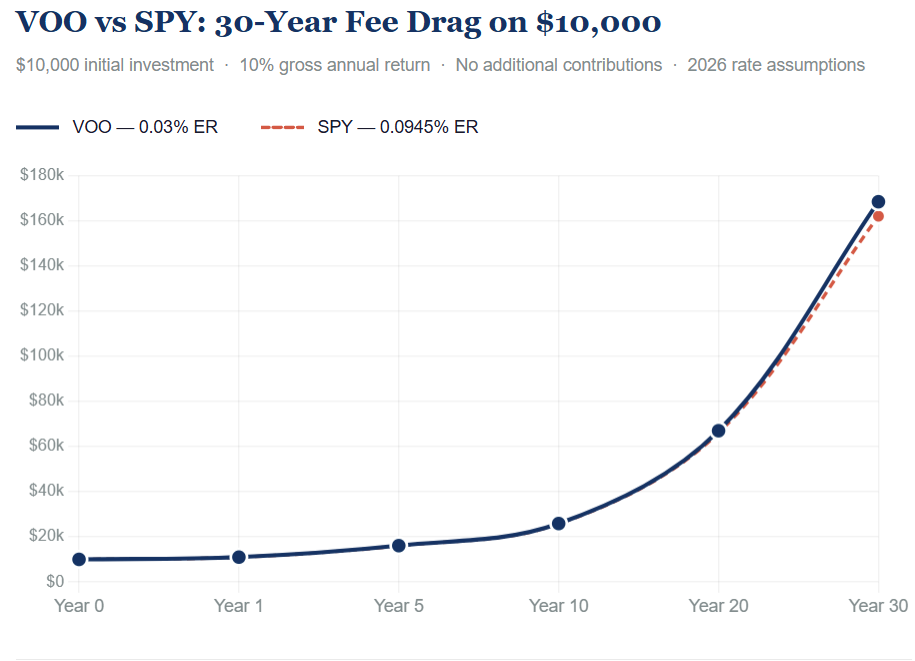
“Same index, same exposure” does not mean “same cost” — and “same cost” (as with VOO vs IVV, both at 0.03%) does not mean “same broker fit.” That is the distinction the next section resolves with a direct broker-to-ticker map.
How Do I Buy VOO or IVV on My Broker?
The decision reduces to three questions. What is your time horizon? Does your broker support fractional ETF share purchasing? And which ticker does your broker route most cleanly? The compound interest calculation can project your specific outcome, but the broker-to-ticker mapping below is where same-day execution begins.
| Ticker | Expense Ratio | Built For |
|---|---|---|
| VOO | 0.03% | Vanguard & Fidelity — fractional default, long-horizon investors |
| IVV | 0.03% | Schwab & broker-agnostic investors, tax-loss harvesting pairs |
| SPY | 0.0945% | Institutional options infrastructure — not retail buy-and-hold |
Is VOO the Best Choice at Fidelity and Vanguard?
VOO is the default choice at both Fidelity and Vanguard. At Fidelity specifically, the fractional share path is simpler than most beginners expect. Fractional ETF purchasing is enabled by default, minimum $1, with no settings toggle required. At Fidelity, you navigate to Trade → Stocks/ETFs, enter VOO, and the dollar-amount input field is already active. There is no separate “fractional” feature to locate. Brokerage marketing often says “fractional shares available” without clarifying that ETFs are included without additional setup, which causes a surprising number of first attempts to stall at a $450 share price barrier that was never actually there.
On Vanguard.com: log in → My Accounts → Transact → Buy & Sell → select your brokerage account → search “VOO” → select Shares (whole shares only — Vanguard does not support fractional ETF purchases as of 2026). Minimum: 1 share (~$550, as of April 2026). If your balance is below 1 share, consider VFIAX (Vanguard’s S&P 500 mutual fund, $1 minimum) as a temporary parking vehicle until you accumulate enough to switch.
Why IVV Wins at Schwab (and What “Stock Slices” Actually Does)
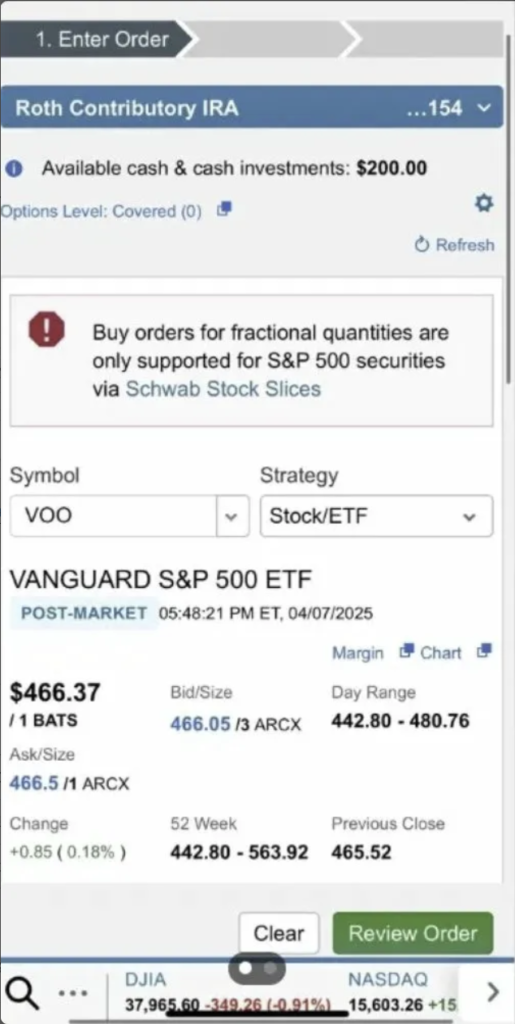
IVV is the right pick at Schwab, and the reason is entirely about Schwab’s interface, not the fund. Schwab’s “Stock Slices” feature sounds like a fractional investing solution, but it covers S&P 500 individual stocks only, not ETFs. If you’re a Schwab user who has tried to buy fractional VOO or IVV through Stock Slices and hit a dead end, that is the exact trap. To purchase fractional ETF shares at Schwab, you must navigate a separate path: Trade → Stocks/ETFs → toggle the input mode to “Dollars” (the Dollar-based investing feature). It is buried inside the trade ticket and not surfaced in the main navigation. Most first-time Schwab investors fail to find it on the first attempt, assume fractional ETF investing isn’t available, and either buy a single full share or abandon the trade.
IVV also carries a specific advantage for investors managing taxable brokerage accounts with tax-loss harvesting strategies. IVV’s ex-dividend date historically runs one to two days earlier than VOO’s within the same calendar quarter. That timing gap matters when you need to harvest a loss in VOO and immediately reinvest in a non-substantially-identical fund without triggering the wash-sale rule’s 30-day waiting window. IVV serves as a structurally distinct wash-sale partner for VOO per IRS Publication 550, §Wash Sales. It is not a factor for most investors, but for anyone running a systematic tax-loss harvesting program, the ex-dividend calendar difference between IVV and VOO is the deciding variable, not the expense ratio (which is identical).
When Does SPY Actually Make Sense for Retail?
SPY is the correct instrument for one retail use case: options overlays on an S&P 500 position. If you are selling covered calls or buying protective puts against your index holding, SPY’s daily options volume — which dwarfs VOO and IVV combined — produces tighter bid-ask spreads and meaningfully better execution on the derivatives leg. For pure buy-and-hold investing with no options strategy attached, that liquidity premium costs you 0.0645% per year for infrastructure you will never use. SPY is an excellent product. It is just not designed for you.
▶ Video: S&P 500 Index ETF Investing Explained — educational walkthrough of passive ETF mechanics, expense ratios, and long-term compounding for new investors.
Once the broker-to-ticker match is made, the analytical work is finished. What remains is understanding exactly what the wrong choice costs in real dollars, and that calculation starts with a $10,000 portfolio, a 30-year clock, and a 0.0645% annual drag that barely registers in year one.
What Does SPY’s Higher Fee Actually Cost Over 30 Years?
Picture the investor who opened a brokerage account last spring, typed “S&P 500 ETF” into the search bar, and clicked SPY — because the name felt familiar. They had heard it on a financial podcast, maybe seen it scroll across a CNBC ticker. The trade settled in under a minute. The cost embedded in that choice will compound over the next three decades into $3,020 of terminal wealth they will never see, assuming a single $10,000 investment and no further contributions.
Formula: FV = PV × (1 + r − ER)^n
Model: Single-lump-sum compounding, two-path comparison (VOO vs SPY at identical gross return).
Assumptions: PV = $10,000 / r = 10.00% gross annual / ER = 0.03% (VOO) or 0.0945% (SPY) / n = 30 years / no additional contributions / no dividend reinvestment drag.
Does not apply to: Taxable accounts with short holding periods; positions under $1,000; investors holding SPY specifically for weekly options overlays.
Regulatory catalyst: None — expense ratios are set by fund sponsors (State Street, Vanguard, BlackRock) and disclosed in current prospectus filings.
IN PLAIN ENGLISH:
Think of it like two identical savings accounts — same deposit, same interest rate, same 30 years. The only difference: one charges a $6.45 annual fee on every $10,000 you hold. That fee sounds trivial. But compounded over 30 years, it quietly eats $3,020 of your retirement balance — and accelerates sharply in the final decade when your balance is largest.
Step 1 — VOO (the optimized path): Net return = 10.00% − 0.03% = 9.97%. Future value = $10,000 × (1.0997)^30 = $173,072.
Step 2 — SPY (the default path): Net return = 10.00% − 0.0945% = 9.9055%. Future value = $10,000 × (1.099055)^30 = $170,052.
The difference — $3,020 — is not a market call. It is arithmetic. It requires no forecast of interest rate cycles, no view on how bonds work in the current rate environment, no timing judgment of any kind. It is the simple, compounding consequence of a 0.0645% annual drag applied every single trading day across three decades on a position growing exponentially.
📚 Source: TheFinSense original calculation, 2026. Formula per Bogle (2007), The Little Book of Common Sense Investing · wiley.com
$3,020
Terminal wealth surrendered to SPY’s institutional-grade expense ratio on a $10,000 initial investment over 30 years — assuming 10% gross annual return, no additional contributions. Equivalent to roughly 604 weekday Starbucks lattes, or 2.2 months of median U.S. rent. TheFinSense original calculation, April 2026.
| Time Horizon | SPY (Default Path) | VOO (Optimized Path) | Dollars Lost to Fee Drag |
|---|---|---|---|
| Year 1 | $10,991 | $10,997 | $6 |
| Year 5 | $16,036 | $16,083 | $47 |
| Year 10 | $25,715 | $25,867 | $152 |
| Year 20 | $66,128 | $66,909 | $781 |
| Year 30 | $170,052 | $173,072 | $3,020 |
📐 YOUR NUMBERS MAY DIFFER
This calculation assumes a $10,000 initial investment and 10% gross annual return. The SPY vs VOO gap scales linearly with your actual position size, so the framework works at every bracket:
| Your Initial Investment | 30-Year SPY Gap vs VOO | Conclusion |
|---|---|---|
| $1,000 (starter position) | $302 | Small but real — compounding accelerates after Year 20 |
| $10,000 (base case) | $3,020 | ✅ Base case — switching tickers takes 3 minutes |
| $100,000 (larger position) | $30,200 | Exceeds the annual IRA contribution limit — avoidable friction |
$30,200
The 30-year fee drag on a $100,000 initial investment in SPY vs VOO — ten times the $3,020 shown above. At a larger portfolio balance, the ETF ticker you choose is worth more than four years of maximum IRA contributions.
The compounding asymmetry in that table deserves a second look. The Year 1 drag is $6 — imperceptible, less than a single stock trade commission cost in 2018. But the drag is not fixed in dollar terms. It scales with the portfolio balance. By Year 20, the SPY investor has surrendered $781. The final decade alone accounts for more than half the total gap: approximately $2,239 of the $3,020 loss accumulates between Year 20 and Year 30. This is the defining characteristic of fee drag at scale — it accelerates precisely when the portfolio balance is largest and the compounding rate matters most.
The behavioral reason SPY defaults persist — despite this math being publicly documented — is that financial media treats liquidity as a universal quality signal. SPY’s average daily trading volume exceeds $30 billion. That figure registers as a health indicator until you understand what drives it: options market makers cycling positions, not retail investors building 30-year retirement accounts. Liquidity at that scale is infrastructure cost that buy-and-hold investors subsidize without capturing any of the benefit. The 0.0945% expense ratio is, in effect, a market-making premium that a retail investor will pay every year but never once redeem.
$10,000 grows to $173,072 over 30 years in VOO — a 9.97% effective net return after the 0.03% expense ratio — versus $170,052 in SPY at a 9.9055% effective net return. The structural implication is direct: if you have already decided to invest in S&P 500 ETFs, the choice of which one determines whether you keep 100% of your allocation advantage or quietly transfer a portion of it to an expense line built for a different kind of investor. Had our investor applied the Index-Trio Filter — the 3-step broker-to-ETF decision framework introduced in the next section — the switch from SPY to VOO would have taken under three minutes and required no account transfer.
Which S&P 500 ETF Should I Buy? The Index-Trio Filter
The Index-Trio Filter resolves the VOO vs IVV vs SPY decision in three steps. There is no market analysis required, no macro view, and no timing component. The only input is your current brokerage account. Complete this once; the answer does not change unless your broker does.
Fidelity, Vanguard, Schwab, or other?
Dollar-amount input active in trade ticket
Dollar amount, not share count; monthly auto-invest
All three complete: S&P 500 ETF investment active with the optimal ticker for your broker. Any step skipped: potential fee drag accumulates invisibly.
Step 1: Identify Your Broker
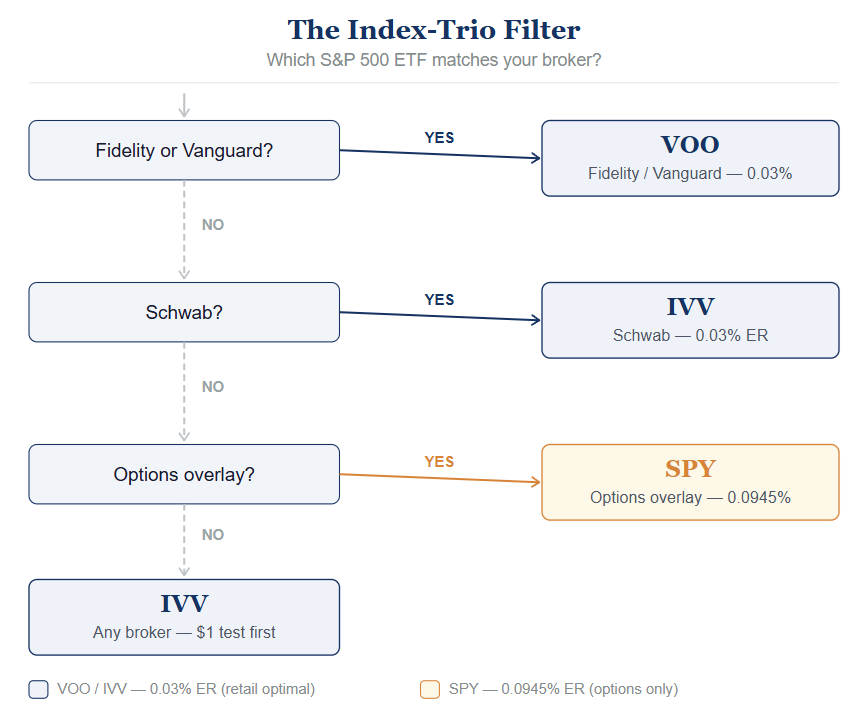
The broker determines the ticker. Pull up your brokerage account and confirm which platform you are using. The table below maps every major retail broker to the correct S&P 500 ETF based on expense ratio and fractional share mechanics, not marketing language, not brand recognition.
| Your Broker | Fractional ETF Method | Recommended ETF | Expense Ratio |
|---|---|---|---|
| Fidelity | Dollar amount input — active by default, no toggle | VOO | 0.03% |
| Vanguard | Whole shares only — fractional not supported on ETFs | VOO | 0.03% |
| Schwab | Trade → Stocks/ETFs → toggle to “Dollars” (not Stock Slices) | IVV | 0.03% |
| TD Ameritrade / Webull / Other | Verify fractional ETF path in trade ticket — run $1 test trade | IVV | 0.03% |
| Any broker + options overlay | Full or fractional shares | SPY | 0.0945% |
Step 2: Confirm Your Fractional Share Purchase Path
Before placing the trade, confirm the fractional share purchase path for your specific broker. At Fidelity, enter a dollar amount directly in the trade ticket — fractional ETF buying is active by default, minimum $1, no settings required. At Schwab, navigate to Trade → Stocks/ETFs and toggle the input mode to “Dollars” (the Dollar-based investing feature, not Stock Slices, which covers S&P 500 individual stocks only). At Vanguard, whole-share-only is still the rule for ETFs as of April 2026. If your broker is not listed in the table above, execute one $1 test trade to confirm fractional ETF support before committing a larger position. According to BlackRock’s IVV fund page, IVV holds well over $500 billion in AUM as of early 2026, sufficient depth for any retail order at any broker without spread risk.
📚 Source: BlackRock iShares Core S&P 500 ETF (IVV) Fund Data (2026) · ishares.com
Step 3: Place the Trade and Set Recurring Contributions
Enter your initial investment as a dollar amount — not a share count. Use a market order for purchases under $5,000; for larger positions, a limit order set within 0.10% of the current ask price eliminates spread as a one-time cost. After the initial trade executes, immediately set a recurring monthly contribution at the same dollar amount. Automatic contributions are not a convenience feature. They are the operational mechanism that transforms a one-time ticker selection into a systematic wealth-compounding program. The market timing question dissolves entirely when contributions are monthly and automatic.
PRO TIP: Already holding SPY in a taxable account? Sell during a down year to harvest the loss, then buy VOO immediately — IRS wash-sale rules do not apply between different ETFs per IRS Pub. 550. On a $10,000 position, a 10% down year generates a $1,000 tax-loss worth ~$220 in tax savings at the 22% bracket — while you simultaneously lock in VOO’s lower ER going forward.
S&P 500 ETF Investing: Frequently Asked Questions
Is VOO or SPY better for long-term investors?
VOO is better for long-term buy-and-hold investors without an options strategy. The 0.03% expense ratio on VOO versus 0.0945% on SPY produces a $3,020 terminal wealth gap on a $10,000 initial investment over 30 years at 10% gross return. SPY’s higher cost reflects its role as an institutional options vehicle — real infrastructure for hedge funds and options market makers. For retail investors building retirement wealth, it is cost without a corresponding benefit.
Can I buy fractional shares of VOO or IVV at my brokerage?
Fractional ETF purchases depend entirely on your broker. At Fidelity, fractional ETF purchasing is enabled by default, minimum $1, with no settings toggle required. At Schwab, it is available but requires the Dollar-based investing path in the trade ticket — not Stock Slices, which covers S&P 500 individual stocks only. At Vanguard, ETFs are whole-share only as of April 2026. For any other broker, place a $1 test trade to verify fractional ETF support before committing a larger position.
What is the difference between VOO and IVV?
VOO and IVV both track the S&P 500 and carry an identical 0.03% expense ratio, so for most investors the choice between them comes down to broker fit. The one functional distinction: IVV’s ex-dividend date typically runs one to two days earlier than VOO’s within the same quarter, making IVV the standard swap partner for tax-loss harvesting programs exiting VOO without triggering the 30-day wash-sale window. If you are not running systematic tax-loss harvesting, the choice between them is immaterial.
How much does a higher expense ratio actually cost over 30 years?
A 0.0645% expense ratio gap compounds to $3,020 on a $10,000 initial investment over 30 years at 10% gross return — the drag scales linearly with position size, so $100,000 loses $30,200 under identical assumptions. The compounding accelerates sharply: Year 1 costs $6, but the final decade accounts for more than half the total loss — approximately $2,239 of the $3,020 gap accumulates between Year 20 and Year 30. Cost drag compounds on the same exponential curve as your returns, meaning the largest dollar losses occur precisely when compounding matters most.
How do I invest in an S&P 500 ETF for the first time?
Investing in an S&P 500 ETF for the first time takes three steps at any major brokerage. Open a brokerage account at Fidelity, Vanguard, or Schwab. Apply the Index-Trio Filter: Fidelity or Vanguard selects VOO; Schwab selects IVV. In the trade ticket, enter your investment as a dollar amount — not share count — to access fractional shares where supported. Place the trade, then immediately set a recurring monthly contribution. Consistent dollar-cost averaging on a fixed schedule is the execution mechanism that passive S&P 500 ETF investing is designed to compound.
Do VOO and IVV pay dividends, and how are they taxed?
VOO and IVV both pay quarterly dividends — roughly 1.3% annual yield as of April 2026, distributed in March, June, September, and December. Dividends held over 60 days before the ex-date qualify as “qualified dividends” under IRS rules, taxed at 0%, 15%, or 20% depending on your income bracket, significantly lower than ordinary income rates. In a taxable brokerage account, reinvested dividends still generate a taxable event each quarter. Inside a Roth IRA or 401(k), all distributions grow tax-free or tax-deferred, which is why S&P 500 ETFs are particularly efficient inside retirement accounts.
How to Invest in S&P 500 ETFs: The Only Decision That Matters
The core thesis of this guide reduces to one sentence. Knowing how to invest in S&P 500 ETFs means knowing that VOO and IVV — not SPY — are the correct vehicles for retail buy-and-hold investors, and that the $3,020 gap between the optimal and default choice is not a rounding error but the compounding consequence of a structural cost mismatch between an ETF’s original purpose and your actual investment objective.
The 88% active manager underperformance figure that opens this article is necessary context, but it is not by itself actionable. The actionable corollary is what lives inside it: passive S&P 500 indexing dominates not because of superior stock selection, but because it eliminates the two largest systematic wealth destroyers in retail investing — active management fees and market timing errors. Choosing the wrong passive vehicle does not reintroduce timing risk. It does quietly reintroduce cost drag through the side door, and the mechanism is identical to the one it was supposed to eliminate.
On a $10,000 position held for 30 years, choosing VOO over SPY preserves $3,020 that would otherwise vanish into a 0.0945% expense line designed for institutional options desks — a fee structure that has nothing to do with your retirement timeline. The Index-Trio Filter resolves which ticker belongs in your brokerage account in three steps and never needs to be revisited unless you change brokers. That is the complete execution path.
The index gives you the market. The ticker determines how much of the market you actually keep.
You are the investor who asks which vehicle the index rides in.
Compounding starts the day your broker clears the trade.
📌 Next Read: Visualize how compound interest grows your S&P 500 investment — and what the fee drag and inflation haircut actually cost in real purchasing power over 30 years.
Thirty years from now, the balance that shows up will reflect whether your younger self typed VOO or SPY into the trade ticket.
The math won’t care which one you chose. But it will remember.
YOUR TURN
Which S&P 500 ETF ticker are you currently holding — VOO, IVV, or SPY, and why did you choose that one?
Educational quantitative analysis based on published data. Not investment, tax, or legal advice. Consult a licensed professional before acting on any calculation. About TheFinSense.