
📅 Originally Published: · Last Updated:
The Bottom Line, Up Front
With a 1.02% annual fee gap, the choice between ETFs vs mutual funds in a taxable brokerage account is not a preference question — it is a structural wealth question. Over 30 years of $600 monthly contributions, that gap mathematically extracts $171,974 from your terminal balance, handing 19.1% of your compounded lifetime returns to a fund manager for performance the data shows 89.50% of managers cannot sustain. The fix is a single allocation rule: passive ETFs in taxable accounts, deployed through the Vehicle-Tax Matrix.
The debate between ETFs vs mutual funds comes down to one number most investors never calculate: 1.02%. That gap — between the 0.03% expense ratio of Vanguard’s VOO and the 1.05% average charged by actively managed equity mutual funds — is so small it fits inside a rounding error. It does not behave like one.
Picture two investors in January 1996. Identical starting portfolios: $10,000 initial deposit, $600 contributed every month, the same 7.5% gross market return. The only variable is the vehicle. Thirty years later, the ETF investor holds $896,878. The mutual fund investor: $724,904. No bad market calls, no catastrophic bets — just 1.02% compounding in reverse, 360 months in a row.
The mechanism behind that $171,974 gap is arithmetic, not opinion. It operates through monthly compounding velocity — the fee subtraction compounds against the investor at precisely the same frequency as gains compound in their favor. Resolving this requires one decision framework: the Vehicle-Tax Matrix, which assigns each investment vehicle to the account type where its structural advantages are fully unlocked. Deploy the matrix once, and the ETFs vs mutual funds question resolves to a single executable rule.
The ETFs vs Mutual Funds Fee Gap: How 1.02% Becomes $171,974
Most investors believe a 1% mutual fund fee is a harmless price for professional management. The data shows otherwise. That 1.02% gap is a structural compounding drag that confiscates over 19% of your lifetime returns.
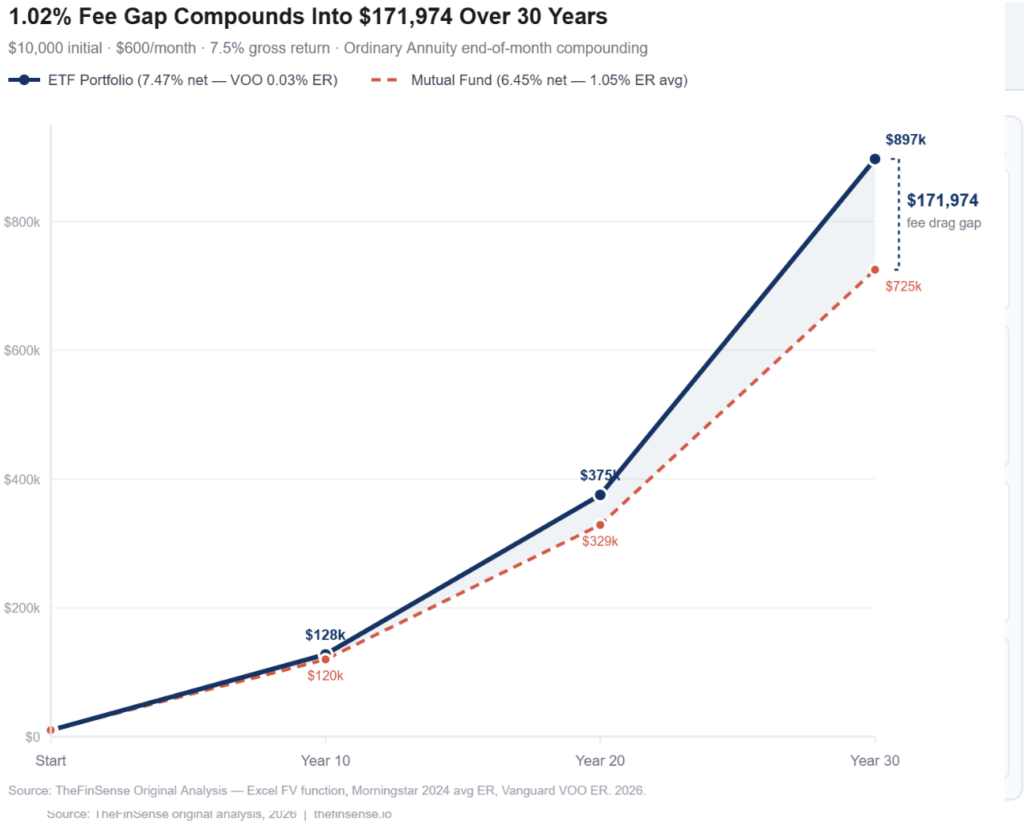
On a standard 30-year portfolio with a $10,000 initial investment and $600 in monthly contributions, that percentage does not stay abstract — it materializes as a precise, calculable $171,974 in terminal wealth destroyed, a figure verifiable via Excel’s FV function under standard end-of-month compounding (Ordinary Annuity). The mutual fund does not need to make a single catastrophic investment to extract this amount. It just needs to exist and apply its fee every month.
The Compounding Velocity Problem: Why Monthly Frequency Is the Multiplier
You have been contributing $600 a month to a benchmark-tracking account, watching the balance grow — almost certainly without accounting for the 1.05% that quietly exits the position each year. The problem is not the fee in isolation. The problem is that the fee compounds against you at monthly intervals, identical in frequency to the compounding that builds your wealth.
At year 10, the damage looks negligible: roughly $7,800. By year 20, monthly compounding has expanded that figure to approximately $46,600 — six times larger despite only doubling the time horizon. At year 30, the gap reaches $171,974. Fee drag does not grow linearly. It accelerates exponentially, powered by the same mechanism that makes compound interest so valuable when it runs in your direction.
| Time Horizon | ETF Portfolio (7.47% net) | Mutual Fund Portfolio (6.45% net) | Dollar Gap |
|---|---|---|---|
| Year 10 | $127,600 | $119,800 | $7,800 |
| Year 20 | $375,300 | $328,700 | $46,600 |
| Year 30 | $896,878 | $724,904 | $171,974 |
The Baseline Calculation: Monthly Compounding Worked Step-by-Step
The terminal wealth figures above derive from a standard Future Value calculation run at monthly compounding frequency, using the Ordinary Annuity structure:
FV = PV × (1 + r)n + PMT × [(1 + r)n − 1] / r
Where PV = $10,000 (initial lump sum), PMT = $600 (monthly contribution), n = 360 months (30 years), and r = the monthly net rate. For the ETF portfolio: r = 7.47% ÷ 12 = 0.6225% per month. For the mutual fund portfolio: r = 6.45% ÷ 12 = 0.5375% per month.
That 0.085 percentage-point difference in monthly rates — invisible on its own — compounds 360 times into a 19.1% terminal wealth differential. Both outputs are replicable in Excel via =FV(rate, nper, pmt, pv) using the exact rate inputs above. The formula does not interpret the fee; it simply compounds it.
💡 PRO TIP: To verify the gap yourself: enter
=FV(0.006225,360,-600,-10000)for the ETF scenario and=FV(0.005375,360,-600,-10000)for the mutual fund scenario. The $171,974 difference appears directly in the output. The negative signs on PMT and PV follow Excel’s cash-flow sign convention — both represent money leaving your pocket.
Why the ETFs vs Mutual Funds Verdict Is Already In — And Has Been Since 1991
When you sit down to compare ETFs vs mutual funds, you are not entering a live debate — you are reviewing a closed case file. The mathematical proof was formalized in 1991. The empirical confirmation arrived in every annual scorecard published since. What most investors experience as a preference question is, structurally, an outcome that follows with mathematical certainty from how markets are constructed.
The Conventional Wisdom the Data Destroyed
The conventional wisdom holds that a 1% annual management fee purchases something real: downside protection, alpha generation, or at minimum, benchmark-competitive returns. According to Vanguard Research’s The Case for Low-Cost Index-Fund Investing, that assumption fails at scale: 82% of actively managed funds underperformed their benchmark over a 15-year measurement window — not in an anomalous market environment, but across a broad historical sample. The paper’s core finding runs directly against the conventional wisdom that active fees purchase sustainable performance.
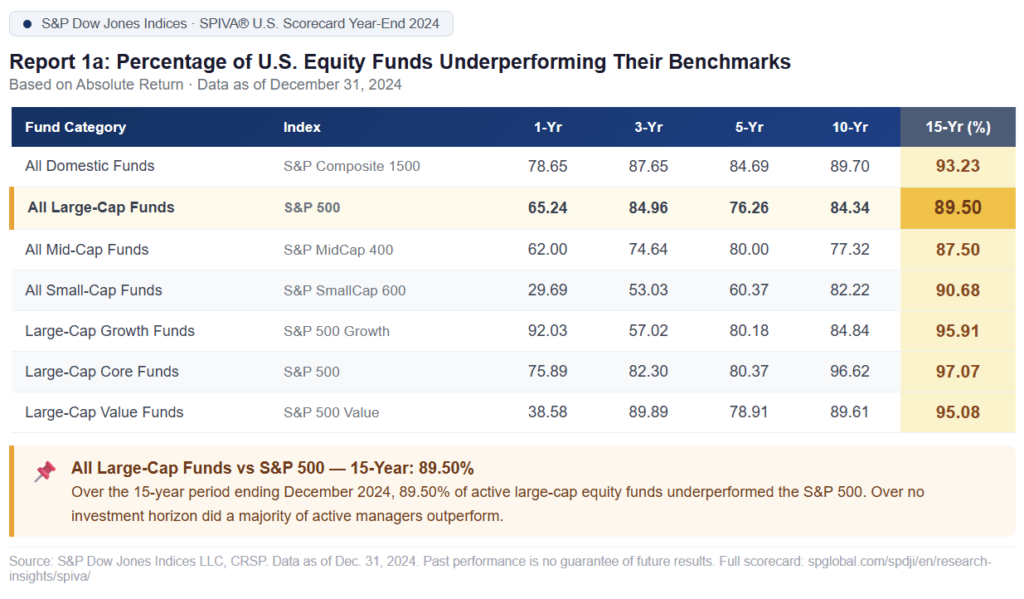
The S&P Dow Jones Indices 2024 SPIVA Year-End Scorecard updates and amplifies that finding: 89.50% of domestic equity funds underperformed their benchmark over the 15-year measurement period as of the 2024 report. The conventional wisdom does not improve with more data. It deteriorates.
89.50%
Of domestic equity mutual funds underperformed their benchmark over 15 years per the S&P Dow Jones Indices 2024 SPIVA Year-End Scorecard — which immediately raises the question: what, precisely, does the 1.02% annual management premium purchase?
What the Nobel Prize Math Proves About ETFs vs Mutual Funds at Every Return Level
The underperformance data is not a streak of bad luck or a period-specific anomaly. It is a mathematical certainty. Nobel Laureate William F. Sharpe established the mechanism in his foundational paper “The Arithmetic of Active Management” — a framework the 2024 SPIVA Year-End Scorecard, produced in collaboration with S&P DJI’s Craig Lazzara, explicitly validates with current data:
“Properly measured, the average actively managed dollar must underperform the average passively managed dollar, net of costs.”
— William F. Sharpe, Nobel Laureate, Stanford University
This is not a market forecast. It is arithmetic. Before fees, active management is a zero-sum game — every dollar of outperformance by one active manager is extracted directly from another participant’s position. Once the 1.02% fee gap is layered on top, the average actively managed mutual fund must underperform the average passive ETF by definition, irrespective of manager skill or market regime. Sharpe’s proof makes the $171,974 gap not a probabilistic finding but an inevitable structural outcome — verifiable, calculable, and avoidable only by abandoning the fee-bearing vehicle entirely.
📌 Next Read: what is an ETF
How the ETF Expense Structure Kills Fee Drag at the Mechanical Level
The 0.03% expense ratio of a passive ETF like Vanguard VOO is not simply a lower number — it reflects a fundamentally different operational architecture. Understanding why ETFs can charge 35 times less than the average active mutual fund requires examining the mechanism that makes that pricing possible: the in-kind redemption process executed by Authorized Participants.
The Authorized Participant Loop: How ETFs Structurally Bypass Forced Capital Gains
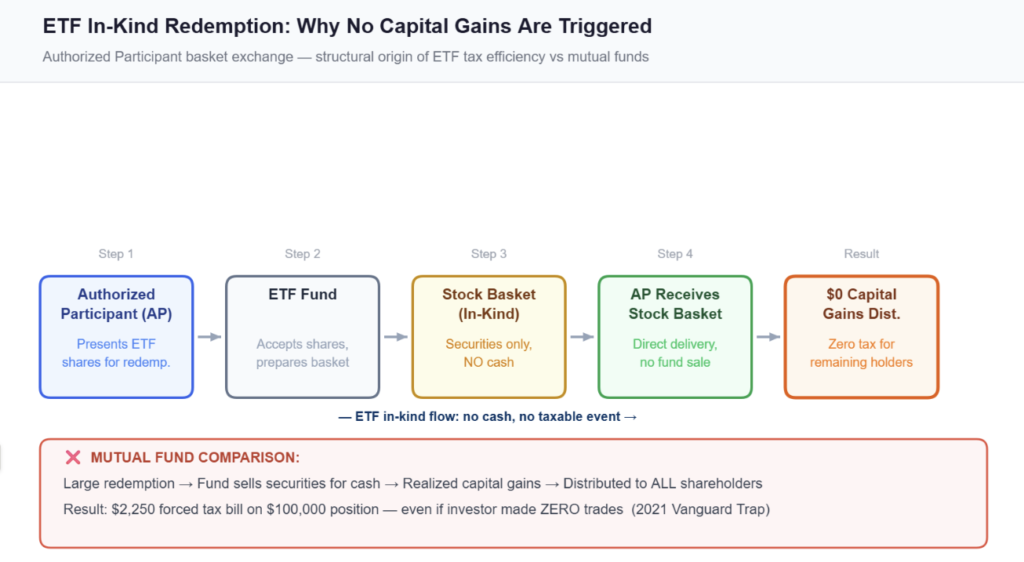
When you hold a mutual fund in a taxable brokerage account, you are not only paying the stated 1.05% expense ratio — you are absorbing the tax distribution risk of every other investor in that fund who chooses to redeem. When institutional-scale redemptions occur, the fund must sell underlying securities to raise cash. That sale generates realized capital gains distributed across all remaining shareholders, including investors who never sold a single share.
ETFs eliminate this mechanism entirely through in-kind redemption. When institutional investors — specifically, Authorized Participants (APs) — redeem a large ETF position, they receive a basket of the underlying securities rather than cash. Because no securities are sold for cash within the fund structure, no taxable event is triggered for continuing shareholders. The compounding tax drag that silently erodes mutual fund returns in taxable accounts structurally does not exist inside the ETF wrapper.
🧠 IN PLAIN ENGLISH:
Think of a mutual fund as a shared piggy bank: when someone wants their money back, the manager has to smash it open — selling securities for cash and triggering a tax event that every remaining shareholder absorbs. An ETF works differently. The departing investor simply swaps their ETF shares for a basket of the stocks inside. No securities sold. No cash transaction within the fund. No shared tax bill for investors who stayed.
The Expense Ratio Stack: Where the 1.05% Goes Inside an Actively Managed Fund
According to Morningstar’s 2023 U.S. Fund Fee Study (2024 release), the average active equity mutual fund expense ratio stands at 1.05% as of the 2024 release. That single figure typically bundles four distinct cost layers — each one eliminated or reduced to near-zero by a passive ETF structure.
The management fee (the stock-picker’s compensation, typically 0.50–0.75%) sits at the top. Below it: the 12b-1 distribution fee (capped at 0.25% under SEC rules, charged for marketing and broker distribution networks). Below that: administrative and operational costs including custodian fees, compliance, and annual audit. At the base — the layer most investors never quantify — portfolio turnover generates transaction costs and tax drag that Morningstar estimates adds an additional 0.25–0.50% to the average fund’s all-in annual cost.
A passive ETF running a buy-and-hold index strategy eliminates the management fee premium (no active stock selection required), the 12b-1 fee (ETFs trade on exchange and bypass broker distribution networks entirely), and the transaction-cost layer (index strategies rebalance infrequently by design). The result: 0.03% for VOO against 1.05% for the Morningstar average active fund — a 35-times cost differential that compounds into the $7,800 / $46,600 / $171,974 divergence sequence demonstrated above.
📌 Next Read: invest in S&P 500 ETFs
▶ Video: ETFs vs Mutual Funds — fee structure breakdown, in-kind redemption mechanism, and the structural cost differences driving the 1.02% expense gap and its 30-year terminal wealth impact.
Case Study: The 2021 Vanguard Target-Date Trap
The $171,974 gap established in Section 1 is the arithmetic forecast — 1.02% compounding in reverse across 360 monthly cycles, derivable from any spreadsheet using the FV function. The 2021 Vanguard Target-Date trap is not a forecast. It is the empirical record of what happens when the mutual fund’s structural tax liability activates without a sell order, without a portfolio decision, and without the investor’s knowledge or consent. This is the structural dimension of the etfs vs mutual funds comparison that does not appear on the annual expense ratio line — because it is not annual. It is event-driven, unpredictable, and triggered by corporate decisions made inside Vanguard’s offices, not the investor’s brokerage terminal.
How a Routine Fund Restructuring Became a Forced Tax Event
In late 2021, Vanguard merged the retail share classes of its Target Retirement fund series with the institutional share classes previously reserved for pension funds and large 401(k) plans. The structural rationale was sound — retail investors gained access to lower operational costs after the merger. What was not communicated prominently in advance was the tax mechanism. The share-class merger required the underlying mutual fund to liquidate low-cost-basis securities to facilitate the exchange, generating realized capital gains inside the fund structure. Those gains were distributed to all remaining retail shareholders.
Per IRS Publication 550, capital gains distributions from mutual funds are taxable in the year received, regardless of whether the investor reinvested the distribution or executed any sale of their own. A retail investor holding $100,000 in the Vanguard Target Retirement 2045 fund (VFORX) inside a taxable brokerage account — who neither bought nor sold a single share during 2021 — received a taxable capital gains distribution of approximately $15,000, equivalent to 15% of NAV. At the 15% federal long-term capital gains rate (CASE_STUDY_BRACKET: 15% federal / 0% state), that distribution generated a forced tax liability of approximately $2,250 — payable in April 2022, for a position the investor never chose to liquidate.
⚠️ WARNING: The 2021 Vanguard Target-Date capital gains event was documented extensively in the Bogleheads investment community. Hundreds of retail investors reported five-figure tax bills on taxable mutual fund positions they had not touched, including one confirmed thread where holders described receiving IRS 1099-DIV forms showing capital gains distributions of $5,000 to $15,000 or more on $100,000 positions — generated by Vanguard’s internal restructuring decision, not any trade the investor executed. (Bogleheads Tax Surprise thread, January 2022)
The Do-Nothing Outcome: ETF Holder vs. Mutual Fund Holder
| Scenario | $100,000 Position — Taxable Brokerage | 2021 Capital Gains Distributed | Forced Tax Bill (15% Federal LTCG) |
|---|---|---|---|
| ETF holder — Vanguard VOO | $100,000 | $0 — in-kind redemption mechanism | $0 |
| Mutual fund holder — Target Retirement 2045 (VFORX) | $100,000 | ~$15,000 (~15% of NAV) | ~$2,250 |
💡 BREAK POINT: This math reverses only if the mutual fund manager consistently generates more than 1.03% in net annual alpha every year for 30 consecutive years — an outcome the 2024 SPIVA Year-End Scorecard shows fewer than 12% of active managers have achieved over any 15-year measurement window. For the other 88%, the $2,250 forced tax event layers directly on top of the $171,974 long-run fee drag calculated in Section 1.
$2,250 extracted from a $100,000 passive position by a corporate restructuring decision the investor had no vote in and no recourse against — a 2.25% immediate wealth drain equivalent in effect to being involuntarily required to sell $15,000 worth of their holding at whatever price the 2021 distribution date imposed — and historically, this structural exposure is not a single-event anomaly: per IRS Publication 550 and the Bogleheads community record, any large-scale redemption wave inside a mutual fund held in a taxable account can trigger a capital gains distribution for all remaining shareholders, regardless of whether they personally traded a single share. That is not an edge case. That is how mutual fund tax exposure works, by design.
📐 YOUR NUMBERS MAY DIFFER
This analysis uses a 1.05% active fund expense ratio against a 0.03% ETF baseline. Here is how the terminal wealth gap changes at different fund fee levels — and when the Vehicle-Tax Matrix becomes non-negotiable.
| Fund Expense Ratio | 30-Year Terminal Wealth ($10k + $600/mo) | Gap vs ETF Baseline | Conclusion |
|---|---|---|---|
| 0.03% ER — ETF baseline (VOO, VTI) | $896,878 | $0 | ETF baseline — optimal; no fee drag |
| 1.05% ER — Morningstar active average (2024) | $724,904 | $171,974 | ✅ Base case — 19.1% of terminal wealth confiscated; Vehicle-Tax Matrix mandatory |
| 2.00% ER — premium or loaded active fund | $599,910 | $296,968 | Catastrophic — 33.1% of terminal wealth destroyed; immediate reallocation warranted |
The Vehicle-Tax Matrix: The Only Decision Framework You Need
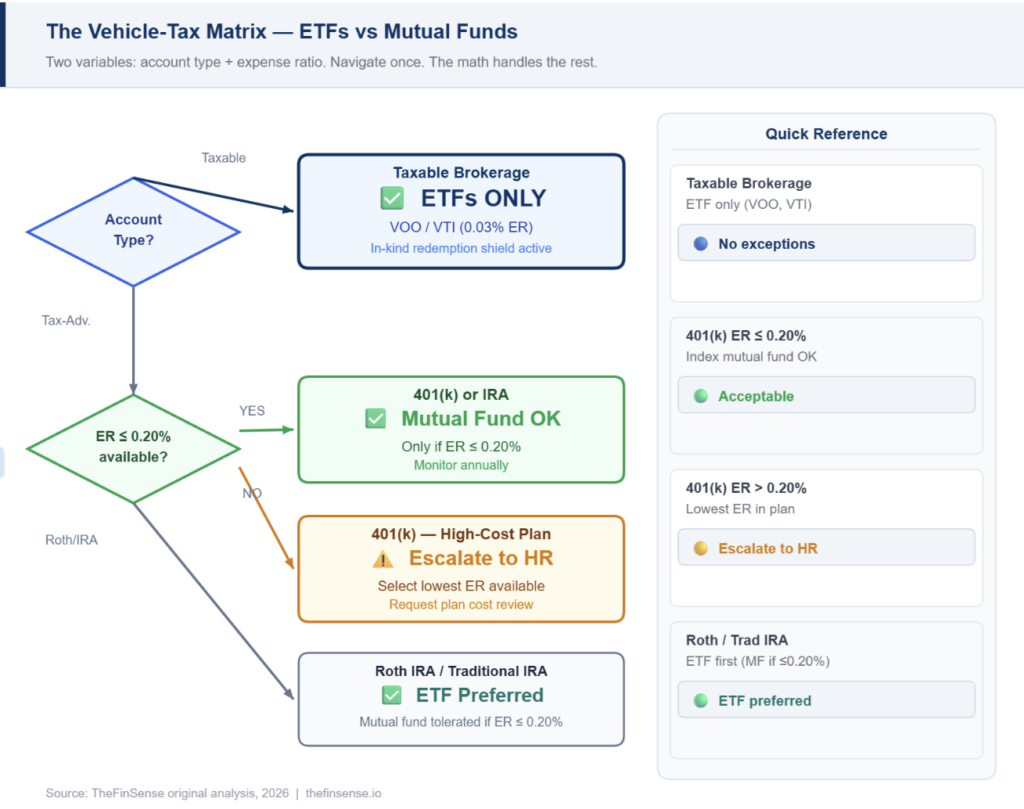
The $171,974 structural fee loss and the $2,250 forced capital gains trap share the same resolution: a single allocation rule that matches each investment vehicle to the account type where its structural advantages are unlocked and its liabilities are neutralized. Every allocation that violates the Matrix leaves fee drag or forced tax exposure permanently active against the investor’s compounding position. The etfs vs mutual funds decision, navigated through the Matrix, does not require forecasting market performance or evaluating individual fund managers. It requires knowing two variables: account type and expense ratio.
The Three-Step Execution Protocol
Step 1: Identify Your Account Type
Holding a mutual fund in a taxable brokerage account without first confirming account type is the decision error that produced the 2021 Vanguard capital gains trap — the $2,250 forced tax bill materializes precisely because investors assumed a “retirement fund” was housed in a tax-advantaged wrapper when it was not.
If you hold any investment fund: Go to your brokerage platform (Vanguard.com, Fidelity.com, or Schwab.com) → Account Overview → confirm the account label reads “Individual Brokerage,” “Roth IRA,” “Traditional IRA,” or “401(k) Plan.” This takes approximately 2 minutes.
Step 2: If Tax-Advantaged (401k or IRA) — Verify Expense Ratios.
Inside a 401(k) or IRA, forced capital gains distributions are sheltered by the account wrapper — neutralizing the mutual fund’s structural tax flaw. The 1.02% fee gap, however, continues compounding inside the shelter. Not verifying the fund’s expense ratio allows the same terminal wealth destruction to operate unchecked, simply without the forced tax event layered on top.
If your account is a 401(k): Go to your 401(k) provider portal (Fidelity NetBenefits, Vanguard Retirement, or your employer’s plan website) → Investment Options → sort all available funds by Expense Ratio → select only index funds at or below 0.20% ER. If no fund below 0.20% exists in the menu, contact your plan administrator to request a cost review. This takes approximately 5 minutes.
Step 3: If Taxable Brokerage — Deploy Passive ETFs Only, Without Exception.
Every day a mutual fund remains in a taxable brokerage account, the ETF’s in-kind redemption structural advantage is unused — leaving the investor permanently exposed to the capital gains distribution event that the ETF wrapper eliminates by design. Each major index mutual fund has an exact passive ETF equivalent with the same underlying index at 0.03% expense ratio or lower.
If you currently hold mutual funds in a taxable individual brokerage: Go to your brokerage → Portfolio or Holdings → identify each mutual fund position → sell the position → purchase the nearest passive ETF equivalent (Vanguard VTSAX → VTI; Fidelity FXAIX → IVV or VOO; Vanguard VFORX → VT). Redirect all new contributions to the ETF equivalent going forward. This takes approximately 8 minutes.
| Account Type | Recommended Vehicle | Structural Reasoning | Matrix Verdict |
|---|---|---|---|
| Taxable Brokerage (Individual) | Passive ETF only — VOO (0.03%), VTI (0.03%), VT (0.07%) | In-kind redemption eliminates forced capital gains; sub-0.10% ER eliminates compounding fee drag | ✅ ETFs only — no exceptions |
| 401(k) — Institutional index shares available (ER ≤0.20%) | Low-cost index mutual fund acceptable | Tax shelter neutralizes capital gains distribution risk; fee gap partially mitigated by plan cost structure | ✅ Acceptable — monitor ER annually |
| 401(k) — No institutional shares (ER >0.20%) | Lowest-ER fund available in plan menu | Tax shelter exists but fee drag compounds unchecked; minimize cost regardless of vehicle | ⚠️ Accept reluctantly — escalate to HR |
| Roth IRA / Traditional IRA | ETF preferred; low-cost mutual fund tolerated | Tax-free or tax-deferred growth shelters distributions; fee gap still compresses terminal wealth — ETF wins at identical index exposure | ✅ ETF preferred — mutual fund tolerated if ER ≤0.20% |
💡 PRO TIP: The Vehicle-Tax Matrix does not require believing that active managers are incompetent — only that the probability of finding one who consistently beats the benchmark by more than 1.03% net annually for 30 consecutive years is below 12%, per the 2024 SPIVA Year-End Scorecard. If you believe you have identified one of those managers, the Matrix says: hold them in a tax-advantaged account only, where their potential performance advantage compounds without being offset by forced capital gains distributions that would otherwise activate in a taxable wrapper.
The $171,974 structural fee loss and the forced capital gains tax exposure documented in the 2021 Vanguard trap are completely neutralized by placing passive ETFs in taxable accounts and strictly matching every allocation to the Vehicle-Tax Matrix. The three-step execution protocol above converts the theoretical framework into brokerage-platform actions with a combined time cost under 15 minutes. Nothing changes in the mathematics of compounding. The only variable that changes is the direction the 1.02% operates.
Frequently Asked Questions: ETFs vs Mutual Funds
Are ETFs vs mutual funds a meaningful difference if I invest inside a Roth IRA?
Inside a Roth IRA, forced capital gains distributions are tax-sheltered — making the mutual fund’s structural tax flaw irrelevant to your annual tax bill. The fee gap still compounds: a 1.05% active fund will still subtract tens of thousands from your terminal balance over 30 years relative to a 0.03% ETF. Deploy the lowest-cost passive ETF available inside the account. The tax shelter does not neutralize fee drag — it only neutralizes the forced capital gains distribution event.
What expense ratio is the break-even threshold where a mutual fund becomes acceptable?
Any expense ratio above 0.03% creates compounding drag relative to an ETF baseline. The practical acceptance threshold is approximately 0.20% — the range occupied by low-cost institutional index funds typically available inside 401(k) plans. Above 0.20%, the fee drag produces statistically meaningful terminal wealth reduction at investment horizons beyond 10 years. The 1.05% Morningstar average active fund expense ratio never clears this threshold, in any account type, at any time horizon above 5 years.
Do ETFs vs mutual funds perform differently in bear markets — do active managers add downside protection?
The data does not support this claim. The 2024 SPIVA Year-End Scorecard tested active mutual fund performance across both bull and bear market conditions and found underperformance rates remained above 80% in both regimes. The expense ratio deducts from NAV daily regardless of market direction — fee drag does not pause during downturns. The claim that active managers add downside protection is the most common argument for paying the 1.02% premium, and the SPIVA 15-year record consistently contradicts it.
What is a 12b-1 fee, and does it appear in the ETF vs mutual fund cost comparison?
A 12b-1 fee is a distribution and marketing charge embedded in a mutual fund’s stated expense ratio, capped at 0.25% annually under SEC rules. It compensates broker networks for fund placement and is charged to all investors — including those who never used a broker to purchase. ETFs trade on exchange and bypass broker distribution entirely, so 12b-1 fees are structurally absent from the ETF cost stack. This single layer accounts for up to 0.25% of the 1.05% total.
If I hold mutual funds in a taxable brokerage account right now, should I sell immediately?
Not necessarily in one transaction. Selling a mutual fund with large embedded unrealized gains triggers an immediate capital gains tax event. The correct approach: calculate the embedded gain in your current position, compare the immediate tax cost against the projected future fee drag from the 1.02% expense ratio gap, and redirect all new contributions into the ETF equivalent immediately. Allow the existing position to liquidate across multiple tax years rather than recognizing all embedded gains in a single filing year.
Bottom Line: The ETFs vs Mutual Funds Math Was Right. Your Intuition Wasn’t.
The $171,974 gap we opened with is not a hypothetical — it is the arithmetic result of 360 consecutive months of 1.02% compounding operating in reverse. It materializes in any account that routes a mutual fund into a taxable brokerage, holds it for 30 years, and never calculates what the fee line actually costs at terminal value. The etfs vs mutual funds decision, navigated with the Vehicle-Tax Matrix, closes this gap by design: passive ETFs in taxable accounts, verified low-ER funds in tax-advantaged accounts, and no active fund held anywhere that does not clear the 0.20% expense ratio threshold. The execution takes under 15 minutes. The compounding consequence of not executing it takes 30 years.
The real cost of the 1.02% fee gap is not the $171,974 itself. It is the capital the $171,974 cannot become. At a 7.47% annual net return, $171,974 compounding for another 20 years beyond the 30-year accumulation horizon reaches approximately $716,000 — a figure that will never appear on your brokerage statement because it was extracted in increments of roughly $478 per month across 360 consecutive months, invisibly, at the exact compounding frequency that builds wealth when operating in your direction. The fee does not confiscate a single lump sum. It operates as a permanent, mathematically symmetric drag — and the mechanism that makes a 30-year retirement account worth building is the same mechanism that makes a 1.02% annual cost worth eliminating in the same sitting.
The math was right. Your intuition wasn’t wrong — it was just missing one variable: the fee.
💬 YOUR TURN
What is the total expense ratio of every mutual fund currently held in your taxable brokerage account right now?
Drop a comment below 👇
📌 Next Read: invest in S&P 500 ETFs