📅 Originally Published: · Last Updated:
Executive Summary
- The overlap is quantifiable — and larger than you think: A 50/50 split between VOO and QQQ concentrates 35.5% of your entire portfolio into just 7 mega-cap tech stocks. The dow vs nasdaq vs sp500 comparison reveals a structural duplication problem most retail investors never examine.
- The Nasdaq 100 is a concentrated momentum fund, not a diversified index: As of March 18, 2026, the top 10 holdings account for 47.15% of QQQ’s total weight per Invesco’s own factsheet — 2.7× the S&P 500’s equivalent top-10 concentration from just a decade ago.
- The fix is structural, not cosmetic: The Index-Integrity Filter — a 3-step overlap diagnostic introduced in this guide — identifies the duplication before it costs you in the next sector correction.
Dow vs Nasdaq vs SP500: 3 Indexes Trap 35% in 7 Stocks
The debate over dow vs nasdaq vs sp500 looks simple from the outside — three indexes, three tickers, three apparently different slices of the American economy. Most retail investors resolve it by buying all three and calling the portfolio complete. The problem isn’t which indexes they own. It’s what’s inside them — and how much of it is exactly the same stock, accessed through three different brand names.
Two of the three indexes are so mathematically entangled that owning both amplifies your largest single bet rather than hedging it. The third runs on a weighting methodology so structurally obsolete that a single corporate accounting decision can cut a company’s index influence in half overnight. Knowing the mechanism behind each index doesn’t just satisfy intellectual curiosity — it determines how much of your capital is actually exposed to a tech drawdown, and by exactly how much. Understanding what a stock represents as an ownership claim is the foundation for seeing why two indexes built from the same ownership claims, weighted identically, are not two independent positions — they are one. The Index-Integrity Filter developed here gives you a three-step diagnostic to find that number before your brokerage dashboard does.
The “All-Weather” Myth: Why 3 Indexes Don’t Equal Diversification
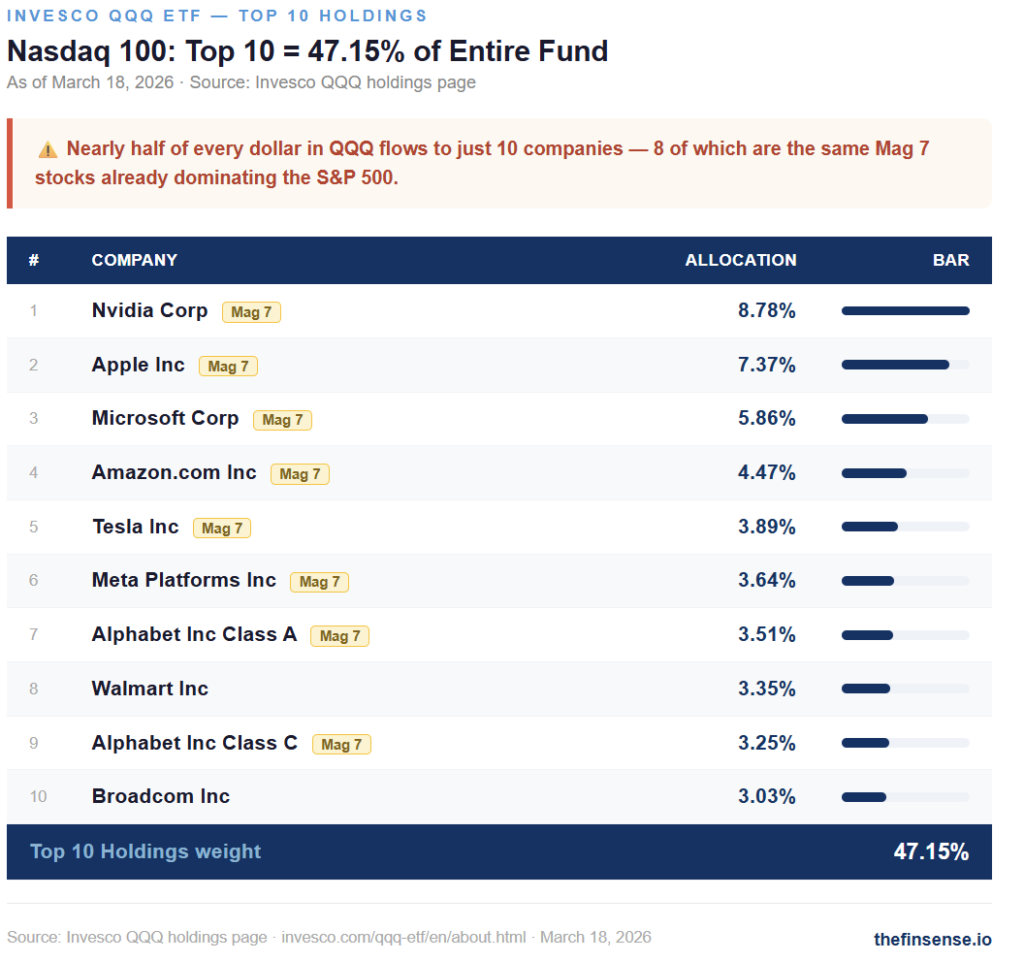
Most retail investors believe buying the S&P 500, Nasdaq, and Dow together creates a perfectly diversified “all-weather” portfolio. The data shows the exact opposite. The overlap is so severe that a 50/50 split between VOO and QQQ concentrates 35.5% of your entire net worth into just 7 tech stocks — a massive concentration premium most investors never meant to take. Here’s the number that makes that concrete: as of March 18, 2026, the top 10 holdings of the Nasdaq 100 account for 47.15% of the entire index per Invesco’s QQQ holdings page. Nearly half of every dollar you put into QQQ flows to ten companies.
That figure alone should reframe the question. The Nasdaq 100 is marketed as a technology-sector diversifier — a way to get broad exposure to the companies building the modern economy. What “broad exposure to 100 companies” actually means in practice is that you’re buying a fund where the ten largest holdings carry the same weight as the bottom 90 combined. That is not a passive index strategy. It is a concentrated momentum strategy with a passive wrapper.
Compare that to where the S&P 500 stood a decade ago. In 2014, the top 10 names in the index represented just 17.50% of total weight per S&P Global’s research on equal-weight index outperformance. Today, the Magnificent 7 alone account for 30.00% of S&P 500 weight as of March 18, 2026 per the S&P 500 Index Factsheet. The S&P 500 has itself moved significantly toward concentration. Adding a Nasdaq 100 position on top of it doesn’t spread your risk further — it double-weights the exact component driving that concentration in the first place.
“Just 10% of the names account for nearly one-half of the index’s total weight… the extent to which equal-weight indices underweight the largest stocks is more significant in large-cap indices.”
— Craig Lazzara, Managing Director, S&P Dow Jones Indices
Lazzara isn’t projecting a future risk. He’s describing what the index structure already shows. The Nasdaq 100 isn’t a departure from this pattern — it’s the extreme version of it. When the single largest component of two indexes you own is the same company (Nvidia, then Apple, then Microsoft), you haven’t diversified across indexes. You’ve stacked the same concentrated bet twice, with two different expense ratios attached.
Why the 35.5% number hasn’t registered widely yet has more to do with how brokerage apps present portfolio information than with any mathematical complexity. The mechanism behind that interface failure — and what it costs in real dollars — is where we go next.
The Brokerage Illusion: $35,500 Trapped in 7 Stocks
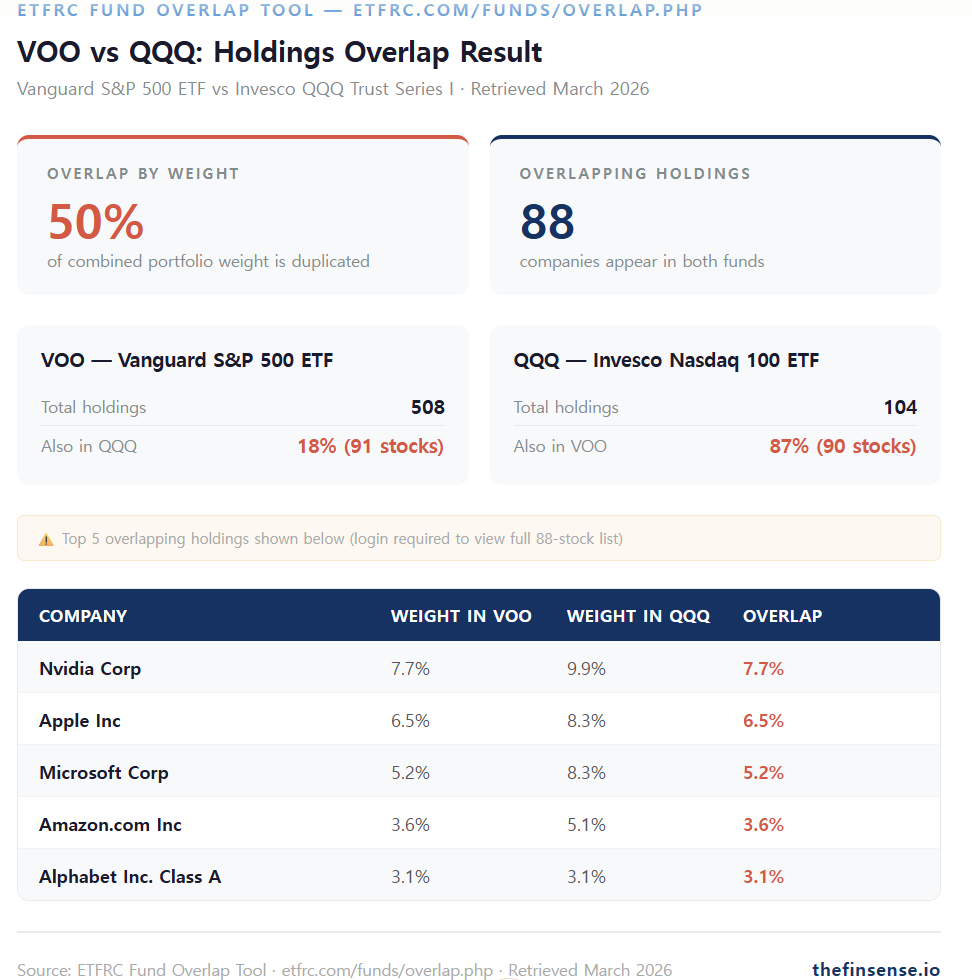
Here’s the mechanism behind the confusion: the major brokerage portfolio analysis tools — Fidelity’s portfolio analysis dashboard, Schwab’s equity summary view, and similar interfaces at most retail platforms — classify SPY and QQQ into entirely different Morningstar style boxes. SPY lands in “Large Blend.” QQQ lands in “Large Growth.” Two different labels. Two different colors on your pie chart. An estimated 87% of QQQ’s holdings also appear in VOO — representing 50% overlap by weight, per ETFRC’s fund overlap tool.
That classification isn’t technically wrong. The Morningstar box reflects expected return behavior patterns based on value-growth scoring, which is genuinely useful for portfolio style analysis. What it doesn’t surface — and was never designed to surface — is what percentage of two funds consists of the same underlying stocks. For that, you have to open each ETF’s holdings page and cross-reference manually. Most retail investors don’t. Most brokerage dashboards don’t prompt them to.
What the Pie Chart Hides
Consider a scenario that’s more common than the industry likes to admit: you open your brokerage account and see a clean allocation split — 40% “Large Blend,” 40% “Large Growth,” with bonds and international exposure filling the rest. The screen is telling you your equity exposure is balanced between two different investment styles. What it is not showing you is that the first 40% and the second 40% are largely the same ten companies, accessed through two different fund wrappers at two different expense ratios.
The Reddit community on r/Bogleheads documented exactly this experience during the 2022 drawdown. One widely-shared account described buying VOO, QQQ, and DIA simultaneously — three indexes, three tickers, what felt like complete market coverage. When the poster finally mapped their actual holdings in a spreadsheet during the 2022 tech correction, they found approximately 80% of their equity dollars concentrated in the same handful of companies. The diversification they believed they’d built was an artifact of their brokerage’s interface, not a structural feature of their portfolio.
50%
The asset-weighted holdings overlap between VOO and QQQ — meaning half your capital in both funds is buying the exact same companies. What that overlap costs in real dollars is what the calculation section proves.
The deeper structural problem: brokerage classification systems were built to categorize investment style, not to flag holdings-level concentration across multiple ETFs. That’s a genuinely useful tool for many portfolio decisions. For identifying that two “diversified” index funds are buying the exact same seven companies at scale, it’s the wrong instrument entirely — like using a thermometer to measure barometric pressure. The readings look authoritative. They’re just not answering the question you actually need answered.
💡 PRO TIP: Before your next rebalancing session, run your equity ETF tickers through ETFRC’s free ETF overlap tool. It shows the exact percentage of shared holdings between any two funds at the position level — the single number your brokerage dashboard almost certainly isn’t computing for you.
Dow vs Nasdaq vs SP500: The Math Behind the Weighting
The dow vs nasdaq vs sp500 comparison is, at its core, a question of three different mathematical rules — not three different sets of stocks. The weighting mechanism each index uses to determine how much each company matters drives everything about concentration risk. Two indexes can hold largely identical companies and still behave very differently in a correction, purely because of how they allocate weight. Understanding that mechanism is the prerequisite to understanding why the 50/50 overlap calculation in the next section produces the number it does.
The Cap-Weighted Giants
Both the S&P 500 and the Nasdaq 100 use market capitalization weighting. The formula: a company’s index weight equals its market cap divided by the sum of market caps for all index constituents. If Company A is worth $3 trillion and the entire index has a combined market cap of $30 trillion, Company A represents exactly 10% of the index. Simple enough — until you see what happens at scale.
Cap-weighting creates a mechanical feedback loop. As a stock price rises, market cap grows, index weight increases, index funds are forced to buy more of it, which can further support the price. This isn’t a theoretical risk — it’s the documented mechanism that has been concentrating passive fund assets into the largest stocks since the mid-2010s. The Nasdaq 100 pushes this dynamic to an extreme: it starts with only 100 companies and then cap-weights them, which is precisely why 10 companies end up commanding 47.15% of the index as of March 18, 2026 per Invesco’s QQQ holdings page.
Quick worked example using round numbers to illustrate the mechanic: if the Nasdaq 100’s total constituent market cap is $20 trillion, and Nvidia, Apple, and Microsoft together represent $9 trillion of that, those three stocks alone account for 45% of the index. The remaining 97 companies split 55%. That’s not a quirk — it’s the mathematically inevitable outcome of applying cap-weighting to a 100-stock universe with a handful of $2-3 trillion companies at the top.
The S&P 500 applies identical logic across 500 companies, which distributes weight more broadly in absolute terms. But the Magnificent 7 — Apple, Microsoft, Nvidia, Amazon, Alphabet, Meta, Tesla — still account for 30.00% of S&P 500 weight as of March 18, 2026 per the S&P 500 Index Factsheet. The larger constituent pool dampens peak concentration compared to the Nasdaq 100, but the same seven companies are the dominant weight in both indexes. That specific overlap is the variable that makes the next section’s calculation matter. For context on what these ownership stakes actually mean, see our primer on what a stock represents — each percentage point of index weight is a proportional ownership claim on those companies’ future earnings.
❌ What investors assume:
Nasdaq 100 = tech sector exposure. S&P 500 = broad market exposure. Owning both gives you two uncorrelated risk profiles that partially offset each other during downturns.
✅ What cap-weighting math shows:
Both indexes are dominated by the same Mag 7 companies at near-identical ranks. When mega-cap tech corrects, both indexes move in near-lockstep. The “balance” exists in the branding. The math underneath it is concentrated duplication.
The Price-Weighted Dinosaur
The Dow Jones Industrial Average runs on a completely different — and considerably older — logic. The Dow is price-weighted: a stock’s influence on the index is determined solely by its per-share price, with zero reference to actual market capitalization. The Dow Divisor (a proprietary adjustment factor maintained and updated by S&P Dow Jones Indices per the official Dow Jones Methodology documentation) is divided into the sum of all 30 component prices to produce the index level.
This produces a counterintuitive result that surprises almost every investor who encounters it for the first time: the most influential stock in the Dow is not Apple. Despite Apple being one of the largest companies by market capitalization in the world, Apple’s relatively modest per-share price (following multiple stock splits) means it contributes a fraction of what a high-priced name like UnitedHealth Group (UNH) does. Because UNH trades at a significantly higher per-share price than Apple, it commands a disproportionately large slice of the Dow’s weighting — regardless of the fact that its total market cap is a fraction of Apple’s. In the Dow, you’re not measuring economic scale. You’re measuring which company printed fewer shares.
The structural absurdity of price-weighting becomes explicit with a historical example: when Apple conducted its 4-for-1 stock split in August 2020, its Dow weight was effectively cut by approximately 75% overnight. Apple’s business didn’t change. Its market cap moved only marginally. The outstanding share count quadrupled — which mechanically quartered the per-share price and thus Apple’s index influence under the Dow’s methodology. A $2 trillion company became a minor weight in the Dow because of a shareholder-friendly accounting adjustment that had nothing to do with Apple’s fundamental business value.
❓ Why does the Dow still use price-weighting if it’s mathematically flawed?
Historical inertia. The Dow was created in 1896 by Charles Dow and Edward Jones using the simplest possible calculation — add the prices of a handful of industrial stocks and divide by the number of stocks. The methodology has been patched (via the Divisor) over 130 years to account for splits, substitutions, and dividends, but the fundamental price-weighting logic has never been replaced. At this point, the Dow’s primary value is its longevity as a sentiment indicator, not its mathematical superiority as a market-cap tracker.
This is where the three-way dow vs nasdaq vs sp500 comparison converges on its key question. You now have the two essential variables on the table: the Nasdaq 100’s Mag 7 concentration sits at approximately 41% of index weight (derived from the 47.15% top-10 figure, with 8 of the top 10 being Mag 7 companies), while the S&P 500’s Mag 7 weight stands at 30.00% as of March 18, 2026. When you split $100,000 evenly between these two indexes, your effective Mag 7 exposure is not the average of those two numbers — it’s a weighted combination that produces a figure your brokerage never calculates for you. The next section runs that calculation.
The Overlap Autopsy: Calculating the True Concentration Risk
The 47.15% concentration figure from the opening — here’s what it meant for a $100,000 investor who assumed the 50/50 VOO-QQQ split was balanced. That Reddit investor who opened their spreadsheet during the 2022 crash and found 80% of their equity dollars in the same handful of stocks wasn’t the victim of bad luck. They were the victim of a calculation they’d never run. The dow vs nasdaq vs sp500 overlap problem isn’t theoretical. It’s arithmetic — and it takes three steps to prove.
The $100,000 50/50 Split
The overlap calculation uses two live data sources: the S&P 500 Mag 7 weight of 30.00% as of March 18, 2026 per the S&P 500 Index Factsheet, and the Nasdaq 100 top-10 weight of 47.15% as of March 18, 2026 per Invesco’s QQQ holdings page. Eight of those top-10 Nasdaq holdings are Mag 7 companies, yielding an effective Mag 7 weight of approximately 41% for the QQQ position. Every intermediate step is shown below — no assumption is left unnamed.
Step 1 — Identify each fund’s effective Mag 7 weight:
VOO (tracks S&P 500): Mag 7 weight = 30.00% as of 2026-03-18 per S&P Global.
QQQ (tracks Nasdaq 100): effective Mag 7 weight ≈ 41.00% as of 2026-03-18 per Invesco.
Step 2 — Apply the weighted average formula:
Effective Portfolio Mag 7 Weight = (VOO allocation × VOO Mag 7%) + (QQQ allocation × QQQ Mag 7%)
= (0.50 × 30.00%) + (0.50 × 41.00%)
= 15.00% + 20.50%
= 35.50%
Step 3 — Translate to dollars on a $100,000 base:
$100,000 × 35.50% = $35,500 concentrated in Mag 7 stocks — before a single individual position is purchased. In plain English: you thought you were splitting capital between a broad market fund and a technology fund. What the math shows is that both funds buy the same seven companies in large quantities, and combining them 50/50 creates a portfolio where more than a third of every dollar is exposed to the same concentrated tech bet.
Bonus scenario — 70% VOO / 30% QQQ:
(0.70 × 30.00%) + (0.30 × 41.00%)
= 21.00% + 12.30%
= 33.30%
Even a heavily VOO-weighted split still runs 3.3 percentage points above the pure S&P 500 baseline. Reducing QQQ to 30% isn’t the fix — it only narrows the gap. The concentration doesn’t disappear until QQQ falls below 15%.
| Portfolio Approach | Effective Top-10 Weight | Effective Mag 7 Weight | $100k in Mag 7 | Verdict |
|---|---|---|---|---|
| VOO Only (S&P 500) | ~31% | 30.00% | $30,000 | ✅ Lowest U.S. large-cap concentration |
| 50/50 VOO + QQQ — Base Case | ~39% blended | 35.50% | $35,500 | ⚠️ Illusion of balance |
| QQQ Only (Nasdaq 100) | 47.15% | ~41.00% | $41,000 | ❌ Maximum concentration exposure |
That 5.5-percentage-point concentration gap above pure S&P 500 exposure means the 50/50 portfolio moves in near-lockstep with Nvidia, Apple, and Microsoft during tech corrections — not with the other 493 companies the diversification story promised. During the 2022 tech correction, the Nasdaq 100 fell approximately 33% peak-to-trough while the equal-weight S&P 500 (RSP) declined less than 20% — meaning the 50/50 holder absorbed roughly 1.6× the drawdown of a genuinely diversified alternative. Not because they held more risk, but because the holdings they combined were never two different positions. They were one position, accessed through two fund tickers at two expense ratios. To see how this concentration drag compounds across multi-decade horizons, the Wealth-Velocity Filter applies the same friction-adjusted compounding logic to your actual portfolio balance.
Break point: This math reverses if QQQ allocation drops below 15% of the total equity portfolio — at that level, effective Mag 7 exposure falls to ≤31.5%, comparable to a pure S&P 500 position. The second reversal condition: if the correlation coefficient between the Mag 7 stocks drops below 0.6 (historically rare; estimated correlation exceeds 0.85 based on 2022–2026 price data), the concentration risk would diminish substantially. Neither condition applies today.
📐 YOUR NUMBERS MAY DIFFER
This calculation assumes a 50/50 VOO-QQQ split. Here’s how the conclusion changes based on your actual QQQ allocation:
| Your QQQ Allocation | Effective Mag 7 Weight | $100k in Mag 7 | Conclusion |
|---|---|---|---|
| 0% (VOO / S&P 500 only) | 30.00% | $30,000 | Lowest viable U.S. large-cap concentration |
| 50% (50/50 VOO + QQQ) | 35.50% | $35,500 | ⚠️ Base case — hidden concentration active |
| Below 15% QQQ (break point) | ≤31.5% | ≤$31,500 | Concentration risk comparable to pure S&P 500 |
Applying the Index-Integrity Filter
The standard passive investing assumption holds that index funds provide mechanical diversification across all their constituents. NBER Working Paper 28253 — “Passive Investing and the Rise of Mega-Firms” directly challenges that assumption: flows into index funds raise the concentration of index weights, disproportionately inflating the largest stocks. This isn’t a marginal finding. The mechanism is structural — every new passive dollar flowing into VOO or QQQ must be allocated to each constituent in proportion to its current weight, which means the largest companies receive the largest absolute dollar inflows regardless of valuation. The strategy that was supposed to eliminate concentration risk is actively reinforcing it at scale. The mechanism compounds with scale: the larger the passive inflow, the more each new dollar proportionally inflates the already-dominant positions — not the laggards. This is why the S&P 500’s Mag 7 weight grew from 17.50% to 30.00% over a decade in which passive investing itself became the dominant investment strategy.
Applied to the 50/50 VOO-QQQ scenario: the more passive capital flows into these two funds, the more the Mag 7 duplication compounds. The NBER paper’s implication runs counter to what most passive investors expect — holding two index funds that both mechanically buy the same seven companies proportional to their market cap is not passive diversification. It is leveraged concentration with diversification branding. The Index-Integrity Filter was built specifically to quantify this problem before a correction does it for you. For how the filter applies to individual ETF analysis, see the companion breakdown on Index-Integrity Filter mechanics.
Applied to this article’s three-index comparison, the filter runs as follows:
- Step 1 — Identify overlap: Any two equity ETFs with greater than 60% holdings overlap — verified via ETFRC’s overlap tool — are treated as a single position for concentration calculations. VOO and QQQ share 88 holdings representing 50% overlap by weight, per ETFRC, clearing this threshold easily.
- Step 2 — Calculate effective single-stock concentration: Apply the weighted average formula above. Output: one percentage representing how much of the combined portfolio is concentrated in the overlapping names. Threshold: above 33% triggers a structural rebalancing review.
- Step 3 — Apply the Sector Cap Rule: No single GICS sector should exceed 25% of total portfolio effective weight after overlap is computed. For technology specifically: 20% maximum, given the documented correlation patterns during the 2020 and 2022 drawdowns. The 50/50 VOO-QQQ portfolio breaches both thresholds simultaneously.
TheFinSense · Original Calculation
VOO vs QQQ: Mag 7 Concentration Gap
$100,000 portfolio · Effective Mag 7 weight by allocation · March 18, 2026
Source: TheFinSense original calculation, 2026
S&P 500 Index Factsheet · Invesco QQQ holdings page · March 18, 2026
thefinsense.io
How to Fix Your Portfolio: A 3-Step Execution Guide
The Index-Integrity Filter identified the problem. This section converts it into same-day action. Each step below meets the execution standard: specific platform, exact navigation path, time estimate, and a decision condition that tells you whether the step applies to your situation. If you can open your brokerage app right now, the complete diagnostic takes under ten minutes — no advisor, no account minimum, no automatic sell requirement unless your overlap number triggers the rebalancing threshold.
One note before starting: these steps are optimized for the investor already holding a combination of VOO, QQQ, or equivalent Nasdaq and S&P 500 ETFs. The Dow’s price-weighting creates structurally low holdings overlap with both (DIA’s top weight is UNH, not Nvidia or Microsoft), so the VOO-QQQ concentration arithmetic doesn’t apply symmetrically. The ETFRC check in Step 1 handles all combinations equally — run it regardless of which specific tickers you hold.
Step 1: Run the ETFRC Overlap Test
The overlap number is the only figure that determines whether two funds represent genuine diversification or a single concentrated position accessed through two tickers at two expense ratios. Your brokerage dashboard computes neither — it classifies by style box, not by holdings. Go to etfrc.com/funds/overlap.php. In the first fund field, enter your primary broad-market ETF ticker (VOO, IVV, or SPY). In the second field, enter your secondary ETF (QQQ or QQQM). Click “Overlap.” The tool returns the number of overlapping holdings and the asset-weighted overlap percentage. This is the single number your brokerage dashboard is almost certainly not computing for you. Time estimate: 2 minutes.
Decision rules:
Overlap result above 60% → proceed to Step 2. Your two funds are a single concentrated position for practical purposes.
Overlap result below 60% → monitor, but no immediate structural action required.
💡 PRO TIP: Repeat the ETFRC check annually after your rebalancing review. Index compositions drift. The VOO-QQQ overlap wasn’t always this high — Mag 7 concentration has increased as those companies grew their market cap share. A fund pair that was adequately uncorrelated three years ago may not be today.
Step 2: Dow vs Nasdaq vs SP500 — Choose Your Primary Engine
Identifying the overlap is diagnostic. Choosing one primary engine is the structural fix — because the concentration problem doesn’t shrink by holding both funds more carefully. It shrinks by deciding which one you actually need and eliminating the duplication. Three structurally sound responses are available depending on your tax situation and intended exposure:
Option A — Consolidate into VOO (maximum breadth): Navigate to your brokerage → Accounts → Holdings → QQQ position → Sell. Redirect the proceeds into VOO or the uncorrelated assets in Step 3. Effective Mag 7 exposure drops from 35.5% to 30.00%. Time estimate: 5 minutes. Decision condition: use this option if you have no intentional tech tilt goal — you simply want broad U.S. market exposure without duplication.
Option B — Reduce QQQ to ≤15% of total equity portfolio: If the decision is “I want an intentional tech tilt,” QQQ is a legitimate vehicle — but only when capped below the 15% threshold from the sensitivity analysis. Calculate the sale amount needed to bring QQQ below threshold → execute via standard sell order. Decision condition: if your state income tax rate exceeds 7%, run the after-tax math on capital gains before executing in a taxable account. Time estimate: 5 minutes for the calculation, 3 minutes for the trade.
⚠️ WARNING: Options A and B involve selling QQQ in a taxable account. If QQQ has appreciated significantly since purchase, realized capital gains could partially offset the concentration fix benefit. Run the after-tax math first: estimated proceeds × applicable capital gains rate. For positions held >1 year, the long-term rate applies (0%, 15%, or 20% depending on income bracket). If the tax drag exceeds the expected benefit from reduced concentration, consider executing the rebalance inside a tax-advantaged account (IRA/401k) instead.
Option C — Replace QQQ with RSP (equal-weight S&P 500): Navigate to your brokerage → Buy → search “RSP” → limit order. RSP holds the same 500 S&P companies but at equal weight — eliminating Mag 7 dominance entirely. Current expense ratio: 0.20% versus VOO’s 0.03%. The 17 basis point annual premium buys a structurally different concentration profile. Decision condition: use this option if you want large-cap U.S. exposure with no single-company dominance — and if the additional cost is acceptable relative to your portfolio size. Time estimate: 3 minutes.
Step 3: Add Uncorrelated Assets
Resolving the QQQ overlap is necessary but not sufficient on its own. If U.S. large-cap tech remains the only equity driver in the portfolio after Step 2, effective Mag 7 concentration is lower — but still present. The position that generates the remaining 30% Mag 7 weight in a pure VOO portfolio has nowhere to diversify within U.S. large-cap equities. Two asset classes fix that structurally without abandoning long-run return expectations:
Small-cap blend — VB or IJR: Navigate to your brokerage → Buy → search “VB” → limit order. Target allocation: 10–15% of total equity portfolio. Russell 2000 constituents (small-cap) have effectively zero overlap with the Nasdaq 100 Mag 7 companies by definition. A 12% VB allocation on a portfolio that was at 35.5% Mag 7 concentration brings effective Mag 7 exposure to approximately 31.2% — below the pure S&P 500 baseline. Time estimate: 3 minutes.
International developed markets — VXUS or VEA: Navigate to your brokerage → Buy → search “VXUS” → limit order. Target allocation: 20% of total portfolio. VXUS holds approximately 8,000 non-U.S. stocks. Its Mag 7 overlap is zero by definition — these are non-U.S. companies. A 20% VXUS allocation on the base $100,000 portfolio reduces effective Mag 7 exposure from 35.5% to approximately 28.4% of total portfolio value, without eliminating the U.S. equity position. Time estimate: 3 minutes.
All three steps combined — consolidating or capping QQQ, adding small-cap, adding international — take approximately 10 minutes and produce a portfolio with quantifiably lower concentration than the original 50/50 arrangement. The fix requires no advisor and no algorithm. It requires the overlap number the ETFRC tool provides in under 60 seconds.
📌 Next Read: invest in S&P 500 ETFs — a deeper breakdown of how to choose between VOO, IVV, and SPY once the overlap problem is resolved.
💬 YOUR TURN
Run the ETFRC check now — what’s your VOO-QQQ overlap number, and does it clear the 60% threshold?
Drop a comment below 👇
FAQ: Frequently Asked Questions About Index Overlap
Should I sell QQQ if I already own VOO?
Not necessarily. Run the ETFRC overlap check first. If QQQ represents more than 15% of your equity portfolio and overlap exceeds 60%, you’re adding concentration, not diversification. The simplest fix is consolidating into VOO or reducing QQQ to sub-15% rather than a full sale. In a taxable account, evaluate capital gains impact before executing any sell order.
Dow vs Nasdaq vs SP500: which is actually better for diversification?
For most long-term investors, the S&P 500 (VOO or IVV) is the structurally superior choice. The Dow’s price-weighting methodology means a company’s influence is determined by per-share price, not economic scale — making it structurally inferior as a broad market tracker. The Nasdaq 100 concentrates nearly half its weight in just 10 holdings, making it a momentum fund in index clothing. For large-cap U.S. exposure with the broadest coverage and most coherent weighting logic, VOO or IVV win on every structural metric.
Why do financial advisors recommend all three?
Most advisors reference all three as market commentary benchmarks, not as simultaneous investment vehicles. When a client holds all three in ETF form, standard portfolio tools classify them into different style boxes without computing holdings-level overlap. The recommendation often reflects media convention and client communication habit, not a deliberate concentration risk assessment for that specific portfolio.
What happens if I just own the S&P 500?
Owning only VOO or IVV is a structurally sound single-fund strategy for broad U.S. market exposure. The Mag 7 still represents 30% of index weight, so tech concentration exists — but significantly lower than the 35.5%+ you carry with a VOO-QQQ combination. Adding 20% international exposure via VXUS reduces that concentration to approximately 24% of total portfolio value, within an acceptable range for a passive strategy.
How do I get true diversification outside of tech?
Three structural moves reduce tech concentration without abandoning U.S. equities: replace QQQ with RSP (equal-weight S&P 500, zero Mag 7 dominance), add VB or IJR (small-cap blend, zero Mag 7 overlap), and allocate 20% to VXUS (international, zero Mag 7 by definition). Each move directly reduces the weighted average that produces the 35.5% concentration figure.
Dow vs Nasdaq vs SP500: The Only Index That’s Actually Diversified
The 47.15% concentration figure that opened this guide was never a projection. It was a calculation — one that followed directly from two live data points: the Nasdaq 100’s 47.15% top-10 weight and the S&P 500’s 30.00% Mag 7 weight, both as of March 18, 2026 per their respective official sources. When those numbers flow through the weighted average formula, the result isn’t a warning about a theoretical future risk. It’s a description of what the 50/50 VOO-QQQ portfolio already looks like today, before the next tech correction makes the math undeniable.
The dow vs nasdaq vs sp500 question resolves cleanly when the Index-Integrity Filter replaces the brokerage pie chart as the analytical instrument. The Dow Jones Industrial Average fails the structural test because it runs on 19th-century price-weighting logic — no amount of blue-chip prestige corrects a methodology that can cut Apple’s index weight by 75% through a share split with zero change to the underlying business. The Nasdaq 100 fails in the opposite direction: it is a cap-weighted fund with only 100 constituents, which mathematically guarantees that 10 companies command nearly half the index. Neither was designed to deliver diversification as a primary output.
The S&P 500 isn’t without flaws. The Mag 7 concentration has grown substantially since 2014, when the top-10 weight stood at 17.50% per S&P Global’s equal-weight research. But the S&P 500 starts from a 500-company base, applies consistent cap-weighting logic, and doesn’t require a second overlapping fund to achieve its stated purpose. The concentration it carries is the price of holding the broadest, most liquid large-cap U.S. equity index available. The concentration the VOO-QQQ combination carries is an unintended consequence of holding two funds that were never designed as a diversification pair — but are marketed and classified as if they were.
35.5%
The minimum Mag 7 concentration a 50/50 VOO-QQQ portfolio carries — before a single individual stock is purchased. The fix: reduce QQQ below 15% and add VXUS. The math updates immediately.
The brokerage dashboard won’t tell you when you’ve crossed the concentration threshold. It will show you two different style boxes and a smooth pie chart. The ETFRC overlap tool — and the three-step formula in this guide — will tell you the number that actually matters. Run it once before your next rebalancing session. The answer takes under two minutes to produce and will almost certainly be different from what your portfolio visualization has been showing you.
The structural irony compounds with every new passive dollar. Every inflow into VOO or QQQ must, by mechanical rule, be allocated proportionally to each constituent’s current weight — which means the largest companies receive the largest absolute inflows, regardless of valuation. The more investors collectively flee individual stock risk by buying index funds, the more capital those index funds mechanically concentrate into the same handful of mega-cap names. Passive investing at sufficient scale is, paradoxically, the most efficient concentration vehicle ever built. It just doesn’t say that on the label.
The math was right. One of these three indexes is diversified. The other two are concentration bets wearing diversification’s name.