📅 Originally Published: · Last Updated:
You found a stock paying multiples of what the index pays. You looked at that number on the screen, ran the mental math, and the case felt obvious. The math was right. The number was the problem.
Executive Summary
- The Yield Trap Math: Roughly 40% of S&P 500 stocks yielding above 8% cut or suspended dividends within two years during downturns — and brokerage screeners rank them first by default.
- The $16,600 Gap: One dividend cut on an 8% yielder destroys $16,600 more per $10,000 than the same capital compounding in a 3% dividend growth stock over a decade.
- The Fix: The Yield Sustainability Filter — a 4-check framework replacing yield-level screening with dividend growth rate, FCF payout ratio trend, and debt trajectory — identifies dividend yield traps before they fire.
What if the highest dividend yield on your screener is a $16,600 warning? Dividend yield traps — positions where an elevated yield masks an impending cut — cost investors that exact amount per $10,000. The damage compounds over a single decade.
Why does every major brokerage screener surface these positions first? How does a falling share price manufacture a rising yield number — and why does the standard payout ratio check miss the danger entirely? The Yield Sustainability Filter answers with four data points where the screener uses one.
The gap between the 8% stock your screener promotes and the 3% grower it buries is not a rounding error. It is a 2.8-to-1 wealth divergence on the same $10,000 — driven by a single mechanism most investors have never examined.
The High-Yield Stock Your Screener Shows First
How many investors have typed “sort by: highest dividend yield” and selected a stock near the top of the list? How many assumed that the biggest number on the screen meant the hardest-working position? Roughly 40% of S&P 500 stocks yielding above 8% cut or suspended their dividends within two years during economic downturns, according to Nuveen Research.
You’ve run the math. Eight percent on $10,000 is $800 a year. Three percent is $300.
The difference is obvious — until you check what happens to that 8% when the company runs out of room to pay it.
The logic fills every dividend forum. On r/dividends, the top thesis is clear: “High yield means I don’t need price appreciation.” Does that income survive two years?
For 4 out of every 10 positions yielding above 8%, the Nuveen data says no. The highest-paying bracket is also the highest-cutting bracket. The screener does not print that statistic.
The Kenneth French Data Library quantifies the damage across decades of US equity returns. The highest-yielding quintile of stocks underperforms the second-highest quintile by more than 2% annually. The stocks that look like they are paying the most are systematically delivering the least.
40%
Approximate share of S&P 500 stocks yielding above 8% that cut or suspended dividends within two years during economic downturns — Nuveen Research.
🧠 IN PLAIN ENGLISH:
Imagine two job candidates. One promises $800 a month in salary — then gets fired after 24 months. The other starts at $300 and gets a raise every year for a decade. Your screener sorts by starting salary. It does not check for job security.
What cost investors $16,600 per $10,000 is not bad stock-picking. It is a structural feature of the tool they used to pick the stock. Something promotes the most dangerous positions to the top of the results page — and the investor was never shown a warning before clicking “buy.”
Why Your Brokerage Screener Is Sorted Backwards
What does a stock look like the year before it cuts its dividend? Higher yield, improving sort position, nothing that looks like a warning.
The payout ratio is covered. Earnings support the dividend. The FCF numbers look fine.
Those are the right metrics — for last quarter. The screener froze the data at the last reporting date. The stock price did not freeze.
When was the last time you checked what happens to the yield number when a stock price falls? Most investors treat yield as a fixed rating. The number moves on its own.
A stock whose price fell 30% last year now sits higher on the screener than it did twelve months ago. The company declared no increase. The screener still promoted it.
The Screener’s Default Sort and the Fidelity Problem
Open Fidelity’s stock screener right now and sort by “Dividend Yield — Highest.” What appears at the top of the list? The stocks whose prices have fallen the most relative to their last declared dividend.
The screener treats both the same: a stable 4% yield on growing cash flows and an 8% yield manufactured by a price collapse. Where is the free cash flow payout ratio on that results page? It is buried behind a separate “Fundamentals” tab — one extra click that most investors never make.
The number that correlates with cut risk is hidden. The number that concentrates cut risk is the default sort column. That is how every major brokerage screener operates.
The highest-yield sort on every major brokerage screener surfaces the 40%-cut-probability stocks first — the tool most investors use to find dividend safety is organized exactly backwards.
A stock paying 8% after a 35% price decline is not offering a premium yield. It is reporting a distress signal — a bigger number. The investor reads the ranking as a recommendation.
The 40% cut probability is already built into that stock’s position at the top of the list.
▶ Video: Dividend Growth Investing by Ben Felix (Common Sense Investing) — breaks down why high dividend yield does not predict high total returns, and how factor exposure explains the performance gap that screeners hide.
The Formula That Makes Dangerous Stocks Look Safe
There is a formula behind the number. It does not care about the company’s future. It only reports the past.
FCF covers the dividend. The payout ratio is under 60%. By every standard screen, the position is safe.
The formula disagrees.
Yield = Dividend ÷ Price: What That Formula Actually Shows
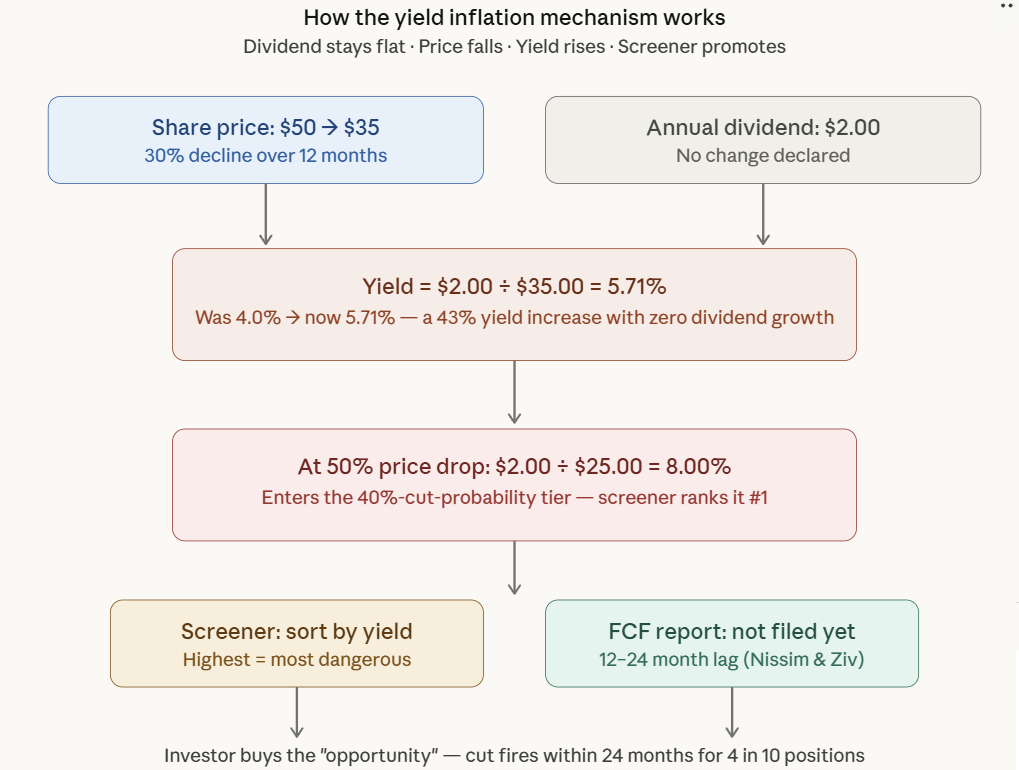
What happens to a 4% yield when the stock price drops 30% and the dividend stays flat? The formula recalculates automatically.
Annual dividend: $2.00. Original price: $50.00, new price: $35.00. New yield: $2.00 ÷ $35.00 = 5.71%.
The yield rose 43%. The company did nothing — no dividend increase, no earnings growth, no strategic change. The price decline alone manufactured a yield that now screens higher than the original position.
Repeat the math at a 50% price decline. $2.00 ÷ $25.00 = 8.00%. The screener now ranks this stock in the top tier — the same tier where 40% of positions cut within two years.
💡 PRO TIP: When a stock’s yield jumps 2+ points in 12 months without a dividend hike, price decline is the driver. Check the 52-week chart before the yield column.
Why FCF Payout Ratio Arrives Too Late
Is the standard safety check — the FCF payout ratio — measuring what investors think it measures? The common assumption: current free cash flow predicts dividend sustainability.
Nissim and Ziv (2001), in the Journal of Finance, found the reverse. Dividend cuts precede earnings deterioration by 12 to 24 months.
What does that lag mean for the investor checking FCF today? The report confirming the dividend is unsustainable has not been filed yet. The company is still posting numbers that pass the screen.
The stock price has already started falling. That is why the yield looks so attractive on the screener right now.
The FCF payout ratio is not wrong. It is late.
By the time it confirms the problem, the market has already repriced the stock. The yield is highest exactly when the danger is greatest.
On Schwab’s stock detail page, the “Forward Dividend Yield” field compounds the timing problem. Forward yield equals the last declared dividend multiplied by four.
The moment a cut is announced, that number becomes stale. The “Forward” label is not flagged as a projection — and no payout sustainability link appears on the main quote page.
The 12-Month Drift After the Cut Announcement
What happens to the share price after the cut is finally announced? According to Michaely, Thaler, and Womack (1995), the average dividend cut triggers a negative 12% return on announcement day alone. Cumulative price drift over the following 12 months ranges from negative 25% to negative 40%.
The investor who bought the 8% yielder collected $800 per year on a $10,000 position. The announcement-day loss alone erased more than a full year of that income in a single session. The 12-month drift erased up to five years of collected income — and that calculation does not include the compounding those dollars will never generate.
“The dividend yield is the single most reliable long-run predictor of equity returns. The trap is mistaking the highest yield for the highest return.”
— Jeremy Siegel, Russell E. Palmer Professor of Finance, Wharton School
A stock whose price has fallen 30% without a dividend reduction now reports a yield 43% higher than 12 months ago. The FCF report that will confirm the problem has not been filed yet.
The formula does not warn you. It reports after the market already has.
FCF deterioration precedes the cut by 12 to 24 months. How does an investor know whether today’s reading is the leading number — or the trailing one?
The formula cannot answer that. A real account statement can.
The ability to visualize compound interest on a $10,000 position tells the full story. The gap between the 8% trap and the 3% grower is where the next decade begins.
The $16,600 Gap: Two Investors, One Decade, One Number
January, Year 1. $10,000 in a stock paying 8%. The number on the screen made the math feel obvious.
The $1,600 collected over 24 months felt like proof. The income was real. The position was working.
The account statement on cut day had a different opinion.
Year-by-Year: The 8% Trap Timeline
What does a $10,000 position in an 8% yielder actually produce over 10 years? The dividend cuts in Year 3. The share price collapses 35% alongside the announcement.
| Year | Position Value | Annual Dividend | Event | Cumulative Income |
|---|---|---|---|---|
| 1 | $10,000 | $800 | — | $800 |
| 2 | $10,000 | $800 | — | $1,600 |
| 3 | $6,500 | $130 | Cut + 35% price drop | $1,730 |
| 4 | $6,500 | $130 | — | $1,860 |
| 5 | $6,500 | $130 | — | $1,990 |
| 6–9 | $6,500 | $130/yr | — | $2,510 |
| 10 | $6,500 | $130 | — | $2,640 |
Two years of income: $1,600. Capital destroyed on one announcement: $3,500. The income did not cover half the loss. The position that looked like it was working had already surrendered more in a single session than it collected in 24 months.
After the cut, the new yield on the $6,500 position is 2%. The $130 per year that remains compounds on a base that will spend the next seven years standing still.
You sorted your brokerage screener by “highest dividend yield” and selected a position near the top of that list. That tier carries a 40% cut probability within two years. The $1,600 you collected over 24 months covered less than half the capital that evaporated the day the cut was announced.
The screener ranked it first. The income arrived on schedule. The cut erased more than the income ever delivered. The position is still open. The math is permanent.
By month 25, the 8% that opened the position is a 2% stub yield on a $6,500 balance. The number on the screen has reported the full story in silence.
Year-by-Year: The 3% Grower Timeline
What does the same $10,000 look like in a stock yielding 3% — with a dividend growth rate of 7% annually and 8% annual price appreciation?
| Year | Share Price | Annual Dividend | Yield on Cost | Cumulative Income |
|---|---|---|---|---|
| 1 | $10,800 | $300 | 3.0% | $300 |
| 2 | $11,664 | $321 | 3.2% | $621 |
| 3 | $12,597 | $343 | 3.4% | $964 |
| 5 | $14,693 | $393 | 3.9% | $1,725 |
| 7 | $17,138 | $450 | 4.5% | $2,596 |
| 10 | $21,589 | $552 | 5.5% | $4,146 |
By Year 3 — the same year the 8% trap fires its cut — the grower has already generated $964 in cumulative income. The share price has climbed to $12,597. The trap investor holds $6,500 and a 2% yield. The grower holds $12,597 and a 3.4% yield on cost — and that yield increases every year for the next seven.
By Year 10, the grower’s annual dividend has risen from $300 to $552. The yield on cost has reached 5.5% — higher than the trap’s pre-cut yield — on a capital base that more than doubled. The trap’s capital base never moved from $6,500.
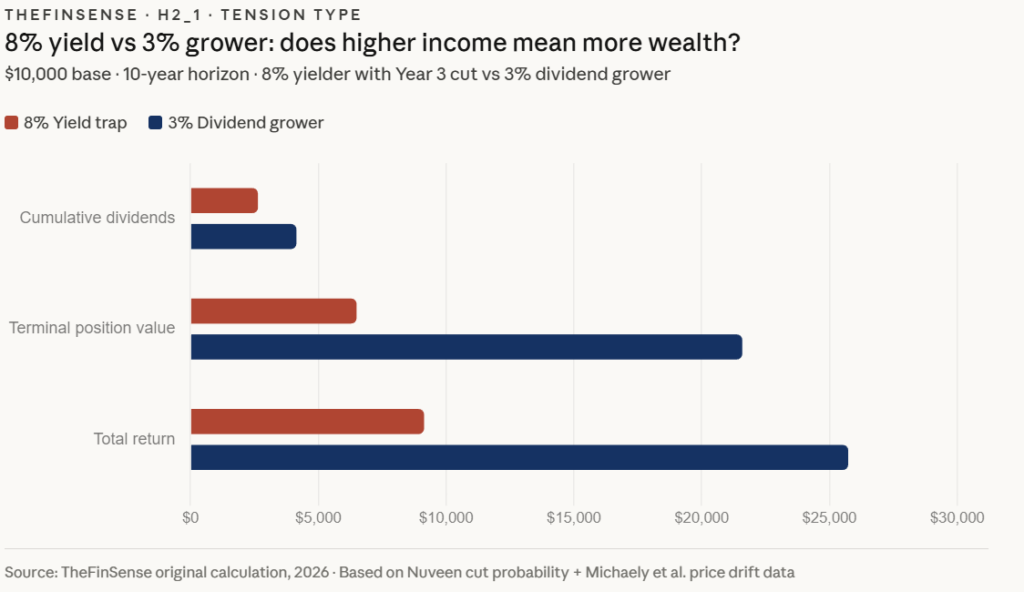
Total Return Comparison: $9,140 vs $25,735
| Metric | 8% Yield Trap (A) | 3% Grower (B) | Difference |
|---|---|---|---|
| Cumulative Dividends | $2,640 | $4,146 | −$1,506 |
| Terminal Position Value | $6,500 | $21,589 | −$15,089 |
| Total Return | $9,140 | $25,735 | −$16,595 |
| Wealth Multiple | 0.91× | 2.57× | 2.8:1 ratio |
TheFinSense Original Calculation
$16,600 Lost: 10 Years of the Wrong Number
$10,000 base · 8% trap (Year 3 cut, 35% price drop) vs 3% grower (7% div growth, 8% price appreciation)
Trap Total Return
$9,140
Grower Total Return
$25,735
Wealth Gap
−$16,595
Source: TheFinSense original calculation, March 2026 · thefinsense.io
8% Yield Trap vs 3% Grower total return divergence on $10,000 over 10 years. Source: TheFinSense original calculation, March 2026.
$16,595
The total wealth gap between the 8% yield trap and the 3% dividend grower on the same $10,000 over one decade. The grower delivered 2.8× more total return.
$16,600 covers a full year of groceries for a family of four — surrendered because a screener column made the wrong number look like the right signal.
The damage is not theoretical. The $10,000 position that paid $1,600 over 24 months surrendered $3,500 in capital on the cut date. The 3% grower running alongside it was already $5,300 ahead by the end of Year 3. The investor collecting the 8% yield was losing the wealth race from the moment the cut fired.
📐 YOUR NUMBERS MAY DIFFER
This calculation assumes a 35% price drop at the moment of the dividend cut. Here’s how the conclusion changes at different price collapse levels:
| Price Drop on Cut | Trap Terminal Value | Gap vs 3% Grower | Conclusion |
|---|---|---|---|
| 20% (mild) | $10,640 | ~$14,300 | Grower still wins decisively |
| 35% (base case) | $9,140 | $16,595 | ✅ Base case |
| 50% (severe) | $7,640 | ~$18,600 | Gap widens — trap nearly destroyed |
| ~8% (break-even) | ~$25,735 | $0 | Threshold — tie (price drop must exceed ~8% for trap to underperform) |
💡 PRO TIP: The break-even price drop is only ~8%. Any cut accompanied by a price decline greater than 8% — and 40% of high-yield cuts trigger 25–40% declines — means the trap destroys more wealth than the grower generates. The odds are not close.
The Yield Sustainability Filter: 4 Checks That Replace the Screener
The $16,600 gap does not require abandoning dividend investing. It requires screening differently — four data points instead of one.
You do not need to give up yield. You need to give up the one metric that has been doing the screening wrong.
The yield inflation mechanism — the formula that promotes declining stocks to the top of your screener — is neutralized by two additions. Dividend growth rate and FCF payout ratio. Every step below targets one thing: the automatic extraction that runs whether you act or not.
If the Yield Exceeds 6%: Flag the Position
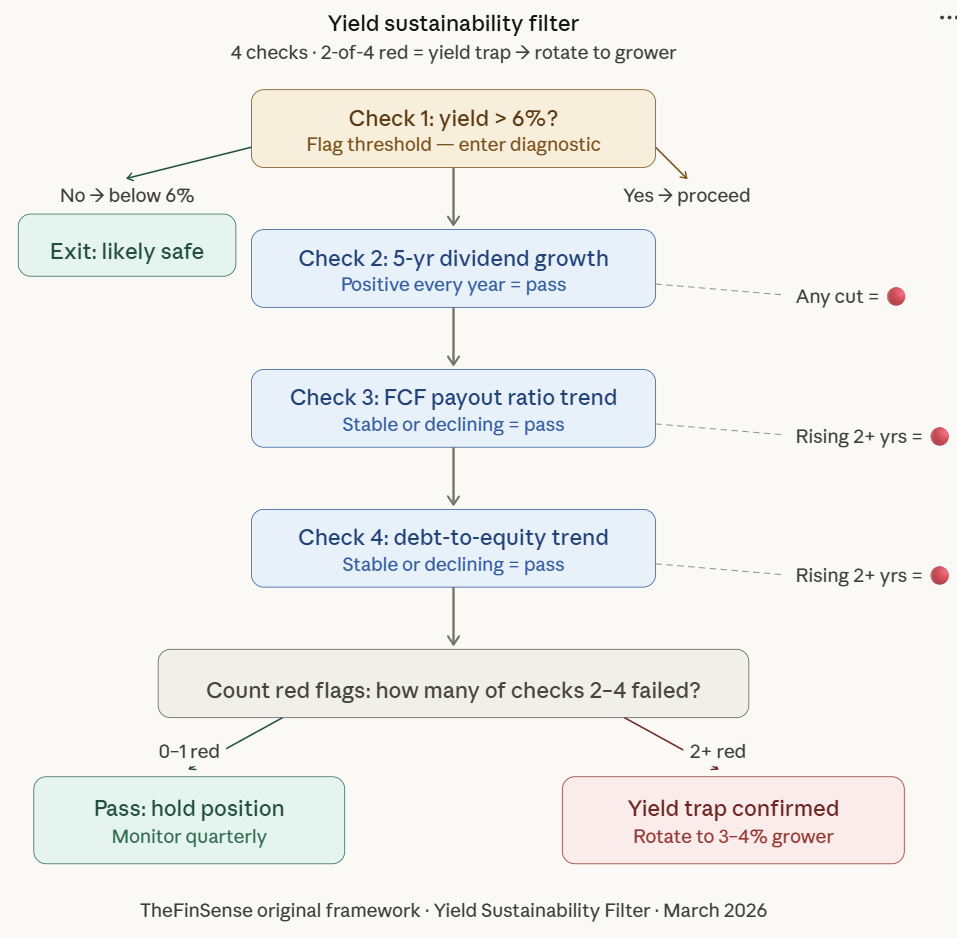
Does the current yield exceed 6%? If yes, the position enters the diagnostic. A yield above 6% does not guarantee a trap — it triggers the next three checks.
Why 6% and not 8%? The 40% cut probability applies to the >8% tier, but the yield inflation mechanism begins operating at lower levels. A stock that yielded 4% twelve months ago now yields 6.5%. That price decline was large enough to move the screener ranking. The mechanism is already active.
💡 PRO TIP: On Fidelity, click “Fundamentals” → “Dividend Yield 1-Year Change.” If the yield increased by more than 1.5 points without a declared dividend raise, the price decline is the driver. That single check takes 15 seconds.
If Dividend Growth Rate Is Negative — or FCF Payout Ratio Is Rising
Check 2: Is the 5-year dividend growth rate positive? Open the stock’s dividend history tab. A stock that has grown its dividend every year for five consecutive years has passed through at least one economic cycle with the payout intact. A negative growth rate — any year with a reduction — is a red flag.
Check 3: Is the FCF payout ratio stable or declining? A rising FCF payout ratio means the company is paying a larger share of its free cash flow as dividends. The direction matters more than the level. A payout ratio that climbed from 45% to 65% in two years is a deteriorating signal — even though 65% passes most static screens.
On Fidelity, the FCF payout ratio sits behind the “Fundamentals” tab — not on the main screener results page. On Schwab, it requires navigating to the “Financial Statements” section. The extra click is the difference between screening by dividend tax drag awareness and screening blind.
⚠️ WARNING: A single-quarter FCF spike (from asset sales or delayed capex) can temporarily suppress the payout ratio. Always check the 4-quarter rolling trend, not the most recent quarter alone.
The 2-of-4 Exit Rule: Identifying Dividend Yield Traps
Check 4: Is the debt-to-equity ratio stable or declining? A company funding its dividend with increasing leverage is borrowing to maintain an appearance of income. The same dynamic makes the yield look sustainable until it is not.
How many red flags does the position carry?
| Check | Green (Pass) | Red (Fail) |
|---|---|---|
| 1. Yield > 6% | Below 6% — exit diagnostic | Above 6% — proceed to Checks 2–4 |
| 2. 5-Year Dividend Growth | Positive every year | Any reduction in 5-year window |
| 3. FCF Payout Ratio Trend | Stable or declining | Rising over 2+ years |
| 4. Debt-to-Equity Trend | Stable or declining | Rising over 2+ years |
Two or more red criteria out of four: the position is a yield trap. Rotate the capital to a 3%–4% yielder with a positive dividend growth rate and stable FCF coverage. The screener that sorted by yield level is now replaced by four diagnostic checks — and the yield inflation mechanism loses its leverage.
🧠 IN PLAIN ENGLISH:
Think of this filter as a doctor reading four vital signs instead of one. Checking only blood pressure tells you something — but checking blood pressure, heart rate, oxygen, and temperature together tells you whether the patient is stable. The yield number is one vital sign. The Yield Sustainability Filter checks all four.
Dividend Yield Traps: Frequently Asked Questions
Are dividend ETFs like VYM or SCHD immune to yield traps?
ETFs dilute individual cut risk but do not eliminate it. VYM holds stocks across yield quintiles, including positions near the trap threshold. SCHD screens for dividend growth history, which partially filters high-yield traps. Neither fund explicitly excludes the yield inflation mechanism — a stock entering the 40%-cut-probability tier can sit in the portfolio until the next rebalance. Check the fund’s screening methodology for FCF payout ratio and growth rate criteria before assuming immunity.
What yield level is actually safe?
No yield level is inherently safe. Safety is a function of dividend growth rate, FCF payout ratio trend, and debt trajectory — not the yield number itself. A 3% yielder with declining FCF and rising debt carries more cut risk than a 5% yielder with ten consecutive years of dividend increases and a stable payout ratio below 60%. The Yield Sustainability Filter replaces the yield-level question with four diagnostic checks.
What happens to a yield trap if I DRIP my dividends?
DRIP on a yield trap accelerates the damage. Each reinvested dividend buys additional shares at a price already declining — so DRIP accumulates more shares of a deteriorating position. When the cut fires, the capital loss applies to a larger share count. The gap widens further with DRIP enabled on the trap side, because compounding works in reverse on a shrinking base. See how $98,371 friction drag compounds over time.
Can a stock recover after a dividend cut?
Some stocks recover, but the timeline devastates compounding. A 35% price collapse requires a 54% gain just to return to the pre-cut value — and that recovery typically takes 7 to 10 years. During those years, the grower portfolio is compounding on a full capital base. Even if the trap stock fully recovers by Year 10, the dividends it paid on the reduced base during recovery are permanently smaller than what the grower generated on an intact base.
Is the Kenneth French data still relevant after 2020?
The French quintile data spans multiple interest rate environments, including the 2020–2022 zero-rate period and the 2022–2025 hiking cycle. The highest-yielding quintile underperformed the second-highest quintile in both regimes. Rising rates in 2022 triggered dividend cuts across utilities and REITs — exactly the sectors that dominated the highest-yield tier. The structural relationship between extreme yield and cut probability is rate-regime invariant because the yield inflation formula operates on price, not policy.
The Bottom Line on Avoiding Dividend Yield Traps
The $16,600 gap we opened with is not a modeling artifact. It is the recorded output of a screener doing exactly what it was designed to do.
The yield number is a formula output — annual dividend divided by current share price. It does not measure sustainability. It does not predict future income. It reports the arithmetic relationship between two numbers, one of which falls before the cut is announced.
The screener sorted by this metric promotes the most dangerous positions to the top of the results page. The Yield Sustainability Filter replaces that single metric with four diagnostic checks. Dividend growth rate, FCF payout ratio trend, debt-to-equity trajectory, and the yield flag — four inputs where the screener used one. The 40%-cut-probability tier disappears from the top of the list.
The real cost of a dividend cut is not the income you stop receiving. It is that the simultaneous share price collapse permanently reduces the capital base generating all future returns. Every dollar of compound interest that follows is calculated on a damaged foundation. The 3% grower does not just collect more income. It compounds on a base that kept growing while the trap’s sat frozen at $6,500 for seven years.
The yield number that made the stock look attractive is the identical signal the market uses to price in its collapse.
The deeper irony is structural. The investors most focused on income protection are the most exposed to income destruction. The screening tool they trust ranks positions by the metric that correlates highest with impending cuts. The dividend snowball cannot compound on a damaged base. The grower does not look impressive in Year 1 — but it arrives at Year 10 with a capital base the trap investor will spend years trying to rebuild.
You no longer screen by yield level — you screen by what sustains it.
What happens to a compounding snowball when you remove the base it was rolling on?
📌 Next Read: Visualize Compound Interest
The number on the screen did not change.
💬 YOUR TURN
Run the Yield Sustainability Filter on your highest-yielding position right now — how many of the 4 checks does it pass?
Drop a comment below 👇