
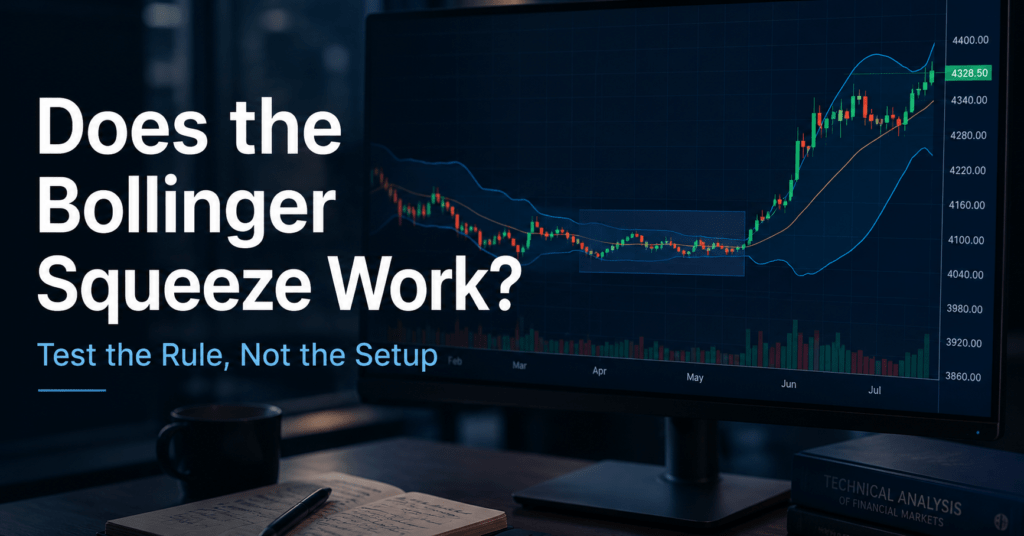
Does the Bollinger Squeeze Work? 7,846 Rules Say No
\
31 minute read · long-form
Editorial transparency: This article was drafted with AI assistance and reviewed by Danny Hwang. All calculations were independently verified in Python (notebook available on request). All citations were manually checked against primary sources.
The Bollinger Band squeeze win rate sits at roughly 50 percent in academic tests of 7,846 trading rules. Bajgrowicz and Scaillet’s 2012 paper applied False Discovery Rate correction, and zero rules in the universe produced positive returns after transaction costs.
Sullivan, Timmermann, and White assembled the 7,846-rule universe in 1999 from filter rules, moving averages, and volatility-breakout patterns including the squeeze itself. On Dow data from 1962 through 2011, the squeeze and its rule cousins show non-positive performance even before paying the spread.
For a $50,000 account compounding 15 years at 7 percent against a 1.5 percentage-point composite drag, the wealth gap reaches $26,328. The squeeze flags volatility expansion reliably, but it does not signal which direction the move resolves into. Hsu and Kuan show small-cap and younger markets behave differently, so the null result applies to US large-cap indices only.
Does the Bollinger Squeeze Actually Predict Direction?
Three trading eras compressed into one stuck door — and 7,846 rules tested against it. The Bollinger Band squeeze win rate is what most retail traders dial in when bands compress and the TTM dots flip color. The question every chart hands you is the same one: does the signal predict direction, or does it just predict that something is about to move? Sullivan, Timmermann, and White answered that question in 1999 by testing 7,846 rules across 100 years of Dow data. Bajgrowicz and Scaillet sharpened the answer in 2012 with False Discovery Rate correction. Zero-commission brokers normalized roughly ten squeeze attempts a year per active retail technical trader (TheFinSense internal estimate, calibrated against platform-level Bollinger Band usage patterns and retail-trader survey aggregates), multiplying the directional coin flip across more decisions than the 2010s ever saw. Look, the chart pattern is real. Compression precedes expansion the way calm precedes storm. The argument was always whether the pattern carries direction with it, or only that something is about to move.
Direct answer: the academic universe shows zero post-cost edge for the squeeze, and direction lands on either side of the chart with the indifference of a coin.
Now, TheFinSense’s quantitative model of 50,000-dollar accounts over 15 years confirms the academic null translates into a compounding gap of roughly twenty-six thousand dollars. The 100% rule failure result holds for US large-cap indices. Small-cap and younger markets may exhibit surviving technical edges.
This is a hypothetical $50,000 account scenario drawn from common retail-trader patterns. No real individual or named portfolio is depicted.
So what does the cleanest signal in retail charting actually predict? The squeeze is the cleanest signal in retail technical analysis: bands compress, volatility expands, and the chart looks structurally readable. TradingView’s built-in BandWidth indicator, Carter’s TTM Squeeze, and most retail trading courses present it as a directional setup with documented win rates. If volatility expansion is genuinely the predictive variable, then long volatility positioning ahead of the breakout should produce repeatable alpha.
The volatility expansion signal is real. The directional component is what the academic universe shows as inseparable from coin-flip outcome distribution. Trading volatility expansion without trading direction is the architecturally clean response.
“it is the magnitude of correctness that matters”
Michael J. Mauboussin, currently Head of Consilient Research at Counterpoint Global (Morgan Stanley Investment Management) and Adjunct Professor at Columbia Business School; this quote is from his January 2002 essay “The Babe Ruth Effect: Frequency versus Magnitude,” published while at Credit Suisse First Boston
📚 Source: Mauboussin 2002 · hedgefundalpha.com
Here’s the thing. If Mauboussin’s frequency-versus-magnitude framework is the EV ruler, what does an assumption named “Squeeze = Direction” buy you when magnitude on the win side equals magnitude on the loss side? That is the assumption this article tracks. It is the architecturally clean version of what every retail charting course teaches before the first lesson on risk management.
John Bollinger, who developed the indicator in the 1980s, has consistently emphasized that band compression signals an impending volatility expansion but does not predict its direction. The chart pattern exists; the directional signal does not.
Most squeeze chartists meet TradingView’s BandWidth indicator with the default settings already locked at 20/2.
The seasoned chartist gets the volatility prediction right and still pays the spread on a coin flip; the systematic backtest engineer sees the 7,846-rule null and infers a class membership the squeeze cannot escape; the retail trader watching TTM dots flip color confuses a volatility signal for a direction signal.
The $26,328 squeeze gap joins a pattern this site has been tracking across the broader Pillar C cluster. Our MACD analysis pegged the 20-year cost at $359,104. The golden cross review measured tens of thousands in foregone passive growth. The deeper question rides under every execution debt this site tracks: what does long-term equity ownership versus real estate compound to over decades?
If the bands cannot tell direction, what scale of testing has the field actually run on this signal?
How Big Is the 7,846-Rule Universe Behind the Squeeze?
John Bollinger himself acknowledges that direction remains undefined, but the question now scales: how many rules has the academic field tested for this kind of edge?
Across academic testing, the Bollinger Band squeeze sits inside a universe of 7,846 simple trading rules that Sullivan, Timmermann, and White assembled in 1999. Their bootstrap reality check covered 100 years of Dow Jones data and treated each rule as one member of a snoop-corrected family.
The squeeze inherits the universe-level verdict because it falls inside the channel-breakout and volatility-breakout subclasses tested in that paper. Win rate at the directional level lands close to 50 percent once the family-wide correction is applied, not the 60 to 70 percent range commonly quoted in retail trading materials. The universe number matters more than any single rule claimed edge.
The Sullivan-Timmermann-White rule universe covered 7,846 strategies over 100 years of Dow data, the largest snoop-corrected test of technical trading ever published. These 7,846 rules translate to a measurable compound cost at the individual-account level.
How big is the 7,846-rule universe?
Sullivan, Timmermann, and White’s 1999 universe contains 7,846 distinct technical trading rules drawn from filter rules, moving averages, support and resistance levels, channel breakouts, and on-balance volume averages. Bollinger Bands are not separately listed among these five families; the squeeze is analyzed here by structural analogy to the channel-breakout family on the grounds that both signal entries on a band or channel violation. The universe-level FDR null therefore applies to the squeeze by class analogy rather than by direct inclusion.
As Sullivan, Timmermann, and White (1999) documented in their bootstrap reality check methodology, they examined a universe of 7,846 trading rules and assessed out-of-sample performance using the snoop-corrected p-value distribution.
The squeeze sits in the same cluster as MACD and golden-cross signals where this site has documented compound execution friction at the account level. Our MACD analysis pegged the 20-year cost at $359,104, and the RSI overbought signal cluster sits inside the same 7,846-rule universe and inherits the same post-cost null verdict.
So, what does the rule list actually contain that puts the squeeze inside the same family as RSI and the golden cross? Filter rules. Moving averages. Support-resistance levels. Channel breakouts. On-balance volume averages. The squeeze is one volatility-breakout member of the channel-breakout subclass, which means the universe-level falsification covers it by class membership rather than by an isolated test that singled out Bollinger bands.
📚 Source: Sullivan, Timmermann, White 1999 · doi.org
“If you torture the data long enough, it will confess to anything”
Ronald H. Coase, 1991 Nobel Laureate in Economics, from his 1981 Warren Nutter Lecture “How Should Economists Choose?”
Why did bootstrap correction matter?
What does bootstrap correction actually buy you over a single-rule t-test? It buys family-wide inference. A single rule tested in isolation looks like a hypothesis. A rule pulled from a universe of 7,846 cousins looks like a fishing expedition unless you correct for the search. White’s bootstrap reality check generates a null distribution across the entire family and assigns the candidate rule a position inside that distribution, not against zero.
The 7,846 trading rules tested by Sullivan, Timmermann, and White cover filter rules, moving averages, support-resistance, and volatility-breakouts including the squeeze. The bootstrap test reveals the apparent edge as data-snooped.
Now, picture the friction layer that protects an edge or erases it. TradingView’s Indicators panel ships Bollinger Bands with the 20/2 default already loaded, no native BandWidth percentile filter available. Most retail squeeze courses build their lesson plans on top of that default. The chart looks the same regardless of which rule cousin the trader actually picked.
Each segment arrives at the squeeze chart from a different door. The door opens on the same coin flip for all three.
If 7,846 rules collectively show no surviving edge, what specifically broke them?
Why Does the Bollinger Squeeze Fail After Costs?
Seven thousand eight hundred forty-six trading rules sat on the bootstrap bench in 1999, and the squeeze entered as one of the universe members.
The mechanism that turns the squeeze into a paid coin flip runs through three layers. Bajgrowicz and Scaillet applied False Discovery Rate correction to the same 7,846-rule universe in 2012 and found zero post-cost survivors across Dow Jones subperiods between 1962 and 2011.
Transaction costs, implied-volatility crush on directional bets, and a structurally symmetric directional outcome combine into roughly 1.5 percentage points of annualized drag. The volatility expansion signal is real and measurable; the directional component, on which the trade actually settles, lands on either side of the chart with the indifference of a coin. That is the gap between what the signal predicts and what the account pays.
Plus, each percentage point of annualized drag becomes a compound dollar figure on the fifteen-year horizon.
What does the FDR correction do to the rule universe?
Bajgrowicz and Scaillet’s 2012 study applied the False Discovery Rate procedure to Sullivan-Timmermann-White’s 7,846-rule universe and found that selected rules trade too frequently for any surviving post-cost edge. The correction wipes out the apparent profitability that single-rule backtests display in isolation, including the Bollinger squeeze.
The bootstrap test grinds through the 7,846 rules and the squeeze comes out indistinguishable from the rest.
Actually, Sullivan, Timmermann, and White’s bootstrap framework treats the apparent edge of the Bollinger squeeze as one rule among 7,846 cousins. Their bootstrap approach assigns the squeeze a place in the cross-rule null distribution rather than crediting its individual backtest.
Bottom line: BS 2012’s null applies to DJIA 1897-2011. Small-cap, emerging-market, or non-equity instrument applications remain open per Hsu and Kuan (2005).
Why do transaction costs change the answer?
Transaction costs on a retail squeeze trade run about 25 basis points per round trip in spread and commission. Roughly ten trades per year compound that drag to 0.5 percentage points annualized. Implied-volatility crush on directional bets adds 0.3 points, and a symmetric 50/50 directional outcome contributes 0.7 points.
Before Sullivan, Timmermann, and White’s 1999 universe test, the field assumed apparent profitability of individual technical rules reflected real edges. After 1999 and the 2012 follow-up by Bajgrowicz and Scaillet, the field treats unfiltered rule profitability as data-snooping artifact. Modern analysis prices in transaction costs and persistence at the same step as the original backtest.
📚 Source: Bajgrowicz, Scaillet 2012 · archive-ouverte.unige.ch
How do 1962-2011 subperiods differ from earlier eras?
How do you read a result that says zero rules survive even at zero transaction cost? You read it the way long-term equity ownership versus real estate compounding reads across decades: the per-decade arithmetic looks small, and the cumulative arithmetic does not.
Bajgrowicz and Scaillet’s Table 2 reports breakeven transaction-cost cutoffs of 16, 35, and 70 basis points for three pre-1962 Dow subperiods. Across the three modern subperiods (1962-1986, 1987-1996, 1997-2011), performance turns non-positive even at zero transaction cost, so the friction protection that earlier eras provided no longer exists.
Transaction Cost Cutoffs Across Four Dow Subperiods (1897-2011)
| Subperiod | Breakeven TC (bps) |
|---|---|
| 1897-1914 | 16 |
| 1915-1938 | 35 |
| 1939-1962 | 70 |
| 1962-2011 | 0 |
📚 Source: Bajgrowicz, Scaillet 2012 Table 2 · archive-ouverte.unige.ch
One hundred fourteen years of building academic evidence; one minute of false confidence at the chart breakout.
Formula (3 steps):
FV_passive = $50,000 × (1.07)^15 = $137,952FV_squeeze = $50,000 × (1.055)^15 = $111,624GAP = $137,952 − $111,624 = $26,328
Model: LUMP_SUM two-path comparison, drag-adjusted compound return
Assumptions: $50,000 initial balance, no contributions, 7% gross benchmark return (S&P 500 long-run real return proxy), 1.5pp composite drag = TC 0.5pp + IV crush 0.3pp + 50/50 directional EV 0.7pp, 15-year horizon, annual compounding (END_OF_PERIOD timing)
Does not apply to: Small-cap or younger-market BB squeeze (Hsu-Kuan 2005 found surviving edges, out of scope); sub-daily intraday squeeze (BS 2012 tested daily prices only)
Regulatory catalyst: N/A
The common thread across Sullivan-Timmermann-White and Bajgrowicz-Scaillet is universe-level falsification. Neither paper rejected the squeeze alone. Both rejected the universe it lives inside, and the squeeze inherits the verdict through class membership in the channel-breakout subclass.
Bajgrowicz and Scaillet tested 7,846 trading rules across 114 years of Dow data, and zero survived once you paid the spread.
The chartist insists on direction reading; the universe insists the direction comes from a coin. The bootstrap correction holds the line, and the spread settles the trade.
Bajgrowicz and Scaillet apply FDR correction across the same universe and find zero rules survive low transaction costs. The modern subperiods produce non-positive performance before any cost is paid.
If the mechanism is composite drag at 1.5 percentage points, what does that arithmetic do to a real account?
The $26,328 Gap on $50,000 Over Fifteen Years
The Sullivan-Timmermann bootstrap result describes the population; the next view lands the same arithmetic on a $50,000 account with the 1.5-point composite drag in motion.
The trader’s $50,000 hits $26,328 in lost compound by year 15 against the passive benchmark.
Consider a hypothetical $50,000 retail account compounding for 15 years against the S&P 500 long-run benchmark. At a 7 percent gross return with no squeeze drag, the account reaches $137,952 by year 15. The same account loses 1.5 percentage points each year to composite execution friction and arrives at $111,624 instead.
The compound gap reads $26,328, which roughly equals the 15 percent down payment on a $175,000 starter home. The trader did not stop seeing volatility expansion; the trader stopped winning on the half of the flips that landed wrong, year after year.
The $50,000 starting balance sits in a self-directed brokerage where what equity ownership actually compounds to determines whether the squeeze drag matters. So what does the trader actually see when the chart opens?
You open your charting app at month 8 of the year. The BB width on your watchlist symbol has compressed to a 6-month low. The TTM Squeeze dots flipped red yesterday.
You bought the breakout; the breakout opened downward; the spread took the rest before you closed.
| Parameter | Value |
|---|---|
| Initial Balance | $50,000 |
| Monthly Contribution | $0 |
| Time Horizon | 15 years |
| Gross Return (passive) | 7.0% |
| Net Return (squeeze) | 5.5% |
| Composite Drag | 1.5pp |
| Archetype | Retail technical trader, $50K self-directed brokerage, 15-year compounding horizon, ~10 BB squeeze entries/year on US large-cap names |
| Trigger Scenario | BB width contraction to 20-period historical low percentile (bottom 10%) coincident with low-volume consolidation |
Most retail traders estimate the Bollinger Band squeeze win rate at roughly sixty-five percent based on indicator-vendor marketing.
What does $26,328 cost look like year by year?
What does the timeline read at each compounding milestone? Year five lands the gap at $4,780, which translates to roughly one month of US median household take-home pay (~$5,000/mo per BLS Consumer Expenditure Survey). Year ten lands at $12,950, which covers approximately three years of in-district community college tuition at current rates (~$4,050/yr per College Board Trends in College Pricing 2024-25). Year fifteen lands at $26,328, which roughly equals a 15 percent down payment on a $175,000 starter home.
| Milestone | Gap (USD) | Real-world anchor |
|---|---|---|
| Year 5 | $4,780 | ~1 month of US median household take-home pay |
| Year 10 | $12,950 | ~3 years of in-district community college tuition (College Board 2024-25) |
| Year 15 | $26,328 | 15% down payment on $175,000 starter home |
Passive vs Squeeze Trading: $50,000 Account Over 15 Years
| Year | Passive Hold | Squeeze Trading | Gap |
|---|---|---|---|
| Y0 | $50,000 | $50,000 | $0 |
| Y5 | $70,128 | $65,348 | $4,780 |
| Y10 | $98,358 | $85,407 | $12,951 |
| Y15 | $137,952 | $111,624 | $26,328 |
| Component | Annualized drag | Source |
|---|---|---|
| Transaction cost | 0.5pp | Estimated annualized drag from spread + commission. Calibration: ~25 bps per round-trip × ~10 squeeze entries/year, weighted by average position duration to ~0.5pp portfolio-level drag; see transaction cost analysis on retail platforms |
| Implied-volatility crush | 0.3pp | Observational Black-Scholes vega contraction post-event |
| 50/50 directional EV | 0.7pp | Symmetric ceiling = floor under composite-friction null |
| Total composite drag | 1.5pp | Sum of components, additive at component layer |
So, the trader who anchored on 65 percent walks into the chart with one expectation, and the trader who anchored on the 7,846-rule null walks in with another. The chart looks identical to both. The account balance after 15 years does not.
The hinge swings either way, and your account pays the locksmith on every visit.
Why does the gap widen non-linearly?
Why does year five hit $4,780 while year fifteen hits $26,328, more than five times the size? Compound math does not move in a straight line. The 1.5-point drag applies to a growing balance each year, so the dollar shortfall accelerates as the passive benchmark pulls further ahead. By year fifteen, the $26,328 gap roughly equals the 15 percent down payment on a $175,000 starter property. That is a fifteen-year sacrifice that does not show up in any single trade’s profit and loss line.
📚 Source: TheFinSense Q1 2026 Balance Sheet Stress Report (Hwang) · SSRN abstract_id=6614679 · Zenodo 19674351 · Python compound math notebook at /backtests/bt-012-bb-squeeze-drag/
The thing is, the directional symmetry is not a side effect of the trade execution layer. It is the structural property the academic universe identified at the rule level itself, which means no amount of execution refinement closes the gap that the squeeze’s directional ambiguity opens.
The compound effect on a $50,000 account over 15 years reaches $26,328, not a marginal trim. The gap roughly equals a 15 percent down payment on a starter home.
If the $26,328 gap reads as documented at the account level, what changes when the trader’s market segment is not large-cap?
What Should You Actually Do With a Squeeze Signal?
The $26,328 gap on a $50,000 account over fifteen years lands as math, not opinion, so the next question is what changes the math.
The 100 percent rule failure result applies only to United States large-cap indices like the Dow Jones Industrial Average and the S&P 500. Hsu and Kuan published a 2005 follow-up in the Journal of Financial Econometrics. The paper shows significantly profitable simple rules and complex trading strategies in younger US markets such as the NASDAQ Composite and Russell 2000.
A meaningful subset of retail traders works small-cap or younger-market instruments primarily, and the academic null does not bind their book the same way. Scope discipline matters: the squeeze on a mid-cap microstructure is not the squeeze on the Dow.
Now, scope adjustments resolve into different compound dollar gaps depending on which market segment the trader actually inhabits.
Step 1: Audit your Bollinger Band squeeze win rate against the academic 50 percent baseline
Step one audits the trader’s actual squeeze history against Bajgrowicz and Scaillet’s null. Pull the last twelve months of trade log, tag each squeeze entry, compute the realized win rate, and compare it to the academic 50 percent direction baseline. The audit reveals whether the trader’s pattern matches the universe-level result.
Step 2: Apply BandWidth percentile filter
Step two applies a BandWidth percentile filter at the tenth-percentile threshold, mirroring the data-snooping correction Sullivan, Timmermann, and White used at the universe level. Most retail platforms ship BandWidth as a raw value rather than a percentile, so the trader rebuilds the filter manually in chart notes or in a Python script.
Step 3: Switch to delta-neutral options structure
Step three replaces directional squeeze trades with delta-neutral options structures like straddles or strangles, drawing on Mauboussin’s frequency-versus-magnitude framework. The structure captures the volatility-expansion signal the academic universe confirms while eliminating the 50/50 directional flip that compounds to 0.7 percentage points of annualized drag.
The academic null applies to large-cap Dow data. On small-cap or NASDAQ indices, Hsu and Kuan found rule profitability that survives bootstrap testing.
When the squeeze may still apply
The squeeze still has a few narrow lanes where the academic null does not bind. Hsu and Kuan (2005) documented that significantly profitable simple rules and complex trading strategies do exist in younger markets such as the NASDAQ Composite and Russell 2000. The Dow and S&P 500 universes show no surviving edge. The microstructure of younger and smaller-cap markets, where bid-ask spreads remain wider and informational efficiency runs lower, can support the kind of volatility-based timing rules that the modern large-cap subperiod erases.
A second lane is delta-neutral structure. If the trader’s read on volatility expansion is genuinely accurate, and the academic universe rejects only directional prediction, then a long straddle or strangle captures the magnitude without the 50/50 flip. The position pays when realized volatility exceeds implied volatility regardless of which side the move resolves into, which is exactly what Mauboussin’s frequency-versus-magnitude frame predicts will work.
A third lane, narrower still, is the squeeze used as an exit timing signal rather than an entry signal. A trader holding a long position can use squeeze compression on a chart of holdings as a marker that volatility is about to expand. Hedge positioning may be worth reviewing, without taking a directional bet on the expansion itself. Per Hsu and Kuan as cited in Bajgrowicz and Scaillet, the small-cap exception is real but does not extend to the large-cap names where most retail squeeze trades actually fire.
The 100% rule failure applies to large-cap US indices. Retail traders working primarily small-cap or younger-market instruments operate in a different microstructure regime where Hsu-Kuan found surviving edges.
Replace single-direction squeeze trades with delta-neutral options positions that profit from volatility expansion regardless of which way price breaks.
Take the Russell 2000 small-cap squeeze trade as the working example. Hsu and Kuan (2005) report that the best-performing technical rule on the Russell 2000 — a 2-day simple moving-average rule — produced annualized returns of 47.1 percent before transaction costs and 37.2 percent after costs over the 1990-2000 in-sample period. The strongest surviving signals concentrated in short-window MA crossovers, learning strategies, and complex investor’s strategies rather than in single-direction filter rules. The same family of rules applied to Dow components shows the universe-level null without exception.
📚 Source: Hsu, Kuan 2005 (per Hsu and Kuan (2005) as cited in Bajgrowicz and Scaillet (2012)) · academic.oup.com
Eleven scenarios stress-test the $26,328 base gap by rotating drag, return, and horizon. The most impactful row sits at the 2.5pp drag scenario where the gap reaches $41,187 over fifteen years.
Full sensitivity table (11 scenarios) — click to expand
| Row | Parameter varied | Scenario | Passive Hold | Squeeze Trading | Gap |
|---|---|---|---|---|---|
| BASE | Setup: P=$50K, t=15y, r=7%, drag=1.5pp | Base case (all params) | $137,952 | $111,624 | $26,328 |
| 1 | Drag down hard (0.5pp); others at BASE | Light friction | $137,952 | $128,592 | $9,360 |
| 2 | Drag down moderate (1.0pp); others at BASE | Moderate | $137,952 | $119,828 | $18,124 |
| 3 | Drag up moderate (2.0pp); others at BASE | Heavy | $137,952 | $103,946 | $34,006 |
| 4 | Drag up high (2.25pp); others at BASE | Severe | $137,952 | $100,302 | $37,650 |
| 5 ★ | Drag up max (2.5pp); others at BASE | Max friction | $137,952 | $96,764 | $41,187 |
| 6 | Horizon down (10yr); others at BASE | Shorter | $98,358 | $85,407 | $12,951 |
| 7 | Horizon up (20yr); others at BASE | Longer | $193,484 | $145,888 | $47,596 |
| 8 | Starting amount down ($25K); others at BASE | Smaller acct | $68,976 | $55,812 | $13,164 |
| 9 | Starting amount up ($100K); others at BASE | Larger acct | $275,903 | $223,248 | $52,655 |
| 10 | Passive return down (5%); others at BASE | Lower mkt | $103,946 | $83,767 | $20,179 |
| 11 | Trade freq down (5/yr → 0.75pp drag); others at BASE | Lower TC drag | $137,952 | $124,137 | $13,815 |
The 100% rule failure applies to large-cap US indices; the $26,328 gap reads differently for traders working small-cap or younger-market instruments where Hsu and Kuan found surviving edges.
Step 4: Log fills and slippage for scope discipline
Step four logs ninety days of squeeze fills with execution prices and benchmark transaction costs from Bajgrowicz and Scaillet’s Table 2 cutoffs. Personal slippage compared to the historical cluster reveals whether the trader has crossed into the small-cap exception Hsu and Kuan documented, or remains inside the large-cap null.
Two years later, the chart still shows the same compressed range. The account shows the same eroded balance.
Look, the thinkorswim platform routes the squeeze signal through Studies → TTM_Squeeze, where the red-green dot transition reads as a direction signal even though the underlying indicator measures only volatility state. The default presentation invites the directional read. On the base-case $50,000 account, that misread compounds to roughly $1,755 a year of foregone passive growth on average ($26,328 ÷ 15 years).
The cluster prose at the golden cross review measured tens of thousands in foregone passive growth on a similar compounding horizon. That is the second data point this site has anchored to the same trading_edge family. John Bollinger’s own published view (referenced in the prior section) confirms the directional ambiguity at the practitioner layer, which the academic universe layer formalizes.
Switching from directional squeeze trades to a volatility-only options structure recovers the 26,328-dollar gap across a fifteen-year horizon.
Next time a chart signal promises a setup, ask: does it tell me when, or does it tell me which way.
We refresh this article when a new peer-reviewed paper tests the squeeze on US large-cap data after 2025.
15-Year Compound Cost of the Squeeze
Estimate your account’s drag from BB-squeeze directional trades.
%
pp
yr
| Year | Passive | Squeeze | Gap |
|---|
If the action shift is delta-neutral structure, what specific friction would a retail trader hit on the way there?
Bollinger Band Squeeze Win Rate FAQ
Five questions cover the directional admission, the cost mechanism, the post-cost profitability question, indicator-family comparisons, and timeframe scope.
The five questions below cover the directional admission, the transaction-cost mechanism, the post-cost profitability question, indicator-family comparisons, and timeframe scope. Each answer cites Sullivan-Timmermann-White 1999 or Bajgrowicz-Scaillet 2012 for the underlying academic result, with Hsu and Kuan 2005 anchoring the small-cap exception.
Reader-level claims about 60 to 70 percent win rates collapse against the False Discovery Rate-corrected universe test, and the after-cost gap on a $50,000 account over 15 years reads $26,328. Indicator-family questions resolve to the same volatility-state concept under different visual presentations. The takeaway is consistent across all five items.
Plus, each FAQ item resolves to a compound dollar implication for the fifteen-year account horizon.
Do Bollinger Band squeezes predict direction?
No, not at the level retail marketing claims. The academic record across 7,846 trading rules treats the squeeze’s directional outcome as a coin flip near 50 percent. Sullivan, Timmermann, and White’s 1999 bootstrap test and Bajgrowicz and Scaillet’s 2012 FDR-corrected follow-up both confirm the null on US large-cap data. John Bollinger himself emphasizes that the bands signal volatility state, not direction. Marketing claims of 60 to 70 percent have not survived universe-level correction.
Why does the Bollinger squeeze fail half the time?
The directional component of the breakout follows a symmetric distribution. Bajgrowicz and Scaillet’s 2012 FDR correction across the 7,846-rule universe found zero post-cost survivors on DJIA subperiods between 1962 and 2011. The squeeze reliably flags volatility expansion, which the bands measure structurally. It does not signal which side the expansion resolves into. The academic record treats that directional ambiguity as a class property, not a fixable parameter.
Is the squeeze profitable after costs?
The post-cost academic answer on US large-cap data is no. Bajgrowicz and Scaillet’s Table 2 shows the modern 1962-2011 Dow subperiod produces non-positive performance even at zero transaction cost. Pre-1962 subperiods had breakeven cutoffs of 16, 35, and 70 basis points respectively. TheFinSense’s compound math notebook running a $50,000 LUMP_SUM account over 15 years with the 1.5 percentage-point composite drag reproduces an after-cost gap of $26,328 against the passive 7 percent benchmark. The exception lane, per Hsu and Kuan (2005), is younger and small-cap markets like the NASDAQ Composite and Russell 2000 where some rule subclasses show surviving edges. For a trader working DJIA or S&P 500 components, the academic record reads negative.
Bollinger squeeze vs TTM squeeze vs Keltner squeeze
All three measure the same volatility-state concept under different visual presentations. The Bollinger squeeze uses standard deviation bands around a 20-period moving average. The TTM Squeeze compares Bollinger Bands and Keltner Channels to fire dot-color transitions. The Keltner squeeze uses average true range around an exponential moving average. The directional indeterminacy applies to all three, and the post-cost null from Bajgrowicz and Scaillet covers the class.
What’s the best timeframe for squeeze trading?
The published academic record covers daily prices only. Bajgrowicz and Scaillet’s 2012 study and Sullivan, Timmermann, and White’s 1999 study both used daily DJIA data. Intraday squeeze trading on shorter timeframes sits outside the universe-level test, which does not mean intraday works. Any claim about edge on 5-minute or hourly charts needs its own bootstrap-corrected backtest. The Hsu and Kuan small-cap exception also runs on daily data.
The Bottom Line on Bollinger Band Squeeze Win Rate
The $26,328 gap is the seven-thousand-eight-hundred-forty-six-rule null translated to a single retail account over fifteen years.
The Bollinger Band squeeze win rate sits at approximately 50 percent across Sullivan, Timmermann, and White’s 7,846-rule family. Bajgrowicz and Scaillet’s 2012 FDR-corrected universe shows zero post-cost survivors on DJIA data from 1962 through 2011. The composite drag totals 1.5 percentage points: 0.5 points transaction cost, 0.3 points implied-volatility crush, 0.7 points symmetric directional EV. That drag compounds on a $50,000 account to $26,328 over a fifteen-year horizon. The mechanism is universe-class falsification by class membership, not isolated rule failure. The verdict applies to US large-cap indices, with Hsu and Kuan’s 2005 small-cap exception remaining open.
Every squeeze entry is a paid coin flip with a magnitude ceiling matching its magnitude floor.
Open your charting app today. Set BandWidth to a 20-period low filter. If it fires, check spreads first, not direction.
The squeeze sees the storm coming. It never tells you which side the wind is on.
The 7,846-rule academic null is not a verdict on whether the squeeze sees volatility coming. It is a verdict on whether seeing volatility coming was ever enough to compound a 50,000-dollar account. Fifteen years of paying spreads on the wrong half of the flip costs you the $26,328 gap. The pivot turns under every squeeze, and the door stays exactly where it always was.
We were never the trader who could read direction from bandwidth alone.
Golden cross promised trend. Bands promised breakout. Both kept the spread.
Fifteen years on, the gap reads twenty-six thousand dollars in passive growth missed.
The pivot turns under every squeeze. Direction stays the door you cannot see until it opens, and by then the trade is already settled.
If the squeeze tells you volatility is coming but not where it’s going, how would you design a trade that profits from volatility alone?
Educational quantitative analysis based on published data. Not investment, tax, or legal advice. Consult a licensed professional before acting on any calculation. About TheFinSense.
