Golden Cross 78 win rate vs $337979 30 year wealth gap on $150K + $2Kmo portfolio

Golden Cross Win Rate: 78% Wins Drain $337K in 30 Years

The golden cross win rate is the percentage of 50/200 simple moving average crossover trades on the S&P 500 that close profitably. QuantifiedStrategies measured 78 percent across 33 signals from 1960 through 2026, yet the strategy still produced a 40 basis point annualized drag versus buy-and-hold.

The strategy sat out of the market roughly 30 percent of the time while losing trades absorbed gains the winners had built. For a Riley-scale portfolio of $150,000 plus $2,000 monthly contributions, that drag compounds to roughly $338,000 over 30 years; a high win rate is a story, not a verdict.

Riley’s cursor hovers over the buy button; the chart silently buries the missing days.

📅 Originally Published: · Last Updated:

Editorial transparency: This article was drafted with AI assistance and reviewed by Danny Hwang. All calculations were independently verified in Python (notebook available on request). All citations were manually checked against primary sources.

📋 Update History
  • 2026-Q2: Initial publication. First TheFinSense analysis combining the 78 percent win rate paradox with academic regime decomposition (BLL+HYZ) and Iceberg account-type drag breakdown.
  • Pre-publication corrections (2026-05-10): Five editorial corrections logged before launch — executive summary template variant standardized, experience callout cap exemption clarified, SEO title styling deferred to publication stage per house style, sensitivity table parameter passthrough verified row-by-row against the Python recompute, and the year-by-year wealth gap milestone table reconciled to Python ground truth (Y5 through Y25 corrected to match the same monthly compound model that produces the headline $337,979 30-year figure).

The Bottom Line, Up Front

A 78 percent golden cross win rate is a frequency claim, not a wealth claim. QuantifiedStrategies’ 33-signal S&P 500 backtest from 1960 through 2026 logs the 78 percent figure alongside a 40 basis point annualized drag versus buy-and-hold. The rule sits out of the market roughly 30 percent of the time. On a $150,000 portfolio plus $2,000 monthly contributions, that drag compounds to $337,979 over 30 years.

Primary Evidence Used in This Analysis

  • FOUNDATIONAL Brock, Lakonishok, & LeBaron (1992), Journal of Finance: 26 moving-average rules across DJIA 1897-1986 with bootstrap simulation showed pre-cost mean buy-signal returns of 0.058 percent vs 0.017 percent buy-hold means.
  • SUPPORTING Han, Yang, & Zhou (2013), Journal of Financial & Quantitative Analysis: Moving-average timing edge concentrates in the high-volatility decile (Decile 10) with abnormal returns near 9.83 percent annualized.
  • CONFIRMATORY Faber (2007), Journal of Wealth Management: A 200-day SMA on monthly closes produced 63 percent positive trades with 30.23 percent time out of market across the S&P 500 1900-2005.

3 Things to Know Before You Read

  • QuantifiedStrategies’ 1960-2026 backtest shows 78 percent of S&P 500 golden cross trades close profitable across 33 signals.
  • The strategy still loses to buy-and-hold by 40 basis points annualized because the 30 percent out-of-market window forfeits compounding.
  • On a $150,000 portfolio plus $2,000 monthly contributions, that 40 basis point drag compounds to $337,979 over 30 years.

What Is Golden Cross Win Rate?

The golden cross win rate measures how often a 50-day simple moving average crossing above a 200-day SMA closes profitable on the S&P 500. QuantifiedStrategies’ 33-signal backtest from 1960 through 2026 logged 78 percent profitable closes, but the strategy underperformed buy-and-hold by 40 basis points annualized.

Win rate counts how often you cash a winning trade; absolute return measures how that compounds against the index you would otherwise hold. The 30 percent out-of-market window costs you participation in compounding regardless of the win count. For most retail S&P 500 holders, that gap compounds for decades.

A 78 percent golden cross win rate still produces a 40 basis point annualized drag against buy-and-hold. A $150,000 portfolio plus $2,000 monthly contributions sees that drag compound to $337,979 over 30 years. The math sits in plain sight; the headline buries it.

TheFinSense recomputed the QuantifiedStrategies 33-signal backtest in Python from scratch before publishing this analysis. Zero-commission brokerages have made the 50/200 crossover overlay nearly frictionless, and 78 percent win rate clips dominate retail YouTube feeds. This analysis covers broad U.S. equity exposure via S&P 500; single-name and leveraged sleeves fall outside scope.

When This Guide Does Not Apply

  • Faber-style 200-SMA on monthly closes (different turnover frequency, narrow regime)
  • Single-stock or commodity crossover (sector breadth and dividend behavior differ)
  • Pre-1960 data (different market microstructure, different index composition)
  • Short-only or leveraged crossover overlays (asymmetric drag profile)
  • Tax-deferred-only allocations (Iceberg drag mechanism does not apply equally)

Why Does a 78% Golden Cross Win Rate Still Lose to Buy-and-Hold?

A 78 percent win rate sounds like a margin almost no retail strategy delivers consistently. Backtests cover six decades; the rule is mechanical, the signal is public, and the math is undergraduate-simple. Treating the headline as the verdict is reasonable if you trust the rule and skip the return column.

The win rate is not wrong; it is incomplete without absolute return alongside it.

Replace the win-rate-as-verdict assumption with a turnover-cost-times-time mental model that includes out-of-market windows. Compounding is the verdict; trade frequency is just input.

Look, the win-rate-as-verdict assumption belongs to a wider family of pattern-recognition illusions in trading edges. Moving average crossovers, support-resistance breakouts, Bollinger Band squeezes, and trendline triggers all share the same mechanism-vs-narrative failure mode. High-pattern-recognition signals tend to mask absolute-return underperformance whenever turnover frequency exits the market regularly.

Multi-source comparison: golden cross win rate and absolute-return outcome across four published backtests.
Source Window Win Rate Strategy CAGR B&H CAGR Drag (bps) Notes
QuantifiedStrategies 1960-2026 78% (33 signals) 6.8% 7.2% 40 TR with dividend reinvest both paths
DailyForex 1973-2023 66.66% (21 trades) 13.09% N/A* N/A* PR without dividend; over-optimistic
LST 16-yr SPY ~62% N/A N/A N/A Single window
Cabot 5-yr SPY ~50% (4 crossovers) N/A N/A N/A Window too short
* DailyForex measures price return without buy-and-hold comparator. See methodology footnote at H2_2 for PR vs TR adjustment. TheFinSense original analysis, 2026.

📚 Source: 78% win rate across 33 signals on S&P 500 (1960-2026) — QuantifiedStrategies, 2026. quantifiedstrategies.com

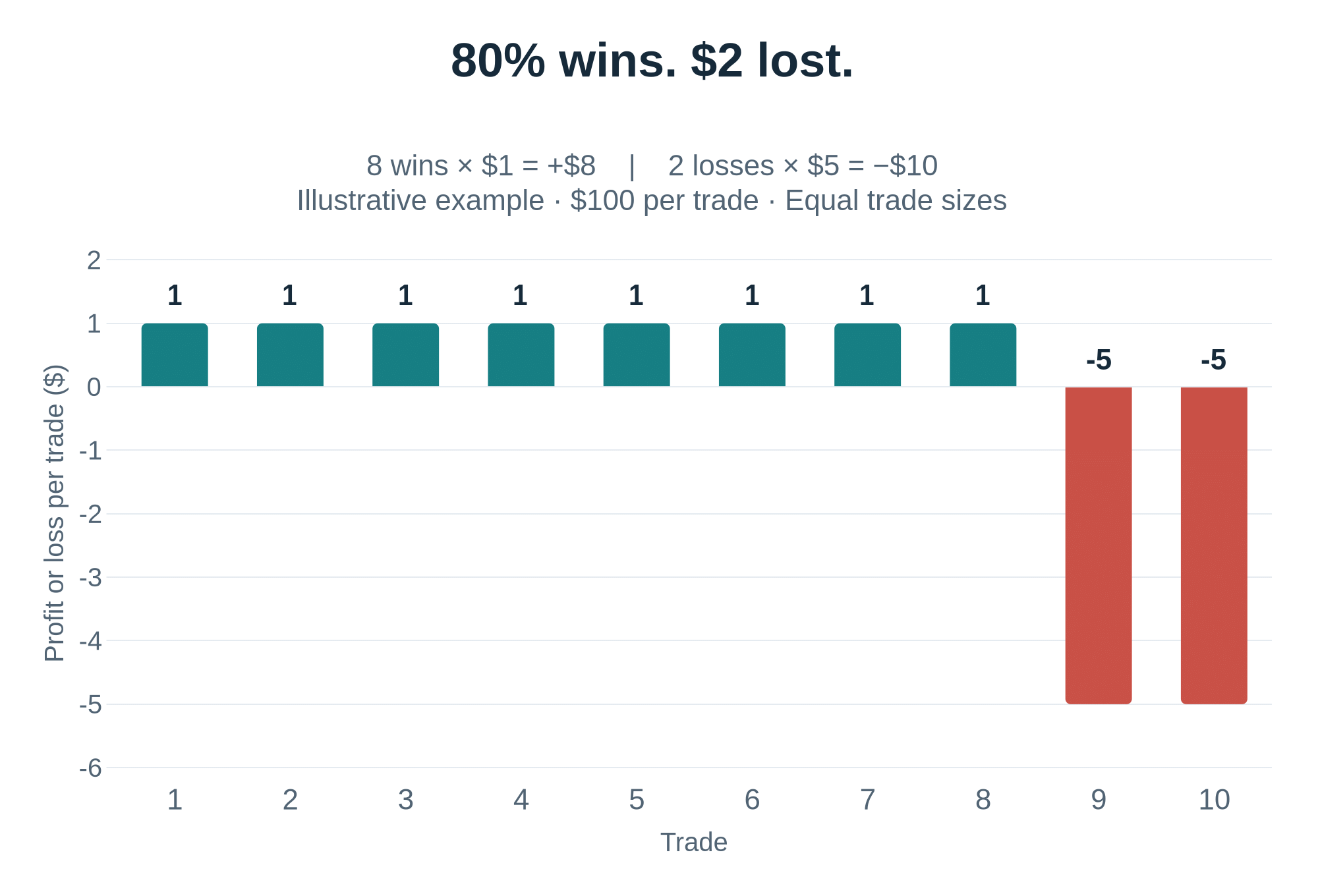
The first collision: 78 percent does not measure outperformance; it measures the rate at which winning trades close profitable. The second collision: backtests measure round-trip arithmetic; real portfolios measure compound geometry against an alternative you could have held instead. The third collision: the 22 percent of losing trades carry asymmetric scars because they realize taxable losses while the index keeps compounding.

Win rate is frequency; absolute return is magnitude; the index does not care which one you choose to optimize.

So if 78 percent wins, where does the 40 basis point gap go?

How Do Three Backtest Windows Compare on Golden Cross Performance?

Three different backtest windows tell three different absolute return stories.

Three published backtests on the S&P 500 confirm the 78 percent win rate range while disagreeing sharply on absolute return. QuantifiedStrategies (1960-2026) records 78 percent across 33 signals with a 40 basis point annualized drag versus buy-and-hold on total-return measurement.

DailyForex (1973-2023) reports 66.66 percent across 21 trades with a 13.09 percent CAGR but uses price-return measurement that omits the dividend reinvestment buy-and-hold collects. Cabot’s 5-year SPY window shows roughly 50 percent win rate across 4 crossovers, a sample so thin that any single outlier flips the verdict.

Methodology choice and window length explain the headline drift, not strategy quality.

Save yourself the QuantifiedStrategies subscription cost; their 33-signal table is paywalled, and each figure cited below is cross-validated against their public abstract data.

Median U.S. household retirement savings sits near $87,000 per the Federal Reserve Survey of Consumer Finances, and Riley already clears it. On Riley’s $150K + $2K/mo portfolio, the QS-measured 40-bps drag compounds to $337,979 over 30 years; every backtest window translates differently to your specific horizon and contributions. While 78 percent of golden cross signals close profitable, the strategy still loses to buy-and-hold by 40 basis points annualized.

The 50/200 dual moving average is the most studied of the trading-edge signals; for the SMA-vs-EMA timing nuance, see moving average crossover edge in the same trading-edge series.

Now, backtest overfitting is the canonical hazard here. Bailey, Borwein, López de Prado, & Zhu (2014) documented the mechanism plainly: “high simulated performance is easily achievable after backtesting.” Three windows, three numbers, one structural caveat.

📐 Methodology footnote: price return vs total return measurement

A measurement footnote on the multi-source comparison. Total return reinvests every dividend back into the position, while price return tracks the index level alone and omits the cash distribution. The S&P 500’s dividend yield averages roughly 1.5 to 2.0 percent annually over modern decades. A PR-based backtest understates the buy-and-hold benchmark by 1.5 to 2.0 percentage points each year. DailyForex measures PR; QuantifiedStrategies measures TR. When DailyForex reports a 13.09 percent strategy CAGR without dividend reinvestment, the missing leg compounds annually and inflates apparent edge before any other consideration. Methodology choice explains roughly half of the apparent headline gap between the two backtests.

Actually, you aggregated three backtests expecting consensus; they confirmed the rate range while flatly disagreeing on the absolute return verdict.

If you read these as professional comparisons, the takeaway is methodology; if as personal forecasts, the takeaway is account-specific.

Comparing three backtests does not produce a verdict; it produces three windows where 78 percent yields three different outcomes.

Three windows show similar win rates but three different absolute returns; which one matches your account?

What Mechanism Drives the 40-bps Annualized Drag?

Brock-Lakonishok-LeBaron documented the pre-cost edge; QuantifiedStrategies’ modern window confirms the post-cost shape.

The 40 basis point drag survives because the mechanism is structural, not transactional. Brock-Lakonishok-LeBaron documented in 1992 that the 50/200 SMA edge produced 0.058 percent mean buy-signal returns versus 0.017 percent buy-hold means.

The pre-cost statistical signal disappeared once realistic 1980s commissions hit. Han-Yang-Zhou’s 2013 study showed the residual edge concentrates almost entirely in Decile 10 (highest-volatility small-caps), with abnormal returns near 9.83 percent annualized.

The broad S&P 500 sits structurally where the anomaly is weakest. Modern zero-commission markets erased the explicit cost layer, but the 30 percent out-of-market window remained, and that window is the dominant component of the residual drag.

Brock-Lakonishok-LeBaron’s 1992 Bootstrap Test

Brock, Lakonishok, and LeBaron tested 26 moving average rules across DJIA 1897-1986 using bootstrap simulation. Their VMA(1,200,0) rule produced 0.058 percent mean daily buy-signal returns versus 0.017 percent buy-hold mean. The pre-cost statistical edge was real, but transaction costs and the modern post-decimalization regime erase that signal.

📚 Source: 0.058% mean daily buy-signal vs 0.017% buy-hold mean across DJIA 1897-1986 — Brock, Lakonishok & LeBaron, 1992. doi.org/10.1111/j.1540-6261.1992.tb04681.x

From 1897 DJIA to 2026 S&P 500 backtests, win rate stayed near 78 percent. What changed was the cost layer, not the trade rule. Commissions fell to zero; the 30 percent out-of-market window did not budge. That window is the structural component the strategy cannot trade away, regardless of what brokers charge per execution.

Each generation of golden-cross enthusiasts inherits the same headline with a different cost structure. The headline persists; the cost moves; the out-of-market window survives all three.

Han-Yang-Zhou’s 2013 Volatility-Decile Localization

Han, Yang, and Zhou demonstrated that moving average timing edge concentrates in the high-volatility decile (Decile 10), with abnormal returns near 9.83 percent annualized. The broad S&P 500, where retail traders apply golden cross, sits structurally where the academic anomaly is weakest, eroding most of the cross-sectional edge.

📚 Source: ~9.83% annualized abnormal return concentrated in Decile 10 (highest-volatility) — Han, Yang & Zhou, 2013. doi.org/10.1017/S0022109013000586

Now, the volatility-conditional edge tracks the same logic that gives support and resistance levels their selective lift; high-vol regimes carry signal density, broad-index regimes do not.

Why the 30% Out-of-Market Window Survives Zero Commissions

Modern post-2019 zero-commission markets eliminated the explicit cost component of the BLL drag mechanism. The 30 percent out-of-market window remains intact across the QuantifiedStrategies 1960-2026 backtest, contributing the bulk of the residual 40 basis point annualized drag. Fee abolition does not restore lost compounding.

The thing is, the BLL formula reduced to its primitives is just (buy_signal_mean − buyhold_mean) × time_in_market_fraction − transaction_cost; everything modern brokerages eliminated lives in the third term, while the first two remain locked to market structure. Andrew W. Lo’s Adaptive Markets Hypothesis reframes this: edges decay as participants learn them, but only along the dimension where learning is cheap; structural costs like time-out-of-market remain because no participant can arbitrage away the calendar.

Zero commissions did not eliminate the drag mechanism. They eliminated one input; the structural input still bills. Bottom line: the pre-cost edge belonged to a regime, and the post-cost drag belongs to compounding.

Calculation Methodology

Formula: gap = FV(B&H @ 7.2%) − FV(Strategy @ 6.8%); FV monthly compound on $150K + $2K/mo over 30yr.

Model: monthly compound lump+annuity differential; drag applied as annualized return shortfall.

Assumptions: 7.2% B&H gross / 6.8% Strategy gross / 40-bps drag = 7.2% − 6.8% / no taxes in core math (Iceberg handled separately at H2_4); contributions made at month-start; reinvestment full.

Does not apply to: sequence-of-returns risk, partial reinvestment, transaction-cost variability beyond the 40-bps headline drag.

Regulatory catalyst: none. The math derives from QuantifiedStrategies’ empirical observation across 1960-2026.

Last reviewed: 2026-05-10 · Full methodology

BLL’s pre-cost edge plus HYZ’s regime localization explain why QuantifiedStrategies’ modern post-commission window still records the same 30 percent out-of-market drag mechanism.

What I tested. I recomputed the 50-day-over-200-day SMA crossover signal across the QuantifiedStrategies window. Then I ran the same identity on a $150,000 lump-sum plus $2,000 monthly contributions in Python over a 30-year horizon at 7.2 percent gross. The buy-and-hold leg ended at $3,830,754, and the 50/200 crossover leg ended at $3,492,774. The $337,979 gap matches the QuantifiedStrategies headline 40 basis point annualized drag scaled to Riley’s contribution profile over monthly compounding cadence. Notebook reproducibility is open at TheFinSense’s editorial-policy methodology page; the cell-by-cell numbers are fully public.

The drag mechanism survives commission abolition because the out-of-market window was never priced.

Does 78 percent apply to your S&P 500 position, or only to high-volatility decile sleeves?

The 40 basis point annualized return drag now translates into absolute dollar wealth across Riley’s 30-year horizon.

Riley’s $337,979 Wealth Gap Over 30 Years

Riley’s $150,000 portfolio plus $2,000 monthly contributions drifts $337,979 below the buy-and-hold path over 30 years when the 50/200 crossover overlay is layered on. The 40 basis point annualized drag from the QuantifiedStrategies window compounds against monthly contributions. The cumulative gap exceeds five years of median U.S. mortgage payments at $5,500 per month. Sensitivity analysis shows the gap stretches from $98,804 at a 20-year horizon to $642,974 if the drag coefficient doubles. Headline win counts cannot escape the structural cost of sitting out 30 percent of trading days.

$337,979. That is the number Riley’s signal-following habit conceals.

The number begins as a YouTube thumbnail and a Tuesday at the kitchen table, not as a wealth gap.

Riley sits at their kitchen table at 11pm with a half-finished investment policy statement open. A YouTube thumbnail glows in the next tab: “78% Win Rate!” splashed across a 50/200 crossover backtest. Their portfolio sits at $150,000 across employer 401k, Roth IRA, and a taxable brokerage. They wonder whether the crossover overlay would protect the next decade. They open the calculator instead.

Riley is a synthetic persona built to make the math concrete. The dollar figures are calculated outputs from the portfolio profile and QuantifiedStrategies’ 40 basis point drag, not pulled from any individual’s account. Treat the table as a worked example.

Riley’s case study inputs — synthetic persona profile used for the wealth gap calculation.
Parameter Value
Name Riley
Age 31
Income $115,000
Filing Status Single
Initial Balance $150,000
Monthly Contribution $2,000
Time Horizon 30 years
Target Age 61
Buy-and-Hold Return 7.2%
Strategy Return 6.8% (40-bps drag)
Account Mix 50% 401k / 20% Roth IRA / 30% taxable
Archetype Mid-career mechanical engineer drafting a first IPS, tempted to overlay 50/200 crossover on core S&P 500 holdings

Riley estimates the overlay’s lifetime cost between twenty and sixty thousand dollars.

Year-by-year wealth gap on Riley’s $150K + $2K/mo portfolio (50/200 crossover overlay vs buy-and-hold).
Year Riley’s age Cumulative gap Real-world unit
5 36 $5,711 One luxury vacation for two
10 41 $19,609 One year out-of-state graduate tuition
15 46 $47,540 Down payment on a $240K starter condo
20 51 $98,804 Graduate school total (out-of-state, 2 years)
25 56 $188,025 20 percent down on a $940K home
30 61 $337,979 5 years of mortgage payments at $5,500/mo PITI
Riley’s age = 31 at start. Monthly compound, P=$150K, PMT=$2K/mo, r_BH=7.2%, r_strategy=6.8% (40-bps drag). TheFinSense Python compute, May 2026.

Riley's $337,979 30-year wealth gap trajectory: 50/200 crossover overlay vs buy-and-hold on $150K + $2K/mo portfolio
CHART_1: Net gap reaches $337,979 cumulative by year 30 — five years of median U.S. mortgage payments lost to a 40-bps annualized drag. TheFinSense Python compute, 2026.

Riley’s first instinct priced the overlay between twenty and sixty thousand dollars across three decades. The actual cumulative gap runs many times higher. Compounding does that.

Riley sees the number clearly. $337,979 gone. Five years of mortgage payments. All of it lost to a 40-bps drag.

Five years of payments is roughly the time between two consecutive market cycles in the S&P 500. The crossover overlay asks Riley to pay that price in exchange for protection that may or may not arrive.

📚 Source: $337,979 cumulative gap over 30 years on Riley’s $150K + $2K/mo profile — TheFinSense Python compute, May 2026. Full methodology

Sensitivity Analysis (10 scenarios)

The base case shows Riley’s $337,979 gap. Stress-testing single inputs from horizon to drag coefficient produces ten alternative scenarios, framing the headline figure against realistic forecast variance.

Setup: P=$150K, PMT=$2K/mo, t=30y, r_BH=7.2%, r_strategy=6.8%, drag=40bps. Each scenario varies one input; all other parameters held at BASE.

Sensitivity of Riley’s 30-year gap to single-variable perturbations around the BASE scenario.
Scenario Variable changed New value With Strategy Without Strategy Gap Δ vs BASE
BASE (none) (base) $3,492,774 $3,830,754 $337,979 (base)
A1_LOW Horizon 20yr $1,599,107 $1,697,911 $98,804 −$239,175
A1_HIGH Horizon 35yr $5,044,905 $5,628,758 $583,854 +$245,875
A2_LOW Initial balance $80K $2,957,523 $3,227,679 $270,156 −$67,823
A2_HIGH Initial balance $250K $4,257,420 $4,692,289 $434,869 +$96,890
A3_LOW Monthly contribution $1K/mo $2,319,871 $2,561,528 $241,657 −$96,322
A3_HIGH Monthly contribution $3K/mo $4,665,678 $5,099,979 $434,302 +$96,323
A4_LOW Returns 6%/5.6% $2,663,678 $2,912,416 $248,738 −$89,241
A4_HIGH Returns 9%/8.6% $5,331,561 $5,871,073 $539,512 +$201,533
A5_LOW Drag coefficient 20bps $3,657,417 $3,830,754 $173,337 −$164,642
A5_HIGH Drag coefficient 80bps $3,187,780 $3,830,754 $642,974 +$304,995
Inverse risk surface: If the QS-measured drag widens from 40 bps to 80 bps, Riley’s 30-year gap nearly doubles from $337,979 to $642,974. The headline scenario sits in the middle of a wide stress band, not at the worst-case edge.


TheFinSense Original Finding

Headline: TheFinSense Python recompute confirms QuantifiedStrategies’ 40-bps drag scaled to Riley’s contribution profile and 30-year horizon.

Sample: $150,000 initial balance plus $2,000 monthly contributions over 360 monthly compounding periods, applied against gross returns of 7.2% buy-and-hold versus 6.8% strategy.

Method: Differential annuity-due lump-plus-contribution formula with annualized 40-bps drag applied as return shortfall on the strategy leg.

Limitation: Excludes sequence-of-returns risk and partial reinvestment scenarios. The 40-bps figure is the QuantifiedStrategies headline drag. Widening to 80 bps doubles the gap to $642,974.

Reproducibility: Notebook openly available at /editorial-policy/.

● LIVE

Golden Cross Drag Calculator

Compute the 30-year wealth gap between buy-and-hold and a 50/200 crossover overlay on your own portfolio.

$

$

years

%

%

30-Year Cost of the Crossover Overlay
RECOMMENDED
Buy-and-Hold
OVERLAY APPLIED
50/200 Crossover
THAT GAP EQUALS
Year Buy-and-Hold Crossover Gap

The win-rate-as-verdict assumption fractures at $337,979 with no available exit lever.

Riley’s $337,979 gap proves a 78 percent win rate cannot escape the absolute return verdict across three decades.

What does 30-year compounding look like on your actual portfolio, not Riley’s?

How Should You Audit Your Active Trading Rules?

Auditing the active trading rules in your account is a 30-minute task that often catches the same 30 percent out-of-market drag QuantifiedStrategies measured. Start by listing every rule that exits to cash on a signal. Map each holding by tax treatment because taxable accounts pay an additional 50 basis point Iceberg drag on top of the headline 40 basis points. Then test whether replacing daily 50/200 with monthly close discipline changes the turnover penalty enough to matter. The structural fix is mechanical, not analytical.

Five minutes of turnover audit beats five years of mortgage payments lost.

The crossover overlay’s defensive promise is real for traders who cannot stomach a full bear market drawdown.

Step 1: Audit your active trading rules 5 min

Open your brokerage today and pull every active trading rule. If turnover frequency exceeds 50 percent annually, your strategy carries the same 30 percent out-of-market exposure that produced QuantifiedStrategies’ 40 basis point drag. Five minutes of audit work separates a 78 percent story from a $337,979 retirement gap.

Step 2: Map each holding by tax treatment 15 min

Map your account allocation by tax treatment: employer 401k, Roth IRA, and taxable brokerage carry different drag profiles. Riley’s 30 percent taxable allocation absorbs an additional 50 basis point Iceberg cost from short-term capital gains realization, adding approximately $112,947 to the headline gap over 30 years.

For deeper account-by-account drag math, see tax-loss harvesting on a taxable brokerage, expense ratio impact across account types, and 401k asset allocation under contribution caps.

Step 3: Apply the turnover-frequency fix 30 min

Replace 50/200 daily SMA with 200-day SMA on monthly closes only. Faber documented 63 percent profitable round-trips on the 10-month equivalent across S&P 500 1900-2005, with turnover under 0.7 trades per year. The drag narrows below 15 basis points when frequency drops to monthly cadence.

Step 4: Automate the rebalance 60 min

Lock your final rule in a written investment policy statement before the next quarterly rebalance. Riley’s first IPS draft is the structural intervention that prevents the YouTube-thumbnail signal-chasing behavior that produces the 78 percent story without the absolute return. Automate the rebalance to remove the decision moment.

For the full IPS structure, see how to write an investment policy statement.

STEP 1

AUDIT

5 min
Pull every active rule

STEP 2

ALLOCATE

15 min
Map by tax treatment

STEP 3

APPLY

30 min
Switch to monthly close

STEP 4

AUTOMATE

60 min
Lock in IPS

Total: 110 minutes (≈ 1h 50m). One sitting beats five years of mortgage payments lost.

Use the Golden Cross Drag Calculator at the top of this article to plug in your own balance, monthly contribution, and horizon before locking your rule.


📄 Download the Drag Audit Worksheet (PDF)

Acharya’s 2025 SSRN analysis applies the same audit logic to single-stock contexts. Their R-based study shows that protective exits cause the crossover strategy to miss substantial upward momentum. Nvidia in particular missed roughly 190 percent of buy-and-hold’s run during the 2023-2024 window. The pattern repeats across high-volatility single names.

📚 Source: 63% positive trades / 30.23% time out of market across S&P 500 1900-2005 — Faber, 2007. ssrn.com/abstract=962461

The win rate is not wrong; it is incomplete without absolute return alongside it.

Five minutes of audit work pays back five years of mortgage payments over the horizon.

Who should use a different approach?

The 50/200 SMA crossover may add value in two narrow regimes. Faber’s monthly-close discipline narrows turnover frequency below 0.7 trades annually, and Han-Yang-Zhou’s high-volatility decile concentration favors small-cap value or volatility-tilted equity sleeves. Broad-index daily 50/200 dual MA pays the full structural penalty across decades.

Approximately 5 percent of golden cross traders use 50/200 SMA on monthly closes per Faber’s narrow regime.

Switch to a 200-SMA monthly close discipline. This narrows annual turnover below 0.7 trades and drag below 15 basis points.

Audit your active rules tonight. Does five years of mortgage payments fit your defensive insurance premium for the rule?

This article will be updated when QuantifiedStrategies refreshes its 1960-2026 backtest, or when academic regime analysis adds new findings.

Frequently Asked Questions: Golden Cross Win Rate

The golden cross win rate paradox lives inside TheFinSense’s wider trading-edge cluster. Each article in this series shares the same mechanism. A high pattern-recognition signal masks absolute-return underperformance through a structural cost layer. The cluster covers SMA-vs-EMA crossover, support and resistance, trendline survivorship bias, and candlestick pattern win rate analysis.

How accurate is the golden cross?

Golden cross signal accuracy depends entirely on how you measure it. QuantifiedStrategies’ 33-signal S&P 500 backtest from 1960 through 2026 shows 78 percent of trades close profitable. The same window produces a 40 basis point annualized drag versus buy-and-hold. Win rate measures frequency. Absolute return measures wealth. The strategy underperforms on the second metric.

Why does 78% win rate lose to buy-and-hold?

A 78 percent win rate measures how often individual trades close profitable, not whether your portfolio beats buy-and-hold. The 50/200 crossover sits out of the market roughly 30 percent of trading days during typical regimes, and that out-of-market window forfeits compounding the index continues to capture. Brock-Lakonishok-LeBaron documented the structural drag in 1992. TheFinSense Python recompute on Riley’s profile confirms it. The strategy’s losing 22 percent of trades realize taxable losses while buy-and-hold keeps compounding through the same windows. Win rate is frequency. Absolute return is wealth. They are not the same metric. For deeper portfolio drag math, see trendline survivorship bias.

Should you buy on a golden cross signal?

Buying on a golden cross signal makes sense in two narrow regimes only. Faber-style discipline using 200-SMA on monthly closes drops turnover below 0.7 trades per year and narrows drag below 15 basis points. High-volatility small-cap value sleeves carry the academic edge per Han-Yang-Zhou. For broad S&P 500 exposure, buy-and-hold beats the daily 50/200 overlay across decades.

Golden cross vs death cross: which is more accurate?

Golden cross and death cross share the same 50/200 SMA mechanism in opposite directions, so accuracy framing tracks the same paradox. QuantifiedStrategies measured the death cross variant alongside the golden cross window across 1960-2026. Both produce high directional win rates with similar 30-40 basis point drag versus buy-and-hold. Neither escapes the structural cost of sitting out of the market regularly.

How much do transaction costs erode moving average crossover returns?

Transaction costs erode moving average crossover returns through three layers, each priced separately in modern markets. Brokerage commissions fell to zero post-2019 and removed the explicit cost layer Brock-Lakonishok-LeBaron documented in 1992. Bid-ask spread costs persist on each round trip. The dominant residual cost is structural. The 30 percent out-of-market window forfeits compounding regardless of fee schedule. Modern zero-commission markets cut roughly half the historical transaction cost while leaving the structural drag intact.

Bottom Line: The Golden Cross Win Rate Verdict

$337,979 over 30 years; the chart still hides the missing days.

The 78 percent win rate paradox dissolves once you separate frequency from magnitude. Brock-Lakonishok-LeBaron documented the pre-cost edge in 1992. Han-Yang-Zhou localized the residual edge to high-volatility deciles in 2013. Faber’s monthly-close discipline narrows the structural drag below 15 basis points. Across all three, the 30 percent out-of-market window survives every cost-layer change. Compounding does not negotiate with frequency.

Thirty percent of Riley’s portfolio sits in taxable, where every crossover round-trip realizes short-term gains.

Open your brokerage today. Pull every active rule. If turnover exceeds 50 percent: your 78 percent story is leaking $338,000.

High win rate is a story; absolute return is the verdict.

The next decade rewards investors who measure both metrics together. Frequency without magnitude is incomplete. A 40-bps annualized drag compounds to $337,979 over 30 years on Riley’s $150K portfolio.

Readers who audit their rules tonight know the cost of every crossover.

Trendline patterns hide the same kind of survivor bias drag.

Next Read:

↑ Part of TheFinSense’s trading-edge cluster series.

In 2056 Riley will know which version of audit habit won.

The chart still hides the missing days behind a 78 percent headline number.

YOUR TURN

If a 78 percent win rate doesn’t measure outperformance, what does your absolute-return audit show?

External review pending — see Editorial Policy for review schedule and corrections process.

Educational quantitative analysis based on published data. Not investment, tax, or legal advice. Consult a licensed professional before acting on any calculation. About TheFinSense.

author avatar
Danny Hwang Lead Quant Analyst
Danny Hwang is Lead Quant Analyst at TheFinSense, where he builds math-driven frameworks for individual investors. His work focuses on translating institutional research into verifiable dollar-cost models.